


Muslim League

Encyclopedia
The All-India Muslim League,, was founded by the All India Muhammadan Educational Conference
at Dhaka
(now Bangladesh
), in 1906, in the context of the circumstances that were generated over the partition of Bengal in 1905. Being a political party to secure the interests of the Muslim diaspora in British India
, the Muslim League played a decisive role during the 1940s in the Indian independence movement
and developed into the driving force behind the creation of Pakistan
as a Muslim
state in the Indian subcontinent
. After the independence of India
and Pakistan, the League continued as a minor party in India, especially in Kerala
, where it is often in government within a coalition with others. In Pakistan, the League formed the country's first government, but disintegrated during the 1950s following an army coup. One or more factions of the Muslim League have been in power in most of the civilian governments of Pakistan since 1947. In Bangladesh, the party was revived in 1976 and won 14 seats in 1979 parliamentary election. Since then its importance has reduced, rendering it insignificant in the political arena.
ruled most of India from the early 16th century, but suffered a major decline in the 18th century. The decline of the Mughal empire and its successor states like Avadh led to a feeling of discontentment among Muslim elites. Muslims represented about 25-30% of the population of British India, and constituted the majority of the population in Baluchistan
, East Bengal
, Kashmir valley, North-West Frontier Province
, West Punjab
, and the Sindh
region of the Karachi Presidency.
In the late 19th century an Indian nationalist movement developed with the Indian National Congress
being founded in 1885 as a forum, that became a political party subsequently. The Congress made no conscious efforts to enlist the Muslim community in its struggle for Indian independence. Although some Muslims were active in the Congress, majority of Muslim leaders did not trust the Hindu predominance and most of the Muslims remained reluctant to join the Congress Party.
A turning point came in 1900 when the British administration in the largest Indian state, the United Provinces (now Uttar Pradesh
), acceded to popular demands and made Hindi
, written in the Devanagari
script, the official language
. This seemed to aggravate minority fears that the Hindu majority would seek to suppress their religion in an independent India. A British official, Sir Percival Griffiths, wrote of these perceptions: "the minority belief that their interest must be regarded as completely separate from those of the majority, and that ethnic tensions between the two communities was possible."
were also the founding fathers who attended this meeting. The name "All India Muslim League" was proposed by Sir Agha Khan III who was appointed its first President. The League's constitution was framed in 1907 in Karachi."
. There were also six vice-presidents, a secretary and two joint secretaries initially appointed for a three-years term, proportionately from different provinces. The principles of the League were espoused in the "Green Book," which included the organisation's constitution, written by Maulana Mohammad Ali
. Its goals at this stage did not include establishing an independent Muslim state, but rather concentrated on protecting Muslim liberties and rights, promoting understanding between the Muslim community and other Indians, educating the Muslim and Indian community at large on the actions of the government, and discouraging violence.
became disillusioned with politics after the failure of his attempt to form a Hindu-Muslim alliance, and he spent most of the 1920s in Britain. The leadership of the League was taken over by Sir Muhammad Iqbal
, who in 1930 first put forward the demand for a separate Muslim state in India. The "Two-Nation Theory
", the belief that Hindus and Muslims were two different nations who could not live in one country, gained popularity among Muslims. The two-state solution was rejected by the Congress leaders, who favoured a united India based on composite national identity. Iqbal's policy of uniting the North-West Frontier Province, Baluchistan, Punjab, and Sindh into a new Muslim majority state united the many factions of the League.
The League, however, rejected the proposal that the committee returned (called the Nehru Report
), arguing that it gave too little representation (one quarter) to Muslims, established Devanagari as the official language of the colony, and demanded that India turn into a de facto unitary state, with residuary powers resting at the center – the League had demanded at least one-third representation in the legislature and sizable autonomy for the Muslim provinces. Jinnah reported a "parting of the ways" after his requests for minor amendments to the proposal were denied outright, and relations between the Congress and the League began to sour.
Sir Muhammad Iqbal did not use the word "Pakistan" in his address. According to some scholars, Iqbal had not presented the idea of a separate Muslim State; rather he wanted a large Muslim province by amalgamating Punjab, Sindh, NWFP and Baluchistan into a big North-Western province within India. They argued that
"Iqbal never pleaded for any kind of partition of the country. Rather he was an ardent proponent of a 'true' federal setup for India.... And wanted a consolidated Muslim majority within the Indian Federation".
Another Indian historian Tara Chand also held that Iqbal was not thinking in terms of partition of India but in terms of a federation of autonomous states within India. Dr. Safdar Mehmood also asserted in a series of articles that in the Allahabad address Iqbal proposed a Muslim majority province within an Indian federation and not an independent state outside an Indian Federation.
On January 28, 1933, Choudhary Rahmat Ali
, founder of Pakistan National Movement voiced his ideas in the pamphlet entitled "Now or Never; Are We to Live or Perish Forever?" The word 'Pakstan' referred to "the five Northern units of India, viz., Punjab, North-West Frontier Province (Afghan Province, now Khyber Pakhtunkhwa), Kashmir, Sind and Baluchistan"". By the end of 1933, the word "Pakistan" became common vocabulary where an “I” was added to ease pronunciation (as in Afghan-i-stan).
In a subsequent book Rehmat Ali discussed the etymology in further detail.
"Pakistan' is both a Persian and an Urdu word. It is composed of letters taken from the names of all our South Asia homelands; that is, Punjab, Afghania, Kashmir, Sindh and Balochistan. It means the land of the Pure".
The British and the Indian Press vehemently criticized these two different schemes and created a confusion about the authorship of the word "Pakistan" to such an extent that even Jawahur Lal Nehru had to write:
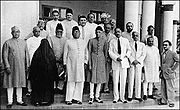 At a League conference in Lahore
in 1940, Jinnah said: "Hindus and the Muslims belong to two different religions, philosophies, social customs and literature.... It is quite clear that Hindus and Muslims derive their inspiration from different sources of history. They have different epics, different heroes and different episodes.... To yoke together two such nations under a single state, one as a numerical minority and the other as a majority, must lead to growing discontent and final destruction of any fabric that may be so built up for the government of such a state."
At Lahore the League formally recommitted itself to creating an independent Muslim state, including Sindh, Punjab, Baluchistan, the North West Frontier Province and Bengal, that would be "wholly autonomous and sovereign". The resolution guaranteed protection for non-Muslim religions. The Lahore Resolution
was adopted on March 23, 1940, and its principles formed the foundation for Pakistan's first constitution. Talks between Jinnah and Gandhi in 1944 in Bombay failed to achieve agreement. This was the last attempt to reach a single-state solution.
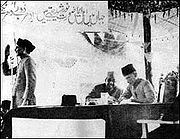 In the 1940s, Jinnah emerged as a leader of the Indian Muslims and was popularly known as Quaid-e-Azam (Great Leader). In the Constituent Assembly
elections of 1946, the League won 425 out of 496 seats reserved for Muslims (and about 89.2% of Muslim votes) on a policy of creating an independent state of Pakistan, and with an implied threat of secession if this was not granted. Gandhi, Maulana Azad and Nehru, who with the election of another Labour government in Britain in 1945 saw independence within reach, were adamantly opposed to dividing India.
However, 1947 saw violent and bloody battles caused due to the communal clashes between the two communities in India. People migrated from India to Pakistan and vice-versa. The situation continued to be tense until the governments of the two nations were formed.
Many years after the partition, the two nations are still trying to heal the wounds left behind by this incision to once-whole body of India. Many are still in search of an identity and a history left behind beyond an impenetrable boundary. The two countries started of with ruined economies and lands and without an established, experienced system of government. They lost many of their most dynamic leaders, such as Gandhi, Jinnah and Muhammad Iqbal, soon after the partition. Pakistan had to face the separation of Bangladesh in 1971. India and Pakistan have been to war twice since the partition and they are still deadlocked over the issue of possession of Kashmir. The same issues of boundaries and divisions, Hindu and Muslim majorities and differences, still persist in Kashmir.
The partition seems to have been inevitable after all, one of the examples being Lord Mountbatten's statement on Jinnah - "I tried every trick I could play... to shake Jinnah's resolve... Nothing would move him from his consuming determination for Pakistan..."
was founded in 1962, as a successor to the previously disbanded Muslim League
in Pakistan. Unlike the original PML which ended in 1958 when General Ayub Khan banned all political parties, each subsequent Muslim League was in some way propped by the military dictators of the time: Ayub Khan, General Zia-ul-Haq and General Pervez Musharraf
. Every time the pro-establishment
political leaders were put together, who splintered apart when the general's blessings faded away. Hence, Pakistan Muslim League refers to several political parties in Pakistan.
led ruling government. It may be noted that all factions will continue to hold their individual identities, as the MML is treated as a platform for parties to come together. "Muttahida" in Urdu
means "united". It consists of the following parties:
(or APML), founded in 2010 by former Army chief & president of pakistanPervez Musharraf
and supporters breaking away from the PML-Q and PML N.
, the Nawaz Sharif
group, ordinarily not recognized as original Muslim League was named so after separartion of PML(Q). Formed as PML (Fida Mohammad Khan
) in 1988 when it split from Junejo's PML in 1988 after Zia's demise. The new party had Fida Khan as its president and Nawaz Sharif as general secretary. PML-N represents a group within Muslim League headed by shareef brothers.
All India Muhammadan Educational Conference
The All India Muhammadan Educational Conference was an organisation promoting modern, liberal education for the Muslim community in India. It was founded by Syed Ahmed Khan, also the founder of the Aligarh Muslim University...
at Dhaka
Dhaka
Dhaka is the capital of Bangladesh and the principal city of Dhaka Division. Dhaka is a megacity and one of the major cities of South Asia. Located on the banks of the Buriganga River, Dhaka, along with its metropolitan area, had a population of over 15 million in 2010, making it the largest city...
(now Bangladesh
Bangladesh
Bangladesh , officially the People's Republic of Bangladesh is a sovereign state located in South Asia. It is bordered by India on all sides except for a small border with Burma to the far southeast and by the Bay of Bengal to the south...
), in 1906, in the context of the circumstances that were generated over the partition of Bengal in 1905. Being a political party to secure the interests of the Muslim diaspora in British India
British Raj
British Raj was the British rule in the Indian subcontinent between 1858 and 1947; The term can also refer to the period of dominion...
, the Muslim League played a decisive role during the 1940s in the Indian independence movement
Indian independence movement
The term Indian independence movement encompasses a wide area of political organisations, philosophies, and movements which had the common aim of ending first British East India Company rule, and then British imperial authority, in parts of South Asia...
and developed into the driving force behind the creation of Pakistan
Pakistan
Pakistan , officially the Islamic Republic of Pakistan is a sovereign state in South Asia. It has a coastline along the Arabian Sea and the Gulf of Oman in the south and is bordered by Afghanistan and Iran in the west, India in the east and China in the far northeast. In the north, Tajikistan...
as a Muslim
Muslim
A Muslim, also spelled Moslem, is an adherent of Islam, a monotheistic, Abrahamic religion based on the Quran, which Muslims consider the verbatim word of God as revealed to prophet Muhammad. "Muslim" is the Arabic term for "submitter" .Muslims believe that God is one and incomparable...
state in the Indian subcontinent
Indian subcontinent
The Indian subcontinent, also Indian Subcontinent, Indo-Pak Subcontinent or South Asian Subcontinent is a region of the Asian continent on the Indian tectonic plate from the Hindu Kush or Hindu Koh, Himalayas and including the Kuen Lun and Karakoram ranges, forming a land mass which extends...
. After the independence of India
India
India , officially the Republic of India , is a country in South Asia. It is the seventh-largest country by geographical area, the second-most populous country with over 1.2 billion people, and the most populous democracy in the world...
and Pakistan, the League continued as a minor party in India, especially in Kerala
Kerala
or Keralam is an Indian state located on the Malabar coast of south-west India. It was created on 1 November 1956 by the States Reorganisation Act by combining various Malayalam speaking regions....
, where it is often in government within a coalition with others. In Pakistan, the League formed the country's first government, but disintegrated during the 1950s following an army coup. One or more factions of the Muslim League have been in power in most of the civilian governments of Pakistan since 1947. In Bangladesh, the party was revived in 1976 and won 14 seats in 1979 parliamentary election. Since then its importance has reduced, rendering it insignificant in the political arena.
Background
Muslim rule was established across India between the 8th and the 14th centuries. The Muslim Mughal EmpireMughal Empire
The Mughal Empire , or Mogul Empire in traditional English usage, was an imperial power from the Indian Subcontinent. The Mughal emperors were descendants of the Timurids...
ruled most of India from the early 16th century, but suffered a major decline in the 18th century. The decline of the Mughal empire and its successor states like Avadh led to a feeling of discontentment among Muslim elites. Muslims represented about 25-30% of the population of British India, and constituted the majority of the population in Baluchistan
Baluchistan (Chief Commissioners Province)
The Chief Commissioner's Province of Baluchistan was a province of British India located in the northern parts of the modern Balochistan province.- History :...
, East Bengal
East Bengal
East Bengal was the name used during two periods in the 20th century for a territory that roughly corresponded to the modern state of Bangladesh. Both instances involved a violent partition of Bengal....
, Kashmir valley, North-West Frontier Province
North-West Frontier Province
Khyber Pakhtunkhwa , formerly known as the North-West Frontier Province and various other names, is one of the four provinces of Pakistan, located in the north-west of the country...
, West Punjab
West Punjab
West Punjab was a province of Pakistan from 1947 to 1955. The province covered an area of 160,622 km², including much of the current Punjab province and the Islamabad Capital Territory, but excluding the former princely state of Bahawalpur. The capital was the city of Lahore and the province...
, and the Sindh
Sindh
Sindh historically referred to as Ba'ab-ul-Islam , is one of the four provinces of Pakistan and historically is home to the Sindhi people. It is also locally known as the "Mehran". Though Muslims form the largest religious group in Sindh, a good number of Christians, Zoroastrians and Hindus can...
region of the Karachi Presidency.
In the late 19th century an Indian nationalist movement developed with the Indian National Congress
Indian National Congress
The Indian National Congress is one of the two major political parties in India, the other being the Bharatiya Janata Party. It is the largest and one of the oldest democratic political parties in the world. The party's modern liberal platform is largely considered center-left in the Indian...
being founded in 1885 as a forum, that became a political party subsequently. The Congress made no conscious efforts to enlist the Muslim community in its struggle for Indian independence. Although some Muslims were active in the Congress, majority of Muslim leaders did not trust the Hindu predominance and most of the Muslims remained reluctant to join the Congress Party.
A turning point came in 1900 when the British administration in the largest Indian state, the United Provinces (now Uttar Pradesh
Uttar Pradesh
Uttar Pradesh abbreviation U.P. , is a state located in the northern part of India. With a population of over 200 million people, it is India's most populous state, as well as the world's most populous sub-national entity...
), acceded to popular demands and made Hindi
Hindi
Standard Hindi, or more precisely Modern Standard Hindi, also known as Manak Hindi , High Hindi, Nagari Hindi, and Literary Hindi, is a standardized and sanskritized register of the Hindustani language derived from the Khariboli dialect of Delhi...
, written in the Devanagari
Devanagari
Devanagari |deva]]" and "nāgarī" ), also called Nagari , is an abugida alphabet of India and Nepal...
script, the official language
Official language
An official language is a language that is given a special legal status in a particular country, state, or other jurisdiction. Typically a nation's official language will be the one used in that nation's courts, parliament and administration. However, official status can also be used to give a...
. This seemed to aggravate minority fears that the Hindu majority would seek to suppress their religion in an independent India. A British official, Sir Percival Griffiths, wrote of these perceptions: "the minority belief that their interest must be regarded as completely separate from those of the majority, and that ethnic tensions between the two communities was possible."
Foundation
The All India Muslim League was founded by the admirers, companions, and followers of the Aligarh Movement. The formation of a Muslim political party on national level was being reckoned to be essential since 1901. The first stage of its formation was the meeting held at Lucknow in September 1906, with participation of representatives from all over India. The decision for re-consideration to form the all Indian Muslim political party was taken and further proceedings were adjourned until the next meeting of All India Muhammadan Educational Conference. The Simla Deputation reconsidered the issue in October 1906 and decided to frame the objectives of the party on the occasion of the annual meeting of Educational Conference; that was later, scheduled to be held at Dhaka. Meanwhile Nawab Salimullah Khan published a detailed scheme through which he suggested the party to be named All India Muslim Confederacy. Pursuant upon the decisions taken earlier in Lukhnow meeting and later in Simla; the annual meeting of All India Muhammadan Educational Conference was held at Dhaka that continued from 27 December, uptil 30 December 1906. that was headed by both Nawab Waqar-ul-Mulk and Nawab Muhasan-ul-Mulk (the Secretary of the Muhammaden Educational Conference); in which he explained its objectives and stressed the unity of the Muslims under the banner of an association. It was formally proposed by Nawab Salimullah Khan and supported by Hakim Ajmal Khan, Maulana Muhammed Ali Jauhar, Zafar Ali Khan and several others. The Founding meeting was hosted by Nawab Sir Khwaja Salimullah and attended by three thousand delegates, while Ameer Ali, Sir Mian Muhammad ShafiMuhammad Shafi
Sir Mian Muhammad Shafi, KCSI, CIE was an Indian Muslim politician. He belonged to the well-known Arain Mian family of Baghbanpura, Lahore. He went to England to study for the Bar in August 1889. He also took active interest in Anjuman-i-Islamiya of London and was elected its President for a term...
were also the founding fathers who attended this meeting. The name "All India Muslim League" was proposed by Sir Agha Khan III who was appointed its first President. The League's constitution was framed in 1907 in Karachi."
Early years
Sir Aga Khan was appointed the first Honorary President of the Muslim League. The headquarters were established at LucknowLucknow
Lucknow is the capital city of Uttar Pradesh in India. Lucknow is the administrative headquarters of Lucknow District and Lucknow Division....
. There were also six vice-presidents, a secretary and two joint secretaries initially appointed for a three-years term, proportionately from different provinces. The principles of the League were espoused in the "Green Book," which included the organisation's constitution, written by Maulana Mohammad Ali
Maulana Mohammad Ali
Maulana Mohammad Ali Jouhar was an Indian Muslim leader, activist, scholar, journalist and poet, and was among the leading figures of the Khilafat Movement....
. Its goals at this stage did not include establishing an independent Muslim state, but rather concentrated on protecting Muslim liberties and rights, promoting understanding between the Muslim community and other Indians, educating the Muslim and Indian community at large on the actions of the government, and discouraging violence.
The search for a solution
Muhammad Ali JinnahMuhammad Ali Jinnah
Muhammad Ali Jinnah was a Muslim lawyer, politician, statesman and the founder of Pakistan. He is popularly and officially known in Pakistan as Quaid-e-Azam and Baba-e-Qaum ....
became disillusioned with politics after the failure of his attempt to form a Hindu-Muslim alliance, and he spent most of the 1920s in Britain. The leadership of the League was taken over by Sir Muhammad Iqbal
Muhammad Iqbal
Sir Muhammad Iqbal , commonly referred to as Allama Iqbal , was a poet and philosopher born in Sialkot, then in the Punjab Province of British India, now in Pakistan...
, who in 1930 first put forward the demand for a separate Muslim state in India. The "Two-Nation Theory
Two-Nation Theory
The Two-Nation Theory proposed by Allama Iqbal is the ideology that the primary identity of Muslims in the Indian subcontinent is their religion, rather than their language or ethnicity, and therefore Indian Hindus and Muslims are two distinct nationalities, regardless of ethnic or other...
", the belief that Hindus and Muslims were two different nations who could not live in one country, gained popularity among Muslims. The two-state solution was rejected by the Congress leaders, who favoured a united India based on composite national identity. Iqbal's policy of uniting the North-West Frontier Province, Baluchistan, Punjab, and Sindh into a new Muslim majority state united the many factions of the League.
The League, however, rejected the proposal that the committee returned (called the Nehru Report
Nehru Report
The "Nehru Report" was a memorandum outlining a proposed new Dominion constitution for India. It was prepared by a committee of the All Parties Conference chaired by Motilal Nehru with his son Jawaharlal acting as secretary...
), arguing that it gave too little representation (one quarter) to Muslims, established Devanagari as the official language of the colony, and demanded that India turn into a de facto unitary state, with residuary powers resting at the center – the League had demanded at least one-third representation in the legislature and sizable autonomy for the Muslim provinces. Jinnah reported a "parting of the ways" after his requests for minor amendments to the proposal were denied outright, and relations between the Congress and the League began to sour.
Conception of Pakistan
On December 29, 1930 Sir Muhammad Iqbal delivered his monumental presidential address to the All India Muslim League annual session. He said:Sir Muhammad Iqbal did not use the word "Pakistan" in his address. According to some scholars, Iqbal had not presented the idea of a separate Muslim State; rather he wanted a large Muslim province by amalgamating Punjab, Sindh, NWFP and Baluchistan into a big North-Western province within India. They argued that
"Iqbal never pleaded for any kind of partition of the country. Rather he was an ardent proponent of a 'true' federal setup for India.... And wanted a consolidated Muslim majority within the Indian Federation".
Another Indian historian Tara Chand also held that Iqbal was not thinking in terms of partition of India but in terms of a federation of autonomous states within India. Dr. Safdar Mehmood also asserted in a series of articles that in the Allahabad address Iqbal proposed a Muslim majority province within an Indian federation and not an independent state outside an Indian Federation.
On January 28, 1933, Choudhary Rahmat Ali
Choudhary Rahmat Ali
Choudhry Rahmat Ali was a Pakistani Muslim nationalist who was one of the earliest proponents of the creation of the state of Pakistan. He is credited with creating the name "Pakistan" for a separate Muslim homeland in South Asia and is generally known as the founder of the movement for its...
, founder of Pakistan National Movement voiced his ideas in the pamphlet entitled "Now or Never; Are We to Live or Perish Forever?" The word 'Pakstan' referred to "the five Northern units of India, viz., Punjab, North-West Frontier Province (Afghan Province, now Khyber Pakhtunkhwa), Kashmir, Sind and Baluchistan"". By the end of 1933, the word "Pakistan" became common vocabulary where an “I” was added to ease pronunciation (as in Afghan-i-stan).
In a subsequent book Rehmat Ali discussed the etymology in further detail.
"Pakistan' is both a Persian and an Urdu word. It is composed of letters taken from the names of all our South Asia homelands; that is, Punjab, Afghania, Kashmir, Sindh and Balochistan. It means the land of the Pure".
The British and the Indian Press vehemently criticized these two different schemes and created a confusion about the authorship of the word "Pakistan" to such an extent that even Jawahur Lal Nehru had to write:
Campaign for Pakistan
Lahore
Lahore is the capital of the Pakistani province of Punjab and the second largest city in the country. With a rich and fabulous history dating back to over a thousand years ago, Lahore is no doubt Pakistan's cultural capital. One of the most densely populated cities in the world, Lahore remains a...
in 1940, Jinnah said: "Hindus and the Muslims belong to two different religions, philosophies, social customs and literature.... It is quite clear that Hindus and Muslims derive their inspiration from different sources of history. They have different epics, different heroes and different episodes.... To yoke together two such nations under a single state, one as a numerical minority and the other as a majority, must lead to growing discontent and final destruction of any fabric that may be so built up for the government of such a state."
At Lahore the League formally recommitted itself to creating an independent Muslim state, including Sindh, Punjab, Baluchistan, the North West Frontier Province and Bengal, that would be "wholly autonomous and sovereign". The resolution guaranteed protection for non-Muslim religions. The Lahore Resolution
Lahore Resolution
The Lahore Resolution , commonly known as the Pakistan Resolution , was a formal political statement adopted by the Muslim League at the occasion of its three-day general session on 22–24 March 1940 that called for greater Muslim autonomy in British India...
was adopted on March 23, 1940, and its principles formed the foundation for Pakistan's first constitution. Talks between Jinnah and Gandhi in 1944 in Bombay failed to achieve agreement. This was the last attempt to reach a single-state solution.
Constituent assembly
A constituent assembly is a body composed for the purpose of drafting or adopting a constitution...
elections of 1946, the League won 425 out of 496 seats reserved for Muslims (and about 89.2% of Muslim votes) on a policy of creating an independent state of Pakistan, and with an implied threat of secession if this was not granted. Gandhi, Maulana Azad and Nehru, who with the election of another Labour government in Britain in 1945 saw independence within reach, were adamantly opposed to dividing India.
However, 1947 saw violent and bloody battles caused due to the communal clashes between the two communities in India. People migrated from India to Pakistan and vice-versa. The situation continued to be tense until the governments of the two nations were formed.
Many years after the partition, the two nations are still trying to heal the wounds left behind by this incision to once-whole body of India. Many are still in search of an identity and a history left behind beyond an impenetrable boundary. The two countries started of with ruined economies and lands and without an established, experienced system of government. They lost many of their most dynamic leaders, such as Gandhi, Jinnah and Muhammad Iqbal, soon after the partition. Pakistan had to face the separation of Bangladesh in 1971. India and Pakistan have been to war twice since the partition and they are still deadlocked over the issue of possession of Kashmir. The same issues of boundaries and divisions, Hindu and Muslim majorities and differences, still persist in Kashmir.
The partition seems to have been inevitable after all, one of the examples being Lord Mountbatten's statement on Jinnah - "I tried every trick I could play... to shake Jinnah's resolve... Nothing would move him from his consuming determination for Pakistan..."
Influence on the future courses of India and Pakistan
The Muslim League not only played a major role in the National Movement, but also after India obtained freedom and Pakistan seceded from the former. We could see that the struggle for a separate Islamic state did not end up in anticlimax after all. On July 18, 1947, the British Parliament passed the Indian Independence Act that finalized the partition agreement. The 562 princely states were given a choice to choose between Hindustan and Pakistan.Present Day Divisions of All India Muslim League which converted into Pakistan Muslim league
The Pakistan Muslim LeaguePakistan Muslim League
The Pakistan Muslim League was founded in 1962, as a successor to the previously disbanded Muslim League in Pakistan. Unlike the original PML which ended in 1958 when General Ayub Khan banned all political parties, each subsequent Muslim League was in some way propped by the military dictators of...
was founded in 1962, as a successor to the previously disbanded Muslim League
Muslim League (Pakistan)
Muslim League was the original successor of All India Muslim League that led the Pakistan Movement achieving an independent nation. After formation of Pakistan, the party was renamed to Muslim League which came to an end soon after Qaid-e-Azam's death on the first marshal law in 1958.-History:On...
in Pakistan. Unlike the original PML which ended in 1958 when General Ayub Khan banned all political parties, each subsequent Muslim League was in some way propped by the military dictators of the time: Ayub Khan, General Zia-ul-Haq and General Pervez Musharraf
Pervez Musharraf
Pervez Musharraf , is a retired four-star general who served as the 13th Chief of Army Staff and tenth President of Pakistan as well as tenth Chairman of the Joint Chiefs of Staff Committee. Musharraf headed and led an administrative military government from October 1999 till August 2007. He ruled...
. Every time the pro-establishment
Establishment (Pakistan)
The Establishment is a term used commonly by Pakistani political scientists and also by political scholars and analysts around the world for the powerful military-dominant oligarchy in Pakistan...
political leaders were put together, who splintered apart when the general's blessings faded away. Hence, Pakistan Muslim League refers to several political parties in Pakistan.
Muttahida Muslim League
Muttahida Muslim League led by Pir Pagara is the "assimilation" of majority of the factions of the Pakistan Muslim League, in a bid to mount a strong opposition to the Pakistan Peoples PartyPakistan Peoples Party
The Pakistan Peoples Party , is a democratic socialist political party in Pakistan affiliated with Socialist International. Pakistan People's Party is the largest political party of Pakistan...
led ruling government. It may be noted that all factions will continue to hold their individual identities, as the MML is treated as a platform for parties to come together. "Muttahida" in Urdu
Urdu
Urdu is a register of the Hindustani language that is identified with Muslims in South Asia. It belongs to the Indo-European family. Urdu is the national language and lingua franca of Pakistan. It is also widely spoken in some regions of India, where it is one of the 22 scheduled languages and an...
means "united". It consists of the following parties:
- PML-FPakistan Muslim League (F)The Pakistan Muslim League is a political party in Pakistan. It is one of the factions of the original Pakistan Muslim League. The letter 'F' in its name stands for functional. It is primarily associated with the Sindhi religious leader Pir Pagara...
, the Functional Muslim League or Pir PagaroPir PagaroPir Pagara is bigest is the title given to the leader of Sunni Muslim Sufi order of Hurs in Sindh province of Pakistan. It comes from the Persian word Pir and the Sindhi word 'Pagara' meaning:....
group, first formed in 1973 when Council and Convention Leagues merged (without Qayyum Muslim League, which was allied with PPP-led government) and elected Pir Pagaro as president. Later on, General Zia got all the Muslim Leagues together, but installed Muhammad Khan JunejoMuhammad Khan JunejoMuhammad Khan Junejo was the tenth Prime Minister of Pakistan.-Early life:He was born at Sindhri in Tharparkar of Sindh. He belongs to Sindhi Muslim Rajput family of Junejo clan. Junejo started his political career at the age of twenty one...
as PML president. Feeling uncomfortable, Pagaro left the party and made his own in 1985. Functional League as it was called merged with PMLQ in 2004 under the patronage of General Musharraf, but Pagaro separated again after a few months to form his own league. In September 2010 the PML-FPakistan Muslim League (F)The Pakistan Muslim League is a political party in Pakistan. It is one of the factions of the original Pakistan Muslim League. The letter 'F' in its name stands for functional. It is primarily associated with the Sindhi religious leader Pir Pagara...
and PML-QPakistan Muslim League (Q)The Pakistan Muslim League or officially Pakistan Muslim League is a centrist, modern political party in Pakistan. The present form of PML-Q was formed prior to 2002 general elections....
united, forming the All Pakistan Muslim League (Pir Pagara). However, the APML has ceased to exist with the formation of this new platform.
- PML-QPakistan Muslim League (Q)The Pakistan Muslim League or officially Pakistan Muslim League is a centrist, modern political party in Pakistan. The present form of PML-Q was formed prior to 2002 general elections....
, the Quaid-e-Azam group , formed by Mian Muhammad Azhar in 2001 at the behest of the establishment with other like-minded leaders of PMLN including Syeda Abida Hussain, Khurshid Mahmud KasuriKhurshid Mahmud KasuriMian Khurshid Mahmood Kasuri is a Pakistani politician and diplomat. He was the Foreign Minister of Pakistan from 2002 to 2007.- Family background :Khurshid M. Kasuri belongs to one of the old political families of Pakistan...
and Chaudhry Shujaat Hussain. Presently headed by Chaudhry Shujaat HussainChaudhry Shujaat HussainChaudhry Shujaat Hussain is a politician from Pakistan who was the Prime Minister of that country from June 30, 2004 until August 28 2004...
when he outmaneuvered Mian Azhar to become the president. Officially called Pakistan Muslim League, after the 2004 unification of many smaller PML factions and other regional parties. In September 2010 the PML-QPakistan Muslim League (Q)The Pakistan Muslim League or officially Pakistan Muslim League is a centrist, modern political party in Pakistan. The present form of PML-Q was formed prior to 2002 general elections....
merged with PML-FPakistan Muslim League (F)The Pakistan Muslim League is a political party in Pakistan. It is one of the factions of the original Pakistan Muslim League. The letter 'F' in its name stands for functional. It is primarily associated with the Sindhi religious leader Pir Pagara...
, forming the All Pakistan Muslim League (Pir Pagara). However, the APML has ceased to exist with the formation of this new platform. May be noted here, the PML-Q itself has not joined this alliance as a whole, only a group within the faction known as the "Like-minded" group has joined hands with Pir Pagara. The Chaudhry brothers, as yet, remain out of this.
- PML-JPakistan Muslim League (J)The Pakistan Muslim League was a political party in Pakistan established in 1993. It merged with PML-Q in 2004.It is one of the factions of the original Pakistan Muslim League, named "J" after Junejo...
, the Muhammad Khan Junejo group. Officially formed in 1985 as Pakistan Muslim League when General Zia-ul-Haq's government cobbled together many factions of PML and installed Junejo as its president. It was re-formed as PML-Junejo after Junejo's death in 1993 by Hamid Nasir ChatthaHamid Nasir ChatthaChaudhry Hamid Nasir Chattha is a politician from Gujranwala, Punjab, Pakistan. He was born on November 15, 1944 at Lahore. Hamid Nasir Chattha is currently a Member of Punjab Assembly, Pakistan after losing in 2008 National Assembly elections. He was previously elected as an MNA in 1985, 1990,...
, Manzoor Wattoo, Nawab Sardar Mushtaq Ahmed Khan Malazai and Iqbal Ahmed Khan when Nawaz Sharif became president of his own league. Hamid Chattha became the president and Iqbal Ahmed Khan the general secretary and Nawab Sardar Mushtaq Ahmed Khan the vice-chairman.But in in 1995 Manzoor Wattoo and Nawab Sardar Mushtaq Ahmed Khan Malazai left the party to form a new Muslim League of their own.It merged with PML-Q in 2004.
- PML-JinnahPakistan Muslim League (Jinnah)The Pakistan Muslim League was a political party in Pakistan. It was one of the factions of the original Pakistan Muslim League, named after the founder of Pakistan Muhammad Ali Jinnah....
, the Jinnah group, founded in 1995 by Manzoor Wattoo and Nawab Sardar Mushtaq Ahmed Khan Malazai after differences with Hamid Chattha.However in 1997 just after 2years both had differences and it wasnot long before Nawab Sardar Mushtaq Ahmed Khan Malazai parted ways and joined Pakistan Muslim League (N)Pakistan Muslim League (N)The Pakistan Muslim League is a conservative political party in Pakistan, affiliated with Western conservatism...
It merged with PML-Q in 2004.
- Awami Muslim League Pakistan, founded in 2008 by Sheikh Rashid Ahmad after differences with PML-Q. Ahmad suggested the unification of all Muslim League parties which resulted in forming the All Pakistan Muslim League led by Pir Pagara in September 2010.
- PML-Zia, the Zia-ul-Haq Shaheed group, founded by Muhammad Ijaz-ul-HaqMuhammad Ijaz-ul-HaqCh Muhammad Ijaz-ul-Haq is a prominent Pakistani politician and a businessman who served as a Federal Minister for Religious Affairs and Minorities under the Government of Prime minister Shaukat Aziz. A former Pakistan Army officer, Haq joined the Pakistan Army in 1971, as second lieutnenat, but...
in 2002 after his differences with both Nawaz Sharif's PML-N and Shujaat Hussain's PML-Q. It merged with the Quaid-e-Azam group following general elections in 2002, but after Ijaz left the party, it was revived once more in February 2010.
All Pakistan Muslim League (Pervez Musharraf)
All Pakistan Muslim LeagueAll Pakistan Muslim League
The APML has been formed to stimulate all Pakistanis apart from of political affiliation, gender, color or faith to once again fight back to win back and preserve their independence...
(or APML), founded in 2010 by former Army chief & president of pakistanPervez Musharraf
Pervez Musharraf
Pervez Musharraf , is a retired four-star general who served as the 13th Chief of Army Staff and tenth President of Pakistan as well as tenth Chairman of the Joint Chiefs of Staff Committee. Musharraf headed and led an administrative military government from October 1999 till August 2007. He ruled...
and supporters breaking away from the PML-Q and PML N.
Pakistan Muslim League (N)
PML-NPakistan Muslim League (N)
The Pakistan Muslim League is a conservative political party in Pakistan, affiliated with Western conservatism...
, the Nawaz Sharif
Nawaz Sharif
Mian Mohammad Nawaz Sharif is a Pakistani conservative politician and steel magnate who served as 12th Prime Minister of Pakistan in two non-consecutive terms from November 1990 to July 1993, and from February 1997 to October 12, 1999...
group, ordinarily not recognized as original Muslim League was named so after separartion of PML(Q). Formed as PML (Fida Mohammad Khan
Fida Mohammad Khan
Khan Fida Mohammad Khan was a former President of the Pakistan Muslim League, former senator and governor of the Khyber-Pakhtunkhwa province of Pakistan....
) in 1988 when it split from Junejo's PML in 1988 after Zia's demise. The new party had Fida Khan as its president and Nawaz Sharif as general secretary. PML-N represents a group within Muslim League headed by shareef brothers.
Historical Versions
Historically, Pakistan Muslim League can also refer to any of the following political parties in Pakistan:- Muslim League (Pakistan)Muslim League (Pakistan)Muslim League was the original successor of All India Muslim League that led the Pakistan Movement achieving an independent nation. After formation of Pakistan, the party was renamed to Muslim League which came to an end soon after Qaid-e-Azam's death on the first marshal law in 1958.-History:On...
, the original successor of All-India Muslim League, which was disbanded on first marshal law. - Convention Muslim LeagueConvention Muslim LeagueThe Convention Muslim League was a faction of the Pakistan Muslim League that split-off in 1962 in support of the military regime of the President of Pakistan Gen. Ayub Khan....
, a political platform created by General Ayub Khan in 1962 when he became the President. - Council Muslim LeagueCouncil Muslim LeagueThe Council Muslim League was a faction of the Pakistan Muslim League that divided from the Convention Muslim League that was supportive of the military regime of the President of Pakistan Gen. Ayub Khan. Mian Mumtaz Daultana, Chaudhry Muhammad Husain Chattha, Khawaja Muhammad Safdar and Chaudhry...
, a party created by political leaders who opposed General Ayub Khan. - Muslim League (Qayyum)Muslim League (Qayyum)Muslim League , was a party created by Khan Abdul Qayyum Khan when he split with the Council Muslim League to run for the 1970 Pakistani general elections....
, a party created by Khan Abdul Qayyum KhanAbdul Qayyum KhanAbdul Qayyum Khan was a major figure in Pakistan politics, in particular in the Khyber-Pakhtunkhwa province where he served as deputy speaker, Chief Minister and Minister in the Central Government and as Federal Interior Minister.-Early life:His father Khan Abdul Hakim was a Tehsildar in N.W.F.P...
when he split with the Council Muslim League to run for the 1970 general electionsPakistani general election, 1970General elections were held for the first time in Pakistan in on 7 December 1970, although the polls in East Pakistan, originally scheduled for October, were delayed by disastrous floods and rescheduled for later in December and January 1971....
.
See also
- Direct Action DayDirect Action DayDirect Action Day , also known as the Great Calcutta Killings, was a day of widespread riot and manslaughter in the city of Calcutta in the Bengal province of British India...
- Indian Independence MovementIndian independence movementThe term Indian independence movement encompasses a wide area of political organisations, philosophies, and movements which had the common aim of ending first British East India Company rule, and then British imperial authority, in parts of South Asia...
- Majlis-e-Ahrar-ul-IslamMajlis-e-Ahrar-ul-IslamMajlis-e-Ahrar-ul-Islam or Majlis-e-Ah'rãr-e-Islam , also known in short as Ahrar, was a conservative Sunni Muslim political party in Pakistan prior to the Partition of India...
- Syed Ata Ullah Shah BukhariSyed Ata Ullah Shah BukhariSyed Ata Ullah Shah Bukhari , was an Indian Muslim scholar, religious and senior political leader from the Indian subcontinent. He was one of the Majlis-e-Ahrar-e-Islam's founding members...
- Indian Muslim nationalismIndian Muslim NationalismMuslim nationalism in South Asia refers to the political and cultural expression of nationalism, founded upon the religious tenets and identity of Islam, of the Muslims of South Asia....
- Indian NationalismIndian nationalismIndian nationalism refers to the many underlying forces that molded the Indian independence movement, and strongly continue to influence the politics of India, as well as being the heart of many contrasting ideologies that have caused ethnic and religious conflict in Indian society...
- Indian National CongressIndian National CongressThe Indian National Congress is one of the two major political parties in India, the other being the Bharatiya Janata Party. It is the largest and one of the oldest democratic political parties in the world. The party's modern liberal platform is largely considered center-left in the Indian...
- Muslim League (Pakistan)Muslim League (Pakistan)Muslim League was the original successor of All India Muslim League that led the Pakistan Movement achieving an independent nation. After formation of Pakistan, the party was renamed to Muslim League which came to an end soon after Qaid-e-Azam's death on the first marshal law in 1958.-History:On...
- Pakistan MovementPakistan MovementThe Pakistan Movement or Tehrik-e-Pakistan refers to the historical movement to have an independent Muslim state named Pakistan created from the separation of the north-western region of the Indian subcontinent, partitioned within or outside the British Indian Empire. It had its origins in the...
- Pakistan Muslim LeaguePakistan Muslim LeagueThe Pakistan Muslim League was founded in 1962, as a successor to the previously disbanded Muslim League in Pakistan. Unlike the original PML which ended in 1958 when General Ayub Khan banned all political parties, each subsequent Muslim League was in some way propped by the military dictators of...
External links
- Government of Pakistan website
- The Constitution of the Islamic Republic of Pakistan
- Chronicles Of Pakistan
- Jinnah at a Meeting of the Muslim League 16-second QuickTimeQuickTimeQuickTime is an extensible proprietary multimedia framework developed by Apple Inc., capable of handling various formats of digital video, picture, sound, panoramic images, and interactivity. The classic version of QuickTime is available for Windows XP and later, as well as Mac OS X Leopard and...
film clip - Colloquium on the One Hundred Years of Muslim League at the University of Chicago, Nov 4, 2006