
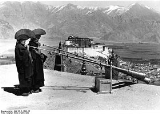
The
music of Tibet reflects the cultural heritage of the trans-Himalayan region, centered in
TibetTibet is a plateau region in Asia, north-east of the Himalayas. It is the traditional homeland of the Tibetan people as well as some other ethnic groups such as Monpas, Qiang, and Lhobas, and is now also inhabited by considerable numbers of Han and Hui people...
but also known wherever ethnic
TibetanThe Tibetan people are an ethnic group that is native to Tibet, which is mostly in the People's Republic of China. They number 5.4 million and are the 10th largest ethnic group in the country. Significant Tibetan minorities also live in India, Nepal, and Bhutan...
groups are found in
IndiaIndia , officially the Republic of India , is a country in South Asia. It is the seventh-largest country by geographical area, the second-most populous country with over 1.2 billion people, and the most populous democracy in the world...
,
BhutanBhutan , officially the Kingdom of Bhutan, is a landlocked state in South Asia, located at the eastern end of the Himalayas and bordered to the south, east and west by the Republic of India and to the north by the People's Republic of China...
,
NepalNepal , officially the Federal Democratic Republic of Nepal, is a landlocked sovereign state located in South Asia. It is located in the Himalayas and bordered to the north by the People's Republic of China, and to the south, east, and west by the Republic of India...
and further abroad. First and foremost Tibetan music is
religious musicReligious music is music performed or composed for religious use or through religious influence.A lot of music has been composed to complement religion, and many composers have derived inspiration from their own religion. Many forms of traditional music have been adapted to fit religions'...
, reflecting the profound influence of
Tibetan BuddhismTibetan Buddhism is the body of Buddhist religious doctrine and institutions characteristic of Tibet and certain regions of the Himalayas, including northern Nepal, Bhutan, and India . It is the state religion of Bhutan...
on the culture.
History
The Lama Mani tradition - the telling of Buddhist parables through song — dates back to the 12th century. The songs were performed by wandering storytellers, who travelled from village to village, drawing on their own often humble origins to relate to people from all backgrounds. Vividly illustrated Buddhist thangka paintings depicted the narrative and helped the audience understand what was essentially a teaching.
Tibetan "street songs" were a traditional form of expression particularly popular as a means of political and other commentary in a country that was previously without newspapers or other means of mass communication. They provided political and social commentary and satire and are a good example of a bardic tradition, akin to that that in medieval Europe or, more recently, the role
calypsoCalypso is a style of Afro-Caribbean music that originated in Trinidad and Tobago from African and European roots. The roots of the genre lay in the arrival of enslaved Africans, who, not being allowed to speak with each other, communicated through song...
s played in the West Indies. As song lyrics in Tibet usually contained stanzas of 4 lines of 6 syllables each, the lyrics could be easily adapted to almost any melody.
Secular Tibetan music has been promoted by organizations like the Dalai Lama's
Tibetan Institute of Performing ArtsThe Tibetan Institute of Performing Arts was founded by Tenzin Gyatso, 14th Dalai Lama on reaching Dharamsala, India in exile from Tibet in August 1959, it was one of the first institutes set up the Dalai Lama, and was established to preserve Tibetan artistic heritage, especially opera, dance, and...
. This organization specialized in the
lhamoLhamo, or Ache Lhamo, which literally means "sister goddess", is a Tibetan folk opera. It is a combination of dances, chants and songs. The repertoire is drawn from Buddhist stories and Tibetan history....
, an
operaOpera is an art form in which singers and musicians perform a dramatic work combining text and musical score, usually in a theatrical setting. Opera incorporates many of the elements of spoken theatre, such as acting, scenery, and costumes and sometimes includes dance...
tic style, before branching out into other styles, including
dance musicDance music is music composed specifically to facilitate or accompany dancing. It can be either a whole musical piece or part of a larger musical arrangement...
like
toesheyToeshey is a genre of traditional Tibetan dance music closely related to Nangma....
and
nangmaNangma is a genre of Tibetan dance music closely related to Toeshey. The word Nangma derives from the Persian word Naghma meaning melody. Both a band and a nightclub have been named after it. "Nangma" is the name of a four-person, traditional Tibetan band dedicated to these two styles of music...
. Nangma is especially popular in the
karaokeis a form of interactive entertainment or video game in which amateur singers sing along with recorded music using a microphone and public address system. The music is typically a well-known pop song minus the lead vocal. Lyrics are usually displayed on a video screen, along with a moving symbol,...
bars of the urban center of Tibet,
LhasaLhasa is the administrative capital of the Tibet Autonomous Region in the People's Republic of China and the second most populous city on the Tibetan Plateau, after Xining. At an altitude of , Lhasa is one of the highest cities in the world...
. Another form of popular music is the classical
gar style, which is performed at rituals and ceremonies.
LuLu is a Tibetan style of folk music of a cappella songs, which are distinctively high in pitch with glottal vibrations.-External links:* of lu music...
are a type of songs that feature glottal vibrations and high pitches. There are also epic bards who sing of Tibet's national hero Gesar.
Chanting
Tibetan music often involves chanting in
TibetanThe Tibetan languages are a cluster of mutually-unintelligible Tibeto-Burman languages spoken primarily by Tibetan peoples who live across a wide area of eastern Central Asia bordering the Indian subcontinent, including the Tibetan Plateau and the northern Indian subcontinent in Baltistan, Ladakh,...
or
SanskritSanskrit , is a historical Indo-Aryan language and the primary liturgical language of Hinduism, Jainism and Buddhism.Buddhism: besides Pali, see Buddhist Hybrid Sanskrit Today, it is listed as one of the 22 scheduled languages of India and is an official language of the state of Uttarakhand...
, as an integral part of the religion. These chants are complex, often recitations of sacred texts or in celebration of various
festivalA festival or gala is an event, usually and ordinarily staged by a local community, which centers on and celebrates some unique aspect of that community and the Festival....
s. Yang chanting, performed without metrical timing, is accompanied by resonant
drumThe drum is a member of the percussion group of musical instruments, which is technically classified as the membranophones. Drums consist of at least one membrane, called a drumhead or drum skin, that is stretched over a shell and struck, either directly with the player's hands, or with a...
s and low, sustained syllables. Other styles include those unique to the various schools of Tibetan Buddhism, such as the classical music of the popular Gelugpa school, and the romantic music of the Nyingmapa, Sakyapa and Kagyupa schools.
Popular and Modern
Tibetans have a very strong popular-music culture, and are also well-represented in Chinese popular culture. Tibetan singers are particularly known for their strong vocal abilities, which many attribute to the high altitudes of the Tibetan Plateau.
Tseten DolmaTseten Dolma is a Tibetan soprano. She was born on August 1, 1937 to a to a serf family in Shigatse, Tibet. Tsetsun was influenced by Tibetan folk music from very young age, and first performed on stage in 1956....
(才旦卓玛) rose to fame in the 1960s for her music-and-dance suite "The Earth is Red". Kelsang Metok (格桑梅朵) is a popular singer who combines the vocal traditions of Tibet with elements of
ChineseC-pop is an abbreviation for Chinese popular music , a loosely defined musical genre by artists originating from mainland China, Hong Kong, and Taiwan. Others come from countries where the Chinese language is used by a large number of the population, such as Singapore and Malaysia...
,
IndianThe music of India includes multiple varieties of folk, popular, pop, classical music and R&B. India's classical music tradition, including Carnatic and Hindustani music, has a history spanning millennia and developed over several eras. It remains fundamental to the lives of Indians today as...
and
WesternWestern culture, sometimes equated with Western civilization or European civilization, refers to cultures of European origin and is used very broadly to refer to a heritage of social norms, ethical values, traditional customs, religious beliefs, political systems, and specific artifacts and...
popPopular music belongs to any of a number of musical genres "having wide appeal" and is typically distributed to large audiences through the music industry. It stands in contrast to both art music and traditional music, which are typically disseminated academically or orally to smaller, local...
. Purba Rgyal (Pubajia or 蒲巴甲) was the 2006 winner of Haonaner, the Chinese version of
American IdolAmerican Idol, titled American Idol: The Search for a Superstar for the first season, is a reality television singing competition created by Simon Fuller and produced by FremantleMedia North America and 19 Entertainment...
. In 2006, he starred in
Sherwood HuSherwood Xuehua Hu Sherwood Xuehua Hu Sherwood Xuehua Hu (born in Shanghai, is a Chinese American Theatre director and film director.Sherwood Hu, “one of the most exciting and dynamic directors to emerge from China”(Kirt Honycutt, “Hollywood Reporter”)...
's
Prince of the Himalayas, an adaptation of Shakespeare's
HamletThe Tragical History of Hamlet, Prince of Denmark, or more simply Hamlet, is a tragedy by William Shakespeare, believed to have been written between 1599 and 1601...
, set in ancient Tibet and featuring an all-Tibetan cast.
In the traditional region of
AmdoAmdo is one of the three traditional regions of Tibet, the other two being Ü-Tsang and Kham; it is also the birth place of the 14th Dalai Lama. Amdo encompasses a large area from the Machu River to the Drichu river . While culturally and ethnically a Tibetan area, Amdo has been administered by a...
(now the Chinese regions of
QinghaiQinghai ; Oirat Mongolian: ; ; Salar:) is a province of the People's Republic of China, named after Qinghai Lake...
and
Sichuan' , known formerly in the West by its postal map spellings of Szechwan or Szechuan is a province in Southwest China with its capital in Chengdu...
), there is a very strong local scene, mostly exposed through videos on local buses. Amdo stars are among others Sherten (short for Sherab Tendzin) and Yadon, who both have reached outside the borders of China with their music.
Tibetan music has had a profound effect on some styles of Western music, especially
New AgeNew Age music is music of various styles intended to create artistic inspiration, relaxation, and optimism. It is used by listeners for yoga, massage, meditation, and reading as a method of stress management or to create a peaceful atmosphere in their home or other environments, and is often...
. Composers like
Philip GlassPhilip Glass is an American composer. He is considered to be one of the most influential composers of the late 20th century and is widely acknowledged as a composer who has brought art music to the public .His music is often described as minimalist, along with...
and
Henry EichheimHenry Eichheim was an American composer, conductor, violinist, organologist, and ethnomusicologist. He is best known as one of the first American composers to combine the sound of indigenous Asian instruments with western orchestral colors.- Life :He was born in Chicago, where he studied at the...
are most well known for their use of Tibetan elements in their music. The first such fusion was
Tibetan Bells, a 1971 release by
Nancy HenningsNancy Hennings is a musician who teamed up with Henry Wolff to make the album Tibetan Bells in 1971, one of the pioneering LPs of new age music. In 1982, with the assistance of Wolff and Grateful Dead drummer Mickey Hart, she produced the mysterious sounding Yamantaka...
and Henry Wolff. The soundtrack to
KundunKundun is a 1997 epic biographical film written by Melissa Mathison and directed by Martin Scorsese. It is based on the life and writings of the 14th Dalai Lama, the exiled political and spiritual leader of Tibet...
, by
Philip GlassPhilip Glass is an American composer. He is considered to be one of the most influential composers of the late 20th century and is widely acknowledged as a composer who has brought art music to the public .His music is often described as minimalist, along with...
, has helped to popularize Tibetan music.
Foreign styles of popular music have also had a major impact within Tibet. Indian
ghazalThe ghazal is a poetic form consisting of rhyming couplets and a refrain, with each line sharing the same meter. A ghazal may be understood as a poetic expression of both the pain of loss or separation and the beauty of love in spite of that pain. The form is ancient, originating in 6th century...
and
filmiFilmi is Indian popular music as written and performed for Indian cinema. Music directors make up the main body of composers; the songs are performed by playback singers and it makes up 72% of the music sales in India....
are very popular, as is
rock and rollRock and roll is a genre of popular music that originated and evolved in the United States during the late 1940s and early 1950s, primarily from a combination of African American blues, country, jazz, and gospel music...
, an
AmericanThe United States of America is a federal constitutional republic comprising fifty states and a federal district...
style which has produced Tibetan performers like
Rangzen ShonuRangzen Shonu was a rock and roll band formed by Tibetans in India. Teresa Teng reportedly integrated some of Rangzen Shonu's signature style after hearing a smuggled cassette in 1988. Rangzen Shonu is best known for the unique sound of Tibetan lyrics accompanied by acoustic guitars rather than...
. Since the relaxation of some laws in the 1980s, Tibetan pop, popularised by the likes of Yadong (Tibet), Dadon (now living in the US),
Jampa TseringJampa Tsering Born in Lhasa in the early 1960s, Jampa Tsering became famous in the late 1980s and early 1990s, releasing an immensely popular album, Gnas mchog gi glu dbyangs , including songs such as "Aro Khampa" ; "Ngai tsewai Lhasa" ; and "Cha chig yinna samchung" .Jampa Tsering studied...
(Tibet), 3-member group AJIA, 4-member group Gao Yuan Hong, 5-member group Gao Yuan Feng, are well known. Gaoyuan Hong in particular has introduced elements of Tibetan language
rappingRapping refers to "spoken or chanted rhyming lyrics". The art form can be broken down into different components, as in the book How to Rap where it is separated into “content”, “flow” , and “delivery”...
into their singles.
Alan Dawa DolmaAlan Dawa Dolma , professionally known as Alan , is a female Tibetan-Chinese singer active in the Japanese music industry....
is the first and currently only Tibetan artist to break into the Japanese music industry.
External links