


Music of Croatia

Encyclopedia
The music of Croatia
, like the divisions of the country itself, has two major influences: the Central Europe
an one, present in the central and northern parts of the country, as well as in Slavonia
, and the Mediterranean one, particularly present in the coastal regions of Dalmatia
and Istria
.
In Croatia both pop
and rock
are popular, as well as pop music influenced by Dalmatia
n or Slavonia
n folk elements.
From the mid-20th century onwards, schlagers and chanson
-inspired music have formed the backbone of the Croatian popular music
.
n liturgy in Benevento script, Northern Gregorian chant
, and original Glagolihic chant).
 Early in the 15th century the ideas of Humanism
in Croatia brought about changes to the world of music. Interest in music began to spread outside of monastic and church walls with growing influence of new spiritual tendencies from Central European and particularly Italian cities. Humanists and philosophers promulgated new musical theories and aesthetic ideas: Federik Grisogono, Pavao Skalić
, Frane Petrić. The writing down of folk and popular music began in mid-sixteenth century: in the poem Fishing and Fishermen’s Talk
from 1558, Petar Hektorović
ingrained Neoplatonic ideals in popular music; and transcripts of Croatian musical folklore were printed in Venetian anthologies (Giulio Cesare Barbetta 1569, Marco Facoli 1588). Julije Skjavetić from Šibenik
published his madrigal
s (Li madrigali a quattro, et a cinque voci 1562), while his Motetti a cinque et a sei voci, (1564) are characterised by a lavish polyphonic structure under the influence of the Dutch school
. Music and dance were a component part of theatrical expression (Mavro Vetranović
, Nikola Nalješković, Marin Držić
, Marin Benetović), while the function of music and sound effects was under the influence of Italian pastorals.
New tendencies of early Baroque
monody soon found their way into the domestic musical tradition, both sacral and secular. Tomaso Cecchini, from Verona
, who spent his entire working life (1603–44) as a choirmaster, organist and composer in Split
and Hvar
, published his madrigals Armonici concetti, libro primo (1612) as the oldest Baroque collection written for the Croatian milieu. The collection Sacrae cantiones (Venice
1620) by Ivan Lukačić
from Šibenik is valuable testimony of sacral music that was performed in Split, and is generally speaking, one of the most significant monuments of old Croatian music altogether. The Franciscans and Paulists
cultivated sacral chants, mostly monophonic and without organ
accompaniment (the manuscript cantos of Frane Divnić, Bone Razmilović, Filip Vlahović-Kapušvarac, Franjo Vukovarac and Petar Knežević).
The tradition of the Baroque
was more lasting in church/sacral music, which was the musical form that was systematically nurtured in numerous monasteries (especially Franciscan ones) as well as in parish and cathedral churches. The preservation of music manuscripts and prints became widespread practice in the mid-18th century. Simple vocal-instrumental music for two voices with organ continuo was the form most frequently performed in churches; more prominent individuals active in the sphere of music could be found only in larger urban centres. They were mostly organist
s and maestri di cappella, skilful composers who had small vocal and/or instrumental ensembles and who frequently acted as music teachers (private or in church schools). The gradual development of the middle class had as one of its consequences the corresponding secular organisation of musical life, particularly in the first decades of the 19th century, a period that saw the establishment of music ensembles, music societies (1827 in Zagreb
, then in Varaždin
, Rijeka
, Osijek
etc.) and music schools.
In addition, public balls and other events were organised (music academies, theatre performances) with the participation of local and foreign musicians (from Italy
, Austria
, Bohemia
etc.) including the private collection of music materials for playing music at home. Music became a component part of various festivities, such as the arrival of important political personalities (the new governor or the Habsburg king Frances I, etc.), the feasts of patron saints (St. Blaise in Dubrovnik
, St. Domnius in Split
, St. Stephen in Hvar
and Zagreb
etc.), for which so called art music was specifically composed, with the inclusion of popular elements (bourgeois dances, folk music of the peasantry).
Many Italian and domestic musicians worked in Dubrovnik: in the cathedral choir and orchestra, in the duke's orchestra, at private and public festivities. An excellent early example of pre-classical symphony and chamber music was given by Luka Sorkočević
, a nobleman educated in Rome, as well as his son Antun, a historian and diplomat.
 Ferdo Livadić
(1799–1879) wrote Notturno in F-sharp minor for piano as early as 1822, which is, along with John Field
's compositions under the same name, one of the earliest examples of that type of piano miniatures in general.
In the course of the 1830s, as a reflection of such tendencies in Europe, the Illyrian Movement
emerged in Croatia which assigned not only to literature but to music as well a particular socio-political role: the forming and guarding of national awareness including the struggle against Hungarization and Germanization. Accordingly, in 1846 Josip Runjanin (1821–1878) put to music Antun Mihanović
's 1835 poem "Horvatska domovina" (Croatian Homeland), which later became the Croatian national anthem
. In such a setting Vatroslav Lisinski
(1819–1954) composed the first Croatian national opera Ljubav i zloba (Love and Malice), which premièred in Zagreb
in 1846.
Taking into consideration the presence of folk music, the aspirations of the Illyrians went far beyond the results achieved, something that is also continued in the work of Ivan Zajc
(1832–1914) in the second half of the century. His masterpiece, the opera Nikola Šubić Zrinjski, ever since its opening night in Zagreb in 1876, had not lost in popularity, partly because its heroic patriotism functions as a symbol of Croatia's victory. Finally, owing to the founder of Croatian ethno-musicology and musical historiography, Franjo Kuhač
(1834–1911), the systematic research of folklore evolved simultaneously with Zajc's endeavours. Finally it should be added that in Zajc's and Kuhač's era, major halls for musical performances and concerts were built: in Zagreb the building of the Croatian Music Institute (1876, 1895) with a concert hall, and the building of the Croatian National Theatre (1895), including the theatre buildings in Rijeka
(1885), Split
(1893) and Osijek
(1907) where, along with the Croatian National Theatre in Zagreb, drama, opera and ballet performances are still played today.
During the 19th century, other instrumentalists and singers won international recognition, for example, the violinist Franjo Krežma
(1862–1881), singers, among which Ilma Murska (1834–1889), Matilda Mallinger (1847–1920) who sang at the opening night of Wagner
's Die Meistersinger von Nürnberg
in 1868, Milka Trnina (1863–1941) and Josip Kašman
(1850–1925), the first Croatian singer to appear at the New York Metropolitan Opera.
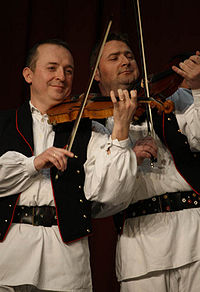 The traditional folk music
of Croatia
is mostly associated with the following:
Only recently has ganga begun to address political issues, frequently adopting overtly nationalistic overtones and incorporating themes from the Croatian Homeland War. Although both men and women regularly perform ganga, it is extremely unusual for them to perform songs together. In the past, it was not unusual for both Catholic and Muslim men to perform ganga together.
music is a form of a cappella
singing that first appeared in littoral Croatia during the middle of the 19th century. The word klapa is derived from a word in slang Italian spoken in Trieste at the time. It refers to "a group of people" and the singing style traces its roots to liturgical church singing. The motifs in general celebrate love, wine (grapes), country (homeland) and sea. The main elements of the music are harmony and melody, with rhythm very rarely being very important.
A klapa group consists of a first tenor
, a second tenor, a baritone
, and a bass. It is possible to double all the voices apart from the first tenor
. Although klapa
is a cappella music, on occasion it is possible to add a gentle guitar
and a mandolin
.
Klapa singing has become increasingly popular in littoral Croatia. Many young people from Dalmatia
treasure klapa
and sing it regularly when going out eating/drinking. This music has gained popularity among mainstream audiences in coastal regions of Croatia, with newer klapas formed by younger generations fusing klapa vocals with other music styles, such as klapa Libar's metal cover of "Pusti da ti leut svira" and the pop/klapa song "Kako ću joj reć' da varin" by klapa Dvd-a Žrnovnica Sv. Florijan, which won the Split Song Festival in 2010.
.jpg)
Tamburica (diminutive of tambura
) music is a form of folk music
that involves these and related string instruments. It became increasingly popular in the 1800s, and small bands began to form, paralleling similar developments in Russia
, Italy
and the Ukraine
.
The main themes of tamburitza songs are the common themes of love and happy village life. Tamburitza music is primarily associated with the northern, Pannonian part of the country. It is sometimes said that the first sextet of tambura players was formed by Pajo Kolarić
of Osijek
in 1847.
Traditional tamburitza ensembles are still commonplace, but more professional groups have formed in the last few decades. These include Zlatni dukati
and Ex Panonia, the first such groups, Zdenac, Slavonske Lole, Berde Band and the modernized rock and roll
-influenced Gazde.
The style of Tambura music played most often in the United States during the latter half of the 20th Century was not significantly different than the style played at the turn of the 19th Century. Free of the influences of pop music in Jugoslavia and the nascent, independent republics, and without large quantities of immigrants bringing new methods and styles, American-style Tambura music, and to a lesser extent, Canadian-style Tambura music stayed true to its roots.
Today, the most prevalent forms of Tambura music are folk-pop combinations.
music is played on this traditional string instrument. It is primarily rooted in epic poetry
with emphasis on important historical or patriotic events. It is the traditional instrument of inland Dalmatia
and of Herzegovina
, the part of Bosnia and Herzegovina
with predominant Croatian population.
Gusle players are known for glorifying outlaws such as hajduk
s or uskok
s of the long gone Turkish reign
or exalting the recent heroes of the Croatian War of Independence. Andrija Kačić Miošić
, a famous 18th century author, had also composed verses in form of the traditional folk poetry (deseterac, ten verses). His book Razgovor ugodni naroda slovinskog became Croatian folk Bible which inspired numerous gusle players ever since.
As for contemporary gusle players in Croatia, one person that particularly stands out is Mile Krajina
. Krajina is a prolific folk poet and gusle player who gained cult status among some conservative
groups. There are also several other prominent Croatian gusle players who often perform at various folk-festivals throughout Croatia and Bosnia-Herzegovina.
, an area north of Zagreb
, is known for small orchestras consisting of Violin
s, Cimbule, Tamburice
and Harmonike
. The Tamburitza is the national Croatian instrument. It is the Croatian national string instrument. Although there is a rich pool of folk songs in this region, traditions are not being cherished and most zagorian folk music available is performed by amateur groups. This is also reflected in the quality of the music which is mostly reduced to happy up beat songs.
The folk music of Međimurje, a small but distinct region in northernmost Croatia, with its melancholic and soothing tunes became the most popular form of folk to be used in the modern ethno pop-rock songs. Beside Cimbule and Violin
s, there is also a tradition of Brass
orchestras which used to play an important role in cultural everyday life. On one hand, they were the foundation of every regional celebration or wedding but on the other hand they were also known for playing at funerals or funeral feasts.
In Istria
and Kvarner, native instruments like sopila
, curla and diple
make a distinctive regional sound. It is partially diatonic in nature following the unique Istrian scale
.
n town Požega
hosts a known folk music festival
, Zlatne žice Slavonije
(Golden strings of Slavonia), which has prompted musicians to compose new songs with far-reaching influences, recently including American bluegrass
.
The towns of Vinkovci
and Đakovo, also in Slavonia, host yearly folklore festivals (Vinkovačke jeseni and Đakovački vezovi) where folk music is also listened to as part of the tradition.
The town of Slavonski Brod holds an annual festival called Brodfest, where many of the great tamburica bands come together to play.
The Dubrovnik Summer Festival puts on dramatic music and ballet. It was founded in 1950.
The Osor Musical Evenings was founded in 1976 and takes place in July and August. It plays classical Croatian masters.
The Musical Evenings in Donat takes place during the summer in Zadar. It was founded in 1961, and plays old music.
of Croatia generally resembles the canzone music of Italy
, while including elements of the native traditional music. Croatian record companies produce a lot of material each year, if only to populate the numerous music festivals. Of special note is the Split
festival which usually produces the most popular summer hit
s.
Seasoned pop singers in Croatia include: Meri Cetinić, Mišo Kovač
, Ivo Robić
, Vice Vukov
, Milan Bačić, Arsen Dedić
, Zdenka Vučković, Darko Domjan, Tereza Kesovija
, Gabi Novak
, Ivica Šerfezi
, Oliver Dragojević
, Tomislav Ivčić
, Doris Dragović
, Radojka Sverko, Maja Blagdan
, and many others. Also, the groups Magazin
and Grupa 777 have had sustained careers.
In more recent times, younger performers such as Severina
, Gibonni
, Marko Perković
/Thompson
, Toni Cetinski
, Divas, E.N.I.
, Lvky
, Danijela
, Antonija Šola
and many others have captured the attention of the pop audience. Each of them have successfully blended various influences into their distinct music style. For example, Thompson's songs include traditional epic themes from the Dinaric regions
; Severina threads between Croatian pop and a folk sound.
Croatian pop music is fairly often listened to in Slovenia
, Bosnia and Herzegovina
, Serbia
, Montenegro
and the Republic of Macedonia
due to the union of Yugoslavia that existed until the 1990s. Conversely, Bosnian singers like Dino Merlin
and Serbian Đorđe Balašević have an audience in Croatia, as well as some others. More recently the Turbo folk - frowned upon by the establishment some music critics and social commentators - has been popular amongst some sections of Croatian youth. A general resentment to Turbo folk remains as it is not broadcast on state radio and TV. Where on private outlets it may be transmitted, it normally triggers a strong negative reaction from those not liking it.
Croatia is a regular contestant on the Eurovision Song Contest
. Back in Yugoslavia, Croatian pop group Riva won the contest in 1989
. Some of the other Croatians who performed on the ESC include Danijel Popović, Put
, Boris Novković
and Claudia Beni
.
, Prljavo Kazalište
, Crvena Jabuka
, Atomsko Sklonište
etc. They originated in the 1970s and 1980s, and for the better part of their career resorted to a more mellow, mainstream pop-rock sound. Of some note is also the Sarajevo school of pop rock
which influenced many of these bands, and which also included singers like Željko Bebek
who later worked in Croatia.
However, Croatian New Wave (Novi Val) movement, which exploded in 1979/80 and lasted throughout the eighties, is considered by many to be the high watermark of Croatian rock music, both in terms of quality and commercial success. The most influential and popular bands of Novi val were Azra
, Haustor
, Film
, even early Prljavo Kazalište
. Other notable acts were Animatori, Buldožer
, Paraf
, Patrola etc.
In the late 1980s, the region of Istria
became home to a kind of called Ča-val, which often used the Čakavian dialect and elements of traditional Istra-Kvarner music.
The New Wave scene has collapsed by the end of the eighties, to be replaced by the newcomers like Daleka Obala
, Majke
and Laufer. While Daleka Obala
sported a pop-rock sound influenced by Novi val, Croatian pop and even Dalmatian folk, Majke
were a back-to-basics, garage-rock act stylistically influenced by bands like the Black Crowes, Led Zeppelin
or Black Sabbath
, as well as their Serbian counterparts Partibrejkers
. Laufer, led by Damir Urban
(who later went on to form Urban & 4
), were an early nineties alternative rock band taking their cue from the grunge movement.
Let 3
and KUD Idijoti
are also prominent rock acts, popular both for their music and their interesting, often controversial, performances and stunts.
Beginning in the late 1980s, folk-rock groups also sprouted across Croatia. The first is said to be Vještice, who combined Međimurje folk music with rock and set the stage for artists like Legen
, Lidija Bajuk
and Dunja Knebl
. At the same time on the other side of Croatia, in Istria, a band called Gustafi
started playing their own strange amalgamate of rock and Istrian folk, but it took them more than a decade to reach the nationwide audience.
The Split metal
band Osmi Putnik
has also been a success in Croatia and still are today and are also popular in other ex-yugoslav republics
The Sisak surf rock band The Bambi Molesters
has in the past years gained sizeable international fame and are often touted as one of the best surf-rock acts in the world today.
Alternative rock/metal band Father
have had success with their first album inspirita in countries like the UK, and have toured with bands like Korn
, Anthrax
and Apocalyptica
.
in Croatia was an offspring of the local pop music and more Western influences. It developed during the late 1980s and early 1990s, picking up on the trends such as euro disco
and eurodance
. It also spawned a wave of electronic music
artists, mostly house
, techno and trance
.
The singer Vanna
rose to prominence through the dance trio E.T., and the music of Vesna Pisarović
has a fair bit of dance beat.
Although E.T. still operates, they've changed singers several times and lost in popularity. The band Colonia
is perhaps the only one that rode the dance wave of the '90s and today is one of the most popular performers in Croatia.
(TBF) from Split
, whose members took inspiration from harsh economic and social conditions of war-torn Dalmatia
, not that different from American inner cities. Their act was followed by multitude of artists and groups in Zagreb
, taking inspiration from American gangsta rap
. The Zagreb rappers Bolesna Braća (also called Sick Rhyme Sayazz) and Tram 11
became particularly popular, and to an extent also the duo Nered & Stoka
.
The Croatian rap gained much from the fact Edo Maajka
, a Bosnian
rapper, signed on to a label in Zagreb. Recently a rapper known as Shorty
gained a lot of popularity by having songs with strong regional flavour of his native Vinkovci
. The Zagreb band Elemental
also burst into the scene featuring one of the few Croatian female rappers.
Also the most popular rap/hip-hop group in Croatia is Connect. They are still very popular group all over the Balkan and Europe. Connect's biggest hits:"Jebena","Prijateljska ljubav","Nebo","Poziv doma","Kiki" and many others.
, written by Jakov Gotovac
in the 1930s, blended the traditional music of the Dinaric
peoples into a scholarly form and achieved great success.
Some of the most renowned Croatian composers are Ivan Zajc
, Vatroslav Lisinski
, Franjo Dugan, Fortunat Pintarić, Luka Sorkočević
, Antun Sorkočević
, Ivan Mane Jarnović
, Anđelko Klobučar
, Boris Papandopulo
, Ivo Malec
, Stanko Horvat, Stjepan Šulek
, Branimir Sakač, Igor Kuljerić
, Ivo Josipović
, Željko Brkanović, Berislav Šipuš, Ivan Božičević
, Frano Parac, Marko Ruždjak, Branimir Krstić, Dubravko Detoni
and Srđan Dedić.
Croatian society of composers (Hrvatsko drustvo skladatelja - HDS) is the main organization promoting modern classical music in Croatia.
Croatia
Croatia , officially the Republic of Croatia , is a unitary democratic parliamentary republic in Europe at the crossroads of the Mitteleuropa, the Balkans, and the Mediterranean. Its capital and largest city is Zagreb. The country is divided into 20 counties and the city of Zagreb. Croatia covers ...
, like the divisions of the country itself, has two major influences: the Central Europe
Central Europe
Central Europe or alternatively Middle Europe is a region of the European continent lying between the variously defined areas of Eastern and Western Europe...
an one, present in the central and northern parts of the country, as well as in Slavonia
Slavonia
Slavonia is a geographical and historical region in eastern Croatia...
, and the Mediterranean one, particularly present in the coastal regions of Dalmatia
Dalmatia
Dalmatia is a historical region on the eastern coast of the Adriatic Sea. It stretches from the island of Rab in the northwest to the Bay of Kotor in the southeast. The hinterland, the Dalmatian Zagora, ranges from fifty kilometers in width in the north to just a few kilometers in the south....
and Istria
Istria
Istria , formerly Histria , is the largest peninsula in the Adriatic Sea. The peninsula is located at the head of the Adriatic between the Gulf of Trieste and the Bay of Kvarner...
.
In Croatia both pop
Pop music
Pop music is usually understood to be commercially recorded music, often oriented toward a youth market, usually consisting of relatively short, simple songs utilizing technological innovations to produce new variations on existing themes.- Definitions :David Hatch and Stephen Millward define pop...
and rock
Rock music
Rock music is a genre of popular music that developed during and after the 1960s, particularly in the United Kingdom and the United States. It has its roots in 1940s and 1950s rock and roll, itself heavily influenced by rhythm and blues and country music...
are popular, as well as pop music influenced by Dalmatia
Dalmatia
Dalmatia is a historical region on the eastern coast of the Adriatic Sea. It stretches from the island of Rab in the northwest to the Bay of Kotor in the southeast. The hinterland, the Dalmatian Zagora, ranges from fifty kilometers in width in the north to just a few kilometers in the south....
n or Slavonia
Slavonia
Slavonia is a geographical and historical region in eastern Croatia...
n folk elements.
From the mid-20th century onwards, schlagers and chanson
Chanson
A chanson is in general any lyric-driven French song, usually polyphonic and secular. A singer specialising in chansons is known as a "chanteur" or "chanteuse" ; a collection of chansons, especially from the late Middle Ages and Renaissance, is also known as a chansonnier.-Chanson de geste:The...
-inspired music have formed the backbone of the Croatian popular music
Croatian popular music
Croatian popular music is the popular music of Croatia.Prominent mainstream pop artists include: Danijela Martinović, Severina, Gibonni, Toni Cetinski and the patriotic band Thompson. Croatia is known for the specific Dalmatian sound performed at various festivals along the Adriatic coast with...
.
History of Music in Croatia
The oldest preserved relics of musical culture in Croatia are sacral in nature and represented by Latin medieval liturgical chant manuscripts (approximately one hundred musical codices and fragments dating from the 11th do the 15th centuries have been preserved to date). They reveal a wealth of various influences and liturgical traditions that converged in this region (DalmatiaDalmatia
Dalmatia is a historical region on the eastern coast of the Adriatic Sea. It stretches from the island of Rab in the northwest to the Bay of Kotor in the southeast. The hinterland, the Dalmatian Zagora, ranges from fifty kilometers in width in the north to just a few kilometers in the south....
n liturgy in Benevento script, Northern Gregorian chant
Gregorian chant
Gregorian chant is the central tradition of Western plainchant, a form of monophonic liturgical music within Western Christianity that accompanied the celebration of Mass and other ritual services...
, and original Glagolihic chant).
Humanism
Humanism is an approach in study, philosophy, world view or practice that focuses on human values and concerns. In philosophy and social science, humanism is a perspective which affirms some notion of human nature, and is contrasted with anti-humanism....
in Croatia brought about changes to the world of music. Interest in music began to spread outside of monastic and church walls with growing influence of new spiritual tendencies from Central European and particularly Italian cities. Humanists and philosophers promulgated new musical theories and aesthetic ideas: Federik Grisogono, Pavao Skalić
Pavao Skalić
Paul Skalich , also known as Stanislav Pavao Skalić or Paulus Scalichius de Lika, was an encyclopedist, Renaissance humanist, and adventurer born in Zagreb, Croatia, and who lived part of his life in Germany...
, Frane Petrić. The writing down of folk and popular music began in mid-sixteenth century: in the poem Fishing and Fishermen’s Talk
Fishing and Fishermen’s Talk
Fishing and Fishermen's Talk is the most important literary work of Croatian Renaissance poet Petar Hektorović, finished on January 14, 1566, and printed in 1568 in Venice...
from 1558, Petar Hektorović
Petar Hektorovic
Petar Hektorović was a Croatian writer.Hektorović was born and died in Stari Grad, Hvar. He was a poet and collector of Hvar's fishermen songs, and an important figure of the Renaissance period in Croatian literature...
ingrained Neoplatonic ideals in popular music; and transcripts of Croatian musical folklore were printed in Venetian anthologies (Giulio Cesare Barbetta 1569, Marco Facoli 1588). Julije Skjavetić from Šibenik
Šibenik
Šibenik is a historic town in Croatia, with population of 51,553 . It is located in central Dalmatia where the river Krka flows into the Adriatic Sea...
published his madrigal
Madrigal (music)
A madrigal is a secular vocal music composition, usually a partsong, of the Renaissance and early Baroque eras. Traditionally, polyphonic madrigals are unaccompanied; the number of voices varies from two to eight, and most frequently from three to six....
s (Li madrigali a quattro, et a cinque voci 1562), while his Motetti a cinque et a sei voci, (1564) are characterised by a lavish polyphonic structure under the influence of the Dutch school
Dutch School (painting)
The Dutch School were painters in the Netherlands from the early Renaissance to the Baroque. It includes Early Netherlandish and Dutch Renaissance artists active in the northern Low Countries and, later, Dutch Golden Age painting in the United Provinces.Many painters, sculptors and architects of...
. Music and dance were a component part of theatrical expression (Mavro Vetranović
Mavro Vetranovic
Mavro Vetranović was a prolific Croatian writer and Benedictine friar from Dubrovnik.Born in Dubrovnik in 1482, he entered the Benedictine Order in 1507 on the island of Mljet, and after a period of education in Monte Cassino in Italy returned to Mljet as the abbot of the monastery...
, Nikola Nalješković, Marin Držić
Marin Držic
Marin Držić is considered the finest Croatian Renaissance playwright and prose writer.- Life :Born into a large and well to do family in Dubrovnik, Držić was trained and ordained as a priest — a calling very unsuitable for his rebel temperament...
, Marin Benetović), while the function of music and sound effects was under the influence of Italian pastorals.
New tendencies of early Baroque
Baroque
The Baroque is a period and the style that used exaggerated motion and clear, easily interpreted detail to produce drama, tension, exuberance, and grandeur in sculpture, painting, literature, dance, and music...
monody soon found their way into the domestic musical tradition, both sacral and secular. Tomaso Cecchini, from Verona
Verona
Verona ; German Bern, Dietrichsbern or Welschbern) is a city in the Veneto, northern Italy, with approx. 265,000 inhabitants and one of the seven chef-lieus of the region. It is the second largest city municipality in the region and the third of North-Eastern Italy. The metropolitan area of Verona...
, who spent his entire working life (1603–44) as a choirmaster, organist and composer in Split
Split (city)
Split is a Mediterranean city on the eastern shores of the Adriatic Sea, centered around the ancient Roman Palace of the Emperor Diocletian and its wide port bay. With a population of 178,192 citizens, and a metropolitan area numbering up to 467,899, Split is by far the largest Dalmatian city and...
and Hvar
Hvar
- Climate :The climate of Hvar is characterized by mild winters and warm summers. The yearly average air temperature is , 686 mm of precipitation fall on the town of Hvar on average every year and the town has a total of 2800 sunshine hours per year. For comparison Hvar has an average of 7.7...
, published his madrigals Armonici concetti, libro primo (1612) as the oldest Baroque collection written for the Croatian milieu. The collection Sacrae cantiones (Venice
Venice
Venice is a city in northern Italy which is renowned for the beauty of its setting, its architecture and its artworks. It is the capital of the Veneto region...
1620) by Ivan Lukačić
Ivan Lukacic
Marko Ivan Lukačić was a Croatian-born musician and composer of the Renaissance and early Baroque.-Biography:...
from Šibenik is valuable testimony of sacral music that was performed in Split, and is generally speaking, one of the most significant monuments of old Croatian music altogether. The Franciscans and Paulists
Paulists
Paulists, or Paulines, is the name used for several Roman Catholic Orders and Congregations taken in honour and under the patronage of St. Paul the Hermit....
cultivated sacral chants, mostly monophonic and without organ
Organ (music)
The organ , is a keyboard instrument of one or more divisions, each played with its own keyboard operated either with the hands or with the feet. The organ is a relatively old musical instrument in the Western musical tradition, dating from the time of Ctesibius of Alexandria who is credited with...
accompaniment (the manuscript cantos of Frane Divnić, Bone Razmilović, Filip Vlahović-Kapušvarac, Franjo Vukovarac and Petar Knežević).
The tradition of the Baroque
Baroque
The Baroque is a period and the style that used exaggerated motion and clear, easily interpreted detail to produce drama, tension, exuberance, and grandeur in sculpture, painting, literature, dance, and music...
was more lasting in church/sacral music, which was the musical form that was systematically nurtured in numerous monasteries (especially Franciscan ones) as well as in parish and cathedral churches. The preservation of music manuscripts and prints became widespread practice in the mid-18th century. Simple vocal-instrumental music for two voices with organ continuo was the form most frequently performed in churches; more prominent individuals active in the sphere of music could be found only in larger urban centres. They were mostly organist
Organist
An organist is a musician who plays any type of organ. An organist may play solo organ works, play with an ensemble or orchestra, or accompany one or more singers or instrumental soloists...
s and maestri di cappella, skilful composers who had small vocal and/or instrumental ensembles and who frequently acted as music teachers (private or in church schools). The gradual development of the middle class had as one of its consequences the corresponding secular organisation of musical life, particularly in the first decades of the 19th century, a period that saw the establishment of music ensembles, music societies (1827 in Zagreb
Zagreb
Zagreb is the capital and the largest city of the Republic of Croatia. It is in the northwest of the country, along the Sava river, at the southern slopes of the Medvednica mountain. Zagreb lies at an elevation of approximately above sea level. According to the last official census, Zagreb's city...
, then in Varaždin
Varaždin
Varaždin is a city in north Croatia, north of Zagreb on the highway A4. The total population is 47,055, with 38,746 on of the city settlement itself . The centre of Varaždin county is located near the Drava river, at...
, Rijeka
Rijeka
Rijeka is the principal seaport and the third largest city in Croatia . It is located on Kvarner Bay, an inlet of the Adriatic Sea and has a population of 128,735 inhabitants...
, Osijek
Osijek
Osijek is the fourth largest city in Croatia with a population of 83,496 in 2011. It is the largest city and the economic and cultural centre of the eastern Croatian region of Slavonia, as well as the administrative centre of Osijek-Baranja county...
etc.) and music schools.
In addition, public balls and other events were organised (music academies, theatre performances) with the participation of local and foreign musicians (from Italy
Italy
Italy , officially the Italian Republic languages]] under the European Charter for Regional or Minority Languages. In each of these, Italy's official name is as follows:;;;;;;;;), is a unitary parliamentary republic in South-Central Europe. To the north it borders France, Switzerland, Austria and...
, Austria
Austria
Austria , officially the Republic of Austria , is a landlocked country of roughly 8.4 million people in Central Europe. It is bordered by the Czech Republic and Germany to the north, Slovakia and Hungary to the east, Slovenia and Italy to the south, and Switzerland and Liechtenstein to the...
, Bohemia
Bohemia
Bohemia is a historical region in central Europe, occupying the western two-thirds of the traditional Czech Lands. It is located in the contemporary Czech Republic with its capital in Prague...
etc.) including the private collection of music materials for playing music at home. Music became a component part of various festivities, such as the arrival of important political personalities (the new governor or the Habsburg king Frances I, etc.), the feasts of patron saints (St. Blaise in Dubrovnik
Dubrovnik
Dubrovnik is a Croatian city on the Adriatic Sea coast, positioned at the terminal end of the Isthmus of Dubrovnik. It is one of the most prominent tourist destinations on the Adriatic, a seaport and the centre of Dubrovnik-Neretva county. Its total population is 42,641...
, St. Domnius in Split
Split (city)
Split is a Mediterranean city on the eastern shores of the Adriatic Sea, centered around the ancient Roman Palace of the Emperor Diocletian and its wide port bay. With a population of 178,192 citizens, and a metropolitan area numbering up to 467,899, Split is by far the largest Dalmatian city and...
, St. Stephen in Hvar
Hvar
- Climate :The climate of Hvar is characterized by mild winters and warm summers. The yearly average air temperature is , 686 mm of precipitation fall on the town of Hvar on average every year and the town has a total of 2800 sunshine hours per year. For comparison Hvar has an average of 7.7...
and Zagreb
Zagreb
Zagreb is the capital and the largest city of the Republic of Croatia. It is in the northwest of the country, along the Sava river, at the southern slopes of the Medvednica mountain. Zagreb lies at an elevation of approximately above sea level. According to the last official census, Zagreb's city...
etc.), for which so called art music was specifically composed, with the inclusion of popular elements (bourgeois dances, folk music of the peasantry).
Many Italian and domestic musicians worked in Dubrovnik: in the cathedral choir and orchestra, in the duke's orchestra, at private and public festivities. An excellent early example of pre-classical symphony and chamber music was given by Luka Sorkočević
Luka Sorkocevic
Count Luka Sorkočević, was a composer from the Republic of Ragusa.Luka Sorkočević was born in Dubrovnik and received an extensive education. His music teacher was the Italian composer Giuseppe Valentini, who was maestro di cappella of Dubrovnik Cathedral in the 1750s...
, a nobleman educated in Rome, as well as his son Antun, a historian and diplomat.
Ferdo Livadic
Ferdo Livadić was a Croatian composer.A leader of the 19th century Croatian national revival, Livadić wrote the tune for "Još Hrvatska ni propala", the anthem of the Illyrian movement...
(1799–1879) wrote Notturno in F-sharp minor for piano as early as 1822, which is, along with John Field
John Field (composer)
John Field was an Irish pianist, composer, and teacher. He was born in Dublin into a musical family, and received his early education there. The Fields soon moved to London, where Field studied under Muzio Clementi...
's compositions under the same name, one of the earliest examples of that type of piano miniatures in general.
In the course of the 1830s, as a reflection of such tendencies in Europe, the Illyrian Movement
Illyrian movement
The Illyrian movement , also Croatian national revival , was a cultural and political campaign with roots in the early modern period, and revived by a group of young Croatian intellectuals during the first half of 19th century, around the years of 1835–1849...
emerged in Croatia which assigned not only to literature but to music as well a particular socio-political role: the forming and guarding of national awareness including the struggle against Hungarization and Germanization. Accordingly, in 1846 Josip Runjanin (1821–1878) put to music Antun Mihanović
Antun Mihanovic
Antun Mihanović was a notable Croatian poet and lyricist, most famous for writing the national anthem of Croatia, which was put to music by Josif Runjanin and adopted in 1891. Klanjec, his birthplace, holds a monument to him and a gallery of his works.Mihanović studied law and worked as a military...
's 1835 poem "Horvatska domovina" (Croatian Homeland), which later became the Croatian national anthem
Lijepa naša domovino
"Lijepa naša domovino" is the national anthem of Croatia. It is often referred to as just "Lijepa naša" in Croatia, which is also a phrase widely used as a metonym for the country....
. In such a setting Vatroslav Lisinski
Vatroslav Lisinski
Vatroslav Lisinski was a Croatian composer.Lisinski was born Ignaz Fuchs to a German Jewish family...
(1819–1954) composed the first Croatian national opera Ljubav i zloba (Love and Malice), which premièred in Zagreb
Zagreb
Zagreb is the capital and the largest city of the Republic of Croatia. It is in the northwest of the country, along the Sava river, at the southern slopes of the Medvednica mountain. Zagreb lies at an elevation of approximately above sea level. According to the last official census, Zagreb's city...
in 1846.
Taking into consideration the presence of folk music, the aspirations of the Illyrians went far beyond the results achieved, something that is also continued in the work of Ivan Zajc
Ivan Zajc
Ivan Dragutin Stjepan Zajc or Ivan pl. Zajc , was a Croatian composer, conductor, director and teacher who for over forty years dominated Croatia's musical culture...
(1832–1914) in the second half of the century. His masterpiece, the opera Nikola Šubić Zrinjski, ever since its opening night in Zagreb in 1876, had not lost in popularity, partly because its heroic patriotism functions as a symbol of Croatia's victory. Finally, owing to the founder of Croatian ethno-musicology and musical historiography, Franjo Kuhač
Franjo Kuhac
Franjo Ksaver Kuhač was a piano teacher, choral conductor, and comparative musicologist who studied Croatian folk music. Kuhač did a great deal of field work in this area, collecting and publishing 1,600 folk songs...
(1834–1911), the systematic research of folklore evolved simultaneously with Zajc's endeavours. Finally it should be added that in Zajc's and Kuhač's era, major halls for musical performances and concerts were built: in Zagreb the building of the Croatian Music Institute (1876, 1895) with a concert hall, and the building of the Croatian National Theatre (1895), including the theatre buildings in Rijeka
Rijeka
Rijeka is the principal seaport and the third largest city in Croatia . It is located on Kvarner Bay, an inlet of the Adriatic Sea and has a population of 128,735 inhabitants...
(1885), Split
Split (city)
Split is a Mediterranean city on the eastern shores of the Adriatic Sea, centered around the ancient Roman Palace of the Emperor Diocletian and its wide port bay. With a population of 178,192 citizens, and a metropolitan area numbering up to 467,899, Split is by far the largest Dalmatian city and...
(1893) and Osijek
Osijek
Osijek is the fourth largest city in Croatia with a population of 83,496 in 2011. It is the largest city and the economic and cultural centre of the eastern Croatian region of Slavonia, as well as the administrative centre of Osijek-Baranja county...
(1907) where, along with the Croatian National Theatre in Zagreb, drama, opera and ballet performances are still played today.
During the 19th century, other instrumentalists and singers won international recognition, for example, the violinist Franjo Krežma
Franjo Krežma
Franjo Krežma , also known as Franz Krezma in German-speaking countries, was a Croatian violinist and composer....
(1862–1881), singers, among which Ilma Murska (1834–1889), Matilda Mallinger (1847–1920) who sang at the opening night of Wagner
Richard Wagner
Wilhelm Richard Wagner was a German composer, conductor, theatre director, philosopher, music theorist, poet, essayist and writer primarily known for his operas...
's Die Meistersinger von Nürnberg
Die Meistersinger von Nürnberg
Die Meistersinger von Nürnberg is an opera in three acts, written and composed by Richard Wagner. It is among the longest operas still commonly performed today, usually taking around four and a half hours. It was first performed at the Königliches Hof- und National-Theater in Munich, on June 21,...
in 1868, Milka Trnina (1863–1941) and Josip Kašman
Josip Kašman
Josip Kašman or Giuseppe Kaschmann, , was a famous operatic baritone...
(1850–1925), the first Croatian singer to appear at the New York Metropolitan Opera.
Folk music
Folk music
Folk music is an English term encompassing both traditional folk music and contemporary folk music. The term originated in the 19th century. Traditional folk music has been defined in several ways: as music transmitted by mouth, as music of the lower classes, and as music with unknown composers....
of Croatia
Croatia
Croatia , officially the Republic of Croatia , is a unitary democratic parliamentary republic in Europe at the crossroads of the Mitteleuropa, the Balkans, and the Mediterranean. Its capital and largest city is Zagreb. The country is divided into 20 counties and the city of Zagreb. Croatia covers ...
is mostly associated with the following:
Ganga
Ganga is a type of singing which is characterized by a lone singer singing one line of lyrics and then others joining in for what can be best described as a wail. It is a very passionate form of singing, which is one of the reasons it has been limited in popularity to small towns. Even though its a unique and autochthonous form of singing by Croats, it is very rare to hear this music on Croatian airwaves. However, several popular Croatian musicians have incorporated some ganga into their work.Only recently has ganga begun to address political issues, frequently adopting overtly nationalistic overtones and incorporating themes from the Croatian Homeland War. Although both men and women regularly perform ganga, it is extremely unusual for them to perform songs together. In the past, it was not unusual for both Catholic and Muslim men to perform ganga together.
Klapa
The klapaKlapa
The klapa music is a form of traditional Croatian a cappella singing . The word klapa translates as "a group of friends" and traces its roots to littoral church singing . The motifs in general celebrate love, wine , country and sea...
music is a form of a cappella
A cappella
A cappella music is specifically solo or group singing without instrumental sound, or a piece intended to be performed in this way. It is the opposite of cantata, which is accompanied singing. A cappella was originally intended to differentiate between Renaissance polyphony and Baroque concertato...
singing that first appeared in littoral Croatia during the middle of the 19th century. The word klapa is derived from a word in slang Italian spoken in Trieste at the time. It refers to "a group of people" and the singing style traces its roots to liturgical church singing. The motifs in general celebrate love, wine (grapes), country (homeland) and sea. The main elements of the music are harmony and melody, with rhythm very rarely being very important.
A klapa group consists of a first tenor
Tenor
The tenor is a type of male singing voice and is the highest male voice within the modal register. The typical tenor voice lies between C3, the C one octave below middle C, to the A above middle C in choral music, and up to high C in solo work. The low extreme for tenors is roughly B2...
, a second tenor, a baritone
Baritone
Baritone is a type of male singing voice that lies between the bass and tenor voices. It is the most common male voice. Originally from the Greek , meaning deep sounding, music for this voice is typically written in the range from the second F below middle C to the F above middle C Baritone (or...
, and a bass. It is possible to double all the voices apart from the first tenor
Tenor
The tenor is a type of male singing voice and is the highest male voice within the modal register. The typical tenor voice lies between C3, the C one octave below middle C, to the A above middle C in choral music, and up to high C in solo work. The low extreme for tenors is roughly B2...
. Although klapa
Klapa
The klapa music is a form of traditional Croatian a cappella singing . The word klapa translates as "a group of friends" and traces its roots to littoral church singing . The motifs in general celebrate love, wine , country and sea...
is a cappella music, on occasion it is possible to add a gentle guitar
Guitar
The guitar is a plucked string instrument, usually played with fingers or a pick. The guitar consists of a body with a rigid neck to which the strings, generally six in number, are attached. Guitars are traditionally constructed of various woods and strung with animal gut or, more recently, with...
and a mandolin
Mandolin
A mandolin is a musical instrument in the lute family . It descends from the mandore, a soprano member of the lute family. The mandolin soundboard comes in many shapes—but generally round or teardrop-shaped, sometimes with scrolls or other projections. A mandolin may have f-holes, or a single...
.
Klapa singing has become increasingly popular in littoral Croatia. Many young people from Dalmatia
Dalmatia
Dalmatia is a historical region on the eastern coast of the Adriatic Sea. It stretches from the island of Rab in the northwest to the Bay of Kotor in the southeast. The hinterland, the Dalmatian Zagora, ranges from fifty kilometers in width in the north to just a few kilometers in the south....
treasure klapa
Klapa
The klapa music is a form of traditional Croatian a cappella singing . The word klapa translates as "a group of friends" and traces its roots to littoral church singing . The motifs in general celebrate love, wine , country and sea...
and sing it regularly when going out eating/drinking. This music has gained popularity among mainstream audiences in coastal regions of Croatia, with newer klapas formed by younger generations fusing klapa vocals with other music styles, such as klapa Libar's metal cover of "Pusti da ti leut svira" and the pop/klapa song "Kako ću joj reć' da varin" by klapa Dvd-a Žrnovnica Sv. Florijan, which won the Split Song Festival in 2010.
Tamburica
Tamburica (diminutive of tambura
Tambura
The tambura, tanpura, or tambora is a long-necked plucked lute . The body shape of the tambura somewhat resembles that of the sitar, but it has no frets – only the open strings are played to accompany other musicians...
) music is a form of folk music
Folk music
Folk music is an English term encompassing both traditional folk music and contemporary folk music. The term originated in the 19th century. Traditional folk music has been defined in several ways: as music transmitted by mouth, as music of the lower classes, and as music with unknown composers....
that involves these and related string instruments. It became increasingly popular in the 1800s, and small bands began to form, paralleling similar developments in Russia
Russia
Russia or , officially known as both Russia and the Russian Federation , is a country in northern Eurasia. It is a federal semi-presidential republic, comprising 83 federal subjects...
, Italy
Italy
Italy , officially the Italian Republic languages]] under the European Charter for Regional or Minority Languages. In each of these, Italy's official name is as follows:;;;;;;;;), is a unitary parliamentary republic in South-Central Europe. To the north it borders France, Switzerland, Austria and...
and the Ukraine
Ukraine
Ukraine is a country in Eastern Europe. It has an area of 603,628 km², making it the second largest contiguous country on the European continent, after Russia...
.
The main themes of tamburitza songs are the common themes of love and happy village life. Tamburitza music is primarily associated with the northern, Pannonian part of the country. It is sometimes said that the first sextet of tambura players was formed by Pajo Kolarić
Pajo Kolaric
Pajo Kolarić was an early Croatian composer for tamburitza. Kolari formed the first amateur tamburitza orchestra in Osijek in 1847. He was a teacher of Mijo Majer.- External links :*http://www.croatianhistory.net/etf/folk.html...
of Osijek
Osijek
Osijek is the fourth largest city in Croatia with a population of 83,496 in 2011. It is the largest city and the economic and cultural centre of the eastern Croatian region of Slavonia, as well as the administrative centre of Osijek-Baranja county...
in 1847.
Traditional tamburitza ensembles are still commonplace, but more professional groups have formed in the last few decades. These include Zlatni dukati
Najbolji Hrvatski Tamburaši
Najbolji Hrvatski Tamburaši is a Croatian tambura group. The group was formed in 1983 as Zlatni Dukati. After a tour of America organized by the Croatian Fraternal Union, the band started to compose more music about Croatia. This came to coincide with the Croatian War of Independence which brought...
and Ex Panonia, the first such groups, Zdenac, Slavonske Lole, Berde Band and the modernized rock and roll
Rock and roll
Rock and roll is a genre of popular music that originated and evolved in the United States during the late 1940s and early 1950s, primarily from a combination of African American blues, country, jazz, and gospel music...
-influenced Gazde.
The style of Tambura music played most often in the United States during the latter half of the 20th Century was not significantly different than the style played at the turn of the 19th Century. Free of the influences of pop music in Jugoslavia and the nascent, independent republics, and without large quantities of immigrants bringing new methods and styles, American-style Tambura music, and to a lesser extent, Canadian-style Tambura music stayed true to its roots.
Today, the most prevalent forms of Tambura music are folk-pop combinations.
Gusle
The gusleGusle
The Gusle is a single-stringed musical instrument traditionally used in the Dinarides region of the Balkans ....
music is played on this traditional string instrument. It is primarily rooted in epic poetry
Epic poetry
An epic is a lengthy narrative poem, ordinarily concerning a serious subject containing details of heroic deeds and events significant to a culture or nation. Oral poetry may qualify as an epic, and Albert Lord and Milman Parry have argued that classical epics were fundamentally an oral poetic form...
with emphasis on important historical or patriotic events. It is the traditional instrument of inland Dalmatia
Dalmatia
Dalmatia is a historical region on the eastern coast of the Adriatic Sea. It stretches from the island of Rab in the northwest to the Bay of Kotor in the southeast. The hinterland, the Dalmatian Zagora, ranges from fifty kilometers in width in the north to just a few kilometers in the south....
and of Herzegovina
Herzegovina
Herzegovina is the southern region of Bosnia and Herzegovina. While there is no official border distinguishing it from the Bosnian region, it is generally accepted that the borders of the region are Croatia to the west, Montenegro to the south, the canton boundaries of the Herzegovina-Neretva...
, the part of Bosnia and Herzegovina
Bosnia and Herzegovina
Bosnia and Herzegovina , sometimes called Bosnia-Herzegovina or simply Bosnia, is a country in Southern Europe, on the Balkan Peninsula. Bordered by Croatia to the north, west and south, Serbia to the east, and Montenegro to the southeast, Bosnia and Herzegovina is almost landlocked, except for the...
with predominant Croatian population.
Gusle players are known for glorifying outlaws such as hajduk
Hajduk
Hajduk is a term most commonly referring to outlaws, highwaymen or freedom fighters in the Balkans, Central- and Eastern Europe....
s or uskok
USKOK
USKOK is a Croatian government institution. It is a State Attorney office specialized in corruption and organized crime.USKOK started work in December 2001...
s of the long gone Turkish reign
Ottoman Empire
The Ottoman EmpireIt was usually referred to as the "Ottoman Empire", the "Turkish Empire", the "Ottoman Caliphate" or more commonly "Turkey" by its contemporaries...
or exalting the recent heroes of the Croatian War of Independence. Andrija Kačić Miošić
Andrija Kacic Miošic
Andrija Kačić Miošić was a Croatian poet and Franciscan monk.Born in Brist near Makarska, he became a Franciscan monk. He was educated in Zaostrog monastery and Buda...
, a famous 18th century author, had also composed verses in form of the traditional folk poetry (deseterac, ten verses). His book Razgovor ugodni naroda slovinskog became Croatian folk Bible which inspired numerous gusle players ever since.
As for contemporary gusle players in Croatia, one person that particularly stands out is Mile Krajina
Mile Krajina
Mile Krajina is a noted gusle player in Croatia, who sings traditional folk songs.Many of his songs are about his birthplace Oklaj in the Cetina region. He mentions reading the works of famous Croatian poet Andrija Kačić Miošić in primary school as an early influence for his poems and songs...
. Krajina is a prolific folk poet and gusle player who gained cult status among some conservative
Conservatism
Conservatism is a political and social philosophy that promotes the maintenance of traditional institutions and supports, at the most, minimal and gradual change in society. Some conservatives seek to preserve things as they are, emphasizing stability and continuity, while others oppose modernism...
groups. There are also several other prominent Croatian gusle players who often perform at various folk-festivals throughout Croatia and Bosnia-Herzegovina.
Diple
Diple is a traditional woodwind musical instrument in Croatian music. Sometimes called "Mih", "mjeh", "mjesina" or only "diple", it is played from Istria, Lika, over Dalmatia Islands and Coast to Herzegovina. "Mih" is made of tanned goat or sheep skin and consists of a "dulac" or "kanela" through which the air is blown and "diple" (chanter) on which it is played. Inside the "mih" on the chanter, two single-blade reeds are situated. Unlike bagpipes, "Mih" doesn't have a "trubanj" or "bordun" (drone). Although they are very similar, the "mih" from different parts of Croatia still differ in type of chanter, in the position of holes or in some tiny details (for example ornaments).Other folk traditions
The folk music of ZagorjeZagorje
Hrvatsko Zagorje is a region in northern Croatia.Zagorje may also refer to:*Zagorje ob Savi, a town and a municipality in Slovenia*NK Zagorje, a Slovenian football club-See also:...
, an area north of Zagreb
Zagreb
Zagreb is the capital and the largest city of the Republic of Croatia. It is in the northwest of the country, along the Sava river, at the southern slopes of the Medvednica mountain. Zagreb lies at an elevation of approximately above sea level. According to the last official census, Zagreb's city...
, is known for small orchestras consisting of Violin
Violin
The violin is a string instrument, usually with four strings tuned in perfect fifths. It is the smallest, highest-pitched member of the violin family of string instruments, which includes the viola and cello....
s, Cimbule, Tamburice
Tamburitza
Tamburica or Tamboura refers to any member of a family of long-necked lutes popular in Eastern and Southern Europe, particularly Croatia , Serbia and Hungary. It is also known in southern Slovenia and Burgenland...
and Harmonike
Accordion
The accordion is a box-shaped musical instrument of the bellows-driven free-reed aerophone family, sometimes referred to as a squeezebox. A person who plays the accordion is called an accordionist....
. The Tamburitza is the national Croatian instrument. It is the Croatian national string instrument. Although there is a rich pool of folk songs in this region, traditions are not being cherished and most zagorian folk music available is performed by amateur groups. This is also reflected in the quality of the music which is mostly reduced to happy up beat songs.
The folk music of Međimurje, a small but distinct region in northernmost Croatia, with its melancholic and soothing tunes became the most popular form of folk to be used in the modern ethno pop-rock songs. Beside Cimbule and Violin
Violin
The violin is a string instrument, usually with four strings tuned in perfect fifths. It is the smallest, highest-pitched member of the violin family of string instruments, which includes the viola and cello....
s, there is also a tradition of Brass
Brass
Brass is an alloy of copper and zinc; the proportions of zinc and copper can be varied to create a range of brasses with varying properties.In comparison, bronze is principally an alloy of copper and tin...
orchestras which used to play an important role in cultural everyday life. On one hand, they were the foundation of every regional celebration or wedding but on the other hand they were also known for playing at funerals or funeral feasts.
In Istria
Istria
Istria , formerly Histria , is the largest peninsula in the Adriatic Sea. The peninsula is located at the head of the Adriatic between the Gulf of Trieste and the Bay of Kvarner...
and Kvarner, native instruments like sopila
Sopila
The sopile is an ancient traditional woodwind instrument of Croatia, similar to the oboe or shawm. It is used in the regions of Kvarner, Kastav, Vinodol, Island Krk, and Istria. Sopile are always played in pair so there are great and small or thin and fat sopila...
, curla and diple
Diple
Diple, dvojnice, or dvojanke are a traditional woodwind musical instrument in Croatian, Montenegrin and Serbian music.-The flute:...
make a distinctive regional sound. It is partially diatonic in nature following the unique Istrian scale
Istrian scale
The Istrian scale is a distinct hexatonic musical scale in the regions of Istria and Kvarner in Croatia. It is used in Istrian and Kvarnerian folk music. The scale could approximately be notated as: E-F-G-Ab-Bb-Cb- See also :* Music of Croatia...
.
Events
The SlavoniaSlavonia
Slavonia is a geographical and historical region in eastern Croatia...
n town Požega
Požega, Croatia
Požega is a city in western Slavonia, eastern Croatia, with a total population of 26,403 . It is the administrative center of the Požega-Slavonia County.-Geography:...
hosts a known folk music festival
Music festival
A music festival is a festival oriented towards music that is sometimes presented with a theme such as musical genre, nationality or locality of musicians, or holiday. They are commonly held outdoors, and are often inclusive of other attractions such as food and merchandise vending machines,...
, Zlatne žice Slavonije
Zlatne žice Slavonije
Zlatne žice Slavonije is a music festival for both tambura and pop music held annually in Požega, Croatia. The modern festival has been held annually since 1990.The first music festival in Požega began in 1969 and was held annually until 1981....
(Golden strings of Slavonia), which has prompted musicians to compose new songs with far-reaching influences, recently including American bluegrass
Bluegrass music
Bluegrass music is a form of American roots music, and a sub-genre of country music. It has mixed roots in Scottish, English, Welsh and Irish traditional music...
.
The towns of Vinkovci
Vinkovci
Vinkovci is a city in Croatia, in the Vukovar-Syrmia County. In the 2011 census, the total population of the city was 35,375, making it the largest town of the county...
and Đakovo, also in Slavonia, host yearly folklore festivals (Vinkovačke jeseni and Đakovački vezovi) where folk music is also listened to as part of the tradition.
The town of Slavonski Brod holds an annual festival called Brodfest, where many of the great tamburica bands come together to play.
The Dubrovnik Summer Festival puts on dramatic music and ballet. It was founded in 1950.
The Osor Musical Evenings was founded in 1976 and takes place in July and August. It plays classical Croatian masters.
The Musical Evenings in Donat takes place during the summer in Zadar. It was founded in 1961, and plays old music.
Pop
The pop musicPop music
Pop music is usually understood to be commercially recorded music, often oriented toward a youth market, usually consisting of relatively short, simple songs utilizing technological innovations to produce new variations on existing themes.- Definitions :David Hatch and Stephen Millward define pop...
of Croatia generally resembles the canzone music of Italy
Music of Italy
The music of Italy ranges across a broad spectrum of opera and instrumental classical music and a body of popular music drawn from both native and imported sources. Music has traditionally been one of the cultural markers of Italian national and ethnic identity and holds an important position in...
, while including elements of the native traditional music. Croatian record companies produce a lot of material each year, if only to populate the numerous music festivals. Of special note is the Split
Split (city)
Split is a Mediterranean city on the eastern shores of the Adriatic Sea, centered around the ancient Roman Palace of the Emperor Diocletian and its wide port bay. With a population of 178,192 citizens, and a metropolitan area numbering up to 467,899, Split is by far the largest Dalmatian city and...
festival which usually produces the most popular summer hit
Summer hit
A summer hit is a term in entertainment industry which refers to a title released and peaked in its popularity during summer and often later quickly faded away..Rick Lyman, a culture reporter for The New York Times, wrote:...
s.
Seasoned pop singers in Croatia include: Meri Cetinić, Mišo Kovač
Mišo Kovac
Mišo Kovač is a Croatian singer who was one of the most popular musical icons of the former Yugoslavia, and still popular today in Croatia.-Biography:...
, Ivo Robić
Ivo Robic
Ivo Robić was Croatian singer and songwriter.-Domestic career:Robić began his career as a soloist with the Radio Zagreb Orchestra, while studying at the same time in Zagreb...
, Vice Vukov
Vice Vukov
Vice Vukov was a Croatian singer and politician.-Biography:During the 1960s, Vukov was one of the most popular singers in Yugoslavia, appearing at the Eurovision Song Contest 1963 with the song "Brodovi" and at the Eurovision Song Contest 1965 with the song "Čežnja".In the aftermath of the...
, Milan Bačić, Arsen Dedić
Arsen Dedic
Arsen Dedić is a Croatian singer-songwriter who has been prominent in the Croatian as well as former Yugoslav music scene. Dedić writes and performs chansons as well as film music...
, Zdenka Vučković, Darko Domjan, Tereza Kesovija
Tereza Kesovija
Tereza Ana Kesovija is an internationally acclaimed Croatian singer, one of the most recognisable figures on the Balkan music scene, renowned for her wide vocal range and operatic style and one of the most important artists of the former Yugoslavia. She also had a very successful career in France...
, Gabi Novak
Gabi Novak
Gabi Novak is a Croatian pop and jazz singer. She became famous in the 1960s.Gabi was born to a Croatian father and a German mother.She is married to Arsen Dedić, a renowned singer-songwriter who also composed many of her songs....
, Ivica Šerfezi
Ivica Šerfezi
Ivica Šerfezi was a Croatian pop singer from Zagreb.Šerfezi started singing in dance halls, and his first real success was a duet with Domenico Modugno on the Maksimir stadium...
, Oliver Dragojević
Oliver Dragojevic
Oliver Dragojević is one of the most popular Croatian pop singers. A native of Vela Luka from the island of Korčula, he emerged onto the music scene in the 1970s thanks to the popular Split Festival, one of several musical annual events which began in the former Yugoslavia and still is being held...
, Tomislav Ivčić
Tomislav Ivcic
Tomislav Ivčić was a Croatian singer, songwriter and politician. He died in a car accident and is buried in Zagreb at the Mirogoj Cemetery....
, Doris Dragović
Doris Dragovic
Dorotea "Doris" Dragović is a Croatian singer-songwriter. She represented Yugoslavia in the Eurovision Song Contest 1986 with the song "Željo moja", finishing the 11th with 49 points, and Croatia in the Eurovision Song Contest 1999 with the song "Marija Magdalena", finishing fourth with 118...
, Radojka Sverko, Maja Blagdan
Maja Blagdan
Maja Blagdan is a Croatian pop singer.She began her singing career in a rock band, Stijene, in 1986.Later she had a solo career. Her first solo album was released in 1993....
, and many others. Also, the groups Magazin
Magazin
Magazin is a Croatian pop band from Split.Founded in the 1970s under the name Dalmatinski magazin , the band quickly began to make a mark on local pop music festivals with its songs influenced by Dalmatian folk music...
and Grupa 777 have had sustained careers.
In more recent times, younger performers such as Severina
Severina Vuckovic
Severina Vučković is a Croatian singer and actress. She is commonly referred to by her stage name Severina.- Music career :Severina's style can be described as pop with various folk and cabaret influences. As a child, she took smaller parts in theatre and opera productions in her native Split...
, Gibonni
Zlatan Stipišic Gibonni
Zlatan Stipišić Gibonni is a Croatian singer, musician and composer from Split.Born in a family with a strong musical tradition , Zlatan Stipišić, who later embraced the nickname Gibonni, began his career in 1980s with the heavy metal band Osmi putnik.Gibonni started his solo career in 1990s with...
, Marko Perković
Marko Perkovic
Marko Perković is a Croatian musician and is the lead singer of the band Thompson since 1991....
/Thompson
Thompson (band)
Thompson is a Croatian rock band. The group was founded by Marko Perković "Thompson", who is often identified with the band itself, "Thompson" being his stage name. Perković is the songwriter and lead vocalist...
, Toni Cetinski
Toni Cetinski
Anthony Cetinski is a Croatian pop singer.Today, he is one of the most popular male singers in Croatia and he is also popular in Bosnia and Herzegovina, Republic of Macedonia, Slovenia, Serbia and Montenegro.-Biography:...
, Divas, E.N.I.
E.N.I.
E.N.I. is Croatian pop band from Rijeka .Like the Rijeka group Put four years earlier, E.N.I. was created out of Putokazi in order to compete in at the Eurovision Song Contest 1997 with the song Probudi Me....
, Lvky
Dragan Lukic Lvky
Dragan Lukić better known by his pseudonyms Lvky and Luky, is a Croatian singer, songwriter and music producer from Split.Luky became famous in late 1990s as a producer for various young artists from Split, including the renowned rap band The Beat Fleet , which he was also a member of; he produced...
, Danijela
Danijela Martinovic
Danijela Martinović, known artistically as Danijela is a popular Croatian singer with success across all of the Balkans.-Biography:...
, Antonija Šola
Antonija Šola
-Early career:Born in Zagreb to Kaja and Marko Šola, both whom hailed from Tomislavgrad, she studied sociology and Croatian culture before turning to show business. In 1998, she won the regional contest of Miss Croatia as Miss Istria and Kvarner....
and many others have captured the attention of the pop audience. Each of them have successfully blended various influences into their distinct music style. For example, Thompson's songs include traditional epic themes from the Dinaric regions
Dinaric Alps
The Dinaric Alps or Dinarides form a mountain chain in Southern Europe, spanning areas of Slovenia, Croatia, Bosnia and Herzegovina, Serbia, Kosovo, Albania and Montenegro....
; Severina threads between Croatian pop and a folk sound.
Croatian pop music is fairly often listened to in Slovenia
Slovenia
Slovenia , officially the Republic of Slovenia , is a country in Central and Southeastern Europe touching the Alps and bordering the Mediterranean. Slovenia borders Italy to the west, Croatia to the south and east, Hungary to the northeast, and Austria to the north, and also has a small portion of...
, Bosnia and Herzegovina
Bosnia and Herzegovina
Bosnia and Herzegovina , sometimes called Bosnia-Herzegovina or simply Bosnia, is a country in Southern Europe, on the Balkan Peninsula. Bordered by Croatia to the north, west and south, Serbia to the east, and Montenegro to the southeast, Bosnia and Herzegovina is almost landlocked, except for the...
, Serbia
Serbia
Serbia , officially the Republic of Serbia , is a landlocked country located at the crossroads of Central and Southeast Europe, covering the southern part of the Carpathian basin and the central part of the Balkans...
, Montenegro
Montenegro
Montenegro Montenegrin: Crna Gora Црна Гора , meaning "Black Mountain") is a country located in Southeastern Europe. It has a coast on the Adriatic Sea to the south-west and is bordered by Croatia to the west, Bosnia and Herzegovina to the northwest, Serbia to the northeast and Albania to the...
and the Republic of Macedonia
Republic of Macedonia
Macedonia , officially the Republic of Macedonia , is a country located in the central Balkan peninsula in Southeast Europe. It is one of the successor states of the former Yugoslavia, from which it declared independence in 1991...
due to the union of Yugoslavia that existed until the 1990s. Conversely, Bosnian singers like Dino Merlin
Dino Merlin
Edin Dervišhalidović , stage name Dino Merlin, , is a prominent Bosnian singer-songwriter and musician. He is a popular singer/songwriter in Bosnia and Herzegovina, and is also popular in the other countries of the former Yugoslavia such as Serbia, Croatia, Montenegro, Republic of Macedonia and...
and Serbian Đorđe Balašević have an audience in Croatia, as well as some others. More recently the Turbo folk - frowned upon by the establishment some music critics and social commentators - has been popular amongst some sections of Croatian youth. A general resentment to Turbo folk remains as it is not broadcast on state radio and TV. Where on private outlets it may be transmitted, it normally triggers a strong negative reaction from those not liking it.
Croatia is a regular contestant on the Eurovision Song Contest
Eurovision Song Contest
The Eurovision Song Contest is an annual competition held among active member countries of the European Broadcasting Union .Each member country submits a song to be performed on live television and then casts votes for the other countries' songs to determine the most popular song in the competition...
. Back in Yugoslavia, Croatian pop group Riva won the contest in 1989
Eurovision Song Contest 1989
The Eurovision Song Contest 1989 was the 34th Eurovision Song Contest and was held on 6 May 1989 in Lausanne, Switzerland. Switzerland gained the hosting rights after Celine Dion's victory in Dublin the previous year. The presenters were Lolita Morena and Jacques Deschenaux. Riva was the winner of...
. Some of the other Croatians who performed on the ESC include Danijel Popović, Put
Put (band)
Put is a Croatian pop band from Rijeka.It was selected from members of Putokazi, in order to appear at 1993 Eurovision Song Contest as the very first representative of independent Croatia, singing "Don't Ever Cry"....
, Boris Novković
Boris Novkovic
Boris Novković is a Croatian pop singer. Born in Sarajevo, Bosnia and Herzegovina in the former Yugoslavia, his interest in a musical career was cultivated by his family background, with a mother who taught music, and a father, Đorđe Novković, who was a leading Croatian songwriter and music manager...
and Claudia Beni
Claudia Beni
Claudia Beni is a pop music singer from Croatia.At the time when she first participated in Dora, the national finals for the Eurovision Song Contest, Claudia was only 12, but she was already an experienced band singer having performed all over Croatia, Bosnia and Herzegovina, Slovenia and...
.
Rock
There are several rather popular and long-lasting mainstream rock acts like Parni ValjakParni Valjak
Parni valjak 1975 is a Croatian and former Yugoslav rock band. They were one of the top acts of the former Yugoslav Rock scene, and currently one of the top rock-and-roll bands in Croatia.-Biography:Parni valjak was founded in 1975...
, Prljavo Kazalište
Prljavo kazalište
Prljavo kazalište is a rock and roll band from Zagreb, Croatia. Since its formation in 1977, the group changed several music styles and line ups but remained one of the top acts of both the Croatian and the former Yugoslav rock scenes.-Beginnings:Prljavo kazalište was formed in 1977 in Dubrava,...
, Crvena Jabuka
Crvena jabuka
Crvena jabuka is a Sarajevo-based pop band that originated in 1985, and since then has remained very popular. They were also a part of the so called New Primitives movement that occurred in the 1980s in the Former Yugoslavia territory....
, Atomsko Sklonište
Atomsko sklonište
Atomsko sklonište is a Croatian and former Yugoslav hard rock band, formed in Pula in 1977. The band is known primarily for its strong anti-war lyrics.-1977-1987:...
etc. They originated in the 1970s and 1980s, and for the better part of their career resorted to a more mellow, mainstream pop-rock sound. Of some note is also the Sarajevo school of pop rock
Sarajevo school of pop rock
The Sarajevo school of pop rock collectively refers to the popular music created between 1960 and 1991 by artists and bands native to Sarajevo, Bosnia and Herzegovina ....
which influenced many of these bands, and which also included singers like Željko Bebek
Željko Bebek
Želimir "Željko" Bebek is a popular Bosnian Croat singer most notable for being the lead vocalist of Bijelo dugme from 1974 to 1984....
who later worked in Croatia.
However, Croatian New Wave (Novi Val) movement, which exploded in 1979/80 and lasted throughout the eighties, is considered by many to be the high watermark of Croatian rock music, both in terms of quality and commercial success. The most influential and popular bands of Novi val were Azra
Azra
Azra was a rock band from Zagreb that was popular across Yugoslavia in the 1980s. Azra was formed in 1977 by its frontman Branimir "Johnny" Štulić. The other two members of the original line-up were Mišo Hrnjak and Boris Leiner . The band is named after a verse from "Der Asra" by Heinrich Heine...
, Haustor
Haustor
Haustor was a rock band from Zagreb, SR Croatia, a member of the Novi val movement, and an important act of the former Yugoslav Rock scene.- Biography :...
, Film
Film
A film, also called a movie or motion picture, is a series of still or moving images. It is produced by recording photographic images with cameras, or by creating images using animation techniques or visual effects...
, even early Prljavo Kazalište
Prljavo kazalište
Prljavo kazalište is a rock and roll band from Zagreb, Croatia. Since its formation in 1977, the group changed several music styles and line ups but remained one of the top acts of both the Croatian and the former Yugoslav rock scenes.-Beginnings:Prljavo kazalište was formed in 1977 in Dubrava,...
. Other notable acts were Animatori, Buldožer
Buldožer
Buldožer was Yugoslav-Slovenian progressive rock band from 1970s and 1980s. They were one of the first bands in communist Yugoslavia that could be considered alternative, and forefathers of the Yugoslav New Wave...
, Paraf
Paraf
Paraf is a punk rock and later post-punk band from Rijeka, Croatia, known as one of the pioneers of punk rock in the former Yugoslavia.- Punk rock years :...
, Patrola etc.
In the late 1980s, the region of Istria
Istria
Istria , formerly Histria , is the largest peninsula in the Adriatic Sea. The peninsula is located at the head of the Adriatic between the Gulf of Trieste and the Bay of Kvarner...
became home to a kind of called Ča-val, which often used the Čakavian dialect and elements of traditional Istra-Kvarner music.
The New Wave scene has collapsed by the end of the eighties, to be replaced by the newcomers like Daleka Obala
Daleka obala
Daleka obala is a Croatian rock band based in Split. The band is composed of Marijan Ban, Jadran Vušković, Boris Hrepić and Zoran Ukić...
, Majke
Majke
Majke are a cult Croatian hard rock band from the City of Vinkovci, a town located at the eastern border of Croatia. Founded in 1986 in Vinkovci, Majke were one of the many bands to appear in a city that had a particularly vibrant rock and alternative scene...
and Laufer. While Daleka Obala
Daleka obala
Daleka obala is a Croatian rock band based in Split. The band is composed of Marijan Ban, Jadran Vušković, Boris Hrepić and Zoran Ukić...
sported a pop-rock sound influenced by Novi val, Croatian pop and even Dalmatian folk, Majke
Majke
Majke are a cult Croatian hard rock band from the City of Vinkovci, a town located at the eastern border of Croatia. Founded in 1986 in Vinkovci, Majke were one of the many bands to appear in a city that had a particularly vibrant rock and alternative scene...
were a back-to-basics, garage-rock act stylistically influenced by bands like the Black Crowes, Led Zeppelin
Led Zeppelin
Led Zeppelin were an English rock band, active in the late 1960s and throughout the 1970s. Formed in 1968, they consisted of guitarist Jimmy Page, singer Robert Plant, bassist/keyboardist John Paul Jones, and drummer John Bonham...
or Black Sabbath
Black Sabbath
Black Sabbath are an English heavy metal band, formed in Aston, Birmingham in 1969 by Ozzy Osbourne , Tony Iommi , Geezer Butler , and Bill Ward . The band has since experienced multiple line-up changes, with Tony Iommi the only constant presence in the band through the years. A total of 22...
, as well as their Serbian counterparts Partibrejkers
Partibrejkers
Partibrejkers is a prominent Serbian rock band from Belgrade, as well as an acclaimed act of the former Yugoslav rock scene....
. Laufer, led by Damir Urban
Damir Urban
Damir Urban is a popular Croatian musician best known for his work as a singer/songwriter for Laufer and for his solo work with his band 4.-Early years:...
(who later went on to form Urban & 4
Damir Urban
Damir Urban is a popular Croatian musician best known for his work as a singer/songwriter for Laufer and for his solo work with his band 4.-Early years:...
), were an early nineties alternative rock band taking their cue from the grunge movement.
Let 3
Let 3
Let 3 is a modern rock band from Rijeka, Croatia formed in 1987. The band frontmen are Damir "Mrle" Martinović and Zoran "Prlja" Prodanović. The band is popular in Croatia and other former Yugoslav republics due to their original approach to rock music and their obscene live performances...
and KUD Idijoti
KUD Idijoti
KUD Idijoti is a punk-rock band from Pula, Croatia. The band was formed on February 2, 1981 and released their first album in 1986...
are also prominent rock acts, popular both for their music and their interesting, often controversial, performances and stunts.
Beginning in the late 1980s, folk-rock groups also sprouted across Croatia. The first is said to be Vještice, who combined Međimurje folk music with rock and set the stage for artists like Legen
Legen
Legen is a settlement in the Slovenj Gradec municipality in northern Slovenia. It lies in the valley of the Barbarski potok stream and the surrounding Pohorje hills to the east of Slovenj Gradec. The area was traditionally part of Styria...
, Lidija Bajuk
Lidija Bajuk
Lidija Bajuk is a Croatian singer-songwriter and poet. She performs traditional Croatian folk songs, mostly from her native region of Međimurje, and writes songs inspired by traditional folk music...
and Dunja Knebl
Dunja Knebl
Dunja Knebl is an acoustic/folk singer from Croatia. She was born in Zagreb, Croatia, but also lived in the USA, Indonesia and Russia. After completing the studies of English and Russian she worked most of her life as a translator and language teacher and sang folk songs to her friends...
. At the same time on the other side of Croatia, in Istria, a band called Gustafi
Gustafi
Gustafi are a Croatian folk rock band formed in Vodnjan, a small town in Istria, in 1980. The band was founded by Edi Maružin, Vlado Maružin, Čedomir Mošnja, Igor Arih and Livio Morosin and was originally called Gustaph y njegovi dobri duhovi...
started playing their own strange amalgamate of rock and Istrian folk, but it took them more than a decade to reach the nationwide audience.
The Split metal
Heavy metal music
Heavy metal is a genre of rock music that developed in the late 1960s and early 1970s, largely in the Midlands of the United Kingdom and the United States...
band Osmi Putnik
Osmi putnik
Osmi putnik is a Croatian and former Yugoslav hard rock/heavy metal band.-1985 - 1989:...
has also been a success in Croatia and still are today and are also popular in other ex-yugoslav republics
The Sisak surf rock band The Bambi Molesters
The Bambi Molesters
The Bambi Molesters is a surf rock band from Sisak, Croatia. Since their formation in 1995 they have taken part in the revival of the 1960s surf genre and continue to contribute to its survival and further development with their music....
has in the past years gained sizeable international fame and are often touted as one of the best surf-rock acts in the world today.
Alternative rock/metal band Father
Father (band)
Father is an alternative metal band from Rijeka, Croatia. The band was assembled in March 2000 under the name Easyman, later changing their name to Father. They released their debut album Inspirita on Dallas Records in October 2005 to critical and commercial acclaim...
have had success with their first album inspirita in countries like the UK, and have toured with bands like Korn
Korn
Korn is an American nu metal band from Bakersfield, California, formed in 1993. The current band line up includes four members: Jonathan Davis, James "Munky" Shaffer, Reginald "Fieldy" Arvizu, and Ray Luzier. The band was formed as an expansion of L.A.P.D.The band released their first demo album,...
, Anthrax
Anthrax (band)
Anthrax is an American heavy metal band from New York City, formed in 1981. Founded by guitarists Scott Ian and Danny Lilker, the band has since released ten studio albums and 20 singles, and an EP featuring Public Enemy. The band was one of the most popular of the 1980s thrash metal scene...
and Apocalyptica
Apocalyptica
Apocalyptica is a band from Helsinki, Finland, formed in 1993. The band is composed of classically trained cellists Eicca Toppinen, Paavo Lötjönen, and Perttu Kivilaakso and drummer Mikko Sirén...
.
Dance
Dance musicDance music
Dance music is music composed specifically to facilitate or accompany dancing. It can be either a whole musical piece or part of a larger musical arrangement...
in Croatia was an offspring of the local pop music and more Western influences. It developed during the late 1980s and early 1990s, picking up on the trends such as euro disco
Euro disco
Euro disco is an all encompassing colloquial term used to describe a variety of European electronic dance music that first originated from disco in the 1970s; incorporating elements of pop, New Wave and rock into disco-like continuous dance atmosphere...
and eurodance
Eurodance
Eurodance is a genre of electronic dance music that originated in the late 1980s or early 1990s primarily in Europe. It combines many elements from House, Techno, Hi-NRG and especially Italo-Disco...
. It also spawned a wave of electronic music
Electronic music
Electronic music is music that employs electronic musical instruments and electronic music technology in its production. In general a distinction can be made between sound produced using electromechanical means and that produced using electronic technology. Examples of electromechanical sound...
artists, mostly house
House music
House music is a genre of electronic dance music that originated in Chicago, Illinois, United States in the early 1980s. It was initially popularized in mid-1980s discothèques catering to the African-American, Latino American, and gay communities; first in Chicago circa 1984, then in other...
, techno and trance
Trance music
Trance is a genre of electronic dance music that developed in the 1990s.:251 It is generally characterized by a tempo of between 125 and 150 bpm,:252 repeating melodic synthesizer phrases, and a musical form that builds up and breaks down throughout a track...
.
The singer Vanna
Vanna (singer)
Ivana Ranilović-Vrdoljak is a pop singer from Croatia. She is also known with her artist name Vanna.-Biography:...
rose to prominence through the dance trio E.T., and the music of Vesna Pisarović
Vesna Pisarovic
Vesna Pisarović is a Croatian pop singer.Pisarović was born in Brčko, Bosnia-Herzegovina, Yugoslavia and grew up in Požega, Croatia, a part of the same country until she was 13...
has a fair bit of dance beat.
Although E.T. still operates, they've changed singers several times and lost in popularity. The band Colonia
Colonia (music group)
Colonia is a Croatian dance music band from Vinkovci, Croatia. They have released nine albums and over 27 singles to date with various songs and albums gaining platinum status...
is perhaps the only one that rode the dance wave of the '90s and today is one of the most popular performers in Croatia.
Rap
The 1990s were marked by the emergence of Croatian rap music. The Ugly Leaders released the first ever Croatian Hip-Hop album, and gained a strong following in and around Rijeka. In 1991, the Croatian Liberation Front released two widely popular protest singles. The first rap band to gain widespread and lasting acclaim was The Beat FleetThe Beat Fleet
The Beat Fleet, also known by initialism TBF, is a rap-rock band from Split, Croatia, founded in 1990. Members of the band are: Mladen Badovinac , Luka Barbić , Aleksandar Antić , Ognjen Pavlović , Nikša Mandalinić, , Janko Novoselić .The Beat Fleet are widely considered to be one of the...
(TBF) from Split
Split (city)
Split is a Mediterranean city on the eastern shores of the Adriatic Sea, centered around the ancient Roman Palace of the Emperor Diocletian and its wide port bay. With a population of 178,192 citizens, and a metropolitan area numbering up to 467,899, Split is by far the largest Dalmatian city and...
, whose members took inspiration from harsh economic and social conditions of war-torn Dalmatia
Dalmatia
Dalmatia is a historical region on the eastern coast of the Adriatic Sea. It stretches from the island of Rab in the northwest to the Bay of Kotor in the southeast. The hinterland, the Dalmatian Zagora, ranges from fifty kilometers in width in the north to just a few kilometers in the south....
, not that different from American inner cities. Their act was followed by multitude of artists and groups in Zagreb
Zagreb
Zagreb is the capital and the largest city of the Republic of Croatia. It is in the northwest of the country, along the Sava river, at the southern slopes of the Medvednica mountain. Zagreb lies at an elevation of approximately above sea level. According to the last official census, Zagreb's city...
, taking inspiration from American gangsta rap
Gangsta rap
Gangsta Rap is a subgenre of hip hop music that evolved from hardcore hip hop and purports to reflect urban crime and the violent lifestyles of inner-city youths. Lyrics in gangsta rap have varied from accurate reflections to fictionalized accounts. Gangsta is a non-rhotic pronunciation of the word...
. The Zagreb rappers Bolesna Braća (also called Sick Rhyme Sayazz) and Tram 11
Tram 11
Tram 11 is a Croatian rap group from Zagreb that was one of the first successful rap acts in Croatia.-History:The group was formed formed in 1996 by Nenad Šimun "Target" and Srđan Ćuk "General Woo"...
became particularly popular, and to an extent also the duo Nered & Stoka
Stoka
Marin Ivanović, better known by his pseudonym Stoka , is a Croatian rap artist who used to be the half of the duo, Nered & Stoka. He stems from the Zagreb neighborhood of Šalata....
.
The Croatian rap gained much from the fact Edo Maajka
Edo Maajka
Edin Osmić , better known by his stage name Edo Maajka, is a Bosnian rapper. His stage name literally means "Edo the Mother".-Early life:...
, a Bosnian
Bosnian
Bosnian may refer to:*Anything related to Bosnia or its inhabitants*Anything related to the state of Bosnia and Herzegovina or its inhabitants* Bosnian language, a South Slavic language spoken mainly in Bosnia and Herzegovina...
rapper, signed on to a label in Zagreb. Recently a rapper known as Shorty
Shorty (rapper)
Shorty, born Dalibor Bartulović, is a Croatian rapper from Vinkovci. He released his debut album in 2004 under the name 1,68 and became famous with his two records Zeka and Dođi u Vinkovce.-Early life:...
gained a lot of popularity by having songs with strong regional flavour of his native Vinkovci
Vinkovci
Vinkovci is a city in Croatia, in the Vukovar-Syrmia County. In the 2011 census, the total population of the city was 35,375, making it the largest town of the county...
. The Zagreb band Elemental
Elemental (music group)
Elemental is a hip-hop group from Zagreb, Croatia, featuring one of Croatia's few female rappers.-Discography:* Vertigo 2010 * Pod pritiskom 2008 * Male stvari, 2004...
also burst into the scene featuring one of the few Croatian female rappers.
Also the most popular rap/hip-hop group in Croatia is Connect. They are still very popular group all over the Balkan and Europe. Connect's biggest hits:"Jebena","Prijateljska ljubav","Nebo","Poziv doma","Kiki" and many others.
Other
The tendency to combine different elements also has a long presence in more classical music: the opera Ero s onoga svijetaEro s onoga svijeta
Ero s onoga svijeta is a comic opera in three acts by Jakov Gotovac, with a libretto by Milan Begović based on a folk tale...
, written by Jakov Gotovac
Jakov Gotovac
Jakov Gotovac was a Croatian composer and conductor of classical music. He is the author of the most famous Croatian opera, the comic Ero s onoga svijeta , which first played in Zagreb in 1935....
in the 1930s, blended the traditional music of the Dinaric
Dinaric Alps
The Dinaric Alps or Dinarides form a mountain chain in Southern Europe, spanning areas of Slovenia, Croatia, Bosnia and Herzegovina, Serbia, Kosovo, Albania and Montenegro....
peoples into a scholarly form and achieved great success.
Classical
Classical musicians and compositions by Croatian composers are generally not well known worldwide despite having produced an interesting contribution over many centuries. Influences of style were often taken from neighbouring influences.Some of the most renowned Croatian composers are Ivan Zajc
Ivan Zajc
Ivan Dragutin Stjepan Zajc or Ivan pl. Zajc , was a Croatian composer, conductor, director and teacher who for over forty years dominated Croatia's musical culture...
, Vatroslav Lisinski
Vatroslav Lisinski
Vatroslav Lisinski was a Croatian composer.Lisinski was born Ignaz Fuchs to a German Jewish family...
, Franjo Dugan, Fortunat Pintarić, Luka Sorkočević
Luka Sorkocevic
Count Luka Sorkočević, was a composer from the Republic of Ragusa.Luka Sorkočević was born in Dubrovnik and received an extensive education. His music teacher was the Italian composer Giuseppe Valentini, who was maestro di cappella of Dubrovnik Cathedral in the 1750s...
, Antun Sorkočević
Antun Sorkocevic
Antun Sorkočević , was a diplomat, writer, composer and member of Ragusan nobility . He was a good friend of Marko Bruerović.Sorkočević was born in Dubrovnik. His father was Luka Sorkočević. Like his father he was also composer...
, Ivan Mane Jarnović
Ivan Mane Jarnovic
Ivan Mane Jarnović was a virtuoso violinist-composer of the 18th century whose family was of possibly Ragusan origin. He had a European career, performing in almost all major centres including Paris, Berlin, Warsaw, St Petersburg, Vienna, Stockholm, Basle, London, Dublin, amongst others...
, Anđelko Klobučar
Anđelko Klobučar
Anđelko Klobučar is a Croatian composer, organist and professor of music. He was awarded the 2002 Porin Lifetime Achievement Award. Klobučar is a full member of the Croatian Academy of Sciences and Arts since 1992.-Sources:*...
, Boris Papandopulo
Boris Papandopulo
Boris Papandopulo , Croatian composer and conductor. He was the son of Greek nobleman Konstantin Papandopulo and Croatian opera singer Maja Strozzi-Pečić....
, Ivo Malec
Ivo Malec
Ivo Malec is a Croatian composer and music educator. One of the earliest Yugoslav composers to obtain high international regard, his works have been performed by symphony orchestras throughout Europe and North America. A graduate of the Academy of Fine Arts Zagreb and the Conservatoire de Paris,...
, Stanko Horvat, Stjepan Šulek
Stjepan Šulek
Stjepan Šulek was a Croatian composer and conductor.- Biography :Born in Zagreb in 1914, Šulek began his music study very early by learning piano, violin, and composition. In 1936 he received his diploma from the Zagreb Academy of Music. Until 1952 Šulek was an active soloist who gave numerous...
, Branimir Sakač, Igor Kuljerić
Igor Kuljeric
Igor Kuljerić was an important Croatian composer. His large opus has followed the stylistic changes and evolutions of 20th and 21st century music....
, Ivo Josipović
Ivo Josipović
Ivo Josipović is a Croatian politician who has been President of Croatia since 2010. Josipović entered politics as a member of the League of Communists of Croatia , and played a key role in the democratic transformation of this party as the author of the first statute of the SDP that replaced the...
, Željko Brkanović, Berislav Šipuš, Ivan Božičević
Ivan Bozicevic
Ivan Božičević is a Croatian composer, pianist, organist and jazz musician.-Biography:Božičević was born in Belgrade. After initial piano studies, joins the composition class of A. Obradović at the Belgrade Faculty of Music. Graduates in 1984, earns a Master's degree in 1989...
, Frano Parac, Marko Ruždjak, Branimir Krstić, Dubravko Detoni
Dubravko Detoni
Dubravko Detoni is a composer, pianist and writer. Although active since the early 1970s he is almost unknown internationally.He was educated in Zagreb, Sienna, Warsaw and Darmstadt, and studied with John Cage in Paris...
and Srđan Dedić.
Croatian society of composers (Hrvatsko drustvo skladatelja - HDS) is the main organization promoting modern classical music in Croatia.
See also
- List of radio stations in Croatia
- Popular music in the Socialist Federal Republic of YugoslaviaPopular music in the Socialist Federal Republic of YugoslaviaSFR Yugoslav pop and rock scene includes the pop and rock music of SFR Yugoslavia , including all their genres and sub-genres. The scene included the constituent republics: SR Slovenia, SR Croatia, SR Bosnia and Herzegovina, SR Montenegro, SR Macedonia and SR Serbia and its subunits: SAP Vojvodina...
- Music of YugoslaviaMusic of Yugoslavia-Meaning:Music of Yugoslavia can mean:#Music of Kingdom of Yugoslavia .#Music of the former Socialist Federal Republic of Yugoslavia which includes the music of its constituent republics: Socialist Republic of Slovenia, Socialist Republic of Croatia, Socialist Republic of Bosnia and Herzegovina,...
- Art of CroatiaArt of CroatiaCroatian art describes the visual arts in Croatia from medieval times to the present. In Early Middle Ages, Croatia was an important centre for art and architecture in south eastern Europe. There were many Croatian artists during the Medieval period, and the arts flourished during the Renaissance...
- GunjacGunjacThe gunjac or bajs is a violincello like Croatian instrument but with only two strings. Gunjac instrumentalists are called bajsisti...