

Mumbai-Pune Expressway

Encyclopedia
Marathi language
Marathi is an Indo-Aryan language spoken by the Marathi people of western and central India. It is the official language of the state of Maharashtra. There are over 68 million fluent speakers worldwide. Marathi has the fourth largest number of native speakers in India and is the fifteenth most...
: यशवंतराव चव्हाण द्रुतगती मार्ग) is India's first six-lane concrete, high-speed, access controlled tolled expressway. It spans a distance of 93 km (57.8 mi) connecting Mumbai
Mumbai
Mumbai , formerly known as Bombay in English, is the capital of the Indian state of Maharashtra. It is the most populous city in India, and the fourth most populous city in the world, with a total metropolitan area population of approximately 20.5 million...
, the administrative capital of Maharashtra
Maharashtra
Maharashtra is a state located in India. It is the second most populous after Uttar Pradesh and third largest state by area in India...
and the financial capital of India
India
India , officially the Republic of India , is a country in South Asia. It is the seventh-largest country by geographical area, the second-most populous country with over 1.2 billion people, and the most populous democracy in the world...
, with Pune
Pune
Pune , is the eighth largest metropolis in India, the second largest in the state of Maharashtra after Mumbai, and the largest city in the Western Ghats. Once the centre of power of the Maratha Empire, it is situated 560 metres above sea level on the Deccan plateau at the confluence of the Mula ...
, an industrial and educational hub. This expressway introduced new levels of speed and safety in automobile transportation to Indian roads.
The expressway has reduced the travel time between the cities of Mumbai and Pune to approximately two hours. For most practical purposes, it has replaced the older Mumbai-Pune stretch of the Mumbai-Chennai National Highway (NH 4
National Highway 4 (India)
National Highway 4 is a major National Highway in Western and Southern India. NH 4 links four of the 10 most populous Indian cities - Mumbai, Pune, Bangalore and Chennai. NH 4 is in length and passes through the states of Maharashtra, Karnataka, Andhra Pradesh and Tamil Nadu.NH 4 constitutes...
), which had become extremely congested and accident-prone over time. The expressway starts at Kalamboli (near Panvel) and ends at Dehu Rd. (near Pune). It cleaves through the scenic Sahyadri mountain ranges via passes (Marathi: घाट) and tunnels. It has five interchanges Kon (Shedung), Chowk, Khalapur, Kusgaon and Talegaon.
The expressway has two carriageways with three concrete lanes each separated by a central divider and a tarmac or concrete shoulder on either side. Vehicles with fewer than four wheels and agricultural tractors
Tractor
A tractor is a vehicle specifically designed to deliver a high tractive effort at slow speeds, for the purposes of hauling a trailer or machinery used in agriculture or construction...
are not permitted, although tractor-trailers (semi-trailer rigs
Semi-trailer truck
A semi-trailer truck, also known as a semi, tractor-trailer, or articulated truck or articulated lorry, is an articulated vehicle consisting of a towing engine , and a semi-trailer A semi-trailer truck, also known as a semi, tractor-trailer, or (in the United Kingdom and Ireland) articulated truck...
are permitted). The expressway handles about 30,000 PCUs
Passenger car equivalent
Passenger Car Equivalent , is a metric used in Transportation Engineering, to assess traffic-flow rate on a highway.A Passenger Car Equivalent is essentially the impact that a mode of transport has on traffic variables compared to a single car...
daily, and is designed to handle up to 1,000,000 PCUs.
History
In 1990, the Government of MaharashtraGovernment of Maharashtra
Government of Maharashtra is the government for the state of Maharashtra in Western India.It is an elected government with 288 MLAs elected to the legislative assembly for a 5 year term.-Ministers:...
appointed RITES and Scott Wilson Kirkpatrick
Scott Wilson Group
Scott Wilson Group plc, with over 5,500 members of staff, is a global integrated design and engineering consultancy for the built and natural environments...
of United Kingdom
United Kingdom
The United Kingdom of Great Britain and Northern IrelandIn the United Kingdom and Dependencies, other languages have been officially recognised as legitimate autochthonous languages under the European Charter for Regional or Minority Languages...
to carry out feasibility studies for the new expressway to be operated on toll basis. RITES submitted their report in 1994 with the estimated cost of project at . The Government of Maharashtra entrusted the work of the construction of Mumbai-Pune expressway to MSRDC in March 1997 on Build-Operate-Transfer
Build-Operate-Transfer
Build-own-operate-transfer or build-operate-transfer is a form of project financing, wherein a private entity receives a concession from the private or public sector to finance, design, construct, and operate a facility stated in the concession contract...
basis with permission to collect toll for 30 years. The environmental clearance from the Ministry of Environment and Forests, Government of India
Government of India
The Government of India, officially known as the Union Government, and also known as the Central Government, was established by the Constitution of India, and is the governing authority of the union of 28 states and seven union territories, collectively called the Republic of India...
was received on October 13, 1997. The Forest Clearance was received on November 11, 1997.
The tender notice was published in leading newspapers all over India and also on the Internet. Due to wide publicity, 133 tenders were sold and on December 18, 1997, 55 tenders were received. After technical and financial evaluation, tenders were accepted and work orders were given on January 1, 1998 to four contractors. Thereafter tenders for widening of Khandala
Khandala
Khandala is a hill station in the Western Ghats in the state of Maharashtra, India, about three kilometres from Lonavala and seven kilometers from Karjat....
and Lonavala-Khandala bypass
Bypass
Bypass may refer to:* Bypass , in effects units, a switch that allows sound* Bypass , in computing, circumventing security features in hacking, or taking a different approach to an issue in troubleshooting* Bypass * Bypass surgery...
works were invited. The tenders were received on August 24, 1998 and orders were issued on September 4, 1998.
Construction
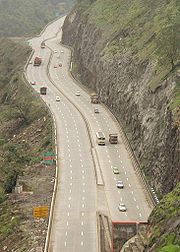
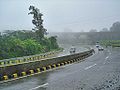
The expressway cost to construct.
The first sections opened in 2000, and the entire route was completed, opened to traffic and made fully operational from April 2002.
Tunnels
It has five illuminated, ventilated tunnels totalling 5,724 metres. These tunnels were built by the Konkan Railway Corporation Ltd.These are:
| Tunnel | Description | |
|---|---|---|
| 1 | Bhatan | This tunnel opened in April 2000. The Mumbai-Pune (North) tube is 1,053 m and the Pune-Mumbai (South) tube is 1,088 m long. |
| 2 | Madap | This tunnel also opened in April 2000. The Mumbai-Pune (North) tube is 305.3 m and the Pune-Mumbai (South) tube is 359.3 m long. |
| 3 | Adoshi | This only has a Pune-Mumbai tube. The Mumbai-Pune carriageway skirts the eastern edge of the tunnel while the Pune-Mumbai carriageway traverses the 258 m long tunnel. |
| 4 | Khandala | This is a curved pair of tubes. The Mumbai-Pune (North) tube is 293.5 m and the Pune-Mumbai (South) tube is 400 m long. |
| 5 | Kamshet-1 | It has 2 tubes roughly 900 m each. |
| 6 | Kamshet-2 | 359 m |
The entire length of expressway has a single layer of barbed wire fencing to keep out stray cattle.
Distances
| Description | Distance | |
|---|---|---|
| 1 | Start of Expressway (Mumbai end) (19°01′11.47"N 73°06′13.21"E) to Kon-Shedung interchange | 8.5 km (5.3 mi) |
| 2 | Kon-Shedung interchange to Bhatan tunnel | 6.3 km (3.9 mi) |
| 3 | Bhatan tunnel to Madap tunnel | 10.6 km (6.6 mi) |
| 4 | Madap tunnel to Khalapur toll station | 7.3 km (4.5 mi) |
| 5 | Khalapur toll station to Khalapur-Sajgaon gas station & rest area | 1.6 km (0.994196378639691 mi) |
| 6 | Khalapur-Sajgaon rest area to Adoshi tunnel. The Mumbai-Pune carriageway skirts the eastern edge of the tunnel while the Pune-Mumbai carriageway traverses the 256 m long tunnel. |
6.9 km (4.3 mi) |
| 7 | Adoshi tunnel to the old British-built Deccan-Konkan stone trestle. This is the site of the old (1830–1928) GIPR reversing station. |
4.5 km (2.8 mi) |
| 8 | Stone trestle to Khandala tunnel | 0.8 km (0.497098189319845 mi) |
| 9 | Khandala tunnel to Khandala | 2.7 km (1.7 mi) |
| 10 | Khandala to Tungarli | 3.5 km (2.2 mi) |
| 11 | Tungarli to Kamshet-1 tunnel | 17.1 km (10.6 mi) |
| 12 | Kamshet-1 tunnel to Kamshet-2 tunnel | 1.2 km (0.745647283979768 mi) |
| 13 | Kamshet-2 tunnel to Talegaon toll station | 11.1 km (6.9 mi) |
| 14 | Talegaon toll station to Somatne interchange | 3.4 km (2.1 mi) |
| 16 | Somatne interchange to End of Expressway (Pune end) (18°39′45.85"N 73°43′35.61"E) | 7.6 km (4.7 mi) |
| Total length of Expressway: Start to End | 93.1 km (57.8 mi) |
Tolls
Toll is collected at Khalapur (Pali Phata) (for the Mumbai-Pune direction) and at Talegaon (for the Pune-Mumbai direction). The toll ranges from for private cars, to for multi-axle trailer trucks.Safety
The Expressway has witnessed a large number of accidents, attributed to human errors and the large volume of traffic. In 10 years there were 1758 accidents, with more than 400 fatalities.. Sporadic instances of robbery have also been reported in the highway.
Future Expansion
MSRDC has decided to extend the Mumbai Pune Expressway from the current endpoint of Kalamboli near Panvel and to extend it till Sion in Mumbai. The extended stretch will reduce commuting time between Mumbai and Pune by 30 minutes. Under the plan, the Sion Panvel ExpresswaySion Panvel Expressway
The Sion Panvel Expressway is a city highway serving the city of Mumbai, India currently under construction. It is one of the busiest and most important roads in the Mumbai Metropolitan Area and connects the city with National Highway 4. It is generally 12 lanes wide . The highway begins at BARC...
corridor will be widened, with dedicated lanes for heavy and light vehicles. Service roads will be built for entry and exit at various points. It will also involve constructing a brand new bridge over the Thane creek parallelly to the current Vashi Mankhurd Bridge. MSRDC will undertake the expansion project. Work is expected to commence in March 2009 and complete by September 2011. The new 22-km link is expected to cost .