
All Topics  
Multi-link suspension

 
Multi Link Suspension

   Email Print
   Bookmark   Link


Multi-link suspension


A multi-link suspension is a type of vehicle suspension
Suspension (vehicle)

Suspension is the term given to the system of spring , shock absorbers and Linkage that connects a vehicle to its wheels. Suspension systems serve a dual purpose ? contributing to the car's car handling and brake for good active safety and driving pleasure, and keeping vehicle occupants comfortable and reasonably well isolated from road no...
 design typically used in independent suspension
Independent suspension

Independent suspension is a broad term for any automobile suspension system that allows each wheel on the same axle to move vertically independently of each other....
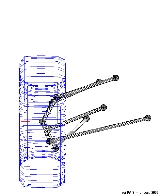
s, using three or more lateral arms, and one or more longitudinal arms. These arms do not have to be of equal length, and may be angled away from their 'obvious' direction.

Typically each arm has a spherical joint (ball joint) or rubber bushing at each end.


Discussion
Ask a question about 'Multi-link suspension'
Start a new discussion about 'Multi-link suspension'
Answer questions from other users
Full Discussion Forum


Encyclopedia


Multi-link rear suspension of the 5-link type (rear view above, top view below)


A multi-link suspension is a type of vehicle suspension
Suspension (vehicle)

Suspension is the term given to the system of spring , shock absorbers and Linkage that connects a vehicle to its wheels. Suspension systems serve a dual purpose ? contributing to the car's car handling and brake for good active safety and driving pleasure, and keeping vehicle occupants comfortable and reasonably well isolated from road no...
 design typically used in independent suspension
Independent suspension

Independent suspension is a broad term for any automobile suspension system that allows each wheel on the same axle to move vertically independently of each other....
s, using three or more lateral arms, and one or more longitudinal arms. These arms do not have to be of equal length, and may be angled away from their 'obvious' direction.

Typically each arm has a spherical joint (ball joint) or rubber bushing at each end. Consequently they react loads along their own length, in tension and compression, but not in bending. Some multi-links do use a trailing arm
Trailing arm

A trailing-arm suspension is an automobile suspension design in which one or more arms are connected between the axle and the chassis. It is usually used on rear axles....
 or wishbone
Wishbone

Wishbone may refer to:* The wishbone, known in anatomy as the furcula, is a fused clavicle bone found in birds which is shaped like the letter Y....
, which has two bushings at one end.

On a front suspension one of the lateral arms is replaced by the tie-rod, which connects the rack or steering box to the wheel hub.

In order to simplify understanding it is usual to consider the function of the arms in each of three orthogonal planes.

Plan view

The arms have to control toe
Toe (automotive)

In automotive engineering, toe is the symmetric angle that each wheel makes with the longitudinal axis of the vehicle, as a function of static geometry, and kinematic and compliant effects....
/steer and lateral compliance. This needs a pair of arms longitudinally separated.

Front view

The arms have to control camber
Camber

Camber may refer to a variety of curvatures and angles:* Camber angle in automobile technology* In the steel industry, the concavity of rolls....
, particularly the way that the camber changes as the wheel moves up (into jounce, or bump) and down into rebound or droop.

Side view

The arms have to react traction and braking loads, usually accomplished via a longitudinal link. They also have to control caster
Caster angle

Caster angle is the angular displacement from the vertical axis of the suspension of a steered wheel in a Automobile, bicycle or other vehicle, measured in the longitudinal direction....
. Note that brake torques also have to be reacted - either by a second longitudinal link, or by rotating the hub, which forces the lateral arms out of plane, so allowing them to react 'spin' forces, or by rigidly fixing the longitudinal link to the hub.

Advantages of multi-link suspension

Multi-link suspension allows the auto designer the ability to incorporate both good ride quality
Ride quality

Ride quality refers to the degree of protection offered vehicle occupants from uneven elements in the road surface, or the terrain if driving off-road....
 and good car handling
Car handling

Car handling and vehicle handling is a description of the way wheeled vehicles perform transverse to their direction of motion, particularly during cornering and swerving....
 in the same vehicle.

In its simplest form the multi-link suspension is orthogonal - that is, it is possible to alter one parameter in the suspension at a time, without affecting anything else. This is in direct contrast to a double wishbone suspension where moving a hardpoint or changing a bushing compliance will affect two or more parameters.

Advantages also extend to off road driving. A multi-link suspension will allow the vehicle to flex more, this means simply that the suspension will be able to move more easily to conform to the varying angles of off roading. This being said, multi-link equipped vehicles are ideally suited for sports such as rock crawling, and desert racing. A side note to the use of multi-link suspension in desert racing, the use of a good sway bar
Sway bar

A sway bar is an automobile suspension device. It connects opposite wheels together through short lever arms linked by a torsion spring. A sway bar increases the suspension's roll stiffness?its resistance to roll in turns, independent of its Hooke's law#Spring equation in the vertical direction....
 is needed to counter body roll.

Disadvantages of multi-link suspension

Multilink suspension is costly and complex. It is also difficult to tune the geometry without a full 3D computer aided design analysis. Compliance under load can have an important effect and must be checked using a multibody simulation software.

See also

  • Vehicles
  • Automotive engineering
    Automotive engineering

    Modern automotive engineering is a branch of vehicle engineering, incorporating elements of Mechanical engineering, Electrical engineering, Electronic engineering, Software engineering and safety engineering as applied to the design, manufacture and operation of motorcycles, automobiles, buses and trucks and their respective engineering subsy...
  • Automotive suspension design
    Automotive suspension design

    Automotive suspension design is an aspect of automotive engineering, concerned with designing the Suspension for cars and trucks.The process entails...


External links