
Home      Discussion      Topics      Dictionary      Almanac
Signup       Login
Mr. Smith Goes to Washington

Mr. Smith Goes to Washington

Overview
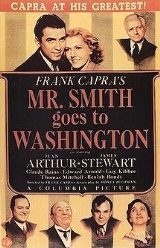
Mr. Smith Goes to Washington is a 1939 American drama film starring Jean Arthur
Jean Arthur
Jean Arthur was an American actress and a major film star of the 1930s and 1940s. She remains arguably the epitome of the female screwball comedy actress. As James Harvey wrote in his recounting of the era, "No one was more closely identified with the screwball comedy than Jean Arthur...

 and James Stewart
James Stewart (actor)
James Maitland Stewart was an American film and stage actor, known for his distinctive voice and his everyman persona. Over the course of his career, he starred in many films widely considered classics and was nominated for five Academy Awards, winning one in competition and receiving one Lifetime...

 about one man's effect on American politics
Politics of the United States
The United States is a federal constitutional republic, in which the President of the United States , Congress, and judiciary share powers reserved to the national government, and the federal government shares sovereignty with the state governments.The executive branch is headed by the President...

. It was directed by Frank Capra
Frank Capra
Frank Russell Capra was a Sicilian-born American film director. He emigrated to the U.S. when he was six, and eventually became a creative force behind major award-winning films during the 1930s and 1940s...

 and written by Sidney Buchman
Sidney Buchman
Sidney Robert Buchman was a screenwriter and producer who worked on 38 films from the late 1920s to the early 1970s. He is also sometimes credited as Sydney Buchman.-Career:...

, based on Lewis R. Foster
Lewis R. Foster
Lewis R. Foster was an American screenwriter, film/television director, and film/television producer. He directed and wrote over one hundred films and television series between 1926 and 1960.-Director:...

's unpublished story. Mr. Smith Goes to Washington was controversial when it was released, but also successful at the box office, and made Stewart a major movie star. The film features a bevy of well-known supporting actors, among them Claude Rains
Claude Rains
Claude Rains was an English stage and film actor whose career spanned 66 years. He was known for many roles in Hollywood films, among them the title role in The Invisible Man , a corrupt senator in Mr. Smith Goes to Washington , Mr...

, Edward Arnold
Edward Arnold (actor)
Edward Arnold was an American actor. He was born on the Lower East Side of New York City as Gunther Edward Arnold Schneider, the son of German immigrants Carl Schneider and Elizabeth Ohse.-Acting career:...

, Guy Kibbee
Guy Kibbee
Guy Bridges Kibbee was an American stage and film actor.Born in El Paso, Texas, Kibbee began his entertainment career on Mississippi riverboats and eventually became a successful Broadway actor...

, Thomas Mitchell
Thomas Mitchell (actor)
Thomas Mitchell was an American actor, playwright and screenwriter. Among his most famous roles in a long career are those of Gerald O'Hara, the father of Scarlett O'Hara in Gone with the Wind, the drunken Doc Boone in John Ford's Stagecoach, and Uncle Billy in It's a Wonderful Life...

 and Beulah Bondi
Beulah Bondi
Beulah Bondi was an American actress.Bondi began her acting career as a young child in theater, and after establishing herself as a stage actress, she reprised her role in Street Scene for the 1931 film version...

.
Discussion
Ask a question about 'Mr. Smith Goes to Washington'
Start a new discussion about 'Mr. Smith Goes to Washington'
Answer questions from other users
Full Discussion Forum
 
Unanswered Questions
Quotations

I wouldn't give you two cents for all your fancy rules if, behind them, they didn't have a little bit of plain, ordinary, everyday kindness and a little looking out for the other fella, too.

[After reading several letter demanding that he end his speech] Well, it looks like this is a lost cause, doesn't it? But then, a man once told me that the only causes worth fighting for are the lost causes. [To Senator Paine] A man we both knew.

[After Jefferson Smith collapses during his filibuster] I'm not fit to be a Senator. I'm not fit to live. Expel me! Expel me! Not him. Every word that boy said is the truth! Every word about Taylor and me and graft and the rotten political corruption of our state. Every word of it is true. I'm not fit for office! I'm not fit for any place of honor or trust. Expel me!

Our steam-roller methods are getting too hard for your sensitive soul. Is that it? The Silver Knight is getting too big for us. My methods have been all right for the past twenty years, Joe. Since I picked you out of a fly-specked hole in the wall and blew you up to look like a Senator. And now you can't stand it.

Capra at his greatest!

Stirring - In the seeing! Precious - In the remembering!

Encyclopedia
Mr. Smith Goes to Washington is a 1939 American drama film starring Jean Arthur
Jean Arthur
Jean Arthur was an American actress and a major film star of the 1930s and 1940s. She remains arguably the epitome of the female screwball comedy actress. As James Harvey wrote in his recounting of the era, "No one was more closely identified with the screwball comedy than Jean Arthur...

 and James Stewart
James Stewart (actor)
James Maitland Stewart was an American film and stage actor, known for his distinctive voice and his everyman persona. Over the course of his career, he starred in many films widely considered classics and was nominated for five Academy Awards, winning one in competition and receiving one Lifetime...

 about one man's effect on American politics
Politics of the United States
The United States is a federal constitutional republic, in which the President of the United States , Congress, and judiciary share powers reserved to the national government, and the federal government shares sovereignty with the state governments.The executive branch is headed by the President...

. It was directed by Frank Capra
Frank Capra
Frank Russell Capra was a Sicilian-born American film director. He emigrated to the U.S. when he was six, and eventually became a creative force behind major award-winning films during the 1930s and 1940s...

 and written by Sidney Buchman
Sidney Buchman
Sidney Robert Buchman was a screenwriter and producer who worked on 38 films from the late 1920s to the early 1970s. He is also sometimes credited as Sydney Buchman.-Career:...

, based on Lewis R. Foster
Lewis R. Foster
Lewis R. Foster was an American screenwriter, film/television director, and film/television producer. He directed and wrote over one hundred films and television series between 1926 and 1960.-Director:...

's unpublished story. Mr. Smith Goes to Washington was controversial when it was released, but also successful at the box office, and made Stewart a major movie star. The film features a bevy of well-known supporting actors, among them Claude Rains
Claude Rains
Claude Rains was an English stage and film actor whose career spanned 66 years. He was known for many roles in Hollywood films, among them the title role in The Invisible Man , a corrupt senator in Mr. Smith Goes to Washington , Mr...

, Edward Arnold
Edward Arnold (actor)
Edward Arnold was an American actor. He was born on the Lower East Side of New York City as Gunther Edward Arnold Schneider, the son of German immigrants Carl Schneider and Elizabeth Ohse.-Acting career:...

, Guy Kibbee
Guy Kibbee
Guy Bridges Kibbee was an American stage and film actor.Born in El Paso, Texas, Kibbee began his entertainment career on Mississippi riverboats and eventually became a successful Broadway actor...

, Thomas Mitchell
Thomas Mitchell (actor)
Thomas Mitchell was an American actor, playwright and screenwriter. Among his most famous roles in a long career are those of Gerald O'Hara, the father of Scarlett O'Hara in Gone with the Wind, the drunken Doc Boone in John Ford's Stagecoach, and Uncle Billy in It's a Wonderful Life...

 and Beulah Bondi
Beulah Bondi
Beulah Bondi was an American actress.Bondi began her acting career as a young child in theater, and after establishing herself as a stage actress, she reprised her role in Street Scene for the 1931 film version...

.

Mr. Smith Goes to Washington was nominated for 11 Academy Awards
12th Academy Awards
The 12th Academy Awards, honoring the best in film for 1939, was held on February 29, 1940, at a banquet in the Coconut Grove at The Ambassador Hotel in Los Angeles. It was hosted by Bob Hope ....

, winning for Best Original Story. In 1989, the Library of Congress
Library of Congress
The Library of Congress is the research library of the United States Congress, de facto national library of the United States, and the oldest federal cultural institution in the United States. Located in three buildings in Washington, D.C., it is the largest library in the world by shelf space and...

 added the movie to the United States National Film Registry
National Film Registry
The National Film Registry is the United States National Film Preservation Board's selection of films for preservation in the Library of Congress. The Board, established by the National Film Preservation Act of 1988, was reauthorized by acts of Congress in 1992, 1996, 2005, and again in October 2008...

, for being "culturally, historically, or aesthetically significant."

Plot


The governor of an unnamed western state, Hubert "Happy" Hopper (Guy Kibbee
Guy Kibbee
Guy Bridges Kibbee was an American stage and film actor.Born in El Paso, Texas, Kibbee began his entertainment career on Mississippi riverboats and eventually became a successful Broadway actor...

), has to pick a replacement for recently deceased U.S. Senator
United States Senate
The United States Senate is the upper house of the bicameral legislature of the United States, and together with the United States House of Representatives comprises the United States Congress. The composition and powers of the Senate are established in Article One of the U.S. Constitution. Each...

 Sam Foley. His corrupt
Political corruption
Political corruption is the use of legislated powers by government officials for illegitimate private gain. Misuse of government power for other purposes, such as repression of political opponents and general police brutality, is not considered political corruption. Neither are illegal acts by...

 political boss
Political boss
A boss, in politics, is a person who wields the power over a particular political region or constituency. Bosses may dictate voting patterns, control appointments, and wield considerable influence in other political processes. They do not necessarily hold public office themselves...

, Jim Taylor (Edward Arnold
Edward Arnold (actor)
Edward Arnold was an American actor. He was born on the Lower East Side of New York City as Gunther Edward Arnold Schneider, the son of German immigrants Carl Schneider and Elizabeth Ohse.-Acting career:...

), pressures Hopper to choose his handpicked stooge, while popular committees want a reformer. The governor's children want him to select Jefferson Smith (James Stewart
James Stewart (actor)
James Maitland Stewart was an American film and stage actor, known for his distinctive voice and his everyman persona. Over the course of his career, he starred in many films widely considered classics and was nominated for five Academy Awards, winning one in competition and receiving one Lifetime...

), the head of the Boy Rangers. Unable to make up his mind between Taylor's stooge and the reformer, Hopper decides to flip a coin. When it lands on edge – and next to a newspaper story on one of Smith's accomplishments – he chooses Smith, calculating that his wholesome image will please the people while his naïveté will make him easy to manipulate.

The very overwhelmed Junior Senator Smith is taken under the wing of the publicly esteemed, but secretly crooked, Senator Joseph Paine (Claude Rains
Claude Rains
Claude Rains was an English stage and film actor whose career spanned 66 years. He was known for many roles in Hollywood films, among them the title role in The Invisible Man , a corrupt senator in Mr. Smith Goes to Washington , Mr...

), who was Smith's late father's oldest and best friend, and he develops an immediate attraction to the senator's daughter, Susan (Astrid Allwyn
Astrid Allwyn
Astrid Allwyn was an American stage and film actress.She studied dancing and dramatics in New York and later joined a stock company. Allwyn made her Broadway debut in 1929 in Elmer Rice's Street Scene. On the strength of her performance in Once in a Lifetime, she was given film work...

). At Senator Paine's home, Smith tries to strike up a conversation with Susan, almost completely befuddled by the young sophisticate. The unforgiving Washington press quickly labels Smith a bumpkin, with no business being a senator.

Paine, to keep Smith busy, suggests he propose a bill. With the help of his chief of staff, Clarissa Saunders (Jean Arthur
Jean Arthur
Jean Arthur was an American actress and a major film star of the 1930s and 1940s. She remains arguably the epitome of the female screwball comedy actress. As James Harvey wrote in his recounting of the era, "No one was more closely identified with the screwball comedy than Jean Arthur...

), Smith comes up with legislation that would authorize a federal government loan to buy some land in his home state for a national boys' camp, to be paid back by youngsters across America. Donations pour in immediately. However, the proposed campsite is already part of a dam-building graft scheme included in a Public Works bill framed by the Taylor political machine and supported by Senator Paine.

Unwilling to crucify the worshipful Smith so that their graft plan will go through, Paine tells Taylor he wants out, but Taylor reminds him that Paine is in power primarily through Taylor's influence. Through Paine, the machine accuses Smith of trying to profit from his bill by producing fraudulent evidence that Smith owns the land in question. Smith is too shocked by Paine's betrayal to defend himself, and runs away.

Saunders has come to believe in him, and talks him into launching a filibuster
Filibuster
A filibuster is a type of parliamentary procedure. Specifically, it is the right of an individual to extend debate, allowing a lone member to delay or entirely prevent a vote on a given proposal...

 to postpone the works bill and prove his innocence on the Senate floor just before the vote to expel him. While Smith talks non-stop, his constituents try to rally around him, but the entrenched opposition is too powerful, and all attempts are crushed. Owing to the influence of the "Taylor machine", newspapers and radio stations in Smith's home state, on Taylor's orders, refuse to report what Smith has to say and even twist the facts against the Senator. An effort by the Boy Rangers to spread the news results in vicious attacks on the children by Taylor's minions.

Although all hope seems lost, the senators begin to pay attention as Smith approaches utter exhaustion. Paine has one last card up his sleeve: he brings in bins of letters and telegrams from Smith's home state from people demanding his expulsion. Nearly broken by the news, Smith finds a small ray of hope in a friendly smile from the President of the Senate (Harry Carey). Smith vows to press on until people believe him, but immediately collapses in a faint. Overcome with guilt, Paine leaves the Senate chamber and attempts to commit suicide
Suicide
Suicide is the act of intentionally causing one's own death. Suicide is often committed out of despair or attributed to some underlying mental disorder, such as depression, bipolar disorder, schizophrenia, alcoholism, or drug abuse...

 by shooting himself. When he is stopped, he bursts back into the Senate chamber, loudly confesses to the whole scheme, and affirms Smith's innocence.

Cast


  • James Stewart
    James Stewart (actor)
    James Maitland Stewart was an American film and stage actor, known for his distinctive voice and his everyman persona. Over the course of his career, he starred in many films widely considered classics and was nominated for five Academy Awards, winning one in competition and receiving one Lifetime...

     as Jefferson Smith
  • Jean Arthur
    Jean Arthur
    Jean Arthur was an American actress and a major film star of the 1930s and 1940s. She remains arguably the epitome of the female screwball comedy actress. As James Harvey wrote in his recounting of the era, "No one was more closely identified with the screwball comedy than Jean Arthur...

     as Clarissa Saunders or "Saunders"
  • Claude Rains
    Claude Rains
    Claude Rains was an English stage and film actor whose career spanned 66 years. He was known for many roles in Hollywood films, among them the title role in The Invisible Man , a corrupt senator in Mr. Smith Goes to Washington , Mr...

     as Senator Joseph Harrison Paine
  • Edward Arnold
    Edward Arnold (actor)
    Edward Arnold was an American actor. He was born on the Lower East Side of New York City as Gunther Edward Arnold Schneider, the son of German immigrants Carl Schneider and Elizabeth Ohse.-Acting career:...

     as Jim Taylor
  • Guy Kibbee
    Guy Kibbee
    Guy Bridges Kibbee was an American stage and film actor.Born in El Paso, Texas, Kibbee began his entertainment career on Mississippi riverboats and eventually became a successful Broadway actor...

     as Governor Hubert "Happy" Hopper
  • Thomas Mitchell
    Thomas Mitchell (actor)
    Thomas Mitchell was an American actor, playwright and screenwriter. Among his most famous roles in a long career are those of Gerald O'Hara, the father of Scarlett O'Hara in Gone with the Wind, the drunken Doc Boone in John Ford's Stagecoach, and Uncle Billy in It's a Wonderful Life...

     as Diz Moore
  • Eugene Pallette
    Eugene Pallette
    Eugene William Pallette was an American actor. He appeared in over 240 silent era and sound era motion pictures between 1913 and 1946....

     as Chick McGann
  • Beulah Bondi
    Beulah Bondi
    Beulah Bondi was an American actress.Bondi began her acting career as a young child in theater, and after establishing herself as a stage actress, she reprised her role in Street Scene for the 1931 film version...

     as Ma Smith
  • H.B. Warner as Senator Agnew
  • Harry Carey as President of the Senate
  • Astrid Allwyn
    Astrid Allwyn
    Astrid Allwyn was an American stage and film actress.She studied dancing and dramatics in New York and later joined a stock company. Allwyn made her Broadway debut in 1929 in Elmer Rice's Street Scene. On the strength of her performance in Once in a Lifetime, she was given film work...

     as Susan Paine


Cast notes:
  • Other veteran character actors who appear in the film include All Bridge, William Demarest
    William Demarest
    Carl William Demarest was an American character actor. He frequently played crusty but good-hearted roles.-Early life and career:...

    , Ruth Donnelly
    Ruth Donnelly
    Ruth Donnelly was an American stage and film actress. Her father was the mayor of Trenton, New Jersey....

    , Porter Hall
    Porter Hall
    Porter Hall was an American character actor known for appearing in a number of films in the 1930s and 1940s...

    , Charles Lane
    Charles Lane (actor)
    Charles Gerstle Levison , better known as Charles Lane, was an American character actor seen in many movies and TV shows, and at the time of his death may have been the oldest living professional American actor. Lane appeared in many Frank Capra films, including You Can't Take It With You , Mr...

     and Grant Mitchell
    Grant Mitchell (actor)
    Grant Mitchell was an American stage actor on Broadway and character actor in many Hollywood films of the 1930s and 1940s...

    . Milton Kibbee
    Milton Kibbee
    Milton Kibbee was an American film actor. He appeared in over 360 films between 1933 and 1953.He was born in Santa Fe, New Mexico, and died in Simi Valley, California...

    , Guy Kibbee's brother, appears in a bit part as a reporter, as does Matt McHugh
    Matt McHugh
    Matt McHugh was an American film actor who appeared in over 200 films between 1931 and 1955, primarily in small parts.-Career:...

    , of the McHugh acting family.

Production


Columbia Pictures
Columbia Pictures
Columbia Pictures Industries, Inc. is an American film production and distribution company. Columbia Pictures now forms part of the Columbia TriStar Motion Picture Group, owned by Sony Pictures Entertainment, a subsidiary of the Japanese conglomerate Sony. It is one of the leading film companies...

 originally purchased Lewis R. Foster
Lewis R. Foster
Lewis R. Foster was an American screenwriter, film/television director, and film/television producer. He directed and wrote over one hundred films and television series between 1926 and 1960.-Director:...

's unpublished story, variously called The Gentleman from Montana and The Gentleman from Wyoming, as a vehicle for Ralph Bellamy
Ralph Bellamy
Ralph Bellamy was an American actor whose career spanned sixty-two years.-Early life:He was born Ralph Rexford Bellamy in Chicago, Illinois, the son of Lilla Louise , a native of Canada, and Charles Rexford Bellamy. He ran away from home when he was fifteen and managed to get into a road show...

, but once Frank Capra
Frank Capra
Frank Russell Capra was a Sicilian-born American film director. He emigrated to the U.S. when he was six, and eventually became a creative force behind major award-winning films during the 1930s and 1940s...

 came onboard as director – after Rouben Mamoulian
Rouben Mamoulian
Rouben Mamoulian was an Armenian-American film and theatre director.-Biography:Born in Tbilisi, Georgia to an Armenian family, Rouben relocated to England and started directing plays in London in 1922...

 had expressed interest – the film was to be a sequel to his Mr. Deeds Goes to Town
Mr. Deeds Goes to Town
Mr. Deeds Goes to Town is a 1936 American screwball comedy film directed by Frank Capra, and starring Gary Cooper and Jean Arthur in her first featured role...

, called Mr. Deeds Goes to Washington, with Gary Cooper
Gary Cooper
Frank James Cooper, known professionally as Gary Cooper, was an American film actor. He was renowned for his quiet, understated acting style and his stoic, but at times intense screen persona, which was particularly well suited to the many Westerns he made...

 reprising his role as Longfellow Deeds.Because Cooper was unavailable, Capra then "saw it immediately as a vehicle for Jimmy Stewart and Jean Arthur," and Stewart was borrowed from MGM
Metro-Goldwyn-Mayer
Metro-Goldwyn-Mayer Inc. is an American media company, involved primarily in the production and distribution of films and television programs. MGM was founded in 1924 when the entertainment entrepreneur Marcus Loew gained control of Metro Pictures, Goldwyn Pictures Corporation and Louis B. Mayer...

. Capra said of Stewart: ""I knew he would make a hell of a Mr. Smith... He looked like the country kid, the idealist. It was very close to him."

Although a youth group is featured in the story, the Boy Scouts of America
Boy Scouts of America
The Boy Scouts of America is one of the largest youth organizations in the United States, with over 4.5 million youth members in its age-related divisions...

 refused to allow their name to be used in the film and instead the fanciful "Boy Rangers" was used.

In January 1938, both Paramount Pictures
Paramount Pictures
Paramount Pictures Corporation is an American film production and distribution company, located at 5555 Melrose Avenue in Hollywood. Founded in 1912 and currently owned by media conglomerate Viacom, it is America's oldest existing film studio; it is also the last major film studio still...

 and MGM
Metro-Goldwyn-Mayer
Metro-Goldwyn-Mayer Inc. is an American media company, involved primarily in the production and distribution of films and television programs. MGM was founded in 1924 when the entertainment entrepreneur Marcus Loew gained control of Metro Pictures, Goldwyn Pictures Corporation and Louis B. Mayer...

 had submitted Foster's story to the censors at the Hays Office, probably indicating that both studios had interest in the project before Columbia purchased it. Joseph Breen
Joseph Breen
Joseph Breen is an American soap opera actor.He played contract parts on both Guiding Light and Loving before being offered his most front-burner role to date: that of Lisa’s long-lost son, Scott Eldridge, on As the World Turns...

, the head of that office, warned the studios:
"[W]e would urge most earnestly that you take serious counsel before embarking on the production of any motion picture based on this story. It looks to us like one that might well be loaded with dynamite, both for the motion picture industry, and for the country at large."
Breen specifically objected to
"the generally unflattering portrayal of our system of Government, which might well lead to such a picture being considered, both here, and more particularly abroad, as a covert attack on the Democratic form of government."
and warned that the film should make clear that
"the Senate is made up of a group of fine, upstanding citizens, who labor long and tirelessly for the best interests of the nation..."


Later, after the screenplay had been written and submitted, Breen reversed course, saying of the film that
"It is a grand yarn that will do a great deal of good for all those who see it and, in my judgment, it is particularly fortunate that this kind of story is to be made at this time. Out of all Senator Jeff's difficulties there has been evolved the importance of a democracy and there is splendidly emphasized the rich and glorious heritage which is ours and which comes when you have a government 'of the people, by the people, and for the people.'"


The film was in production from April 3, 1939 to July 7 of that year. Some location shooting took place in Washington, DC, at Union Station and at the United States Capitol
United States Capitol
The United States Capitol is the meeting place of the United States Congress, the legislature of the federal government of the United States. Located in Washington, D.C., it sits atop Capitol Hill at the eastern end of the National Mall...

, as well as other locations for background use.

In the studio, to ensure authenticity, an elaborate set was created, consisting of Senate committee rooms, cloak rooms, hotel suites as well as specific Washington, DC monuments, all based on a trip Capra and his crew made to the capital. Even the Press Club of Washington was reproduced in minute detail, but the major effort went into a faithful reproduction of the Senate Chamber on the Columbia lot. James D. Preston, a former superintendent of the Senate gallery, acted as technical director for the Senate set, as well as advising on political protocol. The production also utilized the "New York street set" on the Warner Bros.
Warner Bros.
Warner Bros. Entertainment, Inc., also known as Warner Bros. Pictures or simply Warner Bros. , is an American producer of film and television entertainment.One of the major film studios, it is a subsidiary of Time Warner, with its headquarters in Burbank,...

 lot, using a 1,000 extras when that scene was shot.

The ending of the film was apparently changed at some point, as the original program describes Stewart and Arthur returning to Mr. Smith's hometown, where they are met by a big parade, with the implication that they are married and starting a family. In addition, the Taylor political machine was shown being crushed, Stewart visited Claude Rains, on a motorcycle, and forgiving him, and a visit to Smith's mother. Some of this footage can be seen in the film's trailer.

Impact


When it was first released, the film premiered in Constitution Hall in Washington, D.C.
Washington, D.C.
Washington, D.C., formally the District of Columbia and commonly referred to as Washington, "the District", or simply D.C., is the capital of the United States. On July 16, 1790, the United States Congress approved the creation of a permanent national capital as permitted by the U.S. Constitution....

, on October 17, 1939, sponsored by the National Press Club, an event to which 4,000 guests were invited, including 45 senators. Mr. Smith Goes to Washington was attacked by the Washington press, and politicians in the U.S. Congress, as anti-American
Anti-Americanism
The term Anti-Americanism, or Anti-American Sentiment, refers to broad opposition or hostility to the people, policies, culture or government of the United States...

 and pro-Communist
Communism
Communism is a social, political and economic ideology that aims at the establishment of a classless, moneyless, revolutionary and stateless socialist society structured upon common ownership of the means of production...

 for its portrayal of corruption in the American government
Federal government of the United States
The federal government of the United States is the national government of the constitutional republic of fifty states that is the United States of America. The federal government comprises three distinct branches of government: a legislative, an executive and a judiciary. These branches and...

. While Capra claims in his autobiography that some senators walked out of the premiere, contemporary press accounts are unclear about whether this occurred or not, or whether senators yelled back at the screen during the film.


It is known that Alben W. Barkley
Alben W. Barkley
Alben William Barkley was an American politician in the Democratic Party who served as the 35th Vice President of the United States , under President Harry S. Truman....

, a Democrat & the Senate Majority Leader, called the film "silly and stupid," and said it "makes the Senate look like a bunch of crooks." He also remarked that the film was "a grotesque distortion" of the Senate, "as grotesque as anything ever seen! Imagine the Vice President of the United States winking at a pretty girl in the gallery in order to encourage a filibuster!" Barkley thought the film "...showed the Senate as the biggest aggregation of nincompoops on record!"

Pete Harrison, a respected journalist, suggested that the Senate pass a bill allowing theatre owners to refuse to show films that "were not in the best interest of our country." That did not happen, but one of the ways that some senators attempted to retaliate for the damage they felt the film had done to the reputation of their institution was by pushing the passage of the Neely Anti-Block Booking Bill, which eventually led to the breakup of the studio-owned theater chains in the late 1940s. Columbia responded by distributing a program which put forward the film's patriotism and support of democracy, and publicized the film's many positive reviews.

Other objections were voiced as well. Joseph P. Kennedy, the American Ambassador to Great Britain, wrote to Capra and Columbia head Harry Cohn
Harry Cohn
Harry Cohn was the American president and production director of Columbia Pictures.-Career:Cohn was born to a working-class German-Jewish family in New York City. In later years, he appears to have disparaged his heritage...

 to say that he feared the film would damage "America's prestige in Europe", and because of this urged that it be withdrawn from European release. Capra and Cohn responded, citing the film's review, which mollified Kennedy to the extent that he never followed up, although he privately still had doubts about the film.

The film was banned in Nazi Germany
Nazi Germany
Nazi Germany , also known as the Third Reich , but officially called German Reich from 1933 to 1943 and Greater German Reich from 26 June 1943 onward, is the name commonly used to refer to the state of Germany from 1933 to 1945, when it was a totalitarian dictatorship ruled by...

, Fascist
Fascism
Fascism is a radical authoritarian nationalist political ideology. Fascists seek to rejuvenate their nation based on commitment to the national community as an organic entity, in which individuals are bound together in national identity by suprapersonal connections of ancestry, culture, and blood...

 Italy
Italy
Italy , officially the Italian Republic languages]] under the European Charter for Regional or Minority Languages. In each of these, Italy's official name is as follows:;;;;;;;;), is a unitary parliamentary republic in South-Central Europe. To the north it borders France, Switzerland, Austria and...

, Soviet Russia
Russian Soviet Federative Socialist Republic
The Russian Soviet Federative Socialist Republic , commonly referred to as Soviet Russia, Bolshevik Russia, or simply Russia, was the largest, most populous and economically developed republic in the former Soviet Union....

 and Falangist Spain
Spain
Spain , officially the Kingdom of Spain languages]] under the European Charter for Regional or Minority Languages. In each of these, Spain's official name is as follows:;;;;;;), is a country and member state of the European Union located in southwestern Europe on the Iberian Peninsula...

 According to Capra, the film was also dubbed
Dubbing (filmmaking)
Dubbing is the post-production process of recording and replacing voices on a motion picture or television soundtrack subsequent to the original shooting. The term most commonly refers to the substitution of the voices of the actors shown on the screen by those of different performers, who may be...

 in certain European countries to alter the message of the film so it conformed with official ideology.

When a ban on American films was imposed in German-occupied France
France
The French Republic , The French Republic , The French Republic , (commonly known as France , is a unitary semi-presidential republic in Western Europe with several overseas territories and islands located on other continents and in the Indian, Pacific, and Atlantic oceans. Metropolitan France...

 in 1942, some theaters chose to show Mr. Smith Goes to Washington as the last movie before the ban went into effect. One theater owner in Paris
Paris
Paris is the capital and largest city in France, situated on the river Seine, in northern France, at the heart of the Île-de-France region...

 reportedly screened the film nonstop for 30 days after the ban was announced.

The critical response to the film was more measured than the reaction by politicians, domestic and foreign. The critic for the New York Times, for instance, Frank S. Nugent, wrote that
[Capra] is operating, of course, under the protection of that unwritten clause in the Bill of Rights entitling every voting citizen to at least one free swing at the Senate. Mr. Capra's swing is from the floor and in the best of humor; if it fails to rock the august body to its heels — from laughter as much as from injured dignity — it won't be his fault but the Senate's, and we should really begin to worry about the upper house.


Mr. Smith Goes to Washington has been called one of the quintessential whistleblower
Whistleblower
A whistleblower is a person who tells the public or someone in authority about alleged dishonest or illegal activities occurring in a government department, a public or private organization, or a company...

 films in American history. Dr. James Murtagh and Dr. Jeffrey Wigand
Jeffrey Wigand
Jeffrey S. Wigand is a former vice president of research and development at Brown & Williamson in Louisville, Kentucky, who worked on the development of reduced-harm cigarettes...

 cited this film as a seminal event in U.S. history at the first "Whistleblower Week in Washington
Whistleblower Week in Washington
Whistleblower Week in Washington is the name given to a series of events in Washington, D.C. meant to raise awareness about whistleblowing.The first Whistleblower Week took place in Washington, D.C. from May 13–19, 2007 and was sponsored by a loose coalition of whistleblower-related advocacy groups...

" (May 13–19, 2007).

The film has often been listed as among Capra's best, but it has been noted that it
"marked a turning point in Capra's vision of the world, from nervous optimism to a darker, more pessimistic tone. Beginning with American Madness
American Madness
American Madness is a 1932 American film directed by Frank Capra and starring Walter Huston as a New York banker embroiled in scandal. The story thematically anticipates Capra's 1946 classic It's a Wonderful Life, in which Capra repeats the "run on the bank" scene...

in 1932, such Capra films as Lady for a Day
Lady for a Day
Lady for a Day is a 1933 American comedy-drama film directed by Frank Capra. The screenplay by Robert Riskin is based on the short story Madame La Gimp by Damon Runyon...

, It Happened One Night
It Happened One Night
It Happened One Night is a 1934 American romantic comedy film with elements of screwball comedy directed by Frank Capra, in which a pampered socialite tries to get out from under her father's thumb, and falls in love with a roguish reporter . The plot was based on the story Night Bus by Samuel...

, Mr. Deeds Goes to Town
Mr. Deeds Goes to Town
Mr. Deeds Goes to Town is a 1936 American screwball comedy film directed by Frank Capra, and starring Gary Cooper and Jean Arthur in her first featured role...

, and You Can't Take It With You
You Can't Take It with You (film)
You Can't Take It With You Adapted from the Pulitzer Prize-winning play of the same name by George S. Kaufman and Moss Hart. The cast includes James Stewart, Jean Arthur, Lionel Barrymore and Edward Arnold....

had trumpeted their belief in the decency of the common man. In Mr. Smith Goes to Washington, however, the decent common man is surrounded by the most venal, petty, and thuggish group of yahoos ever to pass as decent society in a Capra movie. Everyone in the film -- except for Jefferson Smith and his tiny cadre of believers -- is either in the pay of the political machine run by Edward Arnold's James Taylor or complicit in Taylor's corruption through their silence, and they all sit by as innocent people, including children, are brutalized and intimidated, rights are violated, and the government is brought to a halt."
Nevertheless, Smith's filibuster and the tacit encouragement of the Senate President are both emblematic of the director's belief in the difference that one individual can make. This theme would be expanded further in Capra's It's a Wonderful Life
It's a Wonderful Life
It's a Wonderful Life is a 1946 American Christmas drama film produced and directed by Frank Capra and based on the short story "The Greatest Gift" written by Philip Van Doren Stern....

and other films.

Academy Awards


Mr. Smith Goes to Washington was nominated for 11 Academy Awards but only won one.
Award Result Winner
Outstanding Production
Academy Award for Best Picture
The Academy Award for Best Picture is one of the Academy Awards of Merit presented annually by the Academy of Motion Picture Arts and Sciences to artists working in the motion picture industry. The Best Picture category is the only category in which every member of the Academy is eligible not only...

Columbia Pictures
Columbia Pictures
Columbia Pictures Industries, Inc. is an American film production and distribution company. Columbia Pictures now forms part of the Columbia TriStar Motion Picture Group, owned by Sony Pictures Entertainment, a subsidiary of the Japanese conglomerate Sony. It is one of the leading film companies...

 (Frank Capra
Frank Capra
Frank Russell Capra was a Sicilian-born American film director. He emigrated to the U.S. when he was six, and eventually became a creative force behind major award-winning films during the 1930s and 1940s...

)
Winner was David O. Selznick
David O. Selznick
David O. Selznick was an American film producer. He is best known for having produced Gone with the Wind and Rebecca , both of which earned him an Oscar for Best Picture.-Early years:...

 - Gone with the Wind
Gone with the Wind (film)
Gone with the Wind is a 1939 American historical epic film adapted from Margaret Mitchell's Pulitzer-winning 1936 novel of the same name. It was produced by David O. Selznick and directed by Victor Fleming from a screenplay by Sidney Howard...

Best Director Frank Capra
Frank Capra
Frank Russell Capra was a Sicilian-born American film director. He emigrated to the U.S. when he was six, and eventually became a creative force behind major award-winning films during the 1930s and 1940s...

 
Winner was Victor Fleming
Victor Fleming
Victor Lonzo Fleming was an American film director, cinematographer, and producer. His most popular films were The Wizard of Oz , and Gone with the Wind , for which he won an Academy Award for Best Director.-Life and career:Fleming was born in La Canada, California, the son of Elizabeth Evaleen ...

 - Gone with the Wind
Gone with the Wind (film)
Gone with the Wind is a 1939 American historical epic film adapted from Margaret Mitchell's Pulitzer-winning 1936 novel of the same name. It was produced by David O. Selznick and directed by Victor Fleming from a screenplay by Sidney Howard...

Best Actor
Academy Award for Best Actor
Performance by an Actor in a Leading Role is one of the Academy Awards of Merit presented annually by the Academy of Motion Picture Arts and Sciences to recognize an actor who has delivered an outstanding performance while working within the film industry...

James Stewart
James Stewart
James Stewart was a Hollywood movie actor and USAF brigadier general.James Stewart may also refer to:-Noblemen:*James Stewart, 5th High Steward of Scotland*James Stewart, the Black Knight of Lorn James Stewart (1908–1997) was a Hollywood movie actor and USAF brigadier general.James Stewart...

 
Winner was Robert Donat
Robert Donat
Robert Donat was an English film and stage actor. He is best-known for his roles in Alfred Hitchcock's The 39 Steps and Goodbye, Mr...

 - Goodbye, Mr. Chips
Goodbye, Mr. Chips (1939 film)
Goodbye, Mr. Chips is a 1939 British film based on the novel of the same name by James Hilton. It was directed by Sam Wood, and starred Robert Donat, Greer Garson, Terry Kilburn, John Mills, and Paul Henreid. The screenplay was adapted from the novel by R. C. Sherriff, Claudine West and Eric...

Best Writing, Screenplay Sidney Buchman
Sidney Buchman
Sidney Robert Buchman was a screenwriter and producer who worked on 38 films from the late 1920s to the early 1970s. He is also sometimes credited as Sydney Buchman.-Career:...

 
Winner was Sidney Howard
Sidney Howard
Sidney Coe Howard was an American playwright and screenwriter. He received the Pulitzer Prize for Drama in 1925 and a posthumous Academy Award in 1940 for the screenplay for Gone with the Wind.-Early life:...

 - Gone with the Wind
Gone with the Wind (film)
Gone with the Wind is a 1939 American historical epic film adapted from Margaret Mitchell's Pulitzer-winning 1936 novel of the same name. It was produced by David O. Selznick and directed by Victor Fleming from a screenplay by Sidney Howard...

Best Writing, Original Story
Academy Award for Best Story
The Academy Award for Best Story was an Academy Award given from the beginning of the Academy Awards until 1957, when it was eliminated in favor of the Academy Award for Writing Original Screenplay, which had been introduced in 1940.-1920s:...

Lewis R. Foster
Lewis R. Foster
Lewis R. Foster was an American screenwriter, film/television director, and film/television producer. He directed and wrote over one hundred films and television series between 1926 and 1960.-Director:...

Best Supporting Actor
Academy Award for Best Supporting Actor
Performance by an Actor in a Supporting Role is one of the Academy Awards of Merit presented annually by the Academy of Motion Picture Arts and Sciences to recognize an actor who has delivered an outstanding performance while working within the film industry. Since its inception, however, the...

Harry Carey 
Winner was Thomas Mitchell
Thomas Mitchell (actor)
Thomas Mitchell was an American actor, playwright and screenwriter. Among his most famous roles in a long career are those of Gerald O'Hara, the father of Scarlett O'Hara in Gone with the Wind, the drunken Doc Boone in John Ford's Stagecoach, and Uncle Billy in It's a Wonderful Life...

 - Stagecoach
Best Supporting Actor
Academy Award for Best Supporting Actor
Performance by an Actor in a Supporting Role is one of the Academy Awards of Merit presented annually by the Academy of Motion Picture Arts and Sciences to recognize an actor who has delivered an outstanding performance while working within the film industry. Since its inception, however, the...

Claude Rains
Claude Rains
Claude Rains was an English stage and film actor whose career spanned 66 years. He was known for many roles in Hollywood films, among them the title role in The Invisible Man , a corrupt senator in Mr. Smith Goes to Washington , Mr...

 
Winner was Thomas Mitchell
Thomas Mitchell (actor)
Thomas Mitchell was an American actor, playwright and screenwriter. Among his most famous roles in a long career are those of Gerald O'Hara, the father of Scarlett O'Hara in Gone with the Wind, the drunken Doc Boone in John Ford's Stagecoach, and Uncle Billy in It's a Wonderful Life...

 - Stagecoach
Best Art Direction
Academy Award for Best Art Direction
The Academy Awards are the oldest awards ceremony for achievements in motion pictures. The Academy Award for Best Art Direction recognizes achievement in art direction on a film. The films below are listed with their production year, so the Oscar 2000 for best art direction went to a film from 1999...

Lionel Banks
Lionel Banks
With over 200 films to his credit, Lionel Banks was a hard-working art director from 1935 to 1949...

 
Winner was Lyle R. Wheeler
Lyle R. Wheeler
Lyle Reynolds Wheeler, , was an Academy Award-winning American motion picture art director....

 - Gone with the Wind
Gone with the Wind (film)
Gone with the Wind is a 1939 American historical epic film adapted from Margaret Mitchell's Pulitzer-winning 1936 novel of the same name. It was produced by David O. Selznick and directed by Victor Fleming from a screenplay by Sidney Howard...

Best Film Editing Gene Havlick, Al Clark 
Winner was Hal C. Kern, James E. Mewcom - Gone with the Wind
Gone with the Wind (film)
Gone with the Wind is a 1939 American historical epic film adapted from Margaret Mitchell's Pulitzer-winning 1936 novel of the same name. It was produced by David O. Selznick and directed by Victor Fleming from a screenplay by Sidney Howard...

Best Music, Scoring Dimitri Tiomkin
Dimitri Tiomkin
Dimitri Zinovievich Tiomkin was a Russian-born Hollywood film score composer and conductor. He is considered "one of the giants of Hollywood movie music." Musically trained in Russia, he is best known for his westerns, "where his expansive, muscular style had its greatest impact." Tiomkin...

 
Winner was Herbert Stothart
Herbert Stothart
Herbert Stothart was a song writer, arranger, conductor, and composer. He was also nominated for nine Oscars, winning Best Original Score for The Wizard of Oz.-Biography:...

 - The Wizard of Oz
The Wizard of Oz (1939 film)
The Wizard of Oz is a 1939 American musical fantasy film produced by Metro-Goldwyn-Mayer. It was directed primarily by Victor Fleming. Noel Langley, Florence Ryerson and Edgar Allan Woolf received credit for the screenplay, but there were uncredited contributions by others. The lyrics for the songs...

Best Sound Recording John P. Livadary
John P. Livadary
John Paul Livadary was a sound designer.He started work in 1928 at Columbia Pictures and won the Academy Award for Best Sound three times, in a career that spanned 30 years...

 
Winner was Bernard B. Brown
Bernard B. Brown
Bernard B. Brown was an American sound engineer. He won an Academy Award in the category Sound Recording and was nominated for seven more in the same category. He was also nominated three times in the category Best Visual Effects...

 - When Tomorrow Comes
When Tomorrow Comes (film)
When Tomorrow Comes is a 1939 romantic drama film starring Irene Dunne and Charles Boyer. A waitress falls in love with a man who later turns out to be a married concert pianist. Bernard B...


Other honors

  • Mr. Smith Goes to Washington was named as one of the best films of 1939 by the New York Times and Film Daily, and was nominated for Best Film by the National Board of Review.
  • Jimmy Stewart won the 1939 New York Film Critics Circle Award for Best Actor.
  • In 1989, Mr. Smith Goes to Washington was added to the United States National Film Registry
    National Film Registry
    The National Film Registry is the United States National Film Preservation Board's selection of films for preservation in the Library of Congress. The Board, established by the National Film Preservation Act of 1988, was reauthorized by acts of Congress in 1992, 1996, 2005, and again in October 2008...

     as being deemed "culturally, historically, or aesthetically significant."

American Film Institute
The American Film Institute is an independent non-profit organization created by the National Endowment for the Arts, which was established in 1967 when President Lyndon B. Johnson signed the National Foundation on the Arts and the Humanities Act...

 recognition
  • 1998 AFI's 100 Years... 100 Movies
    AFI's 100 Years... 100 Movies
    The first of the AFI 100 Years… series of cinematic milestones, AFI's 100 Years…100 Movies is a list of the 100 best American movies, as determined by the American Film Institute from a poll of more than 1,500 artists and leaders in the film industry who chose from a list of 400 nominated movies...

     #29
  • 2003 AFI's 100 Years... 100 Heroes and Villains
    AFI's 100 Years... 100 Heroes and Villains
    AFI's 100 Years... 100 Heroes and Villains is a list of the 100 greatest screen characters chosen by American Film Institute in June 2003. It is part of the AFI 100 Years… series. The series was first presented in a CBS special hosted by Arnold Schwarzenegger...

    :
    • Jefferson Smith, hero #11
  • 2006 AFI's 100 Years... 100 Cheers
    AFI's 100 Years... 100 Cheers
    100 Years…100 Cheers: America's Most Inspiring Movies is a list of the most inspiring films as determined by the American Film Institute. It is part of the AFI 100 Years… series, which has been compiling lists of the greatest films of all time in various categories since 1998...

     #5
  • 2007 AFI's 100 Years... 100 Movies (10th Anniversary Edition) #26

Remakes


In 1949, Columbia planned, but never actually produced, a sequel to Mr. Smith Goes to Washington, called Mr. Smith Starts a Riot. They also considered doing a gender-reversed remake in 1952, with Jane Wyman
Jane Wyman
Jane Wyman was an American singer, dancer, and character actress of film and television. She began her film career in the 1930s, and was a prolific performer for two decades...

 playing the lead role.

A television series of the same name, Mr. Smith Goes to Washington
Mr. Smith Goes to Washington (TV series)
Mr. Smith Goes to Washington is a 1962-1963 ABC sitcom starring Fess Parker as Eugene Smith, an honest but unsophisticated U.S. senator from an unidentified small-populated state. The half-hour program is based on the 1939 Frank Capra film, Mr. Smith Goes to Washington, starring James Stewart in...

, ran on ABC
American Broadcasting Company
The American Broadcasting Company is an American commercial broadcasting television network. Created in 1943 from the former NBC Blue radio network, ABC is owned by The Walt Disney Company and is part of Disney-ABC Television Group. Its first broadcast on television was in 1948...

 during the 1962–1963 season, starring Fess Parker
Fess Parker
Fess Elisha Parker, Jr. was an American film and television actor best known for his portrayals of Davy Crockett in the Walt Disney 1955-56 TV mini-series and as TV's Daniel Boone from 1964-70...

, Sandra Warner and Red Foley
Red Foley
Clyde Julian Foley , better known as Red Foley, was an American singer, musician, and radio and TV personality who made a major contribution to the growth of country music after World War II....

. In 1977, Producer Frank Capra, Jr.
Frank Capra, Jr.
Frank Warner Capra was an American studio executive. He was one of the three children of film director Frank Capra and his second wife, Lucille. His own son, Frank Capra III, is an actor.Capra, Jr...

 remade the film as Billy Jack Goes to Washington
Billy Jack Goes to Washington
Billy Jack Goes to Washington is a 1977 film starring Tom Laughlin, the fourth film in the Billy Jack series, and although the earlier films saw enormous success, this film did not. The film only had limited screenings upon its release and never saw a general theatrical release, but has since...

(1977) starring Tom Laughlin
Tom Laughlin (actor)
Tom Laughlin is an American actor, director, screenwriter, author, educator and political activist. Laughlin is best known for his series of Billy Jack films. He has been married to Delores Taylor since 1954. Taylor has also co-produced and acted in all four of the Billy Jack films...

, part of the Billy Jack
Billy Jack
Billy Jack is a 1971 action film. It is the second, and highest grossing, in a series of motion pictures centering on a character of the same name, played by Tom Laughlin who also directed and co-wrote the script. Filming began in Prescott, Arizona, in fall 1969, but the movie was not completed...

 series; it was not a success. The film was also loosely remade as 1992's The Distinguished Gentleman
The Distinguished Gentleman
The Distinguished Gentleman is a comedy starring Eddie Murphy. The film was directed by Jonathan Lynn. In addition to Murphy, the film stars Lane Smith, Sheryl Lee Ralph, Joe Don Baker, Victoria Rowell, Grant Shaud, Kevin McCarthy, Charles S...

, starring Eddie Murphy
Eddie Murphy
Edward Regan "Eddie" Murphy is an American stand-up comedian, actor, writer, singer, director, and musician....

. The film's influence can be seen on many other films that deal with the United States Congress
United States Congress
The United States Congress is the bicameral legislature of the federal government of the United States, consisting of the Senate and the House of Representatives. The Congress meets in the United States Capitol in Washington, D.C....

, including Legally Blonde 2: Red, White & Blonde and Evan Almighty
Evan Almighty
Evan Almighty is a 2007 American religious comedy film and the stand-alone sequel to Bruce Almighty . The film was directed by Tom Shadyac, written by Steve Oedekerk, and starring Steve Carell as the title character. Morgan Freeman also reprised his role as God from the original film. Production of...

. The short-lived 2003 NBC political drama Mister Sterling
Mister Sterling
Mister Sterling is an American television serial drama created by Lawrence O'Donnell that ran from January to March in 2003. It starred Josh Brolin as an idealistic United States Senator, and featured Audra McDonald, William Russ, David Noroña, and James Whitmore as members of his staff...

was described as "a Mr. Smith Goes to Washington for the 21st century", with the show centering on an idealistic young senator from California, getting to grips with Washington and appointed by a scheming, underhanded governor.

The VHS release of "Ernest Rides Again
Ernest Rides Again
Ernest Rides Again is a 1993 comedy film written and directed by John R. Cherry III and starring Jim Varney. It opens with the song "There Once Was A Man Named Worrell". It is the sixth film to feature the character Ernest P. Worrell, and the last to be released theatrically. Its grossing number...

" featured the Saturday Night Live-based short "Mr. Bill Goes to Washington", a parody of Mr. Smith Goes to Washington.

External links