

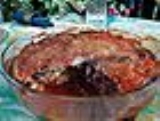
Moussaka

Encyclopedia
Moussaka is an eggplant based dish of the Balkans
, Eastern Mediterranean
, and the Middle East
. The best known variation outside the region is the Greek one.
, usually with minced meat. The Greek version includes layers of meat and aubergine topped with a white sauce/Béchamel sauce
and baked. Turkish musakka
, on the other hand, is not layered. Instead, it is prepared with sautéed aubergines, green peppers, tomatoes, onion
s, and minced meat. It is eaten with cacık
and pilaf
. There are also variants with zucchini
, carrots and potatoes. The Serbian version
and Bulgarian version
use potatoes instead of aubergines, pork mince and the top layer is yogurt mixed with raw eggs and a couple of spoons of flour. In the Arab
world, moussaka is a cooked salad
made up primarily of tomatoes and aubergine, similar to Italian
parmigiana, and is usually served cold as a mezze dish.
The modern Greek version was probably invented by Tselementes in the 1920s. It has three layers: a bottom layer of sautéed aubergine slices; a middle layer of cooked ground lamb cooked with onion, garlic
, chopped tomatoes, herb
s, and spice
s (cinnamon
, allspice
and black pepper
); and a top layer of béchamel sauce
or egg custard. The composed dish is baked until the top layer is browned. Moussaka is usually served lukewarm.
In Serbia and Bulgaria there is also a three-layer version: the bottom layer consists of ground pork and beef, the middle layer slices of potatoes, the top layer a custard. Each layer is cooked on its own and layered in a pan and baked until the top layer is browned.
In the rest of the Balkans, the top layer is often a custard
. This is the version which was introduced into the UK by Elizabeth David
's Mediterranean Cookery and where it remains as the "classic" presentation. Grated cheese
or bread crumbs are often sprinkled on top.
There are variations on this basic recipe, sometimes with no sauce, sometimes with other vegetables. The most common variant in Greece may include courgette (zucchini), part-fried potatoes or sautéed mushrooms in addition to the aubergine. There is even a fast-day
version in the Greek cookbook by Tselementes which includes neither meat nor béchamel sauce
, just vegetables (ground aubergine is used instead of ground meat), tomato sauce, and bread crumbs. In some cases, moussaka is also decoratively layered on top of grape leaves (a common ingredient in Greek cuisine, also used for example in dolmades
).
Balkans
The Balkans is a geopolitical and cultural region of southeastern Europe...
, Eastern Mediterranean
Eastern Mediterranean
The Eastern Mediterranean is a term that denotes the countries geographically to the east of the Mediterranean Sea. This region is also known as Greater Syria or the Levant....
, and the Middle East
Middle East
The Middle East is a region that encompasses Western Asia and Northern Africa. It is often used as a synonym for Near East, in opposition to Far East...
. The best known variation outside the region is the Greek one.
Names and etymology
The name comes from the 'chilled'. This name is used in Greek cuisine (μουσακάς), Turkish (musakka), and the South Slavic languages (musaka/мусака). Other languages call it simply "eggplant casserole" (e.g. Hungarian rakott padlizsán).Preparation
Most versions are based primarily on sautéed eggplant (aubergine) and tomatoTomato
The word "tomato" may refer to the plant or the edible, typically red, fruit which it bears. Originating in South America, the tomato was spread around the world following the Spanish colonization of the Americas, and its many varieties are now widely grown, often in greenhouses in cooler...
, usually with minced meat. The Greek version includes layers of meat and aubergine topped with a white sauce/Béchamel sauce
Béchamel sauce
Béchamel sauce , also known as white sauce, is one of the mother sauces of French cuisine and is used in many recipes of Italian cuisine, for example lasagne. It is used as the base for other sauces . It is traditionally made by whisking scalded milk gradually into a white roux...
and baked. Turkish musakka
Turkish cuisine
Turkish cuisine is largely the heritage of Ottoman cuisine, which can be described as a fusion and refinement of Central Asian, Middle Eastern and Balkan cuisines. Turkish cuisine has in turn influenced those and other neighbouring cuisines, including that of western Europe...
, on the other hand, is not layered. Instead, it is prepared with sautéed aubergines, green peppers, tomatoes, onion
Onion
The onion , also known as the bulb onion, common onion and garden onion, is the most widely cultivated species of the genus Allium. The genus Allium also contains a number of other species variously referred to as onions and cultivated for food, such as the Japanese bunching onion The onion...
s, and minced meat. It is eaten with cacık
Cacik
Cacık is a Turkish dish of seasoned, diluted yoghurt, eaten throughout the former Ottoman world. In Greece a similar, much thicker yoghurt dish is called tzatziki...
and pilaf
Pilaf
Pilaf is a dish in which rice is cooked in a seasoned broth . In some cases, the rice may also attain its brown color by being stirred with bits of cooked onion, as well as a large mix of spices...
. There are also variants with zucchini
Zucchini
The zucchini is a summer squash which often grows to nearly a meter in length, but which is usually harvested at half that size or less. It is a hybrid of the cucumber. Along with certain other squashes, it belongs to the species Cucurbita pepo. Zucchini can be dark or light green...
, carrots and potatoes. The Serbian version
Serbian cuisine
Serbian cuisine is a heterogeneous cuisine, sharing characteristics of the Balkans , the Mediterranean , Turkish, and Central European cuisines....
and Bulgarian version
Bulgarian cuisine
Bulgarian cuisine is a representative of the cuisine of Southeastern Europe. Essentially South Slavic, it shares characteristics with other Balkans cuisines...
use potatoes instead of aubergines, pork mince and the top layer is yogurt mixed with raw eggs and a couple of spoons of flour. In the Arab
Arab
Arab people, also known as Arabs , are a panethnicity primarily living in the Arab world, which is located in Western Asia and North Africa. They are identified as such on one or more of genealogical, linguistic, or cultural grounds, with tribal affiliations, and intra-tribal relationships playing...
world, moussaka is a cooked salad
Salad
Salad is any of a wide variety of dishes, including vegetable salads; salads of pasta, legumes, eggs, or grains; mixed salads incorporating meat, poultry, or seafood; and fruit salads. They may include a mixture of cold and hot, often including raw vegetables or fruits.Green salads include leaf...
made up primarily of tomatoes and aubergine, similar to Italian
Italy
Italy , officially the Italian Republic languages]] under the European Charter for Regional or Minority Languages. In each of these, Italy's official name is as follows:;;;;;;;;), is a unitary parliamentary republic in South-Central Europe. To the north it borders France, Switzerland, Austria and...
parmigiana, and is usually served cold as a mezze dish.
The modern Greek version was probably invented by Tselementes in the 1920s. It has three layers: a bottom layer of sautéed aubergine slices; a middle layer of cooked ground lamb cooked with onion, garlic
Garlic
Allium sativum, commonly known as garlic, is a species in the onion genus, Allium. Its close relatives include the onion, shallot, leek, chive, and rakkyo. Dating back over 6,000 years, garlic is native to central Asia, and has long been a staple in the Mediterranean region, as well as a frequent...
, chopped tomatoes, herb
Herb
Except in botanical usage, an herb is "any plant with leaves, seeds, or flowers used for flavoring, food, medicine, or perfume" or "a part of such a plant as used in cooking"...
s, and spice
Spice
A spice is a dried seed, fruit, root, bark, or vegetative substance used in nutritionally insignificant quantities as a food additive for flavor, color, or as a preservative that kills harmful bacteria or prevents their growth. It may be used to flavour a dish or to hide other flavours...
s (cinnamon
Cinnamon
Cinnamon is a spice obtained from the inner bark of several trees from the genus Cinnamomum that is used in both sweet and savoury foods...
, allspice
Allspice
Allspice, also called Jamaica pepper, pepper, myrtle pepper, pimenta, or newspice, is a spice that is the dried unripe fruit of Pimenta dioica , a mid-canopy tree native to the Greater Antilles, southern Mexico, and Central America, now cultivated in many warm parts of the world...
and black pepper
Black pepper
Black pepper is a flowering vine in the family Piperaceae, cultivated for its fruit, which is usually dried and used as a spice and seasoning. The fruit, known as a peppercorn when dried, is approximately in diameter, dark red when fully mature, and, like all drupes, contains a single seed...
); and a top layer of béchamel sauce
Béchamel sauce
Béchamel sauce , also known as white sauce, is one of the mother sauces of French cuisine and is used in many recipes of Italian cuisine, for example lasagne. It is used as the base for other sauces . It is traditionally made by whisking scalded milk gradually into a white roux...
or egg custard. The composed dish is baked until the top layer is browned. Moussaka is usually served lukewarm.
In Serbia and Bulgaria there is also a three-layer version: the bottom layer consists of ground pork and beef, the middle layer slices of potatoes, the top layer a custard. Each layer is cooked on its own and layered in a pan and baked until the top layer is browned.
In the rest of the Balkans, the top layer is often a custard
Custard
Custard is a variety of culinary preparations based on a cooked mixture of milk or cream and egg yolk. Depending on how much egg or thickener is used, custard may vary in consistency from a thin pouring sauce , to a thick pastry cream used to fill éclairs. The most common custards are used as...
. This is the version which was introduced into the UK by Elizabeth David
Elizabeth David
Elizabeth David CBE was a British cookery writer who, in the mid-20th century, strongly influenced the revitalisation of the art of home cookery with articles and books about European cuisines and traditional British dishes.Born to an upper-class family, David rebelled against social norms of the...
's Mediterranean Cookery and where it remains as the "classic" presentation. Grated cheese
Cheese
Cheese is a generic term for a diverse group of milk-based food products. Cheese is produced throughout the world in wide-ranging flavors, textures, and forms....
or bread crumbs are often sprinkled on top.
There are variations on this basic recipe, sometimes with no sauce, sometimes with other vegetables. The most common variant in Greece may include courgette (zucchini), part-fried potatoes or sautéed mushrooms in addition to the aubergine. There is even a fast-day
Fasting
Fasting is primarily the act of willingly abstaining from some or all food, drink, or both, for a period of time. An absolute fast is normally defined as abstinence from all food and liquid for a defined period, usually a single day , or several days. Other fasts may be only partially restrictive,...
version in the Greek cookbook by Tselementes which includes neither meat nor béchamel sauce
Béchamel sauce
Béchamel sauce , also known as white sauce, is one of the mother sauces of French cuisine and is used in many recipes of Italian cuisine, for example lasagne. It is used as the base for other sauces . It is traditionally made by whisking scalded milk gradually into a white roux...
, just vegetables (ground aubergine is used instead of ground meat), tomato sauce, and bread crumbs. In some cases, moussaka is also decoratively layered on top of grape leaves (a common ingredient in Greek cuisine, also used for example in dolmades
Dolma
Dolma is a family of stuffed vegetable dishes in the cuisines of the former Ottoman Empire and surrounding regions such as Russia, Middle East and the Caucasus and Central and South Asia. Perhaps the best-known is the grape-leaf dolma. Common vegetables to stuff include onion, zucchini, eggplant,...
).