
All Topics  
Mount McKinley

 
Mount McKinley

   Email Print
   Bookmark   Link


Mount McKinley


"Denali" redirects here. For other meanings, see Denali (disambiguation)
Denali (disambiguation)

Denali can refer to* The native name for Mount McKinley, a mountain in Alaska one peak of which is the highest point in North America* Denali National Park and Preserve, within which Mount McKinley is located...
.
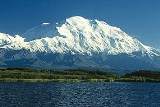
Mount McKinley or Denali ("The Great One") in Alaska
Alaska

Alaska is the largest U.S. state of the United States by area; it is situated in the northwest extremity of the North American continent, with Canada to the east, the Arctic Ocean to the north, and the Pacific Ocean to the west and south, with Russia further west across the Bering Strait....
 is the highest
Extremes on Earth

This article describes extreme locations on Earth. Entries listed in bold are Earth-wide extremes....
 mountain
Mountain

A mountain is a landform that stretches above the surrounding land in a limited area usually in the form of a peak. A mountain is generally steeper than a hill....
 peak in North America
North America

North America is the northern continent of the Americas, situated in the Earth's northern hemisphere and almost totally in the western hemisphere....
, at a height of approximately . It is the centerpiece of Denali National Park
Denali National Park and Preserve

Denali National Park and Preserve is located in Interior of Alaska Alaska and contains Mount McKinley , the tallest mountain in North America. The park and preserve together cover 9,492 mi? ....
.

t McKinley has a larger bulk and rise than Mount Everest
Mount Everest

Mount Everest, also called Sagarmatha or Chomolungma, Qomolangma or Zhumulangma is the List of highest mountains on Earth, as measured by the height of its Topographical summit above sea level, which is ....
. Even though the summit of Everest is about higher as measured from sea level, its base sits on the Tibetan Plateau
Tibetan Plateau

The Tibetan Plateau , also known as the Qinghai-Tibetan Plateau is a vast, elevated plateau in Central Asia covering most of the Tibet Autonomous Region and Qinghai Province in China and Ladakh in Kashmir, India....
 at about , giving it a real vertical rise of a little more than .


Discussion
Ask a question about 'Mount McKinley'
Start a new discussion about 'Mount McKinley'
Answer questions from other users
Full Discussion Forum


Recent Posts


Encyclopedia


"Denali" redirects here. For other meanings, see Denali (disambiguation)
Denali (disambiguation)

Denali can refer to* The native name for Mount McKinley, a mountain in Alaska one peak of which is the highest point in North America* Denali National Park and Preserve, within which Mount McKinley is located...
.
Mount McKinley or Denali ("The Great One") in Alaska
Alaska

Alaska is the largest U.S. state of the United States by area; it is situated in the northwest extremity of the North American continent, with Canada to the east, the Arctic Ocean to the north, and the Pacific Ocean to the west and south, with Russia further west across the Bering Strait....
 is the highest
Extremes on Earth

This article describes extreme locations on Earth. Entries listed in bold are Earth-wide extremes....
 mountain
Mountain

A mountain is a landform that stretches above the surrounding land in a limited area usually in the form of a peak. A mountain is generally steeper than a hill....
 peak in North America
North America

North America is the northern continent of the Americas, situated in the Earth's northern hemisphere and almost totally in the western hemisphere....
, at a height of approximately . It is the centerpiece of Denali National Park
Denali National Park and Preserve

Denali National Park and Preserve is located in Interior of Alaska Alaska and contains Mount McKinley , the tallest mountain in North America. The park and preserve together cover 9,492 mi? ....
.

Notable features

Mount McKinley has a larger bulk and rise than Mount Everest
Mount Everest

Mount Everest, also called Sagarmatha or Chomolungma, Qomolangma or Zhumulangma is the List of highest mountains on Earth, as measured by the height of its Topographical summit above sea level, which is ....
. Even though the summit of Everest is about higher as measured from sea level, its base sits on the Tibetan Plateau
Tibetan Plateau

The Tibetan Plateau , also known as the Qinghai-Tibetan Plateau is a vast, elevated plateau in Central Asia covering most of the Tibet Autonomous Region and Qinghai Province in China and Ladakh in Kashmir, India....
 at about , giving it a real vertical rise of a little more than . The base of Mount McKinley is roughly a 2,000-foot plateau, giving it an actual rise of .

The mountain is also characterized by extremely cold weather. Temperatures as low as and windchills as low as have been recorded by an automated weather station located at . There is also a higher risk of altitude illness for climbers than its altitude would otherwise suggest, due to its high latitude
Latitude

Latitude, usually denoted symbolically by the Greek letter phi gives the location of a place on Earth north or south of the equator. Lines of Latitude are the horizontal lines shown running east-to-west on maps ....
. At the equator, a mountain as high as Mount McKinley would have 47% as much oxygen available on its summit as there is at sea level, but because of its latitude, the pressure on the summit of McKinley is even lower (42%).

Geology

Mount McKinley is a granitic pluton
Pluton

A pluton in geology is an intrusive igneous rock body that crystallized from a magma slowly cooling below the surface of the Earth. Plutons include batholiths, dike , Sill , laccoliths, lopoliths, and other igneous bodies....
 with a crystallization age of around 56 million years. Over tens of millions of years, Mount McKinley has been uplifted by tectonic pressure while at the same time, erosion has stripped away the (somewhat softer) sedimentary rock
Sedimentary rock

Sedimentary rock is one of the three main Rock types . Sedimentary rock is formed by deposition and consolidation of mineral and organic material and from precipitation of minerals from solution....
 above and around it.

The forces that lifted Mount McKinley—the subduction
Subduction

In geology, subduction is the process that takes place at convergent boundary by which one tectonic plate moves under another tectonic plate, sinking into the Earth's mantle, as the plates converge....
 of the Pacific plate
Pacific Plate

The Pacific Plate is an oceanic tectonic plate beneath the Pacific Ocean.To the north the easterly side is a divergent boundary with the Explorer Plate, the Juan de Fuca Plate and the Gorda Plate forming respectively the Explorer Ridge, the Juan de Fuca Ridge and the Gorda Ridge....
 beneath the North American plate
North American Plate

The North American Plate is a tectonic plate covering most of North America, Greenland and part of Siberia. It extends eastward to the Mid-Atlantic Ridge and westward to the Chersky Range in eastern Siberia....
—also raised great ranges across southern Alaska. As that huge sheet of ocean-floor rock plunges downward into the mantle
Mantle (geology)

The mantle is a part of an astronomical object. The interior of the Earth, similar to the other terrestrial planets, is chemically divided into layers....
, it shoves and crumples the continent into soaring mountains which include some of the most active volcanoes on the continent. Mount McKinley in particular is uplifted relative to the rocks around it because it is at the intersection of major active strike-slip faults (faults that move rocks laterally across the Earth's surface) which allow the deep buried rocks to be unroofed more rapidly compared to those around them.

Layout of the mountain

Mount McKinley has two significant summits: the South Summit is the higher one, while the North Summit has an elevation of and a prominence of approximately . The North Summit is sometimes counted as a separate peak (see e.g., the List of United States fourteeners) and sometimes not; it is rarely climbed, except by those doing routes on the north side of the massif
Massif

In geology, a massif is a section of a planet's Crust that is demarcated by geologic faults or flexures. In the Plate tectonics, a massif tends to retain its internal structure while being displaced as a whole....
.

Five large glaciers flow off the slopes of the mountain. The Peters Glacier lies on the northwest side of the massif, while the Muldrow Glacier falls from its northeast slopes. Just to the east of the Muldrow, and abutting the eastern side of the massif, is the Traleika Glacier. The Ruth Glacier
Ruth Glacier

Ruth Glacier is a glacier in Denali National Park and Preserve in the U.S. state of Alaska. Its upper reaches are almost three vertical miles below the summit of Mount McKinley....
 lies to the southeast of the mountain, and the Kahiltna Glacier
Kahiltna Glacier

Kahiltna Glacier is a 36-mile-long glacier of the Alaska Range in the U.S. state of Alaska. It starts on the southwest slope of Mount McKinley near Kahiltna Pass ....
 leads up to the southwest side of the mountain.

Denali Mt Mckinley

Exploration and naming

Numerous native peoples of the area had their own names for this prominent peak. The local Athabaskan
Athabaskan languages

Athabaskan or Athabascan is the name of a large group of closely related Indigenous peoples of the Americas of North America, located in two main Southern and Northern groups in western North America, and of their language family....
 name for the mountain, the one used by the Native Americans with access to the flanks of the mountain (living in the Yukon
Yukon River

The Yukon River is a major watercourse of northwestern North America. Over half of the river lies in the U.S. state of Alaska, with most of the other portion lying in and giving its name to Canada Yukon Territory, and a small part of the river near the source located in British Columbia....
, Tanana
Tanana River

The Tanana River is a tributary of the Yukon River in the U.S. state of Alaska.Its headwaters are located at the confluence of the Chisana River and Nabesna River Rivers just north of Northway, Alaska in eastern Alaska....
 and Kuskokwim basins), is Dinale or Denali (“the High One”). To the South the Dena’ina
Dena’ina

The Dena?ina are an Alaska Native people, an extended tribe of indigenous peoples of the Americas lineage. They are the original inhabitants of the southcentral Alaska region ranging from Seldovia, Alaska in the south to Chickaloon, Alaska in the northeast, Talkeetna, Alaska in the north, Lime Village, Alaska in the Northwest and Pedro Ba...
 people in the Susitna river
Susitna River

The Susitna River is a long river in the Southcentral Alaska region of the U.S. state of Alaska. It is the 15th largest river in the United States of America, ranked by average discharge volume at its mouth....
 valley used the name Dghelay Ka’a (simplified to Doleika), meaning “the big mountain”, while the Aleuts called it Traleika.

The historical first European sighting of Mount McKinley took place on May 6, 1794, when George Vancouver
George Vancouver

Captain George Vancouver Royal Navy was an officer in the Royal Navy, best known for his Vancouver Expedition, including the shores of the modern day Alaska, British Columbia, Washington and Oregon....
 was surveying the Knik Arm of the Cook Inlet and mentioned “distant stupendous mountains” in his journal. However, he uncharacteristically left the mountain unnamed. The mountain is first named on a map by Ferdinand von Wrangell in 1839; the names Tschigmit and Tenada correspond to the locations of Mount Foraker and Mount McKinley. Von Wrangel had been chief administrator of the Russian settlements in North America from 1829–1835. The Russian explorer Lavrenty Zagoskin
Lavrenty Zagoskin

Lavrenty Alekseyevich Zagoskin was a Russian naval officer and explorer of Alaska.Zagoskin was born in 1808 in the Russian district of Penza in a village named Nikolayevka....
 explored the Tanana and Kuskokwim rivers in 1843 and 1844 and was probably the first European to sight the mountain from the other site.

Mountmckinley Ba
The first English name the peak enjoyed, locally, was Densmore’s Mountain, after the gold prospector Frank Densmore who in 1889 had fervently praised the mountain’s majesty. The mountain did not get much press until William Dickey, a New Hampshire-born Seattleite, who had been digging for gold in the sands of the Susitna River, wrote, after his return to the lower states, an account in the New York Sun
New York Sun

'The New York Sun' was a contemporary five-day daily newspaper published in New York City from 2002 until 2008. When it debuted on 2002-04-16, it became "the first general interest broadsheet newspaper to be launched in New York in two generations." The newspaper's president and editor-in-chief was Seth Lipsky, former editor of The Forwar...
 that appeared on January 24, 1897. He wrote “We named our great peak Mount McKinley, after William McKinley
William McKinley

William McKinley, Jr. was the List of Presidents of the United States President of the United States, and the last veteran of the American Civil War to be elected....
 of Ohio, who had been nominated for the Presidency”. By most accounts, the naming was a pure political one; he had met many silver miners who zealously promoted Democratic presidential candidate William Jennings Bryan
William Jennings Bryan

William Jennings Bryan was the Democratic Party nominee for President of the United States in 1896, 1900 and 1908, a lawyer, and the 41st United States Secretary of State under President Woodrow Wilson....
's ideal of a silver standard
Cross of Gold speech

The Cross of Gold speech was a Speech delivered by William Jennings Bryan at the 1896 Democratic National Convention in Chicago on July 9, 1896....
, inspiring him to retaliate by naming the mountain after a strong proponent of the gold standard. His report drew attention with the sentence “We have no doubt that this peak is the highest in North America, and estimate that it is over high.” Until then Mount Saint Elias
Mount Saint Elias

Mount Saint Elias is the second highest mountain in both the United States and Canada, being situated on the Alaska and Yukon border. The U.S....
 was believed to be the continent’s highest (Mount Logan
Mount Logan

Mount Logan is Canada's highest mountain and the List of highest mountains of North America in North America, after Mount McKinley . The mountain was named after Sir William Edmond Logan, a Canadian geologist and founder of the Geological Survey of Canada ....
 was still unknown, while Mount St Elias’ height had been overestimated to beat Pico de Orizaba
Pico de Orizaba

The Pico de Orizaba, or Citlalt?petl , is a stratovolcano, the highest mountain in Mexico and the List of highest mountains of North America in North America....
). Though later praised for his estimate, Dickey admitted that other prospector parties had also guessed the mountain to be over .

Mount McKinley is commonly referred to by its Athabaskan name Denali, which is the name currently recognized by the State of Alaska. When Denali National Park and Preserve was established by the Alaska National Interest Lands Conservation Act
Alaska National Interest Lands Conservation Act

The Alaska National Interest Lands Conservation Act was a United States federal law passed in 1980 by the Congress of the United States and signed into law by President of the United States Jimmy Carter on December 2 of that year....
, December 2, 1980, the Alaska Board of Geographic Names changed the name of the mountain back to Denali. However, the U.S. Board on Geographic Names maintains the name McKinley, ostensibly to help visitors avoid confusion between the mountain and the park. Use of the name "McKinley" remains common, particularly in the Lower 48; however, Alaskans and mountaineers generally use the name "Denali" to refer both to the park and to the mountain.

Following the retirement of U.S. Congressman Ralph Regula
Ralph Regula

Ralph Straus Regula was a Representative in the United States Congress from the Ohio's 16th congressional district of the State of Ohio. He retired in January 2009 after 18 consecutive terms....
 of Ohio who opposed such changes since 1975, there has been renewed interest in renaming the mountain, spearheaded this time by Alaska State Representative Scott Kawasaki
Scott Kawasaki

Scott J. Kawasaki is a Democratic Party member of the Alaska House of Representatives, representing the 9th District since 2006....
, the prime sponsor of Alaska House Joint Resolution 15. From 1973–2009, Regula represented Ohio's 16th district, which includes Canton, the hometown of President McKinley, who never set foot in Alaska.

Climbing history

The first recorded attempt to climb Mount McKinley was by Judge James Wickersham
James Wickersham

James Wickersham was a United States District Court for the District of Alaska for Alaska, appointed by U.S. President William McKinley to the United States District Court for the District of Alaska in 1900....
 in 1903, via the Peters Glacier and the North Face, now known as the Wickersham Wall. This route has tremendous avalanche danger and was not successfully climbed until 1963.

Famed explorer Dr. Frederick Cook
Frederick Cook

Frederick Albert Cook was an United States explorer and medical doctor, noted for his claim of having reached the North Pole in April, 1908, a year before Robert Peary claimed to....
 claimed the first ascent
First ascent

In climbing, a first ascent is the first successful, documented attainment of the top of a mountain, or the first to follow a particular climbing route....
 of the mountain in 1906. His claim was regarded with some suspicion from the start, but was also widely believed. It was later proved fraudulent, with some crucial evidence provided by Bradford Washburn
Bradford Washburn

Henry Bradford Washburn, Jr. was an explorer, mountaineering, photography, and cartography. He established the Boston Museum of Science, served as its director from 1939-1980, and from 1985 until his death served as its Honorary Director ....
 when he was sketched on a lower peak.

In 1910, four locals (Tom Lloyd, Peter Anderson, Billy Taylor, and Charles McGonagall), known as the Sourdough expedition, attempted McKinley, despite a complete lack of climbing experience. They spent approximately three months on the mountain. However, their purported summit day was impressive: carrying a bag of doughnuts, a thermos of cocoa each and a 14-foot (4.2 m) spruce pole, two of them reached the North Summit, lower of the two, and erected the pole near the top. According to them, they took a total of 18 hours — a record that has yet to be breached (as of 2006). No one believed their success (partly due to false claims that they had climbed both summits) until the true first ascent, in 1913.

In 1912, the Parker-Browne expedition nearly reached the summit, turning back within just a few hundred yards of it due to harsh weather. In fact, that probably saved their lives, as a powerful earthquake shattered the glacier they ascended hours after they safely left it.

Denali High Camp
The first ascent of the main summit of McKinley came on June 7, 1913 by a party led by Hudson Stuck
Hudson Stuck

Hudson Stuck with Harry Karstens co-led the first expedition to successfully climb the South Peak of Mount McKinley.Stuck, an Episcopal Church in the United States of America Archdeacon, was born in London....
. The first man to reach the summit was Walter Harper
Walter Harper

Walter Harper was the first person to reach the summit of Mount McKinley, the highest mountain in North America. Harper, an Alaska Native, was part of the mountaineering team of Hudson Stuck....
, an Alaska Native. Harry Karstens and Robert Tatum also made the summit. Tatum later commented, "The view from the top of Mount McKinley is like looking out the windows of Heaven!" They ascended the Muldrow Glacier route pioneered by the earlier expeditions, which is still often climbed today. Stuck confirmed, via binoculars, the presence of a large pole near the North Summit; this report confirmed the Sourdough ascent, and today it is widely believed that the Sourdoughs did succeed on the North Summit. However, the pole was never seen before or since, so there is still some doubt. Stuck also discovered that the Parker-Browne party were only about 200 feet (61 m) of elevation short of the true summit when they turned back.

See the timeline below for more important events in Mount McKinley's climbing history.

The mountain is regularly climbed today, with just over 50% of the expeditions successful, although it is still a dangerous undertaking. By 2003, the mountain had claimed the lives of nearly 100 mountaineers. The vast majority of climbers use the West Buttress Route, pioneered in 1951 by Bradford Washburn
Bradford Washburn

Henry Bradford Washburn, Jr. was an explorer, mountaineering, photography, and cartography. He established the Boston Museum of Science, served as its director from 1939-1980, and from 1985 until his death served as its Honorary Director ....
, after an extensive aerial photographic analysis of the mountain. Climbers typically take two to four weeks to ascend the mountain.

Timeline

  • 1896–1902 Surveys by Robert Muldrow, George Eldridge, Alfred Brooks.
  • 1903. First attempt, by Judge James Wickersham.
  • 1906. Frederick Cook
    Frederick Cook

    Frederick Albert Cook was an United States explorer and medical doctor, noted for his claim of having reached the North Pole in April, 1908, a year before Robert Peary claimed to....
     falsely claims the first ascent
    First ascent

    In climbing, a first ascent is the first successful, documented attainment of the top of a mountain, or the first to follow a particular climbing route....
     of McKinley.
  • 1910. The Sourdoughs ascend the North Summit.
  • 1912. The Parker-Browne attempt almost reaches the South Summit.* 1913. First ascent by Hudson Stuck
    Hudson Stuck

    Hudson Stuck with Harry Karstens co-led the first expedition to successfully climb the South Peak of Mount McKinley.Stuck, an Episcopal Church in the United States of America Archdeacon, was born in London....
    , Walter Harper
    Walter Harper

    Walter Harper was the first person to reach the summit of Mount McKinley, the highest mountain in North America. Harper, an Alaska Native, was part of the mountaineering team of Hudson Stuck....
    , Harry Karstens
    Henry Peter Karstens

    Henry Peter Karstens , known as Harry, was the first superintendent of Mount McKinley National Park , from 1921 to 1928. He was the guide and climbing leader of the first complete ascent of Mount McKinley in 1913, with expedition members Hudson Stuck, Walter Harper, and Robert Tatum....
    , Robert Tatum
    .
  • 1932. Second ascent, by Alfred Lindley
    Alfred Lindley

    Alfred "Al" Damon Lindley was an United States lawyer and sportsman. He participated in a wide variety of sports, including Rowing , skiing and mountaineering ....
    , Harry Liek, Grant Pearson, Erling Strom. (Both peaks were climbed.)
  • 1947. Barbara Washburn
    Barbara Washburn

    Barbara Washburn, wife of Henry Bradford Washburn, was the first woman to climb Mt. McKinley....
     becomes the first woman to reach the summit as her husband Bradford Washburn
    Bradford Washburn

    Henry Bradford Washburn, Jr. was an explorer, mountaineering, photography, and cartography. He established the Boston Museum of Science, served as its director from 1939-1980, and from 1985 until his death served as its Honorary Director ....
     becomes the first to summit twice.
  • 1951. First ascent of the West Buttress Route, led by Bradford Washburn
    Bradford Washburn

    Henry Bradford Washburn, Jr. was an explorer, mountaineering, photography, and cartography. He established the Boston Museum of Science, served as its director from 1939-1980, and from 1985 until his death served as its Honorary Director ....
    .
  • 1954. First ascent of the very long South Buttress Route.
  • 1959. First ascent of the West Rib, now a popular, mildly technical route to the summit.
  • 1961. First ascent of the Cassin
    Riccardo Cassin

    Riccardo Cassin is an Italy mountaineer, developer of Climbing equipment and author....
     Ridge, the best-known technical route on the mountain. This was a major landmark in Alaskan climbing.
  • 1963. Two teams make first ascents of two different routes on the Wickersham Wall.
  • 1967. First winter ascent, via the West Buttress, by Dave Johnston, Art Davidson, and Ray Genet.
  • 1967. Seven members of Joe Wilcox's twelve-man expedition perish, while stranded for ten days near the summit, in what has been described as the worst storm on record. Up to that time, this was the third worst disaster in mountaineering history in terms of lives lost.
  • 1970. First solo ascent by Naomi Uemura
    Naomi Uemura

    was a Japanese people adventurer. He was particularly well known for doing alone what had previously been achieved only with large teams. For example, he was the first person ever to reach the North Pole solo, the first ever to raft the Amazon river solo, and the first ever to climb Mount McKinley solo....
    .
  • 1972 Sylvain Saudan "Skier of the Impossible" skies down the sheer southwest face, conquered for the first time by skier or climber.
  • 1982. Dr. Miri Ercolani is the first woman to solo Mt. Mckinley.
  • 1984. Uemura returns to make the first winter solo ascent, but dies after summitting. Tono Križo, František Korl and Blažej Adam from the Slovak
    Slovakia

    Slovakia . It was amended in September 1998 to allow direct election of the president and again in February 2001 due to EU admission requirements....
     Mountaineering Association climb a very direct route to the summit, now known as the Slovak Route, on the south face of the mountain, to the right of the Cassin Ridge.
  • 1988. First solo winter ascent with safe return, by Vern Tejas.


Weather station

The Japan Alpine Club installed a meteorological station on a ridge near the summit of Denali at an altitude of 5710 m in 1990. In 1998, this weather station was donated to the International Arctic Research Center
International Arctic Research Center

File:Ted Stevens at International Arctic Research Center.jpgThe International Arctic Research Center, or IARC, established in 1999, is a research institution focused on integrating and coordinating study of climate change in the Arctic....
 at the University of Alaska Fairbanks
University of Alaska Fairbanks

The University of Alaska Fairbanks, located in Fairbanks, Alaska, USA, is the flagship campus of the University of Alaska System, and is abbreviated as Alaska or UAF....
. In June 2002, a weather station was placed at the level. This weather station was designed to transmit data in real-time for use by the climbing public and the science community. Since its establishment, annual upgrades to the equipment have been performed with instrumentation custom built for the extreme weather and altitude conditions. This weather station is one of only two weather stations in the world located above .

The weather station recorded temperatures as low as on December 1, 2003. On the previous day, November 30, 2003, a temperature of combined with a windspeed of 18.4 miles per hour to produce a North American record windchill of .

Even in July, temperatures as low as and windchills as low as have been recorded by this weather station.

Subpeaks and nearby mountains

Mount Mckinley Shrouded 2048px
Besides the North Summit mentioned above, other less significant features on the massif which are sometimes included as separate peaks are:

  • South Buttress, ; mean prominence =
  • East Buttress high point, ; mean prominence =
  • East Buttress, most topographically prominent point, ; mean prominence =
  • Browne Tower, ; mean prominence =


None of these peaks is usually regarded as worthwhile objectives in their own right; however they often appear on lists of the highest peaks of the United States. (Only one appears on the List of United States Fourteeners
Fourteener

In mountaineering terminology in the United States, a fourteener is a mountain that exceeds 14,000 feet above mean sea level. The importance of fourteeners is greatest in Colorado, which has the majority of such peaks in North America....
 on Wikipedia.)

Nearby important peaks include:
  • Mount Foraker
    Mount Foraker

    Mount Foraker is a tall mountain in the central Alaska Range, in Denali National Park, southwest of Mount McKinley. It is the second highest peak in the Alaska Range, and the List of United States fourteeners in the United States....
  • Mount Hunter
    Mount Hunter (Alaska)

    Mount Hunter, or Begguya, is a mountain in Denali National Park and Preserve in Alaska. It is approximately 8 miles south of Mount McKinley, or Denali, the highest peak in North America....
  • Mount Huntington
  • Mount Dickey
    Mount Dickey

    Mount Dickey is a peak on the west side of the Ruth Glacier in the Central Alaska Range of mountains, 12 miles southeast of Mount McKinley and 4 miles southwest of The Moose's Tooth....
  • The Moose's Tooth
    The Moose's Tooth

    The Moose's Tooth is a rock peak on the east side of the Ruth Glacier in the Central Alaska Range, 15 miles southeast of Mount McKinley. Despite its relatively low elevation, it is a difficult climb....


See also

  • 4000 metre peaks of Alaska
  • 4000 metre peaks of Canada
  • 4000 metre peaks of North America
  • 4000 metre peaks of the United States
  • Mountain peaks of Alaska
    Mountain peaks of Alaska

    This article comprises three sortable tables of major mountain peaks of the U.S. State of Alaska.Topographic elevation is the vertical distance above the reference geoid, a precise mathematical model of the Earth sea level as an equipotential gravitational surface....
  • Mountain peaks of Canada
    Mountain peaks of Canada

    This article comprises three sortable tables of summit of Canada.Topographic elevation is the vertical distance above the reference geoid, a precise mathematical model of the Earth sea level as an equipotential gravitational surface....
  • Mountain peaks of North America
    Mountain peaks of North America

    This article comprises three sortable tables of major summit of Greater North America.This article defines Greater North America as the northern portion of the continental landmass of the Americas extending from the Panama to Alaska plus the islands surrounding North America....
  • Mountain peaks of the United States
    Mountain peaks of the United States

    This article comprises three sortable tables of major summit of the United States.Topographic elevation is the vertical distance above the reference geoid, a precise mathematical model of the Earth sea level as an equipotential gravitational surface....


Sources

  • Jonathan Waterman, High Alaska, AAC Press, 1988.
  • Dow Scoggins, Discovering Denali
  • R. J. Secor, Denali Climbing Guide (Stackpole Books, 1998) ISBN 0-8117-2717-3
  • Bradford Washburn
    Bradford Washburn

    Henry Bradford Washburn, Jr. was an explorer, mountaineering, photography, and cartography. He established the Boston Museum of Science, served as its director from 1939-1980, and from 1985 until his death served as its Honorary Director ....
     et al, Mount McKinley: The Conquest of Denali (Harry N. Abrams, Inc., 1991) ISBN 0-8109-3611-9
  • Colby Coombs and Bradford Washburn
    Bradford Washburn

    Henry Bradford Washburn, Jr. was an explorer, mountaineering, photography, and cartography. He established the Boston Museum of Science, served as its director from 1939-1980, and from 1985 until his death served as its Honorary Director ....
    , Denali's West Buttress: A Climber's Guide to Mount McKinley's Classic Route
  • Jonathan Waterman, Surviving Denali: A Study of Accidents on Mount McKinley 1903-1990 (American Alpine Club
    American Alpine Club

    The American Alpine Club, or AAC, was founded in 1902 by Charles Ernest Fay, and is the leading national organization in the United States devoted to mountaineering, climbing, and the multitude of issues facing climbers....
    , 1991)
  • Jonathan Waterman, In the Shadow of Denali: Life and Death on Alaska's Mt. McKinley (1994)++
  • Kaye, G. D., Using GIS to estimate the total volume of Mauna Loa Volcano, Hawaii, 98th Annual Meeting, Geological Society of America, (2002).
  • Art Davidson, Minus 148°: First Winter Ascent of Mt. McKinley, 7th ed. (Mountaineers Books, 2004) ISBN 0-89886-687-1
  • Hudson Stuck
    Hudson Stuck

    Hudson Stuck with Harry Karstens co-led the first expedition to successfully climb the South Peak of Mount McKinley.Stuck, an Episcopal Church in the United States of America Archdeacon, was born in London....
    , D.D., Archdeacon of the Yukon, The Ascent of Denali, The 1913 Expedition that First Conquered Mt. McKinley, ((reprinted by) Wolfe Publishing Co., 1988) ISBN 0-935632-69-7
  • James M. Tabor, Forever on the Mountain: The Truth Behind One of Mountaineering's Most Controversial and Mysterious Disasters, W. W. Norton, 2007, ISBN 0393061744 [describing the 1967 tragedy of the Wilcox team]


External links

  • (introduced to the 110th Congress by Rep. Regula)
  • , National Park Service
    National Park Service

    The National Park Service is the List of United States federal agencies that manages all List of areas in the United States National Park System, many U.S....
  • Wilson, Rodman, William J. Mills, Jr., Donald R. Rogers and Michael T. Propst, "," Western Journal of Medicine, 1978 June; 128(6): 471–476.
  • Rodway, George W., "," Wilderness and Environmental Medicine: Vol. 14 (2003), No. 1, pp. 33–38.
  • Freedman, Lew,"Dangerous Steps: Vernon Tejas and the Solo Winter Ascent of Mount McKinley", Stackpole, 1990.