

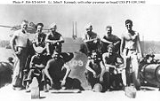
Motor Torpedo Boat PT-109

Encyclopedia
PT-109 was a PT boat
(Patrol Torpedo boat) last commanded by Lieutenant, junior grade
(LTJG) John F. Kennedy
(later President of the United States
) in the Pacific Theater
during World War II
. Kennedy's actions to save his surviving crew after the sinking of the PT-109 made him a war hero, which proved helpful in his political career.
The incident may have also contributed to Kennedy's long-term back problems. After he became President, the incident became a cultural phenomenon, inspiring a song
, many books, movies, various television series, collectible objects, scale model replicas and toys. Interest was revived in May 2002, with the alleged discovery of the wreck by Robert Ballard
.
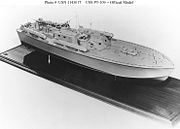 PT-109 belonged to the PT 103 class, hundreds of which were completed between 1942 and 1945 by Elco
. PT-109s keel was laid 4 March 1942 as the seventh Motor Torpedo Boat
(MTB) of the 80 feet (24.4 m)-class built by Elco and was launched on 20 June. She was delivered to the Navy on 10 July 1942, and fitted out in the New York Naval Shipyard at Brooklyn.
The Elco boats were the largest PT boats operated by the US Navy during World War II. At 80 feet (24 m) and 40 tons, they had strong wooden hulls of two layers of 1 inches (2.5 cm) mahogany planking. Powered by three 12-cylinder 1500 hp Packard
gasoline engines (one per propeller shaft), their designed top speed was 41 knots (80 km/h). For space and weight-distribution reasons, the center engine was mounted with the output end facing aft, with power directly transmitted to the propeller shaft. Because the center propeller was deeper, it left less of a wake, and was preferred by skippers for low-wake loitering. Both wing engines were mounted with the output flange facing forward, and power was transmitted through a Vee-drive gearbox to the propeller shafts. The engines were fitted with mufflers on the transom
to direct the exhaust under water, which had to be bypassed for anything other than idle speed. These mufflers were used not only to mask their own noise from the enemy, but to be able to hear enemy aircraft, which were rarely detected overhead before firing their cannons or machine guns or dropping their bombs.
PT 109 could accommodate a crew of 3 officers and 14 enlisted, with the typical crew size between 12 and 14. Fully loaded, PT 109 displaced 56 tons.
The principal offensive weapon was her torpedoes. She was fitted with four 21-inch (53 cm) torpedo tubes containing Mark VIII torpedoes. They weighed 2,600 lb (1,200 kg) each, with 466 pounds (211.4 kg) warheads, and gave the tiny boats a punch at least theoretically effective even against armored ships. Their typical speed of 36 knots (71 km/h) was effective against shipping, but because of rapid marine growth buildup on their hulls in the South Pacific and austere maintenance facilities in forward areas, American PT boats ended up being slower than the top speed of the Japanese destroyer
s and cruiser
s they were tasked with targeting in the Solomons. Torpedoes were also useless against shallow-draft barges, which were their most common targets. With their machine guns and 20 mm cannon, the PT boats could not return the large-caliber gunfire carried by destroyers, which had a much longer effective range, though they were effective against aircraft and ground targets. Because they were fueled with aviation gasoline, a direct hit to a PT boat's engine compartment sometimes resulted in a total loss of boat and crew. In order to have a chance of hitting their target, PT boats had to close to within 2 miles (3.2 km) for a shot, well within the gun range of destroyers; at this distance, a target could easily maneuver to avoid being hit. The boats approached in darkness, fired their torpedoes, which sometimes gave away their positions, and then fled behind smoke screens. Sometimes retreat was hampered by seaplanes which dropped flares and bombs on the boats. The Elco torpedo-launching tubes were powered by a 3 inches (76.2 mm) black powder charge to expel the torpedo from the tube. Additionally, the torpedo was well greased so it would slide out of the tube. Sometimes, the powder charge caused the grease to ignite upon firing, and the resulting flash could give away the position of the PT boat. Crews of PT boats relied on their smaller size, speed and maneuverability, and darkness, to survive.
Ahead of the torpedoes on PT-109 were two depth charge
s, omitted on most PTs, one on each side, about the same diameter as the torpedoes. These were designed to be used against submarines, but were sometimes used by PT commanders to confuse and discourage pursuing destroyers. The PT-109 lost one of its two Mark 6 depth charges a month before Kennedy showed up when the starboard torpedo was inadvertently launched during a storm without first deploying the tube into firing position. The launching torpedo sheared away the depth charge mount and some of the footrail.
PT-109 had a single, 20 mm Oerlikon
anti-aircraft mount at the rear with "109" painted on its mounting base, two open rotating turrets (designed by the same firm that produced the Tucker automobiles), each with twin, .50-caliber (12.7 mm) anti-aircraft machine guns, at opposite corners of the open cockpit, and a smoke generator on her transom. These guns were effective against attacking aircraft.
The day before her most famous mission, PT-109 crew lashed a US Army 37 mm antitank gun to the foredeck
, replacing a small, 2-man life raft. Timbers used to secure the weapon to the deck later helped save their lives when used as a float.
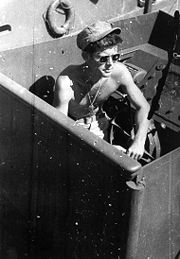 Despite having a bad back, Kennedy used his family influence to get into the war. After starting out as an ensign
with a desk job as for the Office of Naval Intelligence
in October 1941, on July 27, 1942 he entered the Naval Reserve Officers Training School in Chicago. After completing this training three months later, he entered the Motor Torpedo Boat Squadron Training Center in Melville, Rhode Island, where he was promoted to Lieutenant, junior grade before completing his training on December 2. He was then ordered to the training squadron, Motor Torpedo Squadron 4, to take over the command of motor torpedo boat PT-101, a 78- foot Higgins PT boat. In January 1943, PT-101 and four other boats was ordered to Motor Torpedo Boat Squadron 14, which was assigned to Panama
.
The Allies had been in a campaign of island hopping since securing Guadalcanal
in a bloody battle in early 1943. Seeking combat duty, Kennedy transferred on February 23, 1943 as a replacement officer to Motor Torpedo Boat Squadron 2, which was based at Tulagi Island in the Solomons. Traveling to the Pacific on USS Rochambeau, Kennedy arrived at Tulagi on April 14 and took command of PT-109 on April 23. On May 30, several PT boats, including PT-109, were ordered to the Russell Islands in preparation for the invasion of New Georgia.
After the capture of Rendova Island
, the PT boat operations were moved to a "bush" berth there on June 16. From that base PT boats conducted nightly operations, both to disturb the heavy Japanese barge traffic that was resupplying the Japanese garrisons in New Georgia, and to patrol the Ferguson and Blackett Strait
s in order to sight and to give warning when the Japanese Tokyo Express
warships came into the straits to assault U.S. forces in the New Georgia-Rendova area.
On August 1, an attack by 18 Japanese bombers struck the base, wrecking PT-117 and sinking PT-164. Two torpedoes were blown off PT-164 and ran erratically around the bay until they ran ashore on the beach without exploding. Despite the loss of two boats and two crewmen, Kennedy's PT-109 and 14 other boats were sent north on a mission through Ferguson Passage to Blackett Strait, after intelligence reports had indicated that five enemy destroyers were scheduled to run that night from Bougainville Island through Blackett Strait to Vila, on the southern tip of Kolombangara Island. In the PT attack that followed, 15 boats loaded with 60 torpedoes counted only a few observed explosions. However, of the thirty torpedoes fired by PT boats from the four divisions not a single hit was scored. Many of the torpedoes exploded prematurely or ran at the wrong depth. The boats were ordered to return when their torpedoes were expended, but the boats with radar shot their torpedoes first. When they left, remaining boats, such as PT-109, were left without radar, and were not notified that other boats had already engaged the enemy.
PT-109, with PT-162 and PT-169, were ordered to continue patrolling the area in case the enemy ships returned. Around 2am, on a moonless night, Kennedy's boat was idling on one engine to avoid detection of her wake by Japanese aircraft when the crew realized they were in the path of the Japanese destroyer Amagiri
, which was returning to Rabaul
from Vila, Kolombangara after offloading supplies and 900 soldiers. Amagiri was traveling at a relatively high speed of between 23 knots (45 km/h) and 40 kt (75 km/h) in order to reach harbor by dawn, when Allied air patrols were likely to appear.
The crew had less than 10 seconds to get the engines up to speed, and were run down by the destroyer on 2 August 1943 in the Blackett Strait between Kolombangara
and Arundel
in the Solomon Islands
near 8.112140°S 156.905488°E.
Conflicting statements have been made as to whether the destroyer captain had spotted and steered towards the boat; author Donovan, who interviewed members of the destroyer crew, believed the collision was not an accident, though other reports suggest the Amagiri's captain never realized what happened until after the fact. Damage to a propeller slowed the destroyer's trip to its home base.
PT-109 was cut in two. Seamen Andrew Jackson Kirksey and Harold W. Marney were killed, and two other members of the crew were badly injured. For such a catastrophic collision, explosion, and fire, it was a low loss rate compared to other boats that were hit by shell fire. PT-109 was gravely damaged, with watertight compartments keeping only the forward hull afloat in a sea of flames.
PT-169 launched two torpedoes that missed the destroyer and PT-162s torpedoes failed to fire at all. Both boats then turned away from the scene of the action and returned to base without checking for survivors.
island. They placed their lantern, shoes, and nonswimmers on one of the timbers used as a gun mount and began kicking together to propel it. It took four hours for the survivors to reach their destination, 3.5 miles (5.6 km) away, which they reached without interference by sharks or crocodiles. Kennedy, who had been on the Harvard University
varsity swim team, used a life jacket strap clenched between his teeth to tow his badly-burned senior enlisted machinist mate, MM1 Patrick McMahon. The island was only 100 yards (91m) in diameter, with no food or water. The crew had to hide from passing Japanese barges. Kennedy swam about 4 km more, to Naru and Olasana islands, in search of help and food. He then led his men to Olasana Island, which had coconut trees and water.
, Sub Lieutenant Arthur Reginald Evans
, who manned a secret observation post at the top of the Mount Veve
volcano on Kolombangara
island, where more than 10,000 Japanese troops were garrisoned below on the southeast portion. The Navy and its squadron of PT boats held a memorial service for the crew of PT-109 after reports were made of the large explosion. However, Evans dispatched Solomon Islanders
Biuku Gasa and Eroni Kumana
in a dugout canoe to look for possible survivors after decoding news that the explosion he had witnessed was probably from the lost PT-109. The canoes were similar to those used for thousands of years in the Pacific by indigenous peoples
from Polynesia and coastal North and South America. They could avoid detection by Japanese ships and aircraft and, if spotted, would probably be taken for native fishermen.
Kennedy and his men survived for six days on coconuts before they were found by the scouts. Gasa and Kumana disobeyed an order by stopping by Naru to investigate a Japanese wreck, from which they salvaged fuel and food. They first fled by canoe from Kennedy, who to them was simply a shouting stranger. On the next island, they pointed their Tommy guns
at the rest of the crew since the only light-skinned people they expected to find were Japanese and they were not familiar with either the language or the people. Gasa later said "All white people looked the same to me." Kennedy convinced them they were on the same side. The small canoe was not big enough for passengers. Though the Donovan book and movie depict Kennedy offering a coconut inscribed with a message, according to a National Geographic interview, it was Gasa who suggested it and Kumana who climbed a coconut tree to pick one. Kennedy cut the following message on a coconut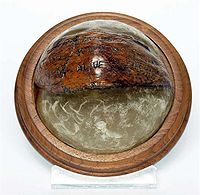
This message was delivered at great risk through 35 nmi (64.8 km) of hostile waters patrolled by the Japanese to the nearest Allied base at Rendova. Other coastwatcher natives who were caught had been tortured and killed. Later, a canoe returned for Kennedy, taking him to the coastwatcher to coordinate the rescue. The PT 157, commanded by Lieutenant William Liebenow, was able to pick up the survivors. The arranged signal was four shots, but since Kennedy only had three bullets in his pistol, Evans gave him a Japanese rifle for the fourth signal shot. The sailors sang "Yes Jesus Loves Me"
to pass the time. Gasa and Kumana received little notice or credit in military reports, books, or movies until 2002 when they were interviewed by National Geographic shortly before Gasa's death.
The coconut shell was preserved in a glass container by Kennedy on his desk during his presidency. It is now on display at the John F. Kennedy Library
in Boston, Massachusetts.
expedition headed by Dr. Robert Ballard
found a torpedo tube from wreckage matching the description and location of Kennedy's vessel in the Solomon Islands. The boat was identified by Dale Ridder (Beach Park, Illinois). The stern section was not found, but a search using remote vehicles found the forward section, which had drifted south of the collision site. Much of the half-buried wreckage and grave site was left undisturbed in accordance with Navy
policy. Max Kennedy, who joined Ballard on the expedition, presented a bust of JFK to the islanders who had found Kennedy and his crew.
A standard uniform
was blue dungarees with a white, round dixie cap for enlisted sailors, washed khakis and service cap for officers. During General Quarters
, the crew manned their battle stations wearing dark blue kapok
life vests and US Army/US Marine Corps-style steel helmets painted gray. The skipper's helmet had stripes and an inverted star (approximating his dress uniform sleeve rank or shoulder board insignia...normally that of LTJG or LT), while the other officer was labeled "XO".
The crew aboard PT-109 on her last mission:
Biuki Gasa died in late August 2005, his passing noted only in a single blog by a relative. According to Time Pacific magazine, Gasa and Kumana were invited to Kennedy's inauguration. However, the island authorities tricked them into giving their trip to local officials. Gasa and Kumana gained a little fame only after being identified by National Geographic. In 2007, the commanding officer of the USS Peleliu
, Captain Ed Rhoades, presented Eroni Kumana with gifts, including an American flag for his actions more than 60 years earlier.
, starring Cliff Robertson
. It had some historical inaccuracies, such as the Navy searching for the boat rather than holding a memorial service for the crew. President Kennedy personally selected Robertson to play him in the film version. As there were only a few Elco PT-105 class hulls in existence by that time (none in operable condition or resembling their WW-II appearance) a few 82' USAF Crash Rescue boats were converted to resemble PT-109 and a few other Elco PT's in the movie.
A song entitled PT-109
by Jimmy Dean
reached #8 on the pop music
, and #3 on the country music
charts in 1962, making it one of Dean's most successful recordings. PT Boats and their commanders were a popular subject in the 1960s and Captain Storm
, a DC comics war hero whose back story had some resemblance to Kennedy's experience, was created just a few months after his assassination. The fictional Storm also lost his boat to a Japanese destroyer; so popular was the notion of a story of a PT Boat commander that it was the first time in history that a war comic character premiered in the first issue of his own series. A version of the true Kennedy story was also published in comic book
form by Classics Illustrated
.
Plum Pudding Island was later renamed Kennedy Island
. A controversy arose when the government sold the land to a private investor who charged admission to tourists.
The 1958 movie South Pacific preceded PT-109 as a drama about Navy sailors in the Pacific theater. In 1961, Premiere Theater presented Seven Against The Sea, a drama about a resourceful group of stranded American PT boat crewmen hiding out on a South Pacific island controlled by the Japanese Navy, a situation apparently inspired by the adventures of Kennedy and his men. This later became the pilot of McHale's Navy
, a successful television situation comedy
series. One episode of the series had a 'cameo' appearance of a PT boat marked "109".
PT-109 was also a subject of toy, plastic and RC model ships in the 1960s, familiar to boys who grew up as Baby Boom
ers. It was still a popular 1/72 scale Revell model kit
in the 21st century. Hasbro also released a PT-109 edition John F. Kennedy G.I. Joe
action figure, dressed in Navy khakis with a miniature version of the famous coconut shell.
The tale is much less familiar to later generations, as the movie was out of print in VHS
in the US by 2006 and was not released in the US on DVD until 2011. It is available outside of the US as a Video CD, but not yet as a DVD.
Spectrum Holobyte
released a naval simulation game roughly based on the events named PT-109
for the Apple Macintosh and MS-DOS
-compatible computers in 1987. In the video game Battlestations Midway, PT-109 is featured in the second mission of the US Campaign.
The novel Gilligan's Wake
is a fictional re-imagining of Gilligan's island where the Skipper served with both John F. Kennedy
and the skipper of McHale's Navy
.
Leslie Martinson directed both the PT-109 movie and Rescue from Gilligan's Island
.
PT boat
PT Boats were a variety of motor torpedo boat , a small, fast vessel used by the United States Navy in World War II to attack larger surface ships. The PT boat squadrons were nicknamed "the mosquito fleet". The Japanese called them "Devil Boats".The original pre–World War I torpedo boats were...
(Patrol Torpedo boat) last commanded by Lieutenant, junior grade
Lieutenant, Junior Grade
Lieutenant is a junior commissioned officer rank in the United States Navy, the United States Coast Guard, the United States Public Health Service Commissioned Corps, United States Merchant Marine USMM, and the National Oceanic and Atmospheric Administration Commissioned Corps, with the pay grade...
(LTJG) John F. Kennedy
John F. Kennedy
John Fitzgerald "Jack" Kennedy , often referred to by his initials JFK, was the 35th President of the United States, serving from 1961 until his assassination in 1963....
(later President of the United States
President of the United States
The President of the United States of America is the head of state and head of government of the United States. The president leads the executive branch of the federal government and is the commander-in-chief of the United States Armed Forces....
) in the Pacific Theater
Pacific Ocean theater of World War II
The Pacific Ocean theatre was one of four major naval theatres of war of World War II, which pitted the forces of Japan against those of the United States, the British Commonwealth, the Netherlands and France....
during World War II
World War II
World War II, or the Second World War , was a global conflict lasting from 1939 to 1945, involving most of the world's nations—including all of the great powers—eventually forming two opposing military alliances: the Allies and the Axis...
. Kennedy's actions to save his surviving crew after the sinking of the PT-109 made him a war hero, which proved helpful in his political career.
The incident may have also contributed to Kennedy's long-term back problems. After he became President, the incident became a cultural phenomenon, inspiring a song
PT-109 (song)
PT-109 was a song by Jimmy Dean about the adventures of John F. Kennedy and the crew of the PT-109. The boat was famous even before Kennedy ran for office because it was cut in two after being rammed by a Japanese destroyer, after which came a survival story, and rescue by native islanders Biuku...
, many books, movies, various television series, collectible objects, scale model replicas and toys. Interest was revived in May 2002, with the alleged discovery of the wreck by Robert Ballard
Robert Ballard
Robert Duane Ballard is a former United States Navy officer and a professor of oceanography at the University of Rhode Island who is most noted for his work in underwater archaeology. He is most famous for the discoveries of the wrecks of the RMS Titanic in 1985, the battleship Bismarck in 1989,...
.
Specifications
Electric Launch Company
The Electric Launch Company, later renamed Elco Motor Yachts, is a United States boat building and electric motor company that has operated from 1893 until present . It was originally run by Henry R. Sutphen in 1895...
. PT-109s keel was laid 4 March 1942 as the seventh Motor Torpedo Boat
Motor Torpedo Boat
Motor Torpedo Boat was the name given to fast torpedo boats by the Royal Navy, and the Royal Canadian Navy.The capitalised term is generally used for the Royal Navy boats and abbreviated to "MTB"...
(MTB) of the 80 feet (24.4 m)-class built by Elco and was launched on 20 June. She was delivered to the Navy on 10 July 1942, and fitted out in the New York Naval Shipyard at Brooklyn.
The Elco boats were the largest PT boats operated by the US Navy during World War II. At 80 feet (24 m) and 40 tons, they had strong wooden hulls of two layers of 1 inches (2.5 cm) mahogany planking. Powered by three 12-cylinder 1500 hp Packard
Packard
Packard was an American luxury-type automobile marque built by the Packard Motor Car Company of Detroit, Michigan, and later by the Studebaker-Packard Corporation of South Bend, Indiana...
gasoline engines (one per propeller shaft), their designed top speed was 41 knots (80 km/h). For space and weight-distribution reasons, the center engine was mounted with the output end facing aft, with power directly transmitted to the propeller shaft. Because the center propeller was deeper, it left less of a wake, and was preferred by skippers for low-wake loitering. Both wing engines were mounted with the output flange facing forward, and power was transmitted through a Vee-drive gearbox to the propeller shafts. The engines were fitted with mufflers on the transom
Transom (nautical)
In naval architecture, a transom is the surface that forms the stern of a vessel. Transoms may be flat or curved and they may be vertical, raked forward, also known as a retroussé or reverse transom, angling forward from the waterline to the deck, or raked aft, often simply called "raked", angling...
to direct the exhaust under water, which had to be bypassed for anything other than idle speed. These mufflers were used not only to mask their own noise from the enemy, but to be able to hear enemy aircraft, which were rarely detected overhead before firing their cannons or machine guns or dropping their bombs.
PT 109 could accommodate a crew of 3 officers and 14 enlisted, with the typical crew size between 12 and 14. Fully loaded, PT 109 displaced 56 tons.
The principal offensive weapon was her torpedoes. She was fitted with four 21-inch (53 cm) torpedo tubes containing Mark VIII torpedoes. They weighed 2,600 lb (1,200 kg) each, with 466 pounds (211.4 kg) warheads, and gave the tiny boats a punch at least theoretically effective even against armored ships. Their typical speed of 36 knots (71 km/h) was effective against shipping, but because of rapid marine growth buildup on their hulls in the South Pacific and austere maintenance facilities in forward areas, American PT boats ended up being slower than the top speed of the Japanese destroyer
Destroyer
In naval terminology, a destroyer is a fast and maneuverable yet long-endurance warship intended to escort larger vessels in a fleet, convoy or battle group and defend them against smaller, powerful, short-range attackers. Destroyers, originally called torpedo-boat destroyers in 1892, evolved from...
s and cruiser
Cruiser
A cruiser is a type of warship. The term has been in use for several hundreds of years, and has had different meanings throughout this period...
s they were tasked with targeting in the Solomons. Torpedoes were also useless against shallow-draft barges, which were their most common targets. With their machine guns and 20 mm cannon, the PT boats could not return the large-caliber gunfire carried by destroyers, which had a much longer effective range, though they were effective against aircraft and ground targets. Because they were fueled with aviation gasoline, a direct hit to a PT boat's engine compartment sometimes resulted in a total loss of boat and crew. In order to have a chance of hitting their target, PT boats had to close to within 2 miles (3.2 km) for a shot, well within the gun range of destroyers; at this distance, a target could easily maneuver to avoid being hit. The boats approached in darkness, fired their torpedoes, which sometimes gave away their positions, and then fled behind smoke screens. Sometimes retreat was hampered by seaplanes which dropped flares and bombs on the boats. The Elco torpedo-launching tubes were powered by a 3 inches (76.2 mm) black powder charge to expel the torpedo from the tube. Additionally, the torpedo was well greased so it would slide out of the tube. Sometimes, the powder charge caused the grease to ignite upon firing, and the resulting flash could give away the position of the PT boat. Crews of PT boats relied on their smaller size, speed and maneuverability, and darkness, to survive.
Ahead of the torpedoes on PT-109 were two depth charge
Depth charge
A depth charge is an anti-submarine warfare weapon intended to destroy or cripple a target submarine by the shock of exploding near it. Most use explosives and a fuze set to go off at a preselected depth in the ocean. Depth charges can be dropped by either surface ships, patrol aircraft, or from...
s, omitted on most PTs, one on each side, about the same diameter as the torpedoes. These were designed to be used against submarines, but were sometimes used by PT commanders to confuse and discourage pursuing destroyers. The PT-109 lost one of its two Mark 6 depth charges a month before Kennedy showed up when the starboard torpedo was inadvertently launched during a storm without first deploying the tube into firing position. The launching torpedo sheared away the depth charge mount and some of the footrail.
PT-109 had a single, 20 mm Oerlikon
Oerlikon Contraves
Rheinmetall Air Defence AG is a division of German armament manufacturer Rheinmetall, created when the company's Oerlikon Contraves unit was renamed on 1 January 2009 and integrated with Rheinmetall's other air-defence products...
anti-aircraft mount at the rear with "109" painted on its mounting base, two open rotating turrets (designed by the same firm that produced the Tucker automobiles), each with twin, .50-caliber (12.7 mm) anti-aircraft machine guns, at opposite corners of the open cockpit, and a smoke generator on her transom. These guns were effective against attacking aircraft.
The day before her most famous mission, PT-109 crew lashed a US Army 37 mm antitank gun to the foredeck
Forecastle
Forecastle refers to the upper deck of a sailing ship forward of the foremast, or the forward part of a ship with the sailors' living quarters...
, replacing a small, 2-man life raft. Timbers used to secure the weapon to the deck later helped save their lives when used as a float.
Under Kennedy's command
Ensign (rank)
Ensign is a junior rank of a commissioned officer in the armed forces of some countries, normally in the infantry or navy. As the junior officer in an infantry regiment was traditionally the carrier of the ensign flag, the rank itself acquired the name....
with a desk job as for the Office of Naval Intelligence
Office of Naval Intelligence
The Office of Naval Intelligence was established in the United States Navy in 1882. ONI was established to "seek out and report" on the advancements in other nations' navies. Its headquarters are at the National Maritime Intelligence Center in Suitland, Maryland...
in October 1941, on July 27, 1942 he entered the Naval Reserve Officers Training School in Chicago. After completing this training three months later, he entered the Motor Torpedo Boat Squadron Training Center in Melville, Rhode Island, where he was promoted to Lieutenant, junior grade before completing his training on December 2. He was then ordered to the training squadron, Motor Torpedo Squadron 4, to take over the command of motor torpedo boat PT-101, a 78- foot Higgins PT boat. In January 1943, PT-101 and four other boats was ordered to Motor Torpedo Boat Squadron 14, which was assigned to Panama
Panama
Panama , officially the Republic of Panama , is the southernmost country of Central America. Situated on the isthmus connecting North and South America, it is bordered by Costa Rica to the northwest, Colombia to the southeast, the Caribbean Sea to the north and the Pacific Ocean to the south. The...
.
The Allies had been in a campaign of island hopping since securing Guadalcanal
Guadalcanal
Guadalcanal is a tropical island in the South-Western Pacific. The largest island in the Solomons, it was discovered by the Spanish expedition of Alvaro de Mendaña in 1568...
in a bloody battle in early 1943. Seeking combat duty, Kennedy transferred on February 23, 1943 as a replacement officer to Motor Torpedo Boat Squadron 2, which was based at Tulagi Island in the Solomons. Traveling to the Pacific on USS Rochambeau, Kennedy arrived at Tulagi on April 14 and took command of PT-109 on April 23. On May 30, several PT boats, including PT-109, were ordered to the Russell Islands in preparation for the invasion of New Georgia.
After the capture of Rendova Island
Rendova Island
Rendova Island is an island, part of the New Georgia Islands of Solomon Islands in the South Pacific, east of Papua New Guinea. There are two indigenous languages spoken on Rendova Island: the Austronesian language Ughele in the north, and the Papuan language Touo in the south.The black-sand...
, the PT boat operations were moved to a "bush" berth there on June 16. From that base PT boats conducted nightly operations, both to disturb the heavy Japanese barge traffic that was resupplying the Japanese garrisons in New Georgia, and to patrol the Ferguson and Blackett Strait
Blackett Strait
Blackett Strait is a waterway in the Western Province of the Solomon Islands. It lies between the islands of Kolombangara to the north, and Arundel Island to the south...
s in order to sight and to give warning when the Japanese Tokyo Express
Tokyo Express
The Tokyo Express was the name given by Allied forces to the use of Imperial Japanese Navy ships at night to deliver personnel, supplies, and equipment to Japanese forces operating in and around New Guinea and the Solomon Islands during the Pacific campaign of World War II...
warships came into the straits to assault U.S. forces in the New Georgia-Rendova area.
On August 1, an attack by 18 Japanese bombers struck the base, wrecking PT-117 and sinking PT-164. Two torpedoes were blown off PT-164 and ran erratically around the bay until they ran ashore on the beach without exploding. Despite the loss of two boats and two crewmen, Kennedy's PT-109 and 14 other boats were sent north on a mission through Ferguson Passage to Blackett Strait, after intelligence reports had indicated that five enemy destroyers were scheduled to run that night from Bougainville Island through Blackett Strait to Vila, on the southern tip of Kolombangara Island. In the PT attack that followed, 15 boats loaded with 60 torpedoes counted only a few observed explosions. However, of the thirty torpedoes fired by PT boats from the four divisions not a single hit was scored. Many of the torpedoes exploded prematurely or ran at the wrong depth. The boats were ordered to return when their torpedoes were expended, but the boats with radar shot their torpedoes first. When they left, remaining boats, such as PT-109, were left without radar, and were not notified that other boats had already engaged the enemy.
PT-109, with PT-162 and PT-169, were ordered to continue patrolling the area in case the enemy ships returned. Around 2am, on a moonless night, Kennedy's boat was idling on one engine to avoid detection of her wake by Japanese aircraft when the crew realized they were in the path of the Japanese destroyer Amagiri
Japanese destroyer Amagiri
was the 15th of 24 s, built for the Imperial Japanese Navy following World War I. When introduced into service, these ships were the most powerful destroyers in the world. They served as first-line destroyers through the 1930s, and remained formidable weapons systems well into the Pacific War. She...
, which was returning to Rabaul
Rabaul
Rabaul is a township in East New Britain province, Papua New Guinea. The town was the provincial capital and most important settlement in the province until it was destroyed in 1994 by falling ash of a volcanic eruption. During the eruption, ash was sent thousands of metres into the air and the...
from Vila, Kolombangara after offloading supplies and 900 soldiers. Amagiri was traveling at a relatively high speed of between 23 knots (45 km/h) and 40 kt (75 km/h) in order to reach harbor by dawn, when Allied air patrols were likely to appear.
The crew had less than 10 seconds to get the engines up to speed, and were run down by the destroyer on 2 August 1943 in the Blackett Strait between Kolombangara
Kolombangara
Kolombangara is an island in the New Georgia Islands group of the Solomon Islands in the southwestern Pacific Ocean...
and Arundel
Arundel Island
Arundel Island is an island, part of the New Georgia Islands in the Solomon Islands. It is located between Kolombangara and New Georgia, at . It is separated from Kolombangara by Blackett Strait....
in the Solomon Islands
Solomon Islands
Solomon Islands is a sovereign state in Oceania, east of Papua New Guinea, consisting of nearly one thousand islands. It covers a land mass of . The capital, Honiara, is located on the island of Guadalcanal...
near 8.112140°S 156.905488°E.
Conflicting statements have been made as to whether the destroyer captain had spotted and steered towards the boat; author Donovan, who interviewed members of the destroyer crew, believed the collision was not an accident, though other reports suggest the Amagiri
PT-109 was cut in two. Seamen Andrew Jackson Kirksey and Harold W. Marney were killed, and two other members of the crew were badly injured. For such a catastrophic collision, explosion, and fire, it was a low loss rate compared to other boats that were hit by shell fire. PT-109 was gravely damaged, with watertight compartments keeping only the forward hull afloat in a sea of flames.
PT-169 launched two torpedoes that missed the destroyer and PT-162s torpedoes failed to fire at all. Both boats then turned away from the scene of the action and returned to base without checking for survivors.
Survival
All of the nearby large islands had Japanese camps on them. The survivors chose the tiny deserted Plum Pudding Island, southwest of KolombangaraKolombangara
Kolombangara is an island in the New Georgia Islands group of the Solomon Islands in the southwestern Pacific Ocean...
island. They placed their lantern, shoes, and nonswimmers on one of the timbers used as a gun mount and began kicking together to propel it. It took four hours for the survivors to reach their destination, 3.5 miles (5.6 km) away, which they reached without interference by sharks or crocodiles. Kennedy, who had been on the Harvard University
Harvard University
Harvard University is a private Ivy League university located in Cambridge, Massachusetts, United States, established in 1636 by the Massachusetts legislature. Harvard is the oldest institution of higher learning in the United States and the first corporation chartered in the country...
varsity swim team, used a life jacket strap clenched between his teeth to tow his badly-burned senior enlisted machinist mate, MM1 Patrick McMahon. The island was only 100 yards (91m) in diameter, with no food or water. The crew had to hide from passing Japanese barges. Kennedy swam about 4 km more, to Naru and Olasana islands, in search of help and food. He then led his men to Olasana Island, which had coconut trees and water.
Rescue
The explosion on 2 August was spotted by an Australian coastwatcherCoastwatchers
The Coastwatchers, also known as the Coast Watch Organisation, Combined Field Intelligence Service or Section C, Allied Intelligence Bureau, were Allied military intelligence operatives stationed on remote Pacific islands during World War II to observe enemy movements and rescue stranded Allied...
, Sub Lieutenant Arthur Reginald Evans
Arthur Reginald Evans
Arthur Reginald Evans was a shipping clerk at Paddington, a suburb of Sydney, when he enlisted in the Australian Imperial Force on 25 July 1940. He was allotted service number NX57823 and served with the 2/9th Army Field Regiment, Royal Australian Artillery until discharged on 9 October 1942 as a...
, who manned a secret observation post at the top of the Mount Veve
Mount Veve
Mount Veve is an extinct volcano on Kolombangara, in the Solomon Islands, at . It is 1768 m tall and is the highest point of the island.- External links :*...
volcano on Kolombangara
Kolombangara
Kolombangara is an island in the New Georgia Islands group of the Solomon Islands in the southwestern Pacific Ocean...
island, where more than 10,000 Japanese troops were garrisoned below on the southeast portion. The Navy and its squadron of PT boats held a memorial service for the crew of PT-109 after reports were made of the large explosion. However, Evans dispatched Solomon Islanders
Solomon Islands
Solomon Islands is a sovereign state in Oceania, east of Papua New Guinea, consisting of nearly one thousand islands. It covers a land mass of . The capital, Honiara, is located on the island of Guadalcanal...
Biuku Gasa and Eroni Kumana
Biuku Gasa and Eroni Kumana
Biuku Gasa and Eroni Kumana were indigenous people of Solomon Islands, of native Melanesian descent, who found John F. Kennedy and his surviving PT-109 crew following the boat's collision with the Japanese destroyer Amagiri near Plum Pudding Island on 1 August 1943...
in a dugout canoe to look for possible survivors after decoding news that the explosion he had witnessed was probably from the lost PT-109. The canoes were similar to those used for thousands of years in the Pacific by indigenous peoples
Indigenous peoples by geographic regions
This is a partial list of indigenous, aboriginal, native peoples by geographical regions. Indigenous peoples are any ethnic group of peoples who inhabit a geographic region, with which they have the earliest known historical connection....
from Polynesia and coastal North and South America. They could avoid detection by Japanese ships and aircraft and, if spotted, would probably be taken for native fishermen.
Kennedy and his men survived for six days on coconuts before they were found by the scouts. Gasa and Kumana disobeyed an order by stopping by Naru to investigate a Japanese wreck, from which they salvaged fuel and food. They first fled by canoe from Kennedy, who to them was simply a shouting stranger. On the next island, they pointed their Tommy guns
Thompson submachine gun
The Thompson is an American submachine gun, invented by John T. Thompson in 1919, that became infamous during the Prohibition era. It was a common sight in the media of the time, being used by both law enforcement officers and criminals...
at the rest of the crew since the only light-skinned people they expected to find were Japanese and they were not familiar with either the language or the people. Gasa later said "All white people looked the same to me." Kennedy convinced them they were on the same side. The small canoe was not big enough for passengers. Though the Donovan book and movie depict Kennedy offering a coconut inscribed with a message, according to a National Geographic interview, it was Gasa who suggested it and Kumana who climbed a coconut tree to pick one. Kennedy cut the following message on a coconut
NAURO ISL
COMMANDER... NATIVE KNOWS POS'IT...
HE CAN PILOT... 11 ALIVE
NEED SMALL BOAT... KENNEDY
This message was delivered at great risk through 35 nmi (64.8 km) of hostile waters patrolled by the Japanese to the nearest Allied base at Rendova. Other coastwatcher natives who were caught had been tortured and killed. Later, a canoe returned for Kennedy, taking him to the coastwatcher to coordinate the rescue. The PT 157, commanded by Lieutenant William Liebenow, was able to pick up the survivors. The arranged signal was four shots, but since Kennedy only had three bullets in his pistol, Evans gave him a Japanese rifle for the fourth signal shot. The sailors sang "Yes Jesus Loves Me"
Jesus Loves Me
Jesus Loves Me is a Christian hymn set to words by Anna Bartlett Warner. The lyrics first appeared as a poem in the context of a novel called Say and Seal, written by Susan Warner and published in 1860. The tune was added in 1862 by William Batchelder Bradbury who found the text of "Jesus Loves Me"...
to pass the time. Gasa and Kumana received little notice or credit in military reports, books, or movies until 2002 when they were interviewed by National Geographic shortly before Gasa's death.
The coconut shell was preserved in a glass container by Kennedy on his desk during his presidency. It is now on display at the John F. Kennedy Library
John F. Kennedy Library
The John F. Kennedy Presidential Library and Museum is the presidential library and museum of the 35th President of the United States, John F. Kennedy. It is located on Columbia Point in the Dorchester neighborhood of Boston, Massachusetts, USA, next to the Boston campus of the University of...
in Boston, Massachusetts.
PT-59
PT-59 was one of the first PT boats converted to a gunboat primarily tasked with hunting down targets their own size or smaller, and was crewed by Kennedy and those from PT-109 who chose to stay in the war rather than go home. On November 2, 1943, (in an incident which was portrayed as an action by PT-109 in the film PT-109) PT-59 went on to rescue Marines ambushed during a raid on Choiseul Island. One gravely wounded Marine died in LT Kennedy's bunk aboard PT-59 that night.The search for Kennedy's PT 109
The wreckage of PT-109 was allegedly located in May 2002 when a National GeographicNational Geographic Society
The National Geographic Society , headquartered in Washington, D.C. in the United States, is one of the largest non-profit scientific and educational institutions in the world. Its interests include geography, archaeology and natural science, the promotion of environmental and historical...
expedition headed by Dr. Robert Ballard
Robert Ballard
Robert Duane Ballard is a former United States Navy officer and a professor of oceanography at the University of Rhode Island who is most noted for his work in underwater archaeology. He is most famous for the discoveries of the wrecks of the RMS Titanic in 1985, the battleship Bismarck in 1989,...
found a torpedo tube from wreckage matching the description and location of Kennedy's vessel in the Solomon Islands. The boat was identified by Dale Ridder (Beach Park, Illinois). The stern section was not found, but a search using remote vehicles found the forward section, which had drifted south of the collision site. Much of the half-buried wreckage and grave site was left undisturbed in accordance with Navy
United States Navy
The United States Navy is the naval warfare service branch of the United States Armed Forces and one of the seven uniformed services of the United States. The U.S. Navy is the largest in the world; its battle fleet tonnage is greater than that of the next 13 largest navies combined. The U.S...
policy. Max Kennedy, who joined Ballard on the expedition, presented a bust of JFK to the islanders who had found Kennedy and his crew.
A standard uniform
Uniforms of the United States Navy
This article examines dress uniforms, daily service uniforms, working uniforms, special situations, and the history of uniforms of the United States Navy...
was blue dungarees with a white, round dixie cap for enlisted sailors, washed khakis and service cap for officers. During General Quarters
General quarters
General Quarters or Battle Stations is an announcement made aboard a naval warship to signal the crew to prepare for battle or imminent damage....
, the crew manned their battle stations wearing dark blue kapok
Kapok
Ceiba pentandra is a tropical tree of the order Malvales and the family Malvaceae , native to Mexico, Central America and the Caribbean, northern South America, and to tropical west Africa...
life vests and US Army/US Marine Corps-style steel helmets painted gray. The skipper's helmet had stripes and an inverted star (approximating his dress uniform sleeve rank or shoulder board insignia...normally that of LTJG or LT), while the other officer was labeled "XO".
The crew aboard PT-109 on her last mission:
- Lieutenant, junior grade (LTJG) John Fitzgerald Kennedy (Boston, Massachusetts), Commanding Officer ("CO" or "Skipper"). Became 35th President of the United States
- Ensign (ENS) Leonard J. Thom (Sandusky, Ohio), Executive Officer ("exec" or "XO")
- Ensign (ENS) George H. R. "Barney" Ross (Highland Park, Illinois); on board as an observer after losing his own boat, attempted to operate the 37mm gun but suffered from night blindness
- Seaman 2/c Raymond Albert (Akron, Ohio) KIA 8 October 1943.
- Gunner's Mate 3/c (GM3) Charles A. "Bucky" Harris (Watertown, Massachusetts)
- Motor Machinist's Mate 2/c (MM2) William Johnston (Dorchester, Massachusetts)
- Torpedoman's Mate 2/c (TM2) Andrew Jackson Kirksey (Reynolds, Georgia) (killed in collision, listed as missing by National Geographic account)
- Radioman 2/c (RM2) John E. Maguire (Dobbs Ferry, New York)
- Motor Machinist’s Mate 2/c (MM2) Harold William Marney (Springfield, Massachusetts) (killed in collision, manning turret closest to impact point)
- Quartermaster 3/c (QM3) Edman Edgar Mauer (St. Louis, Missouri)
- Motor Machinist's Mate 1/c (MM1) Patrick H. "Pappy" McMahon (Wyanet, Illinois) (Only man in engine room during collision, was badly burned, but recovered from his wounds)
- Torpedoman's Mate 2/c (TM2) Ray L. Starkey (Garden Grove, California)
- Motor Machinist's Mate 1/c (MM1) Gerard E. Zinser (Belleville, Illinois) (erroneously called "Gerald" in many publications).
Survivors
Gerard Zinser, the last survivor of PT-109, died in Florida in 2001. Both Solomon Islanders Biuki Gasa and Eroni Kumana were alive when visited by National Geographic in 2002. They were each presented with a gift from the Kennedy family.Biuki Gasa died in late August 2005, his passing noted only in a single blog by a relative. According to Time Pacific magazine, Gasa and Kumana were invited to Kennedy's inauguration. However, the island authorities tricked them into giving their trip to local officials. Gasa and Kumana gained a little fame only after being identified by National Geographic. In 2007, the commanding officer of the USS Peleliu
USS Peleliu (LHA-5)
USS Peleliu is a Tarawa-class amphibious assault ship of the United States Navy, named after the Battle of Peleliu during World War II. Entering service in 1980, the ship has been deployed to the Persian Gulf on several occasions, performed an evacuation of U.S...
, Captain Ed Rhoades, presented Eroni Kumana with gifts, including an American flag for his actions more than 60 years earlier.
Legacy
The episode of PT-109's sinking featured in a book and a 1963 movie, PT 109PT 109 (film)
PT 109 is a 1963 biographical film which depicts the actions of John F. Kennedy in command of Motor Torpedo Boat PT-109 as an officer of the United States Navy during World War II. The movie was adapted by Vincent Flaherty and Howard Sheehan from the book PT 109: John F. Kennedy in World War II by...
, starring Cliff Robertson
Cliff Robertson
Clifford Parker "Cliff" Robertson III was an American actor with a film and television career that spanned half of a century. Robertson portrayed a young John F. Kennedy in the 1963 film PT 109, and won the 1968 Academy Award for Best Actor for his role in the movie Charly...
. It had some historical inaccuracies, such as the Navy searching for the boat rather than holding a memorial service for the crew. President Kennedy personally selected Robertson to play him in the film version. As there were only a few Elco PT-105 class hulls in existence by that time (none in operable condition or resembling their WW-II appearance) a few 82' USAF Crash Rescue boats were converted to resemble PT-109 and a few other Elco PT's in the movie.
A song entitled PT-109
PT-109 (song)
PT-109 was a song by Jimmy Dean about the adventures of John F. Kennedy and the crew of the PT-109. The boat was famous even before Kennedy ran for office because it was cut in two after being rammed by a Japanese destroyer, after which came a survival story, and rescue by native islanders Biuku...
by Jimmy Dean
Jimmy Dean
Jimmy Ray Dean was an American country music singer, television host, actor and businessman. Although he may be best known today as the creator of the Jimmy Dean sausage brand, he became a national television personality starting in 1957, rising to fame for his 1961 country crossover hit "Big Bad...
reached #8 on the pop music
Pop music
Pop music is usually understood to be commercially recorded music, often oriented toward a youth market, usually consisting of relatively short, simple songs utilizing technological innovations to produce new variations on existing themes.- Definitions :David Hatch and Stephen Millward define pop...
, and #3 on the country music
Country music
Country music is a popular American musical style that began in the rural Southern United States in the 1920s. It takes its roots from Western cowboy and folk music...
charts in 1962, making it one of Dean's most successful recordings. PT Boats and their commanders were a popular subject in the 1960s and Captain Storm
The Losers (comics)
The Losers is the name of a war comic book feature published by DC Comics. The name was later given to a reimagined comic book series for DC's Vertigo imprint.The first Losers comic was a war comics feature set during World War II...
, a DC comics war hero whose back story had some resemblance to Kennedy's experience, was created just a few months after his assassination. The fictional Storm also lost his boat to a Japanese destroyer; so popular was the notion of a story of a PT Boat commander that it was the first time in history that a war comic character premiered in the first issue of his own series. A version of the true Kennedy story was also published in comic book
Comic book
A comic book or comicbook is a magazine made up of comics, narrative artwork in the form of separate panels that represent individual scenes, often accompanied by dialog as well as including...
form by Classics Illustrated
Classics Illustrated
Classics Illustrated is a comic book series featuring adaptations of literary classics such as Moby Dick, Hamlet, and The Iliad. Created by Albert Kanter, the series began publication in 1941 and finished its first run in 1971, producing 169 issues. Following the series' demise, various companies...
.
Plum Pudding Island was later renamed Kennedy Island
Kennedy Island
Kennedy Island is an island in the Solomon Islands that was named after John F. Kennedy. The island is remembered to be the area Lt. John F. Kennedy had aided his injured crew after his boat, the PT-109, was rammed by the Japanese destroyer Amagiri in World War II...
. A controversy arose when the government sold the land to a private investor who charged admission to tourists.
The 1958 movie South Pacific preceded PT-109 as a drama about Navy sailors in the Pacific theater. In 1961, Premiere Theater presented Seven Against The Sea, a drama about a resourceful group of stranded American PT boat crewmen hiding out on a South Pacific island controlled by the Japanese Navy, a situation apparently inspired by the adventures of Kennedy and his men. This later became the pilot of McHale's Navy
McHale's Navy
McHale's Navy is an American television sitcom series which ran for 138 half-hour episodes from October 11,1962, to August 31, 1966, on the ABC network. The series was filmed in black and white and originated in a one-hour drama called Seven Against the Sea, broadcast on April 3, 1962...
, a successful television situation comedy
Situation comedy
A situation comedy, often shortened to sitcom, is a genre of comedy that features characters sharing the same common environment, such as a home or workplace, accompanied with jokes as part of the dialogue...
series. One episode of the series had a 'cameo' appearance of a PT boat marked "109".
PT-109 was also a subject of toy, plastic and RC model ships in the 1960s, familiar to boys who grew up as Baby Boom
Baby boom
A baby boom is any period marked by a greatly increased birth rate. This demographic phenomenon is usually ascribed within certain geographical bounds and when the number of annual births exceeds 2 per 100 women...
ers. It was still a popular 1/72 scale Revell model kit
PT-109 (model)
The popularity of the story of John F. Kennedy's PT-109 made it a very popular subject for ship model companies in the 1960s, and it is still popular even as newly manufactured kits in the 2000s...
in the 21st century. Hasbro also released a PT-109 edition John F. Kennedy G.I. Joe
G.I. Joe
G.I. Joe is a line of action figures produced by the toy company Hasbro. The initial product offering represented four of the branches of the U.S. armed forces with the Action Soldier , Action Sailor , Action Pilot , Action Marine and later on, the Action Nurse...
action figure, dressed in Navy khakis with a miniature version of the famous coconut shell.
The tale is much less familiar to later generations, as the movie was out of print in VHS
VHS
The Video Home System is a consumer-level analog recording videocassette standard developed by Victor Company of Japan ....
in the US by 2006 and was not released in the US on DVD until 2011. It is available outside of the US as a Video CD, but not yet as a DVD.
Spectrum Holobyte
Spectrum HoloByte
Spectrum HoloByte, Inc. was a video game developer and publisher originally based in Alameda, California.The company was founded in 1983 and was most famous for its simulation games, notably the Falcon series of flight simulators and Vette!, a driving simulator from 1989...
released a naval simulation game roughly based on the events named PT-109
PT-109 (video game)
PT-109 is a computer game developed by Digital Illusions and Spectrum HoloByte in 1987 for the MacIntosh and MS-DOS-compatible computers. This naval simulation game is roughly based on the events involving the Motor Torpedo Boat PT-109.-Plot:...
for the Apple Macintosh and MS-DOS
MS-DOS
MS-DOS is an operating system for x86-based personal computers. It was the most commonly used member of the DOS family of operating systems, and was the main operating system for IBM PC compatible personal computers during the 1980s to the mid 1990s, until it was gradually superseded by operating...
-compatible computers in 1987. In the video game Battlestations Midway, PT-109 is featured in the second mission of the US Campaign.
The novel Gilligan's Wake
Gilligan's Wake
Gilligan's Wake is a 2003 parallel novel loosely based on the 1960s CBS sitcom Gilligan's Island from the viewpoints of the seven major characters, written by Esquire film and television critic Tom Carson....
is a fictional re-imagining of Gilligan's island where the Skipper served with both John F. Kennedy
John F. Kennedy
John Fitzgerald "Jack" Kennedy , often referred to by his initials JFK, was the 35th President of the United States, serving from 1961 until his assassination in 1963....
and the skipper of McHale's Navy
McHale's Navy
McHale's Navy is an American television sitcom series which ran for 138 half-hour episodes from October 11,1962, to August 31, 1966, on the ABC network. The series was filmed in black and white and originated in a one-hour drama called Seven Against the Sea, broadcast on April 3, 1962...
.
Leslie Martinson directed both the PT-109 movie and Rescue from Gilligan's Island
Rescue From Gilligan's Island
Rescue from Gilligan's Island is a two-part television movie that continues the adventures of the shipwrecked castaways from the 1964–1967 TV series Gilligan's Island starring Bob Denver and Alan Hale, Jr. The film first aired on NBC October 14 and October 21, 1978...
.