


Mosaic authorship

Encyclopedia
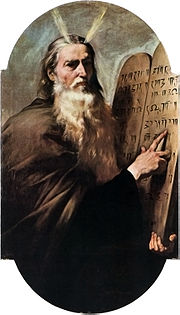
Torah
Torah- A scroll containing the first five books of the BibleThe Torah , is name given by Jews to the first five books of the bible—Genesis , Exodus , Leviticus , Numbers and Deuteronomy Torah- A scroll containing the first five books of the BibleThe Torah , is name given by Jews to the first five...
or Pentateuch) of the Old Testament to Moses
Moses
Moses was, according to the Hebrew Bible and Qur'an, a religious leader, lawgiver and prophet, to whom the authorship of the Torah is traditionally attributed...
. The tradition is first definitively stated in the Babylonian Talmud, an encyclopedia of traditional Jewish learning compiled around the middle of the 1st millennium CE. The Torah, however, does not name its author, and the tradition seems to be founded largely on the fact that it does contain five, somewhat vague, references to Moses writing various things. Other elements which went to form the tradition include the practice among later writers of referring to the "laws of Moses", (although it is not clear just what this meant), and the general sense that authoritative writings should be attached to the names of authoritative figures.
Background: the Torah
In the Christian Old TestamentOld Testament
The Old Testament, of which Christians hold different views, is a Christian term for the religious writings of ancient Israel held sacred and inspired by Christians which overlaps with the 24-book canon of the Masoretic Text of Judaism...
the first five books - Genesis, Exodus, Leviticus
Leviticus
The Book of Leviticus is the third book of the Hebrew Bible, and the third of five books of the Torah ....
, Numbers
Book of Numbers
The Book of Numbers is the fourth book of the Hebrew Bible, and the fourth of five books of the Jewish Torah/Pentateuch....
and Deuteronomy
Deuteronomy
The Book of Deuteronomy is the fifth book of the Hebrew Bible, and of the Jewish Torah/Pentateuch...
- are not set apart in any way from the other books, but in Judaism
Judaism
Judaism ) is the "religion, philosophy, and way of life" of the Jewish people...
they are known as the Torah
Torah
Torah- A scroll containing the first five books of the BibleThe Torah , is name given by Jews to the first five books of the bible—Genesis , Exodus , Leviticus , Numbers and Deuteronomy Torah- A scroll containing the first five books of the BibleThe Torah , is name given by Jews to the first five...
, and are regarded as the most authoritative part of the entire bible.
Genesis tells of the creation of the world
Creation according to Genesis
The Genesis creation narrative describes the divine creation of the world including the first man and woman...
, God's promise to Abraham
Abraham
Abraham , whose birth name was Abram, is the eponym of the Abrahamic religions, among which are Judaism, Christianity and Islam...
of descendants and a land, and the descent of the children of Israel into Egypt. Exodus, Leviticus and Numbers follow with the story of God's deliverance of the Israelites from servitude in Egypt, their meeting with him in the wilderness where they agree to accept him as their god, and their onward journey to the border of Canaan
Canaan
Canaan is a historical region roughly corresponding to modern-day Israel, Palestine, Lebanon, and the western parts of Jordan...
, the land which God promised them. In these three books the central human figure is Moses
Moses
Moses was, according to the Hebrew Bible and Qur'an, a religious leader, lawgiver and prophet, to whom the authorship of the Torah is traditionally attributed...
, the greatest of the biblical prophets, who speaks face to face with God and receives Israel's laws from him. In Deuteronomy, Moses addresses the Israelites for the last time, recalling their history with God and delivering a new set of laws for their future life in the promised land
Promised land
The Promised Land is a term used to describe the land promised or given by God, according to the Hebrew Bible, to the Israelites, the descendants of Jacob. The promise is firstly made to Abraham and then renewed to his son Isaac, and to Isaac's son Jacob , Abraham's grandson...
of Canaan. The Torah ends with the death of Moses and the Israelites about to take possession of the land.
In addition to the Five Books, a Jewish tradition which can be dated to the 2nd century CE holds that Moses also received oral instruction from God at Mount Sinai, and that both were then passed down from generation to generation, the written law in the five books, the oral Torah
Oral Torah
The Oral Torah comprises the legal and interpretative traditions that, according to tradition, were transmitted orally from Mount Sinai, and were not written in the Torah...
in the teachings of the rabbi
Rabbi
In Judaism, a rabbi is a teacher of Torah. This title derives from the Hebrew word רבי , meaning "My Master" , which is the way a student would address a master of Torah...
s.
Basis of the tradition
The tradition that Moses wrote the Five Books grows within the bible and within Judaism after the biblical period (the period of the earliest Christian writings). It reaches a clear statement in the mid-1st millennium with the Babylonian Talmud, an encyclopedia of traditional Jewish lore, which discusses the authorship of all the books of the Hebrew bible and assigns all but the last eight verses of Deuteronomy, which describe the death of Moses, to Moses himself. (Those eight verses it gives to Joshua, who is noted as the author also of the Book of Joshua).The tradition preserved in the Talmud appears to rest primarily on the fact that two of the the five books do refer to Moses writing something, although none of them state that Moses is writing the entire Torah:
- Exodus 17:14: God commands Moses: "Write this, a remembrance..." The context indicates that God is commanding Moses to record Joshua's battle with Amalek described in Exodus 7:8-13.
- Exodus 24:4: "Moses wrote all the words of the Lord." This apparently refers to the laws which God has just given in Exodus 20:21-23:33.
- Exodus 34:28: Moses "wrote upon the tablets the words of the covenant, ten words." The identity of these "ten words" is not made clear, but probably is a reference to the Ten Commandments given several chapters previously, in Exodus 20.
- Deuteronomy 31:9: "Moses wrote this law and gave it to the priests, the sons of Levi, the ones carrying the Ark of the Covenant of the Lord" and Deuteronomy 31:24: "Moses ... finished writing the words of this law on a scroll." It is not clear just what Moses wrote, but it is usually taken to be the collection of laws that make up Deuteronomy 5-30.
- Deuteronomy 31:22: "Moses wrote down this song on that day." The "song" is presumably Deuteronomy 32, the Song of MosesSong of MosesThe Song of Moses in this article relates to the name sometimes given to the poem that appears in Deuteronomy of the Hebrew Bible written/orated just prior to Moses' death atop Mount Nebo....
.
A second fact which appears to have formed the idea that Moses wrote the entire Five Books is the tradition among biblical writers of referring to the "laws of Moses" (Joshua, Kings, Chronicles, Ezra, Nehemiah and Daniel, as well as a wide range of New Testament writings from the Gospels and Acts to the Epistles). In most cases, however, it is not clear what body of writing this refers to. Nehemiah 8:3, for example, tells of Nehemiah reading the Law of Moses "from early morning till the middle of the day" - about six hours. This would require a reading speed faster than one verse every four seconds, without allowing for the interpreters who Nehemiah says were translating his words as he read.
A final factor underpinning the tradition is the sense that authoritative writings must have authoritative authors - thus David came to be associated with the Psalms, Solomon with the Song of Songs, and, within the Christian tradition, the name of the Apostle Paul became attached to the anonymous Epistle to the Hebrews.
Text of the Torah in Talmud and rabbinic tradition
The first unequivocal statement of Mosaic authorship is contained in the TalmudTalmud
The Talmud is a central text of mainstream Judaism. It takes the form of a record of rabbinic discussions pertaining to Jewish law, ethics, philosophy, customs and history....
, c. 200–500, where the rabbis discuss exactly how the Torah was transmitted to Moses.
According to the Babylonian Talmud (Gittin 60a), R' Yochanan asserted that "the Torah was given in a series of small scrolls." This implies that the Torah was written gradually and compiled from a variety of documents over time. This may be an attempt to account for the composite appearance of the five books, but a contrary Talmudic opinion holds that the entire Torah was given at one time.
The Babylonian Talmud
Talmud
The Talmud is a central text of mainstream Judaism. It takes the form of a record of rabbinic discussions pertaining to Jewish law, ethics, philosophy, customs and history....
(tractate Shabbat 115b) states that a peculiar section in the Book of Numbers
Book of Numbers
The Book of Numbers is the fourth book of the Hebrew Bible, and the fourth of five books of the Jewish Torah/Pentateuch....
(10:35 — 36, surrounded by inverted Hebrew
Hebrew alphabet
The Hebrew alphabet , known variously by scholars as the Jewish script, square script, block script, or more historically, the Assyrian script, is used in the writing of the Hebrew language, as well as other Jewish languages, most notably Yiddish, Ladino, and Judeo-Arabic. There have been two...
letter nuns) in fact forms a separate book. On this verse a midrash
Midrash
The Hebrew term Midrash is a homiletic method of biblical exegesis. The term also refers to the whole compilation of homiletic teachings on the Bible....
on the book of Mishle
Book of Proverbs
The Book of Proverbs , commonly referred to simply as Proverbs, is a book of the Hebrew Bible.The original Hebrew title of the book of Proverbs is "Míshlê Shlomoh" . When translated into Greek and Latin, the title took on different forms. In the Greek Septuagint the title became "paroimai paroimiae"...
states that "These two verses stem from an independent book which existed, but was suppressed!" Another (possibly earlier) midrash, Ta'ame Haserot Viyterot , states that this section actually comes from the book of prophecy of Eldad and Medad.
Abaye, a Rabbi who died in the year 339, said that the speeches Moses gave in the first two books were God's words and were said on God's behalf, while the speeches in Deuteronomy where prophetic, but said in his own words and on his own behalf.
Also in the Talmud, Rabbi Judah ben Ilai
Judah ben Ilai
Judah bar Ilai, also known as Judah ben Ilai, Rabbi Judah or Judah the Palestinian , was a tanna of the 2nd Century and son of Rabbi Ilai I. Of the many Judahs in the Talmud, he is the one referred to simply as "Rabbi Judah" and is the most frequently mentioned sage in the Mishnah.Judah bar Ilai...
held that Joshua must have written the final verses of the Torah (Talmud, B. Bat. 15a and Menah. 30a, and in Midrash Sipre. 357).
David Weiss Halivni
David Weiss Halivni
David Weiss Halivni is an American-Israeli rabbi, scholar in the domain of Jewish Sciences and professor of Talmud.-Biography:...
writes that parts of the ancient Midrash
Midrash
The Hebrew term Midrash is a homiletic method of biblical exegesis. The term also refers to the whole compilation of homiletic teachings on the Bible....
literature retain evidence of the redaction
Redaction
Redaction is a form of editing in which multiple source texts are combined and subjected to minor alteration to make them into a single work. Often this is a method of collecting a series of writings on a similar theme and creating a definitive and coherent work...
al period during which Ezra
Ezra
Ezra , also called Ezra the Scribe and Ezra the Priest in the Book of Ezra. According to the Hebrew Bible he returned from the Babylonian exile and reintroduced the Torah in Jerusalem...
redacted and canonized the text of the Torah as it survives today. A rabbinic tradition states that at this time (440 BCE), Ezra edited the text of the Torah, and found ten places in the Torah where lacked certainty as to how to fix the text; these passages appear marked with special punctuation marks called the eser nekudot.
In the Middle Ages, Rabbi Abraham ibn Ezra
Abraham ibn Ezra
Rabbi Abraham ben Meir Ibn Ezra was born at Tudela, Navarre in 1089, and died c. 1167, apparently in Calahorra....
(ca. 1092 - 1167 CE) and others observed that some phrases in the Torah present information that people should only have known after the time of Moses. For example, see Ibn Ezra's comments on Gen 12:6; 22:14; Deut
Deuteronomy
The Book of Deuteronomy is the fifth book of the Hebrew Bible, and of the Jewish Torah/Pentateuch...
1:2; 3:11; and 34:1, 6. Rabbi Joseph Bonfils elucidated Ibn Ezra's comments in his commentary on Ibn Ezra's work. (see below.)
In the 12th century the commentator Rabbi Joseph ben Isaac, known as the Bekhor Shor, noted close similarities between a number of wilderness narratives in Exodus and Numbers, in particular, the incidents of water from the rock and the stories about manna and the quail. He hypothesised that both of these incidents actually happened once, but that parallel traditions about these events eventually developed, both of which made their way into the Torah.
In the 13th century Rabbi Hezekiah ben Manoah
Hezekiah ben Manoah
Hezekiah ben Manoah was a French rabbi and exegete.In memory of his father, who lost his right hand through his stead-fastness in the faith, Hezekiah wrote a commentary on the Pentateuch, under the title Ḥazzeḳuni. It was printed at Venice in 1524...
(known as the Hizkuni) noticed the same textual anomalies that Ibn Ezra had noted; thus R. Hezekiah's commentary on Gen 12:6 notes that this section "is written from the perspective of the future".
In the 15th century, Rabbi Yosef Bonfils, while discussing the comments of Ibn Ezra, noted: "Thus it would seem that Moses did not write this word here, but Joshua or some other prophet wrote it. Since we believe in the prophetic tradition, what possible difference can it make whether Moses wrote this or some other prophet did, since the words of all of them are true and prophetic?"
A review of these issues from an Orthodox Jewish perspective can be found in Modern Scholarship in the Study of Torah: Contributions and Limitations, edited by Shalom Carmy (Jason Aronson, Inc.), and Handbook of Jewish Thought, Volume I, by Aryeh Kaplan
Aryeh Kaplan
Aryeh Moshe Eliyahu Kaplan was a noted American Orthodox rabbi and author known for his "intimate knowledge of both physics and kabbalah." He was lauded as an original thinker and prolific writer, from studies of the Torah, Talmud and mysticism to introductory pamphlets on Jewish beliefs and...
(Moznaim Pub.)
Modern scholarship
Biblical scholars prior to the Renaissance and Reformation were generally not much concerned with the question of who wrote the bible. This began to change as the new field of Classical studies (meaning the study of the literature of ancient Greece and Rome) put the examination of ancient texts on a scientific footing. When these same critical tools were applied to the Torah the numerous duplications in the five books led Richard SimonRichard Simon
Richard Simon was a French Oratorian, influential advanced biblical critic, orientalist, and controversialist.-Early years:...
(1638-1712) to argue that they had not come from one author. Simon proposed that it was Ezra
Ezra
Ezra , also called Ezra the Scribe and Ezra the Priest in the Book of Ezra. According to the Hebrew Bible he returned from the Babylonian exile and reintroduced the Torah in Jerusalem...
, in the post-Exilic period (5th century BCE), who had produced the Torah in its final form, albeit using documents produced by Moses. Jean Astruc
Jean Astruc
Jean Astruc was a professor of medicine at Montpellier and Paris, who wrote the first great treatise on syphilis and venereal diseases, and also, with a small anonymously published book, played a fundamental part in the origins of critical textual analysis of works of scripture...
(1684-1766), accepting Simon's evidence but rejecting his conclusion, argued that Moses was indeed the author of the Torah, and that he had used two major sources and ten additional fragments as the basis for his work.
Modern Orthodox Jewish scholarship
David Zvi HoffmanDavid Zvi Hoffman
David Zvi Hoffmann , was an Orthodox Rabbi and Torah Scholar. Born in Verbó in 1843, he attended various Yeshivas in his native town before he entered the college at Pressburg, from which he graduated in 1865...
, in his commentary to Leviticus, made use of rabbinic homiletic and exegetical interpretations as well as some of his own insights to explain the difficulties noted by Wellhausen and other critics and to defend Mosaic authorship. His Die wichtigsten Instanzen gegen die Graf-Wellhausensche Hypothese (2 vols., 1903/1916) pointed out several difficulties in the Wellhasuen hypothesis, most notably in his theory that the Priestly code, and hence the Jewish conception of monotheism, was of late post-exilic redaction. His approach to biblical investigation is still studied.
Rabbi Mordechai Breuer
Mordechai Breuer
Mordechai Breuer was an Orthodox rabbi. He was one of the world's leading experts on Tanakh , and especially of the text of the Aleppo Codex....
believes that "the Torah must speak in the language of men." Therefore Breuer postulates that the Torah resorts to a technique of multi-vocal communication: texts that appear dissimilar in fact offer a powerful counterpoint.
Rabbi Menachem Mendel Kasher
Menachem Mendel Kasher
Menachem Mendel Kasher was a Polish-born Israeli rabbi and prolific author who authored an encyclopedic work on the Torah entitled Torah Sheleimah.-Early life:...
points to certain traditions of the Oral Torah
Oral Torah
The Oral Torah comprises the legal and interpretative traditions that, according to tradition, were transmitted orally from Mount Sinai, and were not written in the Torah...
which show Moses quoting Genesis prior to the epiphany at Sinai; based on a number of Bible verses and rabbinic statements, he suggests that Moses made use of documents authored by the Patriarchs when redacting that book.
In Revelation Restored, Rabbi David Weiss Halivni
David Weiss Halivni
David Weiss Halivni is an American-Israeli rabbi, scholar in the domain of Jewish Sciences and professor of Talmud.-Biography:...
develops a theory of Chate'u Yisroel (literally, "Israel has sinned"): "According to the biblical account itself, the people of Israel forsook the Torah, in the dramatic episode of the golden calf, only forty days after the revelation at Sinai. From that point on, until the time of Ezra, the scriptures reveal that the people of Israel were steeped in idolatry and negligent of the Mosaic law. Chate'u Yisrael, as a theological account, explains that in the period of neglect and syncretism after the conquest of Canaan when the originally monotheistic Israelites adopted pagan practices from their neighbours, the Torah of Moses became "blemished and maculated." According to Halivni, this process continued until the time of Ezra (c.450 BC), when finally, upon their return from Babylon, the people accepted the Torah. It was at that time that the previously rejected, and therefore maculated, text of the Torah was recompiled and edited by Ezra and his “entourage.” This is attested in the books of Ezra and Nehemiah, and Halivni supports his theory with Talmudic and Midrashic sources which indicate that Ezra played a role in editing the Torah. He further states that while the text of the Pentateuch was corrupted, oral tradition preserved intact many of the laws, which is why the Oral Law appears to contradict the Biblical text in certain details.
A-Mosaica and post-Mosaica
Some who maintain that the Pentateuch is mainly the writing of Moses distinguish some passages as a-Moasiaca or post-Mosaica. As an example of a-Mosaica, there is Numbers 12:3, "(Now Moses was a very humble man, more humble than anyone else on the face of the earth.)" (NIV), for a humble man would not be expected to claim that superlative of himself. As an example of post-Mosaica, the standard example is the description of the death of Moses in Deuteronomy 34.See also
- Documentary hypothesisDocumentary hypothesisThe documentary hypothesis , holds that the Pentateuch was derived from originally independent, parallel and complete narratives, which were subsequently combined into the current form by a series of redactors...
- Wiseman hypothesisWiseman hypothesisThe Wiseman hypothesis, sometimes called the tablet theory, is a theory of the authorship and composition of the Book of Genesis which suggests that Moses compiled Genesis from tablets handed down through Abraham and the other patriarchs. Originally advocated by P. J...
(Tablet theory) - Moses in rabbinic literatureMoses in rabbinic literatureAllusions in rabbinic literature to the Biblical character Moses, who led the people of Israel out of Egypt and through their wanderings in the wilderness, contain various expansions, elaborations and inferences beyond what is presented in the text of the Bible itself.- Overview :Of all Biblical...
- MosesMosesMoses was, according to the Hebrew Bible and Qur'an, a religious leader, lawgiver and prophet, to whom the authorship of the Torah is traditionally attributed...
- TorahTorahTorah- A scroll containing the first five books of the BibleThe Torah , is name given by Jews to the first five books of the bible—Genesis , Exodus , Leviticus , Numbers and Deuteronomy Torah- A scroll containing the first five books of the BibleThe Torah , is name given by Jews to the first five...
- TanakhTanakhThe Tanakh is a name used in Judaism for the canon of the Hebrew Bible. The Tanakh is also known as the Masoretic Text or the Miqra. The name is an acronym formed from the initial Hebrew letters of the Masoretic Text's three traditional subdivisions: The Torah , Nevi'im and Ketuvim —hence...
External links
- Who Wrote the Torah Evidence for Mosaic Authorship
- Explaining anachronisms Explaining the anachronisms