
|
|
|
|
Morning dress
|
| |
|
| |
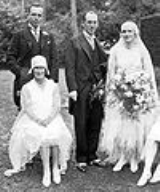
Morning dress is the daytime form of men's formal dress.
name originated from the practice of gentlemen in the nineteenth century riding a horse in the morning with a cutaway front single breasted morning coat. The modern twentieth century morning dress was originally a more casual form of half dress, but as the nineteenth century progressed it gradually became acceptable to wear it in more formal situations instead of a frock coat.

Discussion
Ask a question about 'Morning dress'
Start a new discussion about 'Morning dress'
Answer questions from other users
|
Encyclopedia
Morning dress is the daytime form of men's formal dress.
History
The name originated from the practice of gentlemen in the nineteenth century riding a horse in the morning with a cutaway front single breasted morning coat. The modern twentieth century morning dress was originally a more casual form of half dress, but as the nineteenth century progressed it gradually became acceptable to wear it in more formal situations instead of a frock coat. In the Edwardian era it took over in popularity from the frock coat as the standard daytime form of men's full dress. When it was regarded as a more casual coat, it was common to see it made with step collars (notched lapels in American English), but as it took over from the frock coat in formality it began to be made with the more formal pointed lapels (peaked lapels in American English).
Occasions Men wear morning dress when members of a wedding party. In common with court dress, mess dress, and white tie, morning dress is for prestigious and important social occasions. Despite its name, morning dress may be worn to afternoon social events before five o'clock, but not to events beginning after seven o'clock in the evening.
White tie (evening dress) is the correct, equivalent formal dress for evening social events. The cutaway front of the morning tail coat differs from the evening tail coat (dress coat) in that the waist of former is cut obliquely while the waist of the latter is cut horizontally, and the tail is cut differently from the swallow tailcoat used for evening dress. The skirt waist construction of the coats is equestrian in origin, to ease the wearer's riding his horse. In the U.S., the morning coat is referred to as a cutaway coat.
In the U.K. and the Continent, morning dress is worn to equestrian events (Royal Ascot races), weddings, funerals, and state events. It is also worn by members of a wedding party in the Commonwealth, e.g. Australia and New Zealand. In Europe, the groom sets the sartorial tone: the guests may wear morning dress if he does. In the U.S., morning dress is rare; it usually is worn in traditional weddings and political formal events. In the American South, morning dress is commonly worn by a governor-elect when sworn to office.
Elements
Outline
Briefly, morning dress consists of:
- a morning tailcoat
- a buff (sometimes grey, or at a funeral black) waistcoat (vest in American English), which may be either single-breasted or double-breasted
- a pair of formal striped or checked trousers worn with braces (suspenders in American English)
- a double-cuffed shirt (if laydown collar) or single-cuffed if high collar.
- a stiff white detachable collar (attached using collar studs) or a soft turned-down collar, either sewn on or attached with collar studs.
- a necktie or (commonly at weddings only) a cravat (Ascot tie in American English). A cravat affixed with tie pin is worn with a high/wing-collar shirt. Ascots, despite their name have not been frequently worn at Ascot Racecourse for some decades, the long necktie being preferred.
- a plain or patterned silk handkerchief or pocket square; folded and inserted into the front breast pocket of the morning coat
- black Oxford shoes or dress boots (caps are now worn, despite the business-like image), or boots with a horse riding connection, such as George or Chelsea boot; worn with plain dark socks (or another colour if they can't been seen)
The following can optionally be worn or carried with morning dress:
Description
The morning tailcoat (or simply "morning coat") can be many colours, though most popular is black or Oxford grey herringbone wool with the tails of knee length. The formal trousers worn with it are 'cashmere' striped, or black and white checked.
The most traditional colours for a waistcoat are grey or buff (a yellowish tan colour), with white as another alternative, but black is used for the most formal occasions (grey is usual for weddings). A black morning coat with matching black waistcoat is the most formal option, being worn for funerals, memorial services, diplomatic dress, and with academic dress. The United States Solicitor General and deputies, for example, wears a black morning coat with matching black waistcoat and striped trousers when he argues before the Supreme Court of the United States. Sometimes a white slip, an under-waistcoat just showing inside the top opening of the waistcoat, is worn. Nowadays coloured and patterned waistcoats are sometimes seen, but these are really only considered suitable for weddings.
The trousers should not have turn-ups (cuffs in American English), and should have one or two forward pleats to each leg. Braces (suspenders in American English) should be worn to prevent the waistband from appearing beneath the waistcoat.
A white stiff collar was traditionally worn, normally of the plain turn-down cutaway variety in which case a standard long tie is worn. However, apart from at weddings, in most situations a long tie and turn-down collar have become acceptable as some see that the cravat with morning dress has been overdone. With a cravat a wing collar is worn. If the shirt has turn-down collars it should have sleeves with double cuffs fastened with cufflinks. If a wing collar is worn it should be with a single cuff shirt fastened with cufflinks, with detachable collar and cuffs being the more strictly traditional option. The most formal colour for a shirt is white, but if a coloured or striped shirt is worn, it should have contrasting white collar and cuffs.
Previously, a grey or (if at a funeral) a black tie was obligatory. Now all colours are worn. The original silver Macclesfield design (a small check) is still used particularly with cravats, and is often called a wedding tie.
Shoes should be of the traditional, black plain cap-toe Oxford type without brogueing, but not patent leather which is now reserved for evening formal wear. In the Victorian and Edwardian era button boots and Oxford boots were worn and these can be correctly worn with morning dress today. When worn at equestrian events, boots of equestrian origin such as jodhpur boots, George boots and Chelsea boots are also acceptable. Spats were once frequently seen with morning dress, but are now rarely worn.
Variants
Morning suit Slightly less formally, a morning suit can be worn, which has mid-grey matching morning coat, waistcoat, and trousers (all cut the same as above); being more relaxed, this is a traditional option for events in less formal settings such as Royal Ascot, and is now often worn to weddings as well.
Scottish Highland dress
Scottish Highland dress may also be worn at events requiring morning dress:
The morning suit version of Highland dress consists of:
- Black (or charcoal) semi-formal kilt jacket - the Argyll (or Crail or Braemar) jacket is suitable
- Black (or charcoal) barathea waistcoat matching the jacket
- Kilt
- White shirt with cufflinks (collar either standard or wingtip)
- Silver tie or a tie in a single colour matching the kilt (i.e. not a tartan tie)
- Black Ghillie brogues
- Kilt hose of a colour (not tartan) matching the kilt; alternatively, cream kilt hose.
- Flashes
- Sporran
- Sgian dubh
- Dirk
Semi-formal morning dress This is similar but not equivalent in formality, and thus unlike the above options not interchangeable with full morning dress.
|
| |
|
|