

Mormon cricket

Encyclopedia
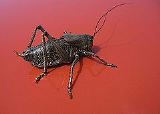
The Mormon cricket is a large insect
that can grow to almost three inches in length. They live throughout western North America
in rangeland
s dominated by sagebrush
and forb
s.
Despite its name, the Mormon cricket is actually a shieldbacked katydid
, not a cricket
.
The Mormon cricket is flightless, but capable of traveling up to two kilometers a day in its swarming phase, during which it is a serious agricultural pest and traffic hazard.
that covers vestigial wings) behind the head may have colored markings. The abdomen may appear to be striped. Females have a long ovipositor
, which should not be mistaken for a stinger. Both sexes have long antennae.
Mormon crickets may undergo morphological changes triggered by high population densities, similar to those seen in locust
s. The most noticeable change is in coloration: solitary individuals typically have green or purple coloration, while swarming individuals are often black, brown or red.
pass through seven instar
s before reaching the adult stage, typically taking 60 to 90 days.
Breeding begins within 10 to 14 days of reaching the adult stage. The male passes a large spermatophore
to the female, which can be up to 27% of his body weight. The spermatophore is mostly food for the female to consume but also contains sperm to fertilize her eggs. The value of this nuptial gift is such that swarming-phase females compete for males. This sexual role-reversal is not seen in solitary-phase females.
The female lays her eggs by thrusting her ovipositor deep into the soil. Females can lay about one hundred eggs each.
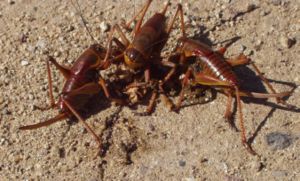
New research shows that Mormon crickets move in these migratory bands, firstly to find new sources of the critical nutrients of protein and salt, and secondly to avoid being eaten by hungry crickets approaching from the rear. The Mormon cricket's cannibalistic behavior may lead to swarm behavior because crickets may need to move constantly forward to avoid attacks from behind.
When a large band crosses a road it can cause a safety hazard by causing distracted revulsion on the part of the driver, and by causing the road surface to become slick with Mormon cricket guts. The crickets also can cause devastation in agricultural areas.
 The Mormon cricket prefers to eat forb
s, but grass
es and shrub
s such as sagebrush
are also eaten, as are insects and other Mormon crickets (especially individuals that have been killed or injured by automobiles or insecticides). A recent study has suggested that the migration of swarms may be a strategy to avoid predation by other Mormon crickets.
During an infestation Mormon crickets can cause significant damage to crops and gardens.
s, crows, coyote
s and various rodents. They were also eaten by Native Americans
. There are no predators that specialize on Mormon crickets, which may be explained by the cricket's migratory habits and large population fluctuations.
The most common chemical control method used is carbaryl
(typically sold as "Sevin") bait. This bait kills both the Mormon crickets that eat the bait, and the crickets that eat crickets that eat the bait. Insecticides applied directly to crops may kill the insects, but due to the large size of swarms this method usually does not save the crop from being destroyed.
As Mormon crickets are flightless, physical barriers may be effective. Barriers should be at least two feet high and made of a smooth material. Recently, residents of some small towns have been effectively using boom boxes and sound system
s playing hard rock
music to divert the moving swarms away from crops and houses. Music seems to deter the insects, although it is unknown if the result is due to the music or the heavy vibrations.
settlement in Utah
was saved from famine
by gull
s eating hordes of Mormon crickets that had been destroying their first wheat
crop; hence the name of the insect. California Gull
s are known to relocate to desert areas to feed on Mormon cricket swarms, although their effectiveness in controlling infestations is thought to be minimal. Tradition and recent eye-witness reports also mention that the gulls vomit after eating Mormon crickets, which may indicate they contain chemicals which induce aversion to eating more.
In 2003, officials in Utah, Idaho and Nevada said that year's infestation might be the worst in recent history.
Insect
Insects are a class of living creatures within the arthropods that have a chitinous exoskeleton, a three-part body , three pairs of jointed legs, compound eyes, and two antennae...
that can grow to almost three inches in length. They live throughout western North America
North America
North America is a continent wholly within the Northern Hemisphere and almost wholly within the Western Hemisphere. It is also considered a northern subcontinent of the Americas...
in rangeland
Rangeland
Rangelands are vast natural landscapes in the form of grasslands, shrublands, woodlands, wetlands, and deserts. Types of rangelands include tallgrass and shortgrass prairies, desert grasslands and shrublands, woodlands, savannas, chaparrals, steppes, and tundras...
s dominated by sagebrush
Sagebrush
Sagebrush is a common name of a number of shrubby plant species in the genus Artemisia native to western North America;Or, the sagebrush steppe ecoregion, having one or more kinds of sagebrush, bunchgrasses and others;...
and forb
Forb
A forb is a herbaceous flowering plant that is not a graminoid . The term is used in biology and in vegetation ecology, especially in relation to grasslands and understory.-Etymology:...
s.
Despite its name, the Mormon cricket is actually a shieldbacked katydid
Tettigoniidae
The family Tettigoniidae, known in American English as katydids and in British English as bush-crickets, contains more than 6,400 species. It is part of the suborder Ensifera and the only family in the superfamily Tettigonioidea. They are also known as long-horned grasshoppers, although they are...
, not a cricket
Cricket (insect)
Crickets, family Gryllidae , are insects somewhat related to grasshoppers, and more closely related to katydids or bush crickets . They have somewhat flattened bodies and long antennae. There are about 900 species of crickets...
.
The Mormon cricket is flightless, but capable of traveling up to two kilometers a day in its swarming phase, during which it is a serious agricultural pest and traffic hazard.
Appearance
Mormon crickets have variable coloration. The overall color may be black, brown, red, purple or green. The "shield" (pronotum or modified prothoraxProthorax
The prothorax is the foremost of the three segments in the thorax of an insect, and bears the first pair of legs. Its principal sclerites are the pronotum , the prosternum , and the propleuron on each side. The prothorax never bears wings in extant insects, though some fossil groups possessed...
that covers vestigial wings) behind the head may have colored markings. The abdomen may appear to be striped. Females have a long ovipositor
Ovipositor
The ovipositor is an organ used by some animals for oviposition, i.e., the laying of eggs. It consists of a maximum of three pairs of appendages formed to transmit the egg, to prepare a place for it, and to place it properly...
, which should not be mistaken for a stinger. Both sexes have long antennae.
Mormon crickets may undergo morphological changes triggered by high population densities, similar to those seen in locust
Locust
Locusts are the swarming phase of short-horned grasshoppers of the family Acrididae. These are species that can breed rapidly under suitable conditions and subsequently become gregarious and migratory...
s. The most noticeable change is in coloration: solitary individuals typically have green or purple coloration, while swarming individuals are often black, brown or red.
Life cycle
Mormon cricket eggs mostly hatch the spring after they are laid, although in some areas eggs may take as many as five years to hatch. Hatching begins when soil temperatures reach 40 °F (4 °C). The nymphsNymph (biology)
In biology, a nymph is the immature form of some invertebrates, particularly insects, which undergoes gradual metamorphosis before reaching its adult stage. Unlike a typical larva, a nymph's overall form already resembles that of the adult. In addition, while a nymph moults it never enters a...
pass through seven instar
Instar
An instar is a developmental stage of arthropods, such as insects, between each molt , until sexual maturity is reached. Arthropods must shed the exoskeleton in order to grow or assume a new form. Differences between instars can often be seen in altered body proportions, colors, patterns, or...
s before reaching the adult stage, typically taking 60 to 90 days.
Breeding begins within 10 to 14 days of reaching the adult stage. The male passes a large spermatophore
Spermatophore
A spermatophore or sperm ampulla is a capsule or mass created by males of various animal species, containing spermatozoa and transferred in entirety to the female's ovipore during copulation...
to the female, which can be up to 27% of his body weight. The spermatophore is mostly food for the female to consume but also contains sperm to fertilize her eggs. The value of this nuptial gift is such that swarming-phase females compete for males. This sexual role-reversal is not seen in solitary-phase females.
The female lays her eggs by thrusting her ovipositor deep into the soil. Females can lay about one hundred eggs each.
Swarming
The Mormon cricket exists in populations of relatively low density throughout most of its range. However, at certain times and places, population explosions or infestations occur in which large numbers of the cricket form roving bands. These bands may include millions of individuals and be found with densities of up to 100 individuals per square meter. These infestations may last years or even decades, and are characterized by a gradual increase and then decrease in population. The factors that trigger these infestations are poorly understood, but are thought to be weather-related.New research shows that Mormon crickets move in these migratory bands, firstly to find new sources of the critical nutrients of protein and salt, and secondly to avoid being eaten by hungry crickets approaching from the rear. The Mormon cricket's cannibalistic behavior may lead to swarm behavior because crickets may need to move constantly forward to avoid attacks from behind.
When a large band crosses a road it can cause a safety hazard by causing distracted revulsion on the part of the driver, and by causing the road surface to become slick with Mormon cricket guts. The crickets also can cause devastation in agricultural areas.
Food
Forb
A forb is a herbaceous flowering plant that is not a graminoid . The term is used in biology and in vegetation ecology, especially in relation to grasslands and understory.-Etymology:...
s, but grass
Grass
Grasses, or more technically graminoids, are monocotyledonous, usually herbaceous plants with narrow leaves growing from the base. They include the "true grasses", of the Poaceae family, as well as the sedges and the rushes . The true grasses include cereals, bamboo and the grasses of lawns ...
es and shrub
Shrub
A shrub or bush is distinguished from a tree by its multiple stems and shorter height, usually under 5–6 m tall. A large number of plants may become either shrubs or trees, depending on the growing conditions they experience...
s such as sagebrush
Sagebrush (plant)
Sagebrush is the common name for Artemisia tridentata and a number of other species of shrubby plants in the genus Artemisia, native to the North American west and other parts of the world. It is sometimes confused with sage plants ....
are also eaten, as are insects and other Mormon crickets (especially individuals that have been killed or injured by automobiles or insecticides). A recent study has suggested that the migration of swarms may be a strategy to avoid predation by other Mormon crickets.
During an infestation Mormon crickets can cause significant damage to crops and gardens.
Control
Mormon crickets are preyed upon by a wide variety of birds and mammals. These predators include California GullCalifornia Gull
The California Gull Larus californicus is a medium-sized gull, smaller on average than the Herring Gull but larger on average than the Ring-billed Gull, though may overlap in size greatly with both....
s, crows, coyote
Coyote
The coyote , also known as the American jackal or the prairie wolf, is a species of canine found throughout North and Central America, ranging from Panama in the south, north through Mexico, the United States and Canada...
s and various rodents. They were also eaten by Native Americans
Native Americans in the United States
Native Americans in the United States are the indigenous peoples in North America within the boundaries of the present-day continental United States, parts of Alaska, and the island state of Hawaii. They are composed of numerous, distinct tribes, states, and ethnic groups, many of which survive as...
. There are no predators that specialize on Mormon crickets, which may be explained by the cricket's migratory habits and large population fluctuations.
The most common chemical control method used is carbaryl
Carbaryl
Carbaryl is a chemical in the carbamate family used chiefly as an insecticide. It is a white crystalline solid commonly sold under the brand name Sevin, a trademark of the Bayer Company. Union Carbide discovered carbaryl and introduced it commercially in 1958...
(typically sold as "Sevin") bait. This bait kills both the Mormon crickets that eat the bait, and the crickets that eat crickets that eat the bait. Insecticides applied directly to crops may kill the insects, but due to the large size of swarms this method usually does not save the crop from being destroyed.
As Mormon crickets are flightless, physical barriers may be effective. Barriers should be at least two feet high and made of a smooth material. Recently, residents of some small towns have been effectively using boom boxes and sound system
High fidelity
High fidelity—or hi-fi—reproduction is a term used by home stereo listeners and home audio enthusiasts to refer to high-quality reproduction of sound or images, to distinguish it from the poorer quality sound produced by inexpensive audio equipment...
s playing hard rock
Hard rock
Hard rock is a loosely defined genre of rock music which has its earliest roots in mid-1960s garage rock, blues rock and psychedelic rock...
music to divert the moving swarms away from crops and houses. Music seems to deter the insects, although it is unknown if the result is due to the music or the heavy vibrations.
Historical
Tradition tells of a story where the first MormonMormon
The term Mormon most commonly denotes an adherent, practitioner, follower, or constituent of Mormonism, which is the largest branch of the Latter Day Saint movement in restorationist Christianity...
settlement in Utah
Utah
Utah is a state in the Western United States. It was the 45th state to join the Union, on January 4, 1896. Approximately 80% of Utah's 2,763,885 people live along the Wasatch Front, centering on Salt Lake City. This leaves vast expanses of the state nearly uninhabited, making the population the...
was saved from famine
Famine
A famine is a widespread scarcity of food, caused by several factors including crop failure, overpopulation, or government policies. This phenomenon is usually accompanied or followed by regional malnutrition, starvation, epidemic, and increased mortality. Every continent in the world has...
by gull
Miracle of the Gulls
The miracle of the gulls is often credited by Latter-day Saints for saving the Mormon pioneers' first harvest in Utah. According to Mormon folklore, seagulls miraculously saved the 1848 crops by eating thousands of insects that were devouring their fields.-Traditional story:After Brigham Young led...
s eating hordes of Mormon crickets that had been destroying their first wheat
Wheat
Wheat is a cereal grain, originally from the Levant region of the Near East, but now cultivated worldwide. In 2007 world production of wheat was 607 million tons, making it the third most-produced cereal after maize and rice...
crop; hence the name of the insect. California Gull
California Gull
The California Gull Larus californicus is a medium-sized gull, smaller on average than the Herring Gull but larger on average than the Ring-billed Gull, though may overlap in size greatly with both....
s are known to relocate to desert areas to feed on Mormon cricket swarms, although their effectiveness in controlling infestations is thought to be minimal. Tradition and recent eye-witness reports also mention that the gulls vomit after eating Mormon crickets, which may indicate they contain chemicals which induce aversion to eating more.
In 2003, officials in Utah, Idaho and Nevada said that year's infestation might be the worst in recent history.