
is the capital
city||A is a local administrative unit in Japan. Cities are ranked on the same level as and , with the difference that they are not a component of...
of
Iwate Prefectureis the second largest prefecture of Japan after Hokkaido. It is located in the Tōhoku region of Honshū island and contains the island's easternmost point. The capital is Morioka. Iwate has the lowest population density of any prefecture outside Hokkaido...
,
JapanJapan is an island nation in East Asia. Located in the Pacific Ocean, it lies to the east of the Sea of Japan, China, North Korea, South Korea and Russia, stretching from the Sea of Okhotsk in the north to the East China Sea and Taiwan in the south...
.
As of 2005, the city has an estimated
populationA population is all the organisms that both belong to the same group or species and live in the same geographical area. The area that is used to define a sexual population is such that inter-breeding is possible between any pair within the area and more probable than cross-breeding with individuals...
of 300,740 and a
population densityPopulation density is a measurement of population per unit area or unit volume. It is frequently applied to living organisms, and particularly to humans...
of 588.11 persons per km². The total area is 489.15 km².
Morioka was founded in 1597 by Nobunao, the 26th lord of the Nanbu clan, as a castle town. In 1655 Nanbu-han was divided into Morioka-han and Hachinohe-han. Its name was changed from 森岡 to 盛岡 (both read as Morioka) in 1683 when the population was 36,000. The city was designated the capital of Iwate on April 1, 1889.
History
Morioka is in the territory inhabited by the
EmishiThe constituted a group of people who lived in northeastern Honshū in the Tōhoku region. They are referred to as in contemporary sources. Some Emishi tribes resisted the rule of the Japanese Emperors during the late Nara and early Heian periods...
people in ancient times. The general
Sakanoue no Tamuramarowas a general and shogun of the early Heian Period of Japan. He was the son of Sakanoue no Karitamaro.-Military career:Serving Emperor Kammu, he was appointed shogun and given the task of conquering the Emishi , a people native to the north of Honshū, which he subjugated...
, who was ordered to conquer the Emishi, built Shiwa Castle here in 803, and the region gradually was brought under imperial control.
At the end of the
Heian periodThe is the last division of classical Japanese history, running from 794 to 1185. The period is named after the capital city of Heian-kyō, or modern Kyōto. It is the period in Japanese history when Buddhism, Taoism and other Chinese influences were at their height...
, Morioka was under the control of the Ōshū Fujiwara Clan based in
Hiraizumiis a town located in Nishiiwai District, Iwate, Japan. It was the home of the Hiraizumi Fujiwaras for about 100 years in the late Heian era and most of the following Kamakura period. At the same time it served as the de facto capital of Oshu, an area containing nearly a third of the Japanese land...
, to the south of Morioka. The clan was destroyed by
shogunA was one of the hereditary military dictators of Japan from 1192 to 1867. In this period, the shoguns, or their shikken regents , were the de facto rulers of Japan though they were nominally appointed by the emperor...
Minamoto no Yoritomowas the founder and the first shogun of the Kamakura Shogunate of Japan. He ruled from 1192 until 1199.-Early life and exile :Yoritomo was the third son of Minamoto no Yoshitomo, heir of the Minamoto clan, and his official wife, a daughter of Fujiwara no Suenori, who was a member of the...
, and the Kudo Clan replaced it. During the
Muromachi periodThe is a division of Japanese history running from approximately 1336 to 1573. The period marks the governance of the Muromachi or Ashikaga shogunate, which was officially established in 1338 by the first Muromachi shogun, Ashikaga Takauji, two years after the brief Kemmu restoration of imperial...
, the
Nanbu clanThe ' was a Japanese samurai clan originating in northern Japan, specifically Mutsu Province . The Nanbu claimed descent from the Minamoto clan, and its members first enter the historical record as residents of Kai Province during the Kamakura period. The clan later moved to Mutsu...
, based in Sannohe to the north, expanded its territory and built Kozukata Castle here. Kozukata changed its name to Morioka in the 17th century.
In the
Boshin WarThe was a civil war in Japan, fought from 1868 to 1869 between forces of the ruling Tokugawa shogunate and those seeking to return political power to the imperial court....
, Morioka made a pro-shogunate alliance with
Aizuis an area comprising the westernmost third of Fukushima Prefecture in Japan. The principal city of the area is Aizuwakamatsu.During the Edo period, Aizu was a feudal domain known as and part of Mutsu Province.-History:...
, and fought against the imperial force. As a consequence Kozukata castle was destroyed in 1874.
As a consequence of the
2011 Tōhoku earthquakeThe 2011 earthquake off the Pacific coast of Tohoku, also known as the 2011 Tohoku earthquake, or the Great East Japan Earthquake, was a magnitude 9.0 undersea megathrust earthquake off the coast of Japan that occurred at 14:46 JST on Friday, 11 March 2011, with the epicenter approximately east...
, Morioka was hit by a 6.1 earthquake.
Merger
On January 10, 2006, the village of
TamayamaTamayama was a village located in Iwate District, Iwate, Japan.On January 10, 2006 Tamayama was merged into the city of Morioka....
, from
Iwate Districtis a district located in Iwate, Japan. As of 2003, the district has an estimated population of 142,495. The total area is 2,846.44 km². The district covers the northern part of Morioka Metropolitan Area...
, was merged into Morioka.
Geography and climate
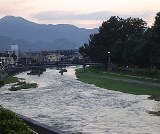
Morioka is located in the Kitakami Basin at the confluence of three rivers, the
KitakamiThe is the fourth largest river in Japan and the largest in the Tōhoku region. It is 249 kilometers long and drains an area of 10,150 square kilometers. It flows through mostly rural areas of Iwate and Miyagi Prefectures. The river is unusual in that it has two mouths, one flowing south into...
, the
ShizukuishiThe is a river in Iwate Prefecture, Japan.The Shizukuishi River rises in the Ōu Mountains just south of Mt. Akita Komagatake in Shizukuishi and empties into the Kitakami River in Morioka. The Gosho Dam is situated on the Shizukuishi River, in western Morioka. This dam was completed in 1981...
and the
NakatsuThe is a river in Iwate Prefecture, Japan. It flows through the city of Morioka, where it enters the Kitakami River....
. The
Kitakami RiverThe is the fourth largest river in Japan and the largest in the Tōhoku region. It is 249 kilometers long and drains an area of 10,150 square kilometers. It flows through mostly rural areas of Iwate and Miyagi Prefectures. The river is unusual in that it has two mouths, one flowing south into...
is the second largest river on the Pacific side of Japan (after the
Kiso GawaThe is a river in Japan roughly 193 km long, flowing through the prefectures of Nagano, Gifu, Aichi, and Mie before emptying into Ise Bay a short distance away from the city of Nagoya. It is the main river of the Kiso Three Rivers and forms a major part of the Nōbi Plain...
) and the longest in Tohoku. It runs through the city from north to south. An active volcano,
Mount Iwateis a stratovolcano complex located northwest of the city of Morioka in western Iwate Prefecture, Tohoku, Japan. The mountain is listed as one of the 100 Famous Japanese Mountains in a book composed in 1964 by mountaineer/author Kyūya Fukada.-Geology:...
, dominates the view to the northwest of the city. Mount Himekami is to the north and
Mount Hayachine, at , is the highest mountain in the Kitakami Range and the second highest in Iwate Prefecture after Mount Iwate.Mt. Hayachine is unusual in that it lies farther east than other large mountains on Honshu and the land in this area is the oldest in Japan...
can sometimes be seen to the southeast.
Transportation
Morioka StationMorioka Station is a railway station located in Morioka, Iwate Prefecture, Japan.-History:The station was opened on November 1, 1890, by Japan's first private railway company, Nippon Tetsudō.-Station layout:...
was the original northern terminal of
Tohoku ShinkansenThe is a Japanese high-speed Shinkansen rail line, connecting Tokyo with Aomori in Aomori Prefecture for a total length of 674 km, Japan's longest Shinkansen line. It runs through the more sparsely populated Tōhoku region of Japan's main island Honshu. It has two spur lines, Yamagata...
. The line was extended to
Hachinohe- Neighbouring municipalities :Aomori Prefecture*Sannohe District**Hashikami**Gonohe**Nanbu*Kamikita District**OiraseIwate Prefecture*Karumai-History:...
in 2002, but the station has kept its significant role in the traffic of northern Tohoku.
Akita ShinkansenThe is a Mini-shinkansen high-speed rail line in Japan. Serving the Kantō and Tōhoku Regions of the country, it links Tokyo and Akita in Akita prefecture with direct service. From Tokyo to Morioka in Iwate prefecture, it operates on the Tōhoku Shinkansen tracks. From there to Ōmagari, it uses the...
also branches off at the station.
Culture
The
Iwate Museum of ArtThe is an art museum in Morioka, Japan. It was opened in 2001.The museum has a permanent exhibition of works by local Iwate Prefecture artists Tetsugoro Yorozu, Shunsuke Matsumoto and Yasutake Funakoshi, and houses temporary exhibitions on both Japanese and foreign themes.- External links :* in...
in Morioka displays works by three notable local artists,
Tetsugoro Yorozuwas a Japanese painter, noted for his work in introducing the Avant-garde trend, especially cubism into Japanese yōga painting in the early 20th century.-Biography:...
, Shunsuke Matsumoto and Yasutake Funakoshi, as well as holding exhibitions on national and international themes.
Temples and shrines
Hoonji is a temple which was originally built at Sannohe by the 13th lord of the Nambu Clan, Moriyuki, in 1394, and brought to Morioka by the 27th lord, Toshinao. It was considered the head temple among the 280 operated by the Nambu Clan. its notable feature is the Rakando (Statues Hall), built in 1735 and rebuilt in 1858. It's central statue Rushana-butsu is reported to be made by Kodo-daishi. Within the Rakando 500 Rakans, ('holy people who deserve other's offerings') which were made in Kyoto and later brought to Morioka, rest on a series of 5 rows of shelves that stretch around the room. Included among their number are representations of Kublai Khan and Marco Polo. Today it is known as a Zen training temple for monks.

Mitsuishi temple (literally, 'three rocks'), has three large rocks on the grounds with shackles around them to represent the story of 'Oni no tegata', which is a legend explaining the origin of the name of Iwate prefecture. According to the legend, there was once a devil who often tormented and harassed the local people. When the people prayed to the spirits of Mitsuishi for protection, the devil was immediately shackled to the rocks and made to promise never to trouble the people again. As a sign of this promise, the devil left a handprint on one of the rocks, thus giving rise to the name Iwate, literally meaning ‘rock hand’. Even now after a rainfall it is said that the devil’s hand print can still be seen.
Food
Morioka attracts tourists with local
noodleThe noodle is a type of food, made from any of a variety of doughs, formed into long thin ribbons, strips, curly-cues, waves, helices, pipes, tubes, strings, or other various shapes, sometimes folded. They are usually cooked in a mixture of boiling water and/or oil. Depending upon the type, noodles...
s such as jajamen, reimen, and wanko
sobais the Japanese name for buckwheat. It is synonymous with a type of thin noodle made from buckwheat flour, and in Japan can refer to any thin noodle . Soba noodles are served either chilled with a dipping sauce, or in hot broth as a noodle soup...
.
BrewingBrewing is the production of beer through steeping a starch source in water and then fermenting with yeast. Brewing has taken place since around the 6th millennium BCE, and archeological evidence suggests that this technique was used in ancient Egypt...
is also a thriving industry of the city. Nambu
Senbeiare a type of Japanese rice crackers. They come in various shapes, sizes, and flavors, usually savory but sometimes sweet. Senbei are often eaten with green tea as a casual snack and offered to visiting house guests as a courtesy refreshment....
, a type of rice cracker, is considered a local delicacy.
Gyutanis a Japanese food that is made from grilled beef tongue. The word gyūtan is a combination of the Japanese word for and the English word tongue. Since gyūtan literally means "cow tongue," the word is also used to refer to cow tongues in Japan. The custom of cooking gyūtan originated in Sendai...
(beef tongue) is also somewhat popular.
Education
Morioka operates its public elementary and junior high schools.
Iwate Prefecture operates public high schools, including:
- Morioka First High School
, often abbreviated as Morioka Ichikō , is a public, coeducational, university preparatory high school in Morioka city, Iwate, Japan. Founded in 1880, Morioka Ichikō is the second oldest high school in Iwate prefecture and one of the oldest in Japan...
- Morioka Third High School
The , commonly referred to as Morioka Third High School or San-Kō, is located in Morioka, Iwate Prefecture, Japan. It is the third oldest public high school in the city, founded in 1963. It has a student body of approximately 1,000 students...
Notable persons
- Ishikawa Takuboku
was a Japanese poet. He died of tuberculosis. Well known as both a tanka and 'modern-style' or 'free-style' poet, he began as a member of the Myōjō group of naturalist poets but later joined the "socialistic" group of Japanese poets and renounced naturalism.-Major works:His major works were two...
, poet
- Kenji Miyazawa
was a Japanese poet and author of children's literature in the early Shōwa period of Japan. He was also known as a devout Buddhist, vegetarian and social activist.-Early life:...
, poet and author of children's literature
- Takashi Hara, former Prime Minister of Japan
The is the head of government of Japan. He is appointed by the Emperor of Japan after being designated by the Diet from among its members, and must enjoy the confidence of the House of Representatives to remain in office...
- Inazo Nitobe
was a Japanese agricultural economist, author, educator, diplomat, politician, and Christian during Meiji and Taishō period Japan.-Early Life:Nitobe was born in Morioka, Mutsu Province . His father was a retainer to the local daimyō of the Nambu clan. His infant name was Inanosuke...
, author, educator, diplomat, and politician during the Meiji periodThe , also known as the Meiji era, is a Japanese era which extended from September 1868 through July 1912. This period represents the first half of the Empire of Japan.- Meiji Restoration and the emperor :...
and Taishō periodThe , or Taishō era, is a period in the history of Japan dating from July 30, 1912 to December 25, 1926, coinciding with the reign of the Taishō Emperor. The health of the new emperor was weak, which prompted the shift in political power from the old oligarchic group of elder statesmen to the Diet...
- Seishirō Itagaki, general in the Imperial Japanese Army
- Katsura Funakoshi
is a Japanese sculptor.He's considered a leading name in the Visual Arts in his country. Funakoshi father was also a sculptor and soon he felt the same vocation. He studied in the University of Art and Design, from 1971 to 1975, and in the University of Fine Arts and Music, from 1975 to 1977. He...
, sculptor
- Mitsumasa Yonai
was an admiral in the Imperial Japanese Navy, and politician. He was the 37th Prime Minister of Japan from 16 January to 22 July 1940.-Early life & Naval career:...
, former Prime Minister of JapanThe is the head of government of Japan. He is appointed by the Emperor of Japan after being designated by the Diet from among its members, and must enjoy the confidence of the House of Representatives to remain in office...
- The Great Sasuke
, , is a Japanese professional wrestler who is best known by his stage name The Great Sasuke, as well as a former Iwate Prefectural Assembly legislator. He has wrestled in Japan and in the United States in various wrestling promotions...
, professional wrestler
- Taka Michinoku
, better known by his ring name TAKA Michinoku , is a professional wrestler who has wrestled all over the world as well he was a former Mixed Martial Artist...
, professional wrestler
- Takatō Ōshima, engineer - made the first Western-style cannon in Japan
External links