
|
|
|
|
Moon landing
|
| |
|
| |
A moon landing is the arrival of an intact manned or unmanned spacecraft on the surface of a planet's natural satellite. The concept has been a goal of humankind since it was first appreciated that the Moon is Earth's closest large celestial body. One of the clearest early examples of the concept in fiction was Jules Verne's novel From the Earth to the Moon, written in 1865, although landing was made as the sequel, Around the Moon, reveals.
e the Soviet Union first succeeded in implementing the concept in 1966, this term referred to 18 spacecraft landings on the Moon through 1976.

Discussion
Ask a question about 'Moon landing'
Start a new discussion about 'Moon landing'
Answer questions from other users
|
Recent Posts

Encyclopedia
A moon landing is the arrival of an intact manned or unmanned spacecraft on the surface of a planet's natural satellite. The concept has been a goal of humankind since it was first appreciated that the Moon is Earth's closest large celestial body. One of the clearest early examples of the concept in fiction was Jules Verne's novel From the Earth to the Moon, written in 1865, although landing was made as the sequel, Around the Moon, reveals.
Unmanned landings
Since the Soviet Union first succeeded in implementing the concept in 1966, this term referred to 18 spacecraft landings on the Moon through 1976. Nine of these missions returned to Earth bearing samples of moon rocks. United States and India are the other countries to make unmanned moon landings.
The Soviet Union later achieved sample returns via the unmanned Luna 16, Luna 20 and Luna 24 moon landings. Since this was during the time of the Cold War, the contest to be the first on the Moon was one of the most visible facets of the Space Race.
Progress in space exploration has since broadened the phrase to include other moons in the solar system as well. The Huygens probe of the Cassini mission to Saturn performed a successful unmanned moon landing on Titan in 2005. Similarly, the Soviet probe Phobos 2 came within of performing an unmanned moon landing on Mars' moon Phobos in 1989 before radio contact with that lander was suddenly lost. A similar Russian sample return mission called Phobos-Grunt ("grunt" means "soil" in Russian) is scheduled for launch in October 2009. There is widespread interest in performing a future moon landing on Jupiter's moon Europa to drill down and explore the possible liquid water ocean beneath its icy surface.
Manned Landings
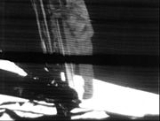
The United States space agency NASA achieved the first manned landing on Earth's Moon as part of the Apollo 11 mission commanded by Neil Armstrong. On July 20, 1969, Armstrong landed the lunar module Eagle on the surface of the Moon with a companion, while the third astronaut orbited above. Armstrong and Buzz Aldrin spent a day on the surface of the Moon before returning to Earth. NASA carried out six manned moon landings between 1969 and 1972.
Scientific background
The primary concern of any moon landing is the high velocity involved that arises from the effects of gravity. In order to go to any moon, a spacecraft must first leave the gravity well of the Earth. The only practical way of accomplishing this currently is with a rocket. Unlike other airborne vehicles such as balloons or jets, only a rocket can continue to increase its speed at high altitudes in the vacuum outside the Earth's atmosphere.
Upon approach of the target moon, the spacecraft must decelerate enough to land safely. The velocity to be shed from the target moon's gravitational attraction is roughly equal to the escape velocity of the target moon. For Earth's Moon, this figure is 2.4 kilometers per second or around 6,000 miles per hour. This change in velocity (referred to as the delta-v) is usually provided by a landing rocket, which must be carried into space by the original launch vehicle as part of the overall spacecraft. An exception is a moon landing on Titan such as that carried out by the Huygens probe. As the only moon with an atmosphere, landings on Titan may be accomplished by using atmospheric entry techniques that are generally lighter in weight than a rocket with equivalent capability.
Whatever method is used to slow a spacecraft as it nears a moon, the key requirement for a "true" moon landing is to be traveling at a survivable speed upon reaching the moon's surface that allows continued operation after touchdown. Such landings may be characterized as "soft" if a human could survive them, and "hard" if only a ruggedized machine would do so. Initial American attempts at performing the first hard moon landing in 1962 failed; the Soviets succeeded in making the first successful hard landing on the Moon in 1966. Generally a hard landing is categorized as one occurring at 100 miles per hour or slower.
Above these speeds, the space mission ends not in a landing but a so-called crash impact where the vehicle and its instruments do not survive touchdown, which without braking rockets generally occurs at speeds of 3000-5000 miles per hour. Such impacts can occur because of malfunctions in a spacecraft, or they can be deliberately arranged for vehicles that do not have an on board landing rocket such as the 2008 Indian MIP. There have been many such moon crashes. For example, during the Apollo program the S-IVB third stage of the Saturn V moon rocket as well as the spent ascent stage of the lunar module were deliberately crashed on the moon several times to provide impacts registering as a moonquake on seismometers that had been left on the lunar surface. Such crashes were instrumental in mapping the internal structure of the Moon.
If a return to Earth is desired after a moon landing is accomplished, the escape velocities of the moon and Earth must again be overcome for the spacecraft to come to rest on the surface of the Earth. Rockets must be used to leave the moon and return to space. Upon reaching Earth, atmospheric entry techniques are used to absorb the kinetic energy of a returning spacecraft and reduce its speed for safe landing. These functions greatly complicate a moon landing mission and lead to many additional operational considerations. Any moon departure rocket must first be carried to the moon's surface by a moon landing rocket, increasing the latter's required size. The moon departure rocket, larger moon landing rocket and any Earth atmosphere entry equipment such as heat shields and parachutes must in turn be lifted by the original launch vehicle, greatly increasing its size by a significant and almost prohibitive degree. This necessitates optimizing the sizing of stages in the launch vehicle as well as consideration of using space rendezvous between multiple spacecraft and reaching intermediate orbits prior to landing; in particular, lunar orbit rendezvous. Thus systems engineering and logistics become major factors in the design of any moon landing mission.
Political background
The intense and expensive effort devoted in the 1960s to achieving first an unmanned and then ultimately a manned moon landing can only be understood in the political context of its historical era. World War II with its 60 million dead, half Soviet, was fresh in the memory of all adults. In the 1940s, the war had introduced many new and deadly innovations including blitzkrieg-style surprise attacks used in the invasion of Poland and in the attack on Pearl Harbor; the V-2 rocket, a ballistic missile which killed thousands in attacks on London; and the atom bomb, which killed tens of thousands in the atomic bombings of Hiroshima and Nagasaki. In the 1950s, tensions mounted between the two ideologically opposed superpowers of the United States and the Soviet Union that had emerged as victors in the conflict, particularly after the development by both countries of the hydrogen bomb.
On October 4, 1957, the Soviet Union launched Sputnik 1 as the first artificial satellite to orbit the Earth and so initiated the Space Age. This unexpected event was a source of pride to the Soviets and shock to the Americans. This dramatic and successful demonstration of the new R-7 Semyorka rocket on only its third test flight meant that the Soviets could use ballistic missiles carrying hydrogen bombs in a surprise attack against any target on Earth, a frightening new capability the Americans did not have. Further, the steady beeping of the radio beacon aboard Sputnik 1 as it passed overhead every 96 minutes was widely viewed on both sides as effective propaganda to Third World countries demonstrating the technological superiority of the Soviet political system compared to the American one. This perception was reinforced by a string of subsequent rapid-fire Soviet space achievements. In 1959, the R-7 rocket was used to launch the first escape from Earth's gravity into a solar orbit, the first crash impact onto the surface of the Moon and the first photography of the never-before-seen far side of the Moon. These were the Luna 1, Luna 2 and Luna 3 spacecraft, respectively.
The American response to these Soviet achievements was to greatly accelerate previously languishing space and missile projects. Military efforts were initiated to develop and produce mass quantities of intercontinental ballistic missiles (ICBMs) that would bridge the so-called missile gap and enable a policy of deterrence to nuclear war with the Soviets known as Mutually Assured Destruction or MAD. These newly-developed missiles were made available to civilians of the newly formed NASA space agency for various projects which would demonstrate the payload, guidance accuracy and reliabilities of American ICBMs to the Soviets. While NASA stressed peaceful and scientific uses for these rockets, their use in various lunar exploration efforts also had secondary goal of realistic, goal-oriented testing of the missiles themselves and development of associated infrastructure just as the Soviets were doing with their R-7. The tight schedules and lofty goals selected by NASA for lunar exploration also had an undeniable element of generating counter-propaganda to show to other countries that American technological prowess was the equal and even superior to that of the Soviets.
U.S. unmanned hard landings (1958-1965)
In contrast to Soviet lunar exploration triumphs in 1959, success eluded initial American efforts to reach the Moon with the Pioneer and Ranger programs. Fifteen consecutive U.S. unmanned lunar missions over a six year period from 1958 to 1964 all failed their primary photographic missions; however Rangers 4 and 6 successfully repeated the Soviet lunar impacts as part of their secondary missions. Failures included three American attempts in 1962 to hard land small seismometer packages released by the main Ranger spacecraft. These surface packages were to use retrorockets to survive landing, unlike the parent vehicle, which was designed to deliberately crash onto the surface. The final three Ranger probes performed successful high altitude lunar reconnaissance photography missions during intentional crash impacts at around 6,000 miles per hour as planned.
Three different designs of Pioneer lunar probes were flown on three different modified ICBMs. Those flown on the Thor booster modified with an Able upper stage carried an infrared image scanning television system with a resolution of 1 milliradian to study the Moon's surface, an ionization chamber to measure radiation in space, a diaphragm/microphone assembly to detect micrometeorites, a magnetometer, and temperature-variable resistors to monitor spacecraft internal thermal conditions. The first, a mission managed by the United States Air Force, exploded during launch; all subsequent Pioneer lunar flights had NASA as the lead management organization. The next two returned to Earth and burned up upon reentry into the atmosphere after achieved maximum altitudes of around 70,000 and , far short of the roughly required to reach the vicinity of the Moon.
NASA then collaborated with the United States Army's Ballistic Missile Agency to fly two extremely small cone-shaped probes on the Juno ICBM, carrying only photocells which would be triggered by the light of the Moon and a lunar radiation environment experiment using a Geiger-Müller tube detector. The first of these reached an altitude of only around , serendipitously gathering data that established the presence of the Van Allen radiation belts before reentering Earth's atmosphere. The second passed by the moon at a distance of over , twice as far away as planned and too far away to trigger either of the on board scientific instruments, yet still becoming the first American spacecraft to reach a solar orbit.
The final Pioneer lunar probe design consisted of four "paddlewheel" solar panels extending from a one-meter diameter spherical spin-stabilized spacecraft body that was equipped to take images of the lunar surface with a television-like system, estimate the Moon's mass and topography of the poles, record the distribution and velocity of micrometeorites, study radiation, measure magnetic fields, detect low frequency electromagnetic waves in space and use a sophisticated integrated propulsion system for maneuvering and orbit insertion as well. None of the four spacecraft built in this series of probes survived launch on its Atlas ICBM outfitted with an Able upper stage.
Following the unsuccessful Atlas-Able Pioneer probes, NASA's Jet Propulsion Laboratory embarked upon an unmanned spacecraft development program whose modular design could be used to support both lunar and interplanetary exploration missions. The interplanetary versions were known as Mariners; lunar versions were Rangers. JPL envisioned three versions of the Ranger lunar probes: Block I prototypes, which would carry various radiation detectors in test flights to a very high Earth orbit that came nowhere near the Moon; Block II, which would try to accomplish the first Moon landing by hard landing a seismometer package; and Block III, which would crash onto the lunar surface without any braking rockets while taking very high resolution wide-area photographs of the Moon during their descent.
The Ranger 1 and 2 Block I missions were virtually identical. Spacecraft experiments included a Lyman-alpha telescope, a rubidium-vapor magnetometer, electrostatic analyzers, medium-energy-range particle detectors, two triple coincidence telescopes, a cosmic-ray integrating ionization chamber, cosmic dust detectors, and scintillation counters. The goal was to place these Block I spacecraft in a very high Earth orbit with an apogee of . From that vantage point, scientists could make direct measurements of the magnetosphere over a period of many months while engineers perfected new methods to routinely track and communicate with spacecraft over such large distances. Such practice was deemed vital to be assured of capturing high-bandwidth television transmissions from the Moon during a one-shot fifteen minute time window in subsequent Block II and Block III lunar descents. Both Block I missions suffered failures of the new Agena upper stage and never left low earth parking orbit after launch; both burned up upon reentry after only a few days.
The first attempts to perform a Moon landing took place in 1962 during the Rangers 3, 4 and 5 missions flown by the United States. All three Block II missions carried a 94 pound, two-foot diameter landing sphere (made of balsa wood) designed to withstand a 150 mile per hour impact. This lander (code-named Tonto) was designed to provide impact cushioning using an exterior blanket of crushable balsa wood and an interior filled with incompressible liquid freon. A 56 pound, one-foot diameter metal payload sphere floated and was free to rotate in a liquid freon reservoir contained in the landing sphere. This payload sphere contained six silver-cadmium batteries to power a fifty milliwatt radio transmitter, a temperature sensitive voltage controlled oscillator to measure lunar surface temperatures, and a seismometer that was designed with sensitivity high enough to detect the impact of a five pound meteorite on the opposite side of the Moon. Weight was distributed in the payload sphere so it would rotate in its liquid blanket to place the seismometer into an upright and operational position no matter what the final resting orientation of the external landing sphere. After landing plugs were to be opened allowing the freon to evaporate and the payload sphere to settle into upright contact with the landing sphere. Four pounds of water were also included to provide thermal control for the lander, absorbing heat and boiling off as low-pressure steam during the hot lunar daytime and retaining sufficient heat to allow the lander electronics to avoid freezing temperatures during the cold lunar nighttime. The batteries and water supply were sized to allow up to three months of operation for the payload sphere. Various mission constraints limited the landing site to Oceanus Procellarum on the lunar equator, which the lander ideally would reach 66 hours after launch.
No cameras were carried by the Ranger landers, and no pictures were to be captured from the lunar surface during the mission. Instead, the ten-foot-high, 730 pound Ranger Block II mother ship carried a 200 scan line television camera which was to capture images from down to during the free-fall descent to the lunar surface. The 13 pound camera was designed to transmit a picture every 10 seconds. Other instruments gathering data before the mother ship crashed onto the Moon at 6,500 miles per hour were a gamma ray spectrometer to measure overall lunar chemical composition and a radar altimeter. At eight seconds before impact and above the lunar surface, the radar altimeter was to give a signal ejecting the landing capsule and its 236 pound solid-fueled braking rocket overboard from the Block II mother ship. The braking rocket was to slow the landing sphere to a dead stop at above the surface and separate, allowing the landing sphere to free fall once more and hit the surface at a survivable speed of 100 miles per hour.
On Ranger 3, failure of the Atlas guidance system and a software error aboard the Agena upper stage combined to put the spacecraft on a course that would miss the Moon. Attempts to salvage lunar photography during a flyby of the Moon were thwarted by in-flight failure of the onboard flight computer. This was probably because of prior heat sterilization of the spacecraft by keeping it above the boiling point of water for 24 hours on the ground, to protect the Moon from being contaminated by Earth organisms. Heat sterilization was also blamed for subsequent in-flight failures of the spacecraft computer on Ranger 4 and the power subsystem on Ranger 5. Only Ranger 4 reached the Moon in an uncontrolled crash impact on the far side of the Moon.
Heat sterilization was discontinued for the final four Block III Ranger probes. These replaced the Block II landing capsule and its retrorocket with a heavier, more capable television system to support landing site selection for upcoming Apollo manned moon landing missions. Six cameras weighing a total of 350 pounds were designed to take thousands of high-altitude photographs in the final twenty minute period before crashing on the lunar surface. Camera resolution was 1,132 scan lines, far higher than the 525 lines found in a typical American 1964 home television. The final pictures taken were expected to have a resolution of around two feet. While Ranger 6 suffered a failure of this camera system and returned no photographs despite an otherwise successful flight, the subsequent Ranger 7 mission to Mare Cognitum was a complete success. Breaking the six year string of failure in American attempts to photograph the moon at close range, the Ranger 7 mission was viewed as a national turning point and instrumental in allowing the key 1965 NASA budget appropriation to pass through the United States Congress intact without a reduction in funds for the Apollo manned moon landing program. Subsequent successes with Ranger 8 and Ranger 9 further buoyed American hopes.
U.S.S.R. unmanned hard landings (1958-1966)
While American lunar exploration missions were undertaken in full view of public scrutiny, Soviet moonshots of the 1960s and 1970s were conducted under a policy of extreme governmental secrecy. Only with the coming of glasnost in the late 1980s and the fall of the Soviet Union in 1991 did historical records come to light allowing a true accounting of Soviet lunar efforts. Unlike the American tradition of assigning a particular mission name in advance of launch, the Soviets assigned a public "Luna" mission number only if a launch resulted in a spacecraft going beyond Earth orbit. If the attempt failed in Earth orbit before departing for the Moon, it was frequently (but not always) given a "Sputnik" or "Cosmos" earth-orbit mission number to hide its failure in reaching the Moon. Launch explosions were not acknowledged at all. This policy had the effect of hiding Soviet moonshot failures from public view, making their successes seem even more impressive.
The Luna 9 spacecraft, launched by the Soviet Union, performed the first successful Moon landing on February 3 1966 using the "hard landing" technique. Airbags protected its 200 pound ejectable capsule which survived an impact speed of over 30 miles per hour—the speed of many automobile accidents causing fatalities on Earth. Luna 13 duplicated this feat with a similar moon landing on December 24, 1966. Both returned panoramic photographs that were the first views from the lunar surface.
American unmanned soft landings (1966-1968)
The American robotic Surveyor program was part of an effort to locate a safe site on the Moon for a human landing and test under actual lunar conditions the radar and landing systems required to make a true controlled touchdown. Five of Surveyor's seven missions made successful unmanned moon landings.
Transition From Direct Ascent Landings To Lunar Orbit Operations (1966) Within four months of each other in early 1966 the Soviet Union and the United States had accomplished successful moon landings with unmanned spacecraft. To the general public both countries had demonstrated roughly equal technical capabilities by returning photographic images from the surface of the Moon. These pictures provided a key affirmative answer to the crucial question of whether or not lunar soil would support upcoming manned landers with their much greater weight.
However, the Luna 9 hard landing of a ruggedized sphere using airbags at a -per-hour ballistic impact speed had much more in common with the failed 1962 Ranger landing attempts and their planned -per-hour impacts than with the Surveyor 1 soft landing on three footpads using its radar-controlled, adjustable-thrust retrorocket. While Luna 9 and Surveyor 1 were both major national accomplishments, only Surveyor 1 had reached its landing site employing key technologies that would be needed for a crewed flight. Thus as of mid-1966, the United States had begun to pull ahead of the Soviet Union in the so-called Space Race to land a man on the Moon.
Advances in other areas were necessary before manned spacecraft could follow unmanned ones to the surface of the Moon. Of particular importance was developing the expertise to perform flight operations in lunar orbit. Ranger, Surveyor and initial Luna moon landing attempts all utilized flight paths from Earth that traveled directly to the lunar surface without first placing the spacecraft in a lunar orbit. Such direct ascents use a minimum amount of fuel for unmanned spacecraft on a one-way trip.
In contrast, manned vehicles need additional fuel after a lunar landing to enable a return trip back to Earth for the crew. Leaving this massive amount of required Earth-return fuel in lunar orbit until it is actually used later in the mission is far more efficient than taking such fuel down to the lunar surface in a Moon landing and then hauling it all back into space yet again, working against lunar gravity both ways. Such considerations lead logically to a lunar orbit rendezvous mission profile for a manned Moon landing.
Accordingly, beginning in mid-1966 both the U.S. and U.S.S.R. naturally progressed into missions which featured lunar orbit operations as a necessary prerequisite to a manned Moon landing. The primary goals of these initial unmanned orbiters were extensive photographic mapping of the entire lunar surface for the selection of manned landing sites and, for the Soviets, the checkout of radio communications gear that would be used in future soft landings.
An unexpected major discovery from initial lunar orbiters were vast volumes of dense materials beneath the surface of the moon's maria. Such mascons can send a manned mission dangerously off course in the final minutes of a moon landing when aiming for a relatively small landing zone that is smooth and safe. Mascons were also found over a longer period of time to greatly disturb the orbits of low-altitude satellites around the Moon, making their orbits unstable and forcing an inevitable crash on the lunar surface in the relatively short period of months to a few years. Thus all lunar orbiter satellites eventually become unintentional "lunar landers" at the end of their missions.
Controlling the location of impact for spent lunar orbiters can have scientific value. For example, in 1999 the NASA Lunar Prospector orbiter was deliberately targeted to impact a permanently shadowed area of Shoemaker Crater near the lunar south pole. It was hoped that energy from the impact would vaporize suspected shadowed ice deposits in the crater and liberate a water vapor plume that would be detectable from Earth. No such plume was observed. However, a small vial of ashes from the body of pioneer lunar scientist Eugene Shoemaker was delivered by the Lunar Prospector to the crater named in his honor - currently the only human remains on the Moon today.
Soviet lunar orbit satellites (1966-1974)
Luna 10 became the first spacecraft to orbit the Moon on 3 April 1966.
U.S. lunar orbit satellites (1966-1967)
Soviet Circumlunar Loop Flights (1967-1970) It was possible to aim a spacecraft from Earth so that it will loop around the Moon and return to Earth without actually entering lunar orbit, following the so-called free return trajectory. Such circumlunar loop missions are simpler than actual lunar orbit missions because rockets for lunar orbit braking and Earth return are not required. However, a manned circumlunar loop trip poses significant challenges above and beyond those found in a manned low-Earth-orbit mission, offering valuable lessons in preparation for a manned moon landing. Foremost among these are mastering the demands of re-entering the Earth's atmosphere upon returning from the Moon. Manned Earth-orbiting vehicles such as the Space Shuttle return to Earth from speeds of around 17,000 miles per hour. Due to the effects of gravity, a vehicle returning from the Moon hits Earth's atmosphere at a much higher speed of around 25,000 miles per hour. The g-loading on astronauts during the resulting deceleration can be at the limits of human endurance even during a nominal reentry. Slight variations in the vehicle flight path and reentry angle during a return from the Moon can easily result in fatal levels of deceleration force.
Achieving a manned circumlunar loop flight prior to a manned lunar landing became a primary goal of the Soviets with their Zond spacecraft program. The first three Zonds were unmanned planetary probes; after that, the Zond name was transferred to a completely separate manned program. The initial focus of these later Zonds was extensive testing of required high-speed reentry techniques. This focus was not shared by the Americans, who chose instead to bypass the stepping stone of a manned circumlunar loop mission and never developed a separate spacecraft for this purpose.
Initial manned spaceflights in the early 1960s placed a single person in low Earth orbit during the Soviet Vostok and American Mercury programs. A two-flight extension of the Vostok program known as Voskhod effectively used Vostok capsules with their ejection seats removed to achieve Soviet space firsts of multiple person crews in 1964 and spacewalks in early 1965. These capabilities were later demonstrated by the Americans in ten Gemini low Earth orbit missions throughout 1965 and 1966, using a totally new second-generation spacecraft design that had little in common with the earlier Mercury. These Gemini missions went on to prove critical techniques for orbital rendezvous and docking that were crucial to a manned lunar landing mission profile.
After the end of the Gemini program, the Soviets Union began flying their second-generation Zond manned spacecraft in 1967 with the ultimate goal of looping a cosmonaut around the moon and returning him immediately to Earth. The Zond spacecraft was launched with the simpler and already operational Proton launch rocket, unlike the parallel Soviet manned moon landing effort also underway at the time based on third-generation Soyuz spacecraft requiring development of the advanced N-1 booster. The Soviets thus believed they could achieve a manned Zond circumlunar flight years before an American manned lunar landing and so score a propaganda victory. However, significant development problems delayed the Zond program and the success of the American Apollo lunar landing program led to the eventual termination of the Zond effort.
Like Zond, Apollo moon flights were generally launched on a free return trajectory that would return them to Earth via a circumlunar loop in the event that a Service Module malfunction failed to place them in lunar orbit as planned. This option was implemented after an explosion aboard the Apollo 13 mission in 1970, which is the only manned circumlunar loop mission flown to date.
Zond 5 was the first spacecraft to carry life from Earth to the vicinity of the Moon and return, initiating the final lap of the Space Race with its payload of turtles, insects, plants and bacteria. Despite the failure suffered in its final moments, the Zond 6 mission was reported by Soviet media as being a success as well. Although hailed worldwide as remarkable achievements, both of these Zond missions actually flew off-nominal reentry trajectories resulting in deceleration forces that would have been fatal to human crewmembers had they been aboard. As a result, the Soviets secretly planned to continue unmanned Zond tests until their reliability to support manned flight had been demonstrated. However, believing from faulty CIA intelligence that a Soviet manned lunar flight was imminent in late 1968, NASA fatefully changed the flight plan of Apollo 8 from an Earth-orbit to a riskier lunar orbit mission scheduled for late December 1968.
In early December 1968 the launch window to the Moon opened for the Soviet launch site in Baikonur, giving the USSR their final chance to beat the US to the Moon. Cosmonauts went on alert and asked to fly the Zond spacecraft then in final countdown at Baikonour on the first manned trip to the Moon. Ultimately, however, the Soviet Politburo decided the risk of crew death was unacceptable given the combined poor performance to that point of Zond/Proton and so scrubbed the launch of a manned Soviet lunar mission. Their decision proved to be a wise one, since this unnumbered Zond mission was destroyed in another unmanned test when it was finally launched several weeks later.
By this time flights of the third generation American Apollo spacecraft had begun. Far more capable than the Zond, the Apollo spacecraft had the necessary rocket power to slip into and out of lunar orbit and to make course adjustments required for a safe reentry during the return to Earth. The Apollo 8 mission carried out the first manned trip to the Moon on 24 December 1968, certifying the Saturn V booster for manned use and flying not a circumlunar loop but instead a full ten orbits around the Moon before returning safely to Earth. Apollo 10 then performed a full dress rehearsal of a manned moon landing in May 1969. This mission stopped short at ten miles (16 km) altitude above the lunar surface, performing necessary low-altitude mapping of trajectory-altering mascons using a factory prototype lunar module that was too overweight to allow a successful landing. With the failure of the unmanned Soviet sample return moon landing attempt Luna 15 in July 1969, the stage was set for Apollo 11.
American manned Moon landings (1969-1972)
American strategy The U.S. Moon exploration program originated during the Eisenhower administration. In a series of mid-1950s articles in Collier's magazine, Wernher von Braun had popularized the idea of a manned expedition to the Moon to establish a lunar base. A manned Moon landing posed several daunting technical challenges to the U.S. and USSR. Besides guidance and weight management, atmospheric re-entry without ablative overheating was a major hurdle. After the Soviet Union's launch of Sputnik, von Braun promoted a plan for the United States Army to establish a military lunar outpost by 1965.
After the early Soviet successes, especially Yuri Gagarin's flight, U.S. President John F. Kennedy looked for an American project that would capture the public imagination. He asked Vice President Lyndon Johnson to make recommendations on a scientific endeavor that would prove U.S. world leadership. The proposals included non-space options such as massive irrigation projects to benefit the Third World. The Soviets, at the time, had more powerful rockets than the United States, which gave them an advantage in some kinds of space missions. Advances in U.S. nuclear weapons technology had led to smaller, lighter warheads, and consequently, rockets with smaller payload capacities. By comparison, Soviet nuclear weapons were much heavier, and the powerful R-7 rocket was developed to carry them. More modest potential missions such as flying around the Moon without landing or establishing a space lab in orbit (both were proposed by Kennedy to von Braun) were determined to offer too much advantage to the Soviets, since the U.S. would have to develop a heavy rocket to match the Soviets. A Moon landing, however, would capture world imagination while functioning as propaganda.
Mindful that the Apollo Program would economically benefit most of the key states in the next election—particularly his home state of Texas because NASA's base was in Houston—Johnson championed the Apollo program. This superficially indicated action to alleviate the fictional "missile gap" between the U.S. and USSR, a campaign promise of Kennedy's in the 1960 election. The Apollo project allowed continued development of dual-use technology. Johnson also advised that for anything less than a lunar landing the USSR had a good chance of beating the U.S. For these reasons, Kennedy seized on Apollo as the ideal focus for American efforts in space. He ensured continuing funding, shielding space spending from the 1963 tax cut and diverting money from other NASA projects. This dismayed NASA's leader, James E. Webb, who urged support for other scientific work.
In conversation with Webb, Kennedy said:
- Everything we do ought to really be tied in to getting on to the moon ahead of the Russians [...] otherwise we shouldn't be spending that kind of money, because I'm not interested in space [...] The only justification for [the cost] is because we hope to beat [the USSR] to demonstrate that instead of being behind by a couple of years, by God, we passed them.
The Saturn V booster was the key to U.S. moon landings. It used more efficient liquid hydrogen fuel instead of kerosene in its upper stages in order to lift heavier payloads beyond Earth orbit. The Saturn had a perfect record of zero failures in thirteen launches. By contrast, the Soviet N-1 exploded in flight during four secret test launches and never achieved operational status.
Whatever he said in private, Kennedy needed a different message to gain public support to uphold what he was saying and his views. Later in 1963, Kennedy asked Vice President Johnson to investigate the possible technological and scientific benefits of a Moon mission. Johnson concluded that the benefits were limited, but, with the help of scientists at NASA, he put together a powerful case, citing possible medical breakthroughs and interesting pictures of Earth from space. For the program to succeed, its proponents would have to defeat criticism from politicians on the left, who wanted more money spent on social programs, and on those on the right, who favored a more military project. By emphasizing the scientific payoff and playing on fears of Soviet space dominance, Kennedy and Johnson managed to swing public opinion: by 1965, 58 percent of Americans favored Apollo, up from 33 percent two years earlier. After Johnson became President in 1963, his continuing defense of the program allowed it to succeed in 1969, as Kennedy had originally hoped.
Soviet strategy
Soviet leader Nikita Khrushchev did not relish "defeat" by any other power, but equally did not relish funding such an expensive project. In October 1963 he said that the USSR was "not at present planning flight by cosmonauts to the Moon", while insisting that the Soviets had not dropped out of the race. Only after another year would the USSR fully commit itself to a Moon-landing attempt, which ultimately failed.
At the same time, Kennedy had suggested various joint programs, including a possible Moon landing by Soviet and American astronauts and the development of better weather-monitoring satellites. Khrushchev, sensing an attempt by Kennedy to steal Russian space technology, rejected the idea: if the USSR went to the Moon, it would go alone. Korolyov, the RSA's chief designer, had started promoting his Soyuz craft and the N-1 launcher rocket that would have the capability of carrying out a manned Moon landing. Khrushchev directed Korolyov's design bureau to arrange further space firsts by modifying the existing Vostok technology, while a second team started building a completely new launcher and craft, the Proton booster and the Zond, for a manned cislunar flight in 1966. In 1964 the new Soviet leadership gave Korolyov the backing for a Moon landing effort and brought all manned projects under his direction. With Korolyov's death and the failure of the first Soyuz flight in 1967, the co-ordination of the Soviet moon landing program quickly unraveled. The Soviets built a landing craft and selected cosmonauts for the mission that would have placed Aleksei Leonov on the Moon's surface, but with the successive launch failures of the N1 booster in 1969, plans for a manned landing suffered first delay and then cancellation.
Apollo Missions
In total twenty-four American astronauts have traveled to the Moon, with twelve walking on its surface and three making the trip twice. Apollo 8 was a lunar-orbit-only mission, Apollo 10 included powered descent and then an abort-mode ascent of the LM, while Apollo 13, originally scheduled as a landing, ended up as a lunar fly-by, by means of free return trajectory; thus, none of these missions made landings. Apollo 7 and Apollo 9 never left Earth orbit. Apart from the inherent dangers of manned moon expeditions as seen with Apollo 13, one reason for their cessation according to astronaut Alan Bean is the cost it imposes in government subsidies.
Human Moon Landings
Other aspects of the Apollo Moon landings
Unlike other international rivalries, the Space Race has remained unaffected in a direct way regarding the desire for territorial expansion. After the successful landings on the Moon, the U.S. explicitly disclaimed the right to ownership of any part of the Moon.
President Richard Nixon had speechwriter William Safire prepare a condolence speech for delivery in the event that Armstrong and Aldrin became marooned on the Moon's surface and could not be rescued.
In the 1940s writer Arthur C Clarke forecast that man would reach the Moon by 2000.
On August 16, 2006, the Associated Press reported that NASA is currently missing the original Slow-scan television tapes (which were made before the scan conversion for conventional TV) of the Apollo 11 Moon walk. Some news outlets have mistakenly reported that the SSTV tapes were found in Western Australia, but those tapes were only recordings of data from the Apollo 11 Early Apollo Surface Experiments Package.
Soviet unmanned soft landings (1969-1976)
Indian unmanned hard landings (2008-)
India became the third country to reach the surface of the moon with a dedicated scientific probe when its lunar orbiting spacecraft Chandrayaan 1 released the Moon Impact Probe. MIP reached the surface of the Moon at 2034 UT(0804 IST) on Nov 14 2008. This date was choosen to commemorate the birthday of Jawaharlal Nehru, the first Indian Prime Minister who initiated India's space program. Developed in India by the Indian Space Research Organisation (ISRO), the MIP had the Indian flag painted on its exterior. Although Japan and ESA had previously commanded their orbiters Hiten and SMART-1 to crash in selected zones on the Moon's surface at the end of their respective lifetimes, India's MIP was the first probe designed specifically for a trip to the lunar surface since the Soviet lander Luna 24 in 1976.
Weighing 34 kilograms, the box shaped MIP carried three instruments – a video imaging system, a mass spectrometer and a radar altimeter. The video imaging system took pictures of the moon’s surface from high altitudes as MIP approached it, relaying those pictures back to Earth during the MIP's descent. The mass spectrometer made measurements of the extremely thin lunar atmosphere. The radar altimeter measured the rate of descent of the MIP probe to the lunar surface, testing that technology for future Indian soft landing missions. Such a soft landing is planned for 2010 or 2011 during the upcoming Chandrayaan 2 mission.
The Indian MIP-1 probe did not include braking rockets and was destroyed upon impacting the lunar surface at its planned speed of 3,100 miles per hour. Its achievement is roughly equivalent to the American Ranger 7 mission flown in 1964.
In popular culture
The moon landings are often referenced by Americans to criticize the failure of a government project or service. A typical example of this appears in the aftermath of a natural disaster: "We can land man on the moon and bring him back safely, but we can't stop a bit of floodwater".
Future plans
The next lunar orbiter currently scheduled for launch is NASA's Lunar Reconnaissance Orbiter mission. The Lunar Precursor Robotic Program (LPRP) is a program of robotic spacecraft missions which NASA will use to prepare for future human spaceflight missions to the Moon. Two LPRP missions, the Lunar Reconnaissance Orbiter (LRO) and the Lunar CRater Observation and Sensing Satellite (LCROSS), are scheduled to launch early in 2009.
Russia plans to send cosmonauts to the Moon by 2025 and establish a permanent manned base there in 2027-2032.
ISRO, the Indian National Space agency, has announced the Chandrayaan program for Lunar exploration. The second mission Chandrayaan II plans to land a motorised rover by 2010/2011.
Other nations, including China, have expressed interest in pursuing human landings on the Moon, but none have currently announced formal plans.
The Google Lunar X Prize competition offers a $20 million award for the first privately-funded team to land a robotic probe on the Moon. Like the Ansari X Prize before it, the competition aims to advance the state of the art in private space exploration.
Hoax accusations
Some conspiracy theorists have insisted that the Apollo moon landings were a hoax. These accusations flourish in part because predictions by enthusiasts that Moon landings would become commonplace have not yet come to pass. Some claims can be empirically discredited by three retroreflector arrays left on the Moon by Apollo 11, 14 and 15. Today, anyone on Earth with an appropriate laser and telescope system may bounce laser beams off these devices, verifying deployment of the Lunar Laser Ranging Experiment at historically documented Apollo moon landing sites. This evidence gives strong standing to Man-Made devices having made successful landings. The Mythbusters have tried to determine if the Moon Landing really was a hoax which included some of these experiments, why the footprint was so clear, why the flag was waving and why Neil Armstrong was viewed so clearly while the section was in a shadow (see MythBusters (2008 season)#Episode 104 – "NASA Moon Landing").
See also
External links
- on moon landings, missions, etc. (includes information on other space agencies' missions
|
| |
|
|