

Moon Treaty

Encyclopedia
The Agreement Governing the Activities of States on the Moon
and Other Celestial Bodies, better known as the Moon Treaty or Moon Agreement, is an international treaty that turns jurisdiction
of all celestial bodies (including the orbits around such bodies) over to the international community. Thus, all activities must conform to international law (notably this includes the UN Charter
).
In practice, it is a failed treaty since it has not been ratified by any nation which engages in self-launched manned space exploration
or has plans to do so (e.g. the United States
, The United Kingdom
, European Union
, Russian Federation
, People's Republic of China
, Japan
, and India
) since its creation in 1979, and thus has a negligible effect on actual spaceflight.
, other than the Earth
, including orbits around or other trajectories to or around them.
The treaty makes a declaration that the Moon should be used for the benefit of all states and all peoples of the international community. It also expresses a desire to prevent the Moon from becoming a source of international conflict. To those ends the treaty:
parties in 1984. As a follow-on to the Outer Space Treaty
, the Moon Treaty intended to establish a regime
for the use of the Moon and other celestial bodies
similar to the one established for the sea floor
in the United Nations Convention on the Law of the Sea
.
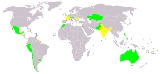
As of December 19, 2008, only 13 states; Australia
, Austria
, Belgium
, Chile
, Kazakhstan
, Lebanon
, Mexico
, Morocco
, Netherlands
, Pakistan
, Peru
, Philippines
, and Uruguay
, have ratified it. France
, Guatemala
, India
and Romania
have signed but have not ratified it. As it is unratified by any major space-faring powers (including India
) and unsigned by most of them (except India
), it is of no direct relevance to current space activities.
Moon
The Moon is Earth's only known natural satellite,There are a number of near-Earth asteroids including 3753 Cruithne that are co-orbital with Earth: their orbits bring them close to Earth for periods of time but then alter in the long term . These are quasi-satellites and not true moons. For more...
and Other Celestial Bodies, better known as the Moon Treaty or Moon Agreement, is an international treaty that turns jurisdiction
Jurisdiction
Jurisdiction is the practical authority granted to a formally constituted legal body or to a political leader to deal with and make pronouncements on legal matters and, by implication, to administer justice within a defined area of responsibility...
of all celestial bodies (including the orbits around such bodies) over to the international community. Thus, all activities must conform to international law (notably this includes the UN Charter
United Nations Charter
The Charter of the United Nations is the foundational treaty of the international organization called the United Nations. It was signed at the San Francisco War Memorial and Performing Arts Center in San Francisco, United States, on 26 June 1945, by 50 of the 51 original member countries...
).
In practice, it is a failed treaty since it has not been ratified by any nation which engages in self-launched manned space exploration
Human spaceflight
Human spaceflight is spaceflight with humans on the spacecraft. When a spacecraft is manned, it can be piloted directly, as opposed to machine or robotic space probes and remotely-controlled satellites....
or has plans to do so (e.g. the United States
United States
The United States of America is a federal constitutional republic comprising fifty states and a federal district...
, The United Kingdom
United Kingdom
The United Kingdom of Great Britain and Northern IrelandIn the United Kingdom and Dependencies, other languages have been officially recognised as legitimate autochthonous languages under the European Charter for Regional or Minority Languages...
, European Union
European Union
The European Union is an economic and political union of 27 independent member states which are located primarily in Europe. The EU traces its origins from the European Coal and Steel Community and the European Economic Community , formed by six countries in 1958...
, Russian Federation
Russia
Russia or , officially known as both Russia and the Russian Federation , is a country in northern Eurasia. It is a federal semi-presidential republic, comprising 83 federal subjects...
, People's Republic of China
People's Republic of China
China , officially the People's Republic of China , is the most populous country in the world, with over 1.3 billion citizens. Located in East Asia, the country covers approximately 9.6 million square kilometres...
, Japan
Japan
Japan is an island nation in East Asia. Located in the Pacific Ocean, it lies to the east of the Sea of Japan, China, North Korea, South Korea and Russia, stretching from the Sea of Okhotsk in the north to the East China Sea and Taiwan in the south...
, and India
India
India , officially the Republic of India , is a country in South Asia. It is the seventh-largest country by geographical area, the second-most populous country with over 1.2 billion people, and the most populous democracy in the world...
) since its creation in 1979, and thus has a negligible effect on actual spaceflight.
Content
The treaty would apply to the Moon and to other celestial bodies within the Solar systemSolar System
The Solar System consists of the Sun and the astronomical objects gravitationally bound in orbit around it, all of which formed from the collapse of a giant molecular cloud approximately 4.6 billion years ago. The vast majority of the system's mass is in the Sun...
, other than the Earth
Earth
Earth is the third planet from the Sun, and the densest and fifth-largest of the eight planets in the Solar System. It is also the largest of the Solar System's four terrestrial planets...
, including orbits around or other trajectories to or around them.
The treaty makes a declaration that the Moon should be used for the benefit of all states and all peoples of the international community. It also expresses a desire to prevent the Moon from becoming a source of international conflict. To those ends the treaty:
- Bans any military use of celestial bodies, including weapon testing or as military bases.
- Bans all exploration and uses of celestial bodies without the approval or benefit of other states under the common heritage of mankindCommon heritage of mankindCommon heritage of mankind is a principle of international law which holds that defined territorial areas and elements of humanity's common heritage should be held in trust for future generations and be protected from exploitation by individual...
principle (article 11). - Requires that the Secretary-General must be notified of all celestial activities (and discoveries developed thanks to those activities).
- Declares all states have an equal right to conduct research on celestial bodies.
- Declares that for any samples obtained during research activities, the state that obtained them must consider making part of it available to all countries/scientific communities for research.
- Bans altering the environment of celestial bodies and requires that states must take measures to prevent accidental contamination.
- Bans any state from claiming sovereigntySovereigntySovereignty is the quality of having supreme, independent authority over a geographic area, such as a territory. It can be found in a power to rule and make law that rests on a political fact for which no purely legal explanation can be provided...
over any territory of celestial bodies. - Bans any ownership of any extraterrestrial property by any organization or person, unless that organization is international and governmental.
- Requires all resource extraction and allocation be made by an international regimeInternational regimeInternational regimes are not subnational actors or non-governmental organizations. They are international actors, and sometimes, when formally organized, many of them can be considered intergovernmental organizations.-Definition and Types:Stephen D...
.
Ratification
The treaty was finalized in 1979 and entered into force for the ratifyingRatification
Ratification is a principal's approval of an act of its agent where the agent lacked authority to legally bind the principal. The term applies to private contract law, international treaties, and constitutionals in federations such as the United States and Canada.- Private law :In contract law, the...
parties in 1984. As a follow-on to the Outer Space Treaty
Outer Space Treaty
The Outer Space Treaty, formally the Treaty on Principles Governing the Activities of States in the Exploration and Use of Outer Space, including the Moon and Other Celestial Bodies, is a treaty that forms the basis of international space law...
, the Moon Treaty intended to establish a regime
Regime
The word regime refers to a set of conditions, most often of a political nature.-Politics:...
for the use of the Moon and other celestial bodies
Astronomical object
Astronomical objects or celestial objects are naturally occurring physical entities, associations or structures that current science has demonstrated to exist in the observable universe. The term astronomical object is sometimes used interchangeably with astronomical body...
similar to the one established for the sea floor
Seabed
The seabed is the bottom of the ocean.- Ocean structure :Most of the oceans have a common structure, created by common physical phenomena, mainly from tectonic movement, and sediment from various sources...
in the United Nations Convention on the Law of the Sea
United Nations Convention on the Law of the Sea
The United Nations Convention on the Law of the Sea , also called the Law of the Sea Convention or the Law of the Sea treaty, is the international agreement that resulted from the third United Nations Conference on the Law of the Sea , which took place from 1973 through 1982...
.
As of December 19, 2008, only 13 states; Australia
Australia
Australia , officially the Commonwealth of Australia, is a country in the Southern Hemisphere comprising the mainland of the Australian continent, the island of Tasmania, and numerous smaller islands in the Indian and Pacific Oceans. It is the world's sixth-largest country by total area...
, Austria
Austria
Austria , officially the Republic of Austria , is a landlocked country of roughly 8.4 million people in Central Europe. It is bordered by the Czech Republic and Germany to the north, Slovakia and Hungary to the east, Slovenia and Italy to the south, and Switzerland and Liechtenstein to the...
, Belgium
Belgium
Belgium , officially the Kingdom of Belgium, is a federal state in Western Europe. It is a founding member of the European Union and hosts the EU's headquarters, and those of several other major international organisations such as NATO.Belgium is also a member of, or affiliated to, many...
, Chile
Chile
Chile ,officially the Republic of Chile , is a country in South America occupying a long, narrow coastal strip between the Andes mountains to the east and the Pacific Ocean to the west. It borders Peru to the north, Bolivia to the northeast, Argentina to the east, and the Drake Passage in the far...
, Kazakhstan
Kazakhstan
Kazakhstan , officially the Republic of Kazakhstan, is a transcontinental country in Central Asia and Eastern Europe. Ranked as the ninth largest country in the world, it is also the world's largest landlocked country; its territory of is greater than Western Europe...
, Lebanon
Lebanon
Lebanon , officially the Republic of LebanonRepublic of Lebanon is the most common term used by Lebanese government agencies. The term Lebanese Republic, a literal translation of the official Arabic and French names that is not used in today's world. Arabic is the most common language spoken among...
, Mexico
Mexico
The United Mexican States , commonly known as Mexico , is a federal constitutional republic in North America. It is bordered on the north by the United States; on the south and west by the Pacific Ocean; on the southeast by Guatemala, Belize, and the Caribbean Sea; and on the east by the Gulf of...
, Morocco
Morocco
Morocco , officially the Kingdom of Morocco , is a country located in North Africa. It has a population of more than 32 million and an area of 710,850 km², and also primarily administers the disputed region of the Western Sahara...
, Netherlands
Netherlands
The Netherlands is a constituent country of the Kingdom of the Netherlands, located mainly in North-West Europe and with several islands in the Caribbean. Mainland Netherlands borders the North Sea to the north and west, Belgium to the south, and Germany to the east, and shares maritime borders...
, Pakistan
Pakistan
Pakistan , officially the Islamic Republic of Pakistan is a sovereign state in South Asia. It has a coastline along the Arabian Sea and the Gulf of Oman in the south and is bordered by Afghanistan and Iran in the west, India in the east and China in the far northeast. In the north, Tajikistan...
, Peru
Peru
Peru , officially the Republic of Peru , is a country in western South America. It is bordered on the north by Ecuador and Colombia, on the east by Brazil, on the southeast by Bolivia, on the south by Chile, and on the west by the Pacific Ocean....
, Philippines
Philippines
The Philippines , officially known as the Republic of the Philippines , is a country in Southeast Asia in the western Pacific Ocean. To its north across the Luzon Strait lies Taiwan. West across the South China Sea sits Vietnam...
, and Uruguay
Uruguay
Uruguay ,officially the Oriental Republic of Uruguay,sometimes the Eastern Republic of Uruguay; ) is a country in the southeastern part of South America. It is home to some 3.5 million people, of whom 1.8 million live in the capital Montevideo and its metropolitan area...
, have ratified it. France
France
The French Republic , The French Republic , The French Republic , (commonly known as France , is a unitary semi-presidential republic in Western Europe with several overseas territories and islands located on other continents and in the Indian, Pacific, and Atlantic oceans. Metropolitan France...
, Guatemala
Guatemala
Guatemala is a country in Central America bordered by Mexico to the north and west, the Pacific Ocean to the southwest, Belize to the northeast, the Caribbean to the east, and Honduras and El Salvador to the southeast...
, India
India
India , officially the Republic of India , is a country in South Asia. It is the seventh-largest country by geographical area, the second-most populous country with over 1.2 billion people, and the most populous democracy in the world...
and Romania
Romania
Romania is a country located at the crossroads of Central and Southeastern Europe, on the Lower Danube, within and outside the Carpathian arch, bordering on the Black Sea...
have signed but have not ratified it. As it is unratified by any major space-faring powers (including India
India
India , officially the Republic of India , is a country in South Asia. It is the seventh-largest country by geographical area, the second-most populous country with over 1.2 billion people, and the most populous democracy in the world...
) and unsigned by most of them (except India
India
India , officially the Republic of India , is a country in South Asia. It is the seventh-largest country by geographical area, the second-most populous country with over 1.2 billion people, and the most populous democracy in the world...
), it is of no direct relevance to current space activities.
External links
- Treaty Text — "Agreement Governing The Activities Of States On The Moon And Other Celestial Bodies" (1979)
- Official Treaty Site — United Nations Office for Outer Space AffairsUnited Nations Office for Outer Space AffairsThe United Nations Office for Outer Space Affairs is an organization of the General Assembly charged with implementing the Assembly's outer space-related policies. It is located in the United Nations Office in Vienna. The Office implements the Program on Space Applications and maintains the...
(UNOOSA), including versions of the treaty in several languages: , , English, Français, Русский, and Español.