
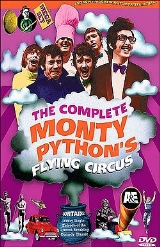
Monty Python’s Flying Circus (known during the final series as just
Monty Python) is a BBC TV
sketch comedyA sketch comedy consists of a series of short comedy scenes or vignettes, called "sketches," commonly between one and ten minutes long. Such sketches are performed by a group of comic actors or comedians, either on stage or through an audio and/or visual medium such as broadcasting...
series. The shows were composed of
surrealitySurreal humour is a form of humour based on violations of causal reasoning with events and behaviours that are logically incongruent. Constructions of surreal humour involve bizarre juxtapositions, non-sequiturs, irrational situations, and/or expressions of nonsense.The humour arises from a...
, risqué or innuendo-laden humour,
sight gagsIn comedy, a visual gag or sight gag is anything which conveys its humor visually, often without words being used at all.There are numerous examples in cinema history of directors who based most of the humour in their films on visual gags, even to the point of using no or minimal dialogue...
and observational sketches without
punchlinesA punch line is the final part of a joke, comedy sketch, or profound statement, usually the word, sentence or exchange of sentences which is intended to be funny or to provoke laughter or thought from listeners...
. It also featured
Terry GilliamTerrence Vance "Terry" Gilliam is an American-born British screenwriter, film director, animator, actor and member of the Monty Python comedy troupe. Gilliam is also known for directing several films, including Brazil , The Adventures of Baron Munchausen , The Fisher King , and 12 Monkeys...
's animations, which are often sequenced or merged with live action.
The first episode was recorded on 7 September and broadcast on 5 October 1969 on BBC One, with 45 episodes airing over four series from 1969 to 1974, plus two episodes for German TV.
The show often targets the idiosyncrasies of
British lifeThe culture of the United Kingdom refers to the patterns of human activity and symbolism associated with the United Kingdom and its people. It is informed by the UK's history as a developed island country, major power, and its composition of four countries—England, Northern Ireland, Scotland and...
(especially that of professionals) and is at times politically charged. The members of Monty Python were highly educated.
Terry JonesTerence Graham Parry Jones is a Welsh comedian, screenwriter, actor, film director, children's author, popular historian, political commentator, and TV documentary host. He is best known as a member of the Monty Python comedy team....
and
Michael PalinMichael Edward Palin, CBE FRGS is an English comedian, actor, writer and television presenter best known for being one of the members of the comedy group Monty Python and for his travel documentaries....
are Oxford graduates;
Eric IdleEric Idle is an English comedian, actor, author, singer, writer, and comedic composer. He was as a member of the British comedy group Monty Python, a member of the The Rutles on Saturday Night Live and author of the play, Spamalot....
,
John CleeseJohn Marwood Cleese is an English actor, comedian, writer, and film producer. He achieved success at the Edinburgh Festival Fringe and as a scriptwriter and performer on The Frost Report...
and
Graham ChapmanGraham Arthur Chapman was a British comedian, physician, writer, actor, and one of the six members of the Monty Python comedy troupe.-Early life and education:...
attended Cambridge; and American-born member
Terry GilliamTerrence Vance "Terry" Gilliam is an American-born British screenwriter, film director, animator, actor and member of the Monty Python comedy troupe. Gilliam is also known for directing several films, including Brazil , The Adventures of Baron Munchausen , The Fisher King , and 12 Monkeys...
is an
Occidental CollegeOccidental College is a private, coeducational liberal arts college located in the Eagle Rock neighborhood of Los Angeles, California. Founded in 1887, Occidental College, or "Oxy" as it is called by students and alumni, is one of the oldest liberal arts colleges on the West Coast...
graduate. Their comedy is often pointedly
intellectualAn intellectual is a person who uses intelligence and critical or analytical reasoning in either a professional or a personal capacity.- Terminology and endeavours :"Intellectual" can denote four types of persons:...
, with numerous erudite references to philosophers and literary figures. The series followed and elaborated upon the style used by
Spike MilliganTerence Alan Patrick Seán "Spike" Milligan Hon. KBE was a comedian, writer, musician, poet, playwright, soldier and actor. His early life was spent in India, where he was born, but the majority of his working life was spent in the United Kingdom. He became an Irish citizen in 1962 after the...
in his groundbreaking series
Q5Q... was a surreal television comedy sketch show from Spike Milligan which ran from 1969 to 1982 on BBC2. There were six series in all, the first five numbered from Q5 to Q9, and a final series titled There's a Lot of It About...
, rather than the traditional sketch show format. The team intended their humour to be impossible to categorise, and succeeded so completely that the adjective "Pythonesque" was invented to define it, and later, similar material. Terry Jones once commented, jokingly, that the fact that they had inspired a new word in the dictionary shows how miserably they had failed.
The Pythons play the majority of the series characters themselves, including the majority of the female characters, but occasionally they required an extra actor. Regular supporting cast members include
Carol ClevelandCarol Cleveland is a British actress/comedienne, most notable for her appearances as the only significant female performer on Monty Python's Flying Circus.-Early life:...
(referred to by the team as the unofficial "Seventh Python"),
Connie BoothConstance "Connie" Booth is an American-born writer and actress, known for appearances on British television and particularly for her portrayal of Polly Sherman in the popular 1970s television show Fawlty Towers, which she co-wrote with her then-husband John Cleese.-Biography:Booth's father was a...
(Cleese's first wife), series Producer
Ian MacNaughtonEdward Ian Macnaughton was a Scottish former actor-turned-television producer/director, best known for his work with the Monty Python team...
,
Ian DavidsonIan Davidson is a British actor and scriptwriter who worked in British television comedies from the 1960s to the 1980s. He appeared in the same Oxford University revue as Terry Jones and Michael Palin of Monty Python, and is probably best known for his numerous appearances on Monty Python's Flying...
,
Neil InnesNeil James Innes is an English writer and performer of comic songs, best known for his collaborative work with Monty Python, and for playing in the Bonzo Dog Doo-Dah Band and later The Rutles.-Personal life:...
(in the fourth series) and The Fred Tomlinson Singers (for musical numbers).
The series' theme song is the first segment of
John Philip SousaJohn Philip Sousa was an American composer and conductor of the late Romantic era, known particularly for American military and patriotic marches. Because of his mastery of march composition, he is known as "The March King" or the "American March King" due to his British counterpart Kenneth J....
's
The Liberty Bell, chosen because it was in the
public domainWorks are in the public domain if the intellectual property rights have expired, if the intellectual property rights are forfeited, or if they are not covered by intellectual property rights at all...
, free to use without charge.
Title
The title
Monty Python's Flying Circus was partly the result of the group's reputation at the BBC. Michael Mills, BBC's Head of Comedy, wanted their name to include the word
circus because the BBC referred to the six members wandering around the building as a "circus" (in particular "Baron Von Took's Flying Circus" after
Barry TookBarry Took was an English comedian, writer and television presenter. He is best remembered in the UK for his weekly role as presenter of Points of View, a BBC TV programme in which viewers' letters criticising or praising the BBC were broadcast...
, who had brought them to the BBC). The group added
flying to make it sound less like an actual circus and more like something from World War I.
Monty Python was added because they claimed it sounded like a really bad theatrical agent, the sort of person who would have brought them together, with
Eric IdleEric Idle is an English comedian, actor, author, singer, writer, and comedic composer. He was as a member of the British comedy group Monty Python, a member of the The Rutles on Saturday Night Live and author of the play, Spamalot....
suggesting Monty and
John CleeseJohn Marwood Cleese is an English actor, comedian, writer, and film producer. He achieved success at the Edinburgh Festival Fringe and as a scriptwriter and performer on The Frost Report...
suggesting Python.
The BBC had rejected some other names put forward by the group including "Whither Canada?", "Ow! It's Colin Plint", "A Horse, a Spoon and a Bucket", "The Toad Elevating Moment" and "Owl Stretching Time".
Recurring characters
In contrast to many other
sketch comedyA sketch comedy consists of a series of short comedy scenes or vignettes, called "sketches," commonly between one and ten minutes long. Such sketches are performed by a group of comic actors or comedians, either on stage or through an audio and/or visual medium such as broadcasting...
shows,
Flying Circus had only a handful of recurring characters, many of whom were involved only in titles and linking sequences, including:
- Arthur Pewtey (Palin), a socially inept, extremely dull man who appears most notably in the "Argument Clinic", "Marriage Guidance Counsellor
The Marriage Guidance Counsellor sketch is from the second Monty Python's Flying Circus episode, "Sex and Violence", first broadcast late on Sunday, 12th October 1969...
", and "Ministry of Silly Walks" sketches. His sketches all take the form of an office appointment with an authority figure (usually played by Cleese, but occasionally Chapman), which are used to parody the officious side of the British establishment by having the professional employed in the most bizarre field of expertise. In the "Marriage Guidance Counsellor" sketch, a cowboy in black (played by Cleese) tells Pewtey to "hold his head high" and "be a man".
- The Reverend Arthur Belling (played by both Chapman and Palin), is the vicar
In the broadest sense, a vicar is a representative, deputy or substitute; anyone acting "in the person of" or agent for a superior . In this sense, the title is comparable to lieutenant...
of St Loony-Up-The-Cream-Bun-and-Jam. He is known for his bizarrely eccentric behaviour. In one sketch he makes an appeal to the insane people of the world to drive sane people insane, and in another sketch politely joins a couple and "converts" them to his loony sect of Christianity.
- The “It’s” man (Palin), a Robinson Crusoe
Robinson Crusoe is a novel by Daniel Defoe that was first published in 1719. Epistolary, confessional, and didactic in form, the book is a fictional autobiography of the title character—a castaway who spends 28 years on a remote tropical island near Trinidad, encountering cannibals, captives, and...
-type castaway with torn clothes and a long, unkempt beard who would appear at the beginning of the programme, often after performing a long or dangerous task, and introduce the show by just saying, “It’s...” before being abruptly cut off by the opening titles, which started with a Terry Gilliam animation sprouting the words 'Monty Python’s Flying Circus'. It’s was an early candidate for the title of the series.
- Historical figures, such as Julius Caesar
Gaius Julius Caesar was a Roman general and statesman and a distinguished writer of Latin prose. He played a critical role in the gradual transformation of the Roman Republic into the Roman Empire....
(Chapman), Napoleon (Jones), or a VikingThe term Viking is customarily used to refer to the Norse explorers, warriors, merchants, and pirates who raided, traded, explored and settled in wide areas of Europe, Asia and the North Atlantic islands from the late 8th to the mid-11th century.These Norsemen used their famed longships to...
(usually Gilliam), entering in the midst of a sketch to interrupt it, appearing randomly in a quick cut-away gag, or delivering a non-sequitur in a cut-away shot.
- A BBC continuity announcer in a dinner jacket (Cleese), seated at a desk, often in highly incongruous locations, such as a forest or a beach. His line, “And now for something completely different
And Now for Something Completely Different is a film spin-off from the television comedy series Monty Python's Flying Circus featuring favorite sketches from the first two seasons. The title was used as a catchphrase in the television show....
,” was used variously as a lead-in to the opening titles and a simple way to link sketches (though Cleese is best known for it, the first time the phrase appeared in the show it was actually spoken by Idle in Episode 2 where he introduced a man with three buttocks). It eventually became the show’s catch phraseA catchphrase is a phrase or expression recognized by its repeated utterance. Such phrases often originate in popular culture and in the arts, and typically spread through a variety of mass media , as well as word of mouth...
, and served as the title for the troupe’s first movie. In Series 3 the line was shortened to simply: "And now..."
- The Gumbys, a group of slow-witted individuals identically attired in gumboots (from which they take their name), high-water trousers, braces
Suspenders or braces are fabric or leather straps worn over the shoulders to hold up trousers. Straps may be elasticated, either entirely or only at attachment ends and most straps are of woven cloth forming an X or Y shape at the back. Braces are typically attached to trousers with buttons...
, and round, wire-rimmed glasses, with toothbrush moustacheThe Toothbrush moustache is a moustache, shaved at the edges, except for three to five centimeters above the centre of the lip...
s and knotted handkerchiefs worn on their heads (a stereotype of the English, working class holidaymaker). They hold their arms stiffly at their sides, speak slowly in loud, throaty voices punctuated by frequent grunts and groans, and have a fondness for pointless violence. All of them are surnamed 'Gumby' (D.P. Gumby, R.S. Gumby, etc.). Even though all Pythons played Gumbies in the show's run, the character is most closely associated with Michael Palin.
- The Knight with a Raw Chicken (Gilliam), who would hit characters over the head with the chicken when they said something particularly silly. A regular during the first series, with another appearance in the third.
- Mr. Badger (Idle), a Scotsman whose speciality was interrupting sketches ("I won't ruin your sketch, for a pound"). He has also been seen as an airplane hijacker
Aircraft hijacking is the unlawful seizure of an aircraft by an individual or a group. In most cases, the pilot is forced to fly according to the orders of the hijackers. Occasionally, however, the hijackers have flown the aircraft themselves, such as the September 11 attacks of 2001...
whose demands grow increasingly eccentric, and was once interviewed (by Cleese) regarding his interpretation of the Magna CartaMagna Carta is an English charter, originally issued in the year 1215 and reissued later in the 13th century in modified versions, which included the most direct challenges to the monarch's authority to date. The charter first passed into law in 1225...
, which Badger believes was actually a piece of chewing gum on a bedspread in DorsetDorset , is a county in South West England on the English Channel coast. The county town is Dorchester which is situated in the south. The Hampshire towns of Bournemouth and Christchurch joined the county with the reorganisation of local government in 1974...
.
- A nude organist
An organist is a musician who plays any type of organ. An organist may play solo organ works, play with an ensemble or orchestra, or accompany one or more singers or instrumental soloists...
(played in his first two appearances by Gilliam, later by Jones) who provided a brief fanfare to punctuate certain sketches (most notably on a sketch poking fun at Sale of the CenturySale of the Century was a UK game show based on a US game show of the same name. It was first shown on ITV from 1972 to 1983, hosted by Nicholas Parsons...
) or as yet another way to introduce the opening titles.
- Mr. Eric Praline
Mr Eric Praline is a fictional character from the television show Monty Python's Flying Circus, played by comedian John Cleese.-Appearances:The Monty Python team consciously decided to avoid recurring characters...
, an eccentric, disgruntled man who often wears a Pac-a-Mac, played by Cleese. His most famous appearance is in the "Dead ParrotThe "Dead Parrot Sketch", alternatively and originally known as the "Pet Shop Sketch" or "Parrot Sketch", is a popular sketch from Monty Python's Flying Circus, and one of the most famous in the history of British television comedy...
" sketch. His name is only mentioned once on-screen, during the “Fish LicenceThe Fish Licence is part one of a two-part segment of the popular British television series, Monty Python's Flying Circus. Eric Praline, played by John Cleese, takes on the role of the put-upon customer who, when seeking to obtain a licence for his pet halibut, Eric, has difficulty explaining to...
” sketch, but his attire (together with Cleese's distinctive, nasal performance) distinguishes him as a recognisable character who makes multiple appearances throughout the series. "Fish Licence" also reveals that he has multiple pets of wildly differing species, all of them named “Eric"Eric the Half-a-Bee" is a song by the British comedy troupe Monty Python. It first appeared on the LP Monty Python's Previous Record but is also on Monty Python Sings and The Final Rip Off 2-CD set...
".
- A well-dressed moustachioed man, referred to in the published scripts as "Mr. Nudge" (Idle) who pointedly annoys uptight characters (usually Jones). He is characterised by his constant nudging gestures and cheeky innuendo. His most famous appearance is in "Nudge Nudge
"Candid Photography", better known as "Nudge Nudge", is a sketch from the third Monty Python's Flying Circus episode, "How to Recognise Different Types of Trees From Quite a Long Way Away" featuring Eric Idle and Terry Jones as two strangers who meet in a pub.-Sketch description:As patrons in a...
", his initial sketch, though he appears in several later ones too, including "The Visitors" sketch.
- Biggles
"Biggles" , a pilot and adventurer, is the title character and main hero of the Biggles series of youth-oriented adventure books written by W. E. Johns....
(Chapman, and in one instance Jones), a WWI pilot. Derived from the famous series of fiction stories by W. E. JohnsWilliam Earl Johns was an English pilot and writer of adventure stories, usually written under the name Captain W. E. Johns. He is best remembered as the creator of the ace pilot and adventurer Biggles.-Early life:...
.
- 'Pepperpots': screeching middle-aged, lower-middle class housewives played by the Pythons in frocks, engaging in surreal and inconsequential conversation. The Pythons played most of the female roles themselves, unless the part called for a younger, more glamorous actress (in which case Carol Cleveland
Carol Cleveland is a British actress/comedienne, most notable for her appearances as the only significant female performer on Monty Python's Flying Circus.-Early life:...
or occasionally Connie BoothConstance "Connie" Booth is an American-born writer and actress, known for appearances on British television and particularly for her portrayal of Polly Sherman in the popular 1970s television show Fawlty Towers, which she co-wrote with her then-husband John Cleese.-Biography:Booth's father was a...
would play the part). “Pepperpot” refers to what the Pythons believed was the typical body shape of middle-class British housewives, as explained by John Cleese in “How to Irritate PeopleHow to Irritate People is a 1968 television broadcast written by John Cleese, Graham Chapman, Marty Feldman and Tim Brooke-Taylor. Cleese, Chapman, and Brooke-Taylor also feature in it, along with future Monty Python collaborators Michael Palin and Connie Booth.In various sketches, Cleese...
”. On the rare occasion these women were named, it was often for comic effect, featuring such names as Mrs. Scum, Mrs. Non-Gorilla or the duo Mrs. Premise and Mrs. Conclusion. Terry JonesTerence Graham Parry Jones is a Welsh comedian, screenwriter, actor, film director, children's author, popular historian, political commentator, and TV documentary host. He is best known as a member of the Monty Python comedy team....
is perhaps most closely associated with the Pepperpots, but all the Pythons were frequent in performing the drag characters.
- Luigi Vercotti (Palin), a mafioso entrepreneur and pimp
A pimp is an agent for prostitutes who collects part of their earnings. The pimp may receive this money in return for advertising services, physical protection, or for providing a location where she may engage clients...
, accompanied in his first appearance by his brother Dino (Jones). His most notable appearances are as Ron Obvious's manager, and as the owner of La Gondola restaurant. With his brother, he attempts to talk the Colonel into paying for protection of his Army baseIn Southern Italy, the pizzo is protection money paid by a business to the Mafia, usually coerced and constituting extortion. The term is derived from the Sicilian pizzu . To wet someone's beak is to pay protection money...
.
- Brief black-and-white stock footage
Stock footage, and similarly, archive footage, library pictures and file footage are film or video footage that may or may not be custom shot for use in a specific film or television program. Stock footage is of beneficial use to filmmakers as it is sometimes less expensive than shooting new...
, lasting only two or three seconds, of middle-aged women sitting in an audience and applauding. The film was taken from a Women’s InstituteThe Women’s Institute is a British, community-based organisation for women. It was formed in 1915 with two clear aims: to revitalise rural communities and to encourage women to become more involved in producing food during the First World War. Since then the organisation's aims have broadened and...
meeting.
- The Spanish Inquisition
"The Spanish Inquisition" is a series of sketches in Monty Python's Flying Circus, Series 2 Episode 2, first broadcast 22 September 1970, parodying the real-life Spanish Inquisition. This episode is itself entitled "The Spanish Inquisition"...
would burst into a previously unrelated sketch whenever their name was mentioned. Their catchphrase was "Nobody expects the Spanish Inquisition!". They consist of Cardinal Ximinez (Palin), Cardinal Fang (Gilliam), and Cardinal Biggles (Jones). They premiered in series two and had sporadic cameos in series two and three.
- Frenchmen: Cleese and Palin would sometimes dress in stereotypical French garb (striped shirt, tight pants, beret
A beret is a soft, round, flat-crowned hat, designated a "cap", usually of woven, hand-knitted wool, crocheted cotton, or wool felt, or acrylic fiber....
) and speak in garbled French, with incomprehensible accents. They had one fake moustache between them, and each would stick it onto the other's lip when it was his turn to speak. They appear giving a demonstration of the technical aspects of the flying sheep in episode 2 ("Sex and Violence"), and appear in the Ministry of Silly Walks sketch as the developers of "La Marche Futile".
- The Compére (Palin), a sleazy nightclub emcee in a red jacket. He linked sketches by introducing them as nightclub acts, and was occasionally seen after the sketch, passing comment on it. In one link, he was the victim of the Knight with a Raw Chicken.
- Spiny Norman
"Piranha Brothers" is a Monty Python sketch, first seen in Series 2, Episode 1 of Monty Python's Flying Circus, originally transmitted on September 15, 1970...
, a Gilliam animation of a giant hedgehog. He's introduced in Series 2, Episode 1 in the Piranha Brothers sketch as an hallucination experienced by Dinsdale Piranha when he's depressed. Afterward he appears randomly in the background of animated cityscapes, shouting "Dinsdale!"
- Cardinal Richelieu (Palin) is impersonated by someone or is impersonating someone else. He is first seen as a witness in court, but turns out to be Ron Higgins, a professional Cardinal Richelieu impersonator. He is later seen as himself impersonating Petula Clark
Petula Clark, CBE is an English singer, actress, and composer whose career has spanned seven decades.Clark's professional career began as an entertainer on BBC Radio during World War II...
.
- “The Colonel” (Chapman), a British Army officer who interrupts sketches that are "too silly" or that contain material he finds offensive (and when non-BBC broadcast repeats need to be cut off for time constraints in syndication).
- Ken Shabby, played by Palin, who starred in his own sketch in the first series, and in the second series appeared in several vox populi segments. He later founded his own religion as Archbishop Shabby.
- Raymond Luxury-Yacht (Chapman) is described as one of Britain's leading skin specialists. He wears an enormous fake nose made of polystyrene
Polystyrene ) also known as Thermocole, abbreviated following ISO Standard PS, is an aromatic polymer made from the monomer styrene, a liquid hydrocarbon that is manufactured from petroleum by the chemical industry...
. He proudly proclaims that his name, "is spelled 'Raymond Luxury-Yacht', but it's pronounced 'Throatwobbler Mangrove'."
Some other characters have proven very memorable, despite the fact that they appear in only one or two episodes. For example, two characters that were often mentioned but never seen were
Ann Haydon-JonesAnn Haydon-Jones Ann Haydon-Jones Ann Haydon-Jones (born Adrianne Shirley Haydon on 7 October 1938 in Birmingham, United Kingdom, is a former table tennis and lawn tennis champion...
and her husband Pip, who lost a political seat to
Engelbert HumperdinckEngelbert Humperdinck is a British pop singer, best known for his hits including "Release Me " and "After the Lovin'" as well as "The Last Waltz" .-Early life:...
in the "
Election Night Special"Election Night Special" is a Monty Python sketch parodying the coverage of United Kingdom general elections, specifically the 1970 general election, on the BBC by including hectic actions by the media and a range of ridiculous candidates....
" sketch.
Several characters appeared multiple times, played by different Pythons. For example, the insanely violent Police Constable Pan Am was played at different times by both Palin and Chapman, and Sgt. Harry "Snapper" Organs of Q division was portrayed by both Jones and Palin. Various historical figures were played by a different cast member in each appearance, such as Mozart (Cleese, then Palin), or Queen Victoria (Jones, then Palin, then all five Pythons in Series 4).
Some of the Pythons' targets recurred more frequently than others.
Reginald MaudlingReginald Maudling was a British politician who held several Cabinet posts, including Chancellor of the Exchequer. He had been spoken of as a prospective Conservative leader since 1955, and was twice seriously considered for the post; he was Edward Heath's chief rival in 1965...
, a contemporary
ConservativeThe Conservative Party, formally the Conservative and Unionist Party, is a centre-right political party in the United Kingdom that adheres to the philosophies of conservatism and British unionism. It is the largest political party in the UK, and is currently the largest single party in the House...
politician, was singled out for perhaps the most consistent ridicule. The contemporary Secretary of State for Education and Science, future Prime Minister
Margaret ThatcherMargaret Hilda Thatcher, Baroness Thatcher, was Prime Minister of the United Kingdom from 1979 to 1990...
, was occasionally mentioned (in particular, a reference to her brain being in her shin received a hearty laugh from the studio audience). Then-US President
Richard NixonRichard Milhous Nixon was the 37th President of the United States, serving from 1969 to 1974. The only president to resign the office, Nixon had previously served as a US representative and senator from California and as the 36th Vice President of the United States from 1953 to 1961 under...
was also frequently mocked, as was Conservative party leader
Edward HeathSir Edward Richard George "Ted" Heath, KG, MBE, PC was a British Conservative politician who served as Prime Minister of the United Kingdom and as Leader of the Conservative Party ....
, Prime Minister for much of the series run. The British police are also a favourite target, often acting bizarrely, stupidly, or abusing their authority, often in drag.
Popular character traits
Although there were few recurring characters, and the six cast members played many diverse roles, each had some character traits that he had perfected.
Chapman
Graham ChapmanGraham Arthur Chapman was a British comedian, physician, writer, actor, and one of the six members of the Monty Python comedy troupe.-Early life and education:...
was well known for his roles as straight-faced men, of any age or class (frequently an authority figure such as a military officer, policeman or doctor) who could, at any moment, engage in “Pythonesque”
maniaMania, the presence of which is a criterion for certain psychiatric diagnoses, is a state of abnormally elevated or irritable mood, arousal, and/ or energy levels. In a sense, it is the opposite of depression...
cal behaviour and then return to their former sobriety (see sketches such as "An Appeal from the Vicar of St. Loony-up-the-Cream-Bun-and-Jam", “The One-Man Wrestling Match”, "Johann Gambolputty" and “
The Argument ClinicThe Argument Sketch is a sketch from Monty Python's Flying Circus. It appeared in the show's 29th episode, following the ending credits. It featured Michael Palin and John Cleese...
"). He was also skilled in abuse, which he brusquely delivered in such sketches as "The Argument Clinic" and "Flying Lessons". His dignified demeanour was put to good use when he played the leading "straight man" in the Python feature films
Holy GrailMonty Python and the Holy Grail is a 1974 British comedy film written and performed by the comedy group Monty Python , and directed by Gilliam and Jones...
(as
King ArthurKing Arthur is a legendary British leader of the late 5th and early 6th centuries, who, according to Medieval histories and romances, led the defence of Britain against Saxon invaders in the early 6th century. The details of Arthur's story are mainly composed of folklore and literary invention, and...
) and
Life of Brian (as the title character).
Cleese
John CleeseJohn Marwood Cleese is an English actor, comedian, writer, and film producer. He achieved success at the Edinburgh Festival Fringe and as a scriptwriter and performer on The Frost Report...
usually played ridiculous authority figures. Gilliam claims that Cleese is the funniest of the Pythons in drag, as he barely needs to be dressed up to look hilarious, with his square chin and 6'5" frame (see the "Mr. and Mrs. Git" sketch). Cleese is also well known for playing very intimidating maniacs (see the skit "Self Defence Against Fresh Fruit"). His character Mr. Praline, the put-upon consumer, featured in some of the most popular sketches, most famously in "
Dead ParrotThe "Dead Parrot Sketch", alternatively and originally known as the "Pet Shop Sketch" or "Parrot Sketch", is a popular sketch from Monty Python's Flying Circus, and one of the most famous in the history of British television comedy...
." One star turn that proved most memorable was "
The Ministry of Silly Walks"The Ministry of Silly Walks" is a sketch from the Monty Python comedy troupe's television show Monty Python's Flying Circus, episode 14, which is entitled "Face the Press". The episode first aired in 1970. A shortened version of the sketch was performed for Monty Python Live at the Hollywood Bowl...
," where he worked for the eponymous government department. The sketch features some rather extravagant physical comedy from the notoriously tall, and loose-limbed, Cleese. Despite its popularity, particularly amongst American fans, this proved to be one sketch which Cleese himself particularly disliked, feeling that many of the laughs it generated were cheap and that no balance was provided by what could have been the true satirical centrepoint. Another of his trademarks is his over-the-top delivery of abuse, particularly his screaming "You bastard!"
Cleese often played foreigners with rather ridiculous accents, especially Frenchmen, most of the time with Palin. Sometimes this is extended to the usage of actual French or German (such as "The Funniest Joke in the World", "Hitler in
MineheadMinehead is a coastal town and civil parish in Somerset, England. It lies on the south bank of the Bristol Channel, north-west of the county town of Taunton, from the border with the county of Devon and in proximity of the Exmoor National Park...
", or "La Marche Futile" at the end of "The Ministry of Silly Walks"), but still with a very heavy accent (or impossible to understand, as for example Hitler's speech).
Gilliam
Many Python sketches were linked together by the
cut-out animationsCutout animation is a technique for producing animations using flat characters, props and backgrounds cut from materials such as paper, card, stiff fabric or even photographs...
of
Terry GilliamTerrence Vance "Terry" Gilliam is an American-born British screenwriter, film director, animator, actor and member of the Monty Python comedy troupe. Gilliam is also known for directing several films, including Brazil , The Adventures of Baron Munchausen , The Fisher King , and 12 Monkeys...
, including the opening titles featuring the iconic giant foot that became a symbol of all that was “Pythonesque.” Gilliam’s unique visual style was characterised by sudden and dramatic movements and deliberate mismatches of scale set in surrealist landscapes populated by
engravingEngraving is the practice of incising a design on to a hard, usually flat surface, by cutting grooves into it. The result may be a decorated object in itself, as when silver, gold, steel, or glass are engraved, or may provide an intaglio printing plate, of copper or another metal, for printing...
s of large buildings with elaborate architecture, grotesque Victorian gadgets, machinery, and people cut from old Sears Roebuck catalogues, supported by Gilliam’s
airbrushAn airbrush is a small, air-operated tool that sprays various media including ink and dye, but most often paint by a process of nebulization. Spray guns developed from the airbrush and are still considered a type of airbrush.-History:...
illustrations and many famous pieces of art. All of these elements were combined in incongruous ways to obtain new and humorous meanings in the tradition of surrealist
collage assembliesA collage is a work of formal art, primarily in the visual arts, made from an assemblage of different forms, thus creating a new whole....
.
The surreal nature of the series allowed Gilliam’s animation to go off on bizarre, imaginative tangents. Some running gags derived from these animations were a giant
hedgehogA hedgehog is any of the spiny mammals of the subfamily Erinaceinae and the order Erinaceomorpha. There are 17 species of hedgehog in five genera, found through parts of Europe, Asia, Africa, and New Zealand . There are no hedgehogs native to Australia, and no living species native to the Americas...
named Spiny Norman who appeared over the tops of buildings shouting, “Dinsdale!”, further petrifying the paranoid
Dinsdale Piranha"Piranha Brothers" is a Monty Python sketch, first seen in Series 2, Episode 1 of Monty Python's Flying Circus, originally transmitted on September 15, 1970...
, and
The Foot of CupidThe Foot of Cupid is a trademark of the BBC television series, Monty Python's Flying Circus.It is often seen in the opening animation credits at middle, then at the end of the opening, dropping down on the title and everything around it with a sound similar to that of a short burst of flatulence.It...
, the giant foot that suddenly squashed things. The foot is appropriated from the figure of
CupidIn Roman mythology, Cupid is the god of desire, affection and erotic love. He is the son of the goddess Venus and the god Mars. His Greek counterpart is Eros...
in Agnolo Bronzino’s “
Venus, Cupid, Folly and TimeVenus, Cupid, Folly, and Time is an allegorical painting by the Florentine artist Agnolo Bronzino. It is now in the National Gallery, London....
”.
Notable Gilliam sequences for the show include The Killer Cars, Conrad Poohs and his Dancing Teeth, the rampage of the cancerous black spot, and a giant cat that stomps its way through London, destroying everything in its path.
Initially only hired to be the animator of the series, Gilliam was not thought of (even by himself) as an on-screen performer at first. The others felt they owed him something and so he sometimes appeared before the camera, generally in the parts that no-one else wanted to play (generally because they required a lot of make-up or involved uncomfortable costumes). The most recurrent of these was The-Knight-Who-Hits-People-With-A-Chicken, a knight in armour who would walk on-set and hit another character on the head with a plucked chicken when they said something really corny. Some of Gilliam's other on-screen portrayals included:
- A man with a stoat
The stoat , also known as the ermine or short-tailed weasel, is a species of Mustelid native to Eurasia and North America, distinguished from the least weasel by its larger size and longer tail with a prominent black tip...
through his head
- Cardinal Fang in The Spanish Inquisition
"The Spanish Inquisition" is a series of sketches in Monty Python's Flying Circus, Series 2 Episode 2, first broadcast 22 September 1970, parodying the real-life Spanish Inquisition. This episode is itself entitled "The Spanish Inquisition"...
sketch
- A dandy wearing only a mask, bikini underwear and a cape, this in "The Visitors" sketch from episode 1.09
- A hotel clerk in The Cycling Tour episode.
Despite (or, according to Cleese in the DVD commentary for
Life of Brian, perhaps because of) an obviously deficient acting ability in comparison to the others, he soon became distinguished as the go-to member for the most obscenely grotesque characters. This carried over into the
Holy Grail feature film, where Gilliam played King Arthur's hunchbacked page "Patsy."
Idle
Eric IdleEric Idle is an English comedian, actor, author, singer, writer, and comedic composer. He was as a member of the British comedy group Monty Python, a member of the The Rutles on Saturday Night Live and author of the play, Spamalot....
is perhaps best remembered for his roles as a cheeky, suggestive playboy (see sketches such as “
Nudge Nudge"Candid Photography", better known as "Nudge Nudge", is a sketch from the third Monty Python's Flying Circus episode, "How to Recognise Different Types of Trees From Quite a Long Way Away" featuring Eric Idle and Terry Jones as two strangers who meet in a pub.-Sketch description:As patrons in a...
"), and as a crafty, slick salesman (see the “Door-to-Door Joke Salesman”, “Encyclopedia Salesman,” and the shop keeper who loves to haggle in
Monty Python’s Life of Brian). He is acknowledged as 'the master of the one-liner' by the other Pythons. He is also considered the best singer/songwriter in the group; for example, he wrote and performed “
Always Look on the Bright Side of Life"Always Look on the Bright Side of Life" is a popular song written by Eric Idle that was originally featured in the 1979 film Monty Python's Life of Brian and has gone on to become a common singalong at public events such as football matches as well as funerals.-History:Whilst trying to come up...
” from
The Life of Brian. Unlike Jones, he often played female characters in a more straightforward way, only altering his voice slightly, as opposed to the falsetto shrieking used by the others. His appearances as upper-class, middle-aged females (such as Rita Fairbanks in the "Reenactment of the Battle Of Pearl Harbor" sketch or the sexually-repressed Protestant wife in the "
Every Sperm is Sacred"Every Sperm Is Sacred" is a musical sketch from the movie Monty Python's The Meaning of Life. The song was released on the album Monty Python Sings and was nominated for a BAFTA Music Award for Best Original Song in a Film in 1983...
" sketch from
The Meaning of Life) are his most notable.
Younger than his colleagues and not from an already-established writing partnership prior to Python, Idle wrote his sketches alone.
Jones
Although all of the Pythons played women,
Terry JonesTerence Graham Parry Jones is a Welsh comedian, screenwriter, actor, film director, children's author, popular historian, political commentator, and TV documentary host. He is best known as a member of the Monty Python comedy team....
is renowned by the rest to be 'the best Rat-Bag woman in the business'. His portrayal of a middle-aged housewife was louder, shriller and more dishevelled than that of any of the other Pythons (see “
Dead BishopThe Dead Bishop sketch, also known as the Church Police or Salvation Fuzz, is a comedic sketch appearing in Episode 29 of Monty Python's Flying Circus, "The Money Programme"...
” sketch, or his role as Brian's mother Mandy in
Life of Brian, Mrs. Linda S-C-U-M in “Mr. Neutron” or in "Spot The Brain Cell," or as the restaurateur in “
Spam"Spam" is a popular Monty Python sketch, first televised in 1970. In the sketch, two customers are in a greasy spoon café trying to order a breakfast from a menu that includes the processed meat product in almost every dish. The term spam is derived from this sketch...
"). He also often played upper-class reserved men, such as in the famous “Nudge, Nudge” sketch and the "It's A Man's Life" sketch, and incompetent authority figures (Harry "Snapper" Organs). Generally, he deferred to the others as a performer, but proved himself behind the scenes, where he would eventually end up pulling most of the strings.
Palin
Michael PalinMichael Edward Palin, CBE FRGS is an English comedian, actor, writer and television presenter best known for being one of the members of the comedy group Monty Python and for his travel documentaries....
was regarded by the other members of the troupe as the one with the widest range, equally adept as a straight man or wildly over the top character. He portrayed many working-class northerners, often portrayed in a disgusting light (see “
The Funniest Joke in the World"The Funniest Joke in the World" is the title most frequently used for written references to a Monty Python's Flying Circus comedy sketch, which is also known by two other phrases that appear within it, "Joke Warfare" and "Killer Joke", the latter being the most commonly spoken title used to refer...
” sketch, or the “
Every Sperm Is Sacred"Every Sperm Is Sacred" is a musical sketch from the movie Monty Python's The Meaning of Life. The song was released on the album Monty Python Sings and was nominated for a BAFTA Music Award for Best Original Song in a Film in 1983...
” segment of
Monty Python's The Meaning of Life). On the one hand, he played weak-willed, put-upon men such as the husband in the "
Marriage Guidance CounsellorThe Marriage Guidance Counsellor sketch is from the second Monty Python's Flying Circus episode, "Sex and Violence", first broadcast late on Sunday, 12th October 1969...
" sketch, or the boring accountant in the “
Vocational Guidance CounsellorVocational Guidance Counsellor is a Monty Python sketch that first aired on December 21, 1969 in the episode "Episode 10". The sketch is credited with creating the popular stereotype of accountants being boring. Four decades on, the Financial Times reported that it still haunts the...
” sketch. He was equally at home as the indefatigable Cardinal Ximinez of Spain in "
The Spanish Inquisition"The Spanish Inquisition" is a series of sketches in Monty Python's Flying Circus, Series 2 Episode 2, first broadcast 22 September 1970, parodying the real-life Spanish Inquisition. This episode is itself entitled "The Spanish Inquisition"...
" sketch. Another high-energy character that Palin portrays is the slick TV show host, constantly smacking his lips together and generally being over-enthusiastic (as in the "Blackmail" sketch) but with an underlying hint of self-revulsion (as when, in one sketch, he wipes his oily palms on his jacket, makes a disgusted face, and then continues). One of his most famous creations was the shopkeeper who attempts to sell useless goods by very weak attempts at being sly and crafty, which are invariably spotted by the customer (often played by Cleese) because the defects in the products are inherently obvious (see the “
Dead ParrotThe "Dead Parrot Sketch", alternatively and originally known as the "Pet Shop Sketch" or "Parrot Sketch", is a popular sketch from Monty Python's Flying Circus, and one of the most famous in the history of British television comedy...
”, the “
Cheese ShopThe Cheese Shop is a well-known sketch from Monty Python's Flying Circus.It appears in episode 33, "Salad Days". The script for the sketch is included in the book The Complete Monty Python's Flying Circus : All the Words, Volume 2.-Origins:...
"); his sleazy club owner, Luigi Vercotti, in the “
Piranha Brothers"Piranha Brothers" is a Monty Python sketch, first seen in Series 2, Episode 1 of Monty Python's Flying Circus, originally transmitted on September 15, 1970...
” and “Army Protection Racket” is another classic variant on this type. Palin is also well known for his leading role in the "
The Lumberjack Song"The Lumberjack Song" is a song by the Monty Python comedy troupe. The song was written by Terry Jones, Michael Palin, and Fred Tomlinson.It first appeared on the ninth episode of Monty Python's Flying Circus, "The Ant: An Introduction" on BBC1 on 14 December 1969...
".
He also often plays heavy-accented foreigners (mostly French (as in "La marche futile") or German ("Hitler in Minehead"), usually alongside Cleese. In one of the last episodes, he even delivers a full speech, first in English, then in French, then in German (with an even heavier accent).
Of all the Pythons, Palin has probably played the fewest female roles. Among his portrayals of women are: Queen Victoria in "Michael Ellis", Debbie Katzenberg the American in
Monty Python's The Meaning of Life or as a rural idiot's wife in the "Idiot in rural society" sketch)
"Lost" sketches
John CleeseJohn Marwood Cleese is an English actor, comedian, writer, and film producer. He achieved success at the Edinburgh Festival Fringe and as a scriptwriter and performer on The Frost Report...
was reportedly unhappy with the use of scatological humour in Python sketches. The final episode of the third series of the show included a sketch called "Wee-Wee Wine Tasting", which was censored following the BBC's and Cleese’s objections. The sketch involves a man taking a tour of a wine cellar where he samples many of the wine bottles' contents, which are actually urine. Also pulled out, though for unknown reasons, was a sketch where Cleese had hired a sculptor to carve a statue of him. The sculptor (Chapman) had made an uncanny likeness of Cleese, except that his nose was extremely long, almost
PinocchioThe Adventures of Pinocchio is a novel for children by Italian author Carlo Collodi, written in Florence. The first half was originally a serial between 1881 and 1883, and then later completed as a book for children in February 1883. It is about the mischievous adventures of Pinocchio , an...
size. The only clue that this sketch was cut out of the episode was in the “Sherry-Drinking Vicar” sketch, where, towards the back of the room, a bust with an enormously long nose sits.
Some material originally recorded went missing later, such as the use of the word "
masturbationMasturbation refers to sexual stimulation of a person's own genitals, usually to the point of orgasm. The stimulation can be performed manually, by use of objects or tools, or by some combination of these methods. Masturbation is a common form of autoeroticism...
" in the "Summarize Proust" sketch (which was muted during the first airing, and later cut out entirely) or "What a silly bunt" in the Travel Agent sketch (which featured a character [Idle] who has a speech impediment that makes him pronounce "C"s as "B"s), which was cut before the sketch ever went to air. However, when this sketch was included in the album
Monty Python's Previous RecordMonty Python's Previous Record was the third album by Monty Python, released in 1972. When packaged in 1994's The Instant Monty Python CD Collection the order of some of the sketches was changed...
and the
Live at the Hollywood BowlMonty Python Live at the Hollywood Bowl is a 1982 concert film in which the Monty Python team perform many of their greatest sketches at the Hollywood Bowl. The show also included filmed inserts which were mostly taken from two Monty Python specials, Monty Python's Fliegender Zirkus, which had been...
film, the line remained intact.
Some sketches were deleted in their entirety and were only recently recovered. One such sketch is the Political Choreographer sketch, where a Conservative Party spokesman (Cleese) delivers a party political broadcast before getting up and dancing, being coached by a choreographer (Idle), and being joined by a chorus of spokesmen dancing behind him. The camera passes two Labour Party spokesmen practicing ballet, and an animation featuring Edward Heath in a tutu. Once deemed lost, a home recorded tape of this sketch, captured from a broadcast from a
BuffaloBuffalo is the second most populous city in the state of New York, after New York City. Located in Western New York on the eastern shores of Lake Erie and at the head of the Niagara River across from Fort Erie, Ontario, Buffalo is the seat of Erie County and the principal city of the...
, New York PBS TV station, recently turned up on YouTube. It can be seen as an extra on the new Region 2/4 eight-disc
The Complete Monty Python's Flying Circus DVD set.
Another is the "Satan" animation following the "Cartoon Religion" piece and preceding to "
How Not To Be Seen"How Not to Be Seen" is a popular sketch from Monty Python's Flying Circus. It was first aired as a the 11th episode of the 2nd series of the show ....
", which had been edited out of the official tape. Three frames of the animation can be seen at the end of the episode, wherein that particular episode is repeated in fastforward. A black and white 16 mm film print has since turned up (found by a private film collector in the USA) showing the animation in its entirety.
At least two references to cancer were censored, both during the second series. In the sixth episode ("It's A Living" or "School Prizes"), Carol Cleveland's narration of a Gilliam cartoon suddenly has a male voice dub "
gangreneGangrene is a serious and potentially life-threatening condition that arises when a considerable mass of body tissue dies . This may occur after an injury or infection, or in people suffering from any chronic health problem affecting blood circulation. The primary cause of gangrene is reduced blood...
" over the word cancer (although the word "cancer" was used unedited when the animation appeared in the movie
And Now for Something Completely DifferentAnd Now for Something Completely Different is a film spin-off from the television comedy series Monty Python's Flying Circus featuring favorite sketches from the first two seasons. The title was used as a catchphrase in the television show....
). Another reference was removed from the "Conquistador Coffee Campaign" sketch in the second series' eleventh episode "How Not to Be Seen", although a reference to
leprosyLeprosy or Hansen's disease is a chronic disease caused by the bacteria Mycobacterium leprae and Mycobacterium lepromatosis. Named after physician Gerhard Armauer Hansen, leprosy is primarily a granulomatous disease of the peripheral nerves and mucosa of the upper respiratory tract; skin lesions...
remained intact. This line has also been recovered from the same 16 mm film print as the above mentioned "Satan" animation.
A restored Region 2 DVD release of Series 1–4 was released in 2007, with no additional features.
Monty Python's Fliegender Zirkus
Two episodes were produced in German for WDR (
Westdeutscher RundfunkWestdeutscher Rundfunk is a German public-broadcasting institution based in the Federal State of North Rhine-Westphalia with its main office in Cologne. WDR is a constituent member of the consortium of German public-broadcasting institutions, ARD...
), both entitled
Monty Python's Fliegender Zirkus (the literal German translation of the English title), today available on DVD. While visiting the UK in the early 1970s, German entertainer and TV producer
Alfred BiolekAlfred Biolek is a well-known German entertainer and television producer...
had caught notice of the Pythons, and excited by their innovative, absurd sketches, he invited them over to Germany in 1971 and 1972 to write two special German episodes of their show and act in them.
The first episode, advertised as
Monty Python’s Fliegender Zirkus: Blödeln für Deutschland ("Monty Python's Flying Circus: Clowning around for Germany"), was produced in 1971, and performed in German. The second episode, advertised as
Monty Python’s Fliegender Zirkus: Blödeln auf die feine englische Art ("Monty Python's Flying Circus: Clowning around in the distinguished English way"), produced in 1972, was recorded in English and for its broadcast in Germany was dubbed in German. The original English recording was transmitted by the BBC in October 1973.
Stage incarnations
At several stages during and after the television series, the members of Monty Python embarked on a series of stage shows. These mostly consisted of sketches from the series, but also included other famous sketches that had preluded them, such as the
Four Yorkshiremen sketchThe "Four Yorkshiremen" sketch is a parody of nostalgic conversations about humble beginnings or difficult childhoods. Four Yorkshiremen reminisce about their upbringing, and as the conversation progresses, they try to outdo one another, their accounts of deprived childhoods becoming increasingly...
, which Cleese and Chapman had written, and performed, for
At Last the 1948 ShowAt Last the 1948 Show is a satirical TV show made by David Frost's company, Paradine Productions , in association with Rediffusion London...
. It subsequently became part of the live Python repertoire. The shows also included songs from collaborator
Neil InnesNeil James Innes is an English writer and performer of comic songs, best known for his collaborative work with Monty Python, and for playing in the Bonzo Dog Doo-Dah Band and later The Rutles.-Personal life:...
.
Recordings of three of these stage shows have subsequently appeared as separate works:
- Monty Python Live at Drury Lane
Monty Python Live at Drury Lane is an album released by Monty Python in 1974, which was recorded at the Drury Lane Theatre in London earlier that year. It was also released in Canada in 1975...
(aka Monty Python Live at the Theatre Royal, Drury Lane), released as their fifth album in 1974
- Monty Python Live at City Center
Monty Python Live at City Center is an album released by Monty Python. It was recorded at the New York City Center in 1976. It was a live album only released in the United States. A CD version was later released in 1997. The sketches come from the television series, with small variations, and Neil...
, released in 1976
- Monty Python Live at the Hollywood Bowl
Monty Python Live at the Hollywood Bowl is a 1982 concert film in which the Monty Python team perform many of their greatest sketches at the Hollywood Bowl. The show also included filmed inserts which were mostly taken from two Monty Python specials, Monty Python's Fliegender Zirkus, which had been...
, released as a film in 1982.
In 2005 a troupe of actors headed by Rémy Renoux, translated and 'adapted' a stage version of
Monty Python’s Flying Circus into French. Usually the original actors defend their material very closely, but given in this case the 'adaptation' and also the translation into French (with subtitles), the gang supported this production. The adapted material sticks reasonably close to the original text, mainly deviating when it comes to ending a sketch, something the Python members themselves changed many times over the course of their stage performances.
Language differences also (understandably) occur in the lyrics of several songs. For example, ‘sit on my face’ (which translated into French would be “Asseyez-vous sur mon visage") becomes 'come in my mouth'.
Landing of The Flying Circus
John CleeseJohn Marwood Cleese is an English actor, comedian, writer, and film producer. He achieved success at the Edinburgh Festival Fringe and as a scriptwriter and performer on The Frost Report...
left the show after the third series, so he did not appear in the final six episodes that made up series four (other than a brief voice-over for one of Gilliam's animations in episode 41 "Michael Ellis"), although he did receive writing credits where applicable (for sketches derived from the writing sessions for
Holy Grail).
Neil InnesNeil James Innes is an English writer and performer of comic songs, best known for his collaborative work with Monty Python, and for playing in the Bonzo Dog Doo-Dah Band and later The Rutles.-Personal life:...
and
Douglas AdamsDouglas Noel Adams was an English writer and dramatist. He is best known as the author of The Hitchhiker's Guide to the Galaxy, which started life in 1978 as a BBC radio comedy before developing into a "trilogy" of five books that sold over 15 million copies in his lifetime, a television...
are notable as the only two non-Pythons to get writing credits in the show – Innes for songs in episodes 40, 42 and 45 (and for contributing to a sketch in episode 45), and Adams for contributing to a sketch about a doctor whose patients are stabbed by his nurse, in episode 45. Innes frequently appeared in the Pythons' stage shows and can also be seen as Sir Robin's lead minstrel in
Monty Python and the Holy GrailMonty Python and the Holy Grail is a 1974 British comedy film written and performed by the comedy group Monty Python , and directed by Gilliam and Jones...
and (briefly) in
Life of BrianMonty Python's Life of Brian, also known as Life of Brian, is a 1979 British comedy film written, directed and largely performed by the Monty Python comedy team...
. Adams had become friends with Chapman, and they later went on to write the failed sketch show pilot
Out of the TreesOut of the Trees is a 1975 television sketch show pilot written by Graham Chapman, Douglas Adams and Bernard McKenna that was broadcast on BBC 2 in 1976. The show shared some of the stream-of-consciousness style of Monty Python's Flying Circus, of which Chapman was a member...
.
Although Cleese stayed for the third series, he claimed that he and Chapman only wrote two original sketches (“Dennis Moore” and “Cheese Shop"), whereas everything else derived from previous material. Either the third series, or the fourth series, made without Cleese, are often seen as the weakest and most uneven of the four series, by both fans and the Pythons themselves. However, with the fourth series the Pythons started making episodes into more coherent stories which would be a precursor to their films, and featured Terry Gilliam onscreen more.
The final episode of Series 4 was recorded on 16 November and broadcast on 5 December 1974. That year NBC's summer replacement series, 'Dean Martin's Comedyworld' aired several segments from the Python shows. This paid enough to the BBC-TV distributors, Time-Life Films, to finally pay for the conversion of the Flying Circus programmes from PAL to the American NTSC system. This meant the PBS stations could afford the series at last. It was an instant hit, rapidly garnering an enormous loyal cult following nationwide that surprised even the Pythons themselves, who did not believe that their humour was exportable without being tailored specifically, even without a language barrier.
When several episodes were broadcast by
ABCThe American Broadcasting Company is an American commercial broadcasting television network. Created in 1943 from the former NBC Blue radio network, ABC is owned by The Walt Disney Company and is part of Disney-ABC Television Group. Its first broadcast on television was in 1948...
in their “Wide World of Entertainment” slot in 1975 the episodes were re-edited, thus losing the continuity and flow intended in the originals. When ABC refused to stop treating the series in this way, the Pythons took them to court. Initially the court ruled that their artistic rights had indeed been violated, but it refused to stop the ABC broadcasts. However, on appeal the team gained control over all subsequent US broadcasts of its programmes. The case also led to their gaining the rights from the BBC once their original contracts ended at the end of 1980 (a unique arrangement at the time).
In April 2006,
Monty Python's Flying Circus returned to non-cable American television on
PBSThe Public Broadcasting Service is an American non-profit public broadcasting television network with 354 member TV stations in the United States which hold collective ownership. Its headquarters is in Arlington, Virginia....
. In connection with this, PBS commissioned
Monty Python's Personal BestMonty Python's Personal Best is a miniseries of six one-hour specials, each showcasing the contributions of a particular Monty Python member...
, a six-episode series featuring each Python’s favourite sketches, plus a tribute to Graham Chapman, who died in 1989.
BBC AmericaBBC America is an American television network, owned and operated by BBC Worldwide, and available on both cable and satellite.-History:The channel launched on March 29, 1998, broadcasting comedy, drama and lifestyle programs from BBC Television and other British television broadcasters like ITV and...
has aired the series on a sporadic basis since the mid-2000s, in an extended 40 minute time slot in order to include commercials.
Independent Film ChannelThe Independent Film Channel is an American cable TV network that airs independent film and related programming. IFC programming includes commercially interrupted feature-length films, original documentaries, shorts, animated series, original series, acquired series, and content exclusively for...
acquired the rights to the show in 2009 (though not exclusive, as BBC America still airs occasional episodes of the show) and airs the show uncut roughly twice a week in a
late nightLate night television in the United States is the block of television programming airing after 11:00 pm and usually through 2:00 am. Traditionally, this type of programming airs after the late local news and is most notable for being the daypart used for a particular genre of programming that falls...
time slot (though more rarely, a prime time showing is seen). IFC also presented a six-part documentary
Monty Python: Almost the Truth (The Lawyers Cut)Monty Python: Almost the Truth is a 2009 television documentary series in six parts that cover the members of the surreal comedy group Monty Python from Flying Circus to the present day. The series highlights their childhood, schooling and university life, and pre-Python work...
, produced by Terry Jones' son, Bill Jones.
Awards and honours
In a list of the BFI TV 100 drawn up by the
British Film InstituteThe British Film Institute is a charitable organisation established by Royal Charter to:-Cinemas:The BFI runs the BFI Southbank and IMAX theatre, both located on the south bank of the River Thames in London...
in 2000, voted for by industry professionals,
Monty Python's Flying Circus placed fifth.
TIME magazine included the show on its 2007 list of the "100 Best TV Shows of All Time."
In a list of the 50 Greatest British Sketches released by
Channel 4Channel 4 is a British public-service television broadcaster which began working on 2 November 1982. Although largely commercially self-funded, it is ultimately publicly owned; originally a subsidiary of the Independent Broadcasting Authority , the station is now owned and operated by the Channel...
in 2005, five Monty Python sketches made the list:
- #2 – Dead Parrot
The "Dead Parrot Sketch", alternatively and originally known as the "Pet Shop Sketch" or "Parrot Sketch", is a popular sketch from Monty Python's Flying Circus, and one of the most famous in the history of British television comedy...
- #12 – The Spanish Inquisition
"The Spanish Inquisition" is a series of sketches in Monty Python's Flying Circus, Series 2 Episode 2, first broadcast 22 September 1970, parodying the real-life Spanish Inquisition. This episode is itself entitled "The Spanish Inquisition"...
- #15 – Ministry of Silly Walks
- #31 – Nudge Nudge
"Candid Photography", better known as "Nudge Nudge", is a sketch from the third Monty Python's Flying Circus episode, "How to Recognise Different Types of Trees From Quite a Long Way Away" featuring Eric Idle and Terry Jones as two strangers who meet in a pub.-Sketch description:As patrons in a...
- #49 – The Lumberjack Song
"The Lumberjack Song" is a song by the Monty Python comedy troupe. The song was written by Terry Jones, Michael Palin, and Fred Tomlinson.It first appeared on the ninth episode of Monty Python's Flying Circus, "The Ant: An Introduction" on BBC1 on 14 December 1969...
In 2004 and 2007,
Monty Python's Flying Circus was ranked #5 and #6 on TV Guide's Top Cult Shows Ever.
Legacy
The Monty Python troupe produced a number of other stage and screen productions together following the production of this series. See
Monty PythonMonty Python was a British surreal comedy group who created their influential Monty Python's Flying Circus, a British television comedy sketch show that first aired on the BBC on 5 October 1969. Forty-five episodes were made over four series...
for a comprehensive list.
In computing, the terms
spamSpam is the use of electronic messaging systems to send unsolicited bulk messages indiscriminately...
and the
Python programming languagePython is a general-purpose, high-level programming language whose design philosophy emphasizes code readability. Python claims to "[combine] remarkable power with very clear syntax", and its standard library is large and comprehensive...
are both derived from the series.
Production
The production team was headed by
Ian MacNaughtonEdward Ian Macnaughton was a Scottish former actor-turned-television producer/director, best known for his work with the Monty Python team...
. Other regular team members included Hazel Pethig (costumes), Madelaine Gaffney (makeup) and John Horton (video effects designer).
See also
- Do Not Adjust Your Set
Do Not Adjust Your Set was a children's television series produced originally by Rediffusion, London, then by the fledgling Thames Television for British commercial television channel ITV from 26 December 1967 to 14 May 1969....
- At Last the 1948 Show
At Last the 1948 Show is a satirical TV show made by David Frost's company, Paradine Productions , in association with Rediffusion London...
- Crosby by-election, 1981
The Crosby by-election, 1981 was a by-election held in England on 26 November 1981 to elect a new Member of Parliament for the House of Commons constituency of Crosby on Merseyside...
(Candidate Tarquin Fin-tim-lin-bin-whin-bim-lim-bus-stop-F'tang-F'tang-Olé-Biscuitbarrel)
External links