

Monkey wrench

Encyclopedia
Wrench
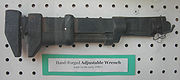
A wrench or spanner is a tool used to provide grip and mechanical advantage in applying torque to turn objects—usually rotary fasteners, such as nuts and bolts—or keep them from turning....
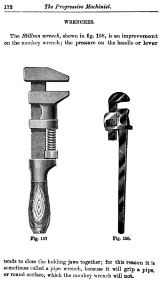
, a later American development of eighteenth century English coach wrenches. It was popular in the nineteenth and early twentieth centuries but is now used only for heavier tasks, having been mostly replaced by the lighter and sleeker shifting adjustable or "Crescent" wrench
Adjustable spanner
An adjustable spanner or adjustable wrench is a spanner with a "jaw" of adjustable width, allowing it to be used with different sizes of fastener head rather than just one faster, as with a conventional fixed spanner...
. The term monkey wrench is also used colloquially (and mistakenly) to refer to the pipe wrench
Pipe wrench
The pipe wrench is an adjustable wrench used for turning soft iron pipes and fittings with a rounded surface. The design of the adjustable jaw allows it to rock in the frame, such that any forward pressure on the handle tends to pull the jaws tighter together. Teeth angled in the direction of turn...
, owing to their broadly alikened shapes.
Etymology and history
Modifier
Modifier may refer to:* Grammatical modifier, a word that modifies the meaning of another word or limits its meaning* Dangling modifier, a word or phrase that modifies a clause in an ambiguous manner...
"denoting a small light structure or piece of equipment contrived to suit an immediate purpose: a monkey foresail ; a monkey bridge."
Adjustable coach wrenches for the odd-sized nuts of wagon wheels were manufactured in England and imported to North America in the late eighteenth and early nineteenth centuries. They were set either by sliding a wedge, or later by twisting the handle, which turned a screw, narrowing or widening the jaws. In 1840, Worcester, Massachusetts
Worcester, Massachusetts
Worcester is a city and the county seat of Worcester County, Massachusetts, United States. Named after Worcester, England, as of the 2010 Census the city's population is 181,045, making it the second largest city in New England after Boston....
knife manufacturer Loring Coes invented a screw-based coach wrench design in which the jaw width was set with a spinning ring fixed under the sliding lower jaw, above the handle. This was patented in 1841 and the tools were advertised and sold in the United States as monkey wrenches, a term which was already in use for the English handle-set coach wrenches. For the next eighty-seven years a very wide and popular range of monkey wrenches was manufactured by Coes family partnerships, licensees and companies, which filed further wrench patents throughout the nineteenth cenutry. Some Coes wrenches could be bought with wooden knife handles, harking back to the company's early knife making business. In 1909 the Coes Wrench Company advertised a six-foot-long "key" wrench, shaped like a monkey wrench, for use on railroads. The Coes wrench designs were acquired by longtime toolmaker Bemis & Call of Springfield, Massachusetts
Springfield, Massachusetts
Springfield is the most populous city in Western New England, and the seat of Hampden County, Massachusetts, United States. Springfield sits on the eastern bank of the Connecticut River near its confluence with three rivers; the western Westfield River, the eastern Chicopee River, and the eastern...
in 1928. After 1939 its successor companies manufactured monkey wrenches from Coes designs until the mid 1960s, yielding a production run of over 120 years.
Monkey wrenches are still manufactured and are used for some heavy tasks but they have otherwise been mostly replaced by the shifting adjustable wrench
Adjustable spanner
An adjustable spanner or adjustable wrench is a spanner with a "jaw" of adjustable width, allowing it to be used with different sizes of fastener head rather than just one faster, as with a conventional fixed spanner...
, sometimes called the "Crescent" wrench, which is much lighter and has a smaller head, allowing it to fit more easily into tight spaces.
Charles Moncky story
The following story can be found in sundry publications from the late nineteenth and early twentieth centuries:That handy tool, the "monkey-wrench", is not so named because it is a handy thing to monkey with, or for any kindred reason. "Monkey" is not its name at all, but "Moncky." Charles Moncky, the inventor of it, sold his patent for $2000, and invested the money in a house in Williamsburg, Kings County, where he now lives.
However, this was refuted by historical and patent research in the late nineteenth century.
Cluedo token
Cluedo
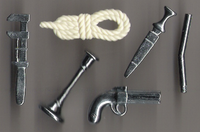
Cluedo is a popular murder/mystery-themed deduction board game originally published by Waddingtons in Leeds, England in 1949. It was devised by Anthony E. Pratt, a solicitor's clerk from Birmingham, England. It is now published by the United States game and toy company Hasbro, which acquired its U.S...
/Clue! is in the shape of an American Coes monkey wrench, although in some traditional UK editions the token is instead shaped like an open ended spanner.
See also
- Adjustable spannerAdjustable spannerAn adjustable spanner or adjustable wrench is a spanner with a "jaw" of adjustable width, allowing it to be used with different sizes of fastener head rather than just one faster, as with a conventional fixed spanner...
- Pipe wrenchPipe wrenchThe pipe wrench is an adjustable wrench used for turning soft iron pipes and fittings with a rounded surface. The design of the adjustable jaw allows it to rock in the frame, such that any forward pressure on the handle tends to pull the jaws tighter together. Teeth angled in the direction of turn...
or Stillson wrench - Plumber wrenchPlumber wrenchA plumber wrench is a tool to rotate pipes used in plumbing. The wrench is adjusted to different pipe diameters by rotating the key ring . This tool can close with significant force and thus does not need to engage a nut...