

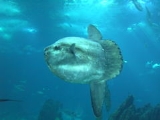
Molidae

Encyclopedia
Molidae is the family of the molas or ocean sunfishes, unique fish whose bodies come to an end just behind the dorsal
and anal fins, giving them a "half-a-fish" appearance. They are also the largest of the ray-finned bony fishes, with the ocean sunfish
Mola mola recorded at up to 3.3 metres (10.8 ft) in length and 2 tonnes (2.2 ST) in weight.
They have the fewest vertebrae of any fish, only 16 in Mola mola. They have fairly rough skin. Also, they completely lack all caudal bones, and most of their skeleton
is made of cartilage
. There are no bony plates in the skin; it is, however, thick and dense like cartilage. They also lack a swim bladder
. The meat contains the same toxin as in pufferfish
and porcupine fish, but not in the same amounts.
Molids mostly swim by using their anal and dorsal fins, the pectoral fins are probably just stabilizers. To steer, they squirt a strong jet of water out of their mouth or gills. They can also make minor adjustments in the orientation of the anal fin or the dorsal fin so as to control the amount of force it produces and the angle at which the force is produced. In this respect, they use their fins much like a bird uses its wings.
Molids are said to be able to produce sound by grinding their pharyngeal teeth
, which are long and claw-like. Typical of a member of Tetraodontiformes
, their teeth are fused into a beak-like structure, making it impossible for them to close their mouth. Despite this, they feed mainly on soft-bodied animals, such as jellyfish and salp
s, although they will also take small fish or crustaceans.
. A molid in need of cleaning will locate a patch of floating algae
or flotsam that is home to half moon perch
. The molid then signals a readiness for cleaning by swimming almost vertically with its head near the surface of the water. It waits for the smaller cleaner fish to feed on the parasite worms. Similarly, the molid may break the surface of the water with its dorsal fin
and beak to attract the attention of a gull
or similar seabird
. The seabird will then dig worms and other stubborn parasites out of the molid's skin.
Dorsal fin
A dorsal fin is a fin located on the backs of various unrelated marine and freshwater vertebrates, including most fishes, marine mammals , and the ichthyosaurs...
and anal fins, giving them a "half-a-fish" appearance. They are also the largest of the ray-finned bony fishes, with the ocean sunfish
Ocean sunfish
The ocean sunfish, Mola mola, or common mola, is the heaviest known bony fish in the world. It has an average adult weight of . The species is native to tropical and temperate waters around the globe. It resembles a fish head with a tail, and its main body is flattened laterally...
Mola mola recorded at up to 3.3 metres (10.8 ft) in length and 2 tonnes (2.2 ST) in weight.
They have the fewest vertebrae of any fish, only 16 in Mola mola. They have fairly rough skin. Also, they completely lack all caudal bones, and most of their skeleton
Skeleton
The skeleton is the body part that forms the supporting structure of an organism. There are two different skeletal types: the exoskeleton, which is the stable outer shell of an organism, and the endoskeleton, which forms the support structure inside the body.In a figurative sense, skeleton can...
is made of cartilage
Cartilage
Cartilage is a flexible connective tissue found in many areas in the bodies of humans and other animals, including the joints between bones, the rib cage, the ear, the nose, the elbow, the knee, the ankle, the bronchial tubes and the intervertebral discs...
. There are no bony plates in the skin; it is, however, thick and dense like cartilage. They also lack a swim bladder
Gas bladder
The swim bladder, gas bladder, fish maw or air bladder is an internal gas-filled organ that contributes to the ability of a fish to control its buoyancy, and thus to stay at the current water depth without having to waste energy in swimming...
. The meat contains the same toxin as in pufferfish
Pufferfish
Tetraodontidae is a family of primarily marine and estuarine fish of the Tetraodontiformes order. The family includes many familiar species which are variously called pufferfish, balloonfish, blowfish, bubblefish, globefish, swellfish, toadfish, toadies, honey toads, sugar toads, and sea squab...
and porcupine fish, but not in the same amounts.
Molids mostly swim by using their anal and dorsal fins, the pectoral fins are probably just stabilizers. To steer, they squirt a strong jet of water out of their mouth or gills. They can also make minor adjustments in the orientation of the anal fin or the dorsal fin so as to control the amount of force it produces and the angle at which the force is produced. In this respect, they use their fins much like a bird uses its wings.
Molids are said to be able to produce sound by grinding their pharyngeal teeth
Pharyngeal teeth
Pharyngeal teeth are teeth in the pharyngeal arch of the throat of cyprinids, suckers, and a number of other fish species lacking teeth.Popular aquarium fish such as goldfish and loaches have these structures. Members of the Botia genus such as clown loaches are known to make distinctive clicking...
, which are long and claw-like. Typical of a member of Tetraodontiformes
Tetraodontiformes
The Tetraodontiformes are an order of highly derived ray-finned fish, also called the Plectognathi. Sometimes these are classified as a suborder of the Perciformes...
, their teeth are fused into a beak-like structure, making it impossible for them to close their mouth. Despite this, they feed mainly on soft-bodied animals, such as jellyfish and salp
Salp
A salp or salpa is a barrel-shaped, planktonic tunicate. It moves by contracting, thus pumping water through its gelatinous body...
s, although they will also take small fish or crustaceans.
Behavior
Molids have been filmed interacting with other species. Since molids are susceptible to skin parasites, they make use of cleaner fishCleaner fish
Cleaner fish are fish that provide a service to other fish species by removing dead skin and ectoparasites. This is an example of mutualism, an ecological interaction that benefits both parties involved. A wide variety of fishes have been observed to display cleaning behaviors including wrasses,...
. A molid in need of cleaning will locate a patch of floating algae
Algae
Algae are a large and diverse group of simple, typically autotrophic organisms, ranging from unicellular to multicellular forms, such as the giant kelps that grow to 65 meters in length. They are photosynthetic like plants, and "simple" because their tissues are not organized into the many...
or flotsam that is home to half moon perch
Halfmoon
The Halfmoon, or Medialuna californiensis, is a species of edible Pacific fish....
. The molid then signals a readiness for cleaning by swimming almost vertically with its head near the surface of the water. It waits for the smaller cleaner fish to feed on the parasite worms. Similarly, the molid may break the surface of the water with its dorsal fin
Dorsal fin
A dorsal fin is a fin located on the backs of various unrelated marine and freshwater vertebrates, including most fishes, marine mammals , and the ichthyosaurs...
and beak to attract the attention of a gull
Gull
Gulls are birds in the family Laridae. They are most closely related to the terns and only distantly related to auks, skimmers, and more distantly to the waders...
or similar seabird
Seabird
Seabirds are birds that have adapted to life within the marine environment. While seabirds vary greatly in lifestyle, behaviour and physiology, they often exhibit striking convergent evolution, as the same environmental problems and feeding niches have resulted in similar adaptations...
. The seabird will then dig worms and other stubborn parasites out of the molid's skin.
Species
The family is small, consisting of just five species in three genera:- Genus Masturus
- Sharptail molaSharptail molaThe sharptail mola, Masturus lanceolatus, is a species of mola found circumglobally in tropical and temperate waters. It is similar in appearance to the ocean sunfish , but can be distinguished by the projection on its clavus . Other common names include sharpfin sunfish, point-tailed sunfish, and...
, Masturus lanceolatus - Masturus oxyuropterus
- Sharptail mola
- Genus MolaMola (genus)Mola is a genus of the family Molidae. It includes two species, the ocean sunfish, Mola mola, and the Southern Ocean sunfish, Mola ramsayi....
- Ocean sunfishOcean sunfishThe ocean sunfish, Mola mola, or common mola, is the heaviest known bony fish in the world. It has an average adult weight of . The species is native to tropical and temperate waters around the globe. It resembles a fish head with a tail, and its main body is flattened laterally...
, Mola mola - Southern sunfishMola ramsayiMola ramsayi, known commonly as the southern ocean sunfish or southern sunfish, is a fish belonging to the family Molidae. It is closely related to its cogener, the large Mola mola, and is found in the Southern Hemisphere.-Description:...
, Mola ramsayiMola ramsayiMola ramsayi, known commonly as the southern ocean sunfish or southern sunfish, is a fish belonging to the family Molidae. It is closely related to its cogener, the large Mola mola, and is found in the Southern Hemisphere.-Description:...
- Ocean sunfish
- Genus RanzaniaSlender sunfishThe Slender sunfish, Ranzania laevis, is a mola of the family Molidae, the only member of the genus Ranzania, found globally in tropical and temperate seas. Its length is up to 1 m.-References:...
- Slender sunfishSlender sunfishThe Slender sunfish, Ranzania laevis, is a mola of the family Molidae, the only member of the genus Ranzania, found globally in tropical and temperate seas. Its length is up to 1 m.-References:...
, Ranzania laevis
- Slender sunfish
External links
- FishBase info for Molidae
- The Open Ocean MarineBio.org. Updated: 28 August 2011.