
Home      Discussion      Topics      Dictionary      Almanac
Signup       Login
Mission San Buenaventura

Mission San Buenaventura

Overview
Mission San Buenaventura was founded on Easter Sunday, March 31, 1782 in Las Californias
Las Californias
The Californias, or in — - was the name given by the Spanish to their northwestern territory of New Spain, comprising the present day states of Baja California and Baja California Sur on the Baja California Peninsula in Mexico; and the present day U.S. state of California in the United States of...

, part of the Spanish
Spain
Spain , officially the Kingdom of Spain languages]] under the European Charter for Regional or Minority Languages. In each of these, Spain's official name is as follows:;;;;;;), is a country and member state of the European Union located in southwestern Europe on the Iberian Peninsula...

 Viceroyalty of New Spain. Named for a Franciscan
Franciscan
Most Franciscans are members of Roman Catholic religious orders founded by Saint Francis of Assisi. Besides Roman Catholic communities, there are also Old Catholic, Anglican, Lutheran, ecumenical and Non-denominational Franciscan communities....

 theologian
Theology
Theology is the systematic and rational study of religion and its influences and of the nature of religious truths, or the learned profession acquired by completing specialized training in religious studies, usually at a university or school of divinity or seminary.-Definition:Augustine of Hippo...

, Saint Bonaventure, it was the last of the missions
Spanish missions in California
The Spanish missions in California comprise a series of religious and military outposts established by Spanish Catholics of the Franciscan Order between 1769 and 1823 to spread the Christian faith among the local Native Americans. The missions represented the first major effort by Europeans to...

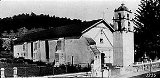
 founded by Father Serra. Mission San Buenaventura was planned to be founded in the year 1770, but the founding was delayed because of the low availability of the military escorts needed to establish Mission San Buenaventura. In 1793, the first church burned down. Today, only a small section of the entire mission still stands; the Cemetery to the left of the church is covered by a school. It took the neophytes 16 years to build the new church, which still stands today.
Discussion
Ask a question about 'Mission San Buenaventura'
Start a new discussion about 'Mission San Buenaventura'
Answer questions from other users
Full Discussion Forum
 
Unanswered Questions
Encyclopedia
Mission San Buenaventura was founded on Easter Sunday, March 31, 1782 in Las Californias
Las Californias
The Californias, or in — - was the name given by the Spanish to their northwestern territory of New Spain, comprising the present day states of Baja California and Baja California Sur on the Baja California Peninsula in Mexico; and the present day U.S. state of California in the United States of...

, part of the Spanish
Spain
Spain , officially the Kingdom of Spain languages]] under the European Charter for Regional or Minority Languages. In each of these, Spain's official name is as follows:;;;;;;), is a country and member state of the European Union located in southwestern Europe on the Iberian Peninsula...

 Viceroyalty of New Spain. Named for a Franciscan
Franciscan
Most Franciscans are members of Roman Catholic religious orders founded by Saint Francis of Assisi. Besides Roman Catholic communities, there are also Old Catholic, Anglican, Lutheran, ecumenical and Non-denominational Franciscan communities....

 theologian
Theology
Theology is the systematic and rational study of religion and its influences and of the nature of religious truths, or the learned profession acquired by completing specialized training in religious studies, usually at a university or school of divinity or seminary.-Definition:Augustine of Hippo...

, Saint Bonaventure, it was the last of the missions
Spanish missions in California
The Spanish missions in California comprise a series of religious and military outposts established by Spanish Catholics of the Franciscan Order between 1769 and 1823 to spread the Christian faith among the local Native Americans. The missions represented the first major effort by Europeans to...

 founded by Father Serra. Mission San Buenaventura was planned to be founded in the year 1770, but the founding was delayed because of the low availability of the military escorts needed to establish Mission San Buenaventura. In 1793, the first church burned down. Today, only a small section of the entire mission still stands; the Cemetery to the left of the church is covered by a school. It took the neophytes 16 years to build the new church, which still stands today.

History


A system of aqueduct
Aqueduct
An aqueduct is a water supply or navigable channel constructed to convey water. In modern engineering, the term is used for any system of pipes, ditches, canals, tunnels, and other structures used for this purpose....

s were built by Chumash Indians
Native Americans in the United States
Native Americans in the United States are the indigenous peoples in North America within the boundaries of the present-day continental United States, parts of Alaska, and the island state of Hawaii. They are composed of numerous, distinct tribes, states, and ethnic groups, many of which survive as...

 between 1805–1815 to meet the needs of the Mission population and consisted of both ditches and elevated stone masonry
Masonry
Masonry is the building of structures from individual units laid in and bound together by mortar; the term masonry can also refer to the units themselves. The common materials of masonry construction are brick, stone, marble, granite, travertine, limestone; concrete block, glass block, stucco, and...

. The watercourse ran from a point on the Ventura River
Ventura River
The Ventura River is a river in Ventura County, California. The river forms at the confluence of Matilija Creek and North Fork Matilija Creek, upstream from the Pacific Ocean...

 about ½ mile north of the remaining ruins and carried the water to holding tanks behind the San Buenaventura Mission, a total of about 7 miles (11.3 km). The entire water distribution system was destroyed by floods and abandoned in 1862.

In 1893, Father Cyprian Rubio "modernized" the interior of the church, painting over the original artwork; when he finished, almost nothing remained of the old church. New priests restored the church to its original style in 1957. Today all that remains of the original Mission is the church and its garden. Services are still held in the parish
Parish
A parish is a territorial unit historically under the pastoral care and clerical jurisdiction of one parish priest, who might be assisted in his pastoral duties by a curate or curates - also priests but not the parish priest - from a more or less central parish church with its associated organization...

 church. A small museum sits at the Mission with displays of Chumash Indian artifacts and mission-era items.

Other historic designations

  • National Register of Historic Places
    National Register of Historic Places
    The National Register of Historic Places is the United States government's official list of districts, sites, buildings, structures, and objects deemed worthy of preservation...

     #NPS–75000497 — Mission San Buenaventura Aqueduct
    Aqueduct
    An aqueduct is a water supply or navigable channel constructed to convey water. In modern engineering, the term is used for any system of pipes, ditches, canals, tunnels, and other structures used for this purpose....

  • California Historical Landmark
    California Historical Landmark
    California Historical Landmarks are buildings, structures, sites, or places in the state of California that have been determined to have statewide historical significance by meeting at least one of the criteria listed below:...

     #113 — Site of "Junípero Serra's Cross" (the first cross on the hill known as La Loma de la Cruz, or the "Hill of the Cross") can be found in Grant Park, and was erected by Junípero Serra upon the Mission's founding
  • California Historical Landmark #114 — Old Mission Reservoir, part of the water system for Mission San Buenaventura (the settling tank or receiving reservoir; the site can be found in Eastwood Park)
  • California Historical Landmark #114–1 — Mission San Buenaventura Aqueduct
    Aqueduct
    An aqueduct is a water supply or navigable channel constructed to convey water. In modern engineering, the term is used for any system of pipes, ditches, canals, tunnels, and other structures used for this purpose....

     (at Canada Larga Road) consists of two surviving sections of viaduct
    Viaduct
    A viaduct is a bridge composed of several small spans. The term viaduct is derived from the Latin via for road and ducere to lead something. However, the Ancient Romans did not use that term per se; it is a modern derivation from an analogy with aqueduct. Like the Roman aqueducts, many early...

     about 100 feet (30.5 m) long, made of cobblestone
    Cobblestone
    Cobblestones are stones that were frequently used in the pavement of early streets. "Cobblestone" is derived from the very old English word "cob", which had a wide range of meanings, one of which was "rounded lump" with overtones of large size...

     and mortar
    Mortar (masonry)
    Mortar is a workable paste used to bind construction blocks together and fill the gaps between them. The blocks may be stone, brick, cinder blocks, etc. Mortar becomes hard when it sets, resulting in a rigid aggregate structure. Modern mortars are typically made from a mixture of sand, a binder...


Mission industries


Some animals at San Buenaventura were cattle
Cattle
Cattle are the most common type of large domesticated ungulates. They are a prominent modern member of the subfamily Bovinae, are the most widespread species of the genus Bos, and are most commonly classified collectively as Bos primigenius...

, horse
Horse
The horse is one of two extant subspecies of Equus ferus, or the wild horse. It is a single-hooved mammal belonging to the taxonomic family Equidae. The horse has evolved over the past 45 to 55 million years from a small multi-toed creature into the large, single-toed animal of today...

s, sheep, donkey
Donkey
The donkey or ass, Equus africanus asinus, is a domesticated member of the Equidae or horse family. The wild ancestor of the donkey is the African Wild Ass, E...

s and goat
Goat
The domestic goat is a subspecies of goat domesticated from the wild goat of southwest Asia and Eastern Europe. The goat is a member of the Bovidae family and is closely related to the sheep as both are in the goat-antelope subfamily Caprinae. There are over three hundred distinct breeds of...

s. The cattle were very important because they provided food, oil and hides. In the year of 1818, 35,274 cattle wandered over the mission lands. A little time after January 7, 1831, the animal population decreased to a low of 4,000 cattle, 3,000 sheep, 300 horses and 60 mules. In July 1839, Inspector-General E.P. Hartnell found 2,208 cattle, 1,670 sheep, 799 horses, 35 mules and 65 goats. The soil around Mission San Buenaventura was very good so the mission could grow many crops. San Buenaventura grew apple
Apple
The apple is the pomaceous fruit of the apple tree, species Malus domestica in the rose family . It is one of the most widely cultivated tree fruits, and the most widely known of the many members of genus Malus that are used by humans. Apple grow on small, deciduous trees that blossom in the spring...

s, grape
Grape
A grape is a non-climacteric fruit, specifically a berry, that grows on the perennial and deciduous woody vines of the genus Vitis. Grapes can be eaten raw or they can be used for making jam, juice, jelly, vinegar, wine, grape seed extracts, raisins, molasses and grape seed oil. Grapes are also...

s, banana
Banana
Banana is the common name for herbaceous plants of the genus Musa and for the fruit they produce. Bananas come in a variety of sizes and colors when ripe, including yellow, purple, and red....

s, pear
Pear
The pear is any of several tree species of genus Pyrus and also the name of the pomaceous fruit of these trees. Several species of pear are valued by humans for their edible fruit, but the fruit of other species is small, hard, and astringent....

s, plum
Plum
A plum or gage is a stone fruit tree in the genus Prunus, subgenus Prunus. The subgenus is distinguished from other subgenera in the shoots having a terminal bud and solitary side buds , the flowers in groups of one to five together on short stems, and the fruit having a groove running down one...

s, pomegranate
Pomegranate
The pomegranate , Punica granatum, is a fruit-bearing deciduous shrub or small tree growing between five and eight meters tall.Native to the area of modern day Iran, the pomegranate has been cultivated in the Caucasus since ancient times. From there it spread to Asian areas such as the Caucasus as...

s, fig
Ficus
Ficus is a genus of about 850 species of woody trees, shrubs, vines, epiphytes, and hemiepiphyte in the family Moraceae. Collectively known as fig trees or figs, they are native throughout the tropics with a few species extending into the semi-warm temperate zone. The Common Fig Ficus is a genus of...

s, orange
Orange (fruit)
An orange—specifically, the sweet orange—is the citrus Citrus × sinensis and its fruit. It is the most commonly grown tree fruit in the world....

s, coconut
Coconut
The coconut palm, Cocos nucifera, is a member of the family Arecaceae . It is the only accepted species in the genus Cocos. The term coconut can refer to the entire coconut palm, the seed, or the fruit, which is not a botanical nut. The spelling cocoanut is an old-fashioned form of the word...

s, bean
Bean
Bean is a common name for large plant seeds of several genera of the family Fabaceae used for human food or animal feed....

s, grain
GRAIN
GRAIN is a small international non-profit organisation that works to support small farmers and social movements in their struggles for community-controlled and biodiversity-based food systems. Our support takes the form of independent research and analysis, networking at local, regional and...

, corn
Maize
Maize known in many English-speaking countries as corn or mielie/mealie, is a grain domesticated by indigenous peoples in Mesoamerica in prehistoric times. The leafy stalk produces ears which contain seeds called kernels. Though technically a grain, maize kernels are used in cooking as a vegetable...

 and barley
Barley
Barley is a major cereal grain, a member of the grass family. It serves as a major animal fodder, as a base malt for beer and certain distilled beverages, and as a component of various health foods...

. In the year of 1818, 12,483 bushels of grain were harvested. Shortly after January 7, 1831, harvests had been reduced to 1,750 bushels of wheat, 2,000 bushels of barley, 500 bushels of corn, and 400 bushels of beans. In July 1839, Inspector-General William E.P. Hartnell found 322 fanegas of wheat, 182 fanegas of corn and 35 fanegas of peas.

Mission bells


Bells
Church bell
A church bell is a bell which is rung in a church either to signify the hour or the time for worshippers to go to church, perhaps to attend a wedding, funeral, or other service...

 were vitally important to daily life at any mission. The bells were rung at mealtimes, to call the Mission residents to work and to religious services, during births and funerals, and other times. Novices were instructed in the intricate rituals associated with ringing the mission bells.

Mission San Buenaventura had five bells. The bells were borrowed from Mission Santa Barbara
Mission Santa Barbara
In 1840, Alta California and Baja California were removed from the Diocese of Sonora to form the Diocese of Both Californias. Bishop Francisco Garcia Diego y Moreno, OFM, established his cathedra at Mission Santa Barbara, making the chapel the pro-cathedral of the diocese until 1849...

 because there were no bells at the time. The bells were never returned. The bell facing north is labeled S. San Francisco 1781. The bell facing east has the inscription: San Pedro Alcantra 1781. A small swinging bell hangs in the southern arch with the lettering: Ave Maria S. Joseph. The only bell used daily at San Buenaventura is large and crown topped with a cross on its side. Inscribed on the bell is Ave Maria Pruysyma D Sapoyan Ano D 1825, which means "Hail Mary Most Pure. Mary of Zapopan Year of 1825." This bell was originally cast for the church of Zapopan but was later sent to Mission San Buenaventura. Another bell, which was once the gift of the Spanish Viceroy, is inscribed Marquez de Croix Mexico November 12, 1770. It is currently owned by Senora Isabel del Valle Cram. There are also two wooden bells in the museum that measure about two feet. These were the only wooden bells in the California missions.

See also


  • USNS Mission Buenaventura (AO-111) — the lead ship
    Lead ship
    The lead ship or class leader is the first of a series or class of ships all constructed according to the same general design. The term is applicable military ships and larger civilian craft.-Overview:...

     in a Class of fleet oilers built during World War II
    World War II
    World War II, or the Second World War , was a global conflict lasting from 1939 to 1945, involving most of the world's nations—including all of the great powers—eventually forming two opposing military alliances: the Allies and the Axis...

    .

External links