

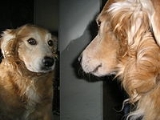
Mirror test

Encyclopedia
The mirror test is a measure of self-awareness
, as animals either possess or lack the ability to recognize themselves in a mirror.
The test was developed by Gordon Gallup Jr.
in 1970, based in part on observations made by Charles Darwin
. While visiting a zoo, Darwin held a mirror up to an orangutan and recorded the animal's reaction, which included making a series of facial expressions. Darwin noted that the significance of these expressions was ambiguous, and could either signify that the primate was making expressions at what it perceived to be another animal, or it could be playing a sort of game with a new toy. Gallup reenacted Darwin's initial experiment with two male and two female wild preadolescent chimpanzees, who had presumably never come into contact with mirrors or reflective surfaces. First each chimpanzee was put into a room by itself for two days. Next a full length mirror was placed in the room for a total of 80 hours in variant distances from the cage - starting farther away and moving closer. A multitude of behaviors were recorded upon introducing the mirrors to these wild chimpanzees. At first the chimpanzees made threatening gestures at their own images, they saw their own reflection as a threat. However after some time the chimpanzees used their own projected images for self directed responding - such as grooming parts of the body before unseen without a mirror, picking their noses, making faces, and blowing bubbles at their own reflections. To even further his findings of self recognition in chimpanzees, Gallup postulated another component to the experiment - manipulating the chimpanzee's appearance and observing the reaction.
Gallup built on these observations by devising a test that attempts to gauge self-awareness by determining whether an animal can recognize its own reflection in a mirror as an image of itself. This is accomplished by surreptitiously marking the animal with two odourless dye spots. The test spot is on a part of the animal that would be visible in front of a mirror, while the control spot is in an accessible but hidden part of the animal's body. Scientists observe that the animal reacts in a manner consistent with it being aware that the test dye is located on its own body while ignoring the control dye. Such behaviour includes turning and adjusting of the body in order to better view the marking in the mirror, or poking at the marking on its own body with a limb while viewing the mirror.
At first, even animals that are capable of passing the mirror test respond as the orangutan described by Darwin. Also young children and people who have been blind from birth but have their sight restored, initially react as if their reflection in the mirror was another person.
Initially, it was thought that gorillas did not pass the test, but there are now several well-documented reports of gorillas (such as Koko
) passing the test. Other primates have so far failed the mirror test, though rhesus macaque
s demonstrated a behavior indicative of at least a partial self-awareness. There is also a barn owl
named Wesley that can recognize itself in the mirror.
Humans tend to fail the mirror test until they are about 18 months old, or what psychoanalysts
call the "mirror stage
".
in which they argued that the pigeon also passes the mirror test. A pigeon was trained to look in a mirror to find a response key behind it which the pigeon then turned to peck - food was the consequence of a correct choice (i.e., the pigeon learned to use a mirror to find critical elements of its environment). Next, the pigeon was trained to peck at dots placed on its feathers; food was, again, the consequence of touching the dot. The latter training was accomplished in the absence of the mirror. The final test was placing a small bib on the pigeon - enough to cover a dot placed on its lower belly. A control period without the mirror present yielded no pecking at the dot. When the mirror was revealed, the pigeon became active, looked in the mirror and then tried to peck on the dot under the bib. It is true that untrained pigeons have never been able to pass the mirror test. However, pigeons do not normally have access to mirrors and do not have the necessary experiences to use them. Giving the pigeons this experience did not guarantee that they would pass the mirror test; the pigeon never pecked dots on its own body in the presence of the mirror (until the final test).
Capuchin monkey
s react to their reflection either with hostility or affection, and mark test experiments have shown that they are incapable of spontaneous mirror self-recognition. Similar tests performed using video technology support these findings, but suggest that the monkeys possess the raw input systems required for explicit self-recognition.
Pigs
are able to the use information seen in a mirror but do not show evidence of self-recognition. In an experiment, 7 of the 8 pigs tested were able to find a bowl of food hidden behind a wall using a mirror. The eighth pig looked behind the mirror for the food.
Proponents of the hard problem of consciousness
claim that the mirror test only demonstrates that some animals possess a particular cognitive capacity for modeling their environment, but not for the presence of phenomenal consciousness per se. Granting consciousness to animals might require demonstrations of thought-directed self-awareness, such as metacognition
.
Some critics, such as philosopher Stuart Smith
, maintain that it does not establish the existence of self-awareness of an independent character in animals whose self-awareness is solely a product of external experience.
Furthermore, even visually oriented creatures may not be familiar enough with mirrors to pass the test, or may not be motivated to touch a mark on their forehead for any number of reasons. Thus, Gallup's mirror test has been criticized as logically invalid because negative results are uninterpretable. Prosopagnosia
cs, for example, may fail the test despite having the ability to report self awareness.
The results uncovered by Asendorpf et al. (1996) proved some issues with the classic mirror test. Their main problem with the classic mirror test is that it assumes that children will recognize the dot of rouge and in recognizing that it’s not normal, try to get rid of it. Asendorpf et al. (1996) found evidence against this. They found that the classic mirror test produced false negatives because the child’s recognition of the dot did not lead to them cleaning it. Therefore, the researchers have assumed that the children may not have developed self-recognition skills yet. In their modified test, in which the doll was cleaned first, they found a stronger relationship between cleaning the doll’s face and the child cleaning their own face. The demonstration with the doll means that showing the children what to do first may lead to more reliable instances of self-recognition.
Self-awareness
Self-awareness is the capacity for introspection and the ability to reconcile oneself as an individual separate from the environment and other individuals...
, as animals either possess or lack the ability to recognize themselves in a mirror.
The test was developed by Gordon Gallup Jr.
Gordon G. Gallup
Gordon G. Gallup, Jr. is a psychologist of the University at Albany's Psychology department, researching biopsychology. He received his Ph.D. from Washington State University in 1968, after which he joined the faculty of the Psychology Department at Tulane University...
in 1970, based in part on observations made by Charles Darwin
Charles Darwin
Charles Robert Darwin FRS was an English naturalist. He established that all species of life have descended over time from common ancestry, and proposed the scientific theory that this branching pattern of evolution resulted from a process that he called natural selection.He published his theory...
. While visiting a zoo, Darwin held a mirror up to an orangutan and recorded the animal's reaction, which included making a series of facial expressions. Darwin noted that the significance of these expressions was ambiguous, and could either signify that the primate was making expressions at what it perceived to be another animal, or it could be playing a sort of game with a new toy. Gallup reenacted Darwin's initial experiment with two male and two female wild preadolescent chimpanzees, who had presumably never come into contact with mirrors or reflective surfaces. First each chimpanzee was put into a room by itself for two days. Next a full length mirror was placed in the room for a total of 80 hours in variant distances from the cage - starting farther away and moving closer. A multitude of behaviors were recorded upon introducing the mirrors to these wild chimpanzees. At first the chimpanzees made threatening gestures at their own images, they saw their own reflection as a threat. However after some time the chimpanzees used their own projected images for self directed responding - such as grooming parts of the body before unseen without a mirror, picking their noses, making faces, and blowing bubbles at their own reflections. To even further his findings of self recognition in chimpanzees, Gallup postulated another component to the experiment - manipulating the chimpanzee's appearance and observing the reaction.
Gallup built on these observations by devising a test that attempts to gauge self-awareness by determining whether an animal can recognize its own reflection in a mirror as an image of itself. This is accomplished by surreptitiously marking the animal with two odourless dye spots. The test spot is on a part of the animal that would be visible in front of a mirror, while the control spot is in an accessible but hidden part of the animal's body. Scientists observe that the animal reacts in a manner consistent with it being aware that the test dye is located on its own body while ignoring the control dye. Such behaviour includes turning and adjusting of the body in order to better view the marking in the mirror, or poking at the marking on its own body with a limb while viewing the mirror.
At first, even animals that are capable of passing the mirror test respond as the orangutan described by Darwin. Also young children and people who have been blind from birth but have their sight restored, initially react as if their reflection in the mirror was another person.
Animals that have been observed to pass
Animals that have passed the mirror test include:- Humans
- All of the other great apesGreat ApesGreat Apes may refer to*Great apes, species in the biological family Hominidae, including humans, chimpanzees, gorillas, and orangutans*Great Apes , a 1997 novel by Will Self...
,- three kinds of GibbonGibbonGibbons are apes in the family Hylobatidae . The family is divided into four genera based on their diploid chromosome number: Hylobates , Hoolock , Nomascus , and Symphalangus . The extinct Bunopithecus sericus is a gibbon or gibbon-like ape which, until recently, was thought to be closely related...
s - BonoboBonoboThe bonobo , Pan paniscus, previously called the pygmy chimpanzee and less often, the dwarf or gracile chimpanzee, is a great ape and one of the two species making up the genus Pan. The other species in genus Pan is Pan troglodytes, or the common chimpanzee...
s - Chimpanzees
- OrangutanOrangutanOrangutans are the only exclusively Asian genus of extant great ape. The largest living arboreal animals, they have proportionally longer arms than the other, more terrestrial, great apes. They are among the most intelligent primates and use a variety of sophisticated tools, also making sleeping...
s - GorillaGorillaGorillas are the largest extant species of primates. They are ground-dwelling, predominantly herbivorous apes that inhabit the forests of central Africa. Gorillas are divided into two species and either four or five subspecies...
s
- three kinds of Gibbon
- Bottlenose dolphins
- Orcas
- Elephants
- European MagpieEuropean MagpieThe European Magpie, Eurasian Magpie, or Common Magpie, , is a resident breeding bird throughout Europe, much of Asia and northwest Africa. It is one of several birds in the crow family named as magpies, and belongs to the Holarctic radiation of "monochrome" magpies...
s
Initially, it was thought that gorillas did not pass the test, but there are now several well-documented reports of gorillas (such as Koko
Koko (gorilla)
Koko is a female western lowland gorilla who, according to Francine "Penny" Patterson, is able to understand more than 1,000 signs based on American Sign Language, and understand approximately 2,000 words of spoken English....
) passing the test. Other primates have so far failed the mirror test, though rhesus macaque
Rhesus Macaque
The Rhesus macaque , also called the Rhesus monkey, is one of the best-known species of Old World monkeys. It is listed as Least Concern in the IUCN Red List of Threatened Species in view of its wide distribution, presumed large population, and its tolerance of a broad range of habitats...
s demonstrated a behavior indicative of at least a partial self-awareness. There is also a barn owl
Barn Owl
The Barn Owl is the most widely distributed species of owl, and one of the most widespread of all birds. It is also referred to as Common Barn Owl, to distinguish it from other species in the barn-owl family Tytonidae. These form one of two main lineages of living owls, the other being the typical...
named Wesley that can recognize itself in the mirror.
Humans tend to fail the mirror test until they are about 18 months old, or what psychoanalysts
Psychoanalysis
Psychoanalysis is a psychological theory developed in the late 19th and early 20th centuries by Austrian neurologist Sigmund Freud. Psychoanalysis has expanded, been criticized and developed in different directions, mostly by some of Freud's former students, such as Alfred Adler and Carl Gustav...
call the "mirror stage
Mirror stage
The mirror stage is a concept in the psychoanalytic theory of Jacques Lacan. Philosopher Raymond Tallis describes the mirror stage as "the cornerstone of Lacan’s oeuvre."...
".
Animals that only pass different versions of the test or other tests involving mirrors
In 1981, Epstein, Lanza and Skinner published a paper in the journal ScienceScience (journal)
Science is the academic journal of the American Association for the Advancement of Science and is one of the world's top scientific journals....
in which they argued that the pigeon also passes the mirror test. A pigeon was trained to look in a mirror to find a response key behind it which the pigeon then turned to peck - food was the consequence of a correct choice (i.e., the pigeon learned to use a mirror to find critical elements of its environment). Next, the pigeon was trained to peck at dots placed on its feathers; food was, again, the consequence of touching the dot. The latter training was accomplished in the absence of the mirror. The final test was placing a small bib on the pigeon - enough to cover a dot placed on its lower belly. A control period without the mirror present yielded no pecking at the dot. When the mirror was revealed, the pigeon became active, looked in the mirror and then tried to peck on the dot under the bib. It is true that untrained pigeons have never been able to pass the mirror test. However, pigeons do not normally have access to mirrors and do not have the necessary experiences to use them. Giving the pigeons this experience did not guarantee that they would pass the mirror test; the pigeon never pecked dots on its own body in the presence of the mirror (until the final test).
Capuchin monkey
Capuchin monkey
The capuchins are New World monkeys of the genus Cebus. The range of capuchin monkeys includes Central America and South America as far south as northern Argentina...
s react to their reflection either with hostility or affection, and mark test experiments have shown that they are incapable of spontaneous mirror self-recognition. Similar tests performed using video technology support these findings, but suggest that the monkeys possess the raw input systems required for explicit self-recognition.
Pigs
PIGS
PIGS is a four letter acronym that can stand for:* PIGS , Phosphatidylinositol glycan anchor biosynthesis, class S, a human gene* PIGS , the economies of Portugal, Italy , Greece and Spain...
are able to the use information seen in a mirror but do not show evidence of self-recognition. In an experiment, 7 of the 8 pigs tested were able to find a bowl of food hidden behind a wall using a mirror. The eighth pig looked behind the mirror for the food.
Discussion
There is some debate as to the value and interpretation of results of the mirror test. While this test has been extensively conducted on primates, there is debate as to the value of the test as applied to animals who rely primarily on senses other than vision. Adaptations of the mirror test have been made in other modalities, such as scent. For instance, biologist Marc Bekoff developed a paradigm using dog urine for testing self-awareness in canines.Proponents of the hard problem of consciousness
Hard problem of consciousness
The hard problem of consciousness is the problem of explaining how and why we have qualitative phenomenal experiences. David Chalmers contrasts this with the "easy problems" of explaining the ability to discriminate, integrate information, report mental states, focus attention, etc...
claim that the mirror test only demonstrates that some animals possess a particular cognitive capacity for modeling their environment, but not for the presence of phenomenal consciousness per se. Granting consciousness to animals might require demonstrations of thought-directed self-awareness, such as metacognition
Metacognition
Metacognition is defined as "cognition about cognition", or "knowing about knowing." It can take many forms; it includes knowledge about when and how to use particular strategies for learning or for problem solving...
.
Some critics, such as philosopher Stuart Smith
Stuart Smith
Stuart Smith may refer to:*Stuart Lyon Smith , politician, psychiatrist, academic and public servant in Ontario, Canada*Stuart Saunders Smith , American composer and percussionist*Stuart Tyson Smith, American Egyptologist...
, maintain that it does not establish the existence of self-awareness of an independent character in animals whose self-awareness is solely a product of external experience.
Furthermore, even visually oriented creatures may not be familiar enough with mirrors to pass the test, or may not be motivated to touch a mark on their forehead for any number of reasons. Thus, Gallup's mirror test has been criticized as logically invalid because negative results are uninterpretable. Prosopagnosia
Prosopagnosia
Prosopagnosia is a disorder of face perception where the ability to recognize faces is impaired, while the ability to recognize other objects may be relatively intact...
cs, for example, may fail the test despite having the ability to report self awareness.
Criticisms
Despite the popularity of the mirror test, Asendorpf et al. (1996) have identified some drawbacks to solely relying on the mirror test as means of self-awareness for young children. In their 1996 study, they observed 109 children in Munich, Germany. They had an average age of 18.6 months. They tested 45 children using the classic mirror rouge test and an additional 59 children using modified mirror test. In the classic test, the experimenter first played with the children, making sure that they looked in the mirror at least three times. After the mirror recognition, the parent placed a large dot of rouge below the child’s right eye. The experimenter then brought the child back in front of the mirror until the child had three more instances of mirror recognition. Once in front of the mirror, the experimenter asked the child, “who is that?” up to three times, if needed, in order get a response. For the modified version of the mirror test, the experimenter introduced a doll with a rouge spot under its eye, and asked the children to help clean the doll. The experiment would ask the child for their help up to three times before cleaning the doll themselves. The doll was then put away and the experimenter played with the child for at least one minute. Then the parent applied the dot of rouge and the experimenter pointed out the mark on the child’s face. They were asked by the experimenter up to three times to clean the dot off of their face.The results uncovered by Asendorpf et al. (1996) proved some issues with the classic mirror test. Their main problem with the classic mirror test is that it assumes that children will recognize the dot of rouge and in recognizing that it’s not normal, try to get rid of it. Asendorpf et al. (1996) found evidence against this. They found that the classic mirror test produced false negatives because the child’s recognition of the dot did not lead to them cleaning it. Therefore, the researchers have assumed that the children may not have developed self-recognition skills yet. In their modified test, in which the doll was cleaned first, they found a stronger relationship between cleaning the doll’s face and the child cleaning their own face. The demonstration with the doll means that showing the children what to do first may lead to more reliable instances of self-recognition.
External links
- The World First Self-Aware Robot and the Success of Mirror Image Cognition (Lecture at the Karlsruhe University and the Munich University, Germany), 8-Nov.-2006.
- Elephants pass mirror test of self-awareness (The Guardian)
- Elephants' jumbo mirror ability (BBC News)
- Elephant study published in Proceedings of National Academy of Sciences, USA
- Elephants see themselves in the mirror (Newscientist.com with video)
- Can a Robot pass the Mirror Test? (www.Conscious-Robots.com)