

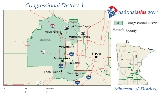
Minnesota's 3rd congressional district

Encyclopedia
Minnesota's 3rd congressional district is one of the most affluent in the state, encompassing the suburbs of Hennepin County to the north, west, and south of Minneapolis. With blue collar
Brooklyn Park
and Coon Rapids
to the north, middle-income Bloomington
to the south, and higher-income Eden Prairie
, Edina
, Maple Grove
, Plymouth
and Wayzata
to the West, it features a mixed characteristic. Republican Erik Paulsen
currently represents the district in the U.S. House of Representatives, having been elected in 2008.
in 2008, equal to his share of the national popular vote. On September 17, 2007, incumbent Republican Jim Ramstad
announced he would not seek reelection in 2008. On November 4, 2008, Republican Erik Paulsen
defeated Democrat Ashwin Madia
to replace Ramstad.
to run for the seat, while the GOP endorsed Paulsen for another term.
On November 2, 2010, Paulsen was re-elected in a landslide, taking 59% to Meffert's 37%.
Blue-collar worker
A blue-collar worker is a member of the working class who performs manual labor. Blue-collar work may involve skilled or unskilled, manufacturing, mining, construction, mechanical, maintenance, technical installation and many other types of physical work...
Brooklyn Park
Brooklyn Park, Minnesota
According to the 2010 census, there were 75,781 people residing in the city. The racial makeup of the city was 52% White, 24% African American, 1% Native American, 15% Asian, 42 residents identifying themselves as Pacific Islander, 4% from other races, and 4% from two or more races...
and Coon Rapids
Coon Rapids, Minnesota
As of the census of 2000, there were 61,627 people, 22,578 households, and 16,572 families residing in the city. The population density was 2,718.1 people per square mile . There were 22,828 housing units at an average density of 1,007.2 per square mile...
to the north, middle-income Bloomington
Bloomington, Minnesota
Bloomington is the fifth largest city in the U.S. state of Minnesota in Hennepin County. Located on the north bank of the Minnesota River above its confluence with the Mississippi River, Bloomington lies at the heart of the southern...
to the south, and higher-income Eden Prairie
Eden Prairie, Minnesota
As of the census of 2000, there were 54,901 people, 20,457 households, and 14,579 families residing in the city. The population density was . There were 21,026 housing units at an average density of 649.2 per square mile...
, Edina
Edina, Minnesota
Edina is a city in Hennepin County, Minnesota, United States, and a first-ring suburb situated immediately southwest of Minneapolis. Edina began as a small farming and milling community in the 1860s. The population was 47,941 at the 2010 census.-Geography:...
, Maple Grove
Maple Grove, Minnesota
As of the census of 2000, there were 50,365 people , 17,532 households, and 13,955 families residing in the city. The population density was 1,532.3 people per square mile . There were 17,745 housing units at an average density of 539.9 per square mile...
, Plymouth
Plymouth, Minnesota
As of the census of 2000, there were 65,894 people, 24,820 households, and 17,647 families residing in the city. The population density was 2,002.0 persons per square mile . There were 25,258 housing units at an average density of 767.4 per square mile...
and Wayzata
Wayzata, Minnesota
Wayzata is a city in Hennepin County, Minnesota, United States, a western suburb of Minneapolis. Wayzata came into existence in the center of Chief Shakopee's Indian village.-Early settlement:...
to the West, it features a mixed characteristic. Republican Erik Paulsen
Erik Paulsen
Erik Paulsen is the U.S. Representative for , serving since 2009. He is a member of the Republican Party. He previously served in the Minnesota House of Representatives...
currently represents the district in the U.S. House of Representatives, having been elected in 2008.
Election of 2008
The district leans slightly Republican with a CPVI of EVEN. However, 53% of people in the district voted for Barack ObamaBarack Obama
Barack Hussein Obama II is the 44th and current President of the United States. He is the first African American to hold the office. Obama previously served as a United States Senator from Illinois, from January 2005 until he resigned following his victory in the 2008 presidential election.Born in...
in 2008, equal to his share of the national popular vote. On September 17, 2007, incumbent Republican Jim Ramstad
Jim Ramstad
James Marvin "Jim" Ramstad is a United States politician from the state of Minnesota.-Early life:Ramstad was born in Jamestown, North Dakota, was educated at the University of Minnesota and the George Washington University Law School. He was an officer in the United States National Guard from 1968...
announced he would not seek reelection in 2008. On November 4, 2008, Republican Erik Paulsen
Erik Paulsen
Erik Paulsen is the U.S. Representative for , serving since 2009. He is a member of the Republican Party. He previously served in the Minnesota House of Representatives...
defeated Democrat Ashwin Madia
Ashwin Madia
Jigar Ashwin Madia, known as Ashwin Madia , is an American attorney and Iraq War veteran who ran for the United States Congress in Minnesota's 3rd congressional district in 2008...
to replace Ramstad.
Election of 2010
On April 10, 2010 the Minnesota Democratic–Farmer–Labor Party Party endorsed Jim MeffertJim Meffert
Jim Meffert is the executive director of the Minnesota Optometric Association and the former president of the Minnesota Parent-Teacher Association. Meffert lives in Edina and was the Democratic nominee for Minnesota's 3rd congressional district in 2010.-Background:Meffert grew up in Marshall,...
to run for the seat, while the GOP endorsed Paulsen for another term.
On November 2, 2010, Paulsen was re-elected in a landslide, taking 59% to Meffert's 37%.
List of representatives
| Congress | Representative | Party | Years | Notes | |
|---|---|---|---|---|---|
| District created | March 4, 1873 | ||||
| 43rd 43rd United States Congress The Forty-third United States Congress was a meeting of the legislative branch of the United States federal government, consisting of the United States Senate and the United States House of Representatives. It met in Washington, D.C. from March 4, 1873 to March 4, 1875, during the fifth and sixth... |
John T. Averill | Republican Republican Party (United States) The Republican Party is one of the two major contemporary political parties in the United States, along with the Democratic Party. Founded by anti-slavery expansion activists in 1854, it is often called the GOP . The party's platform generally reflects American conservatism in the U.S... |
March 4, 1873 - March 3, 1875 | Redistricted Redistricting Redistricting is the process of drawing United States electoral district boundaries, often in response to population changes determined by the results of the decennial census. In 36 states, the state legislature has primary responsibility for creating a redistricting plan, in many cases subject to... from the |
|
| 44th 44th United States Congress The Forty-fourth United States Congress was a meeting of the legislative branch of the United States federal government, consisting of the United States Senate and the United States House of Representatives. It met in Washington, D.C. from March 4, 1875 to March 4, 1877, during the seventh and... |
William S. King William S. King Colonel William Smith King was a Republican United States Representative for Minnesota from March 4, 1875 to March 3, 1877. He engaged in a variety of other activities, including journalism and surveying. King was born in Malone, New York in Franklin County where he grew up and attended the... |
Republican Republican Party (United States) The Republican Party is one of the two major contemporary political parties in the United States, along with the Democratic Party. Founded by anti-slavery expansion activists in 1854, it is often called the GOP . The party's platform generally reflects American conservatism in the U.S... |
March 4, 1875 - March 3, 1877 | ||
| 45th 45th United States Congress -House of Representatives:-Leadership:-Senate:*President: William A. Wheeler *President pro tempore: Thomas W. Ferry -House of Representatives:*Speaker: Samuel J. Randall -Members:This list is arranged by chamber, then by state... |
Jacob H. Stewart Jacob H. Stewart Jacob Henry Stewart was a Representative for the U.S. state of Minnesota.Stewart was born in Clermont, Columbia County, New York on January 15, 1829. He moved with his parents to Peekskill, New York, where he attended the common schools and was graduated from Phillips Academy... |
Republican Republican Party (United States) The Republican Party is one of the two major contemporary political parties in the United States, along with the Democratic Party. Founded by anti-slavery expansion activists in 1854, it is often called the GOP . The party's platform generally reflects American conservatism in the U.S... |
March 4, 1877 - March 3, 1879 | ||
| 46th 46th United States Congress The Forty-sixth United States Congress was a meeting of the legislative branch of the United States federal government, consisting of the United States Senate and the United States House of Representatives. It met in Washington, D.C. from March 4, 1879 to March 4, 1881, during the last two years of... -47th 47th United States Congress The Forty-seventh United States Congress was a meeting of the legislative branch of the United States federal government, consisting of the United States Senate and the United States House of Representatives. It met in Washington, D.C. from March 4, 1881 to March 4, 1883, during the administration... |
William D. Washburn William D. Washburn William Drew Washburn was an American politician. He served in both the United States House of Representatives and the United States Senate as a Republican from Minnesota. Three of his seven brothers became politicians: Elihu B. Washburne, Cadwallader C. Washburn, and Israel Washburn, Jr... |
Republican Republican Party (United States) The Republican Party is one of the two major contemporary political parties in the United States, along with the Democratic Party. Founded by anti-slavery expansion activists in 1854, it is often called the GOP . The party's platform generally reflects American conservatism in the U.S... |
March 4, 1879 - March 3, 1883 | Redistricted Redistricting Redistricting is the process of drawing United States electoral district boundaries, often in response to population changes determined by the results of the decennial census. In 36 states, the state legislature has primary responsibility for creating a redistricting plan, in many cases subject to... to the |
|
| 48th 48th United States Congress The Forty-eighth United States Congress was a meeting of the legislative branch of the United States federal government, consisting of the United States Senate and the United States House of Representatives. It met in Washington, D.C. from March 4, 1883 to March 4, 1885, during the last two years... -49th 49th United States Congress The Forty-ninth United States Congress was a meeting of the legislative branch of the United States federal government, consisting of the United States Senate and the United States House of Representatives. It met in Washington, D.C. from March 4, 1885 to March 4, 1887, during the first two years... |
Horace B. Strait | Republican Republican Party (United States) The Republican Party is one of the two major contemporary political parties in the United States, along with the Democratic Party. Founded by anti-slavery expansion activists in 1854, it is often called the GOP . The party's platform generally reflects American conservatism in the U.S... |
March 4, 1883 - March 3, 1887 | Redistricted Redistricting Redistricting is the process of drawing United States electoral district boundaries, often in response to population changes determined by the results of the decennial census. In 36 states, the state legislature has primary responsibility for creating a redistricting plan, in many cases subject to... from the |
|
| 50th 50th United States Congress The Fiftieth United States Congress was a meeting of the legislative branch of the United States federal government, consisting of the United States Senate and the United States House of Representatives. It met in Washington, D.C. from March 4, 1887 to March 4, 1889, during the third and fourth... |
John L. MacDonald John L. MacDonald John Lewis MacDonald was a Representative from Minnesota; born in Glasgow, Scotland, February 22, 1838; immigrated to Nova Scotia, Canada, with his parents, who later, in 1847, settled in Pittsburgh, Pennsylvania; moved to Minnesota in 1855 and settled in Scott County; studied law; was admitted to... |
Democratic Democratic Party (United States) The Democratic Party is one of two major contemporary political parties in the United States, along with the Republican Party. The party's socially liberal and progressive platform is largely considered center-left in the U.S. political spectrum. The party has the lengthiest record of continuous... |
March 4, 1887 - March 3, 1889 | ||
| 51st 51st United States Congress The Fifty-first United States Congress, referred to by some critics as the Billion Dollar Congress, was a meeting of the legislative branch of the United States federal government, consisting of the United States Senate and the United States House of Representatives. It met in Washington, D.C... |
Darwin Hall Darwin Hall Darwin Scott Hall was a U.S. Representative from Minnesota; born in Mound Prairie, Wheatland Township, Kenosha County, Wisconsin, January 23, 1844; moved with his parents to Waukaw, Winnebago County, in 1847, thence to Grand Rapids, Wisconsin, in 1856; attended the common schools, the local... |
Republican Republican Party (United States) The Republican Party is one of the two major contemporary political parties in the United States, along with the Democratic Party. Founded by anti-slavery expansion activists in 1854, it is often called the GOP . The party's platform generally reflects American conservatism in the U.S... |
March 4, 1889 - March 3, 1891 | ||
| 52nd 52nd United States Congress The Fifty-second United States Congress was a meeting of the legislative branch of the United States federal government, consisting of the United States Senate and the United States House of Representatives. It met in Washington, D.C... -53rd 53rd United States Congress The Fifty-third United States Congress was a meeting of the legislative branch of the United States federal government, consisting of the United States Senate and the United States House of Representatives. It met in Washington, D.C. from March 4, 1893 to March 4, 1895, during the fifth and sixth... |
Osee M. Hall Osee M. Hall Osee Matson Hall was a Representative from Minnesota.Born in Conneaut, Ohio, he attended the local public schools and graduated from Hiram College in Ohio and from Williams College, Williamstown, Massachusetts in 1868.He studied law and was admitted to the bar and commenced practice in Red Wing,... |
Democratic Democratic Party (United States) The Democratic Party is one of two major contemporary political parties in the United States, along with the Republican Party. The party's socially liberal and progressive platform is largely considered center-left in the U.S. political spectrum. The party has the lengthiest record of continuous... |
March 4, 1891 - March 3, 1895 | ||
| 54th 54th United States Congress - House of Representatives :-Leadership:- Senate :* President: Adlai E. Stevenson * President pro tempore: William P. Frye - Majority leadership :* Republican Conference Chairman: John Sherman- Minority leadership :... -57th 57th United States Congress -House of Representatives:*Democratic: 151*Republican: 200 *Populist: 5*Silver : 1TOTAL members: 357-Leadership:-Senate:* President: Theodore Roosevelt , until September 14, 1901, vacant thereafter.... |
Joel Heatwole Joel Heatwole Joel Prescott Heatwole was a U.S. House Representative from Minnesota.He was born at Waterford Mills, Indiana. He attended the public schools, and learned the printer’s trade... |
Republican Republican Party (United States) The Republican Party is one of the two major contemporary political parties in the United States, along with the Democratic Party. Founded by anti-slavery expansion activists in 1854, it is often called the GOP . The party's platform generally reflects American conservatism in the U.S... |
March 4, 1895 - March 3, 1903 | ||
| 58th 58th United States Congress - House of Representatives :* Republican : 209 * Democratic : 176* Silver Republican : 1TOTAL members: 386-Senate:* President: Vacant* President pro tempore: William P. Frye -Members:... -68th 68th United States Congress The Sixty-eighth United States Congress was a meeting of the legislative branch of the United States federal government, consisting of the United States Senate and the United States House of Representatives. It met in Washington, D.C. from March 4, 1923 to March 4, 1925, during the last months of... |
Charles Russell Davis Charles Russell Davis Charles Russell Davis was a member of the United States House of Representatives from Minnesota.He was born in Pittsfield, Illinois but moved with his father to Le Sueur County, Minnesota in 1854, where he attended the public schools and was also instructed by private tutor. He graduated from a... |
Republican Republican Party (United States) The Republican Party is one of the two major contemporary political parties in the United States, along with the Democratic Party. Founded by anti-slavery expansion activists in 1854, it is often called the GOP . The party's platform generally reflects American conservatism in the U.S... |
March 4, 1903 - March 3, 1925 | ||
| 69th 69th United States Congress The Sixty-ninth United States Congress was a meeting of the legislative branch of the United States federal government, consisting of the United States Senate and the United States House of Representatives. It met in Washington, D.C. from March 4, 1925 to March 4, 1927, during the third and fourth... -72nd 72nd United States Congress The Seventy-second United States Congress was a meeting of the legislative branch of the United States federal government, consisting of the United States Senate and the United States House of Representatives. It met in Washington, D.C. from March 4, 1931 to March 4, 1933, during the last two years... |
August H. Andresen | Republican Republican Party (United States) The Republican Party is one of the two major contemporary political parties in the United States, along with the Democratic Party. Founded by anti-slavery expansion activists in 1854, it is often called the GOP . The party's platform generally reflects American conservatism in the U.S... |
March 4, 1925 - March 3, 1933 | ||
| 73rd 73rd United States Congress The Seventy-third United States Congress was a meeting of the legislative branch of the United States federal government, composed of the United States Senate and the United States House of Representatives. It met in Washington, DC from March 4, 1933 to January 3, 1935, during the first two years... |
March 4, 1933 - January 3, 1935 | District inactive, all representatives elected At-large on a general ticket | |||
| 74th 74th United States Congress -House:Also 2 Delegates, 3 Resident Commissioners-Senate:*President of the Senate: John N. Garner *President pro tempore: Key Pittman -Majority leadership:*Majority leader: Joseph T. Robinson... |
Ernest Lundeen Ernest Lundeen Ernest Lundeen was an American lawyer and politician.Lundeen was born and raised on his father's homestead in Brooklyn Township of Lincoln County near Beresford, South Dakota. His father, C. H... |
Farmer-Labor Minnesota Farmer-Labor Party The Minnesota Farmer–Labor Party was a political party in the United States state of Minnesota, the most successful and longest-lasting of the constituent elements of the national Farmer–Labor Party movement, which had a presence in other states... |
January 3, 1935 - January 3, 1937 | Redistricted Redistricting Redistricting is the process of drawing United States electoral district boundaries, often in response to population changes determined by the results of the decennial census. In 36 states, the state legislature has primary responsibility for creating a redistricting plan, in many cases subject to... from the |
|
| 75th 75th United States Congress The Seventy-fifth United States Congress was a meeting of the legislative branch of the United States federal government, composed of the United States Senate and the United States House of Representatives. It met in Washington, DC from January 3, 1937 to January 3, 1939, during the first two years... |
Henry Teigan Henry Teigan Henry George Teigan was an American labor leader and editor who served as a member of the United States House of Representatives from Minnesota.-Background:... |
Farmer-Labor Minnesota Farmer-Labor Party The Minnesota Farmer–Labor Party was a political party in the United States state of Minnesota, the most successful and longest-lasting of the constituent elements of the national Farmer–Labor Party movement, which had a presence in other states... |
January 3, 1937 - January 3, 1939 | ||
| 76th 76th United States Congress The Seventy-sixth United States Congress was a meeting of the legislative branch of the United States federal government, composed of the United States Senate and the United States House of Representatives. It met in Washington, DC from January 3, 1939 to January 3, 1941, during the seventh and... |
John G. Alexander John G. Alexander John Grant Alexander was a Representative to the U.S. Congress from Minnesota; born in Texas Valley, Cortland County, New York; attended the public schools; was graduated from the law department of Cornell University, Ithaca, New York, in 1916; was admitted to the New York bar the same year; moved... |
Republican Republican Party (United States) The Republican Party is one of the two major contemporary political parties in the United States, along with the Democratic Party. Founded by anti-slavery expansion activists in 1854, it is often called the GOP . The party's platform generally reflects American conservatism in the U.S... |
January 3, 1939 - January 3, 1941 | ||
| 77th 77th United States Congress -Major events:* December 7, 1941: Attack on Pearl Harbor* December 8, 1941: Joint Session of Congress met to hear President Roosevelt deliver his "Day of Infamy" speech... -78th 78th United States Congress The Seventy-eighth United States Congress was a meeting of the legislative branch of the United States federal government, composed of the United States Senate and the United States House of Representatives. It met in Washington, DC from January 3, 1943 to January 3, 1945, during the last two years... |
Richard Pillsbury Gale Richard Pillsbury Gale Richard Pillsbury Gale was a U.S. Representative from Minnesota; born in Minneapolis, Hennepin County, Minnesota; attended the public schools of Minneapolis, The Blake School at Hopkins, Minnesota, Minnesota Farm School, and University of Minnesota at Minneapolis; was graduated from Yale... |
Republican Republican Party (United States) The Republican Party is one of the two major contemporary political parties in the United States, along with the Democratic Party. Founded by anti-slavery expansion activists in 1854, it is often called the GOP . The party's platform generally reflects American conservatism in the U.S... |
January 3, 1941 - January 3, 1945 | ||
| 79th 79th United States Congress The Seventy-ninth United States Congress was a meeting of the legislative branch of the United States federal government, composed of the United States Senate and the United States House of Representatives. It met in Washington, DC from January 3, 1945 to January 3, 1947, during the last months of... |
William Gallagher | DFL | January 3, 1945 - August 13, 1946 | Died | |
| Vacant | August 13, 1946 - March 4, 1947 | ||||
| 80th 80th United States Congress The Eightieth United States Congress was a meeting of the legislative branch of the United States federal government, composed of the United States Senate and the United States House of Representatives. It met in Washington, DC from January 3, 1947 to January 3, 1949, during the third and fourth... |
George MacKinnon George MacKinnon George Edward MacKinnon was appointed by President Nixon to the United States Court of Appeals for the District of Columbia in May 1969, where he served until his death in 1995. Judge MacKinnon is also the father of feminist legal scholar Catharine MacKinnon.According to Judge Harry T... |
Republican Republican Party (United States) The Republican Party is one of the two major contemporary political parties in the United States, along with the Democratic Party. Founded by anti-slavery expansion activists in 1854, it is often called the GOP . The party's platform generally reflects American conservatism in the U.S... |
January 3, 1947 - January 3, 1949 | ||
| 81st 81st United States Congress The Eighty-first United States Congress was a meeting of the legislative branch of the United States federal government, composed of the United States Senate and the United States House of Representatives... -86th 86th United States Congress The Eighty-sixth United States Congress was a meeting of the legislative branch of the United States federal government, composed of the United States Senate and the United States House of Representatives. It met in Washington, DC from January 3, 1959 to January 3, 1961, during the last two years... |
Roy Wier Roy Wier Roy William Wier was a U.S. Representative from Minnesota; born in Redfield, Spink County, South Dakota; moved with his parents in 1896 to Minneapolis, Hennepin County, Minnesota; attended the public schools and North High School; learned the telephone and electrical trade, later going into... |
DFL | January 3, 1949 - January 3, 1961 | ||
| 87th 87th United States Congress -House of Representatives :-Senate:* President: Richard Nixon , until January 20, 1961** Lyndon Johnson , from January 20, 1961* President pro tempore: Carl Hayden -House of Representatives:... -91st 91st United States Congress The Ninety-first United States Congress was a meeting of the legislative branch of the United States federal government, composed of the United States Senate and the United States House of Representatives. It met in Washington, DC from January 3, 1969 to January 3, 1971, during the first two years... |
Clark MacGregor Clark MacGregor Clark MacGregor was a Republican U.S. Representative from Minnesota's 3rd Congressional District.MacGregor was born in Minneapolis, Minnesota and graduated cum laude from Dartmouth College in the class of 1944 and the University of Minnesota Law School in 1946 . He was elected to the U.S... |
Republican Republican Party (United States) The Republican Party is one of the two major contemporary political parties in the United States, along with the Democratic Party. Founded by anti-slavery expansion activists in 1854, it is often called the GOP . The party's platform generally reflects American conservatism in the U.S... |
January 3, 1961 - January 3, 1971 | ||
| 92nd 92nd United States Congress The Ninety-second United States Congress was a meeting of the legislative branch of the United States federal government, composed of the United States Senate and the United States House of Representatives... -101st 101st United States Congress The One Hundred First United States Congress was a meeting of the legislative branch of the United States federal government, composed of the United States Senate and the United States House of Representatives. It met in Washington, DC from January 3, 1989 to January 3, 1991, during the first two... |
Bill Frenzel Bill Frenzel William Eldridge "Bill" Frenzel is a former Republican Congressman from Minnesota, representing Minnesota's Third District, which included the southern and western suburbs of Minneapolis.- Early life and career :... |
Republican Republican Party (United States) The Republican Party is one of the two major contemporary political parties in the United States, along with the Democratic Party. Founded by anti-slavery expansion activists in 1854, it is often called the GOP . The party's platform generally reflects American conservatism in the U.S... |
January 3, 1971 - January 3, 1991 | ||
| 102nd 102nd United States Congress -House of Representatives:- Senate :* President:Dan Quayle * President pro tempore: Robert Byrd - Majority leadership :* Majority Leader: George Mitchell* Majority Whip: Wendell Ford- Minority leadership :... -110th 110th United States Congress The One Hundred Tenth United States Congress was the meeting of the legislative branch of the United States federal government, between January 3, 2007, and January 3, 2009, during the last two years of the second term of President George W. Bush. It was composed of the Senate and the House of... |
Jim Ramstad Jim Ramstad James Marvin "Jim" Ramstad is a United States politician from the state of Minnesota.-Early life:Ramstad was born in Jamestown, North Dakota, was educated at the University of Minnesota and the George Washington University Law School. He was an officer in the United States National Guard from 1968... |
Republican Republican Party (United States) The Republican Party is one of the two major contemporary political parties in the United States, along with the Democratic Party. Founded by anti-slavery expansion activists in 1854, it is often called the GOP . The party's platform generally reflects American conservatism in the U.S... |
January 3, 1991 - January 3, 2009 | ||
| 111th 111th United States Congress The One Hundred Eleventh United States Congress was the meeting of the legislative branch of the United States federal government from January 3, 2009 until January 3, 2011. It began during the last two weeks of the George W. Bush administration, with the remainder spanning the first two years of... |
Erik Paulsen Erik Paulsen Erik Paulsen is the U.S. Representative for , serving since 2009. He is a member of the Republican Party. He previously served in the Minnesota House of Representatives... |
Republican Republican Party (United States) The Republican Party is one of the two major contemporary political parties in the United States, along with the Democratic Party. Founded by anti-slavery expansion activists in 1854, it is often called the GOP . The party's platform generally reflects American conservatism in the U.S... |
January 3, 2009 - Present | Incumbent Incumbent The incumbent, in politics, is the existing holder of a political office. This term is usually used in reference to elections, in which races can often be defined as being between an incumbent and non-incumbent. For example, in the 2004 United States presidential election, George W... |
|