

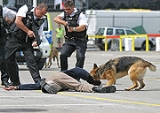
Ministry of Defence Police

Encyclopedia
The Ministry of Defence Police (MDP) is a civilian police force which is part of the United Kingdom
's Ministry of Defence
. The force is part of the larger government agency, the Ministry of Defence Police and Guarding Agency
(MDPGA), together with the Ministry of Defence Guard Service
. The MDPGA was formed in 2004 by bringing the two organisations together under a single administrative headquarters. The MDP are not Military Police
and should not be confused with the Royal Military Police
or any other Service Police organisation. The MDP has an established strength of 3,440 police officers, based at 86 locations across the United Kingdom.
The force was originally formed in 1971 by the merger of three separate service constabularies: the Air Force Department Constabulary
, the Army Department Constabulary
, and the Admiralty Constabulary
. The force, which consists of five divisions, is headquartered at MDPGA Wethersfield, Essex
.
Although superficially similar to other UK police forces, the MDP is significantly different in role, function and accountability. The MDP's primary responsibility is to provide armed security and counter terrorism, as well as uniformed policing and investigative services to Ministry of Defence property, personnel, and installations throughout the United Kingdom.
MDP officers are attested as constables under the Ministry of Defence Police Act 1987
. All MDP officers are trained to use firearms and 75% of those on duty are armed at any given time.
The force has a number of specialised departments and also provides officers for international policing secondments; including the active policing of conflict areas overseas and training of resident police forces in these areas. These overseas missions are carried out under the mandates of the United Nations
, NATO, or the Foreign and Commonwealth Office
.
The MDP is poised for significant restructuring between 2011 and 2014 as part of the coalition government's post 2010 austerity measures, and the Strategic Defence and Security Review
. It is expected to lose 20% of its manpower and stations; to concentrate on high end tasks such as nuclear weapons security, mobile armed policing of the defence estate and defence financial crime.
(previously under the control of the Air Ministry
), the Army Department Constabulary
(previously under the control of the War Office
), and the Admiralty Constabulary
(previously under the control of the Admiralty
).
These earlier constabularies were formed as a result of the Special Constables Act 1923, although their histories can be traced back much further as watchmen. Their powers came from different legislative sources. In 1984, the House of Commons
Defence Select Committee
recognised the difficulties under which the Ministry of Defence Police were operating; the committee's recommendations led to the passing of the Ministry of Defence Police Act 1987
.
, including armed front-line security at high security sites; it deals with both military personnel and civilians. The MDP are not Military Police
and should not be confused with the Royal Military Police
or any other Service Police organisation. Although some critics in the press and pressure groups consider the MDP to be a Paramilitary
force, a claim that is denied by the MDP and the UK government.
The MDP's activities fall into five key areas:
. Since January 2008, the MDP has also taken on the role of providing armed security at four gas terminals in the UK, part of the Critical National Infrastructure.
The MDP once had a presence at 120 Ministry of Defence sites such as the Royal Arsenal
, munitions and storage depots, Royal Ordnance Factories
, and Defence Research Establishments. The end of both the Cold War
and The Troubles
in Northern Ireland
, along with the subsequent closure of the Royal Arsenal
, Woolwich
, and the privatisation of entities such as the Royal Ordnance Factories reduced the number of sites that need an MDP presence. Many Armed Forces
locations that previously relied upon the MDP for armed security have transferred that role to the Military Provost Guard Service
. Some have retained an MDP presence for purely policing purposes, albeit in reduced numbers.
s in one of the three jurisdictions of the UK: England & Wales
, Scotland
, and Northern Ireland
, but can exercise their powers on Ministry of Defence estate throughout the United Kingdom and additionally in the circumstances described below. MDP officers' jurisdiction relates to subject rather than geographic area and is set out in section 2 of the Ministry of Defence Police Act 1987
, which was amended by the Anti Terrorism Crime and Security Act 2001. Officers are based throughout the UK and exercise their jurisdiction over matters relating to the Defence Estate; there is no requirement for them to be on Ministry of Defence land when doing so.
The MDP is classified by the Serious Organised Crime and Police Act 2005
as a special police force. This gives it conditional allowance to exercise the powers available to a constable of a territorial police force; if an offence or incident is encountered outwith their natural jurisdiction. Additionally the MDP is able to provide officers and specialist units to territorial police forces on a mutual assistance basis.
MDP officers are also able to take on the powers of constables of territorial police forces or other special police forces (such as British Transport Police
) in certain situations, as set out in the Ministry of Defence Police Act (as amended). This is known as 'extended jurisdiction'. The protocol that governs this states that MDP officers should only seek to use these extended powers if they come across a situation outside their natural jurisdiction, during the course of their MDP duties. Whenever MDP officers exercise police powers under this 'extended jurisdiction', the Chief Constable MDP has a responsibility to ensure the local Chief Constable is notified as soon as possible.
. Since 1995, its headquarters has been located at the former United States Air Force
base at Wethersfield
, now designated MDPGA Wethersfield. Force-wide command and control facilities are provided from the Central Control Room and Gold Command Suite. MDPGA Wethersfield is also home to the Agency Training Centre, which is responsible for the initial training and development of all MDP Constables and MGS guards.
The MDP has five land-based divisions
: (last restructured in 2003 and currently under review)
Each division is commanded by a Chief Superintendent
and has its own Divisional Command and Control Room which has direct communications with force headquarters, divisional CID, and Divisional Support Groups which are able to respond at short notice to any unforeseen incident or emergency. Each station is commanded by a Senior Police Officer who will vary in rank from Sergeant to Superintendent depending on the station's size, role and staffing.
. The MDP recruits nationally and new entrants can be given a posting anywhere in the UK. In practice most new entrants end up in AWE Division or at RNAD Coulport.
Officers are selected via the NPIA SEARCH assessment centre process. In addition candidates are required to pass the MDP job related fitness assessment and a firearms aptitude test.
, extendable baton and kwikcuffs. They also receive Level three public order training.
The final stage of the course includes the police basic driver assessment (only for driving licence holders) and a 4 week Authorised Firearms Officer
course held at the Firearms Training Centre at MDPGA Wethersfield.
Those officers working with US Forces in the UK are required to hold a US Common Access Card
for which the US Government carries out its own security checks on the officer.
Discipline in the MDP is governed by the Ministry of Defence Police (Conduct) Regulations 2009, which broadly resemble the Police (Conduct) Regulations 2008 that govern territorial police forces. MDP officers retain a full national mobility liability, and can be posted anywhere in the UK at any time. In practice most movement is voluntary, either on promotion or requested moves for personal reasons. Like all UK police forces the MDP does not have the right to take strike action
.
MDP pay follows the same scale as territorial police forces; however, MDP officers are part of the Civil Service Pension Scheme, not the Police Pension Scheme and only contribute 3.5% of their gross salary, compared to territorial police force officers who contribute 11%. To even out this anomaly, MDP officers pay is abated. This is known as the MDP Net Pay Deduction.
The MDP operates a random and 'with cause', alcohol and drugs screening policy. An annual fitness test for all AFOs is to be introduced.
s. The Defence Police Federation (DPF) was created in 1971 and has legal status by provision of the Ministry of Defence Police Act 1987. The DPF functions in a similar fashion to a Trade Union
and aims to do for its members, what trades unions seek to do for theirs: to safeguard their interests and represent them in all matters concerning their work, and their well-being and quality of life whilst at work. Membership is voluntary.
ballistic helmet can also be worn. Some specialist firearms officers (such as those in TSG and SEG) wear dark blue Nomex
coveralls.
Officers on unarmed, general police duties wear a uniform similar to that of territorial police forces; including traditional Custodian helmet
or flat cap (for men) or bowler
(for women). The Tunic dress uniform worn by MDP officers is almost identical to that of the Metropolitan Police Service
, apart from insignia. All officers are issued with personal body armour, PAVA incapacitation spray, batons
and kwikcuffs
, and other standard items of police duty belt kit.
.
Some specialised units use weapons such as the Heckler & Koch MP5
and/or the Sig 229 Pistol. Such units include those working within the Government Security Zone, the Tactical Support Group, and Special Escort Group. The Sig 229 Pistol has now replaced the Browning 9mm within units that carry a sidearm. Units based in the London area are also armed with a Taser
; this is now rolling out to all armed officers as a less-than-lethal option together with the Baton Launcher, already in service.
Officers within AWE Division and those working with Nuclear Weapons or Defence SNM
carry the 2007 variant of the L85A2
assault rifle fitted with the Trijcon ACOG sight
.
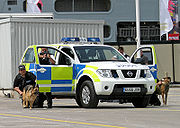
' system of retro-reflective markings for its new vehicles. This brings the MDP's fleet appearance in line with most other UK police forces.
AWE Division and SEG use the Armoured MacNeillie Mercedes Protected Patrol Vehicle. Where used on public roads, these are coloured dark blue, with Battenburg markings. When used within Ministry of Defence establishments only, they are coloured olive drab with black 'Police' markings. This vehicle replaced the MDP's previous armoured vehicle, the Alvis Tactica
in 2010.
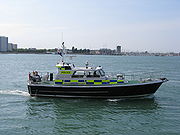
, it works with the Fleet Protection Group Royal Marines
.
. The force maintains a large pool of specially-trained officers nationally, known as the Nuclear Guard Force (NGF) who can be deployed at short notice in the event of a nuclear accident
; they perform this function alongside the UK's national Nuclear Accident Response Organisation
(NARO).
handlers in the force utilise explosive, drug, tactical firearms support, and general purpose police dogs.
in transit.
with offices spread around the UK. The CID investigates defence-related crime. There are a number of specialised units that fall under the larger CID remit. Officers employed within these specialised units must first qualify as a detective
. Such units include:
.
s of territorial police forces. DCPOs work in small teams or often alone, either from dedicated MDP stations, Service Police stations, or embedded with the local police force.
, NATO, or the Foreign and Commonwealth Office
. MDP officers employed overseas routinely carry at least a Sig 229 Pistol for protection.
Approximately 100 MDP officers are deployed overseas, with the largest numbers in Kosovo
and Afghanistan
.
In recent years the MDP have provided officers to Police contingents in many locations around the world, including Bosnia
, Kosovo
, Iraq
, Afghanistan, Sudan
, and Sierra Leone
.
The MDP also provided policing for the Pitcairn Islands
from around 2000 until 2007.
Officers from both these forces occasionally attend courses at the Ministry of Defence Police Agency Training College at Wethersfield, Essex. In June 2005 officers from the GDP marine unit gave assistance to the MoD Police marine unit at Portsmouth during the Trafalgar 200
celebrations.
United Kingdom
The United Kingdom of Great Britain and Northern IrelandIn the United Kingdom and Dependencies, other languages have been officially recognised as legitimate autochthonous languages under the European Charter for Regional or Minority Languages...
's Ministry of Defence
Ministry of Defence (United Kingdom)
The Ministry of Defence is the United Kingdom government department responsible for implementation of government defence policy and is the headquarters of the British Armed Forces....
. The force is part of the larger government agency, the Ministry of Defence Police and Guarding Agency
Ministry of Defence Police and Guarding Agency
The Ministry of Defence Police and Guarding Agency is an executive agency of the Ministry of Defence. The organisation was formed on 1 April 2004 by the amalgamation of the MoD Police Agency with the Ministry of Defence Guard Service, with the purpose of providing a coordinated approach to the...
(MDPGA), together with the Ministry of Defence Guard Service
Ministry of Defence Guard Service
The Ministry of Defence Guard Service is part of the Ministry of Defence Police and Guarding Agency, and provides British Ministry of Defence establishments with unarmed security guard and patrol services....
. The MDPGA was formed in 2004 by bringing the two organisations together under a single administrative headquarters. The MDP are not Military Police
Military police
Military police are police organisations connected with, or part of, the military of a state. The word can have different meanings in different countries, and may refer to:...
and should not be confused with the Royal Military Police
Royal Military Police
The Royal Military Police is the corps of the British Army responsible for the policing of service personnel, and for providing a military police presence both in the UK, and whilst service personnel are deployed overseas on operations and exercises.Members of the RMP are generally known as...
or any other Service Police organisation. The MDP has an established strength of 3,440 police officers, based at 86 locations across the United Kingdom.
The force was originally formed in 1971 by the merger of three separate service constabularies: the Air Force Department Constabulary
Air Force Department Constabulary
The Air Force Department Constabulary was a police force in the United Kingdom, responsible for policing the airfields and aerodromes under the control of the Air Ministry, later the Air Force Department....
, the Army Department Constabulary
Army Department Constabulary
The Army Department Constabulary was a police force in the United Kingdom formed as a result of the Special Constables Act 1923. Originally, the Army used serving soldiers to guard its establishments and the only call for police was at places like the Royal Arsenal at Woolwich...
, and the Admiralty Constabulary
Admiralty Constabulary
The Admiralty Constabulary was a police force in the United Kingdom formed as a result of the Special Constables Act 1923. The Constabulary can trace its history back to 1686 when the Royal Navy needed an organisation to prevent dockyard crime...
. The force, which consists of five divisions, is headquartered at MDPGA Wethersfield, Essex
Essex
Essex is a ceremonial and non-metropolitan county in the East region of England, and one of the home counties. It is located to the northeast of Greater London. It borders with Cambridgeshire and Suffolk to the north, Hertfordshire to the west, Kent to the South and London to the south west...
.
Although superficially similar to other UK police forces, the MDP is significantly different in role, function and accountability. The MDP's primary responsibility is to provide armed security and counter terrorism, as well as uniformed policing and investigative services to Ministry of Defence property, personnel, and installations throughout the United Kingdom.
MDP officers are attested as constables under the Ministry of Defence Police Act 1987
Ministry of Defence Police Act 1987
The Ministry of Defence Police Act 1987 is an Act of the Parliament of the United Kingdom which came into full force on 5 May 1987.-Purpose:The Act continued the existence of the Ministry of Defence Police which had been created under previous laws .-Extent:The Act applies throughout the United...
. All MDP officers are trained to use firearms and 75% of those on duty are armed at any given time.
The force has a number of specialised departments and also provides officers for international policing secondments; including the active policing of conflict areas overseas and training of resident police forces in these areas. These overseas missions are carried out under the mandates of the United Nations
United Nations
The United Nations is an international organization whose stated aims are facilitating cooperation in international law, international security, economic development, social progress, human rights, and achievement of world peace...
, NATO, or the Foreign and Commonwealth Office
Foreign and Commonwealth Office
The Foreign and Commonwealth Office, commonly called the Foreign Office or the FCO is a British government department responsible for promoting the interests of the United Kingdom overseas, created in 1968 by merging the Foreign Office and the Commonwealth Office.The head of the FCO is the...
.
The MDP is poised for significant restructuring between 2011 and 2014 as part of the coalition government's post 2010 austerity measures, and the Strategic Defence and Security Review
Strategic Defence and Security Review
The Strategic Defence and Security Review was announced by the newly formed Conservative-Liberal Democrat coalition government of the United Kingdom in May 2010, and published on 19 October 2010...
. It is expected to lose 20% of its manpower and stations; to concentrate on high end tasks such as nuclear weapons security, mobile armed policing of the defence estate and defence financial crime.
History
The Ministry of Defence Police was formed in 1971 by the merger of three civil constabularies, the Air Force Department ConstabularyAir Force Department Constabulary
The Air Force Department Constabulary was a police force in the United Kingdom, responsible for policing the airfields and aerodromes under the control of the Air Ministry, later the Air Force Department....
(previously under the control of the Air Ministry
Air Ministry
The Air Ministry was a department of the British Government with the responsibility of managing the affairs of the Royal Air Force, that existed from 1918 to 1964...
), the Army Department Constabulary
Army Department Constabulary
The Army Department Constabulary was a police force in the United Kingdom formed as a result of the Special Constables Act 1923. Originally, the Army used serving soldiers to guard its establishments and the only call for police was at places like the Royal Arsenal at Woolwich...
(previously under the control of the War Office
War Office
The War Office was a department of the British Government, responsible for the administration of the British Army between the 17th century and 1964, when its functions were transferred to the Ministry of Defence...
), and the Admiralty Constabulary
Admiralty Constabulary
The Admiralty Constabulary was a police force in the United Kingdom formed as a result of the Special Constables Act 1923. The Constabulary can trace its history back to 1686 when the Royal Navy needed an organisation to prevent dockyard crime...
(previously under the control of the Admiralty
Admiralty
The Admiralty was formerly the authority in the Kingdom of England, and later in the United Kingdom, responsible for the command of the Royal Navy...
).
These earlier constabularies were formed as a result of the Special Constables Act 1923, although their histories can be traced back much further as watchmen. Their powers came from different legislative sources. In 1984, the House of Commons
British House of Commons
The House of Commons is the lower house of the Parliament of the United Kingdom, which also comprises the Sovereign and the House of Lords . Both Commons and Lords meet in the Palace of Westminster. The Commons is a democratically elected body, consisting of 650 members , who are known as Members...
Defence Select Committee
Defence Select Committee
The Defence Select Committee is one of the Select Committees of the British House of Commons, having been established in 1979. It oversees the operations of the Ministry of Defence and its associated public bodies, including the armed forces.-Membership:...
recognised the difficulties under which the Ministry of Defence Police were operating; the committee's recommendations led to the passing of the Ministry of Defence Police Act 1987
Ministry of Defence Police Act 1987
The Ministry of Defence Police Act 1987 is an Act of the Parliament of the United Kingdom which came into full force on 5 May 1987.-Purpose:The Act continued the existence of the Ministry of Defence Police which had been created under previous laws .-Extent:The Act applies throughout the United...
.
Function
The MDP's primary responsibility is policing the Defence Estate throughout the United KingdomUnited Kingdom
The United Kingdom of Great Britain and Northern IrelandIn the United Kingdom and Dependencies, other languages have been officially recognised as legitimate autochthonous languages under the European Charter for Regional or Minority Languages...
, including armed front-line security at high security sites; it deals with both military personnel and civilians. The MDP are not Military Police
Military police
Military police are police organisations connected with, or part of, the military of a state. The word can have different meanings in different countries, and may refer to:...
and should not be confused with the Royal Military Police
Royal Military Police
The Royal Military Police is the corps of the British Army responsible for the policing of service personnel, and for providing a military police presence both in the UK, and whilst service personnel are deployed overseas on operations and exercises.Members of the RMP are generally known as...
or any other Service Police organisation. Although some critics in the press and pressure groups consider the MDP to be a Paramilitary
Paramilitary
A paramilitary is a force whose function and organization are similar to those of a professional military, but which is not considered part of a state's formal armed forces....
force, a claim that is denied by the MDP and the UK government.
The MDP's activities fall into five key areas:
- Armed security and counter-terrorism
- Uniformed policing
- Investigation of crime
- Defence community policing
- International policing
Deployment
The MDP is currently deployed at 86 locations around the United Kingdom. These include—but are no longer limited to—military establishments, defence housing estates, military training areas, the royal dockyards, and the Atomic Weapons EstablishmentAtomic Weapons Establishment
The Atomic Weapons Establishment is responsible for the design, manufacture and support of warheads for the United Kingdom's nuclear deterrent. AWE plc is responsible for the day-to-day operations of AWE...
. Since January 2008, the MDP has also taken on the role of providing armed security at four gas terminals in the UK, part of the Critical National Infrastructure.
The MDP once had a presence at 120 Ministry of Defence sites such as the Royal Arsenal
Royal Arsenal
The Royal Arsenal, Woolwich, originally known as the Woolwich Warren, carried out armaments manufacture, ammunition proofing and explosives research for the British armed forces. It was sited on the south bank of the River Thames in Woolwich in south-east London, England.-Early history:The Warren...
, munitions and storage depots, Royal Ordnance Factories
Royal Ordnance Factory
Royal Ordnance Factories was the collective name of the UK government's munitions factories in and after World War II. Until privatisation in 1987 they were the responsibility of the Ministry of Supply and later the Ministry of Defence....
, and Defence Research Establishments. The end of both the Cold War
Cold War
The Cold War was the continuing state from roughly 1946 to 1991 of political conflict, military tension, proxy wars, and economic competition between the Communist World—primarily the Soviet Union and its satellite states and allies—and the powers of the Western world, primarily the United States...
and The Troubles
The Troubles
The Troubles was a period of ethno-political conflict in Northern Ireland which spilled over at various times into England, the Republic of Ireland, and mainland Europe. The duration of the Troubles is conventionally dated from the late 1960s and considered by many to have ended with the Belfast...
in Northern Ireland
Northern Ireland
Northern Ireland is one of the four countries of the United Kingdom. Situated in the north-east of the island of Ireland, it shares a border with the Republic of Ireland to the south and west...
, along with the subsequent closure of the Royal Arsenal
Royal Arsenal
The Royal Arsenal, Woolwich, originally known as the Woolwich Warren, carried out armaments manufacture, ammunition proofing and explosives research for the British armed forces. It was sited on the south bank of the River Thames in Woolwich in south-east London, England.-Early history:The Warren...
, Woolwich
Woolwich
Woolwich is a district in south London, England, located in the London Borough of Greenwich. The area is identified in the London Plan as one of 35 major centres in Greater London.Woolwich formed part of Kent until 1889 when the County of London was created...
, and the privatisation of entities such as the Royal Ordnance Factories reduced the number of sites that need an MDP presence. Many Armed Forces
British Armed Forces
The British Armed Forces are the armed forces of the United Kingdom of Great Britain and Northern Ireland.Also known as Her Majesty's Armed Forces and sometimes legally the Armed Forces of the Crown, the British Armed Forces encompasses three professional uniformed services, the Royal Navy, the...
locations that previously relied upon the MDP for armed security have transferred that role to the Military Provost Guard Service
Military Provost Guard Service
The Military Provost Guard Service is a service responsible for maintaining security at British Armed Forces sites in the United Kingdom. It is one of three parts of the Adjutant General's Corps Provost Branch...
. Some have retained an MDP presence for purely policing purposes, albeit in reduced numbers.
Jurisdiction
MDP officers are attested as constableConstable
A constable is a person holding a particular office, most commonly in law enforcement. The office of constable can vary significantly in different jurisdictions.-Etymology:...
s in one of the three jurisdictions of the UK: England & Wales
English law
English law is the legal system of England and Wales, and is the basis of common law legal systems used in most Commonwealth countries and the United States except Louisiana...
, Scotland
Scots law
Scots law is the legal system of Scotland. It is considered a hybrid or mixed legal system as it traces its roots to a number of different historical sources. With English law and Northern Irish law it forms the legal system of the United Kingdom; it shares with the two other systems some...
, and Northern Ireland
Northern Ireland law
Northern Ireland law refers to the legal system of statute and common law operating in Northern Ireland since Northern Ireland was established as a separate jurisdiction within the United Kingdom in 1921.-Background:...
, but can exercise their powers on Ministry of Defence estate throughout the United Kingdom and additionally in the circumstances described below. MDP officers' jurisdiction relates to subject rather than geographic area and is set out in section 2 of the Ministry of Defence Police Act 1987
Ministry of Defence Police Act 1987
The Ministry of Defence Police Act 1987 is an Act of the Parliament of the United Kingdom which came into full force on 5 May 1987.-Purpose:The Act continued the existence of the Ministry of Defence Police which had been created under previous laws .-Extent:The Act applies throughout the United...
, which was amended by the Anti Terrorism Crime and Security Act 2001. Officers are based throughout the UK and exercise their jurisdiction over matters relating to the Defence Estate; there is no requirement for them to be on Ministry of Defence land when doing so.
The MDP is classified by the Serious Organised Crime and Police Act 2005
Serious Organised Crime and Police Act 2005
The Serious Organized Crime and Police Act 2005 is an Act of the Parliament of the United Kingdom aimed primarily at creating the Serious Organised Crime Agency, it also significantly extended and simplified the powers of arrest of a constable and introduced restrictions on protests in the...
as a special police force. This gives it conditional allowance to exercise the powers available to a constable of a territorial police force; if an offence or incident is encountered outwith their natural jurisdiction. Additionally the MDP is able to provide officers and specialist units to territorial police forces on a mutual assistance basis.
MDP officers are also able to take on the powers of constables of territorial police forces or other special police forces (such as British Transport Police
British Transport Police
The British Transport Police is a special police force that polices those railways and light-rail systems in Great Britain for which it has entered into an agreement to provide such services...
) in certain situations, as set out in the Ministry of Defence Police Act (as amended). This is known as 'extended jurisdiction'. The protocol that governs this states that MDP officers should only seek to use these extended powers if they come across a situation outside their natural jurisdiction, during the course of their MDP duties. Whenever MDP officers exercise police powers under this 'extended jurisdiction', the Chief Constable MDP has a responsibility to ensure the local Chief Constable is notified as soon as possible.
Policing protocols with other forces
Local agreements with territorial police forces are made under the overarching general protocols agreed between the MDP Chief Constable and other Chief Constables. These set out the agreed working relationship between the MDP and other police forces; outlining, where necessary, areas of responsibility and accountability. The Protocols make provision for consultation and co-operation between the forces, with the aim of delivering the best policing on the ground.Command structure
The MDP has its own Chief Constable who also serves as the Chief Executive of the MDPGA. The MDP uses the standard British police rank structureUK police ranks
Most of the police forces of the United Kingdom use a standardised set of ranks, with a slight variation in the most senior ranks for Greater London's Metropolitan Police Service and the City of London Police...
. Since 1995, its headquarters has been located at the former United States Air Force
United States Air Force
The United States Air Force is the aerial warfare service branch of the United States Armed Forces and one of the American uniformed services. Initially part of the United States Army, the USAF was formed as a separate branch of the military on September 18, 1947 under the National Security Act of...
base at Wethersfield
Wethersfield, Essex
Wethersfield is a village and a civil parish on the B1053 road in the Braintree district of the English county of Essex. It is near the River Pant. Wethersfield has a school, a post office, a fire station and two places of worship. Nearby settlements include the town of Braintree and the village of...
, now designated MDPGA Wethersfield. Force-wide command and control facilities are provided from the Central Control Room and Gold Command Suite. MDPGA Wethersfield is also home to the Agency Training Centre, which is responsible for the initial training and development of all MDP Constables and MGS guards.
The MDP has five land-based divisions
Police division
A division was the usual term for the largest territorial subdivision of most British police forces. In major reforms of police organisation in the 1990s divisions of many forces were restructured and retitled Basic Command Units , although some forces continue to refer to them as divisions.The...
: (last restructured in 2003 and currently under review)
- Scottish Division
- North Eastern Division
- Western Division
- AWEAtomic Weapons EstablishmentThe Atomic Weapons Establishment is responsible for the design, manufacture and support of warheads for the United Kingdom's nuclear deterrent. AWE plc is responsible for the day-to-day operations of AWE...
Division - South East Division
Each division is commanded by a Chief Superintendent
Chief Superintendent
Chief superintendent is a senior rank in police forces organised on the British model.- United Kingdom :In the British police, a chief superintendent is senior to a superintendent and junior to an assistant chief constable .The highest rank below Chief Officer level, chief...
and has its own Divisional Command and Control Room which has direct communications with force headquarters, divisional CID, and Divisional Support Groups which are able to respond at short notice to any unforeseen incident or emergency. Each station is commanded by a Senior Police Officer who will vary in rank from Sergeant to Superintendent depending on the station's size, role and staffing.
Personnel
The established strength of the MDP at the end of 2010 was 3496 Officers, of whom 3153 are male and 343 are female.Entry requirements
Entry requirements for new officers are exactly the same as for UK territorial police forces; however, because all MDP officers can carry firearms, the eyesight focal acuity standard is higher. Entrants must also be British nationalsUnited Kingdom national
United Kingdom national is a term used differently in various United Kingdom Acts of Parliament. Most commonly, it refers to the following classes of persons:* British Citizens;* British Nationals ;...
. The MDP recruits nationally and new entrants can be given a posting anywhere in the UK. In practice most new entrants end up in AWE Division or at RNAD Coulport.
Officers are selected via the NPIA SEARCH assessment centre process. In addition candidates are required to pass the MDP job related fitness assessment and a firearms aptitude test.
Initial training
MDP recruits are trained at the Agency Training Centre at MDPGA Wethersfield on a 17 week fully residential course. The program follows the NPIA initial learning and development syllabus. An MDP anomaly is that there are separate English Law and Scottish Law classes dependent on the individual officer’s posting. Recruits are trained in personal safety including PAVANonivamide
Nonivamide, also called pelargonic acid vanillylamide or PAVA, is an organic compound and a capsaicinoid. It is an amide of pelargonic acid and vanillyl amine. It is present in chili peppers, but is commonly manufactured synthetically...
, extendable baton and kwikcuffs. They also receive Level three public order training.
The final stage of the course includes the police basic driver assessment (only for driving licence holders) and a 4 week Authorised Firearms Officer
Authorised Firearms Officer
An Authorised Firearms Officer is a British police officer who has received training and authorisation to carry and use firearms. The designation is significant because within the United Kingdom, police officers do not routinely carry firearms...
course held at the Firearms Training Centre at MDPGA Wethersfield.
Security clearance
In addition to pre-entry security checks, all MDP officers are required to hold at least UK Government Security Check (SC) clearance (which clears the holder to UK Secret level). All AWE Division officers, and about 30% of all other officers, are required to hold Developed Vetting (DV) status which involves an intrusive background investigation and formal interviews. DV status clears the officer to UK Top Secret level. Not all officers pass the DV process; such officers are then employed at SC security level within the force.Those officers working with US Forces in the UK are required to hold a US Common Access Card
Common Access Card
The Common Access Card is a United States Department of Defense smart card issued as standard identification for active-duty military personnel, reserve personnel, civilian employees, other non-DoD government employees, state employees of the National Guard, and eligible contractor personnel.The...
for which the US Government carries out its own security checks on the officer.
Terms and Conditions
New entrants perform a two year probationary period.Discipline in the MDP is governed by the Ministry of Defence Police (Conduct) Regulations 2009, which broadly resemble the Police (Conduct) Regulations 2008 that govern territorial police forces. MDP officers retain a full national mobility liability, and can be posted anywhere in the UK at any time. In practice most movement is voluntary, either on promotion or requested moves for personal reasons. Like all UK police forces the MDP does not have the right to take strike action
Strike action
Strike action, also called labour strike, on strike, greve , or simply strike, is a work stoppage caused by the mass refusal of employees to work. A strike usually takes place in response to employee grievances. Strikes became important during the industrial revolution, when mass labour became...
.
MDP pay follows the same scale as territorial police forces; however, MDP officers are part of the Civil Service Pension Scheme, not the Police Pension Scheme and only contribute 3.5% of their gross salary, compared to territorial police force officers who contribute 11%. To even out this anomaly, MDP officers pay is abated. This is known as the MDP Net Pay Deduction.
The MDP operates a random and 'with cause', alcohol and drugs screening policy. An annual fitness test for all AFOs is to be introduced.
Defence Police Federation
The MDP has its own federation separate from Home Office Police FederationPolice Federation
Police Federation may refer to:*Police Federation of England and Wales*Police Federation for Northern Ireland*Scottish Police Federation*Defence Police Federation...
s. The Defence Police Federation (DPF) was created in 1971 and has legal status by provision of the Ministry of Defence Police Act 1987. The DPF functions in a similar fashion to a Trade Union
Trade union
A trade union, trades union or labor union is an organization of workers that have banded together to achieve common goals such as better working conditions. The trade union, through its leadership, bargains with the employer on behalf of union members and negotiates labour contracts with...
and aims to do for its members, what trades unions seek to do for theirs: to safeguard their interests and represent them in all matters concerning their work, and their well-being and quality of life whilst at work. Membership is voluntary.
Uniform, armament and equipment
Uniform
The majority of MDP officers are often employed on firearms duties and wear black jackets and trousers, or black polo-type shirts. Head dress depends on role, and is either the standard UK police checkered flat cap or police baseball cap. Ballistic body armor, and a black KevlarKevlar
Kevlar is the registered trademark for a para-aramid synthetic fiber, related to other aramids such as Nomex and Technora. Developed at DuPont in 1965, this high strength material was first commercially used in the early 1970s as a replacement for steel in racing tires...
ballistic helmet can also be worn. Some specialist firearms officers (such as those in TSG and SEG) wear dark blue Nomex
Nomex
Nomex is a registered trademark for flame resistant meta-aramid material developed in the early 1960s by DuPont and first marketed in 1967.- Properties:...
coveralls.
Officers on unarmed, general police duties wear a uniform similar to that of territorial police forces; including traditional Custodian helmet
Custodian helmet
Custodian helmet or centurion helmet, technically known as a 'Home Office pattern helmet', is a helmet worn by many policemen in England and Wales.-History:...
or flat cap (for men) or bowler
Bowler hat
The bowler hat, also known as a coke hat, derby , billycock or bombin, is a hard felt hat with a rounded crown originally created in 1849 for the English soldier and politician Edward Coke, the younger brother of the 2nd Earl of Leicester...
(for women). The Tunic dress uniform worn by MDP officers is almost identical to that of the Metropolitan Police Service
Metropolitan Police Service
The Metropolitan Police Service is the territorial police force responsible for Greater London, excluding the "square mile" of the City of London which is the responsibility of the City of London Police...
, apart from insignia. All officers are issued with personal body armour, PAVA incapacitation spray, batons
Baton (law enforcement)
A truncheon or baton is essentially a club of less than arm's length made of wood, plastic, or metal...
and kwikcuffs
Handcuffs
Handcuffs are restraint devices designed to secure an individual's wrists close together. They comprise two parts, linked together by a chain, a hinge, or rigid bar. Each half has a rotating arm which engages with a ratchet that prevents it from being opened once closed around a person's wrist...
, and other standard items of police duty belt kit.
Armament
All MDP officers are trained to use firearms and about 75% are armed at any one time. Most officers are armed with the force weapon, the Heckler & Koch MP7Heckler & Koch MP7
The MP7 is a German submachine gun manufactured by Heckler & Koch and chambered for the 4.6×30mm cartridge. It was designed with the new cartridge to meet NATO requirements published in 1989, as these requirements call for a personal defense weapon class firearm, with a greater ability to defeat...
.
Some specialised units use weapons such as the Heckler & Koch MP5
Heckler & Koch MP5
The Heckler & Koch MP5 is a 9mm submachine gun of German design, developed in the 1960s by a team of engineers from the German small arms manufacturer Heckler & Koch GmbH of Oberndorf am Neckar....
and/or the Sig 229 Pistol. Such units include those working within the Government Security Zone, the Tactical Support Group, and Special Escort Group. The Sig 229 Pistol has now replaced the Browning 9mm within units that carry a sidearm. Units based in the London area are also armed with a Taser
Taser
A Taser is an electroshock weapon that uses electrical current to disrupt voluntary control of muscles. Its manufacturer, Taser International, calls the effects "neuromuscular incapacitation" and the devices' mechanism "Electro-Muscular Disruption technology"...
; this is now rolling out to all armed officers as a less-than-lethal option together with the Baton Launcher, already in service.
Officers within AWE Division and those working with Nuclear Weapons or Defence SNM
Special nuclear material
Special nuclear material is a term used by the Nuclear Regulatory Commission of the United States to classify fissile materials. The NRC divides special nuclear material into three main categories, according to the risk and potential for its direct use in a clandestine nuclear weapon or for its...
carry the 2007 variant of the L85A2
SA80
The SA80 is a British family of 5.56mm small arms. It is a selective fire, gas-operated assault rifle. SA80 prototypes were trialled in 1976 and production was completed in 1994....
assault rifle fitted with the Trijcon ACOG sight
Advanced Combat Optical Gunsight
Advanced Combat Optical Gunsights are a series of telescopic sights manufactured by Trijicon. The ACOG is designed to be used on the M16 rifle and M4 carbine, but Trijicon has developed ACOG accessories for certain other firearms...
.
Vehicles
The MDP uses a variety of vehicles, from general patrol cars to specialised escort vehicles, police launches, and off-road vehicles. In 2006 the force adopted the 'BattenburgBattenburg markings
Battenburg refers to a pattern of high-visibility markings used to maximise conspicuity, primarily used on vehicles of the emergency services, but also in other applications such as uniforms...
' system of retro-reflective markings for its new vehicles. This brings the MDP's fleet appearance in line with most other UK police forces.
AWE Division and SEG use the Armoured MacNeillie Mercedes Protected Patrol Vehicle. Where used on public roads, these are coloured dark blue, with Battenburg markings. When used within Ministry of Defence establishments only, they are coloured olive drab with black 'Police' markings. This vehicle replaced the MDP's previous armoured vehicle, the Alvis Tactica
Alvis Tactica
Alvis Tactica is a 4x4 or 6x6 wheeled military vehicle produced by Alvis plc of the UK, and later by BAE Systems Land Systems. The vehicle comes in a number of variants including APC, Internal Security and Riot Control...
in 2010.
Special capabilities
Marine unit
The MDP has the largest marine support unit of any of the police forces in the UK. The marine support units are responsible for the waterborne security of Her Majesty's Dockyards and HM Naval Bases. At HMNB ClydeHMNB Clyde
Her Majesty's Naval Base Clyde is one of three operating bases in the United Kingdom for the Royal Navy...
, it works with the Fleet Protection Group Royal Marines
Fleet Protection Group Royal Marines
The Fleet Protection Group Royal Marines , formerly Comacchio Company Royal Marines and Comacchio Group Royal Marines , is a commando-sized specialist unit of the Royal Marines responsible for guarding the United Kingdom's Naval nuclear weapons and other security-related duties.-History:On 1 May...
.
Chemical, biological, radiological or nuclear response
Although only constituting 1.5% of the national police force, the MDP has 8% of the national chemical, biological, radiological or nuclear (CBRN) response capability. Unlike territorial police forces, all MDP officers are trained in CBRN defence. Officers deployed to AWE Division are trained to work in radiologically controlled environmentsRadiation
In physics, radiation is a process in which energetic particles or energetic waves travel through a medium or space. There are two distinct types of radiation; ionizing and non-ionizing...
. The force maintains a large pool of specially-trained officers nationally, known as the Nuclear Guard Force (NGF) who can be deployed at short notice in the event of a nuclear accident
Nuclear and radiation accidents
A nuclear and radiation accident is defined by the International Atomic Energy Agency as "an event that has led to significant consequences to people, the environment or the facility...
; they perform this function alongside the UK's national Nuclear Accident Response Organisation
Nuclear Accident Response Organisation
Defence Nuclear Accident Response Organisation . The UK Ministry of Defence maintains a Nuclear Accident Response Organisation to respond to an accident or incident, including one arising through terrorist acts, involving defence nuclear assets.Defence Nuclear Assets include:* Naval Nuclear...
(NARO).
Dog sections
The 400 police dogPolice dog
A police dog, often referred to as a "K-9 dog" in some areas , is a dog that is trained specifically to assist police and other law-enforcement personnel in their work...
handlers in the force utilise explosive, drug, tactical firearms support, and general purpose police dogs.
Special Escort Group
The MDP Special Escort Group protects nuclear weapons and defence special nuclear materialSpecial nuclear material
Special nuclear material is a term used by the Nuclear Regulatory Commission of the United States to classify fissile materials. The NRC divides special nuclear material into three main categories, according to the risk and potential for its direct use in a clandestine nuclear weapon or for its...
in transit.
Criminal Investigation Department
The MDP has a Criminal Investigation DepartmentCriminal Investigation Department
The Crime Investigation Department is the branch of all Territorial police forces within the British Police and many other Commonwealth police forces, to which plain clothes detectives belong. It is thus distinct from the Uniformed Branch and the Special Branch.The Metropolitan Police Service CID,...
with offices spread around the UK. The CID investigates defence-related crime. There are a number of specialised units that fall under the larger CID remit. Officers employed within these specialised units must first qualify as a detective
Detective
A detective is an investigator, either a member of a police agency or a private person. The latter may be known as private investigators or "private eyes"...
. Such units include:
- Fraud Squad: The Fraud SquadFraud SquadA Fraud Squad is a police department which investigates fraud and other economic crimes. The largest Fraud Squad in the United Kingdom is run by the City of London Police who are responsible for policing London's and the UK's main financial hub....
investigates fraud in Ministry of Defense programmes. - Force Intelligence Bureau: The FIB consists of a number of specialists such as Crime Intelligence Officers, CHIS handlers, Communications Data Investigators (SPoCs), and Special Branch officers who support other investigators, carry out investigations, and gather operational intelligence in cases which merit their attention.
- Crime Scene Investigation: The Force has a number of Forensic Science officers (CSI), formally known as SOCO, who are available to each division.
- Surveillance Unit: The Surveillance UnitSurveillanceSurveillance is the monitoring of the behavior, activities, or other changing information, usually of people. It is sometimes done in a surreptitious manner...
provides a specialised covert surveillance capability in support of MDP investigations. - Major Incident Unit: The Major Incident Unit (MIU) is a group of specially-trained investigators who provide oversight and management of incidents that have caused serious disruption, or in support of complex investigations. Officers in the MIU are trained in the use of the HOLMESHolmesHolmes is a geographical surname of English origin. The name is first recorded in Lancashire in North West England. The name is derived from "holm", a Scandinavian word meaning "a small island". The word was introduced to Great Britain and Ireland by Old Norse-speaking Vikings...
software suite and have a variety of specialist equipment at their disposal. - Computer Crime Unit: The Computer CrimeComputer crimeComputer crime, or cybercrime, refers to any crime that involves a computer and a network. The computer may have been used in the commission of a crime, or it may be the target. Netcrime refers to criminal exploitation of the Internet. Such crimes may threaten a nation’s security and financial health...
Unit provide specialist IT skills and personnel to gather evidence from IT systems, for use in MDP investigations.
Divisional Support Groups
Divisional Support Groups (DSG) provide operational policing support at a local level. There is at least one DSG unit per division.Operational Support Units
Operational Support Units (OSU). The OSU is the MDP's mobile, flexible reserve. Each OSU is a 50-strong rapid response unit tasked with VIP personal protection, public order, and anti-terrorist search duties. The force has two OSU units to cover the north and south of the country. OSU South are based at MDPGA Wethersfield, and OSU North are based at RAF Linton-on-OuseRAF Linton-on-Ouse
RAF Linton-on-Ouse is a Royal Air Force station at Linton-on-Ouse near York in Yorkshire, England. It is currently a major flying training centre, one of the RAF's busiest airfields...
.
Tactical Support Group
The Tactical Support Group are a specialist group of officers found only within AWE Division. MDP TSG are tasked with and equipped to provide an advanced firearms response capability at short notice to the Atomic Weapons Establishment. The TSG specialize in dynamic entry and dynamic intervention inside Nuclear Weapons facilities; including, if necessary, the recapture of Nuclear Weapons and Special Nuclear Material.Defence community police officers
These are unarmed MDP officers who provide community policing to Defence establishments or large military housing estates, in a similar manner to the Neighbourhood Policing TeamNeighbourhood Policing Team
Neighbourhood Policing Teams are a concept developed by the United Kingdom police. It involves small teams of police officers who are dedicated to policing a certain community or area. There are 3,600 NPTs throughout the United Kingdom...
s of territorial police forces. DCPOs work in small teams or often alone, either from dedicated MDP stations, Service Police stations, or embedded with the local police force.
International policing
The MDP carries out a number of international policing activities, including the active policing of conflict areas overseas and training of resident police forces in these areas. These overseas missions are carried out under the mandates of the United NationsUnited Nations
The United Nations is an international organization whose stated aims are facilitating cooperation in international law, international security, economic development, social progress, human rights, and achievement of world peace...
, NATO, or the Foreign and Commonwealth Office
Foreign and Commonwealth Office
The Foreign and Commonwealth Office, commonly called the Foreign Office or the FCO is a British government department responsible for promoting the interests of the United Kingdom overseas, created in 1968 by merging the Foreign Office and the Commonwealth Office.The head of the FCO is the...
. MDP officers employed overseas routinely carry at least a Sig 229 Pistol for protection.
Approximately 100 MDP officers are deployed overseas, with the largest numbers in Kosovo
Kosovo
Kosovo is a region in southeastern Europe. Part of the Ottoman Empire for more than five centuries, later the Autonomous Province of Kosovo and Metohija within Serbia...
and Afghanistan
Afghanistan
Afghanistan , officially the Islamic Republic of Afghanistan, is a landlocked country located in the centre of Asia, forming South Asia, Central Asia and the Middle East. With a population of about 29 million, it has an area of , making it the 42nd most populous and 41st largest nation in the world...
.
In recent years the MDP have provided officers to Police contingents in many locations around the world, including Bosnia
Bosnia and Herzegovina
Bosnia and Herzegovina , sometimes called Bosnia-Herzegovina or simply Bosnia, is a country in Southern Europe, on the Balkan Peninsula. Bordered by Croatia to the north, west and south, Serbia to the east, and Montenegro to the southeast, Bosnia and Herzegovina is almost landlocked, except for the...
, Kosovo
Kosovo
Kosovo is a region in southeastern Europe. Part of the Ottoman Empire for more than five centuries, later the Autonomous Province of Kosovo and Metohija within Serbia...
, Iraq
Iraq
Iraq ; officially the Republic of Iraq is a country in Western Asia spanning most of the northwestern end of the Zagros mountain range, the eastern part of the Syrian Desert and the northern part of the Arabian Desert....
, Afghanistan, Sudan
Sudan
Sudan , officially the Republic of the Sudan , is a country in North Africa, sometimes considered part of the Middle East politically. It is bordered by Egypt to the north, the Red Sea to the northeast, Eritrea and Ethiopia to the east, South Sudan to the south, the Central African Republic to the...
, and Sierra Leone
Sierra Leone
Sierra Leone , officially the Republic of Sierra Leone, is a country in West Africa. It is bordered by Guinea to the north and east, Liberia to the southeast, and the Atlantic Ocean to the west and southwest. Sierra Leone covers a total area of and has an estimated population between 5.4 and 6.4...
.
The MDP also provided policing for the Pitcairn Islands
Pitcairn Islands
The Pitcairn Islands , officially named the Pitcairn, Henderson, Ducie and Oeno Islands, form a group of four volcanic islands in the southern Pacific Ocean. The islands are a British Overseas Territory and overseas territory of the European Union in the Pacific...
from around 2000 until 2007.
Notable incidents and investigations
- 1997: Milos StankovicMilos StankovicMilos Stankovic MBE , a Major in the British Army, was arrested for treason in December 1997. He sued the Ministry of Defence for £1 million for the loss of his army career...
: British Army officer Major Milos Stankovic MBE, whose father was a Serbian, was arrested and interviewed by MDP in 1997 under the Official Secrets ActOfficial Secrets ActThe Official Secrets Act is a stock short title used in the United Kingdom, Ireland, India and Malaysia and formerly in New Zealand for legislation that provides for the protection of state secrets and official information, mainly related to national security.-United Kingdom:*The Official Secrets...
acting on information that alleged that he, while serving as a Serbo-Croat interpreter for senior British Army officers in SarajevoSarajevoSarajevo |Bosnia]], surrounded by the Dinaric Alps and situated along the Miljacka River in the heart of Southeastern Europe and the Balkans....
passed sensitive information to the Bosnian Serbs. During the investigations, MDP officers interviewed more than 100 witnesses in Britain and abroad. But the investigation, which cost more than £250,000 in total, found no evidence of espionage. The case did not proceed to trial. Stankovic went to the press, and sued the MDP for £1Million compensation. In 2007 Mr Justice Saunders threw out the majority of his case and awarded just £5000 for MDP "seizing and removing items outside the terms of a search warrant" but making Stankovic liable for all costs (circa £500,000) "
- 1998, Tony GeraghtyTony GeraghtyTony Geraghty is a British-Irish writer and journalist. He served in the Parachute Regiment, and was awarded the Joint Service Commendation Medal for his work as a military liaison officer with U.S. forces during the Gulf War...
: British–Irish author and journalist Tony Geraghty was arrested and his house searched by MDP Special Branch, investigating offences against the Official Secrets ActOfficial Secrets ActThe Official Secrets Act is a stock short title used in the United Kingdom, Ireland, India and Malaysia and formerly in New Zealand for legislation that provides for the protection of state secrets and official information, mainly related to national security.-United Kingdom:*The Official Secrets...
involving his contact with a former Northern Ireland bomb disposal officer Lt-Col Nigel Wylde. Wylde was subsequently charged with passing secrets to Geraghty, but the case collapsed during trial. It caused much concern in the media that the MDP was effectively beyond public accountability and had the power to impede the freedom of the press.
- 2003–2004, Pitcairn Island Child Abuse investigations (Operation Unique)Pitcairn sexual assault trial of 2004On 30 September 2004, seven men living on Pitcairn Island , went on trial facing 55 charges relating to sexual offences. On 24 October, all but one of the defendants were found guilty on at least some of the charges they faced...
: MDP officers were deployed to PitcairnPitcairn IslandsThe Pitcairn Islands , officially named the Pitcairn, Henderson, Ducie and Oeno Islands, form a group of four volcanic islands in the southern Pacific Ocean. The islands are a British Overseas Territory and overseas territory of the European Union in the Pacific...
as part of the international investigation team into communal child sexual abuse on the island.
- July 7th 2005, Response to London suicide bombings (Operation Toga)Response to the 2005 London bombingsThe 7 July 2005 London bombings were a series of four terrorist bombs set off by British suicide bombers which exploded on the London Underground and a bus during the morning rush hour, killing more than 52 people. The attacks prompted a massive response from the emergency services, and in the...
: This operation saw the MDP's largest deployment of firearms officers on a non Ministry of Defence tasking, to assist the Metropolitan Police to counter the threat of further suicide attacks in Central London.
- 2001–2005, Deepcut Barracks suspicious deaths of 4 soldiersPrincess Royal Barracks, DeepcutThe Princess Royal Barracks, Deepcut, commonly referred to as Deepcut Barracks, is the headquarters of the Royal Logistic Corps of the British Army and the Defence School of Logistics. Located near Camberley, Surrey, England, it was the headquarters of the Royal Army Ordnance Corps until the...
: MDP CID Involvement in investigations, which later led to a complaint to the The Independent Police Complaints Commission (IPCC)Independent Police Complaints CommissionThe Independent Police Complaints Commission is a non-departmental public body in England and Wales responsible for overseeing the system for handling complaints made against police forces in England and Wales.-Role:...
by deceased's families, who refused to believe police conclusions that each of the deaths by shooting, of the 4 soldiers, was suicide. Families alleged that MDP involvement was MoD "collusion" with Surrey Police which "enabled the MoD to cover up events" An independent review by Mr Nicholas Blake QC in 2007 absolved Surrey Police and MDP of any wrongdoing, but was highly critical of the Army. The events of the deaths are the subject of the stage play "Deep CutDeep CutDeep Cut is a play performed by Cardiff based theatre company Sherman Cymru and written by Philip Ralph. It premiered at the Edinburgh Festival in 2008 and won the Amnesty International Freedom of Expression Award in the same year as well as best Actor and Best Actress awards with The Stage's...
" by Philip Ralph.
- 2006, Ipswich Prostitute Murders: MDP Provided an OSU and 100 additional officers for searches and enquiries at the request of Suffolk Constabulary following the murder of 5 prostitutes by Steve WrightSteve Wright (serial killer)Steven Gerald James Wright is an English serial killer, also known as the Suffolk Strangler. He is currently serving life imprisonment for the murder of five women who worked as prostitutes in Ipswich, Suffolk...
- 2008, Helmand Province (Afghanistan)Helmand ProvinceHelmand is one of the 34 provinces of Afghanistan. It is in the southwest of the country. Its capital is Lashkar Gah. The Helmand River flows through the mainly desert region, providing water for irrigation....
: A counter heroin operation by Afghan National PoliceAfghan National PoliceThe Afghan National Police - ANP - is the primary national police force in Afghanistan. It serves as a single law enforcement agency all across the country. The Afghan police force was first created with the establishment of the Afghan nation in the early 18th century...
and MDP seizes 17.5 Tonnes of Opium poppy seeds (enough for 30 tonnes of pure heroin)
- 26 January 2009, Death of Krzysztof Lubkiewicz: The IPCC investigated the MDP after the death of a Polish national immediately after contact with MDP Officers. The Officers themselves were later exonerated, however the IPCC criticised the MDP's divisional control room's procedures, and their communication with other forces. This was the first investigation of the MDP by the IPCC after its jurisdiction was extended to include the MDP in 2008.
- 29 September 2010: The leak of Secretary of State for DefenceSecretary of State for DefenceThe Secretary of State for Defence, popularly known as the Defence Secretary, is the senior Government of the United Kingdom minister in charge of the Ministry of Defence, chairing the Defence Council. It is a Cabinet position...
Liam Fox'sLiam FoxLiam Fox MP is a British Conservative politician, Member of Parliament for North Somerset, and former Secretary of State for Defence....
letter to Prime Minister David CameronDavid CameronDavid William Donald Cameron is the current Prime Minister of the United Kingdom, First Lord of the Treasury, Minister for the Civil Service and Leader of the Conservative Party. Cameron represents Witney as its Member of Parliament ....
: MDP CID London and OSU South were tasked to search MoD Headquarters in Whitehall, and carry out an investigation to uncover the person(s) responsible for leaking a highly damaging letter from Defence Secretary Liam Fox to Prime Minister David Cameron, to the press. In the letter Fox expressed grave concerns about forthcoming defence cuts. No one was ever charged.
Affiliated police forces
The Ministry of Defence also has responsibility for two other civilian police forces:- The Sovereign Base Areas PoliceSovereign Base Areas PoliceThe Sovereign Base Areas Police is the local civilian police force for the British controlled Sovereign Base Areas of Akrotiri and Dhekelia in Cyprus. Established in August 1960, the force has responsibility for all 15,000 residents of the SBAs, including military personnel...
(SBAP), Cyprus: The SBAP provide a full range of policing for both the Eastern and Western Sovereign Base Areas of CyprusCyprusCyprus , officially the Republic of Cyprus , is a Eurasian island country, member of the European Union, in the Eastern Mediterranean, east of Greece, south of Turkey, west of Syria and north of Egypt. It is the third largest island in the Mediterranean Sea.The earliest known human activity on the...
.
- The Gibraltar Defence Police (GDP): The GDP provide police services on Ministry of Defence land and waters in GibraltarGibraltarGibraltar is a British overseas territory located on the southern end of the Iberian Peninsula at the entrance of the Mediterranean. A peninsula with an area of , it has a northern border with Andalusia, Spain. The Rock of Gibraltar is the major landmark of the region...
.
Officers from both these forces occasionally attend courses at the Ministry of Defence Police Agency Training College at Wethersfield, Essex. In June 2005 officers from the GDP marine unit gave assistance to the MoD Police marine unit at Portsmouth during the Trafalgar 200
Trafalgar 200
Trafalgar 200 was a series of events in 2005 held mostly in the United Kingdom to celebrate the 200th anniversary of the Battle of Trafalgar, where a British fleet led by Admiral Nelson defeated a joint Franco-Spanish fleet during the Napoleonic Wars. During the summer of 2005 there was an...
celebrations.
See also
- Ministry of Defence Police and Guarding AgencyMinistry of Defence Police and Guarding AgencyThe Ministry of Defence Police and Guarding Agency is an executive agency of the Ministry of Defence. The organisation was formed on 1 April 2004 by the amalgamation of the MoD Police Agency with the Ministry of Defence Guard Service, with the purpose of providing a coordinated approach to the...
- United States Department of Defense PoliceDepartment of Defense PoliceDepartment of Defense Police, not to be confused with Pentagon Police, are the uniformed civilian police officers of the United States Department of Defense various branches of the United States Armed Forces . They are also referred to as DoD Police...
- List of police forces in the United Kingdom
- Policing in the United KingdomPolicing in the United KingdomLaw enforcement in the United Kingdom is organised separately in each of the legal systems of the United Kingdom: England & Wales, Northern Ireland and Scotland ....