


Minamoto no Sanetomo

Encyclopedia
Minamoto no Sanetomo was the third shogun
Shogun
A was one of the hereditary military dictators of Japan from 1192 to 1867. In this period, the shoguns, or their shikken regents , were the de facto rulers of Japan though they were nominally appointed by the emperor...
of the Kamakura shogunate
Kamakura shogunate
The Kamakura shogunate was a military dictatorship in Japan headed by the shoguns from 1185 to 1333. It was based in Kamakura. The Kamakura period draws its name from the capital of the shogunate...
Sanetomo was the second son of the founder of the Kamakura shogunate
Kamakura shogunate
The Kamakura shogunate was a military dictatorship in Japan headed by the shoguns from 1185 to 1333. It was based in Kamakura. The Kamakura period draws its name from the capital of the shogunate...
Minamoto no Yoritomo
Minamoto no Yoritomo
was the founder and the first shogun of the Kamakura Shogunate of Japan. He ruled from 1192 until 1199.-Early life and exile :Yoritomo was the third son of Minamoto no Yoshitomo, heir of the Minamoto clan, and his official wife, a daughter of Fujiwara no Suenori, who was a member of the...
, his mother was Hōjō Masako
Hojo Masako
was the eldest child of Hōjō Tokimasa by his wife Hōjō no Maki, the first shikken, or regent, of the Kamakura shogunate. She was the sister of Hōjō Yoshitoki, and was married to Minamoto no Yoritomo, the first shogun of the Kamakura period...
, and his older brother was the second Kamakura shogun Minamoto no Yoriie
Minamoto no Yoriie
was the second shogun of Japan's Kamakura shogunate, and the first son of first shogun Yoritomo.- Life :Born from Tokimasa's daughter Hōjō Masako at Hiki Yoshikazu's residence in Kamakura, Yoriie had as wet nurses the wives of powerful men like Hiki himself and Kajiwara Kagetoki, and Hiki's...
.
His childhood name was . He was the last head of the Minamoto clan of Japan
Japan
Japan is an island nation in East Asia. Located in the Pacific Ocean, it lies to the east of the Sea of Japan, China, North Korea, South Korea and Russia, stretching from the Sea of Okhotsk in the north to the East China Sea and Taiwan in the south...
.
Life

Hojo Tokimasa
was the first Hōjō shikken of the Kamakura bakufu and head of the Hōjō clan. He was shikken from the death of Minamoto no Yoritomo in 1199 until his abdication in 1205.- Background: The Hōjō Clan :...
usurped all political and military power of the shogunate, relegating the position and title of Seii Taishogun, or shogun, to a mere figurehead. Through hereditary succession, Sanetomo's older brother Yoriie became Seii Taishogun in 1202, to only be stripped of the title a year later and put under house arrest for plotting against the Hōjō clan
Hojo clan
See the late Hōjō clan for the Hōjō clan of the Sengoku Period.The in the history of Japan was a family who controlled the hereditary title of shikken of the Kamakura Shogunate. In practice, the family had actual governmental power, many times dictatorial, rather than Kamakura shoguns, or the...
. Shortly thereafter in 1203, Sanetomo became head of the Minamoto clan and was appointed Seii Taishogun. In the next year, 1204, Yoriie was assassinated by the Hōjō. Sanetomo was never anything more than a puppet for his mother Hōjō Masako, who used him as a pawn in her war with Tokimasa - Tokimasa would try to depose his grandson a number of times, beginning in 1205, causing Sanetomo to fear for his life the rest of his days.
Sanetomo, understanding his own powerlessness in comparison to the Hōjō and not wanting to meet the same fate as his brother, put all of his time and energy into writing poetry
Poetry
Poetry is a form of literary art in which language is used for its aesthetic and evocative qualities in addition to, or in lieu of, its apparent meaning...
and gaining posts within the powerless but honorary imperial court. Sanetomo was a talented poet, writing over 700 poems between the ages of 17 and 22 while being tutored by Fujiwara no Teika
Fujiwara no Teika
Fujiwara no Teika , also known as Fujiwara no Sadaie or Sada-ie, was a Japanese poet, critic, calligrapher, novelist, anthologist, scribe, and scholar of the late Heian and early Kamakura periods...
, even having one of his tanka included in the anthology Ogura Hyakunin Isshu
Hyakunin Isshu
is a traditional anthology style of compiling Japanese waka poetry where each contributor writes one poem for the anthology. Literally, it translates to "one hundred people, one poem [each]"...
(100 Poems by 100 Poets), a noted collection of Japanese poems of the Heian
Heian period
The is the last division of classical Japanese history, running from 794 to 1185. The period is named after the capital city of Heian-kyō, or modern Kyōto. It is the period in Japanese history when Buddhism, Taoism and other Chinese influences were at their height...
and early Kamakura periods. Sanetomo also achieved the third highest post of the imperial court, Udaijin
Udaijin
Udaijin , most commonly translated as the "Minister of the Right", was a government position in Japan in the late Nara and Heian periods. The position was consolidated in the Taihō Code of 702. The Asuka Kiyomihara Code of 689 marks the initial appearance of the Udaijin in the context of a central...
(Minister of the Right or "vice-premier") in 1218. Eventually, he lapsed into inactivity and despair, plagued by fear of assassination and tormented by his chronic alcoholism (an addiction which Priest Eisai
Eisai
Myōan Eisai was a Japanese Buddhist priest, credited with bringing the Rinzai school of Zen Buddhism and green tea from China to Japan. He is often known simply as Eisai Zenji , literally "Zen master Eisai"....
once tried to break by replacing alcohol with tea
Tea
Tea is an aromatic beverage prepared by adding cured leaves of the Camellia sinensis plant to hot water. The term also refers to the plant itself. After water, tea is the most widely consumed beverage in the world...
).
Assassination
Jokyu
, also called Shōkyū, was a Japanese era name after Kempō and before Jōō. This period spanned the years from April 1219 through April 1222...
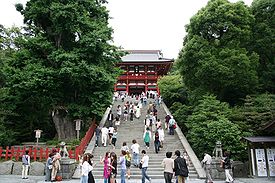
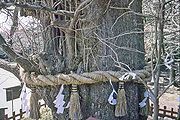
1, 26th day of the 1st month), Sanetomo was coming down from the Senior Shrine at Tsurugaoka Hachiman-gū after assisting to a ceremony celebrating his nomination to Udaijin
Udaijin
Udaijin , most commonly translated as the "Minister of the Right", was a government position in Japan in the late Nara and Heian periods. The position was consolidated in the Taihō Code of 702. The Asuka Kiyomihara Code of 689 marks the initial appearance of the Udaijin in the context of a central...
. His nephew (the son of second shogun Minamoto no Yoriie
Minamoto no Yoriie
was the second shogun of Japan's Kamakura shogunate, and the first son of first shogun Yoritomo.- Life :Born from Tokimasa's daughter Hōjō Masako at Hiki Yoshikazu's residence in Kamakura, Yoriie had as wet nurses the wives of powerful men like Hiki himself and Kajiwara Kagetoki, and Hiki's...
) Kugyō (Minamoto no Yoshinari)
Kugyo (Minamoto no Yoshinari)
, also known as or , was the second son of the second Kamakura shogun of Japan, Minamoto no Yoriie. At the age of six, after his father was killed in Shuzenji in Izu, he became his uncle Sanetomo's adopted son and, thanks to his grandmother Hōjō Masako's intercession, a disciple of Songyō,...
came out from next to the stone stairway of the shrine, then suddenly attacked and assassinated him. For his act he was himself beheaded few hours later, thus bringing the Seiwa Genji
Seiwa Genji
The ' were the most successful and powerful of the many branch families of the Japanese Minamoto clan. Many of the most famous Minamoto warriors, including Minamoto Yoshiie, also known as "Hachimantaro", or God of War, and Minamoto no Yoritomo, the founder of the Kamakura shogunate, were descended...
line of the Minamoto clan and their rule in Kamakura to a sudden end.
Minamoto no Sanetomo was succeeded by Kujō Yoritsune
Kujo Yoritsune
, also known as Fujiwara no Yoritsune, was the fourth shogun of the Kamakura shogunate of Japan. His father was kanpaku Kujō Michiie and his grandmother was a niece of Minamoto no Yoritomo...
as fourth shogun of the Kamakura shogunate.
Eras of Sanetomo's bakufu
The years in which Sanetomo was shogun are more specifically identified by more than one era name or nengō.- KenninKenninwas a after Shōji and before Genkyū. This period spanned the years from February 1201 through February 1204. The reigning emperor was .-Change of era:...
(1201–1204) - GenkyūGenkyuwas a after Kennin and before Ken'ei. This period spanned the years from February 1204 through April 1206. The reigning emperor was .-Change of era:* 1204 : The new era name was created to mark an event or a number of events...
(1204–1206) - Ken'ei (1206–1207)
- Jōgen (Kamakura period) (1207–1211)
- KenryakuKenryakuwas a after Jōgen and before Kempo. This period spanned the years from March 1211 through December 1213. The reigning emperor was .-Change of era:...
(1211–1213) - KenpōKempo (era)was a Japanese era name after Kenryaku and before Jōkyū. This period spanned the years from December 1213 through April 1219...
(1213–1219) - JōkyūJokyu, also called Shōkyū, was a Japanese era name after Kempō and before Jōō. This period spanned the years from April 1219 through April 1222...
(1219–1222)
See also

- Azuma KagamiAzuma KagamiThe , or "mirror of the east", is a Japanese medieval text that chronicles events of the Kamakura Shogunate from Minamoto no Yoritomo's rebellion against the Taira clan in Izokuni of 1180 to Munetaka Shinnō and his return to Kyoto in 1266...