
Mimivirus is a
viralA virus is a small infectious agent that can replicate only inside the living cells of organisms. Viruses infect all types of organisms, from animals and plants to bacteria and archaea...
genus containing a single identified species named
Acanthamoeba polyphaga mimivirus (APMV), or is a group of phylogenetically related large viruses (designated usually MimiN). In colloquial speech, APMV is more commonly referred to as just “mimivirus”. Until October 2011, when a larger virus
Megavirus chilensis was described, it had largest
capsidA capsid is the protein shell of a virus. It consists of several oligomeric structural subunits made of protein called protomers. The observable 3-dimensional morphological subunits, which may or may not correspond to individual proteins, are called capsomeres. The capsid encloses the genetic...
diameter of all known viruses. Mimivirus has a large and complex
genomeIn modern molecular biology and genetics, the genome is the entirety of an organism's hereditary information. It is encoded either in DNA or, for many types of virus, in RNA. The genome includes both the genes and the non-coding sequences of the DNA/RNA....
compared with most other viruses.
Discovery
APMV was discovered serendipitously in 1992 within the
amoebaAmoeba is a genus of Protozoa.History=The amoeba was first discovered by August Johann Rösel von Rosenhof in 1757. Early naturalists referred to Amoeba as the Proteus animalcule after the Greek god Proteus, who could change his shape...
Acanthamoeba polyphaga, after which it is named, during research into
LegionellosisLegionellosis is a potentially fatal infectious disease caused by gram negative, aerobic bacteria belonging to the genus Legionella. Over 90% of legionellosis cases are caused by Legionella pneumophila, a ubiquitous aquatic organism that thrives in temperatures between , with an optimum temperature...
. The virus was observed in a gram stain and mistakenly thought to be a
gram-positiveGram-positive bacteria are those that are stained dark blue or violet by Gram staining. This is in contrast to Gram-negative bacteria, which cannot retain the crystal violet stain, instead taking up the counterstain and appearing red or pink...
bacterium. As a consequence it was named "
Bradfordcoccus", after the district the amoeba was sourced from in
BradfordBradford lies at the heart of the City of Bradford, a metropolitan borough of West Yorkshire, in Northern England. It is situated in the foothills of the Pennines, west of Leeds, and northwest of Wakefield. Bradford became a municipal borough in 1847, and received its charter as a city in 1897...
,
EnglandEngland is a country that is part of the United Kingdom. It shares land borders with Scotland to the north and Wales to the west; the Irish Sea is to the north west, the Celtic Sea to the south west, with the North Sea to the east and the English Channel to the south separating it from continental...
. In 2003, researchers at the Université de la Méditerranée in
MarseilleMarseille , known in antiquity as Massalia , is the second largest city in France, after Paris, with a population of 852,395 within its administrative limits on a land area of . The urban area of Marseille extends beyond the city limits with a population of over 1,420,000 on an area of...
,
FranceThe French Republic , The French Republic , The French Republic , (commonly known as France , is a unitary semi-presidential republic in Western Europe with several overseas territories and islands located on other continents and in the Indian, Pacific, and Atlantic oceans. Metropolitan France...
published a paper in
ScienceScience is the academic journal of the American Association for the Advancement of Science and is one of the world's top scientific journals....
identifying the micro-organism as a virus.
Mimivirus may be a causative agent of some forms of
pneumoniaPneumonia is an inflammatory condition of the lung—especially affecting the microscopic air sacs —associated with fever, chest symptoms, and a lack of air space on a chest X-ray. Pneumonia is typically caused by an infection but there are a number of other causes...
; this is based mainly on indirect evidence in the form of antibodies to the virus discovered in pneumonia patients. However, the classification of mimivirus as a
pathogenA pathogen gignomai "I give birth to") or infectious agent — colloquially, a germ — is a microbe or microorganism such as a virus, bacterium, prion, or fungus that causes disease in its animal or plant host...
is tenuous at present as there have been only a couple of papers published potentially linking mimivirus to actual cases of pneumonia. Indeed, a significant fraction of pneumonia cases are due to unknown
etiologyEtiology is the study of causation, or origination. The word is derived from the Greek , aitiologia, "giving a reason for" ....
.
Classification
Mimivirus has been placed into a viral family by the
International Committee on Taxonomy of VirusesThe International Committee on Taxonomy of Viruses is a committee which authorizes and organizes the taxonomic classification of viruses. They have developed a universal taxonomic scheme for viruses and aim to describe all the viruses of living organisms. Members of the committee are considered to...
as a member of the
Mimiviridae, and has been placed into Group I of the
Baltimore classificationThe Baltimore classification, developed by David Baltimore, is a virus classification system that groups viruses into families, depending on their type of genome and their method of replication....
system.
Although not strictly a method of classification, Mimivirus joins a group of large viruses known as
nucleocytoplasmic large DNA virusesThe nucleocytoplasmic large DNA viruses or NCLDV refers to a number of families of large eukaryotic DNA viruses:# Asfarviridae# Iridoviridae# Marseilleviridae# Megaviridae# Mimiviridae# Phycodnaviridae# Poxviridae...
(NCLDV). They are all large viruses which share both molecular characteristics and large genomes. The mimivirus genome also possesses 21 genes encoding homologs to proteins which are seen to be highly conserved in the majority of NCLDVs, and further work suggests that mimivirus is an early divergent of the general NCLDV group.
Structure
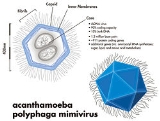
The mimivirus is the second-largest virus, preceded by the recently discovered
Megavirus chilensisMegavirus is a viral genus containing a single identified species named Megavirus chilensis , phylogenetically related to Acanthamoeba polyphaga Mimivirus . In colloquial speech, MGVC is more commonly referred to as just “Megavirus”...
, and has a
capsidA capsid is the protein shell of a virus. It consists of several oligomeric structural subunits made of protein called protomers. The observable 3-dimensional morphological subunits, which may or may not correspond to individual proteins, are called capsomeres. The capsid encloses the genetic...
diameter of 400
nmA nanometre is a unit of length in the metric system, equal to one billionth of a metre. The name combines the SI prefix nano- with the parent unit name metre .The nanometre is often used to express dimensions on the atomic scale: the diameter...
. Protein filaments measuring 100 nm project from the surface of the capsid, bringing the total length of the virus up to 600 nm. Variation in scientific literature renders these figures as highly approximate, with the "size" of the virion being casually listed as anywhere between 400 nm and 800 nm, depending on whether total length or capsid diameter is actually quoted. The capsid appears hexagonal under an
electron microscopeAn electron microscope is a type of microscope that uses a beam of electrons to illuminate the specimen and produce a magnified image. Electron microscopes have a greater resolving power than a light-powered optical microscope, because electrons have wavelengths about 100,000 times shorter than...
, therefore the capsid symmetry is icosahedral. It does not appear to possess an outer viral envelope, suggesting that the virus does not exit the host cell by
exocytosisExocytosis , also known as 'The peni-cytosis', is the durable process by which a cell directs the contents of secretory vesicles out of the cell membrane...
.
The same team that discovered the mimivirus later discovered a slightly larger virus, dubbed the
mamavirusMamavirus is one of the most complex viruses discovered. It is a virus belonging to the family mimiviridae, which includes mimivirus, mamavirus, and marseillevirus The mimiviridae also belong to the family of the nucleocytoplasmic large DNA viruses , which includes the Poxviridae, the...
,
and the
Sputnik virophageSputnik virophage is a subviral agent that reproduces in amoeba cells that are already infected by a certain helper virus; Sputnik uses the helper virus's machinery for reproduction and inhibits replication of the helper virus.Viruses like Sputnik that depend on co-infection of the host cell by...
that infects it.
Mimivirus shares several morphological characteristics with all members of the NCLDV group of viruses. As an internal lipid layer surrounding the central core is present in all other NCLDV viruses, it has been suggested by M. Suzan-Monti et al. that this may also be present in mimivirus. The condensed central core of the virion appears as a dark region under the electron microscope. The large genome of the virus resides within this area.
Several mRNA transcripts can be recovered from purified virions. Like other NCLDVs, transcripts for
DNA polymeraseA DNA polymerase is an enzyme that helps catalyze in the polymerization of deoxyribonucleotides into a DNA strand. DNA polymerases are best known for their feedback role in DNA replication, in which the polymerase "reads" an intact DNA strand as a template and uses it to synthesize the new strand....
, a
capsidA capsid is the protein shell of a virus. It consists of several oligomeric structural subunits made of protein called protomers. The observable 3-dimensional morphological subunits, which may or may not correspond to individual proteins, are called capsomeres. The capsid encloses the genetic...
protein and a TFII-like
transcription factorIn molecular biology and genetics, a transcription factor is a protein that binds to specific DNA sequences, thereby controlling the flow of genetic information from DNA to mRNA...
were found. However, three distinct
aminoacyl tRNA synthetaseAn aminoacyl tRNA synthetase is an enzyme that catalyzes the esterification of a specific amino acid or its precursor to one of all its compatible cognate tRNAs to form an aminoacyl-tRNA. This is sometimes called "charging" the tRNA with the amino acid...
enzyme transcripts and four unknown mRNA molecules specific to mimivirus were also found. These pre-packaged transcripts can be
translatedIn molecular biology and genetics, translation is the third stage of protein biosynthesis . In translation, messenger RNA produced by transcription is decoded by the ribosome to produce a specific amino acid chain, or polypeptide, that will later fold into an active protein...
without viral gene expression and are likely to be necessary to Mimivirus for replication. Other
DNA virusA DNA virus is a virus that has DNA as its genetic material and replicates using a DNA-dependent DNA polymerase. The nucleic acid is usually double-stranded DNA but may also be single-stranded DNA . DNA viruses belong to either Group I or Group II of the Baltimore classification system for viruses...
es, such as the
Human cytomegalovirusCytomegalovirus is a viral genus of the viral group known as Herpesviridae or herpesviruses. It is typically abbreviated as CMV: The species that infects humans is commonly known as human CMV or human herpesvirus-5 , and is the most studied of all cytomegaloviruses...
and
Herpes simplex virus type-1Herpes simplex is a viral disease caused by both Herpes simplex virus type 1 and type 2 . Infection with the herpes virus is categorized into one of several distinct disorders based on the site of infection. Oral herpes, the visible symptoms of which are colloquially called cold sores or fever...
, also feature pre-packaged mRNA transcripts.
Genome
The mimivirus genome is a linear, double-stranded molecule of
DNADeoxyribonucleic acid is a nucleic acid that contains the genetic instructions used in the development and functioning of all known living organisms . The DNA segments that carry this genetic information are called genes, but other DNA sequences have structural purposes, or are involved in...
with 1,181,404
base pairIn molecular biology and genetics, the linking between two nitrogenous bases on opposite complementary DNA or certain types of RNA strands that are connected via hydrogen bonds is called a base pair...
s in length. This makes it the largest viral genome in scientific knowledge, outstripping the next-largest virus genome of the
Cafeteria roenbergensis virusCafeteria roenbergensis virus is a giant virus that infects the marine zooplankton Cafeteria roenbergensis . CroV has the largest genome of any known marine virus, consisting of ~730,000 base pairs of double-stranded DNA...
by about 450,000 base pairs. In addition, it is larger than at least 30 cellular
cladeA clade is a group consisting of a species and all its descendants. In the terms of biological systematics, a clade is a single "branch" on the "tree of life". The idea that such a "natural group" of organisms should be grouped together and given a taxonomic name is central to biological...
s.
In addition to the large size of the genome, mimivirus possesses an estimated 979 protein-coding
geneA gene is a molecular unit of heredity of a living organism. It is a name given to some stretches of DNA and RNA that code for a type of protein or for an RNA chain that has a function in the organism. Living beings depend on genes, as they specify all proteins and functional RNA chains...
s, far exceeding the minimum 4 genes required for viruses to exist (
c.f. MS2The bacteriophage MS2 is an icosahedral, positive-sense single-stranded RNA virus that infects the bacterium Escherichia coli.-History:...
and
QβBacteriophage Qβ is an icosahedral virus with a diameter of 25 nm. Its host is Escherichia coli. Qβ enters its host cell through the side of the F pilus.-Genetics:...
viruses). Analysis of its genome revealed the presence of genes not seen in any other viruses, including
aminoacyl tRNA synthetaseAn aminoacyl tRNA synthetase is an enzyme that catalyzes the esterification of a specific amino acid or its precursor to one of all its compatible cognate tRNAs to form an aminoacyl-tRNA. This is sometimes called "charging" the tRNA with the amino acid...
s, and other genes previously thought only to be encoded by cellular organisms. Like other large DNA viruses, mimivirus contains several genes for sugar, lipid and amino acid metabolism, as well as some metabolic genes not found in any other virus. Roughly 90% of the genome was of coding capacity, with the other 10% being “junk DNA”.
Replication
The stages of mimivirus replication are not well known, but as a minimum it is known that mimivirus attaches to a
chemical receptorIn biochemistry, a receptor is a molecule found on the surface of a cell, which receives specific chemical signals from neighbouring cells or the wider environment within an organism...
on the surface of an amoeba cell and is taken into the cell. Once inside, an
eclipse phase begins, in which the virus disappears and all appears normal within the cell. After about four hours small accumulations can be seen in areas of the cell. Eight hours after infection many mimivirus virions are clearly visible within the cell. The cell
cytoplasmThe cytoplasm is a small gel-like substance residing between the cell membrane holding all the cell's internal sub-structures , except for the nucleus. All the contents of the cells of prokaryote organisms are contained within the cytoplasm...
continues to fill with newly synthesised virions and about 24 hours after initial infection the cell likely bursts open to release the new mimivirus virions.
Little is known about the details of this replication cycle, most obviously attachment to the cell surface and entry, viral core release, DNA replication, transcription, translation, assembly and release of progeny virions. However, scientists have established the general overview given above using electron micrographs of infected cells. These micrographs show mimivirus capsid assembly in the nucleus, acquisition of an inner lipid membrane via budding from the nucleus, and particles similar to those found in many other viruses, including all NCLDV members. These particles are known in other viruses as
viral factories and allow efficient viral assembly by modifying large areas of the host cell.
Implications for defining "life"
Mimivirus possesses many characteristics which place it at the boundary of living and non-living. It is as large as several bacterial species, such as
Rickettsia conoriiRickettsia is a genus of non-motile, Gram-negative, non-sporeforming, highly pleomorphic bacteria that can present as cocci , rods or thread-like . Being obligate intracellular parasites, the Rickettsia survival depends on entry, growth, and replication within the cytoplasm of eukaryotic host cells...
and
Tropheryma whipplei, possesses a genome of comparable size to several bacteria, including those above, and codes for products previously not thought to be encoded by viruses. In addition, mimivirus possesses genes coding for nucleotide and amino acid synthesis, which even some small obligate intracellular bacteria lack. This means that unlike these bacteria, mimivirus is not dependent on the host cell genome for coding the metabolic pathways for these products. They do however, lack genes for ribosomal proteins, making mimivirus dependent on a host cell for protein translation and energy metabolism. These factors combined have thrown scientists into debate over whether mimivirus is a distinct form of life, comparable on a domain scale to Eukarya,
ArchaeaThe Archaea are a group of single-celled microorganisms. A single individual or species from this domain is called an archaeon...
and
BacteriaBacteria are a large domain of prokaryotic microorganisms. Typically a few micrometres in length, bacteria have a wide range of shapes, ranging from spheres to rods and spirals...
. Nevertheless, mimivirus does not exhibit the following characteristics, all of which are part of many conventional definitions of
lifeLife is a characteristic that distinguishes objects that have signaling and self-sustaining processes from those that do not, either because such functions have ceased , or else because they lack such functions and are classified as inanimate...
:
homeostasisHomeostasis is the property of a system that regulates its internal environment and tends to maintain a stable, constant condition of properties like temperature or pH...
, response to stimuli, growth in the normal sense of the term (instead replicating via self-assembly of individual components) or undergoing cellular division.
Because its lineage is very old and could have emerged prior to cellular organisms, mimivirus has added to the debate over the origins of life. Some genes unique to mimivirus, including those coding for the capsid, have been conserved in a variety of viruses which infect organisms from all domains - Eukarya,
ArchaeaThe Archaea are a group of single-celled microorganisms. A single individual or species from this domain is called an archaeon...
and
BacteriaBacteria are a large domain of prokaryotic microorganisms. Typically a few micrometres in length, bacteria have a wide range of shapes, ranging from spheres to rods and spirals...
. This has been used to suggest that mimivirus is related to a type of DNA virus that emerged before cellular organisms and played a key role in the development of all life on Earth. An alternative hypothesis is that there were three distinct types of DNA viruses that were involved in generating the three known
domainsIn biological taxonomy, a domain is the highest taxonomic rank of organisms, higher than a kingdom. According to the three-domain system of Carl Woese, introduced in 1990, the Tree of Life consists of three domains: Archaea, Bacteria and Eukarya...
of life.
See also
- Mycoplasma genitalium
Mycoplasma genitalium is a small parasitic bacterium that lives on the ciliated epithelial cells of the primate genital and respiratory tracts. M. genitalium is the smallest known genome that can constitute a cell, and the second-smallest bacterium after the recently-discovered endosymbiont...
– one of the smallest bacteria
- Pelagibacter ubique
Pelagibacter, with the single species P. ubique, was isolated in 2002 and given a specific name, although it has not yet been validly published according to the bacteriological code. It is an abundant member of the SAR11 clade in the phylum Alphaproteobacteria...
– possesses one of the smallest bacterial genomes
- Nanoarchaeum equitans – smallest known independent cell, one of the smallest known genomes (the smallest published genome belongs to Carsonella rudii )
- Nanobacterium
Nanobacterium is the unit or member name of a proposed class of living organisms, specifically cell-walled microorganisms with a size much smaller than the generally accepted lower limit size for life...
- Nanobe
A nanobe is a tiny filamental structure first found in some rocks and sediments. Some scientists hypothesize that nanobes are the smallest form of life, 1/10 the size of the smallest known bacteria...
- Cafeteria roenbergensis virus
Cafeteria roenbergensis virus is a giant virus that infects the marine zooplankton Cafeteria roenbergensis . CroV has the largest genome of any known marine virus, consisting of ~730,000 base pairs of double-stranded DNA...
the largest marine virus
- Marseillevirus
The Marseillevirus is the prototype of a family of nucleocytoplasmic large DNA viruses of eukaryotes...
another giant virus
- Parvovirus
Parvovirus, often truncated to "parvo", is both the common name in English casually applied to all the viruses in the Parvoviridae taxonomic family, and also the taxonomic name of the Parvovirus genus within the Parvoviridae family...
– smallest known virusA virus is a small infectious agent that can replicate only inside the living cells of organisms. Viruses infect all types of organisms, from animals and plants to bacteria and archaea...
es
- Virophage – a virus that requires the host cell to be co-infected with a giant virus
Further reading
- Peplow, Mark, 2004, "Giant virus qualifies as 'living organism'," News@Nature
Nature, first published on 4 November 1869, is ranked the world's most cited interdisciplinary scientific journal by the Science Edition of the 2010 Journal Citation Reports...
, doi:10.1038/
- New Scientist
New Scientist is a weekly non-peer-reviewed English-language international science magazine, which since 1996 has also run a website, covering recent developments in science and technology for a general audience. Founded in 1956, it is published by Reed Business Information Ltd, a subsidiary of...
, Issue 2544, 25 March 2006.
- GiantVirus.org
External links