


Millicent Fawcett

Encyclopedia
Order of the British Empire
The Most Excellent Order of the British Empire is an order of chivalry established on 4 June 1917 by George V of the United Kingdom. The Order comprises five classes in civil and military divisions...
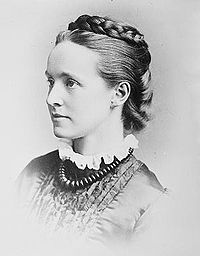
(11 June 1847 – 5 August 1929) was an English suffragist (one who campaigned for women to have the vote
Suffrage
Suffrage, political franchise, or simply the franchise, distinct from mere voting rights, is the civil right to vote gained through the democratic process...
) and an early feminist.
She was born Millicent Garrett in Aldeburgh
Aldeburgh
Aldeburgh is a coastal town in Suffolk, East Anglia, England. Located on the River Alde, the town is notable for its Blue Flag shingle beach and fisherman huts where freshly caught fish are sold daily, and the Aldeburgh Yacht Club...
, Suffolk. As a suffragist, as opposed to a suffragette
Suffragette
"Suffragette" is a term coined by the Daily Mail newspaper as a derogatory label for members of the late 19th and early 20th century movement for women's suffrage in the United Kingdom, in particular members of the Women's Social and Political Union...
, she took a moderate line, but was a tireless campaigner. She concentrated much of her energy on the struggle to improve women's opportunities for higher education and in 1871 co-founded Newnham College, Cambridge
Newnham College, Cambridge
Newnham College is a women-only constituent college of the University of Cambridge, England.The college was founded in 1871 by Henry Sidgwick, and was the second Cambridge college to admit women after Girton College...
. She later became president of the National Union of Women's Suffrage Societies (the NUWSS), a position she held from 1890 until 1919. In July 1901 she was appointed to lead the British Government's commission to South Africa to investigate conditions in the concentration camps that had been created there in the wake of the Second Boer War
Second Boer War
The Second Boer War was fought from 11 October 1899 until 31 May 1902 between the British Empire and the Afrikaans-speaking Dutch settlers of two independent Boer republics, the South African Republic and the Orange Free State...
. Her report corroborated what the campaigner Emily Hobhouse
Emily Hobhouse
Emily Hobhouse was a British welfare campaigner, who is primarily remembered for bringing to the attention of the British public, and working to change, the poor conditions inside the British concentration camps in South Africa built for Boer women and children during the Second Boer War.-Early...
had said about conditions in the camps.
Early life
Millicent Garrett was born on 11 June 1847 in Aldeburgh to Newson GarrettNewson Garrett
Newson Garrett , was a maltster and brewer instrumental in the revival of the town of Aldeburgh, Suffolk, of which he became mayor at the end of his life...
, a warehouse owner, and his wife Louise Dunnell. Newson and Louise had six daughters and four sons, including Millicent and Elizabeth
Elizabeth Garrett Anderson
Elizabeth Garrett Anderson, LSA, MD , was an English physician and feminist, the first woman to gain a medical qualification in Britain and the first female mayor in England.-Early life:...
, later famous as the first woman in the United Kingdom to qualify as a doctor. Newson's business quickly became a success, and all of his children were educated at a private boarding school
Boarding school
A boarding school is a school where some or all pupils study and live during the school year with their fellow students and possibly teachers and/or administrators. The word 'boarding' is used in the sense of "bed and board," i.e., lodging and meals...
in Blackheath, London
Blackheath, London
Blackheath is a district of South London, England. It is named from the large open public grassland which separates it from Greenwich to the north and Lewisham to the west...
run by Louisa Browning, the aunt of Robert Browning
Robert Browning
Robert Browning was an English poet and playwright whose mastery of dramatic verse, especially dramatic monologues, made him one of the foremost Victorian poets.-Early years:...
.
Millicent was sent there in 1858, and left in 1863 with "a sharpened interest in literature and the arts and a passion for self-education". Her sister Louise took her to the sermons of Frederick Maurice, who was a more socially aware and less traditional Anglican
Church of England
The Church of England is the officially established Christian church in England and the Mother Church of the worldwide Anglican Communion. The church considers itself within the tradition of Western Christianity and dates its formal establishment principally to the mission to England by St...
and whose opinion influenced Millicent's view of religion. When she was twelve her sister Elizabeth moved to London to qualify as a doctor, and Millicent regularly visited her there.
Married life
These visits were the start of Millicent's interest in women's rightsWomen's rights
Women's rights are entitlements and freedoms claimed for women and girls of all ages in many societies.In some places these rights are institutionalized or supported by law, local custom, and behaviour, whereas in others they may be ignored or suppressed...
. In 1865 Elizabeth took her to see a speech by John Stuart Mill
John Stuart Mill
John Stuart Mill was a British philosopher, economist and civil servant. An influential contributor to social theory, political theory, and political economy, his conception of liberty justified the freedom of the individual in opposition to unlimited state control. He was a proponent of...
on the subject; Millicent was impressed by this speech, and became an active supporter of his work. In 1866, at the age of 19, she became secretary of the London Society for Women's Suffrage. Mill introduced her to many other women's rights activists, including Henry Fawcett
Henry Fawcett
Henry Fawcett PC was a blind British academic, statesman and economist.-Background and education:Fawcett was born in Salisbury, and educated at King's College School and the University of Cambridge: entering Peterhouse in 1852, he migrated to Trinity Hall the following year, and became a fellow...
, a liberal Member of Parliament who had originally intended to marry Elizabeth before she decided to focus on her medical career. Millicent and the politician became close friends, and despite a fourteen-year age gap they married in 1867. Millicent took his last name, becoming Millicent Garrett Fawcett. The MP had been blinded in a shooting accident in 1858, and Millicent acted as his secretary. The marriage was described as one based on "perfect intellectual sympathy", and Millicent pursued a writing career of her own while caring for him. Their only child, Philippa Fawcett
Philippa Fawcett
Philippa Garrett Fawcett was an English mathematician and educationalist.She was the daughter of the suffragist Millicent Fawcett and of Henry Fawcett MP, Professor of Political Economy at Cambridge and Postmaster General in Gladstone's government...
, was born in 1868.
In 1868 Millicent joined the London Suffrage Committee, and in 1869 she spoke at the first public pro-suffrage meeting to be held in London. In March 1870 she spoke in Brighton, her husband's constituency, and as a speaker was known for her clear speaking voice. In 1870 she published Political Economy for Beginners, which although short was "wildly successful", and ran through 10 editions in 41 years. In 1872 she and her husband published Essays and Lectures on Social and Political Subjects, which contained eight essays by Millicent. In 1875 she was a co-founder of Newnham Hall
Newnham College, Cambridge
Newnham College is a women-only constituent college of the University of Cambridge, England.The college was founded in 1871 by Henry Sidgwick, and was the second Cambridge college to admit women after Girton College...
, and served on its Council.
Widow
The death of her husband on 6 November 1884 made Millicent temporarily withdraw from public life. She sold both family homes and moved with Philippa into the house of Agnes Garrett, her sister. She resumed work in 1885. Millicent began to concentrate on politics. Originally an active Liberal, she joined the Liberal Unionist party in 1886 in opposition to Irish Home Rule. In 1904 she resigned from the party on the issue of Free TradeFree trade
Under a free trade policy, prices emerge from supply and demand, and are the sole determinant of resource allocation. 'Free' trade differs from other forms of trade policy where the allocation of goods and services among trading countries are determined by price strategies that may differ from...
when Joseph Chamberlain
Joseph Chamberlain
Joseph Chamberlain was an influential British politician and statesman. Unlike most major politicians of the time, he was a self-made businessman and had not attended Oxford or Cambridge University....
gained control in his campaign for Tariff Reform.
After the death of Lydia Becker
Lydia Becker
Lydia Ernestine Becker was a leader in the early British suffrage movement, as well as an amateur scientist with interests in biology and astronomy...
, she became the leader of the National Union of Women's Suffrage Societies
National Union of Women's Suffrage Societies
The National Union of Women's Suffrage Societies , also known as the Suffragists was an organisation of women's suffrage societies in the United Kingdom.-Formation and campaigning:...
(NUWSS), the main suffragist organisation in Britain. She held this post until 1919, a year after the first women had been granted the vote. After that, she left the suffrage campaign for the most part, and devoted much of her time to writing books, including a biography of Josephine Butler
Josephine Butler
Josephine Elizabeth Butler was a Victorian era British feminist who was especially concerned with the welfare of prostitutes...
.
She was granted an honorary LLD
Legum Doctor
Legum Doctor is a doctorate-level academic degree in law, or an honorary doctorate, depending on the jurisdiction. The double L in the abbreviation refers to the early practice in the University of Cambridge to teach both Canon Law and Civil Law, the double L indicating the plural, Doctor of both...
by St. Andrew's University
St. Andrew's University
, also known as St Andrew's University, is a private, coeducational university located in Izumi, Osaka, Japan.- Faculties :The university has faculties in International studies, Liberal Arts, Sociology, Economics, Business and Administration, of Law...
in 1905, awarded a damehood
Dame (title)
The title of Dame is the female equivalent of the honour of knighthood in the British honours system . It is also the equivalent form address to 'Sir' for a knight...
(GBE
Order of the British Empire
The Most Excellent Order of the British Empire is an order of chivalry established on 4 June 1917 by George V of the United Kingdom. The Order comprises five classes in civil and military divisions...
) in 1925, and died four years later, in 1929. Her memory is preserved now in the name of the Fawcett Society
Fawcett Society
The Fawcett Society is an organisation in the United Kingdom which campaigns for women's rights. The organisation's roots date back to 1866 when Millicent Garrett Fawcett dedicated her life to the peaceful campaign for women's suffrage....
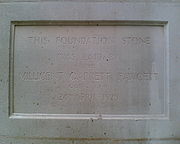
, and in Millicent Fawcett Hall, constructed in 1929 in Westminster
Westminster
Westminster is an area of central London, within the City of Westminster, England. It lies on the north bank of the River Thames, southwest of the City of London and southwest of Charing Cross...
as a place that women could use to debate and discuss the issues that affected them. The hall is currently owned by Westminster School
Westminster School
The Royal College of St. Peter in Westminster, almost always known as Westminster School, is one of Britain's leading independent schools, with the highest Oxford and Cambridge acceptance rate of any secondary school or college in Britain...
and is the location of its drama department, incorporating a 150-seat studio theatre.
Political Activities
Millicent Fawcett (leader of NUWSS) was a moderate campaigner, distancing herself from the militant and violent activities of the PankhurstPankhurst
Pankhurst is a surname, and may refer to:Members of a prominent family of suffragettes:* Emmeline Pankhurst , one of the founders of the British suffragette movement...
s and the Women's Social and Political Union
Women's Social and Political Union
The Women's Social and Political Union was the leading militant organisation campaigning for Women's suffrage in the United Kingdom...
(WSPU). She believed that their actions were in fact harming women's chances of gaining the vote, as they were alienating the MPs who were debating whether or not to give women the vote, as well as souring much of the general public towards the campaign. Despite the publicity given to the WSPU, the NUWSS (one of whose slogans was "Law-Abiding suffragists" ) retained the majority of the support of the women's movement. In 1913 they had 50,000 members compared to 2,000 of the WSPU.
Fawcett also campaigned for the repeal of the Contagious Diseases Acts
Contagious Diseases Acts
The Contagious Diseases Acts were originally passed by the Parliament of the United Kingdom in 1864, with further alterations and editions made to it in 1866 and 1869. In 1862, a committee was established to inquire into venereal disease in the armed forces; on its recommendation the first...
, which reflected sexual double standard
Double standard
A double standard is the unjust application of different sets of principles for similar situations. The concept implies that a single set of principles encompassing all situations is the desirable ideal. The term has been used in print since at least 1895...
s. The Acts required that prostitutes be examined for sexually transmitted diseases, and if they were found to have passed any on to their customers, they were imprisoned. Poor women could be arrested on suspicion of being a prostitute, and could also be imprisoned for refusing consent to the examination, which was invasive and could be painful. The prostitutes' infectious male customers were not subject to the Acts. The Acts were eventually repealed as a result of Fawcett's and others' campaigning.
When the First World War broke out in 1914, while the WSPU ceased all of their activities to focus on the war effort, Fawcett's NUWSS did not. This was largely because as the organisation was significantly less militant than the WSPU, it contained many more pacifists, and general support for the war within the organisation was weaker. The WSPU, in comparison, was called jingoistic
Jingoism
Jingoism is defined in the Oxford English Dictionary as extreme patriotism in the form of aggressive foreign policy. In practice, it is a country's advocation of the use of threats or actual force against other countries in order to safeguard what it perceives as its national interests...
as a result of its leaders' strong support for the war. While Fawcett was not a pacifist, she risked dividing the organisation if she ordered a halt to the campaign, and the diverting of NUWSS funds from the government, as the WSPU had done. The NUWSS continued to campaign for the vote during the war, and used the situation to their advantage by pointing out the contribution women had made to the war effort in their campaigns.
Fawcett is considered instrumental in gaining the vote for six million British women over 30-years-old gaining the vote in 1918.
The archives of Millicent Garrett Fawcett are held at The Women's Library at London Metropolitan University
London Metropolitan University
London Metropolitan University , located in London, England, was formed on 1 August 2002 by the amalgamation of the University of North London and the London Guildhall University . The University has campuses in the City of London and in the London Borough of Islington.The University operates its...
, ref 7MGF.
Works
- 1870: Political Economy for Beginners. Full text online.
- 1872: Essays and Lectures on social and political subjects (written with Henry FawcettHenry FawcettHenry Fawcett PC was a blind British academic, statesman and economist.-Background and education:Fawcett was born in Salisbury, and educated at King's College School and the University of Cambridge: entering Peterhouse in 1852, he migrated to Trinity Hall the following year, and became a fellow...
). Full text online. - 1874: Tales in Political Economy. Full text online.
- 1875: Janet Doncaster, a novel.
- 1889: Some Eminent Women of our Times: short biographical sketches. Full text online.
- 1895: Life of Her Majesty, Queen Victoria. Full text online.
- 1901: Life of the Right Hon. Sir William MolesworthWilliam MolesworthSir William Molesworth, 8th Baronet PC , was a British politician.-Background:Molesworth was born in London and succeeded to the baronetcy in 1823. He was educated privately before entering St John's College, Cambridge as a fellow commoner. Moving to Trinity College, he fought a duel with his...
. Full text online. - 1905: Five Famous French Women. Full text online.
- 1912: Women's Suffrage : a Short History of a Great Movement. ISBN 0-9542632-4-3. Full text online.
- 1920: The Women's Victory and After: Personal reminiscences, 1911–1918. Full text online.
- 1924: What I Remember (Pioneers of the Woman's Movement). ISBN 0-88355-261-2.
- 1927: Josephine ButlerJosephine ButlerJosephine Elizabeth Butler was a Victorian era British feminist who was especially concerned with the welfare of prostitutes...
: her work and principles and their meaning for the twentieth century (written with Ethel M. Turner).
- dozens of articles for periodicals including The Englishwoman, Woman's Leader, Fraser's MagazineFraser's MagazineFraser's Magazine for Town and Country was a general and literary journal published in London from 1830 to 1882, which initially took a strong Tory line in politics. It was founded by Hugh Fraser and William Maginn in 1830 and loosely directed by Maginn under the name Oliver Yorke until about 1840...
, National ReviewNational Review (London)The National Review was founded in 1883 by the English writers Alfred Austin and William Courthope.It was launched as a platform for the views of the British Conservative Party, its masthead incorporating a quotation of the former Conservative Prime Minister, Benjamin Disraeli:Under editor Leopold...
, Macmillan's Magazine, Common Cause, Fortnightly ReviewFortnightly ReviewFortnightly Review was one of the most important and influential magazines in nineteenth-century England. It was founded in 1865 by Anthony Trollope, Frederic Harrison, Edward Spencer Beesly, and six others with an investment of £9,000; the first edition appeared on 15 May 1865...
, Nineteenth CenturyNineteenth Century (periodical)The Nineteenth Century was a British monthly literary magazine founded in 1877 by Sir James Knowles. Many of the early contributors to The Nineteenth Century were members of the Metaphysical Society. The journal was intended to publish debate by leading intellectuals.In 1900, the title was changed...
and Contemporary ReviewContemporary Review-Foundation:It was founded in 1866 by Alexander Strahan and a group of intellectuals anxious to promote intelligent and independent opinion about the great issues of their day. They intended it to be the church-minded counterpart of the resolutely secular Fortnightly Review, which was founded by...
. - Fawcett wrote the introduction to the 1891 edition of Mary WollstonecraftMary WollstonecraftMary Wollstonecraft was an eighteenth-century British writer, philosopher, and advocate of women's rights. During her brief career, she wrote novels, treatises, a travel narrative, a history of the French Revolution, a conduct book, and a children's book...
's book A Vindication of the Rights of WomanA Vindication of the Rights of WomanA Vindication of the Rights of Woman: with Strictures on Political and Moral Subjects , written by the 18th-century British feminist Mary Wollstonecraft, is one of the earliest works of feminist philosophy. In it, Wollstonecraft responds to those educational and political theorists of the 18th...
. Lyndall Gordon states this was an "influential essay", in which Fawcett cleansed the reputation of the early feminist philosopherFeminist philosophyFeminist philosophy refers to philosophy approached from a feminist perspective. Feminist philosophy involves both attempts to use the methods of philosophy to further the cause of the feminist movements, and attempts to criticise or re-evaluate the ideas of traditional philosophy from within a...
and claimed her as a foremother of the struggle for the vote.
See also
- Mary WollstonecraftMary WollstonecraftMary Wollstonecraft was an eighteenth-century British writer, philosopher, and advocate of women's rights. During her brief career, she wrote novels, treatises, a travel narrative, a history of the French Revolution, a conduct book, and a children's book...
, who wrote A Vindication of the Rights of WomanA Vindication of the Rights of WomanA Vindication of the Rights of Woman: with Strictures on Political and Moral Subjects , written by the 18th-century British feminist Mary Wollstonecraft, is one of the earliest works of feminist philosophy. In it, Wollstonecraft responds to those educational and political theorists of the 18th...
in 1792 - Josephine ButlerJosephine ButlerJosephine Elizabeth Butler was a Victorian era British feminist who was especially concerned with the welfare of prostitutes...
and Lydia BeckerLydia BeckerLydia Ernestine Becker was a leader in the early British suffrage movement, as well as an amateur scientist with interests in biology and astronomy...
, early proponents of non-violentNonviolenceNonviolence has two meanings. It can refer, first, to a general philosophy of abstention from violence because of moral or religious principle It can refer to the behaviour of people using nonviolent action Nonviolence has two (closely related) meanings. (1) It can refer, first, to a general...
methods of protest. - Emmeline PankhurstEmmeline PankhurstEmmeline Pankhurst was a British political activist and leader of the British suffragette movement which helped women win the right to vote...
, a proponent of militancy. - Charlotte DespardCharlotte DespardCharlotte Despard was a British-born, later Irish-based suffragist, novelist and Sinn Féin activist....
and Sylvia PankhurstSylvia PankhurstEstelle Sylvia Pankhurst was an English campaigner for the suffragist movement in the United Kingdom. She was for a time a prominent left communist who then devoted herself to the cause of anti-fascism.-Early life:...
, leaders of movements midway between the NUWSS and the WSPU in militancy. - History of feminismHistory of feminismThe history of feminism involves the story of feminist movements and of feminist thinkers. Depending on time, culture and country, feminists around the world have sometimes had different causes and goals...
- Women's suffrage in the United KingdomWomen's suffrage in the United KingdomWomen's suffrage in the United Kingdom as a national movement began in 1872. Women were not prohibited from voting in the United Kingdom until the 1832 Reform Act and the 1835 Municipal Corporations Act...
- The Women's Library (London)The Women's Library (London)The Women's Library in the London Borough of Tower Hamlets is Britain's main library and museum resource on women and the women's movement, especially concentrating on Britain in the 19th and 20th centuries.The Library has over 60,000 books and pamphlets...
- Fawcett SocietyFawcett SocietyThe Fawcett Society is an organisation in the United Kingdom which campaigns for women's rights. The organisation's roots date back to 1866 when Millicent Garrett Fawcett dedicated her life to the peaceful campaign for women's suffrage....
Archives
The archives of Millicent Fawcett are held at The Women's Library at London Metropolitan UniversityLondon Metropolitan University
London Metropolitan University , located in London, England, was formed on 1 August 2002 by the amalgamation of the University of North London and the London Guildhall University . The University has campuses in the City of London and in the London Borough of Islington.The University operates its...
, ref 7MGF