
All Topics  
Military uniform

 
Military Uniform

   Email Print
   Bookmark   Link


Military uniform


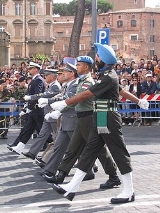
Military uniforms comprises standardised dress
Dress

A Dress is a garment consisting of a skirt with an attached bodice or with a matching bodice giving the effect of a one-piece garment.Dress may also refer to:...
 worn by members of the armed forces
Armed forces

The armed forces of a country are its government-sponsored defense, fighting forces, and organizations. They exist to further the foreign and domestic policies of their governing body, and to defend that body and the nation it represents from external and internal aggressors....
 and paramilitaries
Paramilitary

A paramilitary is a force whose function and organisation are similar to those of a professional military force, but which is not regarded as having the same status....
 of various nations. Military dress and military styles have gone through great changes over the centuries from colourful and elaborate to extremely utilitarian. Military uniforms in the form of standardised and distinctive dress, intended for identification and display, are typically a sign of organized military forces equipped by a central authority.

stinction should be made between uniforms and ethnic dress.


Discussion
Ask a question about 'Military uniform'
Start a new discussion about 'Military uniform'
Answer questions from other users
Full Discussion Forum


Encyclopedia


Military uniforms comprises standardised dress
Dress

A Dress is a garment consisting of a skirt with an attached bodice or with a matching bodice giving the effect of a one-piece garment.Dress may also refer to:...
 worn by members of the armed forces
Armed forces

The armed forces of a country are its government-sponsored defense, fighting forces, and organizations. They exist to further the foreign and domestic policies of their governing body, and to defend that body and the nation it represents from external and internal aggressors....
 and paramilitaries
Paramilitary

A paramilitary is a force whose function and organisation are similar to those of a professional military force, but which is not regarded as having the same status....
 of various nations. Military dress and military styles have gone through great changes over the centuries from colourful and elaborate to extremely utilitarian. Military uniforms in the form of standardised and distinctive dress, intended for identification and display, are typically a sign of organized military forces equipped by a central authority.

History

A distinction should be made between uniforms and ethnic dress. If a particular people or culture favoured a distinctive dress style this could easily create the impression of uniformly dressed warriors. The issue is further complicated by the fact that the distinctive features of particularly effective warrior classes were often copied - weapons, armor, fighting style and native dress. Thus the distinctive and colourful clothing of the Hungarian hussar
Hussar

Hussar refers to a number of types of light cavalry created in Hungary in the 15th century and used throughout Europe and even in Americas since the 18th century....
s became a model for hussar units all over Europe. The kilts and sporrans of Scottish highland clans were distilled into regimental dress when the British Army started to recruit from these tribal groups.

Mercenary or irregular fighters could also develop their own fashions, which set them apart from civilians, but were not really uniforms. The clothing of the German Landsknecht
Landsknecht

Landsknechts were European, most often Germany, mercenary pikeman and supporting infantrys from the late 15th to the late 16th century, and achieved the reputation for being the universal mercenary of the European Renaissance....
e of the 16th century is an example of distinctive military fashion.

Antiquity

There are a few recorded attempts at uniform dress in antiquity, going beyond the similarity to be expected of ethnic or tribal dress. One example is the Spanish infantry of Hannibal who wore white tunics with crimson edgings. Another is the Spartan hoplite
Hoplite

The word hoplite derives from hoplon , meaning an item of armour or equipment, thus 'hoplite' may approximate to 'armoured man'. Hoplites were the citizen-soldiers of the Ancient Greece City-states....
 in his red garment. The terracotta army discovered in the tomb of the first Emperor of Chin (c. 200 BC) have a superficial similarity but closer examination shows up to seven different styles of armour, which do not appear to have been standardised within separate units.

Rome

The legion
Roman legion

The Roman Legion is a term that can apply both as a translation of legio to the entire Roman army and also, more narrowly , to the heavy infantry that was the basic military unit of the Roman army in the period of the late Roman Republic and the Roman Empire....
s of the Roman Republic
Roman Republic

The Roman Republic was the phase of the Ancient Rome characterized by a republican form of government; a period which began with the overthrow of the Roman Roman Kingdom, c....
 and Empire
Roman Empire

The Roman Empire was the Roman Republic phase of the Ancient Rome, characterised by an autocracy form of government and large territorial holdings in Europe and around the Mediterranean....
 wore fairly standardised dress and armour. However the concept of uniforms was not part of their culture and there were considerable differences in detail. Even the armour mass produced in state factories varied according to the province of origin. Fragments of surviving clothing and wall paintings indicate that the basic tunic of the Roman soldier was of red or undyed (off-white) wool. Senior commanders are known to have worn white cloaks and plumes. The centurions who made up the long serving backbone of the legions were distinguished by transverse crests on their helmets, chest ornaments corresponding to modern medals and the long cudgels that they carried.

Late Roman and Byzantine

The regular thematic (provincial) and Tagmata (central) troops of the Byzantine Empire
Byzantine Empire

Byzantine Empire and Eastern Roman Empire are conventional names used to describe the Roman Empire during the Middle Ages, centered on its capital of Constantinople....
 (East Roman) are the first known soldiers to have had what would now be considered regimental or unit identification. During the tenth century AD each of the cavalry "banda" making up these forces is recorded as having plumes and other distinctions in a distinctive colour. While some auxiliary cohorts in the late Roman period had carried shields with distinctive colours or designs, there is no evidence that any one Roman legion was distinguished from another by features other than the numbers on the leather covers protecting their shields.

Medieval Feudal

The feudal system
Feudalism

Feudalism, a term first used in the early modern period , in its most classic sense refers to a Middle Ages European political system composed of a set of reciprocal law and military obligations among the warrior nobility, revolving around the three key concepts of lords, vassals, and fiefs....
 of Western Europe
Western Europe

Western Europe refers to the countries in the western most half of Europe. This concept has had different meanings, political and cultural as well as geographical issues have influenced the area....
 provided instances of distinguishing features denoting allegiance to one or another lord. These however seldom went beyond crude colours and patterns painted on shields or embroidered on surcoats. Orders of military monks such as the Knights Templar or Hospitaler wore mantles respectively of white (with red crosses on the shoulder) or black (with white crosses) over the usual pattern of armour for their periods.

Ottoman Empire

The highly organised armies of the Ottoman Empire
Ottoman Empire

The Ottoman Empire , also known by its contemporaries as the Turkish Empire or Turkey , was an empire that lasted from 1299?1923. It was Treaty of Lausanne by the Republic of Turkey, which was officially proclaimed on October 29, 1923....
 employed distinctive features of dress to distinguish one corps or class of soldier from another. An example would be the conical black hats of felt worn by the Deli cavalry of the early nineteenth century. However the basic costume was usually that of the tribal group or social class from which a particular class of warrior was drawn. As such it was sufficiently varied not to rank as "uniform" in the later sense. An elaborate system of colourful standards largely provided unit identification. Even the appearance of the Janissaries was likely to reflect individual means and taste, although red was a favoured colour and the white felt zarcola headdresses were similar. It was not until the reorganisation of the Ottoman Army by Sultan Mahmud II
Mahmud II

Mahmud II was the 30th Sultan of the Ottoman Empire from 1808 until his death in 1839. He was born at Topkapi Palace, Istanbul, the son of Sultan Abdul Hamid I....
 during the 1820s that completely standardised dress was issued.

Navies


In an early instance of camouflage awareness the sailors of Imperial Rome are reported to have worn blue/green tunic
Tunic

A tunic is any of several types of clothing for the body, with or without sleeves, and of various lengths reaching from the shoulders to somewhere between the hips and the ankles....
s. However uniform dress was not a feature of navies (officers and marines excepted) until comparatively recent times. This may reflect the considerable difference in roles and conditions of service between sailors and soldiers.

Until the middle of the nineteenth century only officers and warrant officers in the Royal Navy
Royal Navy

The Royal Navy of the United Kingdom is the oldest of the British Armed Forces . From the mid-18th century until well into the 20th century, it was the most powerful navy in the world, playing a key part in establishing the British Empire as the dominant world power from 1815 until the early 1940s....
 wore regulated uniforms. Through the 18th century to the Napoleonic Wars
Napoleonic Wars

The Napoleonic Wars were a series of conflicts involving Napoleon I of France First French Empire and changing sets of European allies and opposing coalitions that ran from 1803 to 1815....
 navy officers had a form of dress broadly resembling that of army officers, though in dark blue with white facings. In the early nineteenth century Royal Navy officers developed a more distinctive form of uniform comprising (in full dress) a cocked hat, dark blue coatee with white collar and cuffs, dark blue or white trousers, or breeches. Epaulettes and braiding were gold and varied according to rank. In a simplified form this dress (without the cocked hat) survives as the modern ceremonial dress for flag officers.

Throughout this period sailors supplied or made their own clothing. Sailors developed traditional clothing suitable for their work: loose-fitting trousers with belts made of rope; tunics that slipped over the head, with arms to above the wrist so that the cloth would not foul in ropes passing through a cleat
Cleat

Cleat may refer to:* Cleat , a fitting on ships, boats, and docks to which ropes are tied* Cleat , a type or part of a shoe* Cleats , a comic strip by Bill Hinds...
 or pulley
Pulley

A pulley is a mechanism composed of a wheel with a Groove between two flanges around the wheel's circumference. A rope, cable or belt usually runs inside the groove....
. For cold weather, a jumper
Sweater

A sweater, pullover, jumper, or jersey is a relatively heavy garment intended to cover the torso and arms of the human body and usually worn over a shirt, blouse, T-shirt or other top....
 was knitted
Knitting

Knitting is a method by which yarn may be turned into cloth. Knitting consists of loops called stitches pulled through each other. The active stitches are held on a needle until another loop can be passed through them....
 from string
Yarn

Yarn is a long continuous length of interlocked fibers, suitable for use in the production of textiles, sewing, crocheting, knitting, weaving, embroidery and ropemaking....
 or wool
Wool

Wool is the fiber derived from the specialized skin cells, called follicles, of animals in the Caprinae family, principally domestic sheep, but the hair of certain species of other Mammalia such as cashmere goat, llamas, rabbits and keeshonds may also be called wool....
. For wet weather, old sail cloth was made into a coat (with hat or attached hood) that was waterproofed with tallow
Tallow

Tallow is a rendering form of beef or mutton fat, processed from suet. It is solid at room temperature. Unlike suet, tallow can be stored for extended periods without the need for refrigeration to prevent decomposition, provided it is kept in an airtight container to prevent oxidation....
 or fat
Fat

Fats consist of a wide group of compounds that are generally soluble in organic solvents and largely insoluble in water. Chemistry, fats are generally ester of glycerol and fatty acids....
. In these days, the officers would designate certain afternoons to "make and mend
Make and mend

Make and mend is the term used in the Navy for an "afternoon off".It is derived from the time of sailing ships when sailors would, occasionally but regularly, be allowed time to "make and mend" their uniforms, which were not then supplied by the Royal Navy....
" (clothing). A sailor with little clothing to make or mend used this time as "time off".

In January 1857 the decision was taken to issue complete uniforms to petty officers and seamen. This included features which can still be recognised in the Class I uniform of ratings in the modern Royal Navy - notably the wide blue collar with whites tapes, a black neck kerchief, white lanyard and blue or white jumper. The flared "bell bottom" trousers disappeared after World War II.

Because of the global dominance of the Royal Navy from Trafalgar
Battle of Trafalgar

The Battle of Trafalgar was a sea battle fought between the United Kingdom Royal Navy and the combined fleets of the French Navy and Spanish Navy , during the War of the Third Coalition of the Napoleonic Wars ....
 to World War I
World War I

World War I, or the First World War , was a global military conflict which involved the Great powers, organized into two opposing military alliances: the Allies of World War I and the Central Powers....
 RN uniforms became the model for virtually all other navies. While certain distinctive features emerged - such as the red pompom worn on the crown of the French sailor's cap, the open fronted jacket of the German Navy or the white round cap of the U.S. Navy - the overall pattern remained standard until the development of specialist working or protective rigs during World War II.

Regimental dress

The styles and decoration of military uniforms varied immensely with the status, image and resources of the military throughout the ages. Uniform dress became the norm with the adoption of regimental systems, initially by the French army
French Army

The French Army, officially the Arm?e de Terre , is the Army component of the Military of France and its largest. As of 2007, the army employs 134,000 regular soldiers, 15,500 reservists, and 25,750 civilians....
 in the mid seventeenth century. Earlier, some Swedish infantry had been issued with standard coloured dress under Gustavus Adolphus
Gustavus Adolphus of Sweden

Gustav II Adolf, In the era, which was characterized by nearly endless warfare, he led his armies as Monarch of Sweden—from 1611, as a seventeen year old, until his death in battle while leading a charge during 1632 in the bloody Thirty Years' war—as Sweden rose from the status as a mere regional power and run-of-the-mill king...
 (hence his "yellow" or "blue" regiments). However in the main the levies of the fifteenth and sixteenth centuries wore civilian dress with scarves, pieces of foliage or other makeshift identification. Even Royal guards would only be issued with distinctive coloured or embroidered surcoats to wear over ordinary clothing.

Scarves were easily removed, as in the example of the squire who at the Battle of Edgehill
Battle of Edgehill

The Battle of Edgehill was the first pitched battle of the First English Civil War. It was fought near Edge Hill, Warwickshire and Kineton in southern Warwickshire on Sunday 23 October, 1642....
 put on the orange scarf of the Parliamentarians and with no more elaborate disguise succeeded in recapturing the lost royal standard from the hands of Earl of Essex's
Robert Devereux, 3rd Earl of Essex

Robert Devereux, 3rd Earl of Essex was an English Member of Parliament and soldier during the first half of the seventeenth century. With the start of the English Civil War in 1642 he became the first Captain-General and Chief Commander of the Parliamentarian army, also known as the Roundheads....
 own secretary. By this time, in France at least, the general character of the clothes and accoutrements to be worn on various occasions was strictly regulated by orders. But uniformity of clothing was not to be expected so long as the "enlistment" system prevailed and soldiers were taken in and dismissed at the beginning and end of every campaign. The beginnings of uniform are therefore to be found in truly national armies, in the Indelta of Gustavus Adolphus, and the English armies of the English Civil War
English Civil War

The English Civil War was a series of armed conflicts and political machinations between Roundhead and Cavalier. The First English Civil War and Second English Civil War civil wars pitted the supporters of Charles I of England against the supporters of the Long Parliament, while the Third English Civil War saw fighting between supporters...
. In the earlier years of the latter, though the richer colonels uniformed their men (as, for instance, the Marquess of Newcastle's "Whitecoats" and King Charles's
Charles I of England

Charles I was List of English monarchs, List of monarchs of Scotland and King of Ireland from 27 March 1625 until his capital punishment on 30 January 1649....
 own red-coated Lifeguard of foot), the rustics and the citizens turned out for war in their ordinary rough clothes, donning armour and sword-belt. But in 1645 the Long Parliament
Long Parliament

The Long Parliament is the name of the List of Parliaments of England called by Charles I of England, on 3 November 1640, following the Bishops' Wars....
 raised an army "all its own" for permanent service, and the colonels became officials rather than proprietors. The New Model Army
New Model Army

The New Model Army was formed in 1645 by the roundhead in the English Civil War. It differed from other armies in the same conflict in that it was intended as an army liable for service anywhere in the country, rather than being tied to a single area or garrison....
 was clothed in the civilian costume of the date — ample coat, waistcoat, breeches, stockings and shoes (in the case of cavalry, boots) — but with the distinctive colour throughout the army of red and with regimental facings of various colours and breeches of grey. Soon afterwards the helmet disappeared, and its place was taken by a grey broad-brimmed hat. From the coat was eventually evolved the tunic of the mid-19th century, and the hat became the cocked hat of a later generation, which generally disappeared during the decade of 1800-1810 to reappear in the late 19th and early 20th century, by which time it had its original form of a "slouch-hat." For service in Ireland the New Model Arny's red coat was exchanged for one of russet colour, just as scarlet gave way to khaki for Indian service in the 19th century. The cavalry (Iron Sides), however, wore buff leather coats and armour long after the infantry had abandoned them.

Thus the principle ever since followed — uniform coat and variegated facings — was established. Little or nothing of sentiment led to this. By choice or convenience the majority of the corps out of which the New Model Army was formed had come to be dressed in red, with facings according to the colonel's taste, and it is a curious fact that in Austria sixty years afterwards events took the same course. The colonels there uniforming their men as they saw fit, had by tacit consent, probably to obtain "wholesale " prices, agreed upon a serviceable colour (pearl grey), and when in 1707 Prince Eugene
Prince Eugene of Savoy

Fran?ois-Eug?ne, Prince of Savoy-Carignan , was one of the most prominent and successful military commanders in European history. Born in Paris to aristocratic Italian parents, Eugene grew up around the French court of Louis XIV of France....
 procured the issue of uniform regulations, few line regiments had to be reclothed. In France, as in England and Austria, the cavalry, as yet rather led by the wealthy classes than officered by the professional, was not uniformed upon an army system until after the infantry. But in 1688 six-sevenths of the French cavalry was uniformed in light grey with red facings; and about half the dragoon regiments had red uniforms and blue facings. The Marquis of Louvois
François-Michel le Tellier, Marquis de Louvois

Fran?ois Michel le Tellier, Marquis de Louvois , was the France Secretary of State for War for a significant part of the reign of Louis XIV of France....
, in creating a standing army, had introduced an infantry uniform as a necessary consequence. The native French regiments had light grey coats, the Swiss red, the German black and the Italian blue, with various facings. The French grey was probably decided upon, like the Austrian grey, as being a good "service" colour, which could be cheaply manufactured.

During the eighteenth century the normal military uniform in Europe comprised a standardised form of civilian dress (tricorn hat, long-skirted coat, waistcoat and breeches). One distinctively military feature were the long canvas gaiters which came up to mid-thigh and had multiple buttons. Dress was surprisingly standardised between European armies in cut and general outline. The distinction normally lay in colours (red coats for the British and Danes, light grey then white for the French, Spanish, and Austrian infantry, dark blue for the Prussians, green for the Russians etc). Within each army different regiments were usually distinguished by "facings" - linings, turnbacks and braiding on coats in colours that were distinctive to one or several regiments. The Royal Comtois Infantry Regiment of the French Army, for example, had large dark blue cuffs on its off-white coats. To a certain extent the functions required of a given group of soldiers were reflected in their dress. Thus artillery uniforms in most armies were usually of dark blue - for the practical reason that handling black powder would have soiled lighter coloured clothing. Infantry drummers and cavalry trumpeters often had "reverse" colours with coats the colour of the regimental facings and facings the colour of the regimental coats.

Officers (who paid for their own clothing) were relatively slow to accept uniforms. During the late 17th century they were often dressed in individual styles and colours according to their own taste and means. In part this was because the uniform dress issued to the rank and file was considered a form of livery - the mark of a servant and demeaning to members of the social class from which officers came. One early practice in the French and other armies was for officers to wear coats of the facing colour of their regiments. Rank insignia as such was unknown until well into the 18th century. The gorget
Gorget

File:Gorget .pngA gorget originally was a steel Collar designed to protect the throat. It was a feature of older types of armour and intended to protect against swords and other non-projectile weapons ....
 hanging from a chain around the neck (and a last survival of medieval armour) was the only universally recognised mark of an officer until epaulettes developed from clusters of ribbons formerly worn on the shoulder. In the British army officers were ordered to adopt epaulettes by a clothing warrant dated 1768. Even when officers' uniforms became the subject of detailed regulation they remained easily distinguishable from those of other ranks, by the better quality and richness of the materials and trimmings used.

New uniforms were issued with surprising frequency in some eighteenth century armies (once a year in the British service). It should however be remembered that a soldier had to march, parade, fight and sometimes sleep in the same garment and that such extras as greatcoats or working clothes were seldom issued until the end of the century.

Nineteenth century

The ornamental peak of the military uniform was reached in the early 19th century in Western Europe
Western Europe

Western Europe refers to the countries in the western most half of Europe. This concept has had different meanings, political and cultural as well as geographical issues have influenced the area....
. Sometimes the Napoleonic Wars
Napoleonic Wars

The Napoleonic Wars were a series of conflicts involving Napoleon I of France First French Empire and changing sets of European allies and opposing coalitions that ran from 1803 to 1815....
 are identified as being the acme of colourful and ornate uniforms, but actually the several decades of peace that followed were a time of even more decorative styles and embellishments. The Napoleonic soldier on campaign was likely to present a shabby and nondescript appearance as unsuitable peacetime dress quickly deteriorated or was replaced with whatever local substitutes were available. Until later on in the century dyes were primitive and different batches of uniforms worn by the same unit might present differing shades, especially after exposure to rain and sun. The white uniforms popular amongst many armies through the eighteenth and early nineteenth centuries soiled easily and had to be pipeclayed to retain any semblance of cleanliness. Green as worn by Jäger
Jäger (military)

J?ger Literally, J?ger is a German language word for "hunter". In English language it is often written with the plural J?gers, or as jaeger or incorrectly jager to avoid the Umlaut ....
 and Rifle regiments proved particularly prone to fading until suitable chemical dyes were devised in the 1890s. British soldiers were known for their striking red clothing (hence the name "Redcoats"). This was actually a fairly dull shade of madder red
Alizarin

Alizarin is an organic compound that is historically important as a prominent dye. It is an anthraquinone originally derived from the root of the madder plant....
 until the general adoption of scarlet for tunics in the 1870s.

The end of bright colours


Until 1914 the majority of armies still provided colourful dress uniforms for all ranks, at least for parade and off duty wear. These often retained distinctive features from the past. Most Russian troops for example wore the very dark green introduced by Peter The Great
Peter I of Russia

Peter I the Great or Pyotr Alexeyevich Romanov ruled Russia and later the Russian Empire from until his death, jointly ruling before 1696 with his weak and sickly half-brother, Ivan V of Russia....
 in 1700. German infantry generally wore the dark "Prussian blue
Prussian blue

Prussian blue is a very dark blue, colorfast, non-toxic pigment ? one of the first synthetic pigments ? which was discovered accidentally in Berlin in 1704....
" of the previous two centuries. This and other features of the historic Prussian Army
Prussian Army

The Prussian Army was the army of the Kingdom of Prussia. It was vital to the development of Brandenburg-Prussia as a European power.The Prussian Army had its roots in the meager mercenary forces of Brandenburg during the Thirty Years' War....
 uniform were generally adopted by the other German States as they fell under Prussian influence before and after the Franco-Prussian War
Franco-Prussian War

The Franco-Prussian War or Franco-German War, often referred to in France as the 1870 War was a conflict between Second French Empire and Kingdom of Prussia, while Prussia was backed by the North German Confederation, of which it was a member, and the South German states of Grand Duchy of Baden, History of W?rttemberg#The Kingdom...
 of 1870. Bavarians however continued to wear light blue and Saxon regiments retained a number of distinctions after the establishment of the German Empire
German Empire

The German Empire is the name commonly used in English to describe Germany from the unification of Germany and proclamation of William I, German Emperor as German Emperor on 18 January 1871, to 1918, when it became Weimar republic after defeat in World War I and the abdication of William II, German Emperor ....
 (1871). Two regiments of the Prussian Guard and one of the Russian were still issued with the brass mitre caps of the eighteenth century grenadier
Grenadier (soldier)

A grenadier was originally a specialized soldier, first established as a distinct role in the mid to late 17th century, for the throwing of grenades and sometimes assault operations....
. The British infantry retained their scarlet tunics for parade and "walking out" wear while the bulk of French regiments wore red trousers with dark or light blue tunics. The infantry of the Austro-Hungarian Empire discarded their historic white tunics in 1868 in favour of dark blue. Retained however were the extremely large number of colours appearing on collars, cuffs and shoulder straps to distinguish the various regiments. There were for example ten shades of red, ranging from cherry red to pink. The Swedish Army
Swedish Army

The Swedish Army is the army branch of the Swedish Armed Forces, the military of Sweden....
 had favoured dark blue with yellow facings since the beginning of the eighteenth century. There was infinite variety, even within smaller armies, between regiments, branches or ranks and the subject is a very complex one.

However by 1914 drab colours were increasingly being adopted for active service and ordinary duty wear. The British had worn khaki drill
Khaki drill

Khaki drill or KD was the term for a type of fabric and the British military uniforms made from them. Khaki Drill was worn from 1900 to 1949 and was most often used in tropical service....
 in India and Africa since the Indian Mutiny of 1857. A darker version was adopted for home service field wear in 1902, the same year that the US Army also adopted khaki for non-dress occasions. The Italians introduced grey-green in 1909, followed by the German and Austrian armies who adopted different shades of grey. The Russians had changed to a grey shade of khaki in 1908, following their experience in the Russo Japanese War of 1905. There was however strong attachment to the colourful uniforms as previously worn on all occasions and the process was not an inexorable one. The Danish Army adopted grey-green uniforms for all occasions in 1903, reverted to a combination of dark and light blue in 1910, took up light grey in 1915 and finally settled for khaki in 1923. The Imperial Russian armies following their adoption of khaki-grey field uniforms in 1908, took the opportunity to upgrade their parade uniforms to much more elaborate and colourful styles, and were experimenting with a mix of khaki and bright colours when war broke out in 1914. The Japanese Army
Imperial Japanese Army

The Imperial Japanese Army , or literally Army of Empire of Greater Japan was the official ground based armed force of Imperial Japan from 1867 to 1945....
 probably went further than most in adopting khaki for all occasions after 1905, although even here officers of all branches and the cavalry of the Imperial Guard retained traditional coloured uniforms for formal and ceremonial occasions.

With the exception of Western influenced units such as the "Ever-Triumphant Army" of the Taiping Rebellion
Taiping Rebellion

The Taiping Rebellion was a large-scale revolt in China from 1850 to 1864, during the Qing Dynasty, by an army led by Heterodoxy Christianity convert Hong Xiuquan....
 (1851-66) Chinese armies of the nineteenth century wore dress that was broadly variegated. Embroidered chest panels and coloured buttons on headdresses were used to distinguish rank and sometimes unit. From 1910 the Imperial Chinese Army adopted dark blue uniforms of Japanese style with coloured facings of red, white or yellow to distinguish the different branches. The Imperial Guard Division had a light grey uniform with the same branch colours as the line. A khaki summer uniform was worn by the entire army.

The First World War
World War I

World War I, or the First World War , was a global military conflict which involved the Great powers, organized into two opposing military alliances: the Allies of World War I and the Central Powers....
 finally put an end to the expensive practice of furnishing colourful uniforms to all ranks of the various armies. Amongst the frontline troops of the combatant powers in August 1914 only the Belgian and French armies saw active service in bright colours and old fashioned headgear (although the Austro-Hungarian cavalry retained their blue and red uniforms for field wear after the remainder of the army had gone into pike grey in 1909). The Imperial German field grey of 1910 retained a number of traditional features such as spiked helmets, shakos, busbies and coloured piping from the older uniforms. The demands of modern warfare as well as financial economy soon saw these survivals vanish and by 1916 all involved armies were in either khaki (Russia, Turkish
Ottoman Empire

The Ottoman Empire , also known by its contemporaries as the Turkish Empire or Turkey , was an empire that lasted from 1299?1923. It was Treaty of Lausanne by the Republic of Turkey, which was officially proclaimed on October 29, 1923....
, Serbia, Montenegro, Japan, Greek, French colonial and Britain), various shades of grey (German
German Empire

The German Empire is the name commonly used in English to describe Germany from the unification of Germany and proclamation of William I, German Emperor as German Emperor on 18 January 1871, to 1918, when it became Weimar republic after defeat in World War I and the abdication of William II, German Emperor ....
, Italian
Italy

Italy , officially the Italian Republic , is a country located on the Italian Peninsula in Southern Europe and on the two largest islands in the Mediterranean Sea, Sicily and Sardinia....
, Bulgarian, Portuguese, and Austro-Hungarian
Austria-Hungary

Austria-Hungary, also known as the Austro-Hungarian Empire, the Dual Monarchy or the Kaiserlich und k?niglich Monarchy was a state in Central Europe ruled by the House of Habsburg, constitutionally a personal union between the crowns of the Austrian Empire and the Kingdom of Hungary....
) or sky blue (French and Romanian). The coloured uniforms of peacetime were often relegated to depot wear by recruits doing their basic training.

Steel helmets first appeared in the form of the "Adrian" helmet adopted by the French Army in 1915. The practical advantages of this innovation led the British and German armies to adopt their own helmets by 1916. Other armies followed suit - the Belgians and Italians for example copying the French model and the Austro-Hungarians that of Germany.

Between the wars

The drab uniforms of 1914-18 remained in general use until World War II
World War II

World War II, or the Second World War , was a global military conflict which involved a Participants in World War II, including all of the great powers, organised into two opposing military alliances: the Allies of World War II and the Axis powers....
. This was partly for political reasons since the Republican
Republicanism

Republicanism is the ideology of governing a nation as a republic, where the head of state is appointed by other means than hereditary, often elections....
, Fascist
Fascism

Fascism is a Political radicalism, Authoritarianism Nationalism ideology that aims to create a single-party state with a government led by a dictator who seeks national unity and development by requiring individuals to subordinate self-interest to the collective interest of the nation or Race ....
, Nazi
Nazism

Nazism, officially National Socialism , refers to the ideology and practices of the National Socialist German Workers? Party under Adolf Hitler, and the policies adopted by the dictatorial government of Nazi Germany from 1933 to 1945....
 and Communist
Communism

Communism is a socioeconomic structure and political ideology that promotes the establishment of an egalitarianism, classlessness, stateless society based on common ownership and control of the means of production and property in general....
 regimes that replaced many of the old monarchies and empires had little interest in preserving the splendours of their predecessors. However even in those societies where there was social and political continuity the trend was away from the traditional uniforms worn prior to 1914. The British Army
British Army

The British Army is the Army branch of the British Armed Forces. It came into being with the unification of the Kingdoms of Kingdom of England and Kingdom of Scotland into the Kingdom of Great Britain in 1707....
 reintroduced full dress for Guards regiments (in 1919-20) and regimental bands (by 1928), while permitting officers to wear their mess (evening), blue or green "patrols" (semi-formal) and full dress on appropriate occasions. The French reintroduced "grande tenue" in 1927 for North African regiments which were mostly dependent on voluntary recruiting, and after 1930 required all regular officers to acquire dress uniforms in the pre-1914 colours of their branch or regiment. Elsewhere full or coloured dress of traditional cut was generally restricted to formal uniforms for officers and long service regulars, ceremonial guards and a few other limited categories. The Spanish Army
Spanish Army

The Spanish Army is one of oldest active armies in the world and a branch of the Spanish Armed Forces, in charge of land operations....
 (which had not been involved in World War I) exceptionally continued to issue coloured uniforms to all its conscript rank and file until 1926 and thereafter to the garrisons of Seville, Barcelona and Madrid until 1931. These included red trousers for the line infantry, following the French practice in an example of cross-border influence.

The use of steel helmets was by now almost universal and a number of countries adopted their own designs moving away from the German, British and French models of World War I. The Italians, Soviets and Swiss were amongst these. Steel helmets, originally simply items of utilitarian protective clothing, were adopted as parade headdress by the French, German, Italian and Soviet armies, amongst others, between the Wars.

World War II

Uniforms of varying shades of khaki and grey were universal in World War II but the cut and outline appearance of the different armies still made identification in the field relatively straight forward. A Soviet soldier would, for example be distinguishable from his German opponent by his general outline, even in the fog of battle. British, American, Japanese and French uniforms still retained some distinctive features, even as they became more and more utilitarian in the course of the War. The US Army discarded its World War I style field uniforms in 1941 in favour of a very plain and practical combat dress. This was worn in conjunction with a smart olive drab "Class A" dress uniform. (See United States Army Uniform in World War II
United States Army Uniform in World War II

The United States Army in World War II used a variety of standard and non-standard dress and battle uniforms, which often changed depending upon the theater of war, climatic environment, and supply exigencies....
). By contrast British soldiers, other than officers, had their 1938 battledress for all occasions. In Germany the Nazi regime retained uniforms with many traditional features from Imperial Germany such as field grey, jack boots, collar litzen (braiding) and breeches. Japan followed suit but rather than jack boots, soldiers wore puttees. In 1943, the Soviet Army began to re-adopt many Tsarist features, notably braided epaulettes or shoulder boards for officers. The Red Army's uniforms of the 1943-45 period were similar in style to that of the Tsarist period but with much more sombre colours.

Modern uniforms


As noted above, traditional coloured uniforms have long since given way to clothing more suited for actual combat in modern conditions. While by no means extinct, bright colours are now usually reserved for wear by units having ceremonial functions, some bands and officers attending formal occasions. Elite units normally contrive to having some distinctive features. The US Marines are well known for their traditional midnight blue tunics and sky blue trousers trimmed in red, but these "dress blues" are only issued to a minority of personnel and are otherwise purchased at the cost of the individual for off duty wear. The British Household Cavalry and Foot Guards wear uniforms largely unchanged from 1914 for "public duties" i.e. ceremonial.

The utilitarian necessities of war
War

...
 and economic frugality are now the dominant factors in uniform design. Most military forces, however, have developed several different uniform types, including combat dress, working dress, service or ordinary duty uniforms and (to a very limited extent) ceremonial full dress. The practice of wearing a form of full dress off duty ("walking out dress") has largely died out as the modern soldier prefers the casual clothing of his civilian peers. Soldiers of the French Foreign Legion
French Foreign Legion

The French Foreign Legion is a unique unit separate from the regular French Army, established in 1831. The legion was specifically created as a unit for foreign volunteers, to be commanded by French officers; it is however also open to France citizens, who amount to 24% of recruits....
 do however still wear their white kepis and a modified form of parade dress off duty.

In recent decades, many militaries around the world have gradually simplified the range of uniforms issued. For example, most U.S. servicemen (with the exception of the Navy until 2008) now wear camouflage utilities for daily duty and all but the most formal occasions-whereas in the past the service uniform would be worn unless a soldier was engaged in a dirty or physical task. As an example of modern practice, the US Marine Corps has a distinct blue dress uniform, but other uniforms include khaki button-up shirt
Shirt

A shirt is a cloth garment for the upper body. Originally an item of Undergarment worn exclusively by men, it has become in American English a catch-all term for almost any upper-body garment other than outerwear such as sweaters or Coat , or undergarments such as brassiere ....
s, forest-green coats, and combat camouflage. In other services where camouflage is normally a non-issue, such as navies
Navy

A navy is the branch of a nation's military forces principally designated for naval warfare and amphibious warfare; namely, lake- or ocean-borne combat operations and related functions....
, coloured uniforms are still issued, e.g. the US Navy's white officer uniform for warm weather. Based on recommendations made during a comprehensive briefing by Task Force Uniform on Feb. 24 2006, CNO Michael G. Mullen agreed to production of both a BDU-style working uniform for all Sailors E-1 to O-10 and a more practical, year-round service uniform to withstand day-to-day classroom and office-like environments where the service uniform is typically worn. The new working uniform and service uniform are not expected to be available for purchase and wear until late fall of 2007, after which they will be introduced to Recruit Training Command and eventually distributed to the rest of the fleet. On 6 June 2006 the US Army announced that its green and white uniforms would be replaced for by a universal service uniform in the historic colours of dark blue (for tunics) and light blue (for trousers). The new service dress would be introduced in 2007 and become obligatory for all ranks by 2011.

The British Army
British Army

The British Army is the Army branch of the British Armed Forces. It came into being with the unification of the Kingdoms of Kingdom of England and Kingdom of Scotland into the Kingdom of Great Britain in 1707....
 generally retains its traditional full dress uniforms only for bands and ceremonial units. See British Army Uniform
British Army Uniform

The British Army uniform developed along roughly the same lines as uniforms in other European armies. Its signature colour had become standardised as red for both infantry and cavalry units by the end of the 17th century, except for the Royal Horse Guards and Royal Artillery who wore dark blue; then khaki and blue in the 1930s....
 for more detail.

An attempt in the early 1950s to provide other British soldiers with a plainer (and cheaper) dark blue or green No.1 dress did not meet with much enthusiasm; indeed, most soldiers are not issued with their own No.1 dress, and the most common occasion when it is worn is for a wedding. Parade dress for most British regiments is khaki No. 2 dress with No 1 Dress coloured peaked caps, berets or Glengarry
Glengarry

Glengarry is a boat-shaped cap without a peak made of thick-milled woollen material with a toorie or bobble on top and ribbons hanging down behind....
 bonnetts. Following the introduction of the Combat Soldier 95 (CS95) clothing system of Disruptively Patterned Material (DPM
DPM

DPM is a three-letter abbreviation with multiple meanings:* Duardo Paz-Martinez, author* Damp-proof course* Data Position Measurement* Data processing manual/machine/methods...
) this is worn for most day-to-day business replacing the old 'working' uniform of green Lightweight Trousers and Shirt/Jersey, albeit that these are still used as 'Barrack Dress' by some office based personnel. Tradition is however still strong in British military culture and there are many regimental distinctions added to some uniforms. One example is the King's Royal Hussars
King's Royal Hussars

The King's Royal Hussars is a Cavalry regiments of the British Army of the British Army. It is part of the Royal Armoured Corps and was formed on 4 December 1992 by the amalgamation of two other regiments:...
 who wear their historic crimson trousers with all orders other than fatigue or combat dress. The trews or tartan trousers of Lowland regiments have been retained for certain orders of dress in the newly amalgamated Royal Regiment of Scotland, although the kilt of the Highland regiments is the parade dress. Mess dress
Mess dress

Mess dress is the military term for the formal evening dress worn in the mess or at other formal occasions. It is also known as mess uniform and mess kit....
 in traditional scarlet, blue or green is worn by officers and senior NCOs for formal evening dress.

France has adopted a light beige dress uniform which is worn with coloured kepis, sashes, fringed epaulettes and other traditional items on appropriate occasions. As an alternative full dress for parade camouflage uniforms can be worn with the dress items noted above. The infantry and cavalry of the Republican Guard retain their 19th century dress uniforms, as do the military cadets of Saint-Cyr
École Spéciale Militaire de Saint-Cyr

The ?cole Sp?ciale Militaire de Saint-Cyr is the foremost France military academy. It is often referred to as Saint-Cyr. Its motto is "Ils s'instruisent pour vaincre": literally "They study to vanquish." or "Training for victory"....
 and the École Polytechnique
École Polytechnique

The ?cole Polytechnique , often referred to by the nickname X, is the foremost France grande ?cole of engineering . Founded in 1794 and initially located in the Quartier Latin in central Paris, it was moved to Palaiseau in 1976....
. A medium blue evening dress for officers is now seldom seen but individual branches or regiments may parade bands or "fanfares" (trumpeters) in historic dress dating as far back as the Napoleonic period. The German Army
German Army

The German Army is the land component of the armed forces of the Federal Republic of Germany. Traditionally the German military forces have been composed of the Army, the Deutsche Marine, and an Luftwaffe after World War I....
 has retained a form of field grey for dress wear though of modern cut and worn with berets. The collar braid stripes (litzen), that distinguished regiments of the Prussian Guard prior to 1918, have become a general feature of modern German uniforms.

The Russian Army has retained a number of features, such as officers' epaulettes, high boots and long greatcoats with collar patches for all ranks, which can be traced back to Czarist days. The dress uniform for officers is of the same distinctive blue/green colour as the "Czar's green" worn until 1914. The Kremlin Guard has in recent years been issued with a special ceremonial uniform which closely resembles that of the infantry regiments of the Imperial Guard immediately prior to World War I
World War I

World War I, or the First World War , was a global military conflict which involved the Great powers, organized into two opposing military alliances: the Allies of World War I and the Central Powers....
.

The Spanish Army
Spanish Army

The Spanish Army is one of oldest active armies in the world and a branch of the Spanish Armed Forces, in charge of land operations....
 has reintroduced a number of dress uniforms dating back to the pre-1931 Monarchy. These include a variety of parade uniforms worn by various units of the recreated Royal Guard as well as the traditional dark blue and white uniforms of the Guardia Civil and the blue tunics and red trousers of the 1st Infantry Regiment. While only worn by limited numbers of personnel on special occasions, these uniforms include such distinctively Spanish features as the "Ros" shako of the infantry and the Royal Guard, and the Tricorn of the Civil Guard. Officers of all branches wear dark blue or white gala uniforms for social and ceremonial occasions.

The traditional headdresses of the Bersaglieri
Bersaglieri

The Bersaglieri are a corps of the Italian Army originally created by General Alessandro La Marmora in 1836 to serve in the Piedmontese Army, later to become the Royal Italian Army....
, Horse Artillery and Alpini
Alpini

The Alpini, , are the elite mountain warfare soldiers of the Italian Army. They are currently organized in two operational brigades, which are subordinated to the Alpini Corps Command....
 are still worn by the Italian Army
Italian Army

The Italian Army is the ground defense force of the Military of Italy. On July 29, 2004 it became a professional all-volunteer force of 112,000 active duty personnel....
, the Bersaglieri even wearing their flowing feathers on steel helmets as part of their combat dress. Officers of all branches have a dark blue dress uniform and the Corazzieri (Cuirassiers of the Presidential Guard), Mounted Carabinieri and cadets of the Modena Military Academy wear dress uniforms which date back to the nineteenth century. Individual regiments with a long history, such as the Lancieri di Montebello and the Granatieri di Sardegna occasionally parade honour guards or other detachments in their pre-1915 dark blue uniforms.

All of the above armies wear some form of camouflage uniforms for training and active service. These generally resemble each other and armies in the field are no longer easily differentiated by the distinctive cut or colour of their clothing. Camouflage clothing being cheap, comfortable and practical has increasingly become the usual dress for daily wear in most armies, superseding the various "service" uniforms which were often the field dress of previous wars.

The military of many countries have adopted the economical expedient of smartening up combat uniforms for parade by adding medals, neck scarves and coloured berets to the terrain coloured camouflage uniforms intended for combat. As an interesting example of the combining of old and new features of uniform the French Spahis and the Spanish Regulares
Regulares

Regulares was the name commonly used to designate the volunteer infantry and cavalry units of the Spanish Army recruited in Spanish Morocco. They consisted of Morocco officered by Spaniards....
 still wear the flowing cloaks, fezs, turbans and sashes of the North African colonial regiments from which they are descended with modern khaki or camouflage clothing, on appropriate occasions.

United States Armed Forces let every of its branch to develop and use their own uniforms. In recent years, many Battle Dress Uniform
Battle Dress Uniform

Battle Dress Uniform is the name of the military uniform that the Military of the United States have used as their standard uniform for combat situations since September 1981....
s with famous US Woodland pattern were replaced. USMC developed new digital MARPAT
MARPAT

MARPAT is a pixelated camouflage pattern in use by the United States Marine Corps, introduced with the Marine Corps Combat Utility Uniform , which replaced the Battle Dress Uniform....
 pattern, while the Army developed Universal Pattern (ACU)
Army Combat Uniform

The Army Combat Uniform is the current combat military uniform worn by the United States Army. It is the successor to the Battle Dress Uniform and Desert Camouflage Uniform worn during the 1980s and 1990s....
 for the combat uniforms.

Purpose


Distinctive clothing

One purpose of military
Military

A military is an organization authorized by its nation to use force, usually including use of weapons, in defending its country by combating actual or Threat of force ....
 uniforms is to clearly distinguish combatant
Combatant

A combatant is someone who takes a direct part in the hostilities of an armed conflict. If a combatant follows the law of war, then they are considered a privileged combatant, and upon capture they qualify as a prisoner of war under the Third Geneva Convention ....
s who are protected by the laws of war
Laws of war

The law of war is law concerning acceptable practices relating to war. In cases other than civil wars, it is considered an aspect of public international law ....
 from other persons carrying weapons, who enjoy no such protection. Another purpose in historical times was to make it difficult for deserter
Desertion

In military terminology, desertion is the abandonment of a "duty" or post without permission from one's Government or superior. Ultimate "duty" or "responsibility," however, under International Law, is not necessarily always to a "Government" nor to a "superior," as seen in the fourth of the Nuremberg Principles, which states:...
s to avoid detection; military uniforms were so distinctive with many metal buttons and unique colours that they could not be modified into unrecognizable clothing.

In societies where the military was important, the soldiers were dressed to impress the population and themselves. If the commander raised and equipped the troops out of his own pocket, the appearance of the soldiers was also designed to impress his superiors. Attractive or distinctive uniforms could make a military career desirable to young men (the "peacock" factor). As late as 1914 the British Army found that regiments with particularly striking off duty or parade uniforms found it easier to attract recruits. Thus the four Rifle
The Rifles

The Rifles is a regiment of the British Army. It consists of five regular and two territorial battalions, plus a number of companies in other TA battalions, making the regiment the largest in the infantry....
 regiments in their sombre dark green had a higher public profile than the great mass of line infantry in scarlet.

Visibility or camouflage

Throughout the eighteenth and nineteenth centuries, the typical colour scheme included bright and high contrast colour arrangements which made it easier to distinguish units in battle. Bright uniforms were required as battlefields that were often completely obsurced by smoke from black gunpowder used in both muskets and cannons. Bright uniforms allowed commanders to spot troop locations in clouds of smoke. Large flags were another aid to co-ordination and location for commanders.

However, with the growing prevalence of accurate rifle
Rifle

A rifle is a firearm designed to be fired from the shoulder, with a barrel that has a helical groove or pattern of grooves cut into the barrel walls....
s and other ranged firearm
Firearm

A firearm is a tool that projects either single or multiple projectiles at high velocity through a controlled explosion. The firing is achieved by the gases produced through rapid, confined combustion of a propellant....
s as standard weapons for infantry
Infantry

Infantry are soldiers who are primarily trained for the role of fighting on foot. A soldier in the infantry is known as an infantryman. Infantry units have more physically demanding training than other branches of armies, and place a greater emphasis on fitness, physical strength and aggression....
, it was found from about the 1880s on that these colours made soldiers easy targets for enemies to shoot at a distance. These weapons used a new smokeless powder
Smokeless powder

Smokeless powder is the name given to a number of propellants used in firearms and artillery which produce negligible smoke when fired, unlike the older gunpowder which they replaced....
 that generated far less smoke leaving the battlefield unobscured by smoke and making brightly coloured troops into highly visible targets. In reaction, the various militaries, beginning with the British Armed Forces
British Armed Forces

The armed forces of the United Kingdom, commonly known as the British Armed Forces or His/Her Majesty's Armed Forces, and sometimes legally the Armed Forces of the Crown, encompasses a Royal Navy, an British Army, and an Royal Air Force....
, changed the colours, predominantly to such ones that blended in more with the terrain, such as khaki
Khaki

This article is about the textile. For the colour, see Khaki . Kaki, another name for the persimmon, is often misspelled "Khaki".Khaki is a type of textile or the Khaki ....
 or olive drab, for the purposes of camouflage
Camouflage

Camouflage is a method of cryptic or concealing coloration that allows an otherwise visible organism or object to remain invisibility through deception....
. In addition, this idea was followed with uniforms suitable for particular climates and seasons such as white for snowy regions and tan for sandy ones. Now most armies have some form of camouflaged uniform, such as the British DPM.

Many modern military forces now utilize a system of combat uniforms that not only break up the outline of the soldier for use on the battlefield during the daytime, but also employ a distinctive appearance that makes them difficult to detect with light amplification devices, such as night-vision goggles (NVGs). These modern "digital" print uniforms present a somewhat splotched appearance, generally of somewhat muted colours, that provide visual concealment in a variety of surroundings. The US Army now issues, for all theaters of operations, the Army Combat Uniform
Army Combat Uniform

The Army Combat Uniform is the current combat military uniform worn by the United States Army. It is the successor to the Battle Dress Uniform and Desert Camouflage Uniform worn during the 1980s and 1990s....
 (ACU), which replaces the Battle Dress Uniform
Battle Dress Uniform

Battle Dress Uniform is the name of the military uniform that the Military of the United States have used as their standard uniform for combat situations since September 1981....
 (BDU) and the Desert Combat Uniform (DCU). The colour scheme on these ACUs is a faded green/grey/tan pattern of random-appearing rectangular shapes. Pocket outlines on the front of the jackets are offset from vertical, so as to present a less distinctive straight line for the eye to follow while utilizing NVGs. The US Marine Corps also issues similar uniforms with their MARPAT
MARPAT

MARPAT is a pixelated camouflage pattern in use by the United States Marine Corps, introduced with the Marine Corps Combat Utility Uniform , which replaced the Battle Dress Uniform....
 pattern, though their uniforms are not designed to replace both woodland pattern uniforms and desert pattern, since both woodland digital and desert digital patterns are available. Similarly the US Air Force has begun fielding digital pattern uniforms to their servicemembers, with those uniforms featuring a blue/grey/tan pattern.

Logistics

Mass-produced uniforms are a good way to equip thousands of soldiers quickly and efficiently. Uniforms in standard sizes and designs are also easier to replace on campaign. As an example, English levies raised for service in Ireland or the Continent during the 17th century came to be provided with clothing purchased in bulk and often of a standard colour or cut. This was however only a temporary wartime expedient and the development of uniforms as such had to wait on the formulation of a system of permanent regiments, notably by the French Monarchy (see above).

Psychological warfare

The appearance of the troops was often enhanced in some way to intimidate the enemy. The tall, mitre-shaped caps worn by grenadiers in the 18th century made their wearers appear bigger and more impressive. King Frederick William I of Prussia
Frederick William I of Prussia

Frederick William I of the House of Hohenzollern, was the King in Prussia and Elector of Brandenburg from 1713 until his death. He is popularly known as "the Soldier-King" ....
 had a guard unit of especially tall men with tall mitre hats, the Potsdam Giants
Potsdam Giants

The Potsdam Giants was the Prussian infantry regiment No 6, composed of taller-than-average soldiers. The regiment was founded in 1675 and dissolved in 1806 after the Prussian defeat against Napoleon....
. Prussian hussar
Hussar

Hussar refers to a number of types of light cavalry created in Hungary in the 15th century and used throughout Europe and even in Americas since the 18th century....
s wore the "skull and crossbones" (Totenkopf
Totenkopf

Totenkopf or Totensch?del is the German language word for "skull of a dead man" and is used to describe a military insigne featuring a skull suprapositioned upon crossed long bones; when used in this context it is commonly known as the "death's head" in English....
) on their hats from 1740 to 1918. This tradition continues into the present day with nose art
Nose art

Nose art is a decorative painting or design on the fuselage of a military aircraft, usually located near the nose, and is a form of aircraft graffiti....
 and fin flash on combat aircraft.

The warriors of ancient Sparta
Sparta

Sparta was a city-state in ancient Greece, situated on the Eurotas River in the southern part of the Peloponnese. From circa 650 BC it rose to become the dominant military power in the region and as such was recognized as the overall leader of the combined Greek forces during the Greco-Persian Wars....
, normally known for their austere lifestyle, wore expensive red cloaks. Reportedly this was adopted as the only colour on which the spilled blood of their enemies would not leave stains. There is a popular myth that the historic red coat of the English soldier was adopted for the same reason (in fact, blood does show as a dark stain on red clothing and the British red coat originated as a historical accident, possibly as a result of the relative cheapness of madder red dyes at the time of the English Civil War in the mid 17th century).

Hair styles in military organizations usually follow civilian fashions, but sometimes certain features are associated with soldiers. In the late 19th century, the ornate beard
Beard

A beard is the hair that grows on a person's chin, cheeks, neck, and the area above the upper lip. Typically, only males going through puberty, or post-pubescent males are able to grow beards....
s and moustaches worn by the officer
Officer (armed forces)

An officer is a member of an Armed forces who holds a position of authority.Commissioned officers derive authority directly from a sovereignty power and, as such, hold a Letters patent charging them with the duties and responsibilities of a specific office or position....
s of the day, which complemented their rank
Military rank

Military rank is a system of hierarchy relationships in armed forces or civil institutions organized along military lines. Usually, uniforms denote the bearer's rank by particular insignia affixed to the uniforms....
 and age, were also worn by socially equivalent civilians. In the 20th and 21st centuries, the "high and tight
High and tight

The high and tight is a very short hairstyle most commonly worn by men in military service, predominantly in the United States Marine Corps and the United States Army....
" haircut often distinguished low-ranking soldiers, particularly infantrymen, or, in the United States, Marines and soldiers of all ranks. The principal purpose, however, of the "high and tight
High and tight

The high and tight is a very short hairstyle most commonly worn by men in military service, predominantly in the United States Marine Corps and the United States Army....
" is to prevent lice, promote general hygiene, and with modern regulations against beards to ensure a good seal is made around the face when using a gas mask.

See also

  • List of camouflage patterns
    List of camouflage patterns

    Here is a comprehensive list of military camouflage patterns used in battledress.The list is ordered by continent and country of origin, with other users listed in a separate column....
  • Types of Uniforms
    • Battledress
      Battledress

      Battledress, in the general sense, is the type of uniform used as combat uniforms, as opposed to 'display' dress or formal uniform worn at parades and functions....
    • Mess dress
      Mess dress

      Mess dress is the military term for the formal evening dress worn in the mess or at other formal occasions. It is also known as mess uniform and mess kit....
    • Full dress
      Full dress

      Full dress is a category dress code s that refers to most formal clothing available in Western society....
    • Dress uniform
      Dress uniform

      See military uniform and full dress for wider coverage of dress uniforms.Dress uniform , is the most formal wear military uniform, typically worn at ceremonies, official receptions, and other special occasions; with Order insignias and full size medals....
    • Physical training uniform
      Physical training uniform

      The physical training uniform is a military uniform used during calisthenics drills and, in some cases, very casual periods of time . The United States Army, United States Marines, United States Navy, and United States Air Force require use of a physical training uniform during unit exercise ....
  • Components of military uniform:
    • Bearskin
      Bearskin

      A bearskin is a tall fur cap, usually worn as part of a ceremonial military uniform. Traditionally, the bearskin was the headgear of grenadiers, and is still worn by regiments of grenadiers and foot guards in various armies....
    • Beret
      Beret

      A beret is a soft round cap, usually of wool felt, with a flat crown, which is worn by both men and women and traditionally associated with France....
    • Busby
      Busby

      Busby is the English language name for the Hungarian language pr?mes cs?k? or kucsma, a military headgear made of fur, worn by Hungarian Hussar....
    • Czapka
      Czapka

      File:Ulani Ksiestwa Warszawskiego.JPGFile:Shako of wachtmeister of 1th Uhlan Regiment of Polish Legions 1914-1918.pngFile:Ulans & schapskas.jpgFile:Tschapka k.k.Ulanen subaltern.jpg...
    • Epaulette
      Epaulette

      Epaulette is a French language word meaning "little shoulder" . Epaulettes are a type of ornamental shoulder piece or decoration used as insignia or military rank by the armed force and other organizations....
    • Fez
    • Garrison cap
      Garrison cap

      Image:Luftwaffen Schiffchen.jpg garrison cap, garrison cover, wedge cap, flight cap, side cap, forage cap,overseas cap, or piss-cutter cap is a foldable cap with straight sides and a creased or hollow crown sloping to the back where it is parted....
    • Glengarry
      Glengarry

      Glengarry is a boat-shaped cap without a peak made of thick-milled woollen material with a toorie or bobble on top and ribbons hanging down behind....
    • Hackle
      Hackle

      The hackle is a feather plume that is attached to the headdress.In the British Army and the armies of some Commonwealth of Nations countries the hackle is worn by some infantry regiments, especially those designated fusilier regiments and those with Scotland and Northern Ireland origins....
    • Kepi
      Kepi

      The kepi is a cap with a flat circular top and a visor or peak . The word came into the English language from French , in which it is written with an acute accent: k?pi....
    • Medals
    • Pickelhaube
      Pickelhaube

      The Pickelhaube was a spiked helmet worn in the 19th and 20th centuries by German military, firefighters, and police. It is most closely associated with the Prussian army....
    • Pith helmet
      Pith helmet

      The pith helmet is a lightweight helmet made of cork or pith, typically from the sola or a similar plant , with a cloth cover, designed to shade the wearer's head from the sun....
    • Red Coat
      Red coat

      Red coat or redcoat may refer to:* Red coat , a soldier of the British Army from the historic uniform formerly worn by most regiments* Redcoats , members of the entertainment staff at Butlins holiday camps in the United Kingdom, or a documentary series made following the daily life of a group of these....
    • Rogatywka
      Rogatywka

      Rogatywka is the Poland generic name for an asymmetry, peaked, four-pointed cap used by various Polish military formations throughout the ages....
    • Sash
      Sash

      A sash is a cloth belt used to hold a robe together, and is usually tied about the waist. The Japanese equivalent of a sash, obi , serves to hold a kimono or yukata together....
    • Shako
      Shako

      A shako is a tall, cylindrical military cap, usually with a peak or visor and sometimes tapered at the top. It is usually adorned with some kind of ornamental plate or Cap badge on the front, metallic or otherwise, and often has a feather, Hackle, or pompon attached at the top....
    • Stable belt
      Stable belt

      A stable belt is an item of uniform used in the armed forces of the United Kingdom and other Commonwealth of Nations countries. Stable belts or similar derivatives are also worn by the armed forced of other nations such as the Danish army, Homeguard and Air Force....
  • Military antiquities and collectibles:
    • Militaria
      Militaria

      Militaria are Artifact s or replicas of military, police, etc., collecting for their historical significance. Such antiques include firearms, swords, knife, and other weapons; military uniforms, helmets, other military headgear, and armour; military medal; challenge coins and awards; badges and insignia; military art, sculpture, and printmak...
    • Police patch collecting
  • Military styles:
    • Costume
      Costume

      The term costume can refer to Wardrobe and style of dress in general, or to the distinctive style of dress of a particular people, class, or period....
      s
    • Facial hair
      Facial hair

      Facial hair is a secondary sex characteristic in human males. Many men start developing facial hair in the later years of puberty, approximately between 18-20 years old and most men don't finish developing a fully adult beard until their early 20s or even later....
  • Other military clothing:
    • Armour
      Armour

      Armour or armor is protective covering used to prevent damage from being inflicted to an individual or a vehicle through use of direct contact weapons or projectiles, usually during combat....
  • For Military uniforms depicted in art
    Art

    Art is the process or product of deliberately arranging elements in a way that appeals to the senses or emotions. It encompasses a diverse range of human activities, creations, and modes of expression, including music and literature....
     see Military art
    Military art

    Military art often served the purpose of documentation of battles in a time before the existence of documentary tools, such as the camera and modern journalism....
  • Related lists:
    • List of uniforms and clothing of WWII
      List of uniforms and clothing of WWII

      This is a list of Military uniform and clothing associated with World War II....
    • British Army Uniform
      British Army Uniform

      The British Army uniform developed along roughly the same lines as uniforms in other European armies. Its signature colour had become standardised as red for both infantry and cavalry units by the end of the 17th century, except for the Royal Horse Guards and Royal Artillery who wore dark blue; then khaki and blue in the 1930s....
    • Uniforms of the Canadian Forces
      Uniforms of the Canadian Forces

      Prior to unification in 1968, the uniforms of the Canadian Army, Royal Canadian Navy and Royal Canadian Air Force were similar to their counterparts in the forces of the United Kingdom and other Commonwealth of Nations countries, save for national identifiers and some regimental accoutrements....


External links

  • in New York Public Library's Digital Gallery