
Home      Discussion      Topics      Dictionary      Almanac
Signup       Login
Military production during World War II

Military production during World War II

Discussion
Ask a question about 'Military production during World War II'
Start a new discussion about 'Military production during World War II'
Answer questions from other users
Full Discussion Forum
 
Encyclopedia
Military production during World War II was a critical component to military performance during WWII
World War II
World War II, or the Second World War , was a global military conflict which involved a majority of the world's nations, including all great powers, organized into two opposing military alliances: the Allies and the Axis...

. Over the course of the war, the Allied countries
Allies of World War II
The Allies of World War II were the countries that opposed the Axis powers during the Second World War . The involvement of the Allies in World War II was either natural and inevitable they were invaded or under the direct threat of invasion by the Axis or compelled by concerns that the Axis powers...

 outproduced the Axis countries
Axis Powers
The Axis powers comprised the countries that were opposed to the Allies during World War II. The three major Axis powers—Germany, Italy, and Japan—were part of a military alliance on the signing of the Tripartite Pact in September 1940, which officially founded the Axis powers...

 in most categories of weapons.

Gross domestic product (GDP)


This table shows the relationships in Gross domestic product (GDP)
Gross domestic product
The gross domestic product or gross domestic income is a basic measure of a country's economic performance and is the market value of all final goods and services made within the borders of a country in a year...

, between a selection of Allied and Axis countries, from 1938 to 1945, counted in billion international dollars and 1990 prices.
Country 1938 1939 1940 1941 1942 1943 1944 1945
Austria 24 27 27 29 27 28 29 12
France 186 199 164 130 116 110 93 101
Germany 351 384 387 412 417 426 437 310
Italy 141 151 147 144 145 137 117 92
Japan 169 184 192 196 197 194 189 144
Soviet Union 359 366 417 359 274 305 362 343
UK 284 287 316 344 353 361 346 331
USA 800 869 943 1 094 1 235 1 399 1 499 1 474
Allied Total:
Allies of World War II
The Allies of World War II were the countries that opposed the Axis powers during the Second World War . The involvement of the Allies in World War II was either natural and inevitable they were invaded or under the direct threat of invasion by the Axis or compelled by concerns that the Axis powers...

1 629 1 600 1 331 1 596 1 862 2 065 2 363 2 341
Axis Total:
Axis Powers
The Axis powers comprised the countries that were opposed to the Allies during World War II. The three major Axis powers—Germany, Italy, and Japan—were part of a military alliance on the signing of the Tripartite Pact in September 1940, which officially founded the Axis powers...

685 746 845 911 902 895 826 466
Allied/Axis GDP: 2.38 2.15 1.58 1.75 2.06 2.31 2.86 5.02


Notes on the table (remember that the distribution values are rough estimates):
  1. France-Axis distribution: 1940: 56%, 1941-43: 100%, 1944: 58%.
  2. Italy distribution: 1938-1943: 100% Axis, 1944-1945: 100% Allies
  3. Japanese values are included in Axis totals for all years in order to illustrate potential contribution
  4. Soviet Union-Allies distribution: 1939: Only 67% due to the pact with Germany, but none to Axis. During 1940 Soviet Union is not counted at all. 1941: 44% is distributed to the Allies (after Operation Barbarossa), 1942-1945: 100%.
  5. US values are included in Allied totals for all years in order to illustrate potential contribution & Lend-Lease
    Lend-Lease
    Lend-Lease was the name of the program under which the United States of America supplied the United Kingdom, the Soviet Union, China, France and other Allied nations with vast amounts of war material between 1941 and 1945 in return for, in the case of Britain, military bases in Newfoundland,...

  6. The Allied total is not the immediate sum of the table values; see the distribution rules used above.
  7. The Axis total is not the immediate sum of the table values; see the distribution rules used above.
  8. Allied/Axis GDP: This row shows the relation in GDP between the Allies and the Axis; i.e. 2.00 means the Allied production was 2 times larger than the Axis. Please note that only a selection of countries are included in the table. The distribution of values into alliances is described in the previous notes.


Table data source:
Harrison, Mark, "The Economics of World War II: Six Great Powers in International Comparison", Cambridge University Press (1998).

Summary of production


System Allies Axis
Tanks and SP guns 227,235 52,345
Artillery 914,682 180,141
Mortars 657,318 100,000+
Machineguns 4,744,484 1,058,863
Military trucks 3,060,354 594,859
Military aircraft total 633,072 278,795
Fighter aircraft 212,459 90,684
Attack aircraft 37,549 12,539
Bomber aircraft 153,615 35,415
Reconnaissance aircraft 7,885 13,033
Transport aircraft 43,045 5,657
Training aircraft 93,578 28,516
Aircraft carriers 155 16
Battleships 13 7
Cruisers 82 15
Destroyers 814 86
Convoy escorts 1,102 -
Submarines 422 1,336
Merchant shipping tonnage 33,993,230 5,000,000+
Pillboxes, bunkers (steel, concrete
- uk only - 72,128,141 tonnes
Estimate Concrete runways - 10,000,000 tonnes

Note that most Battleships and Cruisers were produced before the war and many served through its entirety.


Tanks and self-propelled guns


  1. Soviet Union = 105,251 (92,595)
  2. United States = 88,410 (71,067)
  3. Germany = 67,429 (43,920)
  4. United Kingdom = 27,896
  5. Canada = 5,678
  6. Japan = 2,515
  7. Italy = 2,473
  8. Hungary = 500


Note: Number in parenthesis equals the number of tanks and self-propelled guns equipped with main weapons of 75 mm calibre or larger. Smaller producing countries do not have this differentiation.

Artillery


Artillery includes anti-aircraft
Anti-aircraft warfare
Anti-aircraft warfare, or air defence, is any method of engaging hostile military aircraft in defence of ground objectives, ground or naval forces or denial of passage through a specific airspace region, area or anti-aircraft combat zone...

 and anti-tank
Anti-tank warfare
Anti-tank refers to any method of combating military armored fighting vehicles, notably tanks. The most common anti-tank systems include artillery with a high muzzle velocity, missiles , various autocannons firing penetrating ammunition, and anti-tank mines.In the area of anti-tank warfare, three...

 weapons with calibres above 37 mm.
  1. Soviet Union = 516,648
  2. United States = 257,390
  3. Germany = 159,147
  4. United Kingdom = 124,877
  5. Japan = 13,350
  6. Canada = 10,552
  7. Italy = 7,200
  8. Other Commonwealth = 5,215
  9. Hungary = 447

Mortars (over 60 mm)

  1. Soviet Union = 200,300
  2. United States = 105,055
  3. United Kingdom = 102,950
  4. Germany = 73,484
  5. Commonwealth = 46,014

Machineguns


Machineguns do not include sub-machineguns, or machine guns used for arming aircraft.
  1. United States = 2,679,840
  2. Soviet Union = 1,477,400
  3. Germany = 674,280
  4. Japan = 380,000
  5. United Kingdom = 297,336
  6. Canada = 251,925
  7. Other Commonwealth = 37,983
  8. Hungary = 4,583

Military trucks


  1. United States = 2,382,311
  2. Canada = 815,729
  3. United Kingdom = 480,943
  4. Germany = 345,914
  5. Soviet Union = 197,100
  6. Japan = 165,945
  7. Italy = 83,000

Military aircraft of all types

  1. United States = 324,750
  2. Soviet Union = 157,261
  3. United Kingdom = 131,549
  4. Germany = 119,307
  5. Japan = 76,320
  6. Canada = 16,431
  7. Italy = 11,122
  8. France (09/39 - 06/40) = 4,016
  9. Other Commonwealth = 3,081
  10. Hungary = 1,046
  11. Romania = 1,000

Fighter aircraft

  1. United States = 99,950
  2. Soviet Union = 63,087
  3. Germany = 55,727
  4. United Kingdom = 49,422
  5. Japan = 30,447
  6. Italy = 4,510
  7. France (09/39 - 06/40): 1,597 = 542 MS.406
    Morane-Saulnier M.S.406
    The M.S.406 was a French Armée de l'Air fighter aircraft built by Morane-Saulnier starting in 1938. Numerically it was France's most important fighter during the opening stages of World War II but was under-powered, weakly-armed and lacked full armour protection when compared to its contemporaries...

     + 437 D.520
    Dewoitine D.520
    The Dewoitine D.520 was a French fighter aircraft that entered service in early 1940, shortly after the opening of World War II. Unlike the Morane-Saulnier M.S.406, which was at that time the Armée de l'Airs most numerous fighter, the Dewoitine D.520 came close to being a match for the latest...

    + 518 MB.151
    Bloch MB.150
    The Bloch MB.150 was a French low-wing, all-metal monoplane fighter aircraft with retractable landing gear and enclosed cockpit developed by Société des Avions Marcel Bloch as a contender in the 1934 French air ministry competition for a new fighter design.-Development:Although the competition was...

    + 80 C.714
    Caudron C.714
    The C.710 were a series of fighter aircraft developed by Caudron-Renault for the French Armée de l'Air just prior to the start of World War II. One version, the C.714, saw limited production, and were assigned to Polish pilots flying in France after the fall of Poland in 1939...

     + 20 VG-33
    Arsenal VG-33
    The Arsenal VG-33 was a fast French light fighter aircraft which arrived too late to see service in the Armée de l'Air during the Battle of France.-Development:...


Bomber aircraft


  1. United States = 97,810
  2. United Kingdom = 34,689
  3. Soviet Union = 21,116
  4. Germany
    German aircraft production during World War II
    The following is a list of production of aircraft of wartime Germany during World War II by type and year. Note that some figures may not be accurate, and it is not comprehensive. Aircraft variants of different roles are listed separately...

    : 18,449 = 214 Ar 234
    Arado Ar 234
    The Arado Ar 234 was the world's first operational jet powered bomber, built by the German Arado company in the closing stages of World War II. In the field it was used almost entirely in the reconnaissance role, but in its few uses as a bomber it proved to be nearly impossible to...

     + 475 Do 17
    Dornier Do 17
    The Dornier Do 17, sometimes referred to as the Fliegender Bleistift , was a World War II German light bomber produced by Claudius Dornier's company, Dornier Flugzeugwerke...

     + 1,366 Do 217
    Dornier Do 217
    The Dornier Do 217 was a bomber used by German Luftwaffe during World War II as a more powerful version of the Dornier Do 17, known as the Fliegender Bleistift . Designed in 1937 and 1938, its design was refined and production began in 1940. It entered service in 1941 and by the beginning of 1942...

     + 5,656 He 111
    Heinkel He 111
    The Heinkel He 111 was a German aircraft designed by Siegfried and Walter Günter in the early 1930s in violation of the Treaty of Versailles. Often described as a "Wolf in sheep's clothing", it masqueraded as a transport aircraft, but its purpose was to provide the Luftwaffe with a fast medium...

     + 1,146 He 177
    Heinkel He 177
    The Heinkel He 177 Greif was a long-range bomber of the Luftwaffe. This troubled aircraft was the only heavy bomber built in large numbers by Germany during World War II. Luftwaffe aircrew nicknamed it the Luftwaffenfeuerzeug or the "Flaming Coffin" due to serious engine problems on the initial...

     + 9,122 Ju 88
    Junkers Ju 88
    The Junkers Ju 88 was a World War II German Luftwaffe twin-engine, multi-role aircraft.Designed by Hugo Junkers' Junkers company in the mid-1930s, it suffered from a number of technical problems during the later stages of its development and early operational roles, but became one of the most...

     + 466 Ju 188
    Junkers Ju 188
    The Junkers Ju 188 was a German Luftwaffe high-performance medium bomber built during World War II, the planned follow-on to the famed Ju 88 with better performance and payload...

     + 4 Ju 388
    Junkers Ju 388
    The Junkers Ju 388 Störtebeker was a World War II Luftwaffe multi-role aircraft based on the Ju 88 airframe by way of the Ju 188. It was introduced very late in the war, and production problems and the general war conditions meant few were delivered....

  5. Japan = 15,117
  6. Italy = 2,063
  7. France (09/39 - 06/40) = 712

Transport aircraft

  1. United States = 23,929
  2. Soviet Union = 17,332
  3. Germany = 3,079
  4. Japan = 2,110
  5. United Kingdom = 1,784
  6. Italy = 468

Training aircraft

  1. United States = 57,623
  2. United Kingdom = 31,864
  3. Japan = 15,201
  4. Germany = 11,546
  5. Soviet Union = 4,061
  6. Italy = 1,769

Naval ships


Aircraft carriers

  1. United States = 22 (141)
  2. Japan = 16
  3. United Kingdom = 14
  4. Germany = 0 None completed by the end of the war. Two were in production , Graf Zeppelin
    German aircraft carrier Graf Zeppelin
    Graf Zeppelin was the only aircraft carrier launched by Germany during World War II and represented part of the Kriegsmarine's attempt to create a well-balanced oceangoing fleet, capable of projecting German naval power far beyond the narrow confines of the Baltic and North Seas...

     and Flugzeugträger B
    Flugzeugträger B
    The Flugzeugträger B was the sister ship of the Kriegsmarine's only launched aircraft carrier, the Graf Zeppelin....

    .
  5. Italy = 0 None completed by the end of the war. Two were in production: see Aquila
    Italian aircraft carrier Aquila
    Aquila was an Italian aircraft carrier converted from the trans-Atlantic passenger liner Roma during World War II. Work on Aquila began in late 1941 at the Ansaldo shipyard in Genoa and continued for the next two years. With the signing of the Italian armistice on 8 September 1943, however, all...

     and Sparviero
    Italian aircraft carrier Sparviero
    Sparviero was an Italian aircraft carrier designed and built during World War II. She was originally the ocean liner MS Augustus. The conversion was started in 1942 and was almost completed, but the ship was never delivered to the Regia Marina...

    .


Figure in parentheses indicates merchant vessels converted to Escort carriers.

Battleships


  1. United States = 8
  2. United Kingdom = 5
  3. Italy = 3
  4. Japan = 2
  5. Germany = 2

Cruisers

  1. United States = 48
  2. United Kingdom = 32
  3. Japan = 9
  4. Italy = 6
  5. Soviet Union = 2

Destroyers

  1. United States = 349
  2. United Kingdom = 240
  3. Japan = 63
  4. Soviet Union = 25
  5. Germany = 17
  6. Italy = 6

Convoy escorts


  1. United States = 420
  2. United Kingdom = 413
  3. Canada = 191
  4. Germany = 23

Submarines

  1. Germany = 1,141
  2. United States = 203
  3. Japan = 167
  4. United Kingdom = 167
  5. Soviet Union = 52
  6. Italy = 28

Merchant tonnage

  1. United States = 33,993,230
  2. United Kingdom = 6,378,899
  3. Japan = 4,152,361
  4. Canada = 3,742,100
  5. Commonwealth = 2,702,943
  6. Italy = 1,469,606

Concrete bunkers and pillboxes


Estimate - uk only - 72,128,141 tonnes of steel and concrete
germany-132,685,348 tonnes of steel and concrete

Coal


In millions of metric tons
  1. Germany = 2,420.3
  2. United States = 2,149.7
  3. United Kingdom = 1,441.2
  4. Soviet Union = 590.8
  5. Japan = 184.5
  6. Canada = 101.9
  7. Italy = 16.9
  8. Hungary = 6.6
  9. Romania = 1.6

Iron Ore


In millions of metric tons
  1. United States = 396.9
  2. Germany = 240.7
  3. United Kingdom = 119.2
  4. Soviet Union = 71.3
  5. Japan = 21.0
  6. Hungary = 14.1
  7. Romania = 10.8
  8. Italy = 4.4
  9. Canada = 3.6


Crude Oil


In millions of metric tonne
Tonne
A tonne or metric ton , also referred to as a metric tonne, is a measurement of mass equal to , or approximately the mass of one cubic metre of water. It is not an SI unit but is accepted for use with the SI...

s

  1. United States = 833.2
  2. Soviet Union = 110.6
  3. United Kingdom = 90.8
  4. Germany = 33.4 (including 23.4 synthetic)
  5. Romania = 25.0
  6. Canada = 8.4
  7. Japan = 5.2
  8. Hungary = 3.1

See also

  • American armored fighting vehicle production during World War II
    American armored fighting vehicle production during World War II
    This page details tank production by the United States of America during World War II.- Stuart series :The USA began 1942 with the M2 Light Tanks and M1 Combat Cars . These were machine gun-armed light vehicles, the tanks belonging to the Infantry and the Combat Cars belonging to the Cavalry...

  • Army-Navy ‘E’ Award
    Army-Navy ‘E’ Award
    The Army-Navy 'E’ Award was an honor presented to a company during World War 2 for excellence in production of war equipment. The award was also known as the Army-Navy Production Award. The award would consist of a pennant for the plant and emblems for all employees in the plant at the time the...

  • German armored fighting vehicle production during World War II
    German armored fighting vehicle production during World War II
    This article lists production figures for German armored fighting vehicles during the World War II era. Vehicles include tanks, self-propelled artillery, assault guns and tank destroyers....

  • Italian aircraft production 1935 to 1945
    Italian aircraft production 1935 to 1945
    Italian aircraft production 1935 to 1945. Figures may not be accurate. Primarily military aircraft involved in the World War II.- Fighters and fighter-bombers :- Heavy fighters and fighter-bombers :- Bombers :- Recon and/or Transport :...

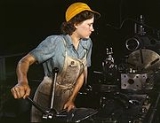
  • Rosie the Riveter
    Rosie the Riveter
    Rosie the Riveter is a cultural icon of the United States, representing the American women who worked in war factories during World War II, many of whom worked in the manufacturing plants that produced munitions and materiel. These women sometimes took entirely new jobs and sometimes took the...

  • Soviet armored fighting vehicle production during World War II
    Soviet armored fighting vehicle production during World War II
    During the Second World War from the start of the war between the Soviet Union and Germany on 22 June 1941 Soviet armoured vehicle production was necessary to replace losses due to combat and the loss of production facilities....

  • World War II aircraft production
    World War II aircraft production
    World War II aircraft production by country and year.See Also:*German aircraft production during World War II*Italian aircraft production 1935 to 1945*United States aircraft production during World War II...

  • World War II
    World War II
    World War II, or the Second World War , was a global military conflict which involved a majority of the world's nations, including all great powers, organized into two opposing military alliances: the Allies and the Axis...


External links