

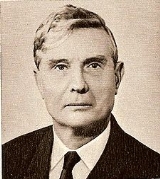
Mikhail Suslov

Encyclopedia
Mikhail Andreyevich Suslov was a Soviet
statesman during the Cold War
. He served as Second Secretary of the Communist Party of the Soviet Union
from 1965, and as unofficial Chief Ideologue of the Party until his death in 1982. Suslov was responsible for party democracy and the separation of power
within the Communist Party. His conservative attitude toward change made him one of the foremost anti-reformist Soviet leaders.
Born in rural Russia in 1902, Suslov became a member of the All-Union Communist Party (Bolsheviks) in 1921 and studied economics for much of the 1920s. He left his job as a teacher in 1931 to pursue politics full-time, becoming one of the many Soviet politicians who took part in the mass repression begun by Joseph Stalin
's regime. Suslov impressed the Soviet leadership to such an extent in the pre-Eastern Front
Soviet Union that he was made First Secretary of Stavropol Krai
administrative area
. During the war, Suslov headed the local Stavropol
guerilla movement. He became a member of the Organisational Bureau
(Orgburo) of the Central Committee in 1946 and, four years later, was elected to the Presidium (Politburo) of the All-Union Communist Party.
Suslov lost much of the recognition and influence he had earned following the reshuffle of the Soviet leadership following Stalin's death. However, by the late 1950s, Suslov had risen to become the leader of the conservative opposition to Nikita Khrushchev
's leadership. After Khrushchev was ousted in 1964, Suslov supported the establishment of a collective leadership
. He also supported inner-party democracy and opposed the reestablishment of the one-man rule as seen during the Stalin and Khrushchev Eras. During the Brezhnev Era, Suslov was considered to be the Party's Chief Ideologue and second-in-command. His death on 25 January 1982 is viewed as starting the battle to succeed Brezhnev in the post of General Secretary
.
, a rural locality in Pavlovsky District
, Ulyanovsk Oblast
, Russian Empire
on 21 November 1902. Suslov began work in the local Komsomol
organisation in Saratov
in 1918, eventually becoming a member of the Poverty Relief Committee. After working in the Komsomol for nearly three years, Suslov became a member of the All-Union Communist Party (bolsheviks) in 1921. After graduating from the rabfak
, he studied economics at the Plekhanov Institute of National Economy between 1924–1928. In the summer of 1928, after graduating from the Plekhanov institute, he became a graduate student (research fellow) in economics at the Institute of Red Professors
, teaching at Moscow State University
and at the Industrial Academy.
In 1931 he abandoned teaching in favour of the party apparatus. He became an inspector on the Communist Party's Soviet Control Commission and on the People's Commissariat of the Workers' and Peasants' Inspectorate. His main task there was to adjudicate on large numbers of "personal cases", breaches of discipline, and appeals against expulsion from the party. In 1933 and 1934 Suslov directed a commission charged with purging the party in the Ural
and Chernigov provinces. The purge was organised by Lazar Kaganovich
, then Chairman of the Soviet Control Commission. Author Yuri Druzhnikov contends that Suslov was involved with setting up several show trial
s, and contributed to the Party by expelling all members deviating from the Party line
, meaning Trotskyists, Zinovievists, and other left-wing deviationists. On the orders of Joseph Stalin
, Suslov purged the city of Rostov
in 1938. Suslov was made First Secretary of the Stavropol Krai
's Communist Party in 1939.
in World War II
(also known as the "Great Patriotic War
"), Suslov was a member of the Military Soviet of the Northern Group of Forces
and led the Stavropol Krai Headquarters of the Partisan Divisions (the local guerilla movement). According to Soviet historiography, Suslov's years as a guerilla fighter were highly successful; however, testimonies from participants differ from the official account. These participants claim that there were a number of organisational problems which reduced their effectiveness on the battlefield. During the war, Suslov spent much of his time mobilising workers to fight against the German invaders. The guerilla movement he led was operated by the regional party cells. During the liberation of the Northern Caucasus, Suslov maintained close contact with the Red Army
.
During the war, Suslov supervised the deportations
of Chechens and other Muslim
minorities from the Caucasus
. In 1944–1946, he chaired the Central Committee Bureau for Lithuania
n Affairs. Anti-Soviet samizdat
literature from the height of his power in the 1970s would accuse him of being personally responsible for the deportation and killings of the nationalist Lithuanians who became political opponents of the Soviets during the course of Soviet re-entry into the Baltic states
on their drive to Berlin in 1944. Suslov, in the words of historian Simon Sebag-Montefiore, "brutally purged" the Baltics in the aftermath of the Great Patriotic War.
, and immediately became the Head of the Foreign Policy Department of the Central Committee. Within a year, Suslov was appointed Head of the Central Committee Department for Agitation
and Propaganda
. He also became a harsh critic of the Jewish Anti-Fascist Committee
in the post-war years. In 1947 Suslov was transferred to Moscow and elected to the Central Committee Secretariat
; he would retain this seat for the rest of his life. Suslov had the full confidence of Stalin, and in 1948, he was entrusted with the task of speaking on behalf of the Central Committee before a solemn meeting on the twenty-fourth anniversary of Vladimir Lenin
's death. From September 1949 to 1951 he was editor-in-chief of the central Party daily Pravda
.
In 1949 Suslov became a member, along with Georgy Malenkov
, Lavrentiy Beria
, and Lazar Kaganovich, of a commission created to investigate charges levied against Moscow's local Communist Party First Secretary, Georgy Popov. Russian historian Roy Medvedev
speculates in his book, Neizvestnyi Stalin, that Stalin had made Suslov his "secret heir". In June 1950 Suslov was elected to the Presidium of the Supreme Soviet
. He was promoted to the CPSU Presidium (later known as the Politburo) in 1952 following the 19th Party Congress. He suffered a temporary reversal when Stalin died, and was dismissed from the Presidium in 1953. He continued to work in the Supreme Soviet, even becoming Chairman of the Commission of Foreign Affairs in the years immediately following Stalin's death.
. In Suslov's ideological report on 16 February, he updated his criticism of Stalin and his personality cult:
During the Hungarian Revolution of 1956, Suslov, along with Anastas Mikoyan
, was in close proximity to Budapest
in order to direct the activities of the Soviet troops and lend assistance to the new Hungarian leadership. Suslov and Mikoyan attended the Politburo meeting of the Hungarian Socialist Workers' Party
, which elected János Kádár
to the General Secretaryship. In a telegram to the Soviet leadership, Suslov and Mikoyan acknowledged that the situation had become more dire, but both were content with the dismissal of Ernő Gerő
as General Secretary and the choice of Kádár as his successor. The Presidium of the Supreme Soviet
criticised Suslov's and Mikoyan's concessions to the new revolutionary government in the People's Republic of Hungary
. Despite his initial reservations, Suslov eventually supported the Presidium's decision to intervene in Hungary militarily and replace the counterrevolutionary government's leadership there.
In June 1957, Suslov backed Khrushchev during his struggle with the Anti-Party Group
led by Georgy Malenkov
, Vyacheslav Molotov
, Lazar Kaganovich
, and Dmitry Shepilov. Mikoyan later wrote in his memoirs that he convinced Suslov to support Khrushchev by telling him that Khrushchev would emerge the winner even if he did not have enough support in the Presidium. The following October, Suslov accused Georgy Zhukov
, the Minister of Defence, of "Bonapartism" at the Central Committee plenum that removed him from all Party and government posts. The removal of Zhukov had the effect of firmly subordinating the armed forces to Party control.
In a speech on 22 January 1958, Khrushchev officially proposed to dissolve the Machine and Tractor Station
s (MTS). This reform had a particular salience on Soviet ideology. In a socialist society, cooperative ownership of property was considered a "lower" form of public ownership than state ownership. Khrushchev's proposal to expand cooperative ownership ran contrary to the Marxist
theory as interpreted by Stalin. Suslov, who supported Stalin's economic policy, believed Khrushchev's proposal to be unacceptable on ideological grounds. In a election speech to the Supreme Soviet in March 1958, Suslov refused to recognise the ideological significance of Khrushchev's reform, preferring instead to focus on the reform's practical benefits in improving productivity. Unlike other Party leaders, Suslov avoided mentioning Khrushchev as the MTS reform's initiator.
The 21st Party Congress
convened in January 1959. Khrushchev wanted to consider the draft of a new Seven-Year plan. Suslov cautiously demonstrated against Khrushchev's statement that the country had developed from the socialist state of development
to the higher state of communist development. He believed Khrushchev's view to be flawed, and countered that his view had not been approved by the Party. To discredit Khrushchev's assertion further, Suslov deferred to Karl Marx
and Vladimir Lenin
:
Suslov was becoming progressively more critical of Khrushchev's policies, his political intransigence, and his campaign to eliminate what was left of the old Stalinist guard
. There were also deep-seated divergences in foreign and domestic policy between Suslov and Khrushchev. Suslov was opposed to the idea of improving Soviet–United States relations
, and was against Khrushchev's attempts at rapprochement with Yugoslavia
. Domestically, Suslov opposed Khrushchev's policy of de-Stalinisation and his economic decentralisation scheme
.
Suslov visited the United Kingdom in 1959 as a parliamentarian for the Supreme Soviet. The visit was a success, and Hugh Gaitskell
, the Leader of the Labour Party
, travelled to the Soviet Union later that year as a guest.
Sino–Soviet relations had long been strained, and as Suslov told the Central Committee in one his reports, "The crux of the matter is that the Leadership of the CCP
has recently developed tendencies to exaggerate the degree of maturity of socialist relations in China... There are elements of conceit and haughtiness. [These shortcomings] are largely explained by the atmosphere of the cult of personality
of comrade Mao Zedong
... who, by all accounts, himself has come to believe in his own infallibillity." Suslov compared Mao's growing personality cult with that seen under Joseph Stalin.
In the years following the failure of the Anti-Party Group, Suslov became the leader of the opposition faction in the Central Committee, known as the "Moscow faction", to Khrushchev's leadership. Khrushchev was able to hold on to power by conceding to various opposition demands in times of crisis, such as during the 1960 U-2 incident and the Cuban Missile Crisis
. In the aftermath of the U-2 Crisis Suslov was able to remove, and replace, several of Khrushchev's appointees in the Politburo with new anti-Khrushchevist members. Khrushchev's position was greatly weakened after the failure of the Cuban Missile Crisis, and Suslov's power greatly increased. A campaign to oust Khrushchev from office was initiated in 1964. Although leader of the opposition, Suslov had fallen seriously ill during his trip to the People's Republic of China the previous year; instead, the opposition was led by Leonid Brezhnev
and Alexei Kosygin.
and Fyodor Kulakov
.
A collective leadership
was founded immediately after Khrushchev's ouster, consisting of Brezhnev as First Secretary, Kosygin as head of government, and Anastas Mikoyan
(and later Nikolai Podgorny
) as head of state. From the beginning, Suslov was a vocal critic of one-man rule such as that seen under Joseph Stalin and Khrushchev. While he condemned Stalin's one-man rule, he equally criticised the individualistic assertiveness of Khrushchev's de-Stalinisation policy. A strong supporter of democratic centralism
, Suslov prevented Brezhnev from taking over Kosygin's post as head of government in 1970. Kirilenko, Brezhnev, and Suslov were members of an unofficial Troika within the Communist Party leadership
.
Throughout the Brezhnev Era, Suslov became increasingly conservative. He blocked any radical reforms, such as the 1965 Soviet economic reform
initiated by Kosygin, and was opposed to détente
because it undermined socialist world revolution
. Suslov was opposed to any sort of radical reforms attempted by the Eastern Bloc
leaders, but voted against Soviet military intervention in both the People's Republic of Hungary
in 1956 (initially), and in the Czechoslovak Socialist Republic
in 1968 during the Prague Spring
. Suslov was regarded, according to Christian Schmidt-Häuer, as the "pope" for Orthodox communists in the Eastern Bloc. Throughout his political career, Suslov became increasingly concerned that the Soviet Union's leading role in the communist movement would be compromised. Häuer, in her book Gorbachev: The Path to Power, argues that Suslov was a Russian nationalist
who believed "Russia was the centre of the universe".
It was during the Brezhnev Era that Suslov was given the unofficial title "Chief Ideologue of the Communist Party". Suslov spent much time in memorializing the legacies of Vladimir Lenin
, Karl Marx
and Friedrich Engels
. However, Suslov followed the party line and supported the retreat from some of the beliefs of Marxism-Leninism
. Examples of ideological retreat include the end of single, Party-approved natural science versions of biology
, chemistry
and physics
. There still existed a tight ideological control over literature. This included not only literature critical of Soviet rule: much of Lenin's work was also routinely censored.
had seriously eroded the authority of the Polish United Workers' Party
. Suslov's position on this matter carried particular weight as he chaired a Politburo Commission, established on 25 August 1980, on how to deal with the Polish crisis
. Members of the commission included such high-ranking Soviets as Andropov, Minister of Defence Dmitriy Ustinov
, Andrei Gromyko
, the Minister of Foreign Affairs and Brezhnev's long-time associate Konstantin Chernenko
. On 28 August, the Commission considered Soviet military intervention to stabilise the region. Wojciech Jaruzelski
, First Secretary of the Polish United Workers' Party, was able to persuade the Commission that a Soviet military intervention would only aggravate the situation. Suslov agreed with Jaruzelski's argument, stating that "if troops are introduced, that will mean a catastrophe. I think that we all share the unanimous opinion here that there can be no discussion of any introduction of troops". Suslov was able to persuade Jaruzelski and the Polish leadership to establish martial law in Poland
.
In January 1982, Yuri Andropov
revealed to Suslov that Semyon Tsvigun, the First Deputy Chairman of the KGB
, had covered Galina
and Yuri
, Brezhnev's children, from corruption investigations. When these facts were revealed to him, Suslov challenged Tsvigun to make a statement on the matter. Suslov even threatened Tsvigun with an expulsion from the Communist Party, but Tsvigun died on 19 January 1982 before he could challenge Suslov's statement. Two days later, Suslov had a coronary
, and died on 25 January of arteriosclerosis
and diabetes. His death is viewed as starting the battle to succeed Brezhnev, in which Andropov, who assumed Suslov's post as the Party's Second Secretary, sidelined Kirilenko and Chernenko during the last days of Brezhnev's rule. Suslov was buried on 29 January at the Kremlin Wall Necropolis
. Brezhnev expressed great sadness at Suslov's passing.
, and one first degree Order of the Patriotic War
. The USSR Academy of Sciences awarded Suslov with the Gold Medal of Karl Marx. Suslov was awarded the highest state awards of the German Democratic Republic, the Mongolian People's Republic, and the Czechoslovak Socialist Republic
.
, a British M.D., was once requested to see her in the Kremlin Hospital; it was one of the few cases where a renowned foreign doctor was invited to visit the Kremlin Hospital. Suslov expressed his gratitude for Lown's work, but avoided meeting Lown in person because he was a representative of an "imperialistic" country. Yelizaveta and Suslov had two children together, Revolii (born 1929) named after the Russian Revolution and his second child, Maya (born 1939) was named after May Day
.
Soviet people
Soviet people or Soviet nation was an umbrella demonym for the population of the Soviet Union. Initially used as a nonspecific reference to the Soviet population, it was eventually declared to be a "new historical, social and international unity of people".-Nationality politics in early Soviet...
statesman during the Cold War
Cold War
The Cold War was the continuing state from roughly 1946 to 1991 of political conflict, military tension, proxy wars, and economic competition between the Communist World—primarily the Soviet Union and its satellite states and allies—and the powers of the Western world, primarily the United States...
. He served as Second Secretary of the Communist Party of the Soviet Union
Communist Party of the Soviet Union
The Communist Party of the Soviet Union was the only legal, ruling political party in the Soviet Union and one of the largest communist organizations in the world...
from 1965, and as unofficial Chief Ideologue of the Party until his death in 1982. Suslov was responsible for party democracy and the separation of power
Separation of Power
Separation of Power is Vince Flynn's fourth novel, and the third to feature Mitch Rapp, an American agent that works for the CIA as an operative for a covert counterterrorism unit called the "Orion Team."-Plot summary:...
within the Communist Party. His conservative attitude toward change made him one of the foremost anti-reformist Soviet leaders.
Born in rural Russia in 1902, Suslov became a member of the All-Union Communist Party (Bolsheviks) in 1921 and studied economics for much of the 1920s. He left his job as a teacher in 1931 to pursue politics full-time, becoming one of the many Soviet politicians who took part in the mass repression begun by Joseph Stalin
Joseph Stalin
Joseph Vissarionovich Stalin was the Premier of the Soviet Union from 6 May 1941 to 5 March 1953. He was among the Bolshevik revolutionaries who brought about the October Revolution and had held the position of first General Secretary of the Communist Party of the Soviet Union's Central Committee...
's regime. Suslov impressed the Soviet leadership to such an extent in the pre-Eastern Front
Eastern Front (World War II)
The Eastern Front of World War II was a theatre of World War II between the European Axis powers and co-belligerent Finland against the Soviet Union, Poland, and some other Allies which encompassed Northern, Southern and Eastern Europe from 22 June 1941 to 9 May 1945...
Soviet Union that he was made First Secretary of Stavropol Krai
Stavropol Krai
Stavropol Krai is a federal subject of Russia . Its administrative center is the city of Stavropol. Population: -Geography:Stavropol Krai encompasses the central part of the Fore-Caucasus and most of the northern slopes of Caucasus Major...
administrative area
Federal subjects of Russia
Russia is a federation which, since March 1, 2008, consists of 83 federal subjects . In 1993, when the Constitution was adopted, there were 89 federal subjects listed...
. During the war, Suslov headed the local Stavropol
Stavropol
-International relations:-Twin towns/sister cities:Stavropol is twinned with: Des Moines, United States Béziers, France Pazardzhik, Bulgaria-External links:* **...
guerilla movement. He became a member of the Organisational Bureau
Orgburo
The Orgburo of the Central Committee of the Communist Party of the Soviet Union existed from 1919–52, until the 19th Congress, when the Orgburo was abolished and its functions were transferred to the enlarged Secretariat....
(Orgburo) of the Central Committee in 1946 and, four years later, was elected to the Presidium (Politburo) of the All-Union Communist Party.
Suslov lost much of the recognition and influence he had earned following the reshuffle of the Soviet leadership following Stalin's death. However, by the late 1950s, Suslov had risen to become the leader of the conservative opposition to Nikita Khrushchev
Nikita Khrushchev
Nikita Sergeyevich Khrushchev led the Soviet Union during part of the Cold War. He served as First Secretary of the Communist Party of the Soviet Union from 1953 to 1964, and as Chairman of the Council of Ministers, or Premier, from 1958 to 1964...
's leadership. After Khrushchev was ousted in 1964, Suslov supported the establishment of a collective leadership
Collective leadership
Collective leadership or Collectivity of leadership , was considered an ideal form of governance in the Union of Soviet Socialist Republics...
. He also supported inner-party democracy and opposed the reestablishment of the one-man rule as seen during the Stalin and Khrushchev Eras. During the Brezhnev Era, Suslov was considered to be the Party's Chief Ideologue and second-in-command. His death on 25 January 1982 is viewed as starting the battle to succeed Brezhnev in the post of General Secretary
General Secretary of the Communist Party of the Soviet Union
General Secretary of the Central Committee of the Communist Party of the Soviet Union was the title given to the leader of the Communist Party of the Soviet Union. With some exceptions, the office was synonymous with leader of the Soviet Union...
.
Early years and career
Suslov was born in ShakhovskoyeShakhovskoye, Ulyanovsk Oblast
Shakhovskoye is a rural locality in Pavlovsky District of Ulyanovsk Oblast, Russia.There is a "Protection of the Virgin" church in Shakhovskoye, which was built in 1878.The Soviet statesman Mikhail Suslov was born in the village in 1902....
, a rural locality in Pavlovsky District
Pavlovsky District, Ulyanovsk Oblast
Pavlovsky District, Ulyanovsk Oblast is an administrative and municipal district , one of the 21 in Ulyanovsk Oblast, Russia....
, Ulyanovsk Oblast
Ulyanovsk Oblast
Ulyanovsk Oblast is a federal subject of Russia . It is located in the Volga Federal District. Its administrative center is the city of Ulyanovsk...
, Russian Empire
Russian Empire
The Russian Empire was a state that existed from 1721 until the Russian Revolution of 1917. It was the successor to the Tsardom of Russia and the predecessor of the Soviet Union...
on 21 November 1902. Suslov began work in the local Komsomol
Komsomol
The Communist Union of Youth , usually known as Komsomol , was the youth division of the Communist Party of the Soviet Union. The Komsomol in its earliest form was established in urban centers in 1918. During the early years, it was a Russian organization, known as the Russian Communist Union of...
organisation in Saratov
Saratov
-Modern Saratov:The Saratov region is highly industrialized, due in part to the rich in natural and industrial resources of the area. The region is also one of the more important and largest cultural and scientific centres in Russia...
in 1918, eventually becoming a member of the Poverty Relief Committee. After working in the Komsomol for nearly three years, Suslov became a member of the All-Union Communist Party (bolsheviks) in 1921. After graduating from the rabfak
Rabfak
Rabfak was the Workers' Faculty in the Soviet Union. It prepared Soviet workers to enter institutions of higher education....
, he studied economics at the Plekhanov Institute of National Economy between 1924–1928. In the summer of 1928, after graduating from the Plekhanov institute, he became a graduate student (research fellow) in economics at the Institute of Red Professors
Institute of Red Professors
The Institute of Red Professors was an institute of graduate-level education in the Marxist social sciences located in the Orthodox Convent of the Passion, Moscow. It was founded in February 1921 to address shortage of Marxist professors but only about 25% of its graduates continued an academic...
, teaching at Moscow State University
Moscow State University
Lomonosov Moscow State University , previously known as Lomonosov University or MSU , is the largest university in Russia. Founded in 1755, it also claims to be one of the oldest university in Russia and to have the tallest educational building in the world. Its current rector is Viktor Sadovnichiy...
and at the Industrial Academy.
In 1931 he abandoned teaching in favour of the party apparatus. He became an inspector on the Communist Party's Soviet Control Commission and on the People's Commissariat of the Workers' and Peasants' Inspectorate. His main task there was to adjudicate on large numbers of "personal cases", breaches of discipline, and appeals against expulsion from the party. In 1933 and 1934 Suslov directed a commission charged with purging the party in the Ural
Ural (region)
Ural is a geographical region located around the Ural Mountains, between the East European and West Siberian plains. It extends approximately from north to south, from the Arctic Ocean to the bend of Ural River near Orsk city. The boundary between Europe and Asia runs along the eastern side of...
and Chernigov provinces. The purge was organised by Lazar Kaganovich
Lazar Kaganovich
Lazar Moiseyevich Kaganovich was a Soviet politician and administrator and one of the main associates of Joseph Stalin.-Early life:Kaganovich was born in 1893 to Jewish parents in the village of Kabany, Radomyshl uyezd, Kiev Governorate, Russian Empire...
, then Chairman of the Soviet Control Commission. Author Yuri Druzhnikov contends that Suslov was involved with setting up several show trial
Show trial
The term show trial is a pejorative description of a type of highly public trial in which there is a strong connotation that the judicial authorities have already determined the guilt of the defendant. The actual trial has as its only goal to present the accusation and the verdict to the public as...
s, and contributed to the Party by expelling all members deviating from the Party line
Party line (politics)
In politics, the line or the party line is an idiom for a political party or social movement's canon agenda, as well as specific ideological elements specific to the organization's partisanship. The common phrase toeing the party line describes a person who speaks in a manner that conforms to his...
, meaning Trotskyists, Zinovievists, and other left-wing deviationists. On the orders of Joseph Stalin
Joseph Stalin
Joseph Vissarionovich Stalin was the Premier of the Soviet Union from 6 May 1941 to 5 March 1953. He was among the Bolshevik revolutionaries who brought about the October Revolution and had held the position of first General Secretary of the Communist Party of the Soviet Union's Central Committee...
, Suslov purged the city of Rostov
Rostov
Rostov is a town in Yaroslavl Oblast, Russia, one of the oldest in the country and a tourist center of the Golden Ring. It is located on the shores of Lake Nero, northeast of Moscow. Population:...
in 1938. Suslov was made First Secretary of the Stavropol Krai
Stavropol Krai
Stavropol Krai is a federal subject of Russia . Its administrative center is the city of Stavropol. Population: -Geography:Stavropol Krai encompasses the central part of the Fore-Caucasus and most of the northern slopes of Caucasus Major...
's Communist Party in 1939.
Wartime activities
During the Eastern FrontEastern Front (World War II)
The Eastern Front of World War II was a theatre of World War II between the European Axis powers and co-belligerent Finland against the Soviet Union, Poland, and some other Allies which encompassed Northern, Southern and Eastern Europe from 22 June 1941 to 9 May 1945...
in World War II
World War II
World War II, or the Second World War , was a global conflict lasting from 1939 to 1945, involving most of the world's nations—including all of the great powers—eventually forming two opposing military alliances: the Allies and the Axis...
(also known as the "Great Patriotic War
Great Patriotic War (term)
The term Great Patriotic War , Velíkaya Otéchestvennaya voyná,) is used in Russia and some other states of the former Soviet Union to describe the portion of World War II from 22 June 1941 to 9 May 1945, against Nazi Germany and its allies in the many fronts of Soviet-German war.-History:The term...
"), Suslov was a member of the Military Soviet of the Northern Group of Forces
Northern Group of Forces
The Northern Group of Forces was the military formation of the Soviet Army stationed in Poland from the end of Second World War in 1945 until 1993 when they were withdrawn in the aftermath of the fall of Soviet Union...
and led the Stavropol Krai Headquarters of the Partisan Divisions (the local guerilla movement). According to Soviet historiography, Suslov's years as a guerilla fighter were highly successful; however, testimonies from participants differ from the official account. These participants claim that there were a number of organisational problems which reduced their effectiveness on the battlefield. During the war, Suslov spent much of his time mobilising workers to fight against the German invaders. The guerilla movement he led was operated by the regional party cells. During the liberation of the Northern Caucasus, Suslov maintained close contact with the Red Army
Red Army
The Workers' and Peasants' Red Army started out as the Soviet Union's revolutionary communist combat groups during the Russian Civil War of 1918-1922. It grew into the national army of the Soviet Union. By the 1930s the Red Army was among the largest armies in history.The "Red Army" name refers to...
.
During the war, Suslov supervised the deportations
Operation Lentil (Caucasus)
Operation Lentil was the Soviet expulsion of the whole of the native Chechen and Ingush populations of the North Caucasus to Siberia, Kazakhstan and Kyrgyzstan during World War II....
of Chechens and other Muslim
Muslim
A Muslim, also spelled Moslem, is an adherent of Islam, a monotheistic, Abrahamic religion based on the Quran, which Muslims consider the verbatim word of God as revealed to prophet Muhammad. "Muslim" is the Arabic term for "submitter" .Muslims believe that God is one and incomparable...
minorities from the Caucasus
Caucasus
The Caucasus, also Caucas or Caucasia , is a geopolitical region at the border of Europe and Asia, and situated between the Black and the Caspian sea...
. In 1944–1946, he chaired the Central Committee Bureau for Lithuania
Lithuania
Lithuania , officially the Republic of Lithuania is a country in Northern Europe, the biggest of the three Baltic states. It is situated along the southeastern shore of the Baltic Sea, whereby to the west lie Sweden and Denmark...
n Affairs. Anti-Soviet samizdat
Samizdat
Samizdat was a key form of dissident activity across the Soviet bloc in which individuals reproduced censored publications by hand and passed the documents from reader to reader...
literature from the height of his power in the 1970s would accuse him of being personally responsible for the deportation and killings of the nationalist Lithuanians who became political opponents of the Soviets during the course of Soviet re-entry into the Baltic states
Baltic states
The term Baltic states refers to the Baltic territories which gained independence from the Russian Empire in the wake of World War I: primarily the contiguous trio of Estonia, Latvia, Lithuania ; Finland also fell within the scope of the term after initially gaining independence in the 1920s.The...
on their drive to Berlin in 1944. Suslov, in the words of historian Simon Sebag-Montefiore, "brutally purged" the Baltics in the aftermath of the Great Patriotic War.
Stalin's protégé
In 1946, Suslov was made a member of the OrgburoOrgburo
The Orgburo of the Central Committee of the Communist Party of the Soviet Union existed from 1919–52, until the 19th Congress, when the Orgburo was abolished and its functions were transferred to the enlarged Secretariat....
, and immediately became the Head of the Foreign Policy Department of the Central Committee. Within a year, Suslov was appointed Head of the Central Committee Department for Agitation
Agitation
Agitation may refer to:* Agitation , putting into motion by shaking or stirring* Emotional state of excitement or restlessness** Psychomotor agitation, an extreme form of the above, which can be a side effect of antipsychotic medication...
and Propaganda
Propaganda in the Soviet Union
Communist propaganda in the Soviet Union was extensively based on the Marxism-Leninism ideology to promote the Communist Party line. In societies with pervasive censorship, the propaganda was omnipresent and very efficient...
. He also became a harsh critic of the Jewish Anti-Fascist Committee
Jewish Anti-Fascist Committee
The Jewish Anti-Fascist Committee was formed on Joseph Stalin's order in Kuibyshev in April 1942 with the official support of the Soviet authorities...
in the post-war years. In 1947 Suslov was transferred to Moscow and elected to the Central Committee Secretariat
Secretariat of the CPSU Central Committee
The Secretariat of the CPSU Central Committee was a key body within the Communist Party of the Soviet Union and was responsible for the central administration of the party as opposed to drafting government policy which was usually handled by the Politburo...
; he would retain this seat for the rest of his life. Suslov had the full confidence of Stalin, and in 1948, he was entrusted with the task of speaking on behalf of the Central Committee before a solemn meeting on the twenty-fourth anniversary of Vladimir Lenin
Vladimir Lenin
Vladimir Ilyich Lenin was a Russian Marxist revolutionary and communist politician who led the October Revolution of 1917. As leader of the Bolsheviks, he headed the Soviet state during its initial years , as it fought to establish control of Russia in the Russian Civil War and worked to create a...
's death. From September 1949 to 1951 he was editor-in-chief of the central Party daily Pravda
Pravda
Pravda was a leading newspaper of the Soviet Union and an official organ of the Central Committee of the Communist Party between 1912 and 1991....
.
In 1949 Suslov became a member, along with Georgy Malenkov
Georgy Malenkov
Georgy Maximilianovich Malenkov was a Soviet politician, Communist Party leader and close collaborator of Joseph Stalin. After Stalin's death, he became Premier of the Soviet Union and was in 1953 briefly considered the most powerful Soviet politician before being overshadowed by Nikita...
, Lavrentiy Beria
Lavrentiy Beria
Lavrentiy Pavlovich Beria was a Georgian Soviet politician and state security administrator, chief of the Soviet security and secret police apparatus under Joseph Stalin during World War II, and Deputy Premier in the postwar years ....
, and Lazar Kaganovich, of a commission created to investigate charges levied against Moscow's local Communist Party First Secretary, Georgy Popov. Russian historian Roy Medvedev
Roy Medvedev
Roy Aleksandrovich Medvedev |Georgia]]) is a Russian historian renowned as the author of the dissident history of Stalinism, Let History Judge , first published in English in 1972...
speculates in his book, Neizvestnyi Stalin, that Stalin had made Suslov his "secret heir". In June 1950 Suslov was elected to the Presidium of the Supreme Soviet
Presidium of the Supreme Soviet
The Presidium of the Supreme Soviet was a Soviet governmental institution – a permanent body of the Supreme Soviets . This body was of the all-Union level , as well as in all Soviet republics and autonomous republics...
. He was promoted to the CPSU Presidium (later known as the Politburo) in 1952 following the 19th Party Congress. He suffered a temporary reversal when Stalin died, and was dismissed from the Presidium in 1953. He continued to work in the Supreme Soviet, even becoming Chairman of the Commission of Foreign Affairs in the years immediately following Stalin's death.
Khrushchev era
Suslov recovered his authority in 1955, and was elected to a seat in the Presidium by bypassing the customary candidate membership. In the 20th Party Congress of 1956, Khrushchev delivered the famous Secret Speech about Stalin's cult of personalityCult of personality
A cult of personality arises when an individual uses mass media, propaganda, or other methods, to create an idealized and heroic public image, often through unquestioning flattery and praise. Cults of personality are usually associated with dictatorships...
. In Suslov's ideological report on 16 February, he updated his criticism of Stalin and his personality cult:
During the Hungarian Revolution of 1956, Suslov, along with Anastas Mikoyan
Anastas Mikoyan
Anastas Ivanovich Mikoyan was an Armenian Old Bolshevik and Soviet statesman during the rules of Vladimir Lenin, Joseph Stalin, Nikita Khrushchev, and Leonid Brezhnev....
, was in close proximity to Budapest
Budapest
Budapest is the capital of Hungary. As the largest city of Hungary, it is the country's principal political, cultural, commercial, industrial, and transportation centre. In 2011, Budapest had 1,733,685 inhabitants, down from its 1989 peak of 2,113,645 due to suburbanization. The Budapest Commuter...
in order to direct the activities of the Soviet troops and lend assistance to the new Hungarian leadership. Suslov and Mikoyan attended the Politburo meeting of the Hungarian Socialist Workers' Party
Hungarian Socialist Workers' Party
The Hungarian Socialist Workers' Party was the ruling Marxist–Leninist party of Hungary between 1956 and 1989. It was organised from elements of the Hungarian Working People's Party during the 1956 Hungarian Revolution...
, which elected János Kádár
János Kádár
János Kádár was a Hungarian communist leader and the General Secretary of the Hungarian Socialist Workers' Party, presiding over the country from 1956 until his forced retirement in 1988. His thirty-two year term as General Secretary makes Kádár the longest ruler of the People's Republic of Hungary...
to the General Secretaryship. In a telegram to the Soviet leadership, Suslov and Mikoyan acknowledged that the situation had become more dire, but both were content with the dismissal of Ernő Gerő
Erno Gero
Ernő Gerő was a Hungarian Communist Party leader in the period after World War II and briefly in 1956 the most powerful man in Hungary as first secretary of its ruling communist party.-Life and career:...
as General Secretary and the choice of Kádár as his successor. The Presidium of the Supreme Soviet
Presidium of the Supreme Soviet
The Presidium of the Supreme Soviet was a Soviet governmental institution – a permanent body of the Supreme Soviets . This body was of the all-Union level , as well as in all Soviet republics and autonomous republics...
criticised Suslov's and Mikoyan's concessions to the new revolutionary government in the People's Republic of Hungary
People's Republic of Hungary
The People's Republic of Hungary or Hungarian People's Republic was the official state name of Hungary from 1949 to 1989 during its Communist period under the guidance of the Soviet Union. The state remained in existence until 1989 when opposition forces consolidated in forcing the regime to...
. Despite his initial reservations, Suslov eventually supported the Presidium's decision to intervene in Hungary militarily and replace the counterrevolutionary government's leadership there.
In June 1957, Suslov backed Khrushchev during his struggle with the Anti-Party Group
Anti-Party Group
The Anti-Party Group was a group within the leadership of the Communist Party of the Soviet Union that unsuccessfully attempted to depose Nikita Khrushchev as First Secretary of the Party in May 1957. The group, named by that epithet by Khrushchev, was led by former Premiers Georgy Malenkov and...
led by Georgy Malenkov
Georgy Malenkov
Georgy Maximilianovich Malenkov was a Soviet politician, Communist Party leader and close collaborator of Joseph Stalin. After Stalin's death, he became Premier of the Soviet Union and was in 1953 briefly considered the most powerful Soviet politician before being overshadowed by Nikita...
, Vyacheslav Molotov
Vyacheslav Molotov
Vyacheslav Mikhailovich Molotov was a Soviet politician and diplomat, an Old Bolshevik and a leading figure in the Soviet government from the 1920s, when he rose to power as a protégé of Joseph Stalin, to 1957, when he was dismissed from the Presidium of the Central Committee by Nikita Khrushchev...
, Lazar Kaganovich
Lazar Kaganovich
Lazar Moiseyevich Kaganovich was a Soviet politician and administrator and one of the main associates of Joseph Stalin.-Early life:Kaganovich was born in 1893 to Jewish parents in the village of Kabany, Radomyshl uyezd, Kiev Governorate, Russian Empire...
, and Dmitry Shepilov. Mikoyan later wrote in his memoirs that he convinced Suslov to support Khrushchev by telling him that Khrushchev would emerge the winner even if he did not have enough support in the Presidium. The following October, Suslov accused Georgy Zhukov
Georgy Zhukov
Marshal of the Soviet Union Georgy Konstantinovich Zhukov , was a Russian career officer in the Red Army who, in the course of World War II, played a pivotal role in leading the Red Army through much of Eastern Europe to liberate the Soviet Union and other nations from the Axis Powers' occupation...
, the Minister of Defence, of "Bonapartism" at the Central Committee plenum that removed him from all Party and government posts. The removal of Zhukov had the effect of firmly subordinating the armed forces to Party control.
In a speech on 22 January 1958, Khrushchev officially proposed to dissolve the Machine and Tractor Station
Machine and Tractor Station
The Machine and Tractor Station was a state enterprise for ownership and maintenance of agricultural machinery that were used in kolkhozes. The first ever MTS was organized in the Odeska region...
s (MTS). This reform had a particular salience on Soviet ideology. In a socialist society, cooperative ownership of property was considered a "lower" form of public ownership than state ownership. Khrushchev's proposal to expand cooperative ownership ran contrary to the Marxist
Marxism
Marxism is an economic and sociopolitical worldview and method of socioeconomic inquiry that centers upon a materialist interpretation of history, a dialectical view of social change, and an analysis and critique of the development of capitalism. Marxism was pioneered in the early to mid 19th...
theory as interpreted by Stalin. Suslov, who supported Stalin's economic policy, believed Khrushchev's proposal to be unacceptable on ideological grounds. In a election speech to the Supreme Soviet in March 1958, Suslov refused to recognise the ideological significance of Khrushchev's reform, preferring instead to focus on the reform's practical benefits in improving productivity. Unlike other Party leaders, Suslov avoided mentioning Khrushchev as the MTS reform's initiator.
The 21st Party Congress
21st Congress of the Communist Party of the Soviet Union
The 21st Congress of the Communist Party of the Soviet Union took place in Moscow, USSR 27 January - 5 February 1959. It was a mid-term or "Extraordinary" Congress, timed so that Khrushchev could try to consolidate his power over rivals after the attempted coup of the so-called "Anti-Party Group"...
convened in January 1959. Khrushchev wanted to consider the draft of a new Seven-Year plan. Suslov cautiously demonstrated against Khrushchev's statement that the country had developed from the socialist state of development
Socialism (Marxism)
In Marxist theory, socialism, or the socialist mode of production, refers to a specific historical phase of economic development and its corresponding set of social relations that eventually supersede capitalism...
to the higher state of communist development. He believed Khrushchev's view to be flawed, and countered that his view had not been approved by the Party. To discredit Khrushchev's assertion further, Suslov deferred to Karl Marx
Karl Marx
Karl Heinrich Marx was a German philosopher, economist, sociologist, historian, journalist, and revolutionary socialist. His ideas played a significant role in the development of social science and the socialist political movement...
and Vladimir Lenin
Vladimir Lenin
Vladimir Ilyich Lenin was a Russian Marxist revolutionary and communist politician who led the October Revolution of 1917. As leader of the Bolsheviks, he headed the Soviet state during its initial years , as it fought to establish control of Russia in the Russian Civil War and worked to create a...
:
Suslov was becoming progressively more critical of Khrushchev's policies, his political intransigence, and his campaign to eliminate what was left of the old Stalinist guard
Stalinism
Stalinism refers to the ideology that Joseph Stalin conceived and implemented in the Soviet Union, and is generally considered a branch of Marxist–Leninist ideology but considered by some historians to be a significant deviation from this philosophy...
. There were also deep-seated divergences in foreign and domestic policy between Suslov and Khrushchev. Suslov was opposed to the idea of improving Soviet–United States relations
Soviet–United States relations
The relations between the United States and the Union of Soviet Socialist Republics succeed the relations between the Russian Empire and the United States and predate the post-Soviet Russo-United States relations . Full diplomatic relations between the two countries were established late due to...
, and was against Khrushchev's attempts at rapprochement with Yugoslavia
Socialist Federal Republic of Yugoslavia
The Socialist Federal Republic of Yugoslavia was the Yugoslav state that existed from the abolition of the Yugoslav monarchy until it was dissolved in 1992 amid the Yugoslav Wars. It was a socialist state and a federation made up of six socialist republics: Bosnia and Herzegovina, Croatia,...
. Domestically, Suslov opposed Khrushchev's policy of de-Stalinisation and his economic decentralisation scheme
Supreme Soviet of the National Economy
Supreme Soviet of the National Economy, Superior Soviet of the People's Economy, Vesenkha was the superior state institution for management of the economy of the RSFSR and later of the Soviet Union...
.
Suslov visited the United Kingdom in 1959 as a parliamentarian for the Supreme Soviet. The visit was a success, and Hugh Gaitskell
Hugh Gaitskell
Hugh Todd Naylor Gaitskell CBE was a British Labour politician, who held Cabinet office in Clement Attlee's governments, and was the Leader of the Labour Party and Leader of the Opposition from 1955, until his death in 1963.-Early life:He was born in Kensington, London, the third and youngest...
, the Leader of the Labour Party
Labour Party (UK)
The Labour Party is a centre-left democratic socialist party in the United Kingdom. It surpassed the Liberal Party in general elections during the early 1920s, forming minority governments under Ramsay MacDonald in 1924 and 1929-1931. The party was in a wartime coalition from 1940 to 1945, after...
, travelled to the Soviet Union later that year as a guest.
Sino–Soviet relations had long been strained, and as Suslov told the Central Committee in one his reports, "The crux of the matter is that the Leadership of the CCP
Politburo of the Communist Party of China
The Central Politburo of the Communist Party of China or Political bureau of the CPC Central Committee , formerly as Central Bureau before 1927, is a group of 24 people who oversee the Communist Party of China...
has recently developed tendencies to exaggerate the degree of maturity of socialist relations in China... There are elements of conceit and haughtiness. [These shortcomings] are largely explained by the atmosphere of the cult of personality
Cult of personality
A cult of personality arises when an individual uses mass media, propaganda, or other methods, to create an idealized and heroic public image, often through unquestioning flattery and praise. Cults of personality are usually associated with dictatorships...
of comrade Mao Zedong
Mao Zedong
Mao Zedong, also transliterated as Mao Tse-tung , and commonly referred to as Chairman Mao , was a Chinese Communist revolutionary, guerrilla warfare strategist, Marxist political philosopher, and leader of the Chinese Revolution...
... who, by all accounts, himself has come to believe in his own infallibillity." Suslov compared Mao's growing personality cult with that seen under Joseph Stalin.
In the years following the failure of the Anti-Party Group, Suslov became the leader of the opposition faction in the Central Committee, known as the "Moscow faction", to Khrushchev's leadership. Khrushchev was able to hold on to power by conceding to various opposition demands in times of crisis, such as during the 1960 U-2 incident and the Cuban Missile Crisis
Cuban Missile Crisis
The Cuban Missile Crisis was a confrontation among the Soviet Union, Cuba and the United States in October 1962, during the Cold War...
. In the aftermath of the U-2 Crisis Suslov was able to remove, and replace, several of Khrushchev's appointees in the Politburo with new anti-Khrushchevist members. Khrushchev's position was greatly weakened after the failure of the Cuban Missile Crisis, and Suslov's power greatly increased. A campaign to oust Khrushchev from office was initiated in 1964. Although leader of the opposition, Suslov had fallen seriously ill during his trip to the People's Republic of China the previous year; instead, the opposition was led by Leonid Brezhnev
Leonid Brezhnev
Leonid Ilyich Brezhnev – 10 November 1982) was the General Secretary of the Central Committee of the Communist Party of the Soviet Union , presiding over the country from 1964 until his death in 1982. His eighteen-year term as General Secretary was second only to that of Joseph Stalin in...
and Alexei Kosygin.
Collective leadership
In October 1964 Khrushchev was ousted. Suslov played a crucial role in the event. Suslov was, alongside Premier Alexei Kosygin and First Secretary Leonid Brezhnev, one of the most influential Soviet politicians of the 1960s following the ouster of Khrushchev. Having led the opposition against Khrushchev for years, Suslov had acquired and wielded great power within the Central Committee when Brezhnev rose to power. However, Suslov was never interested in becoming the leader of the Soviet Union, and was content to remain the man behind the scenes. During most of his term, Suslov was one of four people who had both a seat in the Secretariat and the Politburo; the three others were Brezhnev, Andrei KirilenkoAndrei Kirilenko (politician)
Andrei Pavlovich Kirilenko was a Soviet statesman from the start to the end of the Cold War. In 1906, Kirilenko was born in Alexeyevka, Belgorod Oblast, Russian Empire, to a Russian working class family. He graduated in the 1920s from a local vocational school, and again in the mid-to-late 1930s...
and Fyodor Kulakov
Fyodor Kulakov
Fyodor Davydovich Kulakov was a Soviet-Russian statesman during the Cold War....
.
A collective leadership
Collective leadership
Collective leadership or Collectivity of leadership , was considered an ideal form of governance in the Union of Soviet Socialist Republics...
was founded immediately after Khrushchev's ouster, consisting of Brezhnev as First Secretary, Kosygin as head of government, and Anastas Mikoyan
Anastas Mikoyan
Anastas Ivanovich Mikoyan was an Armenian Old Bolshevik and Soviet statesman during the rules of Vladimir Lenin, Joseph Stalin, Nikita Khrushchev, and Leonid Brezhnev....
(and later Nikolai Podgorny
Nikolai Podgorny
Nikolai Viktorovich Podgorny was a Soviet Ukrainian statesman during the Cold War. He served as First Secretary of the Central Committee of the Communist Party of Ukraine, or leader of the Ukrainian SSR, from 1957 to 1963 and as Chairman of the Presidium of the Supreme Soviet from 1965 to 1977...
) as head of state. From the beginning, Suslov was a vocal critic of one-man rule such as that seen under Joseph Stalin and Khrushchev. While he condemned Stalin's one-man rule, he equally criticised the individualistic assertiveness of Khrushchev's de-Stalinisation policy. A strong supporter of democratic centralism
Democratic centralism
Democratic centralism is the name given to the principles of internal organization used by Leninist political parties, and the term is sometimes used as a synonym for any Leninist policy inside a political party...
, Suslov prevented Brezhnev from taking over Kosygin's post as head of government in 1970. Kirilenko, Brezhnev, and Suslov were members of an unofficial Troika within the Communist Party leadership
Communist Party of the Soviet Union
The Communist Party of the Soviet Union was the only legal, ruling political party in the Soviet Union and one of the largest communist organizations in the world...
.
Throughout the Brezhnev Era, Suslov became increasingly conservative. He blocked any radical reforms, such as the 1965 Soviet economic reform
1965 Soviet economic reform
The 1965 Soviet economic reform, widely referred to simply as the Kosygin reform or Liberman reform, was a reform of economic management and planning, carried out between 1965 and 1971...
initiated by Kosygin, and was opposed to détente
Détente
Détente is the easing of strained relations, especially in a political situation. The term is often used in reference to the general easing of relations between the Soviet Union and the United States in the 1970s, a thawing at a period roughly in the middle of the Cold War...
because it undermined socialist world revolution
World revolution
World revolution is the Marxist concept of overthrowing capitalism in all countries through the conscious revolutionary action of the organized working class...
. Suslov was opposed to any sort of radical reforms attempted by the Eastern Bloc
Eastern bloc
The term Eastern Bloc or Communist Bloc refers to the former communist states of Eastern and Central Europe, generally the Soviet Union and the countries of the Warsaw Pact...
leaders, but voted against Soviet military intervention in both the People's Republic of Hungary
People's Republic of Hungary
The People's Republic of Hungary or Hungarian People's Republic was the official state name of Hungary from 1949 to 1989 during its Communist period under the guidance of the Soviet Union. The state remained in existence until 1989 when opposition forces consolidated in forcing the regime to...
in 1956 (initially), and in the Czechoslovak Socialist Republic
Czechoslovak Socialist Republic
The Czechoslovak Socialist Republic was the official name of Czechoslovakia from 1960 until end of 1989 , a Soviet satellite state of the Eastern Bloc....
in 1968 during the Prague Spring
Prague Spring
The Prague Spring was a period of political liberalization in Czechoslovakia during the era of its domination by the Soviet Union after World War II...
. Suslov was regarded, according to Christian Schmidt-Häuer, as the "pope" for Orthodox communists in the Eastern Bloc. Throughout his political career, Suslov became increasingly concerned that the Soviet Union's leading role in the communist movement would be compromised. Häuer, in her book Gorbachev: The Path to Power, argues that Suslov was a Russian nationalist
Russian nationalism
Russian nationalism is a term referring to a Russian form of nationalism. Russian nationalism has a long history dating from the days of Muscovy to Russian Empire, and continued in some form in the Soviet Union. It is closely related to Pan-Slavism...
who believed "Russia was the centre of the universe".
It was during the Brezhnev Era that Suslov was given the unofficial title "Chief Ideologue of the Communist Party". Suslov spent much time in memorializing the legacies of Vladimir Lenin
Vladimir Lenin
Vladimir Ilyich Lenin was a Russian Marxist revolutionary and communist politician who led the October Revolution of 1917. As leader of the Bolsheviks, he headed the Soviet state during its initial years , as it fought to establish control of Russia in the Russian Civil War and worked to create a...
, Karl Marx
Karl Marx
Karl Heinrich Marx was a German philosopher, economist, sociologist, historian, journalist, and revolutionary socialist. His ideas played a significant role in the development of social science and the socialist political movement...
and Friedrich Engels
Friedrich Engels
Friedrich Engels was a German industrialist, social scientist, author, political theorist, philosopher, and father of Marxist theory, alongside Karl Marx. In 1845 he published The Condition of the Working Class in England, based on personal observations and research...
. However, Suslov followed the party line and supported the retreat from some of the beliefs of Marxism-Leninism
Marxism-Leninism
Marxism–Leninism is a communist ideology, officially based upon the theories of Marxism and Vladimir Lenin, that promotes the development and creation of a international communist society through the leadership of a vanguard party over a revolutionary socialist state that represents a dictatorship...
. Examples of ideological retreat include the end of single, Party-approved natural science versions of biology
Biology
Biology is a natural science concerned with the study of life and living organisms, including their structure, function, growth, origin, evolution, distribution, and taxonomy. Biology is a vast subject containing many subdivisions, topics, and disciplines...
, chemistry
Chemistry
Chemistry is the science of matter, especially its chemical reactions, but also its composition, structure and properties. Chemistry is concerned with atoms and their interactions with other atoms, and particularly with the properties of chemical bonds....
and physics
Physics
Physics is a natural science that involves the study of matter and its motion through spacetime, along with related concepts such as energy and force. More broadly, it is the general analysis of nature, conducted in order to understand how the universe behaves.Physics is one of the oldest academic...
. There still existed a tight ideological control over literature. This included not only literature critical of Soviet rule: much of Lenin's work was also routinely censored.
Later life and death
At the beginning of the 1980s, the political and economic turmoil in the People's Republic of PolandPeople's Republic of Poland
The People's Republic of Poland was the official name of Poland from 1952 to 1990. Although the Soviet Union took control of the country immediately after the liberation from Nazi Germany in 1944, the name of the state was not changed until eight years later...
had seriously eroded the authority of the Polish United Workers' Party
Polish United Workers' Party
The Polish United Workers' Party was the Communist party which governed the People's Republic of Poland from 1948 to 1989. Ideologically it was based on the theories of Marxism-Leninism.- The Party's Program and Goals :...
. Suslov's position on this matter carried particular weight as he chaired a Politburo Commission, established on 25 August 1980, on how to deal with the Polish crisis
Soviet reaction to the Polish crisis of 1980–1981
The Polish crisis of 1980–1981, associated with the emergence of the Solidarity mass movement in Poland, challenged the Soviet control over the satellite countries of the Eastern Bloc....
. Members of the commission included such high-ranking Soviets as Andropov, Minister of Defence Dmitriy Ustinov
Dmitriy Ustinov
Dmitriy Feodorovich Ustinov was Minister of Defense of the Soviet Union from 1976 until his death.-Early life:Dimitry Feodorovich Ustinov was born in a working-class family in Samara. During the civil war, when hunger became intolerable, his sick father went to Samarkand, leaving Dimitry as head...
, Andrei Gromyko
Andrei Gromyko
Andrei Andreyevich Gromyko was a Soviet statesman during the Cold War. He served as Minister of Foreign Affairs and as Chairman of the Presidium of the Supreme Soviet . Gromyko was responsible for many top decisions on Soviet foreign policy until he retired in 1987. In the West he was given the...
, the Minister of Foreign Affairs and Brezhnev's long-time associate Konstantin Chernenko
Konstantin Chernenko
Konstantin Ustinovich Chernenko was a Soviet politician and the fifth General Secretary of the Communist Party of the Soviet Union. He led the Soviet Union from 13 February 1984 until his death thirteen months later, on 10 March 1985...
. On 28 August, the Commission considered Soviet military intervention to stabilise the region. Wojciech Jaruzelski
Wojciech Jaruzelski
Wojciech Witold Jaruzelski is a retired Polish military officer and Communist politician. He was the last Communist leader of Poland from 1981 to 1989, Prime Minister from 1981 to 1985 and the country's head of state from 1985 to 1990. He was also the last commander-in-chief of the Polish People's...
, First Secretary of the Polish United Workers' Party, was able to persuade the Commission that a Soviet military intervention would only aggravate the situation. Suslov agreed with Jaruzelski's argument, stating that "if troops are introduced, that will mean a catastrophe. I think that we all share the unanimous opinion here that there can be no discussion of any introduction of troops". Suslov was able to persuade Jaruzelski and the Polish leadership to establish martial law in Poland
Martial law in Poland
Martial law in Poland refers to the period of time from December 13, 1981 to July 22, 1983, when the authoritarian government of the People's Republic of Poland drastically restricted normal life by introducing martial law in an attempt to crush political opposition to it. Thousands of opposition...
.
In January 1982, Yuri Andropov
Yuri Andropov
Yuri Vladimirovich Andropov was a Soviet politician and the General Secretary of the Communist Party of the Soviet Union from 12 November 1982 until his death fifteen months later.-Early life:...
revealed to Suslov that Semyon Tsvigun, the First Deputy Chairman of the KGB
KGB
The KGB was the commonly used acronym for the . It was the national security agency of the Soviet Union from 1954 until 1991, and was the premier internal security, intelligence, and secret police organization during that time.The State Security Agency of the Republic of Belarus currently uses the...
, had covered Galina
Galina Brezhneva
Galina Leonidovna Brezhneva was the daughter of Soviet politician and longtime General Secretary Leonid Brezhnev and Viktoria Brezhneva.-Life and death:...
and Yuri
Yuri Brezhnev
Yuri Leonidovich Brezhnev is the son of Soviet politician and longtime General Secretary Leonid Brezhnev and Viktoria Brezhneva.-Life and career:By Konstantin Chernenko's death Yuri had become a chronic alcoholic...
, Brezhnev's children, from corruption investigations. When these facts were revealed to him, Suslov challenged Tsvigun to make a statement on the matter. Suslov even threatened Tsvigun with an expulsion from the Communist Party, but Tsvigun died on 19 January 1982 before he could challenge Suslov's statement. Two days later, Suslov had a coronary
Coronary disease
Coronary disease refers to the failure of coronary circulation to supply adequate circulation to cardiac muscle and surrounding tissue. It is already the most common form of disease affecting the heart and an important cause of premature death in Europe, the Baltic states, Russia, North and South...
, and died on 25 January of arteriosclerosis
Arteriosclerosis
Arteriosclerosis refers to a stiffening of arteries.Arteriosclerosis is a general term describing any hardening of medium or large arteries It should not be confused with "arteriolosclerosis" or "atherosclerosis".Also known by the name "myoconditis" which is...
and diabetes. His death is viewed as starting the battle to succeed Brezhnev, in which Andropov, who assumed Suslov's post as the Party's Second Secretary, sidelined Kirilenko and Chernenko during the last days of Brezhnev's rule. Suslov was buried on 29 January at the Kremlin Wall Necropolis
Kremlin Wall Necropolis
Burials in the Kremlin Wall Necropolis in Moscow began in November 1917, when 240 pro-Bolshevik victims of the October Revolution were buried in mass graves on Red Square. It is centered on both sides of Lenin's Mausoleum, initially built in wood in 1924 and rebuilt in granite in 1929–1930...
. Brezhnev expressed great sadness at Suslov's passing.
Recognition
Suslov was awarded several decorations and medals during his life; among them were two Hero of Socialist Labour awards, five Orders of Lenin, one Order of the October RevolutionOrder of the October Revolution
The Order of the October Revolution was instituted on October 31, 1967, in time for the 50th anniversary of the October Revolution. It was awarded to individuals or groups for services furthering communism or the state, or in enhancing the defenses of the Soviet Union, military and civil...
, and one first degree Order of the Patriotic War
Order of the Patriotic War
The Order of the Patriotic War is a Soviet military decoration that was awarded to all soldiers in the Soviet armed forces, security troops, and to partisans for heroic deeds during the German-Soviet War, known by the former-Soviet Union as the Great Patriotic War.- History :The Order was...
. The USSR Academy of Sciences awarded Suslov with the Gold Medal of Karl Marx. Suslov was awarded the highest state awards of the German Democratic Republic, the Mongolian People's Republic, and the Czechoslovak Socialist Republic
Czechoslovak Socialist Republic
The Czechoslovak Socialist Republic was the official name of Czechoslovakia from 1960 until end of 1989 , a Soviet satellite state of the Eastern Bloc....
.
Personal life
Suslov married Yelizaveta Alexandrovna (1903–1972), who worked as the Director of the Moscow Institute for Stomatology. In her life, she badly suffered from internal diseases, especially diabetes in a severe form, but ignored her physician's recommendations. Bernard LownBernard Lown
Bernard Lown, M.D. is the original developer of the defibrillator and is an internationally known peace activist. International Physicians for the Prevention of Nuclear War, an organization he helped to create, was awarded the 1985 Nobel Peace Prize for its work against nuclear proliferation...
, a British M.D., was once requested to see her in the Kremlin Hospital; it was one of the few cases where a renowned foreign doctor was invited to visit the Kremlin Hospital. Suslov expressed his gratitude for Lown's work, but avoided meeting Lown in person because he was a representative of an "imperialistic" country. Yelizaveta and Suslov had two children together, Revolii (born 1929) named after the Russian Revolution and his second child, Maya (born 1939) was named after May Day
May Day
May Day on May 1 is an ancient northern hemisphere spring festival and usually a public holiday; it is also a traditional spring holiday in many cultures....
.