
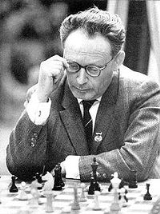
Mikhail Moiseyevich Botvinnik ( – May 5, 1995) was a Soviet
International GrandmasterThe title Grandmaster is awarded to strong chess players by the world chess organization FIDE. Apart from "World Champion", Grandmaster is the highest title a chess player can attain....
and three-time
World Chess ChampionThe World Chess Championship is played to determine the World Champion in the board game chess. Both men and women are eligible to contest this title....
. Working as an
electrical engineerElectrical engineering, sometimes referred to as electrical and electronic engineering, is a field of engineering that deals with the study and application of electricity, electronics and electromagnetism. The field first became an identifiable occupation in the late nineteenth century after...
at the same time, he was one of the very few famous chess players who achieved distinction in another career while playing top-class competitive chess. He also developed a chess-playing algorithm that tried to "think" like a top human player, but this approach has been superseded by a
brute-force searchIn computer science, brute-force search or exhaustive search, also known as generate and test, is a trivial but very general problem-solving technique that consists of systematically enumerating all possible candidates for the solution and checking whether each candidate satisfies the problem's...
strategy that exploits the rapid increase in the calculation speed of modern computers.
Botvinnik was the first world-class player to develop within the
Soviet UnionThe Union of Soviet Socialist Republics was a constitutionally socialist state that existed in Eurasia from 1922 to 1991. The name is a translation of the , tr. Soyuz Sovetskikh Sotsialisticheskikh Respublik, abbreviated СССР, SSSR. The common short name is Soviet Union, from , Sovetskiy Soyuz...
(
AlekhineAlexander Alexandrovich Alekhine was the fourth World Chess Champion.By the age of twenty-two, he was already among the strongest chess players in the world. During the 1920s, he won most of the tournaments in which he played...
was a top player before the Russian Revolution), putting him under political pressure but also giving him considerable influence within Soviet chess. From time to time he was accused of using that influence to his own advantage, but the evidence is unclear and some suggest he resisted attempts by Soviet officials to intimidate some of his rivals.
Botvinnik also played a major role in the organization of chess, making a significant contribution to the design of the
World Chess ChampionshipThe World Chess Championship is played to determine the World Champion in the board game chess. Both men and women are eligible to contest this title....
system after
World War IIWorld War II, or the Second World War , was a global military conflict which involved a majority of the world's nations, including all great powers, organized into two opposing military alliances: the Allies and the Axis...
and becoming a leading member of the coaching system that enabled the Soviet Union to dominate top-class chess during that time. His famous pupils include World Champions
Anatoly KarpovAnatoly Yevgenyevich Karpov is a Soviet and Russian chess grandmaster and former World Champion. He was world champion from 1975 to 1985, played three more matches for the title from 1986 to 1990, then was FIDE World Champion from 1993 to 1999...
,
Garry KasparovGarry Kasparov is a Russian former World Chess Champion, writer, and political activist, whom many consider the greatest chess player of all time.Kasparov became the youngest ever undisputed World Chess Champion in 1985...
and
Vladimir KramnikVladimir Borisovich Kramnik is a Russian chess grandmaster. He was Classical World Chess Champion from 2000 to 2006, and undisputed World Chess Champion from 2006 to 2007....
.
Early years
Mikhail Moiseyevich Botvinnik was born on August 17, 1911, in what was then Kuokkala in the Russian-controlled but semi-autonomous
Grand Duchy of FinlandThe Grand Duchy of Finland was the predecessor state of modern Finland that existed in its territory 1809–1917 as part of the Russian Empire.- History :...
, but is now the district of Repino in
Saint PetersburgSaint Petersburg is a city and a federal subject of Russia located on the Neva River at the head of the Gulf of Finland on the Baltic Sea. The city's other names were Petrograd and Leningrad...
. Although his parents were Jewish, his father was a
dental technicianA dental technician is a member of the dental team who, with a written work order, produces dental appliances such as a removable prothesis, including dentures and orthodontic appliances, and adjunctive services such as denture repairs, and fixed prostheses, such as crowns and bridges.Dental...
and his mother a dentist, which allowed the family to live outside the
Pale of SettlementThe Pale of Settlement was the term given to a region of Imperial Russia, along its western border, in which permanent residence of Jews was allowed, and beyond which Jewish residence was generally prohibited...
to which most Jews in Russia were restricted at the time. As a result, Mikhail Botvinnik grew up in Saint Petersburg's
Nevsky ProspektNevsky Prospekt , or the Nevsky Avenue, is the main street in the city of St Petersburg. Planned by Peter the Great as beginning the road to Novgorod and Moscow, the avenue runs from the Admiralty to the Moscow Railway Station and, after making a turn at Vosstaniya Square, to the Alexander Nevsky...
. His father forbade the speaking of Yiddish at home, and Mikhail and his older brother Issy attended
SovietThe Union of Soviet Socialist Republics was a constitutionally socialist state that existed in Eurasia from 1922 to 1991. The name is a translation of the , tr. Soyuz Sovetskikh Sotsialisticheskikh Respublik, abbreviated СССР, SSSR. The common short name is Soviet Union, from , Sovetskiy Soyuz...
schools. Mikhail Botvinnik later said, "I am a Jew by blood, Russian by culture, Soviet by upbringing."
In 1920, his mother became ill and his father left the family, but maintained contact with the children, even after his second marriage, to a Russian woman. At about the same time, Mikhail started reading newspapers, and became a committed Communist.
In autumn 1923, at the age of twelve, Mikhail Botvinnik was taught chess by a school friend of his older brother, using a home-made set, and instantly fell in love with the game. He finished in mid-table in the school championship, sought advice from another of his brother's friends, and concluded that for him it was better to think out "concrete concepts" and then derive general principles from these – and went on to beat his brother's friend quite easily. In winter 1924, Botvinnik won his school's championship, and exaggerated his age by three years in order to become a member of the Petrograd Chess Assembly – to which the Assembly's President turned a blind eye. Botvinnik won his first two tournaments organized by the Assembly. Shortly afterwards,
Nikolai KrylenkoNikolai Vasilyevich Krylenko was a Russian Bolshevik revolutionary and a Soviet politician. Krylenko served in a variety of posts in the Soviet legal system, rising to become People's Commissar of Justice and Prosecutor General of the Russian Soviet Federated Socialist Republic.Krylenko was an...
, a chess fanatic and leading member of the
Soviet legal systemThe Law of the Soviet Union—also known as Socialist Law—was the law developed in the Soviet Union following the October Revolution of 1917...
who later organized Stalin's show trials, began building a huge nation-wide chess organization, and the Assembly was replaced by a club in the city's Palace of Labor.
To test the strength of Soviet chess masters, Krylenko organized the
Moscow 1925 chess tournamentThe international super tournament, organised by Nikolai Krylenko, was held in Moscow, the Soviet Union, from 10 November to 8 December 1925. It was the world's first state-sponsored chess tournament. There were eleven foreign stars and ten Soviet masters. World champion José Raúl Capablanca and...
. On a rest day during the event, world champion
José Raúl CapablancaJosé Raúl Capablanca y Graupera was a Cuban chess player who was world chess champion from 1921 to 1927. He is often considered one of the greatest chess players of all time, and was renowned for his exceptional end game skill and speed of play...
gave a
simultaneous exhibitionA simultaneous exhibition or simultaneous display is a chess exhibition in which one player plays multiple chess games at a time with a number of other players. Such an exhibition is often referred to simply as a "simul".In a regular simul, no chess clocks are used...
in
LeningradLeningrad is the former name of Saint Petersburg, Russia.Leningrad may also refer to:Places:* Leningrad Oblast, a federal subject of Russia, around Saint Petersburg* Leningrad, Tajikistan, capital of Muminobod district in Khatlon Province...
. Botvinnik was selected as one of his opponents, and won their game. In 1926, he reached the final stage of the Leningrad championship. Later that year, he was selected for Leningrad's team in a match against
Stockholm' is the capital and largest city of Sweden. It is the site of the national Swedish government, the Riksdag , and the official residence of the Swedish Monarch as well as the prime minister. The Monarch resides at Drottningholm Palace outside of Stockholm since 1980 and uses the Royal Palace of...
, held in
SwedenSweden , officially the Kingdom of Sweden , is a Nordic country on the Scandinavian Peninsula in Northern Europe...
, and scored +1 =1 against the future grandmaster
Gösta Stoltz-Biography:Stoltz played a few matches with strong chess masters. In 1926, he lost to Mikhail Botvinnik at a team match Stockholm – Leningrad in Stockholm. In 1927, he drew with Allan Nilsson in Göteborg . In 1930, he won against Isaac Kashdan in Stockholm. In 1930, he lost to Rudolf Spielmann ...
. On his return, he entertained his schoolmates with a vivid account of the rough sea journey back to Russia. Botvinnik was commissioned to annotate two games from the match, and the fact that his analyses were to be published made him aware of the need for objectivity. In December 1926, he became a candidate member of his school's
KomsomolThe Communist Union of Youth , usually called Komsomol ) , was the youth wing of the Communist Party of the Soviet Union. Its full name since 1922 was Vsesoyuzny Leninskiy Kommunisticheskiy Soyuz Molodyozhi...
branch. Around this time his mother became concerned about his poor physique, and as a result he started a program of daily exercise, which he maintained for most of his life.
When Botvinnik finished the school curriculum, he was below the minimum age for the entrance examinations for higher education. While waiting, he qualified for his first
USSR ChampionshipUSSR Championship* Soviet Top League - football competition.* Soviet Hockey League - Top league of Soviet hockey* Soviet Championship - rugby union competition.* USSR Chess Championship - chess competition....
final stage in 1927 as the youngest player ever at that time, tied for fifth place and won the title of National Master. He wanted to study Electrical Technology at the Leningrad Polytechnical Institute and passed the entrance examination; however, there was a persistent excess of applications for this course and the
Prolestud, which controlled admissions, had a policy of admitting only children of engineers and industrial workers. After an appeal by a local chess official, he was admitted in 1928 to Leningrad University's Mathematics Department. In January 1929, Botvinnik played for Leningrad in the student team chess championship against Moscow. Leningrad won and the team manager, who was also Deputy Chairman of the
Prolestud, secured Botvinnik a transfer to the Polytechnic's Electromechanical Department, where he was one of only four students who entered straight from school. As a result, he had to do a whole year's work in five months, and failed one of the examinations. Early in the same year he placed joint third in the semi-final stage of the USSR Championship, and thus failed to reach the final stage.
His progress was fairly rapid, mostly under the training of Soviet Master and coach
Abram ModelAbram Model was a Russian chess master, although he had his master title taken away by the Soviet chess authorities due to lack of results....
, in
LeningradLeningrad is the former name of Saint Petersburg, Russia.Leningrad may also refer to:Places:* Leningrad Oblast, a federal subject of Russia, around Saint Petersburg* Leningrad, Tajikistan, capital of Muminobod district in Khatlon Province...
.
He won the Leningrad Masters' tournament in 1930 with 6½/8, following this up the next year by winning the
Championship of Leningrad-References: *************...
by 2½ points over former Soviet champion
Peter Romanovsky Peter Arsenievich Romanovsky was a Russian chess International Master, International Arbiter, and author.-Biography:...
.
Soviet champion
In 1931, at the age of 20, Botvinnik won his first
Soviet ChampionshipThis is a list of all the winners of the USSR Chess Championship. It was the strongest national chess championship ever held, with eight world chess champions and four world championship finalists among its winners...
in
MoscowMoscow is the capital and the largest city of Russia. It is also the largest metropolitan area in Europe, and ranks among the largest urban areas in the world. Moscow is a major political, economic, cultural, religious, financial, educational, and transportation centre of Russia and the world, a...
, scoring 13½ out of 17. He commented that the field was not very strong, as some of the pre-Revolution masters were absent. In late summer 1931, he graduated with a degree in
Electrical EngineeringElectrical engineering, sometimes referred to as electrical and electronic engineering, is a field of engineering that deals with the study and application of electricity, electronics and electromagnetism. The field first became an identifiable occupation in the late nineteenth century after...
, after completing a practical assignment on temporary transmission lines at the
Dnieper Hydroelectric StationThe Dnieper Hydroelectric Station is the largest hydroelectric power station in Ukraine and was the largest in Europe at the time of its construction...
. He stayed on at the Leningrad Polytechnical Institute to study for a Candidate's degree.
In 1933, he repeated his Soviet Championship win, in his home city of Leningrad, with 14/19, describing the results as evidence that Krylenko's plan to develop a new generation of Soviet masters had borne fruit. He and other young masters successfully requested the support of a senior Leningrad
Communist PartyThe Communist Party of the Soviet Union was the ruling and only legal political party in the Soviet Union and one of the largest communist organizations in the...
official in arranging contests involving both Soviet and foreign players, as there had been none since the
Moscow 1925 chess tournamentThe international super tournament, organised by Nikolai Krylenko, was held in Moscow, the Soviet Union, from 10 November to 8 December 1925. It was the world's first state-sponsored chess tournament. There were eleven foreign stars and ten Soviet masters. World champion José Raúl Capablanca and...
.
Soon afterwards, Botvinnik was informed that Alexander Ilyin-Genevsky, one of the older masters and a member of the Soviet embassy in
PraguePrague is the capital and largest city of the Czech Republic. Nicknames for Prague have included "the mother of cities" , "city of a hundred spires", or Stověžatá Praha in Czech and "the golden city" or Zlaté město in Czech.Situated on the River Vltava in central Bohemia, Prague has been the...
, had arranged a match between
Salo FlohrSalomon Mikhailovich Flohr was a leading Czech and later Soviet chess grandmaster of the early 20th century. He became a national hero in Czechoslovakia during the 1930s and his name was used to sell many of the luxury products of the time, including Salo Flohr cigarettes, Salo Flohr slippers and...
and himself, with his opponent then regarded as one of the most credible contenders for
Alexander AlekhineAlexander Alexandrovich Alekhine was the fourth World Chess Champion.By the age of twenty-two, he was already among the strongest chess players in the world. During the 1920s, he won most of the tournaments in which he played...
's
World Chess ChampionshipThe World Chess Championship is played to determine the World Champion in the board game chess. Both men and women are eligible to contest this title....
title. The highest-level chess officials in the Soviet Union opposed this on the grounds that Botvinnik stood little chance against such a strong opponent, which caused Krylenko to insist on the match, saying that "We have to know our real strength."
Botvinnik used what he regarded as the first version of his method of preparing for a contest, but fell two games behind by the end of the first six, played in Moscow. However, aided by his old friend
RagozinViacheslav Vasilyevich Ragozin was a Soviet chess Grandmaster, an International Arbiter of chess, and a World Correspondence Chess Champion. He was also a chess writer and editor.- Biography :...
and coach Abram Model, he leveled the score in Leningrad and the match was drawn. When describing the post-match party, Botvinnik wrote that at the time he danced the foxtrot and
CharlestonThe Charleston is a dance named for the city of Charleston, South Carolina. The rhythm was popularized in mainstream dance music in the United States by a 1923 tune called The Charleston by composer/pianist James P. Johnson which originated in the Broadway show Runnin' Wild and became one of the...
to a professional standard.
In his first tournament outside the USSR, the
HastingsThe Hastings International Chess Congress is an annual chess congress which takes place in Hastings, England, around the turn of the year. The main event is the Hastings Premier tournament, which was traditionally a 10 to 16 player round-robin tournament. In 2004/05 the tournament was played in the...
1934–35, Botvinnik achieved only a tie for 5th-6th places, with 5/9. He wrote that, in London after the tournament,
Emanuel LaskerEmanuel Lasker was a German chess player, mathematician, and philosopher who was World Chess Champion for 27 years...
said his arrival only two hours before the first round began was a serious mistake and that he should have allowed ten days for acclimatization.
Botvinnik placed first equal with Flohr, ½ point ahead of Lasker and one point ahead of
José Raúl CapablancaJosé Raúl Capablanca y Graupera was a Cuban chess player who was world chess champion from 1921 to 1927. He is often considered one of the greatest chess players of all time, and was renowned for his exceptional end game skill and speed of play...
, in Moscow's second International Tournament, held in 1935. After consulting Capablanca and Lasker, Krylenko proposed to award Botvinnik the title grandmaster, but Botvinnik objected that "titles were not the point." However he accepted a free car and a 67% increase in his postgraduate study
grantGrants are funds disbursed by one party , often a Government Department, Corporation, Foundation or Trust, to a recipient, often a nonprofit entity, educational institution, business or an individual. In order to receive a grant, some form of "Grant Writing" often referred to as either a proposal...
, both provided by the People's Commissariat of Heavy Industry.
He later reported to Krylenko that the 1935 tournament made it difficult to judge the strength of the top Soviet players, as it included a mixture of top-class and weaker players. Botvinnik advocated a double
round-robinThe term round-robin describes correspondence to a single address authored or signed by numerous individuals .Colloquially, however, 'round-robin' is frequently given an opposite meaning, being used to describe a letter with an author copied and sent to multiple recipients. For example, the sending...
event featuring the top five Soviet players and the five strongest non-Soviet players available. Despite politicking over the Soviet choices, both Krylenko and the Central Committee of the
KomsomolThe Communist Union of Youth , usually called Komsomol ) , was the youth wing of the Communist Party of the Soviet Union. Its full name since 1922 was Vsesoyuzny Leninskiy Kommunisticheskiy Soyuz Molodyozhi...
quickly authorised the tournament. This was played in Moscow in June 1936, and Botvinnik finished second, one point behind Capablanca and 2½ ahead of Flohr. However, he took consolation from the fact the Soviet Union's best had held their own against top-class competition.
In early winter, 1936, Botvinnik was invited to play in a tournament at
NottinghamNottingham is a city and unitary authority in the East Midlands. It is located in the ceremonial county of Nottinghamshire, England and is one of only eight members of the English Core Cities Group....
, England. Krylenko authorized his participation and, to help Botvinnik play at his best, allowed Botvinnik's wife to accompany him – a privilege rarely extended to chess players at any time in Soviet history. Taking Lasker's advice, Botvinnik arrived ten days before play started. Although his Soviet rivals forecast disaster for him, he scored an undefeated shared first place (+6 =8) with Capablanca, ½ point ahead of current World Champion
Max EuweMachgielis Euwe was a Dutch chess Grandmaster, mathematician, and author. He was the fifth player to become World Chess Champion . Euwe also served as President of FIDE, the World Chess Federation, from 1970 to 1978...
and rising American stars
Reuben FineReuben Fine was one of the strongest chess players in the world from the mid 1930s through the 1940s, an International Grandmaster, psychologist and author of books on both chess and psychology. Fine won five medals in three chess Olympiads. Fine won the U.S...
and
Samuel ReshevskySamuel "Sammy" Herman Reshevsky was a famous chess prodigy and later a leading American chess Grandmaster...
, and 1 point ahead of ex-champion
Alexander AlekhineAlexander Alexandrovich Alekhine was the fourth World Chess Champion.By the age of twenty-two, he was already among the strongest chess players in the world. During the 1920s, he won most of the tournaments in which he played...
. This was the first tournament victory by a Soviet master outside his own country. When the result reached Russia, Krylenko drafted a letter to be sent in Botvinnik's name to Stalin. On returning to Russia Botvinnik discovered he had been awarded the "Mark of Honour".
Three weeks later, he began work on his dissertation for the Candidate's degree, obtaining this in June 1937, after his supervisor described the dissertation as "short and good", and the first work in its field. As a result of his efforts, he missed the 1937 Soviet championship, won by
Grigory LevenfishGrigory Yakovlevich Levenfish was a leading Jewish Russian chess grandmaster of the 1920s and 1930s. He was twice Soviet champion , and drew a 1937 match against future world champion Mikhail Botvinnik...
, who was then nearly fifty. Later in 1937, Botvinnik drew a match of thirteen games against
Grigory LevenfishGrigory Yakovlevich Levenfish was a leading Jewish Russian chess grandmaster of the 1920s and 1930s. He was twice Soviet champion , and drew a 1937 match against future world champion Mikhail Botvinnik...
. Accounts differ about how the match was arranged: Levenfish later wrote that Botvinnik challenged him; while Botvinnik wrote that Krylenko, angered by Botvinnik's absence from the tournament, ordered the match.
Botvinnik won further Soviet Championship titles in 1939, 1944, 1945, and 1952, bringing his total to six – a record he shares with
Mikhail TalMikhail Tal was a Soviet-Latvian chess player, a Grandmaster, and the eighth World Chess Champion....
. In 1945 he dominated the tournament, scoring 15/17; however in 1952 he tied with
Mark TaimanovMark Evgenievich Taimanov is a leading Russian chess player and concert pianist.-Chess:He was awarded the International Grandmaster title in 1952 and played in the Candidates Tournament in Zurich in 1953, where he tied for eighth place. From 1946 to 1956, he was among the world's top ten players...
and won the play-off match.
World title contender
In 1938, the world's top eight players met in the Netherlands to compete in the
AVRO tournamentThe AVRO tournament was a chess tournament held in the Netherlands in 1938, sponsored by the Dutch broadcasting company AVRO. The event was a double round-robin tournament...
, whose winner was supposed to get a title match with the World Champion,
Alexander AlekhineAlexander Alexandrovich Alekhine was the fourth World Chess Champion.By the age of twenty-two, he was already among the strongest chess players in the world. During the 1920s, he won most of the tournaments in which he played...
. Botvinnik placed third, behind
Paul KeresPaul Keres , was an Estonian chess grandmaster.Keres narrowly missed a chance at a World Chess Championship match on five occasions. He won the 1938 AVRO tournament, which led to negotiations for a World Championship match against Alexander Alekhine, but the match never took place due to World War II...
and
Reuben FineReuben Fine was one of the strongest chess players in the world from the mid 1930s through the 1940s, an International Grandmaster, psychologist and author of books on both chess and psychology. Fine won five medals in three chess Olympiads. Fine won the U.S...
. According to Botvinnik, Alekhine was most interested in playing an opponent who could raise the funds. After consulting the nearest available Soviet officials, Botvinnik discreetly challenged Alekhine, who promptly accepted, subject to conditions that would enable him to acclimatize in Russia and get some high-quality competitive practice a few months before the match. In Botvinnik's opinion, Alekhine was partly motivated by the desire for a reconciliation with the Soviet authorities, so that he could again visit his homeland. The match, including funding, was authorised at the highest Soviet political level in January 1939; however, a letter of confirmation was only sent two months later – in Botvinnik's opinion, because of opposition by his Soviet rivals, especially those who had become prominent before the Russian Revolution – and the outbreak of World War II prevented a World Championship match.
In spring 1939, Botvinnik won the USSR Championship, and his book on the tournament described the approach to preparation which he had been developing since 1933. One striking feature of this was emphasis on opening preparation in order to gain positional advantage in the middle game, an asset that that could be used for years, rather than seeking immediate tactical surprises that could only be used once.
Botvinnik took an early lead in the 1940 USSR Championship, but faded badly in the later stages, eventually sharing fifth place. He attributed this to the unaccustomed difficulty of concentrating in a party-like atmosphere filled with noise and tobacco smoke. Botvinnik wrote to a friendly official, commenting that the champion was to be the winner of a match between
Igor BondarevskyIgor Zakharovich Bondarevsky was a Soviet Russian chess Grandmaster in both over-the-board and correspondence chess, an International Arbiter, trainer, and chess author...
and
Andor LilienthalAndor Arnoldovich Lilienthal is a Hungarian chess Grandmaster. In his long career, he played against ten male and female world champions, beating Emanuel Lasker, José Raúl Capablanca, Alexander Alekhine, Max Euwe, Mikhail Botvinnik, Vasily Smyslov, and Vera Menchik. He celebrated his 98th...
, who had tied for first place, but had no achievements in international competition. The official's efforts led to a tournament for the title of "Absolute Champion of the USSR", whose official aim was to identify a Soviet challenger for Alekhine's title. The contestants were the top six finishers in the Soviet Championship – Bondarevsky, Lilienthal,
Paul KeresPaul Keres , was an Estonian chess grandmaster.Keres narrowly missed a chance at a World Chess Championship match on five occasions. He won the 1938 AVRO tournament, which led to negotiations for a World Championship match against Alexander Alekhine, but the match never took place due to World War II...
(who had recently become a Soviet citizen), future World Champion
Vasily SmyslovVasily Vasilyevich Smyslov is a Russian chess grandmaster, and was World Chess Champion from 1957 to 1958....
,
Isaac BoleslavskyIsaac Yefremovich Boleslavsky was a Ukrainian-Jewish chess Grandmaster.-Early career:In 1933, Boleslavsky became schoolboy champion of Dnipropetrovsk....
and Botvinnik – who were to play a quadruple round robin. Botvinnik's preparation with his second,
Viacheslav RagozinViacheslav Vasilyevich Ragozin was a Soviet chess Grandmaster, an International Arbiter of chess, and a World Correspondence Chess Champion. He was also a chess writer and editor.- Biography :...
, included training matches in noisy, smoky rooms and he slept in the playing room, without opening the window. He won the tournament, 2½ points ahead of Keres and three ahead of Smyslov; moreover, with plus scores in the "mini-matches" against all his rivals.
In April 1941
Nazi GermanyNazi Germany and the Third Reich are the common English names for Germany between 1933 and 1945, while it was led by Adolf Hitler and the National Socialist German Worker's Party . The name Third Reich refers to the state as the successor to the Holy Roman Empire of the Middle Ages and the German...
invaded the Soviet Union. Botvinnik's wife Gayane, a ballerina, told him that her colleagues at the
Kirov-People:*Nikolay Kirov , Soviet track and field athlete*Sergey Kirov , a Bolshevik revolutionary and a Soviet communist-Things named after Sergey Kirov:*Kirov Plant, St. Petersburg...
Opera and Ballet Theatre were being evacuated to the city of
PermPerm is a city and administrative center of Perm Krai, Russia. It is situated on the banks of the Kama River, in the European part of Russia near the Ural Mountains....
, then known as Molotov in honour of
Vyacheslav MolotovVyacheslav Mikhailovich Molotov was a Soviet politician and diplomat, a leading figure in the Soviet government from the 1920s, when he rose to power as a protégé of Joseph Stalin, to 1957, when he was dismissed from Presidium of the Central Committee by Nikita Khrushchev...
. The family found an apartment there, and Botvinnik obtained a job with the local electricity supply organization – at the lowest pay rate and on condition that he did no research, as he had only a Candidate's degree. Botvinnik's only child, a daughter named Olya, was born in Perm in April 1942.
In the evenings, Botvinnik wrote a book in which he annotated all the games of the "Absolute Championship of the USSR", in order to maintain his analytic skills in readiness for a match with Alekhine. His work included wood-cutting for fuel, which left him with insufficient energy for chess analysis. Botvinnik obtained from Molotov an order that he should be given three days off normal work in order to study chess.
In 1943, after a two-year lay-off from competitive chess, Botvinnik won a tournament in
SverdlovskSverdlovsk is a city in Luhansk Oblast of south-eastern Ukraine. Serving as the administrative center of Sverdlovskyi Raion , the city itself is also designated as a separate raion within the oblast, and is located approximately 80km from the oblast capital, Luhansk.The current estimated...
, scoring 1½ out of 2 against each of his competitors – who included Smyslov,
Vladimir MakogonovVladimir Andreevich Makogonov was a chess player from Azerbaijan. He was born in Nakhchivan but lived in Baku for most of his life. He became an International Master in 1950 and was awarded an honorary Grandmaster title in 1987. Makogonov never became well known outside the Soviet Union, but was...
, Boleslavsky, and Ragozin.
ChessbaseChessBase GmbH is a German company that markets chess software, maintains a chess news site, and operates a server for online chess, that encourages good behaviour on the server. Set up in 1998, it maintains and sells massive databases, containing most historic games, that permit analysis that had...
regards this as one of the fifty strongest tournaments between 1851 and 1986.
Shortly afterwards, Botvinnik was urged to return to Moscow by the People's
CommissarCommissar is the English transliteration of an official title used in Russia after the Bolshevik revolution.The title was mostly associated with a number of Cheka and military functions in many Bolshevik and Soviet government military forces during the Russian Civil War; the White Army widely used...
for Power Stations, an admirer and subsequent good friend. On his return, Botvinnik suggested a match with
Samuel ReshevskySamuel "Sammy" Herman Reshevsky was a famous chess prodigy and later a leading American chess Grandmaster...
in order to strengthen his claim for a title match with Alekhine, but this received no political support. In December 1943, he won the Moscow Championship, ahead of Smyslov. At the same time, opposition to his plan for a match with Alekhine re-surfaced, on the grounds that Alekhine was a political enemy and the only proper course was to demand that he be stripped of the title. The dispute ended in Botvinnik's favor, and in the dismissal of a senior chess official, one of those to have opposed Botvinnik's plan, who was also a
KGBThe KGB was the national security agency of the USSR. From 1954 until 1991, the Committee for State Security was the Communist state's premier secret police, internal security, and espionage organization, whose coat of arms—the Shield and the Sword—illustrate a national military hierarchy...
colonel.
After Botvinnik won the 1944 and 1945 Soviet championships, most top Soviet players supported his desire for a World Championship match with Alekhine. However, the allegations that Alekhine had written anti-Semitic articles while in Nazi-occupied France made it difficult to host the match in the USSR. Botvinnik opened negotiations with the British Chess Federation to host the match in England, but these were cut short by Alekhine's death in 1946.
When the Second World War ended, Botvinnik won the first high-level post-war tournament, at
Groningen in 1946Groningen 1946 was the first major international chess tournament to be held after World War II.Held at Groningen in August and September 1946, it was considered a miracle that the Netherlands could stage such an event just fifteen months after the end of the war.Mikhail Botvinnik won the...
, with 14½ points from nineteen games, ½ point ahead of former World Champion
Max EuweMachgielis Euwe was a Dutch chess Grandmaster, mathematician, and author. He was the fifth player to become World Chess Champion . Euwe also served as President of FIDE, the World Chess Federation, from 1970 to 1978...
and two ahead of Smyslov He and Euwe both struggled in the last few rounds, and Botvinnik had a narrow escape against Euwe, who he acknowledged had always been a difficult opponent for him. This was Botvinnik's first outright victory in a tournament outside the Soviet Union.
Botvinnik also won the very strong Mikhail Chigorin Memorial tournament held at Moscow 1947.
World Champion
Botvinnik strongly influenced the design of the system which would be used for World Championship competition from 1948 to 1963. Viktor Baturinsky wrote, in his introduction to Botvinnik's own book
Botvinnik's Best Games 1947–1970 (page 2), "Now came Botvinnik's turn to defend his title in accordance with the new qualifying system which he himself had outlined in 1946."
On the basis of his strong results during and just after World War II, Botvinnik was one of five players to contest the
1948 World Chess ChampionshipThe 1948 World Chess Championship was a tournament played to determine a new World Chess Champion following the death of the previous champion Alexander Alekhine in 1946. The tournament marked the passing of control of the championship title to FIDE, the International Chess Federation which had...
, which was held at
The HagueThe Hague is the third largest city in the Netherlands after Amsterdam and Rotterdam, with a population of 485,818 and an area of approximately 100 km²...
and Moscow. He won the 1948 tournament convincingly, with a score of 14/20, three points clear, becoming the sixth World Champion. While he was on vacation in
RigaRiga is the capital and largest city of Latvia, a major industrial, commercial, cultural and financial centre of the Baltics, and an important seaport, situated on the mouth of the Daugava...
after the tournament, an eleven-year old boy called
Mikhail TalMikhail Tal was a Soviet-Latvian chess player, a Grandmaster, and the eighth World Chess Champion....
paid a visit, hoping to play a game against the new champion. Tal was met by Botvinnik's wife, who said the champion was asleep, and that she had made him take a rest from chess.
Botvinnik then held the title, with two brief interruptions, for the next fifteen years, during which he played seven world championship matches. In 1951, he drew with
David BronsteinDavid Ionovich Bronstein was a world-class chess grandmaster and highly renowned writer...
over 24 games in
MoscowMoscow is the capital and the largest city of Russia. It is also the largest metropolitan area in Europe, and ranks among the largest urban areas in the world. Moscow is a major political, economic, cultural, religious, financial, educational, and transportation centre of Russia and the world, a...
, +5 =14 -5, keeping the world title, but it was a struggle for Botvinnik, who won the second-last game and drew the last in order to tie the match. In 1954, he drew with
Vasily SmyslovVasily Vasilyevich Smyslov is a Russian chess grandmaster, and was World Chess Champion from 1957 to 1958....
over 24 games at Moscow, +7 =10 -7, again retaining the title. In 1957, he lost to Smyslov by 9½–12½ in Moscow, but the rules then in force allowed him a rematch without having to go through the Candidates' Tournament, and in 1958 he won the rematch in Moscow; Smyslov said his health was poor during the return match. In 1960, Botvinnik was convincingly beaten 8½-12½ at Moscow by Tal, now 23 years old, but again exercised his right to a rematch in 1961, and won by 13–8 in Moscow. Commentators agreed that Tal's play was weaker in the rematch, probably due to his health, but also that Botvinnik's play was better than in the 1960 match, largely due to thorough preparation. Botvinnik changed his style in the rematch, avoiding the tactical complications in which Tal excelled and aiming for closed positions and endgames, where Tal's technique was not outstanding. Finally, in 1963, he lost the title to
Tigran PetrosianTigran Petrosian was World Chess Champion from 1963 to 1969.He is often known by the Russian version of his name, Tigran Vartanovich Petrosian . He was nicknamed "Iron Tigran" due to his playing style because of his almost impenetrable defence, which emphasised safety above all else...
, by 9½-12½ in Moscow. FIDE had by then altered the rules, and he was not allowed a rematch. The rematch rule had been nicknamed the "Botvinnik rule", because he twice benefited from it.
Though ranking as formal World Champion, Botvinnik had a relatively poor playing record in the early 1950s: he played no game after winning the 1948 match tournament until he defended his title, then struggled to draw his 1951 championship match with Bronstein, placed only fifth in the 1951 Soviet Championship, and tied for third in the 1952
Geza MaroczyGéza Maróczy was a leading Hungarian chess Grandmaster, one of the best players in the world in his time. He was also a practising engineer.-Early career:...
Memorial tournament in
BudapestBudapest is the capital of Hungary. As the largest city of Hungary, it serves as the country's principal political, cultural, commercial, industrial, and transportation center and is considered an important hub in Central Europe. In 2009, Budapest had 1,712,210 inhabitants, down from a mid-1980s...
; and he had also performed poorly in Soviet training contests. Botvinnik did not play in the Soviet team that won the 1952
Chess OlympiadThe Chess Olympiad is a biennial chess tournament in which teams from all over the world compete against each other. The event is organised by FIDE, which selects the host nation.-Birth of the Olympiad:The first Olympiad was unofficial...
in Helsinki: the players voted for the line-up and placed Botvinnik on second board, with Keres on top board; Botvinnik protested and refused to play. Keres' playing record from 1950 to early 1952 had been outstanding.
Botvinnik won the 1952 Soviet Championship (joint first with
Mark TaimanovMark Evgenievich Taimanov is a leading Russian chess player and concert pianist.-Chess:He was awarded the International Grandmaster title in 1952 and played in the Candidates Tournament in Zurich in 1953, where he tied for eighth place. From 1946 to 1956, he was among the world's top ten players...
in the tournament, won the play-off match). He included several wins from that tournament over the 1952 Soviet team members in his book
Botvinnik's Best Games 1947–1970, writing "these games had a definite significance for me". In 1956, he tied for first place with Smyslov in the 1956 Alexander Alekhine Memorial in Moscow, despite a last-round loss to Keres.
Team tournaments
Botvinnik was selected for the Soviet Olympiad team from 1954 to 1964 inclusively, and helped his team to gold medal finishes each of those six times. At
AmsterdamAmsterdam is the capital and largest city of the Netherlands, located in the province of North Holland in the west of the country...
1954 he was on board one and won the gold medal with 8⅓/11. Then at home for
MoscowMoscow is the capital and the largest city of Russia. It is also the largest metropolitan area in Europe, and ranks among the largest urban areas in the world. Moscow is a major political, economic, cultural, religious, financial, educational, and transportation centre of Russia and the world, a...
1956, he was again board one, and scored 9⅓/13 for the bronze medal. For
MunichMunich is the capital city of Bavaria, Germany. It is located on the River Isar north of the Bavarian Alps. Munich is the third largest city in Germany, after Berlin and Hamburg...
1958, he scored 9/12 for the silver medal on board one. At
LeipzigLeipzig is, with a population of 515,459, the largest city in the federal state of Saxony, Germany.-Origins:Leipzig's name is derived from the Slavic word Lipsk, which means "settlement where the lime trees stand"....
1960, he played board two behind Mikhail Tal, having lost his title to Tal earlier that year; But he won the board two gold medal with 10⅓/13. He was back on board one for
VarnaVarna is the largest city and seaside resort on the Bulgarian Black Sea Coast and in Northern Bulgaria, third-largest in Bulgaria after Sofia and Plovdiv, and 77th-largest in the European Union, with a population of 355,450 .Commonly referred to as the marine capital of Bulgaria, Varna is a...
1962, scored 8/12, but failed to win a medal for the only time at an Olympiad. His final Olympiad was
Tel AvivTel Aviv-Yafo , usually called Tel Aviv, is the second largest city in Israel, with an estimated population of 391,300. The city is situated on the Israeli Mediterranean coastline, with a land area of...
1964, where he won the bronze with 9/12, playing board 2 as he had lost his title to Petrosian. Overall, in six Olympiads, he scored 54½/73 for an outstanding
74.6 percent.
Botvinnik also played twice for the USSR in the European Team Championship. At
OberhausenOberhausen is a Ruhr Area city on the river Emscher between Duisburg and Essen . The city hosts the International Short Film Festival Oberhausen and its Gasometer Oberhausen is an anchor point of the European Route of Industrial Heritage.-History:Oberhausen was named for its 1847 train station...
1961, he scored 6/9 for the gold medal on board one. But at
HamburgHamburg is the second-largest city in Germany and the sixth-largest city in the European Union...
1965, he struggled on board two with only 3½/8. Both times the Soviet Union won the team gold medals. Botvinnik played one of the final events of his career at the
Russia (USSR) vs Rest of the WorldThere have been three chess matches featuring Russia vs Rest of the World. The matches have all been keenly contested and played with great sportsmanship.-Background:...
match in
BelgradeBelgrade Belgrade Belgrade (Serbian Cyrillic: Београд, Serbian Latin: Beograd (meaning "White City" in Serbian) is the capital and largest city of Serbia. The city lies on two international waterways, at the confluence of the Sava and Danube rivers, where Central Europe's Pannonian Plain meets...
1970, scoring 2½/4 against
Milan MatulovicMilan Matulović is a chess Grandmaster who was the second or third strongest Yugoslav player for much of the 1960s and 1970s behind Svetozar Gligorić and possibly Borislav Ivkov. He was primarily active before 1977, but has remained an occasional tournament competitor as recently as...
, as the USSR narrowly triumphed.
Late career
After losing the world title for the final time, to
Tigran PetrosianTigran Petrosian was World Chess Champion from 1963 to 1969.He is often known by the Russian version of his name, Tigran Vartanovich Petrosian . He was nicknamed "Iron Tigran" due to his playing style because of his almost impenetrable defence, which emphasised safety above all else...
in Moscow in 1963, Botvinnik withdrew from the following World Championship cycle after FIDE declined, at its annual congress in 1965, to grant a losing champion the automatic right to a rematch, though he remained involved with competitive chess, appearing in several highly-rated tournaments and continuing to produce memorable games.
He retired from competitive play in 1970, aged 59, preferring instead to occupy himself with the development of
computer chessComputer chess is computer architecture encompassing hardware and software capable of playing chess autonomously without human guidance. Computer chess occurs as solo entertainment , as aids to chess analysis, for computer chess competitions, and as research to provide insights into human...
programs and to assist with the training of younger Soviet players, earning him the nickname of "Patriarch of the Soviet Chess School" (see below).
Botvinnik's autobiography,
K Dostizheniyu Tseli, was published in Russian in 1978, and in English translation as
Achieving the Aim (ISBN 0-08-024120-4) in 1981. A staunch Communist, he was noticeably shaken by the collapse of the Soviet Union and lost some of his standing in Russian chess during the
Boris YeltsinBoris Nikolayevich Yeltsin was the first President of the Russian Federation, serving from 1991 to 1999....
era. Botvinnik died of
pancreatic cancerPancreatic cancer is a malignant neoplasm of the pancreas. Each year in the United States, about 42,470 individuals are diagnosed with this condition and 35,240 die from the disease. The prognosis is generally poor; less than 5 percent of those diagnosed are still alive five years after diagnosis...
in 1995
http://www.scr-kuppenheim.de/extra/sosonko.htm.
Political controversies
The Soviet Union regarded chess as a symbol of Communist superiority, and hence the Soviet chess world was extremely politicized. As Botvinnik was the first world-class player produced by the Soviet Union, everything he said or did (or did not say or do) had political repercussions, and there were rumors that Soviet opponents were given hints that they should not beat him.
David BronsteinDavid Ionovich Bronstein was a world-class chess grandmaster and highly renowned writer...
wrote that
Boris VerlinskyBoris Markovich Verlinsky was a Ukrainian-Russian International Master of chess. He was one of the top Soviet players of the 1920s, and was in the top 20 in the world in 1926, clearly of Grandmaster strength at that time. He was also deaf.- Biography :In 1909, Verlinsky tied for 10th-11th in St...
had won the 1929 Soviet Championship and was granted the first Soviet Grandmaster title for this achievement, yet he was later stripped of it, when it was thought more politically correct to make Botvinnik the first official Soviet GM (as distinct from the-then nonexistent FIDE grandmaster title).
Botvinnik wrote that before the last round of the 1935 Moscow tournament Soviet Commissar of Justice
Nikolai KrylenkoNikolai Vasilyevich Krylenko was a Russian Bolshevik revolutionary and a Soviet politician. Krylenko served in a variety of posts in the Soviet legal system, rising to become People's Commissar of Justice and Prosecutor General of the Russian Soviet Federated Socialist Republic.Krylenko was an...
, who was also in charge of Soviet chess, proposed that Ilya Rabinovich should deliberately lose to Botvinnik, to ensure that Botvinnik took first place. Botvinnik refused, saying "... then I will myself put a piece
en prise and resign". The game was drawn, and Botvinnik shared first place with
Salo FlohrSalomon Mikhailovich Flohr was a leading Czech and later Soviet chess grandmaster of the early 20th century. He became a national hero in Czechoslovakia during the 1930s and his name was used to sell many of the luxury products of the time, including Salo Flohr cigarettes, Salo Flohr slippers and...
.
Botvinnik sent an effusive telegram of thanks to Stalin after his victory at the great tournament in Nottingham in 1936. Many years later he said that it had been written in Moscow and that
KGBThe KGB was the national security agency of the USSR. From 1954 until 1991, the Committee for State Security was the Communist state's premier secret police, internal security, and espionage organization, whose coat of arms—the Shield and the Sword—illustrate a national military hierarchy...
agents told him to sign it.
Botvinnik played relatively poorly in the very strong 1940 Soviet Championship, finishing in a tie for fifth/sixth places, with 11½/19, two full points behind
Igor BondarevskyIgor Zakharovich Bondarevsky was a Soviet Russian chess Grandmaster in both over-the-board and correspondence chess, an International Arbiter, trainer, and chess author...
and
Andor LilienthalAndor Arnoldovich Lilienthal is a Hungarian chess Grandmaster. In his long career, he played against ten male and female world champions, beating Emanuel Lasker, José Raúl Capablanca, Alexander Alekhine, Max Euwe, Mikhail Botvinnik, Vasily Smyslov, and Vera Menchik. He celebrated his 98th...
. With
World War IIWorld War II, or the Second World War , was a global military conflict which involved a majority of the world's nations, including all great powers, organized into two opposing military alliances: the Allies and the Axis...
under way by this time, and the strong possibility of little or no chess for some time in the future, Botvinnik seems to have prevailed upon the Soviet chess leadership to hold another tournament "in order to clarify the situation". This wound up being the 1941 Absolute Championship of the USSR, which featured the top six finishers from the 1940 event, playing each other four times. After a personal appeal to the defence minister,
Vyacheslav MolotovVyacheslav Mikhailovich Molotov was a Soviet politician and diplomat, a leading figure in the Soviet government from the 1920s, when he rose to power as a protégé of Joseph Stalin, to 1957, when he was dismissed from Presidium of the Central Committee by Nikita Khrushchev...
, Botvinnik was exempted from war work for three days a week in order to concentrate on chess preparations. He won this tournament convincingly, and thus reclaimed his position as the USSR's top player.
Bronstein claimed that at the end of the 1946 Groningen tournament, a few months after the death of reigning world champion
Alexander AlekhineAlexander Alexandrovich Alekhine was the fourth World Chess Champion.By the age of twenty-two, he was already among the strongest chess players in the world. During the 1920s, he won most of the tournaments in which he played...
, Botvinnik personally invited
Samuel ReshevskySamuel "Sammy" Herman Reshevsky was a famous chess prodigy and later a leading American chess Grandmaster...
,
Reuben FineReuben Fine was one of the strongest chess players in the world from the mid 1930s through the 1940s, an International Grandmaster, psychologist and author of books on both chess and psychology. Fine won five medals in three chess Olympiads. Fine won the U.S...
,
Max EuweMachgielis Euwe was a Dutch chess Grandmaster, mathematician, and author. He was the fifth player to become World Chess Champion . Euwe also served as President of FIDE, the World Chess Federation, from 1970 to 1978...
,
Vasily SmyslovVasily Vasilyevich Smyslov is a Russian chess grandmaster, and was World Chess Champion from 1957 to 1958....
, and
Paul KeresPaul Keres , was an Estonian chess grandmaster.Keres narrowly missed a chance at a World Chess Championship match on five occasions. He won the 1938 AVRO tournament, which led to negotiations for a World Championship match against Alexander Alekhine, but the match never took place due to World War II...
to join him in a tournament to decide the new world champion, but other evidence suggests that FIDE (the
"governing body"A sport governing body is a sports organization that has a regulatory or sanctioning function. Sport governing bodies come in various forms, and have a variety of regulatory functions. Examples of this can include disciplinary action for rule infractions and deciding on rule changes in the sport...
of chess), had already proposed a World Championship tournament before the Groningen tournament began, and at this stage the Soviet Union was not a member and therefore took no part in framing that proposal.
Since Keres lost his first four games against Botvinnik in the
1948 World Championship tournamentThe 1948 World Chess Championship was a tournament played to determine a new World Chess Champion following the death of the previous champion Alexander Alekhine in 1946. The tournament marked the passing of control of the championship title to FIDE, the International Chess Federation which had...
, winning only in the final cycle after the outcome of the tournament had been decided, suspicions have sometimes been raised that Keres was forced to "throw" games to allow Botvinnik to win the Championship. Chess historian Taylor Kingston investigated all the available evidence and arguments, and concluded that: Soviet chess officials gave Keres strong hints that he should not hinder Botvinnik's attempt to win the World Championship; Botvinnik only discovered this about half-way through the tournament and protested so strongly that he angered Soviet officials; Keres probably did not deliberately lose games to Botvinnik or anyone else in the tournament.
Bronstein insinuated that Soviet officials pressured him to lose in the 1951 world championship match so that Botvinnik would keep the title, but comments by Botvinnik's second,
Salo FlohrSalomon Mikhailovich Flohr was a leading Czech and later Soviet chess grandmaster of the early 20th century. He became a national hero in Czechoslovakia during the 1930s and his name was used to sell many of the luxury products of the time, including Salo Flohr cigarettes, Salo Flohr slippers and...
, and Botvinnik's own annotations to the critical 23rd game indicate that Botvinnik knew of no such plot.
In 1956, FIDE changed the world championship rules so that a defeated champion would have the right to a return match.
Yuri AverbakhYuri Lvovich Averbakh is a Russian chess player and author.-Biography and career:His father was German Jewish, and his ancestors came from Germany and were named Auerbach, meaning "meadow brook." His mother was Russian...
alleged that this was done at the urging of the two Soviet representatives in FIDE, who were personal friends of Botvinnik. Averbakh also claims that Botvinnik's friends were behind FIDE's decision in 1956 to limit the number of players from the same country that could compete in the Candidates Tournament, and that this was to Botvinnik's advantage as it reduced the number of Soviet players he might have to meet in the title match.
Botvinnik asked to be allowed to play in the 1956
Candidates TournamentThe Candidates Tournament was a triennial chess tournament organized by the world chess federation FIDE as the final contest to determine the challenger for the World Chess Championship...
, as he wanted to use the event as part of his warm-up for the next year's title match, but his request was refused.
Mikhail TalMikhail Tal was a Soviet-Latvian chess player, a Grandmaster, and the eighth World Chess Champion....
's chronic kidney problems contributed to his defeat in his 1961 return match with Botvinnik, and his doctors in Riga advised that he should postpone the match for health reasons. Averbakh claimed that Botvinnik would agree to a postponement only if Tal was certified unfit by
Moscow doctors, and that Tal then decided to play.
While there is no doubt that Botvinnik sincerely believed in
CommunismCommunism is a socioeconomic structure and political ideology that promotes the establishment of an egalitarian, classless, stateless society based on common ownership and control of the means of production and property in general. Karl Marx posited that communism would be the final stage in human...
, he by no means submissively followed the party line. In 1954, he wrote an article about inciting socialist revolution in western countries, aiming to spread Communism without a third world war. And in 1960 Botvinnik wrote a letter to the Soviet Government proposing economic reforms that were contrary to party policy.
In 1976 Soviet grandmasters were asked to sign a letter condemning
Viktor KorchnoiViktor Lvovich Korchnoi Viktor Lvovich Korchnoi Viktor Lvovich Korchnoi (also Korchnoy, Kortchnoy, Kortschnoi, etc.; pronounced in the original Russian as "karch NOY"; Ви́ктор Льво́вич Корчно́й, born March 23, 1931, in Leningrad, USSR, defected to the Netherlands, and has resided in Switzerland for...
as a "traitor" after Korchnoi
defectedIn politics, a defector is a person who gives up allegiance to one state or political entity in exchange for allegiance to another. More broadly, it involves abandoning a person, cause or doctrine to whom or to which one is bound by some tie, as of allegiance or duty.This term is also applied,...
. Botvinnik evaded this "request" by saying that he wanted to write his own letter denouncing Korchnoi. By this time, however, his importance had waned and officials would not give him this "privilege", so Botvinnik's name did not appear on the group letter – an outcome Botvinnik may have foreseen. Bronstein and
Boris SpasskyBoris Vasilievich Spassky is a Russian-French chess grandmaster. He was the tenth World Chess Champion, holding the title from 1969 to 1972....
openly refused to sign the letter.
Playing strength and style
- For more information see Comparing top chess players throughout history
Reuben FineReuben Fine was one of the strongest chess players in the world from the mid 1930s through the 1940s, an International Grandmaster, psychologist and author of books on both chess and psychology. Fine won five medals in three chess Olympiads. Fine won the U.S...
observed that Botvinnik was at or near the top of the chess world for thirty years – from 1933, when he drew a match against Flohr, to 1963, when he lost the world championship for the final time, to Petrosian – "a feat equaled historically only by
Emanuel LaskerEmanuel Lasker was a German chess player, mathematician, and philosopher who was World Chess Champion for 27 years...
and
SteinitzWilhelm Steinitz was an Austrian-American chess player and the first undisputed world chess champion from 1886 to 1894. Some contemporaries and later writers described him as world champion since 1866, when he won a match against Adolf Anderssen...
". The statistical rating system used in
Raymond KeeneRaymond Dennis Keene OBE is an English chess Grandmaster. He won the British Chess Championship in 1971, and was the first player from England to earn a Grandmaster norm, in 1974. In 1976 he became the second Englishman, following Tony Miles, to be awarded the Grandmaster title...
and
Nathan DivinskyNathan Joseph Divinsky is a Canadian mathematician, chess master, and chess writer, who is also known for being the former husband of the 19th Prime Minister of Canada, Kim Campbell. Divinsky and Campbell were married from 1972 to 1983....
's book Warriors of the Mind concludes that Botvinnik was the fourth strongest player of all time: behind
Garry KasparovGarry Kasparov is a Russian former World Chess Champion, writer, and political activist, whom many consider the greatest chess player of all time.Kasparov became the youngest ever undisputed World Chess Champion in 1985...
,
Anatoly KarpovAnatoly Yevgenyevich Karpov is a Soviet and Russian chess grandmaster and former World Champion. He was world champion from 1975 to 1985, played three more matches for the title from 1986 to 1990, then was FIDE World Champion from 1993 to 1999...
and
Bobby FischerRobert James "Bobby" Fischer was an American chess Grandmaster, and the eleventh World Chess Champion. He is widely considered one of the greatest chess players of all time. Later in life he renounced his US citizenship and became an Icelandic citizen.Fischer's achievements are legendary...
but ahead of
José Raúl CapablancaJosé Raúl Capablanca y Graupera was a Cuban chess player who was world chess champion from 1921 to 1927. He is often considered one of the greatest chess players of all time, and was renowned for his exceptional end game skill and speed of play...
, Lasker,
Viktor KorchnoiViktor Lvovich Korchnoi Viktor Lvovich Korchnoi Viktor Lvovich Korchnoi (also Korchnoy, Kortchnoy, Kortschnoi, etc.; pronounced in the original Russian as "karch NOY"; Ви́ктор Льво́вич Корчно́й, born March 23, 1931, in Leningrad, USSR, defected to the Netherlands, and has resided in Switzerland for...
,
Boris SpasskyBoris Vasilievich Spassky is a Russian-French chess grandmaster. He was the tenth World Chess Champion, holding the title from 1969 to 1972....
,
Vasily SmyslovVasily Vasilyevich Smyslov is a Russian chess grandmaster, and was World Chess Champion from 1957 to 1958....
and
Tigran PetrosianTigran Petrosian was World Chess Champion from 1963 to 1969.He is often known by the Russian version of his name, Tigran Vartanovich Petrosian . He was nicknamed "Iron Tigran" due to his playing style because of his almost impenetrable defence, which emphasised safety above all else...
. The
ChessmetricsChessmetrics is a system for rating chess players devised by Jeff Sonas. It is intended as an improvement over the Elo rating system.-Implementation:...
system is sensitive to the length of the periods being compared, but places Botvinnik third in a comparison of players' best individual years (1946 for Botvinnik) and sixth in a comparison of fifteen-year periods (1935–1949 in Botvinnik's case). In 2005 Chessmetrics' creator Jeff Sonas wrote an article which examined various ways of comparing the strength of "world number one" players, some not based on Chessmetrics; and Botvinnik generally emerged as one of the top six (the greatest exceptions were in criteria related to tournament results).
This may seem surprising in the light of Botvinnik's results in the 1950s and early 1960s, when he failed to win a world championship match outright (as reigning champion) and his tournament results were patchy. But after the FIDE
world championship cycleThe World Chess Championship is played to determine the World Champion in the board game chess. Both men and women are eligible to contest this title....
was established in 1948, reigning champions had to play the strongest contender every three years, and successful title defenses became less common than in the pre-
World War IIWorld War II, or the Second World War , was a global military conflict which involved a majority of the world's nations, including all great powers, organized into two opposing military alliances: the Allies and the Axis...
years, when the titleholder could select his challenger. Despite this, Botvinnik held the world title for a longer period than any of his successors except
Garry KasparovGarry Kasparov is a Russian former World Chess Champion, writer, and political activist, whom many consider the greatest chess player of all time.Kasparov became the youngest ever undisputed World Chess Champion in 1985...
. Botvinnik also became world champion at the relatively late age of 37, because World War II brought international competition to a virtual halt for six years; and he was 52 years old when he finally lost his title (only
Wilhelm SteinitzWilhelm Steinitz was an Austrian-American chess player and the first undisputed world chess champion from 1886 to 1894. Some contemporaries and later writers described him as world champion since 1866, when he won a match against Adolf Anderssen...
and Emanuel Lasker were older when they were defeated). Botvinnik's best years were from 1935 to 1946; during that period he dominated Soviet chess; and the USSR's 15½-4½ win in the
1945 radio match against the USAThe USA vs. USSR radio chess match 1945 was a chess match between the US and the USSR that was conducted over the radio from September 1 to September 4, 1945. The ten leading masters of the United States played the ten leading masters of the Soviet Union for chess supremecy. The match was played...
proved that the USSR's top players were considerably better than the USA's (who had dominated
international team competitionsThe Chess Olympiad is a biennial chess tournament in which teams from all over the world compete against each other. The event is organised by FIDE, which selects the host nation.-Birth of the Olympiad:The first Olympiad was unofficial...
in the 1930s).
Botvinnik generally sought tense positions with chances for both sides; hence his results were often better with the Black pieces as he could avoid lines that were likely to produce draws. He had a strong grasp of long-term strategy, and was often willing to accept weaknesses that his opponent could not exploit in exchange for some advantage that Botvinnik could exploit. He confessed that he was relatively weak in tactical calculation, yet many of his games feature
sacrificesIn the game of chess, a sacrifice is a move giving up a piece or pawn in the hopes of gaining tactical or positional compensation in other forms. A sacrifice could also be a deliberate exchange of a chess piece of higher value for an opponent's piece of lower value.Any chess piece except the king...
– often long-term positional sacrifices whose purpose was not to force a quick win, but to improve his position and undermine his opponent's. Botvinnik was also capable of all-out sacrificial attacks when he thought the position justified it. Botvinnik saw himself as a "universal player" (
all-rounderAn all-rounder is a cricket player who regularly performs well at both batting and bowling. Although all bowlers must bat and quite a few batsmen do bowl occasionally, most players are skilled in only one of the two disciplines and are considered specialists...
), in contrast to all-out tactical calculators like
Mikhail TalMikhail Tal was a Soviet-Latvian chess player, a Grandmaster, and the eighth World Chess Champion....
or purely positional players like
Tigran PetrosianTigran Petrosian was World Chess Champion from 1963 to 1969.He is often known by the Russian version of his name, Tigran Vartanovich Petrosian . He was nicknamed "Iron Tigran" due to his playing style because of his almost impenetrable defence, which emphasised safety above all else...
.
Reuben FineReuben Fine was one of the strongest chess players in the world from the mid 1930s through the 1940s, an International Grandmaster, psychologist and author of books on both chess and psychology. Fine won five medals in three chess Olympiads. Fine won the U.S...
considered Botvinnik's collection of best games one of the three most beautiful up to the mid-1950s (the other two were
Alexander AlekhineAlexander Alexandrovich Alekhine was the fourth World Chess Champion.By the age of twenty-two, he was already among the strongest chess players in the world. During the 1920s, he won most of the tournaments in which he played...
's and
Akiba RubinsteinAkiba Kiwelowicz Rubinstein was a famous Polish chess Grandmaster at the beginning of the 20th century.-Biography:...
's).
Kasparov quotes Tigran Petrosian as saying, "There was a very unpleasant feeling of inevitability. Once in a conversation with
KeresPaul Keres , was an Estonian chess grandmaster.Keres narrowly missed a chance at a World Chess Championship match on five occasions. He won the 1938 AVRO tournament, which led to negotiations for a World Championship match against Alexander Alekhine, but the match never took place due to World War II...
I mentioned this and even compared Botvinnik with a bulldozer, which sweeps away everything in its path. Keres smiled and said: 'But can you imagine what it was like to play him when he was young?'"
Influence on the game
Botvinnik's example and teaching established the modern approach to preparing for competitive chess: regular but moderate physical exercise; analysing very thoroughly a relatively narrow repertoire of openings; annotating one's own games, those of past great players and those of competitors; publishing one's annotations so that others can point out any errors; studying strong opponents to discover their strengths and weaknesses; ruthless objectivity about one's own strengths and weaknesses. Botvinnik also played many short training matches against strong grandmasters including
Salo FlohrSalomon Mikhailovich Flohr was a leading Czech and later Soviet chess grandmaster of the early 20th century. He became a national hero in Czechoslovakia during the 1930s and his name was used to sell many of the luxury products of the time, including Salo Flohr cigarettes, Salo Flohr slippers and...
,
Yuri AverbakhYuri Lvovich Averbakh is a Russian chess player and author.-Biography and career:His father was German Jewish, and his ancestors came from Germany and were named Auerbach, meaning "meadow brook." His mother was Russian...
,
Viacheslav RagozinViacheslav Vasilyevich Ragozin was a Soviet chess Grandmaster, an International Arbiter of chess, and a World Correspondence Chess Champion. He was also a chess writer and editor.- Biography :...
, and Semion Furman – in noisy or smoky rooms if he thought he would have to face such conditions in actual competition.
Vladimir KramnikVladimir Borisovich Kramnik is a Russian chess grandmaster. He was Classical World Chess Champion from 2000 to 2006, and undisputed World Chess Champion from 2006 to 2007....
said, "Botvinnik's chess career was the way of a genius, although he was not a genius," meaning that Botvinnik was brilliant at making the best use of his talents.
Although Botvinnik did not use a wide range of openings, he made major contributions to those he did use, for example: the Botvinnik variation of the
Semi-Slav DefenseThe Semi-Slav Defense is a variation of the Queen's Gambit chess opening, defined by the position reached after- Main Line :The main line continues with 5.e3, when Black usually develops with 5.....
in the
Queen's Gambit DeclinedThe Queen's Gambit Declined is a chess opening characterized by the opening moves:The Queen's Gambit Declined is often reached by a number of other move orders, such as 1.d4 e6 2.c4 d5; 1.d4 Nf6 2.c4 e6 3.Nf3 d5; 1.c4 e6 2.Nc3 d5 3.d4; or 1.Nf3 d5 2.c4 e6 3.d4.In its broadest sense, the Queen's...
, the Kasparov/Botvinnik system in the Exchange Variation of the Queen's Gambit Declined, the
Caro-Kann DefenceThe Caro-Kann Defence is a common defense against the King's Pawn Opening characterized by the moves:The usual continuation isfollowed by 3.Nc3 , 3.Nd2 , 3.exd5 , or 3.e5 . 2.Nc3 is the modern variation which has gained much popularity...
(both the Panov-Botvinnik Attack for White and various approaches for Black), the Winawer Variation of the
French DefenceThe French Defence is a chess opening. It is characterized by the moves:The French has a reputation for solidity and resilience, though it can result in a somewhat cramped game for Black in the early stages...
, the Botvinnik System in the
English OpeningIn chess, the English Opening is the opening where White begins 1.c4.A flank opening, it is the fourth most popular and, according to various databases, anywhere from one of the two most successful to the fourth most successful of White's twenty possible first moves...
. In his openings research Botvinnik did not aim to produce tactical tricks that would only be effective once but rather systems in which he aimed to understand typical positions and their possibilities better than his rivals. His advice to his pupils included "My theory of the openings fitted into one notebook" and "You don’t have to know that which everyone knows, but it is important to know that which not everyone knows." In fact he used different notebooks in different periods, and copied a few analyses from one notebook to the next.
The "Soviet School of Chess" that dominated competition from 1945 to about 2000 followed Botvinnik's approach to preparation and to openings research; and, although Soviet players had their own preferred styles of play, they adopted his combative approach and willingness to ignore "classical" principles if doing so offered credible prospects of a lasting advantage.
In 1963 Botvinnik founded his own school within the Soviet coaching system, and its graduates include world champions
Anatoly KarpovAnatoly Yevgenyevich Karpov is a Soviet and Russian chess grandmaster and former World Champion. He was world champion from 1975 to 1985, played three more matches for the title from 1986 to 1990, then was FIDE World Champion from 1993 to 1999...
,
Garry KasparovGarry Kasparov is a Russian former World Chess Champion, writer, and political activist, whom many consider the greatest chess player of all time.Kasparov became the youngest ever undisputed World Chess Champion in 1985...
and Vladimir Kramnik, and other top-class players such as
Alexei ShirovAlexei Dmitrievich Shirov is a chess grandmaster. On the September 2009 FIDE rating list he was ranked #18 among active players in the world with an ELO rating of 2730...
, Vladimir Akopian and
Jaan EhlvestJaan Ehlvest is a chess player. He was made a Grandmaster in 1987 and was Estonian sportsman of the year in 1987 and 1989. Since 2006 he has represented the United States of America....
. Botvinnik was not an infallible spotter of chess talent: although he said of the 11-year old Kasparov, "The future of chess lies in the hands of this young man," he said on first seeing Karpov, "The boy doesn't have a clue about chess, and there's no future at all for him in this profession." But Karpov recounts fondly his youthful memories of the Botvinnik school and credits Botvinnik's training, especially the homework he assigned, with a marked improvement in his own play. Kasparov presents Botvinnik almost as a kind of father figure, going some way towards balancing the common public perception of Botvinnik as dour and aloof; and Kasparov inherited Botvinnik's emphasis on preparation, research and innovation. Botvinnik was still playing a major teaching role in his late 70s, when Kramnik entered the school, and made a favorable impression on his pupil.
Electrical engineering
Engineering was as much of a passion for Botvinnik as chess – at Nottingham in 1936, where he had his first major tournament win outside the USSR, he said "I wish I could do what he's done in electrical engineering" (referring to
Milan VidmarMilan Vidmar was a Slovene electrical engineer, chess player, chess theorist, philosopher, and writer. He was a specialist in power transformers and transmission of electric current.- Biography :...
, another grandmaster). He was awarded the Order of the Badge of Honour for his work on power stations in the Urals during World War II (while he was also establishing himself as the world's strongest chess player), and in 1956 joined the Research Institute for Electrical Energy as a senior research scientist.
Computer chess
In the 1950s Botvinnik became interested in computers, at first mainly for playing chess but he later also co-authored reports on the possible use of
artificial intelligenceArtificial intelligence is the intelligence of machines and the branch of computer science which aims to create it. Textbooks define the field as "the study and design of intelligent agents,"...
in managing the Soviet economy. Botvinnik's research on chess-playing programs concentrated on "selective searches", which used general chess principles to decide which moves were worth considering. This was the only feasible approach for the primitive computers available in the Soviet Union in the early 1960s, which were only capable of searching three or four
half-movesIn two-player sequential games, a ply refers to one turn taken by one of the players. The word is used to clarify what is meant when one might otherwise say "turn"....
deep (i.e. A's move, B's move, A's move, B's move) if they tried to examine every variation. Botvinnik eventually developed an
algorithmIn mathematics, computing, linguistics, and related subjects, an algorithm is an effective method for solving a problem using a finite sequence of instructions. Algorithms are used for calculation, data processing, and many other fields....
that was reasonably good at finding the right move in difficult positions, but it often missed the right move in simple positions, e.g. where it was possible to checkmate in two moves. This "selective" approach turned out to be a dead end, as computers were powerful enough by the mid-1970s to perform a
brute-force searchIn computer science, brute-force search or exhaustive search, also known as generate and test, is a trivial but very general problem-solving technique that consists of systematically enumerating all possible candidates for the solution and checking whether each candidate satisfies the problem's...
(checking all possible moves) several moves deep and today's vastly more powerful computers do this well enough to compete against human world champions. However, his PIONEER program contained a generalized method of decision-making that, with a few adjustments, enabled it to plan maintenance of power stations all over the USSR. In September 7, 1991 Botvinnik was awarded an honorary degree in mathematics of the University of Ferrara (Italy) for his work on computer chess.
Notable chess games
- Botvinnik vs Chekhover, Moscow 1935, Réti Opening, 1–0
- Botvinnik vs Capablanca, AVRO 1938, Nimzoindian Defense, 1–0 At first sight Botvinnik's opening play looks unpromising, but he knew how his attack would develop.
- Keres vs Botvinnik, USSR Absolute Championship 1941, Nimzoindian Defense, 0–1 Playing as Black
The first-move advantage in chess is the inherent advantage of the player who makes the first move in chess. Chess players and theorists generally agree that White begins the game with some advantage. Statistics compiled since 1851 support this view, showing that White consistently wins slightly...
, Botvinnik demolishes a world title contender in 22 moves.
- Tolush vs Botvinnik, USSR Championship 1944, 0–1 Long-term positional sacrifices.
- Denker vs Botvinnik, USA vs USSR radio match 1945, 0–1 Botvinnik uses the Botvinnik System in the Semi-Slav Defense
The Semi-Slav Defense is a variation of the Queen's Gambit chess opening, defined by the position reached after- Main Line :The main line continues with 5.e3, when Black usually develops with 5.....
to bulldoze US champion Arnold DenkerArnold Sheldon Denker was an American chess player, a Grandmaster, and a chess writer.He was born in New York City, and was a promising boxer in his early years....
.
- Botvinnik vs Keres, Alekhine Memorial Tournament Moscow 1966, 1–0 Botvinnik shows his superior understanding of closed positions, and when to open them.
- Botvinnik vs Portisch, Monaco 1968, 1–0 A fireworks display starting with an exchange sacrifice on the c-file, a tactic on which Botvinnik wrote the book.
Tournament results
The following table gives Botvinnik's placings and scores in tournaments. The first "Score" column gives the number of points on the total possible. In the second "Score" column, "+" indicates the number of won games, "−" the number of losses, and "=" the number of draws.
| Date | Location | Tournament | Placing | |Notes |
| 1923 |
Leningrad Leningrad is the former name of Saint Petersburg, Russia.Leningrad may also refer to:Places:* Leningrad Oblast, a federal subject of Russia, around Saint Petersburg* Leningrad, Tajikistan, capital of Muminobod district in Khatlon Province... |
School championship |
— |
— |
— |
Botvinnik estimates "about 10th out of 16". |
| 1924 |
Leningrad |
School championship |
1st |
5 / 6 |
+5 -1 =0 |
|
| 1924 |
Leningrad |
non-category |
1st |
11½ / 13 |
+11 -1 =1 |
|
| 1924 |
Leningrad |
2B and 3rd Categories |
1st |
11½ / 13 |
+11 -1 =1 |
|
| 1924 |
Leningrad |
2A Category |
— |
— |
— |
Tournament unfinished |
| 1925 |
Leningrad |
2A and 1B Categories |
1st |
10 / 11 |
+10 -1 =0 |
|
| 1925 |
Leningrad |
1st Category |
3rd |
7½ / 11 |
+7 -3 =1 |
|
| 1925 |
Leningrad |
1st Category |
— |
— |
— |
Tournament unfinished |
| 1926 |
Leningrad |
Leningrad Championship, Semi-finals |
1st |
11½ / 12 |
+11 -0 =1 |
|
| 1926 |
Leningrad |
Leningrad Championship |
2nd= |
7 / 9 |
+6 -1 =2 |
|
| 1926 |
Leningrad |
Northwest Provincial Championship, Semi-finals |
2nd= |
9 / 11 |
+8 -1 =2 |
|
| 1926 |
Leningrad |
Northwest Provincial Championship |
3rd |
6½ / 10 |
+4 -1 =5 |
|
| 1927 |
Leningrad |
Tournament of "Six" |
2nd |
7½ / 10 |
+6 -1 =3 |
|
| 1927 |
Moscow Moscow is the capital and the largest city of Russia. It is also the largest metropolitan area in Europe, and ranks among the largest urban areas in the world. Moscow is a major political, economic, cultural, religious, financial, educational, and transportation centre of Russia and the world, a... |
5th USSR Chess Championship This is a list of all the winners of the USSR Chess Championship. It was the strongest national chess championship ever held, with eight world chess champions and four world championship finalists among its winners... |
5th= |
12½ / 20 |
+9 -4 =7 |
|
| 1928 |
Leningrad |
Regional Metalworkers' Committee Championship |
1st |
8½ / 11 |
+7 -1 =3 |
|
| 1929 |
Leningrad |
Regional Committee of Educational Workers' Championship |
1st |
11½ / 14 |
+9 -0 =5 |
|
| 1929 |
OdessaOdessa or Odesa is the administrative center of the Odessa Oblast located in southern Ukraine. The city is a major seaport located on the shore of the Black Sea and the fourth largest city in Ukraine with a population of 1,029,000 .Odessa was founded by Hacı I Giray, the Khan of Crimea, in 1240... |
6th USSR Chess Championship, Quarter-finals |
1st |
7 / 8 |
+6 -0 =2 |
|
| 1929 |
Odessa |
6th USSR Chess Championship, Semi-finals |
3rd= |
2½ / 5 |
+2 -2 =1 |
|
| 1930 |
Leningrad |
Masters' Tournament |
1st |
6½ / 8 |
+6 -1 =1 |
|
| 1931 |
Leningrad |
Leningrad Championship |
1st |
14 / 17 |
+12 -1 =4 |
|
| 1931 |
Moscow |
7th USSR Chess Championship, Semi-finals |
2nd |
6½ / 9 |
+6 -2 =1 |
|
| 1931 |
Moscow |
7th USSR Chess Championship |
1st |
13½ / 17 |
+12 -2 =3 |
|
| 1932 |
Leningrad |
Leningrad Championship |
1st |
10 / 11 |
+9 -0 =2 |
|
| 1932 |
Leningrad |
Masters' Tournament in House of Scientists |
1st |
7 / 10 |
+6 -2 =2 |
|
| 1933 |
Leningrad |
Masters' Tournament |
1st= |
10 / 13 |
+7 -0 =6 |
|
| 1933 |
Leningrad |
8th USSR Chess Championship |
1st |
14 / 19 |
+11 -2 =6 |
|
| 1934 |
Leningrad |
Tournament including Euwe and Kmoch |
1st |
7½ / 11 |
+5 -1 =5 |
|
| 1934 |
HastingsHastings is a town and Borough on the coast of East Sussex in England. It includes originally separate settlements, as well as the inevitable growth of the town through the building of new estates.... |
Hastings International Chess Congress The Hastings International Chess Congress is an annual chess congress which takes place in Hastings, England, around the turn of the year. The main event is the Hastings Premier tournament, which was traditionally a 10 to 16 player round-robin tournament. In 2004/05 the tournament was played in the... |
5th= |
5 / 9 |
+3 -2 =4 |
|
| 1935 |
Moscow |
2nd International Tournament |
1st= |
13 / 19 |
+9 -2 =8 |
|
| 1936 |
Moscow |
3rd International Tournament |
2nd |
12 / 18 |
+7 -1 =10 |
|
| 1936 |
NottinghamNottingham is a city and unitary authority in the East Midlands. It is located in the ceremonial county of Nottinghamshire, England and is one of only eight members of the English Core Cities Group.... |
International Tournament |
1st= |
10 / 14 |
+6 -0 =8 |
|
| 1938 |
Leningrad |
11th USSR Chess Championship, Semi-finals |
1st |
14 / 17 |
+12 -1 =4 |
|
| 1938 |
AmsterdamAmsterdam is the capital and largest city of the Netherlands, located in the province of North Holland in the west of the country... , etc. |
AVRO tournament |
3rd |
7½ / 14 |
+3 -2 =9 |
|
| 1939 |
Leningrad |
11th USSR Chess Championship |
1st |
12½ / 17 |
+8 -0 =9 |
|
| 1940 |
Moscow |
12th USSR Chess Championship |
5th= |
11½ / 19 |
+8 -4 =7 |
|
| 1941 |
Leningrad, Moscow |
Absolute Chess Championship of the USSR |
1st |
13½ / 20 |
+9 -2 =9 |
|
| 1943 |
Sverdlovsk Sverdlovsk is a city in Luhansk Oblast of south-eastern Ukraine. Serving as the administrative center of Sverdlovskyi Raion , the city itself is also designated as a separate raion within the oblast, and is located approximately 80km from the oblast capital, Luhansk.The current estimated... |
Masters' Tournament |
1st |
10½ / 14 |
+7 -0 =7 |
|
| 1943 |
Moscow |
Moscow Championship |
1st |
13½ / 16 |
+12 -1 =3 |
|
| 1944 |
Moscow |
13th USSR Chess Championship |
1st |
12½ / 16 |
+11 -2 =3 |
|
| 1944 |
Moscow |
15th USSR Chess Championship |
1st |
15 / 17 |
+13 -0 =4 |
|
| 1946 |
Groningen||-| |-| |-| |-| |-| |-| |-| |-| |}Groningen is the capital city of the province of Groningen in the Netherlands. With a population of 185,000, it is by far the largest city in the north of the Netherlands.... |
International Tournament |
1st |
14½ / 19 |
+13 -3 =3 |
|
| 1947 |
Moscow |
Tchigorin Memorial Tournament |
1st |
11 / 15 |
+8 -1 =6 |
|
| 1948 |
The HagueThe Hague is the third largest city in the Netherlands after Amsterdam and Rotterdam, with a population of 485,818 and an area of approximately 100 km²... , Moscow |
World Chess Championship TournamentThe 1948 World Chess Championship was a tournament played to determine a new World Chess Champion following the death of the previous champion Alexander Alekhine in 1946. The tournament marked the passing of control of the championship title to FIDE, the International Chess Federation which had... |
1st |
14 / 20 |
+10 -2 =8 |
|
Match results
Here are Botvinnik's results in matches. In the second "Score" column, "+" indicates the number of won games, "−" the number of losses, and "=" the number of draws.
| Date | Opponent | Result | | Location | |Notes |
| 1933 |
Salo FlohrSalomon Mikhailovich Flohr was a leading Czech and later Soviet chess grandmaster of the early 20th century. He became a national hero in Czechoslovakia during the 1930s and his name was used to sell many of the luxury products of the time, including Salo Flohr cigarettes, Salo Flohr slippers and... |
Drawn |
Moscow Moscow is the capital and the largest city of Russia. It is also the largest metropolitan area in Europe, and ranks among the largest urban areas in the world. Moscow is a major political, economic, cultural, religious, financial, educational, and transportation centre of Russia and the world, a... , LeningradLeningrad is the former name of Saint Petersburg, Russia.Leningrad may also refer to:Places:* Leningrad Oblast, a federal subject of Russia, around Saint Petersburg* Leningrad, Tajikistan, capital of Muminobod district in Khatlon Province... |
6 / 12 |
+2 =8 −2 |
|
| 1937 |
Grigory Levenfish Grigory Yakovlevich Levenfish was a leading Jewish Russian chess grandmaster of the 1920s and 1930s. He was twice Soviet champion , and drew a 1937 match against future world champion Mikhail Botvinnik... |
Drawn |
Moscow, Leningrad |
6½ / 13 |
+5 =5 −3 |
|
| 1940 |
Viacheslav Ragozin Viacheslav Vasilyevich Ragozin was a Soviet chess Grandmaster, an International Arbiter of chess, and a World Correspondence Chess Champion. He was also a chess writer and editor.- Biography :... |
Won |
Moscow, Leningrad |
8½ / 12 |
+5 =0 −7 |
|
External links