


Middle East Institute

Encyclopedia
Think tank
A think tank is an organization that conducts research and engages in advocacy in areas such as social policy, political strategy, economics, military, and technology issues. Most think tanks are non-profit organizations, which some countries such as the United States and Canada provide with tax...
and cultural center in Washington, DC. Founded in 1946, MEI is the oldest institution in Washington dedicated exclusively to the study of the Middle East
Middle East
The Middle East is a region that encompasses Western Asia and Northern Africa. It is often used as a synonym for Near East, in opposition to Far East...
. Its founder, architect and philanthropist George Camp Keiser, assembled a team of statesmen and scholars, among them Congressman Christian Herter
Christian Herter
Christian Archibald Herter was an American politician and statesman; 59th governor of Massachusetts from 1953 to 1957, and United States Secretary of State from 1959 to 1961.-Early life:...
, Ambassador George V. Allen, and academics Halford L. Hoskins and Harold Glidden. The mission of the institute, as stated in its 1948 corporate charter, is “to increase knowledge of the Middle East among the citizens of the United States and to promote a better understanding between the people of these two areas.”
MEI fulfills its mission by:
- • Publishing The Middle East Journal.
- • Organizing lectures and conferences featuring regional experts from around the world, notably the MEI Annual Conference.
- • Offering Arabic, Hebrew, PersianPersian languagePersian is an Iranian language within the Indo-Iranian branch of the Indo-European languages. It is primarily spoken in Iran, Afghanistan, Tajikistan and countries which historically came under Persian influence...
and TurkishTurkish languageTurkish is a language spoken as a native language by over 83 million people worldwide, making it the most commonly spoken of the Turkic languages. Its speakers are located predominantly in Turkey and Northern Cyprus with smaller groups in Iraq, Greece, Bulgaria, the Republic of Macedonia, Kosovo,...
language classes, as well as courses on regional studies and current events. - • Maintaining the George Camp Keiser Library.
- • Hosting scholars, sponsoring research, and providing regional expertise to government, media, and individuals.
Mission and Policy
MEI's mission is “…to increase knowledge of the Middle East among citizens of the United States and to promote better understanding between the peoples of the two areas".MEI was and remains a non-profit, non-partisan organization dedicated to the neutral dissemination of information about the Middle East. While the Institute's employees and Scholars often publicize their political opinions, MEI itself expressly does not take positions on Middle East policy.
Brief history
In 1946, architect George Camp Keiser felt strongly that the Middle East, a region that he had traveled through prior to World War II, should be better understood as the United States entered the postwar period. To this end, he brought together in Washington a group of like-minded people to form the Middle East Institute. His colleagues on the original Board of Governors included Halford L. Hoskins, Director of the Johns Hopkins UniversityJohns Hopkins University
The Johns Hopkins University, commonly referred to as Johns Hopkins, JHU, or simply Hopkins, is a private research university based in Baltimore, Maryland, United States...
School of Advanced International Studies (SAIS) and of the Institute; Christian A. Herter, then congressman from Massachusetts and later Dwight Eisenhower
Dwight D. Eisenhower
Dwight David "Ike" Eisenhower was the 34th President of the United States, from 1953 until 1961. He was a five-star general in the United States Army...
's Secretary of State
United States Secretary of State
The United States Secretary of State is the head of the United States Department of State, concerned with foreign affairs. The Secretary is a member of the Cabinet and the highest-ranking cabinet secretary both in line of succession and order of precedence...
; Ambassador George V. Allen; Harold Glidden, who directed the Islamic Department at the Library of Congress
Library of Congress
The Library of Congress is the research library of the United States Congress, de facto national library of the United States, and the oldest federal cultural institution in the United States. Located in three buildings in Washington, D.C., it is the largest library in the world by shelf space and...
; and Harvey P. Hall, the first Editor of the Middle East Journal, who had taught at the American University of Beirut
American University of Beirut
The American University of Beirut is a private, independent university in Beirut, Lebanon. It was founded as the Syrian Protestant College by American missionaries in 1866...
and Robert College. Keiser himself was not only the founder of the organization, but also its chief source of financial support. The era of the Institute's founding was characterized by decolonization in the Middle East and the birth of the Cold War
Cold War
The Cold War was the continuing state from roughly 1946 to 1991 of political conflict, military tension, proxy wars, and economic competition between the Communist World—primarily the Soviet Union and its satellite states and allies—and the powers of the Western world, primarily the United States...
. The concept of area studies, i.e. the interdisciplinary approach to training diplomats, business people, and others who would work in the area studied, was a new phenomenon at the time and was closely linked to foreign policy initiatives in the United States. Keiser and his group recognized the need for studying the Middle East using this framework.
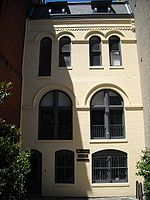
The Institute found a temporary home at 1906 Florida Avenue NW with the School of Advanced International Studies, which was founded in 1944. The two organizations were linked administratively through the Diplomatic Affairs Foundation, the parent organization of SAIS. The Institute concentrated on establishing a library, publishing the Journal, holding annual conferences and sponsoring formal courses in Middle East studies at SAIS. In 1948 the Institute decided to forge a separate corporate identity, and slowly split from SAIS, which joined The Johns Hopkins University in 1950. The break with SAIS necessitated finding a new location for the Institute. After spending a year at 2002 P Street, Keiser discovered and negotiated in late 1954 the purchase of two inter-connecting townhouses in the Dupont Circle
Dupont Circle
Dupont Circle is a traffic circle, park, neighborhood, and historic district in Northwest Washington, D.C. The traffic circle is located at the intersection of Massachusetts Avenue NW, Connecticut Avenue NW, New Hampshire Avenue NW, P Street NW, and 19th Street NW...
neighborhood at 1761-1763 N Street NW with a joint garden and carriage house. The house, formerly occupied by Senator James B. Eustis and by architect Henry Ives Cobb
Henry Ives Cobb
Henry Ives Cobb , born in Brookline, Massachusetts to Albert Adams and Mary Russell Candler Cobb, was a Chicago-based architect in the last decades of the 19th century, known for his designs in the Romanesque and Victorian Gothic styles...
, is the Institute's current location.
During the early years, the Institute was small, its membership resembling that of a club. The annual conference, held at the Friends Meeting House on Florida Avenue, brought together approximately 150 people, a close-knit group accustomed to writing short articles for the Institute's newsletter to inform fellow members about their trips to the area. Gradually, the Institute began to gain prestige, develop new functions and programs, and expand its membership. MEI now has approximately 2,500 worldwide members and the annual conference is attended regularly by 500-600 people.
By 1956, the Institute was a vibrant place. Between 1956 and 1966, there were a series of part time presidents including Edwin M. Wright
Edwin M. Wright
Edwin M. Wright is an American foreign policy specialist. Employed by the US State Department from 1945 to 1955 in a number of capacities, he was especially involved in the events leading up to and surrounding the establishment of Israel....
, James Terry Duce and Kermit Roosevelt, Jr.
Kermit Roosevelt, Jr.
Kermit "Kim" Roosevelt, Jr. , was a political action officer of the Central Intelligence Agency's Directorate of Plans who coordinated the Operation Ajax, which aimed to orchestrate a coup d’état against Iran's prime minister, Mohammed Mosaddeq, and return Mohammad Reza Pahlavi, the Shah of Iran,...
, who all served as Institute presidents in addition to their professional or business responsibilities. New projects were launched with the hope that they would be self-supporting. Among these were Lands East, an illustrated magazine, and the Middle East Report of the Week, an "insiders" newsletter which was produced on a mimeograph machine. Additional projects were financed by the Ford Foundation. A few conferences were organized for the US Department of State and the Rockefeller Foundation
Rockefeller Foundation
The Rockefeller Foundation is a prominent philanthropic organization and private foundation based at 420 Fifth Avenue, New York City. The preeminent institution established by the six-generation Rockefeller family, it was founded by John D. Rockefeller , along with his son John D. Rockefeller, Jr...
financed a series of discussion dinners. Georgetown University
Georgetown University
Georgetown University is a private, Jesuit, research university whose main campus is in the Georgetown neighborhood of Washington, D.C. Founded in 1789, it is the oldest Catholic university in the United States...
invited the Institute to hold its annual conference there, providing free accommodations and a volunteer staff. Occasional lectures were also held at the Institute.
By 1966, MEI realized that it could not survive without full time leadership. Ambassador Raymond A. Hare
Raymond A. Hare
Raymond Arthur Hare was a United States diplomat, who was Director General of the United States Foreign Service from 1954 to 1956 and Assistant Secretary of State for Near Eastern and South Asian Affairs from 1965 to 1966.-Early years, 1901—1939:...
was asked to be the first full time President of the Institute, an offer which he accepted. Hare stabilized the organization at a relatively low level of activity appropriate with its resources. He also concentrated on fundraising and expanded the base of corporate donations by doubling the number of contributors. He served until 1969.
In 1969, Ambassador Parker T. Hart
Parker T. Hart
-Biography:Parker T. Hart was born in Medford, Massachusetts on September 28, 1910. He received a B.A. from Dartmouth College in 1933, an M.A. from Harvard University in 1935, and a diploma from the Institute des Hautes Études Internationales in Geneva in 1936. He attended the Edmund A...
became president and served until 1973. Hart established new projects and promoted a variety of events at the Institute. For this purpose he hired the first Programs Director, Malcolm Pack. Together they helped organize weekend retreats and create personal meetings with Palestinian and Israeli students as well as interactions with Greek and Turkish communities in Cyprus. For the first time, MEI was conducting a wide range of programs outside of Washington, DC. Within the capital, MEI began its on-going annual conference on Middle Eastern Business as well as an internship program for undergraduate and graduate students.
During this period, MEI introduced The Middle East Monitor, an insider newsletter of sorts, published between 1971 and 1975. The Monitors logo was the source of the current MEI logo.
Between 1975 and 1986, Ambassador L. Dean Brown served as President. This was the longest presidential tenure in MEI's history, even longer than that of its founder. Under Ambassador Brown, the Institute focused mostly on business and investment opportunities between the Middle East and the United States. ( Ambassador Brown had served in Amman, Jordan during Black September, 1970 and was fond of mentioning how his son found a "Wanted" poster with his picture on it, which was distributed in Amman by the Palestinian factions opposing King Hussein. There is a well-known picture of Ambassador Brown riding a tank through the streets of Amman at that time, a tank being the only safe way to negotiate Amman's streets. )
Ambassador Lucius D. Battle
Lucius D. Battle
Lucius Durham Battle , known as Luke Battle, was a career Foreign Service officer who served with distinction in Washington, Europe and the Middle East.-Early life:...
served as MEI's President twice: once for an 18-month period (’74-’75) and again from 1986 to 1990. Under his leadership MEI absorbed the functions of the American Institute for Islamic Affairs (AIIA), dedicated the Sultan Qaboos bin Said Research Center and grew the Institute's endowment fund significantly. He and then-Vice President Ambassador Christopher Van Hollen also began a tradition of traveling throughout the Middle East to gain support for MEI's mission.
Ambassador Robert Keeley
Robert Keeley
Robert Keeley may refer to:*Robert Keeley , British composer and pianist*Robert V. Keeley , former United States Ambassador to Greece, Zimbabwe, and Mauritius*Robert Keeley , 19th-century English comedian...
succeeded Ambassador Brown and served as President until 1995. During his tenure, MEI became a leading source for information on the Gulf
Persian Gulf
The Persian Gulf, in Southwest Asia, is an extension of the Indian Ocean located between Iran and the Arabian Peninsula.The Persian Gulf was the focus of the 1980–1988 Iran-Iraq War, in which each side attacked the other's oil tankers...
region in particular, organized its first language-focused trip to the Middle East, set-up a meeting in Cairo between Israeli and Palestinian officials, and the building underwent extensive renovations.
The next man to assume this post was Ambassador Roscoe S. Suddarth
Roscoe S. Suddarth
Roscoe Seldon "Rocky" Suddarth is an American career diplomat. Suddarth was a Foreign Service Officer and served as United States Ambassador to Jordan from 1987 to 1990...
, who stayed on as President until 2001. During this time, the Foundation for Middle East Peace
Foundation for Middle East Peace
The Foundation for Middle East Peace is an American nonprofit organization that promotes peace between Israel and Palestinians via the two-state solution. The organization was established in 1979 by Merle Thorpe, Jr. Ambassador Philip C. Wilcox, Jr...
began renting space in the building (1996) and MEI celebrated its 50th anniversary.
Ambassador Edward S. Walker Jr. assumed the presidency in 2001 and left the post in 2006. While continuing MEI's tradition of hosting cultural events and discussions on a wide range of topics, Walker often highlighted America's struggle with the Arab-Israeli conflict, the challenge of global terrorism, and the situation in Iraq, focusing mostly on US foreign policy in these areas. The Sultan Qaboos Cultural Center also opened during this time.
In 2007, Ambassador Wendy Chamberlin
Wendy Chamberlin
Wendy Chamberlin is a veteran diplomat who has served in the United States Department of State and USAID, worked for the UN High Commissioner on Refugees , and now serves as President of the Middle East Institute.- US Department of State :...
, MEI's current President, became the first woman in MEI's history to hold this position. Since then she has worked to renovate MEI's facilities, improve its finances, and expand its reach.
Programs and Communications
This department organizes events that will “promote better understanding” between the people of both the US and the Middle East. In order to achieve MEI's goal, Programs hosts an annual conference, which focuses on issues of immediate relevance to the region, such as Gulf security, defense in the Middle East, the Arab-Israeli peace process and human development in the Arab world. The department organizes and publicizes weekly panels and talks featuring Middle Eastern and American policy makers, government officials, academics and professors who present their own ideas, work and analysis on a wide range of subjects. It also organizes media workshops in DC and occasional educational tours to the region.Programs and Communications also coordinates the work of MEI's many regional scholars and monitors their many media appearances in print, radio, and television. The department also coordinates online outreach and oversees website development.
Publications
The Publications Department is best known for The Middle East Journal. This quarterly publication is the only publication printed by MEI. The Publications Department issues five other electronic publications in addition to the Journal:- The MEI Bulletin: Information is given about books that are new to the library, any changes in MEI's staff, events at the Institute and issues currently being discussed and researched at the Institute.
- Policy Briefs: Analytical pieces written by MEI Scholars and other leading analysts on a broad range of issues.
- Commentaries: MEI Scholars express their opinions on current events in and related to the Middle East.
- Viewpoints: Leading experts contribute opinions to online dialogues which tackle issues of contemporary significance.
- Encounters: Short pieces in which people discuss their experiences in the Middle East. Profiles of individuals from the region are also included.
While the department publishes articles, viewpoints or analytical papers from writers with different perspectives, it emphasizes the Institute's neutral, non-partisan approach to all topics.
The Middle East Journal (MEJ) in depth
MEJ was first published in 1947, making it the oldest US peer-reviewed publication on the modern Middle East. The Journal is published quarterly and carries analyses of political, economic, and social developments as well as historical events in North AfricaNorth Africa
North Africa or Northern Africa is the northernmost region of the African continent, linked by the Sahara to Sub-Saharan Africa. Geopolitically, the United Nations definition of Northern Africa includes eight countries or territories; Algeria, Egypt, Libya, Morocco, South Sudan, Sudan, Tunisia, and...
, the Middle East, the Caucasus
Caucasus
The Caucasus, also Caucas or Caucasia , is a geopolitical region at the border of Europe and Asia, and situated between the Black and the Caspian sea...
region, and Central Asia
Central Asia
Central Asia is a core region of the Asian continent from the Caspian Sea in the west, China in the east, Afghanistan in the south, and Russia in the north...
. Each issue features articles from scholars on the Middle East, as well as book reviews and a chronology of regional events organized by topic and country for each quarter. Like the Middle East Institute, the Journal does not take policy positions and features authors from across the political spectrum and around the world. The fundamental policy of the Journal as well as of the Institute is to provide a forum that represents all views on turbulent issues facing the Middle East while maintaining a non-partisan stance.
MEI was founded by a group of diplomats and scholars whose goal was to promote the study of the region in a modern, policy-relevant context. From the outset, one of MEI's priorities was "the editing and publishing of an authoritative journal on Middle Eastern affairs.” Accordingly, the first issue of the Journal appeared in January 1947. In its "Editorial Foreword," the following mission for the new publication appeared:
- “Even though the American people may be suffering from a surfeit of periodical publications, no apology need be offered for adding a quarterly journal relating to the Middle East. Except to a very few Americans - Foreign Service and Army officers, educators, businessmen, travelers - this area is essentially terra incognita. Such a circumstance was a matter of no great practical consequence when the world was large and only loosely knit together. Now that the Middle East is very near the United States in point of time-distance and almost equally near with respect to matters of concern in American foreign policy, it deserves such thoughtful attention as can be initiated and encouraged through the pages of The Middle East Journal.”
In its early years, the Journal covered regional issues and history from the 19th and 20th Centuries. In the 1980s, however, the Journal restricted its coverage to the post-World War II era. The Journal publishes articles from a range of disciplines, including but not limited to political science, history, sociology, anthropology, and economics.
The current Editor of MEJ, Dr. Michael Collins Dunn, has been in this post since 1999.
Languages and Regional Studies
Its aim is to promote MEI’s mission through education and empowerment. This department offers evening and weekend regional studies and language classes in Arabic, Hebrew, Persian and Turkish. The classes are nationally accredited and taught by experienced native and non-native speakers. The students include people from both public and private sectors and everyone from government officials to university students. The classes are open to the general public and are taught in a seminar format or through private and group tutoring. Off-site classes at requesting institutions as well as study abroad are offered as well as training programs for teachers of Middle Eastern languages. The Director of the Department of Languages and Regional Studies is Mr. Mohamed Elmenshawy.The George Camp Keiser Library
The library, named after MEI's founder, began with the Institute's birth in 1946. It is currently housed behind MEI's main building in a carriage house which was renovated in the mid-1980s using a contribution from the Sultan of Oman.It is known to have the most considerable English language collection of literature on the Middle East in Washington outside of the Library of Congress
Library of Congress
The Library of Congress is the research library of the United States Congress, de facto national library of the United States, and the oldest federal cultural institution in the United States. Located in three buildings in Washington, D.C., it is the largest library in the world by shelf space and...
and holds materials in regional languages such as Arabic, Hebrew, Turkish and Persian. Works in the library include material covering current events, economics, history, politics, religion, and languages of the Middle East. It is estimated to house approximately 25,000 books and periodicals as well as a small DVD collection, all devoted to the region. The library is open to the public for in-house use.
Over the years, students, professors, and scholars have used the library to gather research for essays, books, and doctoral dissertations.
The library is staffed by a full-time librarian. In an effort to extend its reach beyond the DC area, online research guides and a chatting service are available.
Center for Pakistan Studies
Founded in April 2009, the Center for Pakistan Studies aims to foster closer relations between Pakistan and the US while also improving mutual understanding. While PakistanPakistan
Pakistan , officially the Islamic Republic of Pakistan is a sovereign state in South Asia. It has a coastline along the Arabian Sea and the Gulf of Oman in the south and is bordered by Afghanistan and Iran in the west, India in the east and China in the far northeast. In the north, Tajikistan...
is not part of the “traditional” Middle East, it was included in MEI's original definition of the region due to its strong ties to Middle Eastern countries as well as its connection with the US.
The center’s main focus is to create a “virtual think tank” of Pakistan experts where all Pakistanis and Americans can contribute to debates on policy issues which are important to Pakistan's relationship with the Middle East and the United States. This is done in its unique online forum.
This forum has a daily news feed as well as a collection of documents and publications from the US Government. The Center also has two main areas of study: news from Pakistan, where people may leave comments, and the main issues facing Pakistan, such as security, water and energy, political and constitutional issues, India and Kashmir, and economics. The general public may state their opinions on each of these topics. These ideas will be published in a book by the end of the 2009.
The Center is set to host an annual conference in February 2010 which will include scholars, professionals and prominent diplomats. The Director for the Center for Pakistan Studies is Dr. Nasim Ashraf.
Center for Turkish Studies
MEI established the Center for Turkish Studies in Summer 2009 to promote increased knowledge and understanding of Turkish politics, economics, and society among US policy makers as well as the American public at large. The distinctive feature of the Center for Turkish Studies is its analysis of TurkeyTurkey
Turkey , known officially as the Republic of Turkey , is a Eurasian country located in Western Asia and in East Thrace in Southeastern Europe...
within the context of its relationship with the Middle East. Through its activities, the Center for Turkish Studies aims to enhance knowledge, understanding and dialogue between the US and Turkey, provide in-depth analysis of Turkish engagement with the Middle East and provide a channel of communication for academic and policy circles in the US, Turkey and the Middle East. The head of MEI’s Center for Turkish studies is Dr.Gönül Tol.
Sultan Qaboos Cultural Center (SQCC)
The Sultan Qaboos Cultural CenterSultan Qaboos Cultural Center
The Sultan Qaboos Cultural Center is a program of the Middle East Institute , in cooperation with the Sultanate of Oman, to promote the understanding of the culture and heritage of Oman and the countries of the Arabian Peninsula...
was created in 2005 after an agreement was reached between MEI and the Government of the Sultanate of Oman. Both parties agreed to transform the Sultan Qaboos bin Said Research Center for Middle East Studies, located at MEI since the mid-1980s, into a more ambitious Sultan Qaboos Cultural Center.
SQCC adds a unique cultural dimension to MEI's initiatives, focusing on outreach programs, an informative website, educational resources and cultural partnerships that highlight Oman and the Gulf region. SQCC sponsors historical exhibits, Omani film screenings, and other cultural events at American museums and performance centers. Ambassador Elizabeth McKune serves as SQCC's Executive Director.
Executive Leadership
- General Anthony ZinniAnthony ZinniAnthony Charles Zinni is a retired four-star General in the United States Marine Corps and a former Commander in Chief of U.S. Central Command...
: Chairman of the Board - Ambassador Wendy ChamberlinWendy ChamberlinWendy Chamberlin is a veteran diplomat who has served in the United States Department of State and USAID, worked for the UN High Commissioner on Refugees , and now serves as President of the Middle East Institute.- US Department of State :...
: President - Kate SeelyeKate SeelyeKate Seelye is a journalist specializing in coverage of the Middle East. Seelye reports for NPR, and has contributed to the BBC, Channel 4, and PBS....
: Vice President of Programs and Communications