
Microsoft Message Queuing or
MSMQ is a
Message QueueIn computer science, message queues and mailboxes are software-engineering components used for interprocess communication, or for inter-thread communication within the same process. They use a queue for messaging – the passing of control or of content...
implementation developed by
MicrosoftMicrosoft Corporation is an American public multinational corporation headquartered in Redmond, Washington, USA that develops, manufactures, licenses, and supports a wide range of products and services predominantly related to computing through its various product divisions...
and deployed in its
WindowsMicrosoft Windows is a series of operating systems produced by Microsoft.Microsoft introduced an operating environment named Windows on November 20, 1985 as an add-on to MS-DOS in response to the growing interest in graphical user interfaces . Microsoft Windows came to dominate the world's personal...
Server operating systems since Windows NT 4 and
Windows 95Windows 95 is a consumer-oriented graphical user interface-based operating system. It was released on August 24, 1995 by Microsoft, and was a significant progression from the company's previous Windows products...
. The latest Windows 7 also includes this component. In addition to its mainstream server platform support, MSMQ has been incorporated into Microsoft Embedded platforms since 1999 and the release of
Windows CEMicrosoft Windows CE is an operating system developed by Microsoft for embedded systems. Windows CE is a distinct operating system and kernel, rather than a trimmed-down version of desktop Windows...
3.0.
Overview
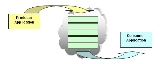
MSMQ is essentially a messaging protocol that allows applications running on separate servers/processes to communicate in a failsafe manner. A queue is a temporary storage location from which messages can be sent and received reliably, as and when conditions permit. This enables communication across heterogeneous networks and between computers which may not always be connected. By contrast,
socketsIn computer networking, an Internet socket or network socket is an endpoint of a bidirectional inter-process communication flow across an Internet Protocol-based computer network, such as the Internet....
and other network protocols assume that direct connections always exist.
MSMQ has been available to developers on Microsoft platforms since 1997, and has commonly been used in enterprise software built with Visual Studio, both in the native pre-.NET incarnation (version 5 and 6), and in Visual Studio .NET. Microsoft also has incorporated MSMQ in its messaging technology framework,
Windows Communication FoundationThe Windows Communication Foundation , previously known as "Indigo", is an application programming interface in the .NET Framework for building connected, service-oriented applications.-The architectures:...
(WCF). Under WCF, MSMQ can be used for providing secure, reliable transport with a unified programming model compatible with other communications standards.
MSMQ is responsible for reliably delivering messages between applications inside and outside the enterprise. MSMQ ensures reliable delivery by placing messages that fail to reach their intended destination in a queue and then resending them once the destination is reachable. It also supports security and priority based messaging. Dead letter queues can be created for looking at messages which timed out or failed for other reasons.
MSMQ also supports transactions. It permits multiple operations on multiple queues, with all of the operations wrapped in a single transaction, thus ensuring that either all or none of the operations will take effect. Microsoft
Distributed Transaction CoordinatorThe Distributed Transaction Coordinator service is a component of modern versions of Microsoft Windows that is responsible for coordinating transactions that span multiple resource managers, such as databases, message queues, and file systems...
(MSDTC) supports transactional access to MSMQ and other resources.
The following ports are used for Microsoft Message Queuing operations:
- TCP: 1801
- RPC: 135, 2101*, 2103*, 2105*
- UDP: 3527, 1801
* These port numbers may be incremented by 11 if the initial choice of RPC port is being used when Message Queuing initializes. Port 135 is queried to discover the 2xxx ports.
Version References
- Version 1.0 (May 1997). Supports Windows 95
Windows 95 is a consumer-oriented graphical user interface-based operating system. It was released on August 24, 1995 by Microsoft, and was a significant progression from the company's previous Windows products...
, Windows NT 4.0Windows NT 4.0 is a preemptive, graphical and business-oriented operating system designed to work with either uniprocessor or symmetric multi-processor computers. It was the next release of Microsoft's Windows NT line of operating systems and was released to manufacturing on 31 July 1996...
SP 3, Windows 98Windows 98 is a graphical operating system by Microsoft. It is the second major release in the Windows 9x line of operating systems. It was released to manufacturing on 15 May 1998 and to retail on 25 June 1998. Windows 98 is the successor to Windows 95. Like its predecessor, it is a hybrid...
and Windows MeWindows Millennium Edition, or Windows Me , is a graphical operating system released on September 14, 2000 by Microsoft, and was the last operating system released in the Windows 9x series. Support for Windows Me ended on July 11, 2006....
.
- Version 2.0, included with Windows 2000
Windows 2000 is a line of operating systems produced by Microsoft for use on personal computers, business desktops, laptops, and servers. Windows 2000 was released to manufacturing on 15 December 1999 and launched to retail on 17 February 2000. It is the successor to Windows NT 4.0, and is the...
.
- New features include: Support for registering public message queues in Active Directory
Active Directory is a directory service created by Microsoft for Windows domain networks. It is included in most Windows Server operating systems. Server computers on which Active Directory is running are called domain controllers....
, 128-bit encryption and digital certificate support, full COMComponent Object Model is a binary-interface standard for software componentry introduced by Microsoft in 1993. It is used to enable interprocess communication and dynamic object creation in a large range of programming languages...
support for message properties (achieving functional parity with the Win32 APIThe Windows API, informally WinAPI, is Microsoft's core set of application programming interfaces available in the Microsoft Windows operating systems. It was formerly called the Win32 API; however, the name "Windows API" more accurately reflects its roots in 16-bit Windows and its support on...
function calls, full DNS path name support, improved performance in multi-threaded applications.
- Version 3.0, included with Windows XP
Windows XP is an operating system produced by Microsoft for use on personal computers, including home and business desktops, laptops and media centers. First released to computer manufacturers on August 24, 2001, it is the second most popular version of Windows, based on installed user base...
(Professional, not Home Edition) and Windows Server 2003Windows Server 2003 is a server operating system produced by Microsoft, introduced on 24 April 2003. An updated version, Windows Server 2003 R2, was released to manufacturing on 6 December 2005...
.
- New features include: Internet Messaging (referencing queues via HTTP, SOAP
SOAP, originally defined as Simple Object Access Protocol, is a protocol specification for exchanging structured information in the implementation of Web Services in computer networks...
-formatted messages, MSMQ support for Internet Information ServicesInternet Information Services – formerly called Internet Information Server – is a web server application and set of feature extension modules created by Microsoft for use with Microsoft Windows. It is the most used web server after Apache HTTP Server. IIS 7.5 supports HTTP, HTTPS,...
), queue aliases, multicasting of messages, and additional support for programmatic maintenance and administration of queues and MSMQ itself.
- Version 4.0, part of Windows Vista
Windows Vista is an operating system released in several variations developed by Microsoft for use on personal computers, including home and business desktops, laptops, tablet PCs, and media center PCs...
and Windows Server 2008.
- New features include: Subqueues, improved support for "poison messages" (messages which continually fail to be processed correctly by the receiver), and support for transactional receives of messages from a remote queue.
- Version 5.0, part of Windows 7 and Windows Server 2008 R2
Windows Server 2008 R2 is a server operating system produced by Microsoft. It was released to manufacturing on July 22, 2009 and launched on October 22, 2009. According to the Windows Server Team blog, the retail availability was September 14, 2009. It is built on Windows NT 6.1, the same core...
.
- New features include: support for Secure Hash Algorithm 2.0 (SHA2) and all advanced hash algorithms that are supported in Windows 2008 R2; by default, weaker hash algorithms are disabled.
See also
- List of Microsoft Windows components
- Java Message Service
The Java Message Service API is a Java Message Oriented Middleware API for sending messages between two or more clients. JMS is a part of the Java Platform, Enterprise Edition, and is defined by a specification developed under the Java Community Process as JSR 914...
– similar technology on the JavaJava is a programming language originally developed by James Gosling at Sun Microsystems and released in 1995 as a core component of Sun Microsystems' Java platform. The language derives much of its syntax from C and C++ but has a simpler object model and fewer low-level facilities...
platform
- Amazon Simple Queue Service
Amazon Simple Queue Service is a distributed queue messaging service introduced by Amazon.com in April of 2006. It supports programmatic sending of messages via web service applications as a way to communicate over the internet...
– commoditized messaging service provided by Amazon.comAmazon.com, Inc. is a multinational electronic commerce company headquartered in Seattle, Washington, United States. It is the world's largest online retailer. Amazon has separate websites for the following countries: United States, Canada, United Kingdom, Germany, France, Italy, Spain, Japan, and...
for a per-use fee. It allows users to rent access to messaging without having to maintain their own server.
External links