

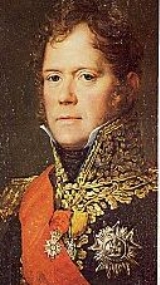
Michel Ney

Encyclopedia
Michel Ney 1st Duc d'Elchingen
, 1st Prince de la Moskowa (10 January 1769 – 7 December 1815) was a French
soldier and military commander during the French Revolutionary Wars
and the Napoleonic Wars
. He was one of the original 18 Marshals of France
created by Napoleon I
. He was known as Le Rougeaud ("red faced" or "ruddy") by his men and nicknamed le Brave des Braves ("the bravest of the brave") by Napoleon.
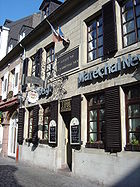 Michel Ney was born in Saarlouis
, the second son of Pierre Ney (1738–1826), a master
barrel
-cooper
and veteran of the Seven Years' War
, and of his wife Margarethe Grewelinger (1739–1791). Ney was the paternal grandson of Matthias Ney (1700–1780) and wife Margarethe Becker (d. 1767), and the maternal grandson of Valentin Grewelinger and wife Margaretha Ding. His hometown at the time of his birth comprised a French
-speaking enclave in a predominantly German
-speaking portion of Lorraine
, and Ney grew up bilingual
.
Ney was educated at the Collège des Augustins, and subsequently became a notary in Saarlouis, and then overseer of mines and forges.
did not suit Ney, and he enlisted in the Colonel-General Hussar Regiment in 1787. Ney rapidly rose through the non-commissioned ranks. He served in the Army of the North from 1792–94, with which he saw action at the Cannonade of Valmy
, the Battle of Neerwinden
, and other engagements. Ney was commissioned in October 1792, transferred to the Sambre-et-Meuse in June 1794, and wounded at the Siege of Mainz. Ney was promoted to général de brigade in August 1796, and commanded cavalry on the German Fronts. On 17 April 1797, during the battle of Neuwied, Ney led a cavalry charge against Austrian lancers trying to seize French cannons. The lancers were beaten back, but Ney’s cavalry were counter-attacked by heavy cavalry. During the mêlée, Ney was thrown from his horse and made a prisoner of war; on 8 May he was exchanged for an Austrian general. Following the capture of Mannheim
, Ney was promoted to géneral de division in March 1799. Later in 1799, Ney commanded cavalry in the armies of Switzerland and the Danube. At Winterthur
, Ney was wounded in the thigh and wrist. After Ney’s recovery he fought at Hohenlinden
under General Moreau
in December 1800. From September 1802, Ney commanded French troops in Switzerland and performed diplomatic duties.
, and was praised for his conduct at Elchingen
. In November 1805, Ney invaded the Tyrol, capturing Innsbruck
from Archduke John
. In the 1806 campaign, Ney fought at Jena
and then occupied Erfurt. Later in the campaign, Ney successfully besieged Magdeburg
. In the 1807 campaign Ney arrived with reinforcements in time to save Napoleon from defeat at Eylau
, although the battle ended as a draw. Later in the campaign, Ney fought at Güttstadt, and commanded the right wing at Friedland
. On 6 June 1808, Ney was created Duke of Elchingen. In August 1808 Ney was sent to Spain in command of VI Corps, and won a number of minor actions. In 1809 he routed an Anglo-Portuguese force under Sir Robert Wilson at Baños. In 1810 Ney joined Marshal Masséna
in the invasion of Portugal, where he took Ciudad Rodrigo
from the Spanish and Almeida
from the British and Portuguese, brusquely defeated the British on the River Côa
, and fought at Buçaco
. During the retreat from Torres Vedras, Ney worsted Wellington
's forces in a series of lauded rearguard
actions (Pombal
, Redinha
, Casal Novo
, Foz d'Aronce) with which he delayed the pursuing enemy forces enough to allow the main French force to retreat unmolested. He was ultimately removed from command for insubordination.
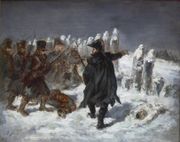
_-_marshall_ney_at_retreat_in_russia.jpg) Ney was given command of III Corps
Ney was given command of III Corps
of La Grande Armée
during the 1812 invasion of Russia. At Smolensk
, Ney was wounded in the neck, but recovered enough to later fight in the central sector at Borodino
. During the retreat from Moscow, Ney commanded the rear-guard and was anecdotally known as "the last Frenchman on Russian soil". After being cut off from the main army, Ney managed to rejoin it, which delighted Napoleon. For this action Ney was given the nickname "the bravest of the brave" by Napoleon
. Ney fought at Beresina
and helped hold the vital bridge at Kovno (modern-day Kaunas
), where legend portrays Ney as the last of the invaders to cross the bridge and exit Russia. On 25 March 1813, Ney was given the title of Prince of the Moskowa. During the 1813 campaign Ney fought at Weissenfels, was wounded at Lützen
, and commanded the left wing at Bautzen
. Ney later fought at Dennewitz
and Leipzig
, where he was again wounded. In the 1814 campaign in France, Ney fought various battles and commanded various units. At Fontainebleau
Ney became the spokesman for the Marshals' revolt on 4 April 1814, demanding Napoleon's abdication. Ney informed Napoleon that the army would not march on Paris
; Napoleon responded "the army will obey me!" to which Ney answered, "the army will obey its chiefs".
When Paris fell and the Bourbons reclaimed the throne, Ney, who had pressured Napoleon to accept his first abdication and exile, was promoted, lauded, and made a peer
by the newly enthroned Louis XVIII
. Although Ney had pledged his allegiance to the restored monarchy, the Bourbon court reacted coolly to his common origins.
On 15 June 1815, Napoleon appointed Ney commander of the left wing of the Army of the North. On 16 June Napoleon's forces split up into two wings to fight two separate battles simultaneously. Ney attacked Wellington
at Quatre Bras
(and received criticism for attacking slowly,) while Napoleon attacked Blücher's
Prussians at Ligny
. Although Ney was criticized for not capturing Quatre Bras early, there is still debate as to what time Napoleon actually ordered Ney to capture Quatre Bras. At Ligny, Napoleon ordered General d'Erlon
to move his corps (currently on Napoleon's left and Ney's right) to the Prussians' rear in order to cut off their line of retreat. D'Erlon began to move into position, but suddenly stopped and began moving away, much to the surprise and horror of Napoleon. The reason for the sudden change in movement is that Ney had ordered d'Erlon to come to his aid at Quatre Bras. Without d'Erlon's corps blocking the Prussians' line of retreat, the French victory at Ligny was not complete, and the Prussians were not routed. To be fair, Ney was d'Erlon's direct superior and Napoleon never informed Ney of his plans.
At Waterloo
Ney was again in command of the left wing of the army. At around 3:30 p.m., Ney ordered a mass cavalry charge against the Anglo-Allied line. Ney's cavalry overran the enemy cannons, but found the infantry formed in cavalry-proof square formations. Ney, without infantry or artillery support, was unable to break the squares. The action earned Ney criticism, and some argue that it led to Napoleon’s defeat at Waterloo. There is still debate as to the responsibility for the cavalry charge and why it was unsupported. Ney’s cavalry also failed to spike enemy cannons (driving an iron spike into the firing hole) while they were under French control (during a cavalry attack the crew of a cannon retreated into the squares for protection, and then re-manned their piece as the horsemen receded). Ney’s cavalry carried equipment needed to spike cannons, and spiking the cannons would likely have made them useless for the rest of the battle. The loss of a large number of cannons would weaken an army and could have caused the Anglo-Allied force to withdraw from the battle. Ney was seen during one of the charges beating his sword against the side of a British cannon in furious frustration. During the battle he had five horses killed under him.
There has been a theory that the logic of his deciding on some of his actions at Waterloo was affected by post-traumatic stress syndrome caused by his experiences in the Russian campaign.
 When Napoleon was defeated, dethroned, and exiled for the second time in the summer of 1815, Ney was arrested (on 3 August 1815), and tried (4 December 1815) for treason by the Chamber of Peers. On 6 December 1815 he was condemned, and executed by firing squad in Paris near the Luxembourg Garden on 7 December 1815 – an event that deeply divided the French public. He refused to wear a blindfold and was allowed the right to give the order to fire, reportedly saying:
Ney's execution was an example intended for Napoleon's other marshals and generals, many of whom were eventually exonerated by the Bourbon monarchy
. Ney is buried in Paris at Père Lachaise Cemetery
.
. Proponents of this theory argue that Ney had Masonic
ties, including to the Duke of Wellington
, who helped him fake his execution and flee abroad. According to this account, the soldiers in the firing squad put blood packets over his heart and then shot blanks at the Marshal. He was then smuggled to the United States and continued his life as a school teacher.
A man called Peter Stuart Ney arrived in the United States in 1816, and later taught school in North and South Carolina, including at Davidson College
, where he designed the school seal still in use. He died in 1846, reportedly after uttering the final words, "Bessières
is dead; the Old Guard
is dead; now, please, let me die." On his gravestone in Cleveland, North Carolina
, at Third Creek Presbyterian Church on Third Creek Church Road, one will find the words "(...) soldier of the French Revolution under Napoleon Bonaparte (...)." The legend gained enough ground for P.S. Ney's grave to be exhumed in 1887 and a plaster cast made of the skull by a local doctor, though it was subsequently lost. In 1936, a letter sent to TIME magazine from a Charles W. Allison from Charlotte, North Carolina, claimed that the skull had been found in the doctor's family attic by his daughter. This skull, he reported, "shows evidence of having been scarred by bullets and swords".
Another legend has Michael Rudolph
, a Continental Army
officer in the American Revolutionary War
, making his way to France after his forced resignation in 1793 and eventually becoming Ney.
on 5 August 1802 . Aglaé was the daughter of Pierre César Auguié (1738–1815) and Adélaïde Henriette Genet (1758–1794). Her paternal grandparents were Pierre César Auguié (1708–1776) and Marie Guary (1709–1788); her maternal grandparents were Edmé Jacques Genet (1726–1781) and Marie Anne Louise Cardon.
Ney and his wife had four sons:
Elchingen
Elchingen is a municipality about 7 km east of Ulm–Neu-Ulm in the district of Neu-Ulm in Bavaria, GermanyMunicipality parts:* Thalfingen: 4 211 residents, 8.83 km²* Oberelchingen: 3 024 residents, 7.31 km²...
, 1st Prince de la Moskowa (10 January 1769 – 7 December 1815) was a French
France
The French Republic , The French Republic , The French Republic , (commonly known as France , is a unitary semi-presidential republic in Western Europe with several overseas territories and islands located on other continents and in the Indian, Pacific, and Atlantic oceans. Metropolitan France...
soldier and military commander during the French Revolutionary Wars
French Revolutionary Wars
The French Revolutionary Wars were a series of major conflicts, from 1792 until 1802, fought between the French Revolutionary government and several European states...
and the Napoleonic Wars
Napoleonic Wars
The Napoleonic Wars were a series of wars declared against Napoleon's French Empire by opposing coalitions that ran from 1803 to 1815. As a continuation of the wars sparked by the French Revolution of 1789, they revolutionised European armies and played out on an unprecedented scale, mainly due to...
. He was one of the original 18 Marshals of France
Marshal of France
The Marshal of France is a military distinction in contemporary France, not a military rank. It is granted to generals for exceptional achievements...
created by Napoleon I
Napoleon I of France
Napoleon Bonaparte was a French military and political leader during the latter stages of the French Revolution.As Napoleon I, he was Emperor of the French from 1804 to 1815...
. He was known as Le Rougeaud ("red faced" or "ruddy") by his men and nicknamed le Brave des Braves ("the bravest of the brave") by Napoleon.
Early life
Saarlouis
Saarlouis is a city in the Saarland, Germany, capital of the district of Saarlouis. In 2006, the town had a population of 38,327. Saarlouis, as the name implies, is located at the river Saar....
, the second son of Pierre Ney (1738–1826), a master
Master craftsman
A master craftsman or master tradesman was a member of a guild. In the European guild system, only masters were allowed to be members of the guild....
barrel
Barrel
A barrel or cask is a hollow cylindrical container, traditionally made of vertical wooden staves and bound by wooden or metal hoops. Traditionally, the barrel was a standard size of measure referring to a set capacity or weight of a given commodity. A small barrel is called a keg.For example, a...
-cooper
Cooper (profession)
Traditionally, a cooper is someone who makes wooden staved vessels of a conical form, of greater length than breadth, bound together with hoops and possessing flat ends or heads...
and veteran of the Seven Years' War
Seven Years' War
The Seven Years' War was a global military war between 1756 and 1763, involving most of the great powers of the time and affecting Europe, North America, Central America, the West African coast, India, and the Philippines...
, and of his wife Margarethe Grewelinger (1739–1791). Ney was the paternal grandson of Matthias Ney (1700–1780) and wife Margarethe Becker (d. 1767), and the maternal grandson of Valentin Grewelinger and wife Margaretha Ding. His hometown at the time of his birth comprised a French
French language
French is a Romance language spoken as a first language in France, the Romandy region in Switzerland, Wallonia and Brussels in Belgium, Monaco, the regions of Quebec and Acadia in Canada, and by various communities elsewhere. Second-language speakers of French are distributed throughout many parts...
-speaking enclave in a predominantly German
German language
German is a West Germanic language, related to and classified alongside English and Dutch. With an estimated 90 – 98 million native speakers, German is one of the world's major languages and is the most widely-spoken first language in the European Union....
-speaking portion of Lorraine
Lorraine (province)
The Duchy of Upper Lorraine was an historical duchy roughly corresponding with the present-day northeastern Lorraine region of France, including parts of modern Luxembourg and Germany. The main cities were Metz, Verdun, and the historic capital Nancy....
, and Ney grew up bilingual
Multilingualism
Multilingualism is the act of using, or promoting the use of, multiple languages, either by an individual speaker or by a community of speakers. Multilingual speakers outnumber monolingual speakers in the world's population. Multilingualism is becoming a social phenomenon governed by the needs of...
.
Ney was educated at the Collège des Augustins, and subsequently became a notary in Saarlouis, and then overseer of mines and forges.
French Revolutionary Wars
The life as a civil servantCivil service
The term civil service has two distinct meanings:* A branch of governmental service in which individuals are employed on the basis of professional merit as proven by competitive examinations....
did not suit Ney, and he enlisted in the Colonel-General Hussar Regiment in 1787. Ney rapidly rose through the non-commissioned ranks. He served in the Army of the North from 1792–94, with which he saw action at the Cannonade of Valmy
Battle of Valmy
The Battle of Valmy was the first major victory by the army of France during the French Revolution. The action took place on 20 September 1792 as Prussian troops commanded by the Duke of Brunswick attempted to march on Paris...
, the Battle of Neerwinden
Battle of Neerwinden (1793)
The Battle of Neerwinden took place on near the village of Neerwinden in present-day Belgium between the Austrians under Prince Josias of Coburg and the French under General Dumouriez...
, and other engagements. Ney was commissioned in October 1792, transferred to the Sambre-et-Meuse in June 1794, and wounded at the Siege of Mainz. Ney was promoted to général de brigade in August 1796, and commanded cavalry on the German Fronts. On 17 April 1797, during the battle of Neuwied, Ney led a cavalry charge against Austrian lancers trying to seize French cannons. The lancers were beaten back, but Ney’s cavalry were counter-attacked by heavy cavalry. During the mêlée, Ney was thrown from his horse and made a prisoner of war; on 8 May he was exchanged for an Austrian general. Following the capture of Mannheim
Mannheim
Mannheim is a city in southwestern Germany. With about 315,000 inhabitants, Mannheim is the second-largest city in the Bundesland of Baden-Württemberg, following the capital city of Stuttgart....
, Ney was promoted to géneral de division in March 1799. Later in 1799, Ney commanded cavalry in the armies of Switzerland and the Danube. At Winterthur
Battle of Winterthur (1799)
The Battle of Winterthur was an important action between elements of the Army of the Danube and elements of the Habsburg army, commanded by Friedrich Freiherr von Hotze, during the War of the Second Coalition, part of the French Revolutionary Wars. The small town of Winterthur lies northeast of...
, Ney was wounded in the thigh and wrist. After Ney’s recovery he fought at Hohenlinden
Battle of Hohenlinden (1800)
The Battle of Hohenlinden was fought on 3 December 1800 during the French Revolutionary Wars. A French army under Jean Victor Marie Moreau won a decisive victory over the Austrians and Bavarians led by Archduke John of Austria. After being forced into a disastrous retreat, the allies were compelled...
under General Moreau
Jean Victor Marie Moreau
Jean Victor Marie Moreau was a French general who helped Napoleon Bonaparte to power, but later became a rival and was banished to the United States.- Early life :Moreau was born at Morlaix in Brittany...
in December 1800. From September 1802, Ney commanded French troops in Switzerland and performed diplomatic duties.
Napoleonic Wars
On 19 May 1804, Ney received his Marshal's baton, emblematic of his status as a Marshal of the Empire, the Napoleonic era's equivalent of Marshal of France. In the 1805 campaign Ney took command of VI Corps of La Grande ArméeLa Grande Armée
The Grande Armée first entered the annals of history when, in 1805, Napoleon I renamed the army that he had assembled on the French coast of the English Channel for the proposed invasion of Britain...
, and was praised for his conduct at Elchingen
Battle of Elchingen
The Battle of Elchingen, fought on October 14, 1805, saw French forces under Michel Ney rout an Austrian corps led by Johann Sigismund Riesch. This defeat led to a large part of the Austrian army being invested in the fortress of Ulm by the army of Emperor Napoleon I of France while other...
. In November 1805, Ney invaded the Tyrol, capturing Innsbruck
Innsbruck
- Main sights :- Buildings :*Golden Roof*Kaiserliche Hofburg *Hofkirche with the cenotaph of Maximilian I, Holy Roman Emperor*Altes Landhaus...
from Archduke John
Archduke Johann of Austria
Archduke John of Austria was a member of the Habsburg dynasty, an Austrian field marshal and German Imperial regent .-Biography:...
. In the 1806 campaign, Ney fought at Jena
Battle of Jena-Auerstedt
The twin battles of Jena and Auerstedt were fought on 14 October 1806 on the plateau west of the river Saale in today's Germany, between the forces of Napoleon I of France and Frederick William III of Prussia...
and then occupied Erfurt. Later in the campaign, Ney successfully besieged Magdeburg
Magdeburg
Magdeburg , is the largest city and the capital city of the Bundesland of Saxony-Anhalt, Germany. Magdeburg is situated on the Elbe River and was one of the most important medieval cities of Europe....
. In the 1807 campaign Ney arrived with reinforcements in time to save Napoleon from defeat at Eylau
Battle of Eylau
The Battle of Eylau or Battle of Preussisch-Eylau, 7 and 8 February 1807, was a bloody and inconclusive battle between Napoléon's Grande Armée and a Russian Empire army under Levin August, Count von Bennigsen near the town of Preußisch Eylau in East Prussia. Late in the battle, the Russians...
, although the battle ended as a draw. Later in the campaign, Ney fought at Güttstadt, and commanded the right wing at Friedland
Battle of Friedland
The Battle of Friedland saw Napoleon I's French army decisively defeat Count von Bennigsen's Russian army about twenty-seven miles southeast of Königsberg...
. On 6 June 1808, Ney was created Duke of Elchingen. In August 1808 Ney was sent to Spain in command of VI Corps, and won a number of minor actions. In 1809 he routed an Anglo-Portuguese force under Sir Robert Wilson at Baños. In 1810 Ney joined Marshal Masséna
André Masséna
André Masséna 1st Duc de Rivoli, 1st Prince d'Essling was a French military commander during the Revolutionary and Napoleonic Wars....
in the invasion of Portugal, where he took Ciudad Rodrigo
Siege of Ciudad Rodrigo (1810)
In the Siege of Ciudad Rodrigo, the French Marshal Michel Ney took the fortified city from Field Marshal Don Andrés Perez de Herrasti on 9 July 1810 after a siege that began on 26 April...
from the Spanish and Almeida
Siege of Almeida (1810)
In the Siege of Almeida, the French corps of Marshal Michel Ney captured the border fortress from Brigadier General William Cox's Portuguese garrison. This action was fought in the summer of 1810 during the Peninsular War portion of the Napoleonic Wars...
from the British and Portuguese, brusquely defeated the British on the River Côa
Battle of Coa
The Battle of the River Côa was a relatively minor battle that occurred during the Peninsular War period of the Napoleonic Wars...
, and fought at Buçaco
Battle of Buçaco
The Battle of Bussaco resulted in the defeat of French forces by Lord Wellington's Anglo-Portuguese Army, in Portugal during the Peninsular War....
. During the retreat from Torres Vedras, Ney worsted Wellington
Arthur Wellesley, 1st Duke of Wellington
Field Marshal Arthur Wellesley, 1st Duke of Wellington, KG, GCB, GCH, PC, FRS , was an Irish-born British soldier and statesman, and one of the leading military and political figures of the 19th century...
's forces in a series of lauded rearguard
Rearguard
Rearguard may refer to:* A military detachment protecting the rear of a larger military formation, especially when retreating from a pursuing enemy force. * Rear Guard , a computer game released in 1982...
actions (Pombal
Battle of Pombal
The Battle of Pombal was a sharp skirmish during Marshal Masséna's retreat from the Lines of Torres Vedras, the first in a series of lauded rearguard actions fought by Michel Ney...
, Redinha
Battle of Redinha
The Battle of Redinha was a rearguard action which took place on March 12, 1811, during Masséna's retreat from Portugal, by a French division under Marshal Ney against a considerably larger Anglo-Portuguese force under Wellington. Challenging the Allies with only one or two divisions, Ney's 7,000...
, Casal Novo
Battle of Casal Novo
The Battle of Casal Novo was a rear-guard action fought on March 14, 1811, during Massena's retreat from Portugal. During this retreat the French rear-guard, under command of Michel Ney, performed admirably in a series of sharp rear-guard actions...
, Foz d'Aronce) with which he delayed the pursuing enemy forces enough to allow the main French force to retreat unmolested. He was ultimately removed from command for insubordination.
Russia to Fontainebleau
III Corps (Grande Armée)
The III Corps of the Grande Armée were few military units during the Napoleonic Wars. The III Corps came to prominence between 1805 and 1809 under the command of Marshal Louis Nicolas Davout, when it repeatedly scored impressive victories single-handedly or in conjunction with other French forces...
of La Grande Armée
La Grande Armée
The Grande Armée first entered the annals of history when, in 1805, Napoleon I renamed the army that he had assembled on the French coast of the English Channel for the proposed invasion of Britain...
during the 1812 invasion of Russia. At Smolensk
Battle of Smolensk (1812)
The Battle of Smolensk, the first major battle of the French invasion of Russia took place on August 16–18, 1812, between 175,000 men of the Grande Armée under Napoleon Bonaparte and 130,000 Russians under Barclay de Tolly, though only about 50,000 and 60,000 respectively were actually engaged...
, Ney was wounded in the neck, but recovered enough to later fight in the central sector at Borodino
Battle of Borodino
The Battle of Borodino , fought on September 7, 1812, was the largest and bloodiest single-day action of the French invasion of Russia and all Napoleonic Wars, involving more than 250,000 troops and resulting in at least 70,000 casualties...
. During the retreat from Moscow, Ney commanded the rear-guard and was anecdotally known as "the last Frenchman on Russian soil". After being cut off from the main army, Ney managed to rejoin it, which delighted Napoleon. For this action Ney was given the nickname "the bravest of the brave" by Napoleon
Napoleon I
Napoleon Bonaparte was a French military and political leader during the latter stages of the French Revolution.As Napoleon I, he was Emperor of the French from 1804 to 1815...
. Ney fought at Beresina
Battle of Berezina
The Battle of Berezina took place November 26–29, 1812 between the French army of Napoleon, retreating after his invasion of Russia and crossing the Berezina , and the Russian armies under Mikhail Kutuzov, Peter Wittgenstein and Admiral Pavel Chichagov. The battle ended with a mixed outcome...
and helped hold the vital bridge at Kovno (modern-day Kaunas
Kaunas
Kaunas is the second-largest city in Lithuania and has historically been a leading centre of Lithuanian economic, academic, and cultural life. Kaunas was the biggest city and the center of a powiat in Trakai Voivodeship of the Grand Duchy of Lithuania since 1413. During Russian Empire occupation...
), where legend portrays Ney as the last of the invaders to cross the bridge and exit Russia. On 25 March 1813, Ney was given the title of Prince of the Moskowa. During the 1813 campaign Ney fought at Weissenfels, was wounded at Lützen
Battle of Lützen (1813)
In the Battle of Lützen , Napoleon I of France lured a combined Prussian and Russian force into a trap, halting the advances of the Sixth Coalition after his devastating losses in Russia. The Russian commander, Prince Peter Wittgenstein, attempting to undo Napoleon's capture of Leipzig, attacked...
, and commanded the left wing at Bautzen
Battle of Bautzen
In the Battle of Bautzen a combined Russian/Prussian army was pushed back by Napoleon, but escaped destruction, some sources claim, because Michel Ney failed to block their retreat...
. Ney later fought at Dennewitz
Battle of Dennewitz
The Battle of Dennewitz took place on 6 September 1813 between the forces of the First French Empire and an army of Prussians and Russians of the Sixth Coalition. It occurred in Dennewitz, a village of Germany, in the Prussian province of Brandenburg, near Jüterbog, 40 km. S.W...
and Leipzig
Battle of Leipzig
The Battle of Leipzig or Battle of the Nations, on 16–19 October 1813, was fought by the coalition armies of Russia, Prussia, Austria and Sweden against the French army of Napoleon. Napoleon's army also contained Polish and Italian troops as well as Germans from the Confederation of the Rhine...
, where he was again wounded. In the 1814 campaign in France, Ney fought various battles and commanded various units. At Fontainebleau
Fontainebleau
Fontainebleau is a commune in the metropolitan area of Paris, France. It is located south-southeast of the centre of Paris. Fontainebleau is a sub-prefecture of the Seine-et-Marne department, and it is the seat of the arrondissement of Fontainebleau...
Ney became the spokesman for the Marshals' revolt on 4 April 1814, demanding Napoleon's abdication. Ney informed Napoleon that the army would not march on Paris
Paris
Paris is the capital and largest city in France, situated on the river Seine, in northern France, at the heart of the Île-de-France region...
; Napoleon responded "the army will obey me!" to which Ney answered, "the army will obey its chiefs".
When Paris fell and the Bourbons reclaimed the throne, Ney, who had pressured Napoleon to accept his first abdication and exile, was promoted, lauded, and made a peer
Peerage
The Peerage is a legal system of largely hereditary titles in the United Kingdom, which constitute the ranks of British nobility and is part of the British honours system...
by the newly enthroned Louis XVIII
Louis XVIII of France
Louis XVIII , known as "the Unavoidable", was King of France and of Navarre from 1814 to 1824, omitting the Hundred Days in 1815...
. Although Ney had pledged his allegiance to the restored monarchy, the Bourbon court reacted coolly to his common origins.
The Hundred Days campaign
When hearing of Napoleon’s return to France, Ney, determined to keep France at peace and to show his loyalty to Louis XVIII, organized a force to stop Napoleon’s march on Paris. Ney also pledged to bring Napoleon back alive in an iron cage. Napoleon was aware of Ney’s plans and sent him a letter which said, in part, ‘I shall receive you as after the Battle of the Moskowa’. Despite Ney’s promise to the King, he joined Napoleon at Auxerre, on 18 March 1815.On 15 June 1815, Napoleon appointed Ney commander of the left wing of the Army of the North. On 16 June Napoleon's forces split up into two wings to fight two separate battles simultaneously. Ney attacked Wellington
Arthur Wellesley, 1st Duke of Wellington
Field Marshal Arthur Wellesley, 1st Duke of Wellington, KG, GCB, GCH, PC, FRS , was an Irish-born British soldier and statesman, and one of the leading military and political figures of the 19th century...
at Quatre Bras
Battle of Quatre Bras
The Battle of Quatre Bras, between Wellington's Anglo-Dutch army and the left wing of the Armée du Nord under Marshal Michel Ney, was fought near the strategic crossroads of Quatre Bras on 16 June 1815.- Prelude :...
(and received criticism for attacking slowly,) while Napoleon attacked Blücher's
Gebhard Leberecht von Blücher
Gebhard Leberecht von Blücher, Fürst von Wahlstatt , Graf , later elevated to Fürst von Wahlstatt, was a Prussian Generalfeldmarschall who led his army against Napoleon I at the Battle of the Nations at Leipzig in 1813 and at the Battle of Waterloo in 1815 with the Duke of Wellington.He is...
Prussians at Ligny
Battle of Ligny
The Battle of Ligny was the last victory of the military career of Napoleon I. In this battle, French troops of the Armée du Nord under Napoleon's command, defeated a Prussian army under Field Marshal Blücher, near Ligny in present-day Belgium. The bulk of the Prussian army survived, however, and...
. Although Ney was criticized for not capturing Quatre Bras early, there is still debate as to what time Napoleon actually ordered Ney to capture Quatre Bras. At Ligny, Napoleon ordered General d'Erlon
Jean-Baptiste Drouet, Comte d'Erlon
Jean-Baptiste Drouet, comte d'Erlon was a marshal of France and a soldier in Napoleon's Army. D'Erlon notably commanded the I Corps of the Armée du Nord at the battle of Waterloo....
to move his corps (currently on Napoleon's left and Ney's right) to the Prussians' rear in order to cut off their line of retreat. D'Erlon began to move into position, but suddenly stopped and began moving away, much to the surprise and horror of Napoleon. The reason for the sudden change in movement is that Ney had ordered d'Erlon to come to his aid at Quatre Bras. Without d'Erlon's corps blocking the Prussians' line of retreat, the French victory at Ligny was not complete, and the Prussians were not routed. To be fair, Ney was d'Erlon's direct superior and Napoleon never informed Ney of his plans.
At Waterloo
Battle of Waterloo
The Battle of Waterloo was fought on Sunday 18 June 1815 near Waterloo in present-day Belgium, then part of the United Kingdom of the Netherlands...
Ney was again in command of the left wing of the army. At around 3:30 p.m., Ney ordered a mass cavalry charge against the Anglo-Allied line. Ney's cavalry overran the enemy cannons, but found the infantry formed in cavalry-proof square formations. Ney, without infantry or artillery support, was unable to break the squares. The action earned Ney criticism, and some argue that it led to Napoleon’s defeat at Waterloo. There is still debate as to the responsibility for the cavalry charge and why it was unsupported. Ney’s cavalry also failed to spike enemy cannons (driving an iron spike into the firing hole) while they were under French control (during a cavalry attack the crew of a cannon retreated into the squares for protection, and then re-manned their piece as the horsemen receded). Ney’s cavalry carried equipment needed to spike cannons, and spiking the cannons would likely have made them useless for the rest of the battle. The loss of a large number of cannons would weaken an army and could have caused the Anglo-Allied force to withdraw from the battle. Ney was seen during one of the charges beating his sword against the side of a British cannon in furious frustration. During the battle he had five horses killed under him.
There has been a theory that the logic of his deciding on some of his actions at Waterloo was affected by post-traumatic stress syndrome caused by his experiences in the Russian campaign.
Execution
"Soldiers, when I give the command to fire, fire straight at my heart. Wait for the order. It will be my last to you. I protest against my condemnation. I have fought a hundred battles for France, and not one against her ... Soldiers, Fire!"
Ney's execution was an example intended for Napoleon's other marshals and generals, many of whom were eventually exonerated by the Bourbon monarchy
House of Bourbon
The House of Bourbon is a European royal house, a branch of the Capetian dynasty . Bourbon kings first ruled Navarre and France in the 16th century. By the 18th century, members of the Bourbon dynasty also held thrones in Spain, Naples, Sicily, and Parma...
. Ney is buried in Paris at Père Lachaise Cemetery
Père Lachaise Cemetery
Père Lachaise Cemetery is the largest cemetery in the city of Paris, France , though there are larger cemeteries in the city's suburbs.Père Lachaise is in the 20th arrondissement, and is reputed to be the world's most-visited cemetery, attracting hundreds of thousands of visitors annually to the...
.
Pretenders and legends
One of the more colorful legends of Ney that grew up after his execution was that he had managed to escape to the United StatesUnited States
The United States of America is a federal constitutional republic comprising fifty states and a federal district...
. Proponents of this theory argue that Ney had Masonic
Freemasonry
Freemasonry is a fraternal organisation that arose from obscure origins in the late 16th to early 17th century. Freemasonry now exists in various forms all over the world, with a membership estimated at around six million, including approximately 150,000 under the jurisdictions of the Grand Lodge...
ties, including to the Duke of Wellington
Arthur Wellesley, 1st Duke of Wellington
Field Marshal Arthur Wellesley, 1st Duke of Wellington, KG, GCB, GCH, PC, FRS , was an Irish-born British soldier and statesman, and one of the leading military and political figures of the 19th century...
, who helped him fake his execution and flee abroad. According to this account, the soldiers in the firing squad put blood packets over his heart and then shot blanks at the Marshal. He was then smuggled to the United States and continued his life as a school teacher.
A man called Peter Stuart Ney arrived in the United States in 1816, and later taught school in North and South Carolina, including at Davidson College
Davidson College
Davidson College is a private liberal arts college in Davidson, North Carolina. The college has graduated 23 Rhodes Scholars and is consistently ranked in the top ten liberal arts colleges in the country by U.S. News and World Report magazine, although it has recently dropped to 11th in U.S. News...
, where he designed the school seal still in use. He died in 1846, reportedly after uttering the final words, "Bessières
Jean-Baptiste Bessières
Jean-Baptiste Bessières, 1st Duc d' Istria was a Marshal of France of the Napoleonic Era. His younger brother, Bertrand, followed in his footsteps and eventually became a Divisional General...
is dead; the Old Guard
Old Guard
The Old Guard were the elite veteran elements of theEmperor Napoleon's Imperial Guard. As such it was the most prestigious formation in Napoleon's Grande Armée....
is dead; now, please, let me die." On his gravestone in Cleveland, North Carolina
Cleveland, North Carolina
Cleveland is a town in the Cleveland Township of Rowan County, North Carolina, United States. The population was 808 at the 2000 census.It is named after Cleveland, England, but it is rumored that the town is actually named after Grover Cleveland after he visited the town during his presidential...
, at Third Creek Presbyterian Church on Third Creek Church Road, one will find the words "(...) soldier of the French Revolution under Napoleon Bonaparte (...)." The legend gained enough ground for P.S. Ney's grave to be exhumed in 1887 and a plaster cast made of the skull by a local doctor, though it was subsequently lost. In 1936, a letter sent to TIME magazine from a Charles W. Allison from Charlotte, North Carolina, claimed that the skull had been found in the doctor's family attic by his daughter. This skull, he reported, "shows evidence of having been scarred by bullets and swords".
Another legend has Michael Rudolph
Michael Rudolph
Michael Rudolph was an officer in the United States Army who served as acting Adjutant General and acting Inspector General of the U.S. Army in 1793....
, a Continental Army
Continental Army
The Continental Army was formed after the outbreak of the American Revolutionary War by the colonies that became the United States of America. Established by a resolution of the Continental Congress on June 14, 1775, it was created to coordinate the military efforts of the Thirteen Colonies in...
officer in the American Revolutionary War
American Revolutionary War
The American Revolutionary War , the American War of Independence, or simply the Revolutionary War, began as a war between the Kingdom of Great Britain and thirteen British colonies in North America, and ended in a global war between several European great powers.The war was the result of the...
, making his way to France after his forced resignation in 1793 and eventually becoming Ney.
Marriage and children
Ney married Aglaé Louise Auguié (Paris, 24 March 1782 – Paris, 1 July 1854) at GrignonGrignon
Grignon may refer to:* Grignon, Côte-d'Or, commune in France* Grignon, Savoie, commune in France* Thiverval-Grignon, commune in Yvelines département, France* Institut National Agronomique Paris-Grignon, a French grande école, part of AgroParisTech....
on 5 August 1802 . Aglaé was the daughter of Pierre César Auguié (1738–1815) and Adélaïde Henriette Genet (1758–1794). Her paternal grandparents were Pierre César Auguié (1708–1776) and Marie Guary (1709–1788); her maternal grandparents were Edmé Jacques Genet (1726–1781) and Marie Anne Louise Cardon.
Ney and his wife had four sons:
- Joseph Napoléon, 2nd Prince de La Moskowa (Paris, 8 May 1803–Saint-Germain-en-LayeSaint-Germain-en-LayeSaint-Germain-en-Laye is a commune in the Yvelines department in the Île-de-France in north-central France. It is located in the western suburbs of Paris from the centre.Inhabitants are called Saint-Germanois...
, 25 July 1857). Married Albine Laffitte (Paris, 12 May 1805-Paris, 18 July 1881) in Paris on 26 January 1828, by whom he had issue. The male line of his descendants is now extinct. Joseph also had a bastard son who was married without issue. - Michel Louis Félix, recognized as 2nd Duc d'Elchingen 1826 (Paris, 24 August 1804–GallipoliGallipoliThe Gallipoli peninsula is located in Turkish Thrace , the European part of Turkey, with the Aegean Sea to the west and the Dardanelles straits to the east. Gallipoli derives its name from the Greek "Καλλίπολις" , meaning "Beautiful City"...
, during the Crimean WarCrimean WarThe Crimean War was a conflict fought between the Russian Empire and an alliance of the French Empire, the British Empire, the Ottoman Empire, and the Kingdom of Sardinia. The war was part of a long-running contest between the major European powers for influence over territories of the declining...
, 14 July 1854). He married Marie-Joséphine Souham (Luberzac, 20 December 1801–Versailles, 1 July 1889) in Paris on 19 January 1833, by whom he had issue, with the male line becoming extinct in 1969. - Eugène Michel (Paris, 12 July 1806-Paris, 25 October 1845), who died unmarried and without issue.
- Edgar Napoléon Henry, recognized as 3rd Prince de La Moskowa 1857 (Paris, 12 April 1812-Paris, 4 October 1882), who married Clotilde de La Rochelambert (Saint-CloudSaint-CloudSaint-Cloud is a commune in the western suburbs of Paris, France. It is located from the centre of Paris.Like other communes of the Hauts-de-Seine such as Marnes-la-Coquette, Neuilly-sur-Seine or Vaucresson, Saint-Cloud is one of the wealthiest cities in France, ranked 22nd out of the 36500 in...
, 27 July 1829-Paris, 24 July 1867) in Paris on 16 January 1869, but died without issue; the title of Prince de la Moskowa then reverted to Michel's issue.