


Michal Kalecki

Encyclopedia
Michał Kalecki ' was a Polish
economist
who specialized in macroeconomics
of a broadly-defined Keynesian sort. Over the course of his life, Kalecki worked at the London School of Economics
, University of Cambridge
, University of Oxford
and Warsaw School of Economics
as well as an economic advisor to governments of Cuba
, Israel
, Mexico
and India
.
Kalecki has been called “one of the most distinguished economists of the 20th century” and was regarded as "even more left-wing" than John Maynard Keynes
. It is often claimed that he developed many of the same ideas as Keynes, before Keynes; however, since he published in Polish
, he remains much less known to the English-speaking world. He was also one of the first macroeconomists to apply mathematical models and statistical data to economic questions.
was born in Łódź (Poland
) on June 22, 1899. Information about his early years of life is very sparse, part of it being lost during the Nazi occupation. In 1917 Kalecki finished a Bachelor's degree, in order to join later the University of Warsaw
, where he began civil engineering
. He was a very clever student, and in this period he formalized a generalization of Pascal's theorem
, concerning a hexagon drawn within a second degree curve. Kalecki generalized this for a polygon
of 2n sides.
However, after his father had lost a small textile
workshop, and though he obtained a job as an accountant
, the young Kalecki had to search for another job in order to earn some money. During his first year in Warsaw
he continued working sporadic jobs. After finishing his first year of engineering, he had to abandon his studies and from 1918 to 1921 he was in military service. Upon leaving the military he joined the Polytechnic
of Gdansk
, staying there until 1924. Kalecki was then 25 years old.
During these years he first approached economics
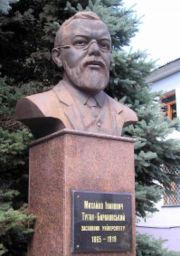
, although informally. He read mostly "unorthodox" works, particularly those of Mikhail Tugan-Baranovsky
and Rosa Luxemburg
. Years later, this early influence of these two economists would be felt in some of his own writings related to the potential growth of a capitalist system
.
 In 1924 Kalecki was about to finish his studies when his father lost his job again. This forced him to leave the university again and this time permanently, because he needed to find a better paid job. His first job (which was also economic in nature) was to collect data on companies which asked for credit. In this same period he tried unsuccessfully to start a newspaper and then was forced to write articles for two economic newspapers, the Polska gospodarcza and Przeglad gospodarczy. It was probably in writing these articles that he began to acquired skills in obtaining and analyzing empirical
information which was later included in his writings.
After five years and many articles he applied in 1929 for work at the Research Institute of Business Cycle and Prices (RIBCP). The experience he had acquired in the use of statistics got him the job. On June 18, 1930, he married Ada Szternfeld. In RIBCP he met Ludwig Landau, whose knowledge of statistics
influenced the way that years later Kalecki presented the statistical part of his works. As a result his first works had a practical character particularly in establishing relationships between macro-magnitudes.
In fact the first article that anticipated many subsequent contributions was published in 1932 in a magazine (which disappeared the same year) called Przeglad socjalistyczny (Socialist Review), under the pseudonym of Henryk Braun. The article dealt with the subject of the impact of wage cuts during an economic downturn. It was the first step towards the contributions he would make the following year.
 In 1933 Kalecki wrote an essay that brought together many of the issues which would dominate his thoughts for the rest of his life. This essay was Proba teorii koniunktury (An Essay on the Theory of the Business Cycle), which was published by the RIBCP and in which for the first time Kalecki was able to develop a comprehensive theory of business cycles. In October of the same year Kalecki read his essay to the International Econometrics Association and in 1935 published it in two major journals: Revue d’Economie Politique and Econometrica
. Although the readers of both journals were not particularly impressed, Kalecki's article received favourable comments from such leading economists as Ragnar Frisch and Jan Tinbergen
.
The following year he was granted a scholarship
, which enabled him to travel to Sweden
with his wife, where the followers of Knut Wicksell
were trying to formalize a theory similar to Kalecki's. About that time he learnt of the publication of Keynes's General Theory. This was most likely his motive for traveling to England
. He first visited the London School of Economics
and afterward went to Cambridge
. Thus began his friendship with Richard Kahn
, Joan Robinson
and Piero Sraffa
, leaving an indelible mark on all of them.
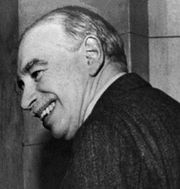
In 1937 he met John Maynard Keynes
. The meeting was cooler than expected, Keynes keeping aloof. Although the conclusions they had arrived at in their respective works were very similar, their characters could not have been more different. Kalecki very graciously neglected to mention that he enjoyed priority of publication
. As Joan Robinson
reminds us:
In 1939 Kalecki wrote one of his most important works, Essays in the Theory of Economic Fluctuations. Although his conception changed through the years, all the essential elements of Kaleckian economics were already present in this work: in a sense his subsequent work would consist of mere elaborations on ideas he had already propounded.
 In 1937 his friend Ludwig Landau was ejected from the RIBCP for political motives, which moved Kalecki to resign in protest and extend his stay abroad. But for this fortuitous fact, the war would have caught Kalecki in Poland and given his Jewish origins he would probably not have survived.
In any case, the Oxford Institute of Statistics (OIS) hired Kalecki in 1940. His job there consisted mainly of writing reports for the British Government concerning the management of the war economy
. This did not prevent him from giving the occasional lecture at Oxford University. However, despite the elaborate reports prepared by Kalecki for the Government (most of them were concerned with the operation of the rationing of goods) the economists working for the Government often disregarded these reports. They did so, among other reasons, because many economists at the OIS were refugees. In the words of G. Feiwel: “As a consequence of this void in historical reporting, Kalecki's work of the war period is far less known than it deserves to be”.
However, some of Kalecki’s major works were written during this period: in 1943 he wrote two articles, one of which dealt with new additions made to traditional business cycle theory
. The second article presented Kalecki’s completely original theory of business cycles caused by political events. The latter was published in 1944 and was based on the premise of full employment
. Actually that article was a compilation of studies by Kalecki and his colleagues at the OIS, who, however, were strongly influenced by Kalecki’s thinking.
In 1945 Kalecki left the OIS, upset because he felt that his talents were not sufficiently appreciated. Kalecki displayed great modesty about his work and did not expect to be paid splendid tribute for his accomplishments. He was offended at being discriminated against on account of his immigrant status. In fact, one reason why he left the OIS and was not appointed to a more senior position was that he had not applied to become a British subject. (“Subject” was the term then used in Britain instead of “citizen”.)
, where he stayed not long, moving to Montreal
later, where he stayed fifteen months. In July 1946 he accepted the Polish government invitation to head the Central Planning Office of the Ministry of Economics, but he left some months later. At the end of 1946 he decided to move to New York
. He liked the position offered him in the Economic Department of the United Nations Secretariat
. He remained there until 1954, allowing him to develop his work as a political advisor. As in 1945, Kalecki resigned the position as a protest signal. It was argued instead that he was punished on political grounds (a non merited economic planner stance was attributed to him). In any case, the Senator Joseph McCarthy’s witch hunt depressed him as many of his closest friends were directly affected. In 1955 he returned to Poland
and basically never went back to work abroad for any extended period.
 When he arrived in Poland, Kalecki was quite hopeful with the ability to make reforms that were socially advantageous. In 1957 he was appointed chairman of the Committee for the Perspective Plan. The plan had a horizon covering 1961 to 1975, and was basically a practical level embodiment of Kalecki's theories of growth in socialist economies. However, final plan developed by Kalecki was dismissed by board members as too gloomy and tinged as defeatist. Then things got worse, as related by G. Feiwel:
Thereafter, Kalecki spent much time of the rest of his life in teaching and research. There were however issues that he had neglected during his time at the Commission. In 1959 he began directing a seminar on the socio-economic problems of the Third World
along with Oskar Lange
and Czeslaw Bobrowski
. For him the problem was not new, having already written outstanding articles dealing with these issues thoroughly, especially those related to development.
He also devoted this period to the study of mathematics
. In fact, this was in part a continuation of the interest he had when he was young and generalized Pascal’s theorem. The investigations were in number theory
and probability
. For him these periods of time dedicated to mathematics were a release of extreme disappointment caused by the lack of power to help his country in economic policy
.
had said years before that knowledge of the laws governing the capitalist economy would make people more prosperous, happy and more responsible respect the economic decisions taken. However, Kalecki contested this view, arguing that in fact the idea of political business cycle
(governments can force situations to their advantages) seems to point in the opposite direction.
As he grew older, Kalecki was ever more convinced of this, showing an increasingly pessimistic view of humanity.
Michal Kalecki died on April 4, 1970 at the age of 70 years, and although he was bitterly disappointed with all political developments, he lived long enough to see recognized the value of his many original contributions to economics. In his last visit to Cambridge
he gave a conference where he was greatly applauded for the clearness of his explanation as well as by the trajectory of his life.
Probably one of the most moving paragraphs concerning the end of his life we owe Feiwel, an excellent summary of the life of this remarkable man:
), he often did it from a slightly unusual perspective and with original contributions.
Tthe literature written about him has tried to distil certain aspects of his work, which already can be considered almost a reference in studies on his theoretical work.
Kalecki's most famous contribution is his profit equation. Kalecki, whose early influences always came from Marxist economists, thought that the volume and profit sharing in a capitalist society were vital points to be treated. This followed from Marx's work on certain relationships such as the rate of surplus value
or the organic composition of capital
(and even a forecast about the overall trend of profits
). However, Marx was never able to make any meaningful statement about the total volume of profits in a given period.
Kalecki derived this relationship in an extremely concise, elegant and intuitive way. He starts by making simplifications which he later progressively eliminates. These assumptions are:
With these assumptions Kalecki derives the following accounting identity
:
where is the volume of gross profits (profits plus depreciation),
  is the volume of total wages,
  is capitalists consumption,
  is workers consumption and
  is the gross investment that have been made in the economy. Since we have supposed workers do not save (that is, to say
  in the preceding equation), we can simplify the two terms and arrive at:
This is the famous profits equation, which says that profits are equal to the sum of investment
and capitalist’s consumption.
At this point, Kalecki goes on to determine the causal link between the two sides of the equation: Does capitalist’s consumption and investment determine profits or profits instead determine capitalist consumption and investment? In answer to this, Kalecki says
For someone who has not seen before the preceding relationship, it might after a rigorous examination seem somewhat paradoxical. If the capitalists consume more, obviously the amount of funds which they have at the end of the year should be less. However, this reasoning, obvious the individual entrepreneur, is not true for the business class as a whole, as the consumption of one capitalist becomes part of the profits of another. In a way , they are masters of their fate.
On the other hand, we should point out that if in the preceding equation we move capitalist consumption to the left, the equation becomes:
Since profits minus capitalist’s consumption are the total saving in the economy because the workers do not save. The previous causal relationship still applies, and goes from investment to saving. That is to say, total savings are determined once investment has been determined. So, in some way, investment generates sufficient resources. Investment finances itself, so that equality between savings and investment is not caused by any interest rate mechanism as earlier economists thought.
Finally, we can eliminate the assumptions of the original equation: the economy can be open, there may be a government sector
and we can let workers save something. The resulting equation is:
In this model total profits (net taxes this time) are the sum of capitalist consumption, investment, public deficit, net external surplus (exports minus imports) minus workers savings.
Before trying to explain income distribution, Kalecki introduces some behavioural assumptions in his simplified equation of profits. For him, investment is determined by a combination of many factors difficult to explain, which are considered given, exogenous
. Regarding capitalist consumption, he considers that a simplified form is the following equation:
That is, capitalist consumption depends on a fixed part (independent part), the term , and a proportional share of profits, the term
  , which is called the marginal propensity to consume of the capitalists. If this consumption function is substituted into the profit equation, we have:
And, if we finally express in terms of , this give us:
The advantage of this manipulation is that we have reduced the two earnings determinants (capitalist’s consumption and investment) to only one (investment).
on its variable average costs (raw materials, wages of employees on the shop floor that are supposed to be variable) in order to cover their overhead
costs (salaries to senior management and administration) to obtain a certain amount of profit. The mark-up fixed by firms is higher or lower depending on the degree of monopoly, or the ease with which firms raise the price without seeing reduced the quantity demanded.
This can be summarized in the next equation:
where and
and  are respectively again profits and wages,
  is the average mark-up for the whole economy,
  is the cost of raw materials and
  is the total amount of salaries (which must be distinguished from wages, since these are variables and salaries are considered fixed).
The preceding equation allows us to derive the wage share in the national income. If we add to both members , and pass one to the other side, we have:
If we multiply each side by , and we pass to the other term, we have:
or, which is the same:
where is the wage share in the national income and
  is the relation between the cost of raw materials and wages. It follows that the wage share in the national income depends negatively on mark-up and on the relationship of raw material costs to wages.
At this point Kalecki’s interest is in finding out what’s happen to the wage share during the business cycle
. During recessions, firms collaborate among themselves to cope with the fall of profits, so the degree of monopoly
increases and this increases the mark-up. The parameter goes up. Nonetheless, the lack of demand during recessions causes a fall in the price of raw materials, so the
  parameter goes down. The argument is symmetrical during the boom: prices of raw materials rise (
 parameter increases) meanwhile the strength of unions due to increased occupation of labour causes the degree of monopoly
to fall and thereby the mark-up level. We conclude therefore that α parameter is roughly constant over the business cycle
.
Finally, we need an equation that determines the total product of an economy. We can state that:
that is simply to say that the share of profits and salaries are the complement of the share of wages. Solving for we have:
Now we have the three components necessary to determine total product: an equation of profits, a theory of income distribution and an equation that links the product with profits and income distribution. Now it only remains to substitute the equation of which we obtained before:
The preceding equation finally shows the determination of income in a closed system without public sector
. It shows that output is completely determined by investment
. How will output change from one period to the next? Insofar we have assumed that and
and  are constants, the above formula comes down to the multiplier
:
That is to say, the problem of the change in output and hence the business cycle
it is due to changes in the volume of investment
. Therefore it is in investment
where we must find the reasons for the fluctuations of a capitalist economy.
in a capitalist system
. If we can find an investment function
which somehow was well specified, then surely we could resolve many problems of the capitalist economy. This subject was treated for a long time by Kalecki, and he was never completely satisfied with his solutions. This is because the factors that determine the investment
decisions are multiple and not always are clear.
A thorough analysis of this subject would be intolerably long, so the best way to continue is to introduce the solution that Kalecki gave in one of his books.
Kalecki’s investment function
in the study of business cycles is the following:
where is the amount of investment decisions in fixed capital,
  ,
,  and
and  are parameters that specify a linear relation,
  is a constant which can vary in the long-run,
  are profits
, is the gross saving generated by the firm
, and is the stock of fixed capital
.
The previous equation shows that investment decisions depend positively on the savings generated by the firm, on the rate of change of profits and a constant subject to long-term changes, and negatively on the increase of fixed capital.
We can see that the above equation is able to generate cycles by itself. During booms, firms are able to generate more cash-flow and enjoy increases in profits. However, the increase in orders for capital investment increases the stock of capital, until it proves unprofitable to make more investments. Ultimately, the variations in the level of investment generate the business cycles. As Kalecki would say later:
published 7 volumes of the Collected Works of Michal Kalecki, referring to him as "one of the most distinguished economists of the 20th century." Many of his works were translated into English for the first time in this collection.
Kalecki's work would inspire the Cambridge (UK) Post-Keynesians - especially Joan Robinson
, Kaldor and Goodwin
, as well as modern American post-Keynesian economics.
Poland
Poland , officially the Republic of Poland , is a country in Central Europe bordered by Germany to the west; the Czech Republic and Slovakia to the south; Ukraine, Belarus and Lithuania to the east; and the Baltic Sea and Kaliningrad Oblast, a Russian exclave, to the north...
economist
Economics
Economics is the social science that analyzes the production, distribution, and consumption of goods and services. The term economics comes from the Ancient Greek from + , hence "rules of the house"...
who specialized in macroeconomics
Macroeconomics
Macroeconomics is a branch of economics dealing with the performance, structure, behavior, and decision-making of the whole economy. This includes a national, regional, or global economy...
of a broadly-defined Keynesian sort. Over the course of his life, Kalecki worked at the London School of Economics
London School of Economics
The London School of Economics and Political Science is a public research university specialised in the social sciences located in London, United Kingdom, and a constituent college of the federal University of London...
, University of Cambridge
University of Cambridge
The University of Cambridge is a public research university located in Cambridge, United Kingdom. It is the second-oldest university in both the United Kingdom and the English-speaking world , and the seventh-oldest globally...
, University of Oxford
University of Oxford
The University of Oxford is a university located in Oxford, United Kingdom. It is the second-oldest surviving university in the world and the oldest in the English-speaking world. Although its exact date of foundation is unclear, there is evidence of teaching as far back as 1096...
and Warsaw School of Economics
Warsaw School of Economics
Warsaw School of Economics is the oldest economic university in Poland.The Warsaw School of Economics was founded in 1906 as a private school under the name August Zieliński Private Trade Courses for Men. On 30 July 1919 it became a separate legal entity and was granted the status of an...
as well as an economic advisor to governments of Cuba
Cuba
The Republic of Cuba is an island nation in the Caribbean. The nation of Cuba consists of the main island of Cuba, the Isla de la Juventud, and several archipelagos. Havana is the largest city in Cuba and the country's capital. Santiago de Cuba is the second largest city...
, Israel
Israel
The State of Israel is a parliamentary republic located in the Middle East, along the eastern shore of the Mediterranean Sea...
, Mexico
Mexico
The United Mexican States , commonly known as Mexico , is a federal constitutional republic in North America. It is bordered on the north by the United States; on the south and west by the Pacific Ocean; on the southeast by Guatemala, Belize, and the Caribbean Sea; and on the east by the Gulf of...
and India
India
India , officially the Republic of India , is a country in South Asia. It is the seventh-largest country by geographical area, the second-most populous country with over 1.2 billion people, and the most populous democracy in the world...
.
Kalecki has been called “one of the most distinguished economists of the 20th century” and was regarded as "even more left-wing" than John Maynard Keynes
John Maynard Keynes
John Maynard Keynes, Baron Keynes of Tilton, CB FBA , was a British economist whose ideas have profoundly affected the theory and practice of modern macroeconomics, as well as the economic policies of governments...
. It is often claimed that he developed many of the same ideas as Keynes, before Keynes; however, since he published in Polish
Polish language
Polish is a language of the Lechitic subgroup of West Slavic languages, used throughout Poland and by Polish minorities in other countries...
, he remains much less known to the English-speaking world. He was also one of the first macroeconomists to apply mathematical models and statistical data to economic questions.
Early years: 1899-1932.
Michal KaleckiMichal Kalecki
Michał Kalecki was a Polish economist who specialized in macroeconomics of a broadly-defined Keynesian sort...
was born in Łódź (Poland
Poland
Poland , officially the Republic of Poland , is a country in Central Europe bordered by Germany to the west; the Czech Republic and Slovakia to the south; Ukraine, Belarus and Lithuania to the east; and the Baltic Sea and Kaliningrad Oblast, a Russian exclave, to the north...
) on June 22, 1899. Information about his early years of life is very sparse, part of it being lost during the Nazi occupation. In 1917 Kalecki finished a Bachelor's degree, in order to join later the University of Warsaw
University of Warsaw
The University of Warsaw is the largest university in Poland and one of the most prestigious, ranked as best Polish university in 2010 and 2011...
, where he began civil engineering
Civil engineering
Civil engineering is a professional engineering discipline that deals with the design, construction, and maintenance of the physical and naturally built environment, including works like roads, bridges, canals, dams, and buildings...
. He was a very clever student, and in this period he formalized a generalization of Pascal's theorem
Pascal's theorem
In projective geometry, Pascal's theorem states that if an arbitrary hexagon is inscribed in any conic section, and pairs of opposite sides are extended until they meet, the three intersection points will lie on a straight line, the Pascal line of that configuration.- Related results :This theorem...
, concerning a hexagon drawn within a second degree curve. Kalecki generalized this for a polygon
Polygon
In geometry a polygon is a flat shape consisting of straight lines that are joined to form a closed chain orcircuit.A polygon is traditionally a plane figure that is bounded by a closed path, composed of a finite sequence of straight line segments...
of 2n sides.
However, after his father had lost a small textile
Textile
A textile or cloth is a flexible woven material consisting of a network of natural or artificial fibres often referred to as thread or yarn. Yarn is produced by spinning raw fibres of wool, flax, cotton, or other material to produce long strands...
workshop, and though he obtained a job as an accountant
Accountant
An accountant is a practitioner of accountancy or accounting , which is the measurement, disclosure or provision of assurance about financial information that helps managers, investors, tax authorities and others make decisions about allocating resources.The Big Four auditors are the largest...
, the young Kalecki had to search for another job in order to earn some money. During his first year in Warsaw
Warsaw
Warsaw is the capital and largest city of Poland. It is located on the Vistula River, roughly from the Baltic Sea and from the Carpathian Mountains. Its population in 2010 was estimated at 1,716,855 residents with a greater metropolitan area of 2,631,902 residents, making Warsaw the 10th most...
he continued working sporadic jobs. After finishing his first year of engineering, he had to abandon his studies and from 1918 to 1921 he was in military service. Upon leaving the military he joined the Polytechnic
Polytechnic
Polytechnic may refer to:Education:* Institute of technology, and polytechnic, several types of educational institutions, including:** Polytechnic , a higher education institution...
of Gdansk
Gdansk
Gdańsk is a Polish city on the Baltic coast, at the centre of the country's fourth-largest metropolitan area.The city lies on the southern edge of Gdańsk Bay , in a conurbation with the city of Gdynia, spa town of Sopot, and suburban communities, which together form a metropolitan area called the...
, staying there until 1924. Kalecki was then 25 years old.
During these years he first approached economics
Economics
Economics is the social science that analyzes the production, distribution, and consumption of goods and services. The term economics comes from the Ancient Greek from + , hence "rules of the house"...
, although informally. He read mostly "unorthodox" works, particularly those of Mikhail Tugan-Baranovsky
Mikhail Tugan-Baranovsky
Mikhail Ivanovich Tugan-Baranovsky or Myhaylo Tuhan-Baranovsky was the Ukrainian politician, statesman, and a noted Russian-Ukrainian economist, a tutor of Nikolai Kondratiev...
and Rosa Luxemburg
Rosa Luxemburg
Rosa Luxemburg was a Marxist theorist, philosopher, economist and activist of Polish Jewish descent who became a naturalized German citizen...
. Years later, this early influence of these two economists would be felt in some of his own writings related to the potential growth of a capitalist system
System
System is a set of interacting or interdependent components forming an integrated whole....
.
Empirical
The word empirical denotes information gained by means of observation or experimentation. Empirical data are data produced by an experiment or observation....
information which was later included in his writings.
After five years and many articles he applied in 1929 for work at the Research Institute of Business Cycle and Prices (RIBCP). The experience he had acquired in the use of statistics got him the job. On June 18, 1930, he married Ada Szternfeld. In RIBCP he met Ludwig Landau, whose knowledge of statistics
Statistics
Statistics is the study of the collection, organization, analysis, and interpretation of data. It deals with all aspects of this, including the planning of data collection in terms of the design of surveys and experiments....
influenced the way that years later Kalecki presented the statistical part of his works. As a result his first works had a practical character particularly in establishing relationships between macro-magnitudes.
In fact the first article that anticipated many subsequent contributions was published in 1932 in a magazine (which disappeared the same year) called Przeglad socjalistyczny (Socialist Review), under the pseudonym of Henryk Braun. The article dealt with the subject of the impact of wage cuts during an economic downturn. It was the first step towards the contributions he would make the following year.
The revolution of Kalecki and Keynes: 1933-1939
Econometrica
Econometrica is a peer-reviewed academic journal of economics, publishing articles not only in econometrics but in many areas of economics. It is published by the Econometric Society and distributed by Wiley-Blackwell. Econometrica is one of the most highly ranked economics journals in the world...
. Although the readers of both journals were not particularly impressed, Kalecki's article received favourable comments from such leading economists as Ragnar Frisch and Jan Tinbergen
Jan Tinbergen
Jan Tinbergen , was a Dutch economist. He was awarded the first Bank of Sweden Prize in Economic Sciences in Memory of Alfred Nobel in 1969, which he shared with Ragnar Frisch for having developed and applied dynamic models for the analysis of economic processes...
.
The following year he was granted a scholarship
Scholarship
A scholarship is an award of financial aid for a student to further education. Scholarships are awarded on various criteria usually reflecting the values and purposes of the donor or founder of the award.-Types:...
, which enabled him to travel to Sweden
Sweden
Sweden , officially the Kingdom of Sweden , is a Nordic country on the Scandinavian Peninsula in Northern Europe. Sweden borders with Norway and Finland and is connected to Denmark by a bridge-tunnel across the Öresund....
with his wife, where the followers of Knut Wicksell
Knut Wicksell
Johan Gustaf Knut Wicksell was a leading Swedish economist of the Stockholm school. His economic contributions would influence both the Keynesian and Austrian schools of economic thought....
were trying to formalize a theory similar to Kalecki's. About that time he learnt of the publication of Keynes's General Theory. This was most likely his motive for traveling to England
England
England is a country that is part of the United Kingdom. It shares land borders with Scotland to the north and Wales to the west; the Irish Sea is to the north west, the Celtic Sea to the south west, with the North Sea to the east and the English Channel to the south separating it from continental...
. He first visited the London School of Economics
London School of Economics
The London School of Economics and Political Science is a public research university specialised in the social sciences located in London, United Kingdom, and a constituent college of the federal University of London...
and afterward went to Cambridge
Cambridge
The city of Cambridge is a university town and the administrative centre of the county of Cambridgeshire, England. It lies in East Anglia about north of London. Cambridge is at the heart of the high-technology centre known as Silicon Fen – a play on Silicon Valley and the fens surrounding the...
. Thus began his friendship with Richard Kahn
Richard Kahn, Baron Kahn
Richard Ferdinand Kahn, Baron Kahn, CBE, FBA was a British economist.Kahn was born in Hampstead to Augustus Kahn, a German schoolmaster and an orthodox Jew, and Regina Schoyer. He raised in England and was educated on St Paul's School, London...
, Joan Robinson
Joan Robinson
Joan Violet Robinson FBA was a post-Keynesian economist who was well known for her knowledge of monetary economics and wide-ranging contributions to economic theory...
and Piero Sraffa
Piero Sraffa
Piero Sraffa was an influential Italian economist whose book Production of Commodities by Means of Commodities is taken as founding the Neo-Ricardian school of Economics.- Early life :...
, leaving an indelible mark on all of them.
In 1937 he met John Maynard Keynes
John Maynard Keynes
John Maynard Keynes, Baron Keynes of Tilton, CB FBA , was a British economist whose ideas have profoundly affected the theory and practice of modern macroeconomics, as well as the economic policies of governments...
. The meeting was cooler than expected, Keynes keeping aloof. Although the conclusions they had arrived at in their respective works were very similar, their characters could not have been more different. Kalecki very graciously neglected to mention that he enjoyed priority of publication
Priority right
In patent, industrial design rights and trademark laws, a priority right or right of priority is a time-limited right, triggered by the first filing of an application for a patent, an industrial design or a trademark respectively...
. As Joan Robinson
Joan Robinson
Joan Violet Robinson FBA was a post-Keynesian economist who was well known for her knowledge of monetary economics and wide-ranging contributions to economic theory...
reminds us:
In 1939 Kalecki wrote one of his most important works, Essays in the Theory of Economic Fluctuations. Although his conception changed through the years, all the essential elements of Kaleckian economics were already present in this work: in a sense his subsequent work would consist of mere elaborations on ideas he had already propounded.
The war years: 1940-1945.
In any case, the Oxford Institute of Statistics (OIS) hired Kalecki in 1940. His job there consisted mainly of writing reports for the British Government concerning the management of the war economy
War economy
War economy is the term used to describe the contingencies undertaken by the modern state to mobilise its economy for war production. Philippe Le Billon describes a war economy as a "system of producing, mobilising and allocating resources to sustain the violence".Many states increase the degree of...
. This did not prevent him from giving the occasional lecture at Oxford University. However, despite the elaborate reports prepared by Kalecki for the Government (most of them were concerned with the operation of the rationing of goods) the economists working for the Government often disregarded these reports. They did so, among other reasons, because many economists at the OIS were refugees. In the words of G. Feiwel: “As a consequence of this void in historical reporting, Kalecki's work of the war period is far less known than it deserves to be”.
However, some of Kalecki’s major works were written during this period: in 1943 he wrote two articles, one of which dealt with new additions made to traditional business cycle theory
Business cycle
The term business cycle refers to economy-wide fluctuations in production or economic activity over several months or years...
. The second article presented Kalecki’s completely original theory of business cycles caused by political events. The latter was published in 1944 and was based on the premise of full employment
Employment
Employment is a contract between two parties, one being the employer and the other being the employee. An employee may be defined as:- Employee :...
. Actually that article was a compilation of studies by Kalecki and his colleagues at the OIS, who, however, were strongly influenced by Kalecki’s thinking.
In 1945 Kalecki left the OIS, upset because he felt that his talents were not sufficiently appreciated. Kalecki displayed great modesty about his work and did not expect to be paid splendid tribute for his accomplishments. He was offended at being discriminated against on account of his immigrant status. In fact, one reason why he left the OIS and was not appointed to a more senior position was that he had not applied to become a British subject. (“Subject” was the term then used in Britain instead of “citizen”.)
The postwar years: 1945-1968.
Leaving OIS, Kalecki went to ParísParis
Paris is the capital and largest city in France, situated on the river Seine, in northern France, at the heart of the Île-de-France region...
, where he stayed not long, moving to Montreal
Montreal
Montreal is a city in Canada. It is the largest city in the province of Quebec, the second-largest city in Canada and the seventh largest in North America...
later, where he stayed fifteen months. In July 1946 he accepted the Polish government invitation to head the Central Planning Office of the Ministry of Economics, but he left some months later. At the end of 1946 he decided to move to New York
New York
New York is a state in the Northeastern region of the United States. It is the nation's third most populous state. New York is bordered by New Jersey and Pennsylvania to the south, and by Connecticut, Massachusetts and Vermont to the east...
. He liked the position offered him in the Economic Department of the United Nations Secretariat
United Nations Secretariat
The United Nations Secretariat is one of the five principal organs of the United Nations and it is headed by the United Nations Secretary-General, assisted by a staff of international civil servants worldwide. It provides studies, information, and facilities needed by United Nations bodies for...
. He remained there until 1954, allowing him to develop his work as a political advisor. As in 1945, Kalecki resigned the position as a protest signal. It was argued instead that he was punished on political grounds (a non merited economic planner stance was attributed to him). In any case, the Senator Joseph McCarthy’s witch hunt depressed him as many of his closest friends were directly affected. In 1955 he returned to Poland
Poland
Poland , officially the Republic of Poland , is a country in Central Europe bordered by Germany to the west; the Czech Republic and Slovakia to the south; Ukraine, Belarus and Lithuania to the east; and the Baltic Sea and Kaliningrad Oblast, a Russian exclave, to the north...
and basically never went back to work abroad for any extended period.
Thereafter, Kalecki spent much time of the rest of his life in teaching and research. There were however issues that he had neglected during his time at the Commission. In 1959 he began directing a seminar on the socio-economic problems of the Third World
Third World
The term Third World arose during the Cold War to define countries that remained non-aligned with either capitalism and NATO , or communism and the Soviet Union...
along with Oskar Lange
Oskar Lange
Oskar Ryszard Lange was a Polish economist and diplomat...
and Czeslaw Bobrowski
Czeslaw Bobrowski
Czesław Bobrowski was a Polish economist. In postwar Poland, he was a director of Central Planning Office from 1945-1948, author of the Three-Year Plan...
. For him the problem was not new, having already written outstanding articles dealing with these issues thoroughly, especially those related to development.
He also devoted this period to the study of mathematics
Mathematics
Mathematics is the study of quantity, space, structure, and change. Mathematicians seek out patterns and formulate new conjectures. Mathematicians resolve the truth or falsity of conjectures by mathematical proofs, which are arguments sufficient to convince other mathematicians of their validity...
. In fact, this was in part a continuation of the interest he had when he was young and generalized Pascal’s theorem. The investigations were in number theory
Number theory
Number theory is a branch of pure mathematics devoted primarily to the study of the integers. Number theorists study prime numbers as well...
and probability
Probability
Probability is ordinarily used to describe an attitude of mind towards some proposition of whose truth we arenot certain. The proposition of interest is usually of the form "Will a specific event occur?" The attitude of mind is of the form "How certain are we that the event will occur?" The...
. For him these periods of time dedicated to mathematics were a release of extreme disappointment caused by the lack of power to help his country in economic policy
Economic policy
Economic policy refers to the actions that governments take in the economic field. It covers the systems for setting interest rates and government budget as well as the labor market, national ownership, and many other areas of government interventions into the economy.Such policies are often...
.
Later years 1968-1970.
John Maynard KeynesJohn Maynard Keynes
John Maynard Keynes, Baron Keynes of Tilton, CB FBA , was a British economist whose ideas have profoundly affected the theory and practice of modern macroeconomics, as well as the economic policies of governments...
had said years before that knowledge of the laws governing the capitalist economy would make people more prosperous, happy and more responsible respect the economic decisions taken. However, Kalecki contested this view, arguing that in fact the idea of political business cycle
Business cycle
The term business cycle refers to economy-wide fluctuations in production or economic activity over several months or years...
(governments can force situations to their advantages) seems to point in the opposite direction.
As he grew older, Kalecki was ever more convinced of this, showing an increasingly pessimistic view of humanity.
Michal Kalecki died on April 4, 1970 at the age of 70 years, and although he was bitterly disappointed with all political developments, he lived long enough to see recognized the value of his many original contributions to economics. In his last visit to Cambridge
Cambridge
The city of Cambridge is a university town and the administrative centre of the county of Cambridgeshire, England. It lies in East Anglia about north of London. Cambridge is at the heart of the high-technology centre known as Silicon Fen – a play on Silicon Valley and the fens surrounding the...
he gave a conference where he was greatly applauded for the clearness of his explanation as well as by the trajectory of his life.
Probably one of the most moving paragraphs concerning the end of his life we owe Feiwel, an excellent summary of the life of this remarkable man:
The profit equation
The volume of economic literature written by Kalecki during his life was very large. Although in most of his articles he returned to the same subjects (business cycles, determinants of investment or socialist planningPlanned economy
A planned economy is an economic system in which decisions regarding production and investment are embodied in a plan formulated by a central authority, usually by a government agency...
), he often did it from a slightly unusual perspective and with original contributions.
Tthe literature written about him has tried to distil certain aspects of his work, which already can be considered almost a reference in studies on his theoretical work.
Kalecki's most famous contribution is his profit equation. Kalecki, whose early influences always came from Marxist economists, thought that the volume and profit sharing in a capitalist society were vital points to be treated. This followed from Marx's work on certain relationships such as the rate of surplus value
Surplus value
Surplus value is a concept used famously by Karl Marx in his critique of political economy. Although Marx did not himself invent the term, he developed the concept...
or the organic composition of capital
Organic composition of capital
The organic composition of capital is a concept created by Karl Marx in his critique of political economy and used in Marxian economics as a theoretical alternative to neo-classical concepts of factors of production, production functions, capital productivity and capital-output ratios. Marx first...
(and even a forecast about the overall trend of profits
Profit (economics)
In economics, the term profit has two related but distinct meanings. Normal profit represents the total opportunity costs of a venture to an entrepreneur or investor, whilst economic profit In economics, the term profit has two related but distinct meanings. Normal profit represents the total...
). However, Marx was never able to make any meaningful statement about the total volume of profits in a given period.
Kalecki derived this relationship in an extremely concise, elegant and intuitive way. He starts by making simplifications which he later progressively eliminates. These assumptions are:
- Divide the whole economy into two groups: workers, who earn only wages and capitalists, who earns only profits.
- Workers do not save.
- The economy is closed (there is no international tradeInternational tradeInternational trade is the exchange of capital, goods, and services across international borders or territories. In most countries, such trade represents a significant share of gross domestic product...
) and there is no public sectorPublic sectorThe public sector, sometimes referred to as the state sector, is a part of the state that deals with either the production, delivery and allocation of goods and services by and for the government or its citizens, whether national, regional or local/municipal.Examples of public sector activity range...
.
With these assumptions Kalecki derives the following accounting identity
Accounting identity
In finance and economics, an accounting identity is an equality that must be true regardless of the value of its variables, or a statement that by definition must be true. The term is also used in economics to refer to equalities that are by definition or construction true, such as the balance of...
:

where
is the volume of gross profits (profits plus depreciation), is the volume of total wages, is capitalists consumption, is workers consumption and is the gross investment that have been made in the economy. Since we have supposed workers do not save (that is, to say in the preceding equation), we can simplify the two terms and arrive at: ,
,
This is the famous profits equation, which says that profits are equal to the sum of investment
Investment
Investment has different meanings in finance and economics. Finance investment is putting money into something with the expectation of gain, that upon thorough analysis, has a high degree of security for the principal amount, as well as security of return, within an expected period of time...
and capitalist’s consumption.
At this point, Kalecki goes on to determine the causal link between the two sides of the equation: Does capitalist’s consumption and investment determine profits or profits instead determine capitalist consumption and investment? In answer to this, Kalecki says
For someone who has not seen before the preceding relationship, it might after a rigorous examination seem somewhat paradoxical. If the capitalists consume more, obviously the amount of funds which they have at the end of the year should be less. However, this reasoning, obvious the individual entrepreneur, is not true for the business class as a whole, as the consumption of one capitalist becomes part of the profits of another. In a way , they are masters of their fate.
On the other hand, we should point out that if in the preceding equation we move capitalist consumption to the left, the equation becomes:

Since profits minus capitalist’s consumption are the total saving in the economy because the workers do not save. The previous causal relationship still applies, and goes from investment to saving. That is to say, total savings are determined once investment has been determined. So, in some way, investment generates sufficient resources. Investment finances itself, so that equality between savings and investment is not caused by any interest rate mechanism as earlier economists thought.
Finally, we can eliminate the assumptions of the original equation: the economy can be open, there may be a government sector
Public sector
The public sector, sometimes referred to as the state sector, is a part of the state that deals with either the production, delivery and allocation of goods and services by and for the government or its citizens, whether national, regional or local/municipal.Examples of public sector activity range...
and we can let workers save something. The resulting equation is:

In this model total profits (net taxes this time) are the sum of capitalist consumption, investment, public deficit, net external surplus (exports minus imports) minus workers savings.
Before trying to explain income distribution, Kalecki introduces some behavioural assumptions in his simplified equation of profits. For him, investment is determined by a combination of many factors difficult to explain, which are considered given, exogenous
Exogenous
Exogenous refers to an action or object coming from outside a system. It is the opposite of endogenous, something generated from within the system....
. Regarding capitalist consumption, he considers that a simplified form is the following equation:

That is, capitalist consumption depends on a fixed part (independent part), the term
, and a proportional share of profits, the term , which is called the marginal propensity to consume of the capitalists. If this consumption function is substituted into the profit equation, we have:
And, if we finally express in terms of
, this give us:
The advantage of this manipulation is that we have reduced the two earnings determinants (capitalist’s consumption and investment) to only one (investment).
Income distribution and the constancy of the share of wages
Income distribution is the other pillar of Kalecki’s efforts to build a business cycle theory. To do this, Kalecki assumes that the industries compete in imperfectly competitive markets, more particularly in oligopolistic markets where the firms set a mark-upMarkup (business)
Markup is the difference between the cost of a good or service and its selling price. A markup is added on to the total cost incurred by the producer of a good or service in order to create a profit. The total cost reflects the total amount of both fixed and variable expenses to produce and...
on its variable average costs (raw materials, wages of employees on the shop floor that are supposed to be variable) in order to cover their overhead
Overhead (business)
In business, overhead or overhead expense refers to an ongoing expense of operating a business...
costs (salaries to senior management and administration) to obtain a certain amount of profit. The mark-up fixed by firms is higher or lower depending on the degree of monopoly, or the ease with which firms raise the price without seeing reduced the quantity demanded.
This can be summarized in the next equation:

where
and are respectively again profits and wages, is the average mark-up for the whole economy, is the cost of raw materials and is the total amount of salaries (which must be distinguished from wages, since these are variables and salaries are considered fixed).The preceding equation allows us to derive the wage share in the national income. If we add to both members
, and pass one to the other side, we have:
If we multiply each side by
, and we pass to the other term, we have:
or, which is the same:

where
is the wage share in the national income and is the relation between the cost of raw materials and wages. It follows that the wage share in the national income depends negatively on mark-up and on the relationship of raw material costs to wages.At this point Kalecki’s interest is in finding out what’s happen to the wage share during the business cycle
Business cycle
The term business cycle refers to economy-wide fluctuations in production or economic activity over several months or years...
. During recessions, firms collaborate among themselves to cope with the fall of profits, so the degree of monopoly
Monopoly
A monopoly exists when a specific person or enterprise is the only supplier of a particular commodity...
increases and this increases the mark-up. The
parameter goes up. Nonetheless, the lack of demand during recessions causes a fall in the price of raw materials, so the parameter goes down. The argument is symmetrical during the boom: prices of raw materials rise ( parameter increases) meanwhile the strength of unions due to increased occupation of labour causes the degree of monopolyMonopoly
A monopoly exists when a specific person or enterprise is the only supplier of a particular commodity...
to fall and thereby the mark-up level. We conclude therefore that α parameter is roughly constant over the business cycle
Business cycle
The term business cycle refers to economy-wide fluctuations in production or economic activity over several months or years...
.
Finally, we need an equation that determines the total product of an economy. We can state that:

that is simply to say that the share of profits and salaries are the complement of the share of wages. Solving for
we have:
Now we have the three components necessary to determine total product: an equation of profits, a theory of income distribution and an equation that links the product with profits and income distribution. Now it only remains to substitute the equation of
which we obtained before:
The preceding equation finally shows the determination of income in a closed system without public sector
Public sector
The public sector, sometimes referred to as the state sector, is a part of the state that deals with either the production, delivery and allocation of goods and services by and for the government or its citizens, whether national, regional or local/municipal.Examples of public sector activity range...
. It shows that output is completely determined by investment
Investment
Investment has different meanings in finance and economics. Finance investment is putting money into something with the expectation of gain, that upon thorough analysis, has a high degree of security for the principal amount, as well as security of return, within an expected period of time...
. How will output change from one period to the next? Insofar we have assumed that
and are constants, the above formula comes down to the multiplierMultiplier (economics)
In economics, the fiscal multiplier is the ratio of a change in national income to the change in government spending that causes it. More generally, the exogenous spending multiplier is the ratio of a change in national income to any autonomous change in spending In economics, the fiscal...
:

That is to say, the problem of the change in output and hence the business cycle
Business cycle
The term business cycle refers to economy-wide fluctuations in production or economic activity over several months or years...
it is due to changes in the volume of investment
Investment
Investment has different meanings in finance and economics. Finance investment is putting money into something with the expectation of gain, that upon thorough analysis, has a high degree of security for the principal amount, as well as security of return, within an expected period of time...
. Therefore it is in investment
Investment
Investment has different meanings in finance and economics. Finance investment is putting money into something with the expectation of gain, that upon thorough analysis, has a high degree of security for the principal amount, as well as security of return, within an expected period of time...
where we must find the reasons for the fluctuations of a capitalist economy.
Determinants of investment
All this allow us to see the crucial role played by investmentInvestment
Investment has different meanings in finance and economics. Finance investment is putting money into something with the expectation of gain, that upon thorough analysis, has a high degree of security for the principal amount, as well as security of return, within an expected period of time...
in a capitalist system
Capitalism
Capitalism is an economic system that became dominant in the Western world following the demise of feudalism. There is no consensus on the precise definition nor on how the term should be used as a historical category...
. If we can find an investment function
Investment function
investment function is relation ship between income nd investment on businessThe investment function is a summary of the variables that influence the levels of aggregate investments...
which somehow was well specified, then surely we could resolve many problems of the capitalist economy. This subject was treated for a long time by Kalecki, and he was never completely satisfied with his solutions. This is because the factors that determine the investment
Investment
Investment has different meanings in finance and economics. Finance investment is putting money into something with the expectation of gain, that upon thorough analysis, has a high degree of security for the principal amount, as well as security of return, within an expected period of time...
decisions are multiple and not always are clear.
A thorough analysis of this subject would be intolerably long, so the best way to continue is to introduce the solution that Kalecki gave in one of his books.
Kalecki’s investment function
Investment function
investment function is relation ship between income nd investment on businessThe investment function is a summary of the variables that influence the levels of aggregate investments...
in the study of business cycles is the following:

where
is the amount of investment decisions in fixed capital, , and are parameters that specify a linear relation, is a constant which can vary in the long-run, are profitsProfit (economics)
In economics, the term profit has two related but distinct meanings. Normal profit represents the total opportunity costs of a venture to an entrepreneur or investor, whilst economic profit In economics, the term profit has two related but distinct meanings. Normal profit represents the total...
,
is the gross saving generated by the firmFirm
A firm is a business.Firm or The Firm may also refer to:-Organizations:* Hooligan firm, a group of unruly football fans* The Firm, Inc., a talent management company* Fair Immigration Reform Movement...
, and
is the stock of fixed capitalFixed capital
Fixed capital is a concept in economics and accounting, first theoretically analysed in some depth by the economist David Ricardo. It refers to any kind of real or physical capital that is not used up in the production of a product and is contrasted with circulating capital such as raw materials,...
.
The previous equation shows that investment decisions depend positively on the savings generated by the firm, on the rate of change of profits and a constant subject to long-term changes, and negatively on the increase of fixed capital.
We can see that the above equation is able to generate cycles by itself. During booms, firms are able to generate more cash-flow and enjoy increases in profits. However, the increase in orders for capital investment increases the stock of capital, until it proves unprofitable to make more investments. Ultimately, the variations in the level of investment generate the business cycles. As Kalecki would say later:
Influence
In the first half of the 1990s, Oxford University PressOxford University Press
Oxford University Press is the largest university press in the world. It is a department of the University of Oxford and is governed by a group of 15 academics appointed by the Vice-Chancellor known as the Delegates of the Press. They are headed by the Secretary to the Delegates, who serves as...
published 7 volumes of the Collected Works of Michal Kalecki, referring to him as "one of the most distinguished economists of the 20th century." Many of his works were translated into English for the first time in this collection.
Kalecki's work would inspire the Cambridge (UK) Post-Keynesians - especially Joan Robinson
Joan Robinson
Joan Violet Robinson FBA was a post-Keynesian economist who was well known for her knowledge of monetary economics and wide-ranging contributions to economic theory...
, Kaldor and Goodwin
Richard M. Goodwin
Richard M. Goodwin was an American mathematician and economist. He was born in Indiana.Goodwin received his BA and PhD at Harvard, and he taught there from 1942 until 1950. He taught at the University of Cambridge until 1979 and the University of Siena until 1984.Goodwin worked on the interaction...
, as well as modern American post-Keynesian economics.
In Polish
- Próba teorii koniunktury (1933)
- Szacunek dochodu społecznego w roku 1929 (1934, z Ludwikiem Landauem)
- Dochód społeczny w roku 1933 i podstawy badań periodycznych nad zmianami dochodu (1935, z Landauem)
- Teoría cyklu koniunkturalnego (1935)
- Płace nominalne i realne (1939)
- Teoría dynamiki gospodarczej (1958)
- Zagadnienia finansowania rozwoju ekonomicznego (1959, w: Problemy wzrostu ekonomicznych krajów słabo rozwiniętych pod redakcją Ignacego Sachsa i Jerzego Zdanowicza)
- Uogólnienie wzoru efektywności inwestycji (1959, z Mieczysławem Rakowskim)
- Polityczne aspekty pełnego zatrudnienia (1961)
- O podstawowych zasadach planowania wieloletniego (1963)
- Zarys teorii wzrostu gospodarki socjalistycznej (1963)
- Model ekonomiczny a materialistyczne pojmowanie dziejów (1964)
- Dzieła (1979–1980, 2 tomy)
In English
- "Mr Keynes's Predictions", 1932, Przegląd Socjalistyczny.
- An Essay on the Theory of the Business Cycle (Próba teorii koniunktury), 1933.
- "On foreign trade and domestic exports", 1933, Ekonomista.
- "Essai d'une theorie du mouvement cyclique des affaires", 1935, Revue d'economie politique.
- "A Macrodynamic Theory of Business Cycles", 1935, Econometrica.
- "The Mechanism of Business Upswing" (El mecanismo del auge económico), 1935, Polska Gospodarcza.
- "Business upswing and the balance of payments" (El auge económico y la balanza de pagos), 1935, Polska Gospodarcza.
- "Some Remarks on Keynes's Theory", 1936, Ekonomista.
- "A Theory of the Business Cycle", 1937, Review of Economic Studies.
- "A Theory of Commodity, Income and Capital Taxation", 1937, Economic Journal.
- "The Principle of Increasing Risk", 1937, Económica.
- "The Determinants of Distribution of the National Income", 1938, Econometrica.
- Essays in the Theory of Economic Fluctuations, 1939.
- "A Theory of Profits", 1942, Economic Journal.
- Studies in Economic Dynamics, 1943.
- "Political Aspects of Full Employment", 1943, Political Quarterly.
- Economic Implications of the Beveridge Plan (1943)
- "Professor Pigou on the Classical Stationary State", 1944, Economic Journal.
- "Three Ways to Full Employment", 1944 in Economics of Full Employment.
- "A Note on Long Run Unemployment", 1950, Review of Economic Studies.
- Theory of Economic Dynamics: An essay on cyclical and long- run changes in capitalist economy, 1954.
- "Observations on the Theory of Growth", 1962, Economic Journal.
- Studies in the Theory of Business Cycles, 1933-1939, 1966.
- "The Problem of Effective Demand with Tugan-Baranovski and Rosa Luxemburg", 1967, Ekonomista.
- "The Marxian Equations of Reproduction and Modern Economics", 1968, Social Science Information.
- "Trend and the Business Cycle", 1968, Economic Journal.
- "Class Struggle and the Distribution of National Income" (Lucha de clases y distribución del ingreso), 1971, Kyklos.
- Selected Essays on the Dynamics of the Capitalist Economy, 1933–1970, 1971.
- Selected Essays on the Economic Growth of the Socialist and the Mixed Economy, 1972.
- The Last Phase in the Transformation of Capitalism, 1972.
- Essays on Developing Economies, 1976.
- Collected Works of Michał Kalecki (seven volumes..), Oxford University Press, 1990-1997.
In Spanish
- Teoría de la dinámica económica: ensayo sobre los movimientos cíclicos y a largo plazo de la economía capitalista, Fondo de Cultura Económica, 1956
- El Desarrollo de la Economía Socialista, Fondo de Cultura Económica, 1968
- Estudios sobre la Teoría de los Ciclos Económicos, Ariel, 1970
- Economía socialista y mixta: selección de ensayos sobre crecimiento económico, Fondo de Cultura Económica, 1976
- Ensayos escogidos sobre dinámica de la economía capitalista 1933-1970, Fondo de Cultura Económica, 1977
- Ensayos sobre las economías en vías de desarrollo, Crítica, 1980
External links
- Biography
- Kalecki Distribution Cycle
- Peter Kriesler's Keynes, Kalecki and the General Theory"
- Peter Kriesler's "Microfoundations: A Kaleckian perspective"
- Malcolm Sawyer's "The Kaleckian Analysis and the New Mellium"
- Review (by Gary Dymski) of Sebastiani's book, Kalecki and Unemployment Equilibrium in JEL
- Alberto Chilosi "Kalecki's Theory of Income Determination: A Reconstruction and an Assessment"