

Michal

Encyclopedia
Michal was a daughter of Saul
, king of Israel, who loved and became the wife of David
, who later became king of Judah, and later still of the united Kingdom of Israel.
Their story is recorded in the Book of Samuel
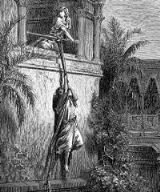
. It is recorded that she chose the welfare of David over the wishes of her father. When Saul's messengers were searching for David in order to kill him, Michal secretly sent him away while pretending he was ill and laid up in bed. She let David down through a window and hid teraphim
in his bed as a ruse.
Whilst David was hiding for his life, Saul gave Michal as a wife to Palti, son of Laish, and David took several other wives, including Abigail
. Later when David became king of Judah and Ish-bosheth
Michal's brother (and Saul's son) was king of Israel, David demanded her return to him, in return for peace between them. This Ish-bosheth did, despite the public protests of Palti.
These events have raised moral issues within Judaism, especially in the context of the prohibition in . On the one hand, some argue that it is prohibited to re-establish a marriage with a previous spouse who has subsequently remarried. On the other hand, other commentators explain that David had not divorced Michal at this point in time, but rather Saul acted to break their marriage by marrying her off to another without David's consent. On that view, they were not technically divorced as David had not issued a writ of divorcement according to biblical law.
After Michal was back with David, she criticized David because he danced, partially unclothed out of spite of her and her new covering, as he brought the Ark of the Covenant
to the newly-captured Jerusalem in a religious procession. Michal died barren and childless, as stated in . Steven McKenzie, author of King David: A Biography, suggests that David prevented Michal and her other surviving relatives, such as Meribaal
, from having children in order to extinguish the line of Saul and deny potential rivals to the throne.
The appearance of contradiction concerning Michal dying childless appears in where there is mention of "the five sons of Michal the daughter of Saul". However, the full phrase in 2 Samuel 21:8 is "the five sons of Michal the daughter of Saul, whom she brought up for Adriel the son of Barzillai the Meholathite". Now, Merab, Michal's older sister, was the wife of Adriel . These five sons were not birthed by Michal but were brought up or educated by Michal after Merab perhaps had died. Merab brought them forth, and Michal brought them up.
Unlike Abigail
and Bathsheba
, Michal is not described as being beautiful, although according to Louis Ginzberg
, the Rabbinic tradition is that she was of "entrancing beauty."
"Like you I am sad, O Michal ... and like you doomed to love a man whom I despise." (Poem "Michal" in her book Flowers of Perhaps.)
, very rarely found in pre-Zionist communities. It is a very common female first name in contemporary Israel
. Michal is not a form of Michael
, but possibly means "brook," or "stream."
Saul
-People:Saul is a given/first name in English, the Anglicized form of the Hebrew name Shaul from the Hebrew Bible:* Saul , including people with this given namein the Bible:* Saul , a king of Edom...
, king of Israel, who loved and became the wife of David
David
David was the second king of the united Kingdom of Israel according to the Hebrew Bible and, according to the Gospels of Matthew and Luke, an ancestor of Jesus Christ through both Saint Joseph and Mary...
, who later became king of Judah, and later still of the united Kingdom of Israel.
Their story is recorded in the Book of Samuel
Books of Samuel
The Books of Samuel in the Jewish bible are part of the Former Prophets, , a theological history of the Israelites affirming and explaining the Torah under the guidance of the prophets.Samuel begins by telling how the prophet Samuel is chosen by...
. It is recorded that she chose the welfare of David over the wishes of her father. When Saul's messengers were searching for David in order to kill him, Michal secretly sent him away while pretending he was ill and laid up in bed. She let David down through a window and hid teraphim
Teraphim
Teraphim is a Hebrew word from the Bible, found only in the plural, of uncertain etymology. Despite being plural, Teraphim may refer to singular objects, using the Hebrew plural of excellence...
in his bed as a ruse.
Whilst David was hiding for his life, Saul gave Michal as a wife to Palti, son of Laish, and David took several other wives, including Abigail
Abigail
Abigail was the wife of Nabal; she became a wife of David after Nabal's death .In the passage, Nabal demonstrates ingratitude towards David, and Abigail attempts to placate David in order to stop him taking revenge...
. Later when David became king of Judah and Ish-bosheth
Ish-bosheth
According to the Hebrew Bible, Ish-bosheth also called Eshbaal , Ashbaal or Ishbaal, was one of the four sons of King Saul, born c. 1047 BC...
Michal's brother (and Saul's son) was king of Israel, David demanded her return to him, in return for peace between them. This Ish-bosheth did, despite the public protests of Palti.
These events have raised moral issues within Judaism, especially in the context of the prohibition in . On the one hand, some argue that it is prohibited to re-establish a marriage with a previous spouse who has subsequently remarried. On the other hand, other commentators explain that David had not divorced Michal at this point in time, but rather Saul acted to break their marriage by marrying her off to another without David's consent. On that view, they were not technically divorced as David had not issued a writ of divorcement according to biblical law.
After Michal was back with David, she criticized David because he danced, partially unclothed out of spite of her and her new covering, as he brought the Ark of the Covenant
Ark of the Covenant
The Ark of the Covenant , also known as the Ark of the Testimony, is a chest described in Book of Exodus as solely containing the Tablets of Stone on which the Ten Commandments were inscribed...
to the newly-captured Jerusalem in a religious procession. Michal died barren and childless, as stated in . Steven McKenzie, author of King David: A Biography, suggests that David prevented Michal and her other surviving relatives, such as Meribaal
Mephibosheth
Mephibosheth was the name of two men of the family of Saul, who is stated in the books of Samuel of the Hebrew Bible to have been the first king of ancient Israel:...
, from having children in order to extinguish the line of Saul and deny potential rivals to the throne.
The appearance of contradiction concerning Michal dying childless appears in where there is mention of "the five sons of Michal the daughter of Saul". However, the full phrase in 2 Samuel 21:8 is "the five sons of Michal the daughter of Saul, whom she brought up for Adriel the son of Barzillai the Meholathite". Now, Merab, Michal's older sister, was the wife of Adriel . These five sons were not birthed by Michal but were brought up or educated by Michal after Merab perhaps had died. Merab brought them forth, and Michal brought them up.
Unlike Abigail
Abigail
Abigail was the wife of Nabal; she became a wife of David after Nabal's death .In the passage, Nabal demonstrates ingratitude towards David, and Abigail attempts to placate David in order to stop him taking revenge...
and Bathsheba
Bathsheba
According to the Hebrew Bible, Bathsheba was the wife of Uriah the Hittite and later of David, king of the United Kingdom of Israel and Judah. She is most known for the Bible story in which King David seduced her....
, Michal is not described as being beautiful, although according to Louis Ginzberg
Louis Ginzberg
Rabbi Louis Ginzberg was a Talmudist and leading figure in the Conservative Movement of Judaism of the twentieth century. He was born on November 28, 1873, in Kovno, Lithuania; he died on November 11, 1953, in New York City.-Biographical background:...
, the Rabbinic tradition is that she was of "entrancing beauty."
Michal in poetry
- The Israeli poet Ra'hel Bluwstein sees a parallel between herself and Michal:
"Like you I am sad, O Michal ... and like you doomed to love a man whom I despise." (Poem "Michal" in her book Flowers of Perhaps.)
- "Michal"
- “And Michal, Saul’s daughter, loved David
- And she despised him in her heart”
-
- Michal, distant sister, time’s thread has not been severed,
- time’s thorns in your sad vineyard have not prevailed.
- Still in my ear I hear the tinkling of your gold anklet,
- the stripes in your silk garment have not paled.
-
- Often I have seen you standing by your small window
- pride and tenderness mingling in your eyes.
- Like you I am sad, O Michal, distant sister, and like you doomed to
- love a man whom I despise.
- Or alternatively translated:
- "Michal"
- Though years divide, we’re sisters yet;
- Your vineyard stands though weeds invade;
- Still tinkle anklet, amulet;
- Your red silk garment does not fade.
-
- By a small window still you stand,
- Proud but a death within your eyes.
- My sister, I can understand –
- Who also love whom I despise.
-
-
- 1927, Israel
- Translated by Robert Friend
-
Use as a name
"Michal" was one of the Biblical names embraced by ZionismZionism
Zionism is a Jewish political movement that, in its broadest sense, has supported the self-determination of the Jewish people in a sovereign Jewish national homeland. Since the establishment of the State of Israel, the Zionist movement continues primarily to advocate on behalf of the Jewish state...
, very rarely found in pre-Zionist communities. It is a very common female first name in contemporary Israel
Israel
The State of Israel is a parliamentary republic located in the Middle East, along the eastern shore of the Mediterranean Sea...
. Michal is not a form of Michael
Michael
Michael is a given name that comes from the , derived from the Hebrew question מי כמו אלוהים? meaning "Who is like God?" In English, it is sometimes shortened to Mike, Mikey, or, especially in Ireland, Mick...
, but possibly means "brook," or "stream."