
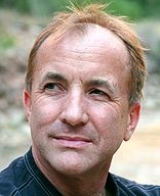
Michael Brant Shermer is an American science writer, historian of science, founder of
The Skeptics SocietyThe Skeptics Society is a nonprofit, member-supported organization devoted to promoting scientific skepticism and resisting the spread of pseudoscience, superstition, and irrational beliefs. The Skeptics Society was originally founded as a Los Angeles-area skeptical group to replace the defunct...
, and Editor in Chief of its magazine
SkepticSkeptic is a quarterly science education and science advocacy magazine published internationally by The Skeptics Society, a nonprofit organization devoted to promoting scientific skepticism and resisting the spread of pseudoscience, superstition, and irrational beliefs...
, which is largely devoted to investigating
pseudoscientificPseudoscience is a claim, belief, or practice which is presented as scientific, but which does not adhere to a valid scientific method, lacks supporting evidence or plausibility, cannot be reliably tested, or otherwise lacks scientific status...
and
supernaturalThe supernatural or is that which is not subject to the laws of nature, or more figuratively, that which is said to exist above and beyond nature...
claims. The Skeptics Society currently has over 55,000 members. Shermer also engages in debates on topics pertaining to pseudoscience and religion, in which he promulgates the need for scientific skepticism, expresses his views on those topics from that perspective.
Shermer is also the producer and co-host of the 13-hour
Fox Family (now ABC Family)ABC Family, stylized as abc family, is an American television network, owned by ABC Family Worldwide Inc., a subsidiary of the Disney-ABC Television Group division of The Walt Disney Company...
televisionTelevision is a telecommunication medium for transmitting and receiving moving images that can be monochrome or colored, with accompanying sound...
series Exploring the Unknown. Since April 2001, he has been a monthly columnist for
Scientific AmericanScientific American is a popular science magazine. It is notable for its long history of presenting science monthly to an educated but not necessarily scientific public, through its careful attention to the clarity of its text as well as the quality of its specially commissioned color graphics...
magazine with his Skeptic column. Shermer states he was once a
fundamentalist ChristianChristian fundamentalism, also known as Fundamentalist Christianity, or Fundamentalism, arose out of British and American Protestantism in the late 19th century and early 20th century among evangelical Christians...
, but converted from a
beliefBelief is the psychological state in which an individual holds a proposition or premise to be true.-Belief, knowledge and epistemology:The terms belief and knowledge are used differently in philosophy....
in God during his graduate studies, and has described himself as an agnostic, nontheist, atheist and advocate for
humanistHumanism is an approach in study, philosophy, world view or practice that focuses on human values and concerns. In philosophy and social science, humanism is a perspective which affirms some notion of human nature, and is contrasted with anti-humanism....
philosophy as well as the
science of moralityScience of morality can refer to a number of ethically naturalistic views. Historically, the term was introduced by Jeremy Bentham . In meta-ethics, ethical naturalism bases morality on rational and empirical consideration of the natural world...
. He has expressed reservations about such labels, however, as he sees them being used in the service of 'pigeonholing,' and prefers to simply be called a skeptic.
Early life, education and career
Shermer was born on September 8, 1954, and raised in
Southern CaliforniaSouthern California is a megaregion, or megapolitan area, in the southern area of the U.S. state of California. Large urban areas include Greater Los Angeles and Greater San Diego. The urban area stretches along the coast from Ventura through the Southland and Inland Empire to San Diego...
. His parents divorced when he was four. Both of his parents remarried, his mother to a man with three children, who became Shermer's stepsiblings, and his father to a woman with whom he had two daughters, Shermer's half-sisters. His father would later die of a heart attack in 1986, and his mother of brain cancer in 2000.
Although Shermer went to Sunday school, he says that neither his biological nor stepparents or siblings were religious nor non-religious, as they did not hold much discussion on the topic, and did not attend church nor pray together. In 1971, at the beginning of his senior year in high school, Shermer announced he was a Born Again Christian, which came about through the influence of his best friend, George. For the next seven years he would evangelize door-to-door as part of his profoundly held beliefs.
He graduated from
Crescenta Valley High SchoolCrescenta Valley High School is a secondary school located at 2900 Community Avenue in La Crescenta-Montrose, an unincorporated community in Los Angeles County, California, United States. The school is a part of the Glendale Unified School District....
in 1972. He began his undergraduate studies at
Pepperdine UniversityPepperdine University is an independent, private, medium-sized university affiliated with the Churches of Christ. The university's campus overlooking the Pacific Ocean in unincorporated Los Angeles County, California, United States, near Malibu, is the location for Seaver College, the School of...
, initially majoring in
ChristianA Christian is a person who adheres to Christianity, an Abrahamic, monotheistic religion based on the life and teachings of Jesus of Nazareth as recorded in the Canonical gospels and the letters of the New Testament...
theologyTheology is the systematic and rational study of religion and its influences and of the nature of religious truths, or the learned profession acquired by completing specialized training in religious studies, usually at a university or school of divinity or seminary.-Definition:Augustine of Hippo...
, later switching to
psychologyPsychology is the study of the mind and behavior. Its immediate goal is to understand individuals and groups by both establishing general principles and researching specific cases. For many, the ultimate goal of psychology is to benefit society...
. He completed his
bachelor's degreeA bachelor's degree is usually an academic degree awarded for an undergraduate course or major that generally lasts for three or four years, but can range anywhere from two to six years depending on the region of the world...
in
psychologyPsychology is the study of the mind and behavior. Its immediate goal is to understand individuals and groups by both establishing general principles and researching specific cases. For many, the ultimate goal of psychology is to benefit society...
/
biologyBiology is a natural science concerned with the study of life and living organisms, including their structure, function, growth, origin, evolution, distribution, and taxonomy. Biology is a vast subject containing many subdivisions, topics, and disciplines...
at Pepperdine in 1976.
Shermer's graduate studies in experimental psychology at
California State University, FullertonCalifornia State University, Fullerton is a public university located in Fullerton, California. It is the largest institution in the CSU System by enrollment, it offers long-distance education and adult-degree programs...
, led to many after-class discussions with professors Bayard Brattstrom and Meg White. These, along with his studies in
ethologyEthology is the scientific study of animal behavior, and a sub-topic of zoology....
and
cultural anthropologyCultural anthropology is a branch of anthropology focused on the study of cultural variation among humans, collecting data about the impact of global economic and political processes on local cultural realities. Anthropologists use a variety of methods, including participant observation,...
, led to him to question his religious beliefs, and by mid-way through his graduate training, he removed the Christian
ichthysIchthys, from Koine Greek: , is the Greek word for "fish"....
that he had been wearing around his neck. Shermer completed his
master's degreeA master's is an academic degree granted to individuals who have undergone study demonstrating a mastery or high-order overview of a specific field of study or area of professional practice...
from California State University in
experimental psychologyExperimental psychology is a methodological approach, rather than a subject, and encompasses varied fields within psychology. Experimental psychologists have traditionally conducted research, published articles, and taught classes on neuroscience, developmental psychology, sensation, perception,...
in 1978.
Shermer began competitive bicycling in 1979, and spent a decade in the sport. During the course of his cycling, Shermer worked with cycling technologists in developing better products for the sport. During his association with Bell Helmets, a bicycle-race sponsor, Shermer advised them on design issues regarding their development of expanded-polystyrene for use in
cycling helmetsA bicycle helmet is a helmet intended to be worn while riding a bicycle. They are designed to attenuate impacts to the skull of a cyclist in falls while minimizing side effects such as interference with peripheral vision...
, which would absorb impact far better than the old leather "hairnet" helmets used by bicyclists for decades. Shermer advised them that if their helmets looked too much like motorcycle helmets, in which polystyrene was already being used, and not like the old hairnet helmets, that no serious cyclists or amateur would use them. This suggestion led to their first model, the V1 Pro, which looked like a black leather hairnet, but functioned on the inside like a motorcycle helmet. In 1982, Shermer worked with Dr. Wayman Spence, whose small supply company, Spenco Medical, adapted the gel technology Spence developed for bedridden patients with pressure sores into cycling gloves and saddles to alleviate the
carpal tunnel syndromeCarpal Tunnel Syndrome is an entrapment idiopathic median neuropathy, causing paresthesia, pain, and other symptoms in the distribution of the median nerve due to its compression at the wrist in the carpal tunnel. The pathophysiology is not completely understood but can be considered compression...
and saddle sores suffered by cyclists.
During the decade in which he raced long distances, he helped to found the 3,000-mile nonstop transcontinental bicycle
Race Across AmericaThe Race Across America, or RAAM, is an ultra marathon bicycle race across the United States that started in 1982 as the Great American Bike Race....
(along with Lon Haldeman and John Marino), in which he competed five times (1982, 1983, 1984, 1985, 1989), was assistant race director six years, and executive race director seven years. An acute medical condition is named for him: "Shermer's neck" is pain in and extreme weakness of the neck muscles found among long-distance bicyclists. Shermer suffered the condition during the 1983 Race Across America. Shermer's embrace of
scientific skepticismScientific skepticism is the practice of questioning the veracity of claims lacking empirical evidence or reproducibility, as part of a methodological norm pursuing "the extension of certified knowledge". For example, Robert K...
crystallized during his time as a cyclist, explaining, "I became a skeptic on Saturday, August 6, 1983, on the long climbing road to Loveland Pass, Colorado" after months of training under the guidance of a "nutritionist" with an unaccredited Ph.D. After years of practicing
acupunctureAcupuncture is a type of alternative medicine that treats patients by insertion and manipulation of solid, generally thin needles in the body....
,
chiropracticChiropractic is a health care profession concerned with the diagnosis, treatment and prevention of disorders of the neuromusculoskeletal system and the effects of these disorders on general health. It is generally categorized as complementary and alternative medicine...
, massage therapy, negative ions,
rolfingRolfing is a therapy system created by The Rolf Institute of Structural Integration and is a system whereby the alleged manipulation of the fasciae by specific methods is theorized to yield therapeutic benefit....
,
pyramid powerPyramid power refers to alleged supernatural or paranormal properties of the ancient Egyptian pyramids and objects of similar shape. With this power, model pyramids are said to preserve foods, sharpen or maintain the sharpneses of razor blades, improve health , function "as a...
,
fundamentalist ChristianityChristian fundamentalism, also known as Fundamentalist Christianity, or Fundamentalism, arose out of British and American Protestantism in the late 19th century and early 20th century among evangelical Christians...
, and "a host of weird things" (with the exception of drugs) to improve his life and training, Shermer stopped rationalizing the failure of these practices. Shermer would later produce several documentaries on cycling.
Shermer earned his
Ph.D.A Ph.D. is a Doctor of Philosophy, an academic degree.Ph.D. may also refer to:* Ph.D. , a 1980s British group*Piled Higher and Deeper, a web comic strip*PhD: Phantasy Degree, a Korean comic series* PhD Docbook renderer, an XML renderer...
at
Claremont Graduate UniversityClaremont Graduate University is a private, all-graduate research university located in Claremont, California, a city east of downtown Los Angeles...
in
history of scienceThe history of science is the study of the historical development of human understandings of the natural world and the domains of the social sciences....
in 1991 (with his dissertation titled "Heretic-Scientist:
Alfred Russel WallaceAlfred Russel Wallace, OM, FRS was a British naturalist, explorer, geographer, anthropologist and biologist...
and the Evolution of Man: A Study on the Nature of Historical Change"). Shermer later based a full-length, 2002 book on his dissertation: In Darwin's Shadow: The Life and Science of Alfred Russel Wallace: A Biographical Study on the Psychology of History.
Before starting the Skeptics Society, Shermer was a professor of the history of science at
Occidental CollegeOccidental College is a private, coeducational liberal arts college located in the Eagle Rock neighborhood of Los Angeles, California. Founded in 1887, Occidental College, or "Oxy" as it is called by students and alumni, is one of the oldest liberal arts colleges on the West Coast...
, California. Since 2007, Shermer has been an adjunct professor at
Claremont Graduate UniversityClaremont Graduate University is a private, all-graduate research university located in Claremont, California, a city east of downtown Los Angeles...
.
Skeptics Society and Caltech Lecture Series
In 1992 Shermer started the Skeptics Society, which produces
SkepticSkeptic is a quarterly science education and science advocacy magazine published internationally by The Skeptics Society, a nonprofit organization devoted to promoting scientific skepticism and resisting the spread of pseudoscience, superstition, and irrational beliefs...
magazine and currently has over 55,000 members. In addition, the group organizes the Caltech Lecture Series which offers speakers on a wide range of topics relating to science, psychology, social issues, religion/atheism, skepticism, etc. Past speakers include
Stephen Jay GouldStephen Jay Gould was an American paleontologist, evolutionary biologist, and historian of science. He was also one of the most influential and widely read writers of popular science of his generation....
,
Jared DiamondJared Mason Diamond is an American scientist and author whose work draws from a variety of fields. He is currently Professor of Geography and Physiology at UCLA...
,
Donald JohansonDonald Carl Johanson is an American paleoanthropologist. Along with Maurice Taieb, and Yves Coppens he is known for the discovery of the skeleton of the female hominid australopithecine known as "Lucy", in the Afar Triangle region of Hadar, Ethiopia.-Early years:Johanson was born in Chicago,...
,
Julia SweeneyJulia Anne Sweeney is an American actress, comedian and author best known as a cast member on Saturday Night Live and for her autobiographical solo shows.-Personal life:...
,
Richard DawkinsClinton Richard Dawkins, FRS, FRSL , known as Richard Dawkins, is a British ethologist, evolutionary biologist and author...
,
Philip ZimbardoPhilip George Zimbardo is an American psychologist and a professor emeritus at Stanford University. He is president of the Heroic Imagination Project...
,
Steven PinkerSteven Arthur Pinker is a Canadian-American experimental psychologist, cognitive scientist, linguist and popular science author...
,
Carol TavrisCarol Anne Tavris is an American social psychologist and author. She received a Ph.D. in social psychology from the University of Michigan, and has taught psychology at the University of California, Los Angeles and the New School for Social Research...
,
David BaltimoreDavid Baltimore is an American biologist, university administrator, and Nobel laureate in Physiology or Medicine. He served as president of the California Institute of Technology from 1997 to 2006, and is currently the Robert A. Millikan Professor of Biology at Caltech...
,
Lisa RandallLisa Randall is an American theoretical physicist and a leading expert on particle physics and cosmology. She works on several of the competing models of string theory in the quest to explain the fabric of the universe. Her most well known contribution to the field is the Randall-Sundrum model,...
,
Daniel DennettDaniel Clement Dennett is an American philosopher, writer and cognitive scientist whose research centers on the philosophy of mind, philosophy of science and philosophy of biology, particularly as those fields relate to evolutionary biology and cognitive science. He is currently the Co-director of...
,
Tim FlanneryTimothy Fridtjof Flannery is an Australian mammalogist, palaeontologist, environmentalist and global warming activist....
, Lawrence Krauss,
Michio Kakuis an American theoretical physicist, the Henry Semat Professor of Theoretical Physics in the City College of New York of City University of New York, the co-founder of string field theory, and a "communicator" and "popularizer" of science...
,
Susan BlackmoreSusan Jane Blackmore is an English freelance writer, lecturer, and broadcaster on psychology and the paranormal, perhaps best known for her book The Meme Machine.-Career:...
,
Christof KochChristof Koch is an American neuroscientist working on the neural basis of consciousness. He is the Lois and Victor Troendle Professor of Cognitive and Behavioral Biology at California Institute of Technology, where he has been since 1986...
,
Alison GopnikAlison Gopnik , daughter of Myrna Gopnik, is an American Professor of Psychology at the University of California, Berkeley. She is known for her work in the areas of cognitive and language development, specializing in causal learning and theory of mind...
,
Ursula GoodenoughUrsula W. Goodenough is a Professor of Biology at Washington University in St. Louis and author of the best selling book Sacred Depths of Nature...
,
Edward TufteEdward Rolf Tufte is an American statistician and professor emeritus of political science, statistics, and computer science at Yale University. He is noted for his writings on information design and as a pioneer in the field of data visualization....
, Bjorn Lomborg,
Sam HarrisSam Harris is an American author, and neuroscientist, as well as the co-founder and current CEO of Project Reason. He received a Bachelor of Arts in philosophy from Stanford University, before receiving a Ph.D. in neuroscience from UCLA...
,
Jeff SchweitzerJeff Schweitzer is an American non-fiction author, scientist, political commentator and proponent of scientific skepticism. His published works are largely devoted to the interrelationship between politics, morality, religion and science....
and many others. The lectures occur on Sunday afternoons, and are open to the public for a nominal fee.
Published works
Shermer is the author of several books that attempt to explain the ubiquity of irrational or poorly substantiated beliefs, including UFOs,
BigfootBigfoot, also known as sasquatch, is an ape-like cryptid that purportedly inhabits forests, mainly in the Pacific Northwest region of North America. Bigfoot is usually described as a large, hairy, bipedal humanoid...
, and paranormal claims. In 1997 he wrote Why People Believe Weird Things, which explores a variety of "weird" ideas and groups (including cults), in the tradition of the skeptical writings of
Martin GardnerMartin Gardner was an American mathematics and science writer specializing in recreational mathematics, but with interests encompassing micromagic, stage magic, literature , philosophy, scientific skepticism, and religion...
. A revised and expanded edition was published in 2002. From the Introduction:
In How We Believe: The Search for God in an Age of Science, Shermer explored the psychology behind the belief in God. In its introduction Shermer wrote "Never in history have so many, and such a high percentage of the population, believed in God. Not only is God not dead as Nietzsche proclaimed, but he has never been more alive."
In early 2002, Shermer's Scientific American column introduced
Shermer's Last LawShermer's last law is:"Any sufficiently advanced ETI is indistinguishable from God." It's Michael Shermer's modification of the third law of Arthur C. Clarke's famous three laws...
, the notion that "any sufficiently advanced extraterrestrial intelligence is indistinguishable from God." Shermer's Last Law is a spin on Clarke's Third Law.
In 2002, Shermer and
Alex GrobmanAlex Grobman is an American historian.Grobman grew up in Camden, New Jersey, the son of a pharmacist and a synagogue secretary. He earned his PhD at the Hebrew University of Jerusalem....
wrote their book
Denying History: Who Says the Holocaust Never Happened and Why Do They Say It?Denying History: Who Says the Holocaust Never Happened and Why Do They Say It? is a 2000 book by Michael Shermer and Alex Grobman about Holocaust denial.-Reviews:...
which examined and refuted the
Holocaust denialHolocaust denial is the act of denying the genocide of Jews in World War II, usually referred to as the Holocaust. The key claims of Holocaust denial are: the German Nazi government had no official policy or intention of exterminating Jews, Nazi authorities did not use extermination camps and gas...
movement. This book recounts meeting various denialists and concludes that free speech is the best way to deal with
pseudohistoryPseudohistory is a pejorative term applied to a type of historical revisionism, often involving sensational claims whose acceptance would require rewriting a significant amount of commonly accepted history, and based on methods that depart from standard historiographical conventions.Cryptohistory...
.
Science Friction: Where the Known Meets the UnknownScience Friction: Where the Known Meets the Unknown is a 2004 book by Michael Shermer, a historian of science and founder of The Skeptics Society. It contains thirteen essays about "personal barriers and biases that plague and propel science, especially when scientists push against the unknown...
was released in 2005. Then his 2006 book Why Darwin Matters: The Case Against Intelligent Design, marshals point-by-point arguments supporting
evolutionEvolution is any change across successive generations in the heritable characteristics of biological populations. Evolutionary processes give rise to diversity at every level of biological organisation, including species, individual organisms and molecules such as DNA and proteins.Life on Earth...
, sharply criticizing
Intelligent DesignIntelligent design is the proposition that "certain features of the universe and of living things are best explained by an intelligent cause, not an undirected process such as natural selection." It is a form of creationism and a contemporary adaptation of the traditional teleological argument for...
. This book also argues that science cannot invalidate religion, and that
ChristianA Christian is a person who adheres to Christianity, an Abrahamic, monotheistic religion based on the life and teachings of Jesus of Nazareth as recorded in the Canonical gospels and the letters of the New Testament...
s and
conservativesConservatism is a political and social philosophy that promotes the maintenance of traditional institutions and supports, at the most, minimal and gradual change in society. Some conservatives seek to preserve things as they are, emphasizing stability and continuity, while others oppose modernism...
can and should accept evolution.
In June 2006, Shermer, who formerly expressed skepticism regarding the
mainstream scientific viewThe predominant scientific opinion on climate change is that the Earth is in an ongoing phase of global warming primarily caused by an enhanced greenhouse effect due to the anthropogenic release of carbon dioxide and other greenhouse gases...
on
global warmingGlobal warming refers to the rising average temperature of Earth's atmosphere and oceans and its projected continuation. In the last 100 years, Earth's average surface temperature increased by about with about two thirds of the increase occurring over just the last three decades...
, wrote that, in view of the accumulation of evidence, the position of denying global warming is no longer tenable.
The Mind of The Market: Compassionate Apes, Competitive Humans, and Other Tales from Evolutionary Economics was released in 2007. In it Shermer reports on the findings of multiple behavioral and biochemical studies that address evolutionary explanations for modern behavior.
In February 2009, Shermer published The History of Science: A Sweeping Visage of Science and its History, a 25-hour audio lecture.
In May 2011, Shermer published The Believing Brain: From Ghosts and Gods to Politics and Conspiracies---How We Construct Beliefs and Reinforce Them as Truths.
Media appearances and lectures
Shermer has appeared on several television shows and documentaries. In addition, he appears regularly at conferences and other speaking engagements.
Shermer appeared as a guest on
DonahuePhillip John "Phil" Donahue is an American media personality, writer, and film producer best known as the creator and host of The Phil Donahue Show. The television program, also known as Donahue, was the first to use a talk show format. The show had a 26-year run on U.S...
in 1994 to respond to Bradley Smith's and David Cole's
Holocaust denialHolocaust denial is the act of denying the genocide of Jews in World War II, usually referred to as the Holocaust. The key claims of Holocaust denial are: the German Nazi government had no official policy or intention of exterminating Jews, Nazi authorities did not use extermination camps and gas...
claims, and in 1995 on
The Oprah Winfrey ShowThe Oprah Winfrey Show is an American syndicated talk show hosted and produced by its namesake Oprah Winfrey. It ran nationally for 25 seasons beginning in 1986, before concluding in 2011. It is the highest-rated talk show in American television history....
to challenge
Rosemary AlteaRosemary Altea is a New York Times best - selling author and psychic medium. She has appeared on various televisions shows, including Larry King Live, The Oprah Winfrey Show "20/20," "Unsolved mysteries", "Prime Time, with Diane Sawyer," "Politically Incorrect," "Leeza," "The View," and Fox and...
's psychic claims. Shermer made a guest appearance in a 2004 episode of
Penn & TellerPenn & Teller are Las Vegas headliners whose act is an amalgam of illusion and comedy. Penn Jillette is a raconteur; Teller generally uses mime while performing, although his voice can occasionally be heard during their performance...
's
Bullshit!Penn & Teller: Bullshit! is an American documentary television series that aired from 2003 to 2010 on the premium cable channel Showtime. In Canada, the series aired on The Movie Network and Movie Central.- Overview :...
, in which he argued that events in the
BibleThe Bible refers to any one of the collections of the primary religious texts of Judaism and Christianity. There is no common version of the Bible, as the individual books , their contents and their order vary among denominations...
constitute "mythic storytelling," rather than events described literally. His stance was supported by the show's hosts, who have expressed their own atheism. The episode in question, The Bible: Fact or Fiction?, sought to debunk the notion that the Bible is an
empiricallyEmpiricism is a theory of knowledge that asserts that knowledge comes only or primarily via sensory experience. One of several views of epistemology, the study of human knowledge, along with rationalism, idealism and historicism, empiricism emphasizes the role of experience and evidence,...
reliable historical record. Opposing Shermer was
Paul MaierPaul L. Maier was the Russell H. Seibert Professor of Ancient History at Western Michigan University. Dr. Maier retired in the Spring of 2011. He retains the title of professor emeritus in the Department of History at Western Michigan University...
, professor of ancient history at
Western Michigan UniversityWestern Michigan University is a public university located in Kalamazoo, Michigan, United States. The university was established in 1903 by Dwight B. Waldo, and as of the Fall 2010 semester, its enrollment is 25,045....
.
Shermer made several appearances on
NBCThe National Broadcasting Company is an American commercial broadcasting television network and former radio network headquartered in the GE Building in New York City's Rockefeller Center with additional major offices near Los Angeles and in Chicago...
's daytime paranormal-themed show The Other Side in 1994 and 1995. After getting to know that show's producers, he made a formal pitch to their production company for his own skepticism-oriented reality show whose aim would be to present points of view of both believers and skeptics. His proposals were not fruitful, but several years later, one of the executives of that company went to work for the then-newly formed Fox Family Channel, and impressed with Shermer's show treatment, requested he pitch it to the network. The network picked up the series, Exploring the Unknown, of which Shermer became a producer and cohost. The series, which was budgeted at approximately $200,000USD per episode, was viewed by Shermer as a direct extension of the work done at the Skeptics Society and Skeptic magazine, and would enable Shermer to reach more people. The equivocal title was chosen so as to not tip off guests or viewers as to the skeptical nature of the show. Various segments from Exploring the Unknown can be found on Shermer's
YouTubeYouTube is a video-sharing website, created by three former PayPal employees in February 2005, on which users can upload, view and share videos....
channel.
Shermer has been a speaker at all three Beyond Belief events from 2006 to 2008. He also spoke at the 2006 TED Conference on "Why people believe strange things."
Shermer is a frequent guest on
SkepticalitySkepticality is the official biweekly podcast of The Skeptics Society's Skeptic magazine. It explores rational thought, skeptical ideas, and famous myths from around the world and throughout history...
, the official
podcastA podcast is a series of digital media files that are released episodically and often downloaded through web syndication...
of Skeptic.
On August 21, 2010, Dr. Shermer was honored with an award recognizing his contributions in the skeptical field, from The IIG during its 10th Anniversary Gala.
Exploring the Unknown
The following are segments Shermer's 1999 Fox Family TV series, Exploring the Unknown.
- "Michael Shermer and Out of Body Experiences"
- "Michael Shermer on How to Fake UFO Photographs"
- "Michael Shermer on Spoonbending"
- "Michael Shermer Firewalking Across Hot Coals"
- "Michael Shermer Tests the Polygraph
A polygraph measures and records several physiological indices such as blood pressure, pulse, respiration, and skin conductivity while the subject is asked and answers a series of questions...
and Lie Detection, Part 1"
- "Michael Shermer Tests the Polygraph and Lie Detection, Part 2"
- "Michael Shermer Learns the Art of Con Games, Part 1"
- "Michael Shermer Learns the Art of Con Games, Part 2"
- "Michael Shermer Decodes the Bible Code
The Bible code , also known as the Torah code, is a purported set of secret messages encoded within the text Hebrew Bible and describing prophesies and other guidance regarding the future. This hidden code has been described as a method by which specific letters from the text can be selected to...
"
- "Michael Shermer Explores Graphology
Graphology is the pseudoscientific study and analysis of handwriting, especially in relation to human psychology. In the medical field, it can be used to refer to the study of handwriting as an aid in diagnosis and tracking of diseases of the brain and nervous system...
/Handwriting Analysis, Part 1"
- "Michael Shermer Explores Graphology/Handwriting Analysis, Part 2"
- "Michael Shermer Remote Viewing
Remote viewing is the practice of seeking impressions about a distant or unseen target using paranormal means, in particular, extra-sensory perception or "sensing with mind"...
Experiment Part 1"
- "Michael Shermer Remote Viewing Experiment Part 2"
Other television and film appearances
- August 1983 news segment on Shermer bicycling in Race Across America
The Race Across America, or RAAM, is an ultra marathon bicycle race across the United States that started in 1982 as the Great American Bike Race....
- Unsolved Mysteries
Unsolved Mysteries is an American television program, hosted by Robert Stack, from 1987 until 2002, and later by Dennis Farina, starting in 2008...
, James Van PraaghJames Van Praagh is a self-proclaimed medium who has written several books on spirituality and spirit communication.-Early life and career:Van Praagh was born in Bayside, New York and is the youngest of four children...
segment, 1994
- The Phil Donahue Show
The Phil Donahue Show, also known as Donahue, is an American television talk show that ran for 26 years on national television. Its run was preceded by three years of local broadcast in Dayton, Ohio, and it was broadcast nationwide between 1967 and 1996.In 2002, Donahue was ranked #29 on TV Guide's...
, 1994
- "The Power of Belief
The Power of Belief was a ABC News Special aired on October 6, 1998, hosted by John Stossel. Stossel examines popular claims of therapeutic touch, psychic detectives, faith healing voodoo curses, channelling, and the media's lack of inquiry into pseudoscience....
", ABC NewsABC News is the news gathering and broadcasting division of American broadcast television network ABC, a subsidiary of The Walt Disney Company...
, 1998
- Politically Incorrect
Politically Incorrect is a late-night, half-hour political talk show hosted by Bill Maher that ran from 1993 to 2002. It premiered on Comedy Central from 1993 to 1997, and later on ABC in 1997, which cancelled it in 2002....
, December 22, 2000
- 20/20, December 5, 2003
- Dennis Miller
Dennis Miller is an American stand-up comedian, political commentator, actor, sports commentator, and television and radio personality. He is known for his critical assessments laced with pop culture references...
, May 19 and May 20, 2004
- "The Bible: Fact or Fiction?", Penn & Teller: Bullshit!, 2004
- The Question of God: Sigmund Freud & C.S. Lewis, 2004
- The Eyes of Nye
The Eyes of Nye is a science program airing on public television in the United States in 2005 and featuring Bill Nye. The show was more sophisticated than its predecessor Bill Nye the Science Guy, as it was aimed more toward adults and teenagers than children. All episodes were rated TV-G, except...
on "PseudosciencePseudoscience is a claim, belief, or practice which is presented as scientific, but which does not adhere to a valid scientific method, lacks supporting evidence or plausibility, cannot be reliably tested, or otherwise lacks scientific status...
", 2005
- The Skeptic's Guide to the Universe, October 4, 2006
- "Doomsday 2012", Decoding the Past
Decoding the Past is a History Channel paranormal television series that "decodes" the past by looking for unusual, and mysterious things written about throughout history that may give clues as to what will happen in the future.-Episodes:...
, 2007
- Larry King Live
Larry King Live is an American talk show hosted by Larry King on CNN from 1985 to 2010. It was CNN's most watched and longest-running program, with over one million viewers nightly....
, July 13, 2007 and January 24, 2008
- Expelled: No Intelligence Allowed
Expelled: No Intelligence Allowed is a 2008 documentary film, directed by Nathan Frankowski and hosted by Ben Stein. The film contends that the mainstream science establishment suppresses academics who believe they see evidence of intelligent design in nature and who criticize evidence supporting...
, 2008
- "Does God Have a Future?", Nightline
Nightline, or ABC News Nightline is a late-night news program broadcast by ABC in the United States, and has a franchised formula to other networks and stations elsewhere in the world. It airs weeknights, usually for 31 minutes. Created by Roone Arledge, the program featured Ted Koppel as its main...
, ABCThe American Broadcasting Company is an American commercial broadcasting television network. Created in 1943 from the former NBC Blue radio network, ABC is owned by The Walt Disney Company and is part of Disney-ABC Television Group. Its first broadcast on television was in 1948...
, March 23, 2010
- "What Were You Thinking?", Dateline NBC
Dateline NBC, or Dateline, is a U.S. weekly television newsmagazine broadcast by NBC. It previously was NBC's flagship news magazine, but now focuses on true crime stories. It airs Friday at 9 p.m. EST and after football season on Sunday at 7 p.m. EST.-History:Dateline is historically notable for...
, April 25, 2010
- "Did You See That?", Dateline NBC, July 16, 2010
- The Colbert Report, July 11, 2011
- Paranormal Challenge
Paranormal Challenge is an American paranormal competitive reality spinoff television series that premiered on June 17, 2011 on the Travel Channel...
, Linda Vista Hospital, August 26, 2011
Radio and Web appearances
- Coast to Coast AM
Coast to Coast AM is a North American late-night syndicated radio talk show that deals with a variety of topics, but most frequently ones that relate to either the paranormal or conspiracy theories. It was created by Art Bell and is distributed by Premiere Radio Networks. The program currently...
, September 1, 2007
- Mr. Deity
Mr. Deity is a series of satirical short films that parody aspects of religion, created by Brian Keith Dalton and distributed by Lazy Eye Pictures. It stars Brian Keith Dalton, Jimbo Marshall, Sean Douglas, and Amy Rohren. It premiered on December 27, 2006...
and the Skeptic YouTubeYouTube is a video-sharing website, created by three former PayPal employees in February 2005, on which users can upload, view and share videos....
, September 15, 2009
- Skepticality
Skepticality is the official biweekly podcast of The Skeptics Society's Skeptic magazine. It explores rational thought, skeptical ideas, and famous myths from around the world and throughout history...
- Coast to Coast AM
Coast to Coast AM is a North American late-night syndicated radio talk show that deals with a variety of topics, but most frequently ones that relate to either the paranormal or conspiracy theories. It was created by Art Bell and is distributed by Premiere Radio Networks. The program currently...
, May 21, 2011
- KGO
KGO is a news/talk-format radio station radio with offices and studios in San Francisco, California. Unlike most other American news/talk stations, KGO originates nearly all of its own programming locally. Since 1978, KGO radio has received Arbitron's number-one ranking in the Bay Area...
May 25, 2011
Personal life
Shermer lives in
Altadena, CaliforniaAltadena is an unincorporated area and census-designated place in Los Angeles County, California, United States, approximately from the downtown Los Angeles Civic Center, and directly north of the city of Pasadena, California...
, on the edge of a cliff in the foothills of the
San Gabriel MountainsThe San Gabriel Mountains Range is located in northern Los Angeles County and western San Bernardino County, California, United States. The mountain range lies between the Los Angeles Basin and the Mojave Desert, with Interstate 5 to the west and Interstate 15 to the east...
atop which
Mount WilsonMount Wilson is one of the better known peaks in the San Gabriel Mountains, part of the Angeles National Forest in Los Angeles County, California. It is the location of the Mount Wilson Observatory and has become the astronomical center of Southern California with and telescopes, and and tall...
stands.
Politically, Shermer has described himself as a
libertarianLibertarianism, in the strictest sense, is the political philosophy that holds individual liberty as the basic moral principle of society. In the broadest sense, it is any political philosophy which approximates this view...
.
List of books by Shermer
- Sport Cycling: A Guide to Training, Racing, and Endurance 1985 ISBN 0-8092-5244-9
- Cycling: Endurance and Speed (Sportsperformance) 1987 ISBN 0-8092-4775-5
- Teach Your Child Science 1989 ISBN 0-929923-08-1
- Why People Believe Weird Things: Pseudoscience, Superstition, and Other Confusions of Our Time
Why People Believe Weird Things: Pseudoscience, Superstition, and Other Confusions of Our Time is a book by Michael Shermer. The foreword was written by Stephen Jay Gould.-Content:...
. (1997, 2nd Revision edition 2002) ISBN 0-8050-7089-3
- Teach Your Child Math and Mathemagics 1999 ISBN 0-7373-0134-1
- The Borderlands of Science: Where Sense Meets Nonsense 2001 ISBN 0-19-514326-4
- How We Believe: The Search for God in an Age of Science 2001 ISBN 0-613-35413-3
- The Skeptic Encyclopedia of Pseudoscience
The Skeptic Encyclopedia of Pseudoscience is a collection of articles that discuss the Skeptics Society's scientific findings of investigations into popular pseudoscientific and supernatural claims...
(ed.) 2002 ISBN 1-576-07653-9
- Denying History: Who Says the Holocaust Never Happened and Why Do They Say It? 2002 ISBN 0-520-23469-3
- In Darwin's Shadow: The Life and Science of Alfred Russel Wallace: A Biographical Study on the Psychology of History 2002 ISBN 0-19-514830-4
- The Science of Good and Evil: Why People Cheat, Gossip, Care, Share, and Follow the Golden Rule 2004 ISBN 0-8050-7520-8
- Science Friction: Where the Known Meets the Unknown
Science Friction: Where the Known Meets the Unknown is a 2004 book by Michael Shermer, a historian of science and founder of The Skeptics Society. It contains thirteen essays about "personal barriers and biases that plague and propel science, especially when scientists push against the unknown...
2005 ISBN 0-8050-7708-1
- Secrets of Mental Math: The Mathemagician's Guide to Lightning Calculation and Amazing Math Tricks 2006 ISBN 978-0307338402
- Why Darwin Matters: The Case Against Intelligent Design 2006 ISBN 978-0-8050-8121-3
- The Mind of The Market: Compassionate Apes, Competitive Humans, and Other Tales from Evolutionary Economics 2007 ISBN 978-0805078329
- The History of Science: A Sweeping Visage of Science and its History 2009 audio lecture
- The Believing Brain: From Ghosts and Gods to Politics and Conspiracies—How We Construct Beliefs and Reinforce Them as Truths 2011 ISBN 978-0805091250
List of Skeptic columns published in Scientific American
- 2001–04 Colorful Pebbles and Darwin's Dictum
- 2001–05 The Erotic–Fierce People
- 2001–06 Fox's Flapdoodle
- 2001–07 Starbucks in the Forbidden City
- 2001–08 Deconstructing the Dead
- 2001–09 Nano Nonsense and Cryonics
- 2001–10 I Was Wrong
- 2001–11 Baloney Detection
- 2001–12 More Baloney Detection
- 2002–01 Shermer’s Last Law
- 2002–02 The Gradual Illumination of the Mind
- 2002–03 Hermits and Cranks
- 2002–04 Skepticism as a Virtue
- 2002–05 The Exquisite Balance
- 2002–06 The Shamans of Scientism
- 2002–07 Vox Populi
- 2002–08 Why ET Hasn’t Called
- 2002–09 Smart People Believe Weird Things
- 2002–10 The Physicist and the Abalone Diver
- 2002–11 Mesmerized by Magnetism
- 2002–12 The Captain Kirk Principle
- 2003–01 Digits and Fidgets
- 2003–02 Psychic Drift
- 2003–03 Demon–Haunted Brain
- 2003–04 I, Clone
- 2003–05 Show Me the Body
- 2003–06 Codified Claptrap
- 2003–07 Bottled Twaddle
- 2003–08 The Ignoble Savage
- 2003–09 The Domesticated Savage
- 2003–10 Remember the Six Billion
- 2003–11 Candle in the Dark
- 2003–12 What’s the Harm
- 2004–01 Bunkum!
- 2004–02 A Bounty of Science
- 2004–03 None So Blind
- 2004–04 Magic Water and Mencken’s Maxim
- 2004–05 The Enchanted Glass
- 2004–06 Death by Theory
- 2004–07 God’s Number Is Up
- 2004–08 Miracle on Probability Street
- 2004–09 Mustangs, Monists and Meaning
- 2004–10 The Myth Is the Message
- 2004–11 Flying Carpets and Scientifi c Prayers
- 2004–12 Common Sense
- 2005–01 Quantum Quackery
- 2005–02 Abducted!
- 2005–03 The Fossil Fallacy
- 2005–04 The Feynman–Tufte Principle
- 2005–05 Turn Me On, Dead Man
- 2005–06 Fahrenheit 2777
- 2005–07 Hope Springs Eternal
- 2005–08 Full of Holes
- 2005–09 Rumsfeld’s Wisdom
- 2005–10 Unweaving the Heart
- 2005–11 Rupert’s Resonance
- 2005–12 Mr. Skeptic Goes to Esalen
|
2006–01 Murdercide
2006–02 It’s Dogged as Does It
2006–03 Cures and Cons
2006–04 As Luck Would Have It
2006–05 SHAM Scam
2006–06 The Flipping Point
2006–07 The Political Brain
2006–08 Folk Science
2006–09 Fake, Mistake, Replicate
2006–10 Darwin on the Right
2006–11 Wronger Than Wrong Michael Shermer has called "wronger than wrong" Asimov's Axiom, after the noted author Isaac Asimov, who discussed the issue in his book of essays, The Relativity of Wrong. A statement that equates two errors is wronger than wrong when one of the errors is clearly wronger than the other...
2006–12 Bowling for God
2007–01 Airborne Baloney
2007–02 Eat, Drink and Be Merry
2007–03 (Can't Get No) Satisfaction
2007–04 Free to Choose
2007–05 Bush's Mistake and Kennedy's Error
2007–06 The (Other) Secret
2007–07 The Prospects for Homo economicus
2007–08 Bad Apples and Bad Barrels
2007–09 Rational Atheism
2007–10 The Really Hard Science
2007–11 Weirdonomics and Quirkology
2007–12 An Unauthorized Autobiography of Science
2008–01 Evonomics
2008–02 The Mind of the Market
2008–03 Adam's Maxim and Spinoza's Conjecture
2008–04 Wag the Dog
2008–05 A New Phrenology?
2008–06 Expelled Exposed
2008–07 Sacred Science
2008–08 Wheat Grass Juice and Folk Medicine
2008–09 Folk Numeracy and Middle Land
2008–10 A Random Walk Through Middle Land
2008–11 Stage Fright
2008–12 Patternicity
2009–01 Telephone to the Dead
2009–02 Darwin Misunderstood
2009–07 I Want to Believe
2009–08 Shakespeare, Interrupted
2009–09 Skeptic – Paranoia Strikes Deep
2009–10 Captain Hook Meets Adam Smith
2009–11 Will E.T. Look Like Us?
2009–12 Political Science: The Psychological Differences in the U.S.'s Red–Blue Divide
2010–01 Kool–Aid Psychology: Realism versus Optimism
2010–02 Cultivate Your Garden
2010–03 Surviving Death on Larry King Live
2010–04 The Sensed–Presence Effect
2010–05 Doing Science in the Past
2010–06 When Ideas Have Sex
2010–07 When Scientists Sin
2010–08 Our Neanderthal Brethren
2010–09 Democracy’s Laboratory
2010–10 Can You Hear Me Now
2010–11 The Skeptic’s Skeptic
2010–12 The Conspiracy Theory Detector
2011–01 The Science of Right and Wrong
2011-02 Houdini's Advice
2011-03 Wrong Again
2011-04 UFOs, UAPs, CRAPs
2011-05 Extra Sensory Pornception
2011-06 Gambling on ET |
External links
- Official website
- Official YouTube Channel
- Skeptic.com – Official website of The Skeptics Society
The Skeptics Society is a nonprofit, member-supported organization devoted to promoting scientific skepticism and resisting the spread of pseudoscience, superstition, and irrational beliefs. The Skeptics Society was originally founded as a Los Angeles-area skeptical group to replace the defunct...
- Skepticality – Official podcast of The Skeptics Society
- Michael Shermer at the Internet Movie Database
Internet Movie Database is an online database of information related to movies, television shows, actors, production crew personnel, video games and fictional characters featured in visual entertainment media. It is one of the most popular online entertainment destinations, with over 100 million...
- Goldring, Ariel. "An Interview with Michael Shermer" Free Market Mojo, 2010, accessed February 25, 2011
- Shermer, Michael. Democracy's Laboratory: Are Science and Politics Interrelated? Scientific American
Scientific American is a popular science magazine. It is notable for its long history of presenting science monthly to an educated but not necessarily scientific public, through its careful attention to the clarity of its text as well as the quality of its specially commissioned color graphics...
, September 2010
Media
- Multimedia files featuring Michael Shermer
- “Michael Shermer's Baloney Detection Kit”, Richard Dawkins Foundation, YouTube Channel, June 22, 2009
- On strange beliefs, Ted Talks, February 2006
- The pattern behind self-deception, Ted Talks, February 2010
- Real Detroit Weekly Interview, February 7, 2007
- Skeptiko Audio Interview: Darwin, Evolution and Creativity, February 14, 2007
- Is Christianity Good for the World? – Debate with Dinesh D'Souza
Dinesh D'Souza is an author and public speaker and a former Robert and Karen Rishwain Research Fellow at the Hoover Institution at Stanford University. He is currently the President of The King's College in New York City. D'Souza is a noted Christian apologist and conservative writer and speaker....
at the Oregon State UniversityOregon State University is a coeducational, public research university located in Corvallis, Oregon, United States. The university offers undergraduate, graduate and doctoral degrees and a multitude of research opportunities. There are more than 200 academic degree programs offered through the...
Socratic Club on October 15, 2007, part 1
- Is Christianity Good for the World? – Debate with Dinesh D'Souza at the Oregon State University Socratic Club on October 15, 2007, part 2
- Michael Shermer interviewed about The Mind of the Market, The Polyschizmatic Reprobates Hour
- Video of an hour-long interview/discussion with Shermer by John Horgan
John Horgan is an American science journalist best known for his 1996 book The End of Science. He has written for many publications, including Scientific American, The New York Times, Time, Newsweek, and IEEE Spectrum...
on Bloggingheads.tvBloggingheads.tv is a political, world events, philosophy, and science video blog discussion site in which the participants take part in an active back and forth conversation via webcam which is then broadcast online to viewers...
- “Michael Shermer debates Jonathan Wells on Evolution v. Intelligent Design” at the Cato Institute
The Cato Institute is a libertarian think tank headquartered in Washington, D.C. It was founded in 1977 by Edward H. Crane, who remains president and CEO, and Charles Koch, chairman of the board and chief executive officer of the conglomerate Koch Industries, Inc., the largest privately held...
, Part 1 of 7, YouTubeYouTube is a video-sharing website, created by three former PayPal employees in February 2005, on which users can upload, view and share videos....
, taped October 12, 2006, posted May 11, 2008
- “Michael Shermer visits the Kentucky Creation Museum
The Creation Museum is a museum near Petersburg, Kentucky that presents an account of the origins of the universe, life, mankind, and man's early history according to a literal reading of the Book of Genesis...
", YouTube, March 15, 2009
- “The Nightline Face-Off: Does God Have a Future? (1 of 12)”, ABC News.com/YouTube, Taped March 14, 2010, Posted May 23, 2010
- “Michael Shermer debates John Lennox on God”, YouTube, October 29, 2008
- "Michael Shermer visits Sydney", Maynard, September 28, 2011