
All Topics  
Micelle


   Email Print
   Bookmark   Link


Micelle


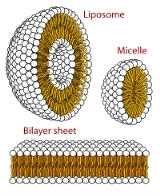
A micelle (plural micelles, micella, or micellae) is an aggregate of surfactant
Surfactant

Surfactants are wetting agents that lower the surface tension of a liquid, allowing easier spreading, and lower the interfacial tension between two liquids....
 molecules dispersed in a liquid colloid
Colloid

A colloid is a type of chemical mixture where one substance is dispersed evenly throughout another. The particles of the dispersed substance are only suspended in the mixture, unlike a solution, where they are completely dissolved within....
. A typical micelle in aqueous solution
Aqueous solution

An aqueous solution is a solution in which the solvent is water. It is usually shown in chemical equations by appending to the relevant formula....
 forms an aggregate with the hydrophilic "head" regions in contact with surrounding solvent
Solvent

A solvent is a liquid or gas that dissolves a solid, liquid, or gaseous solute, resulting in a solution.The most common solvent in everyday life is water....
, sequestering the hydrophobic tail regions in the micelle centre. This type of micelle is known as a normal phase micelle (oil-in-water micelle). Inverse micelles have the headgroups at the centre with the tails extending out (water-in-oil micelle).


Discussion
Ask a question about 'Micelle'
Start a new discussion about 'Micelle'
Answer questions from other users
Full Discussion Forum


Recent Posts


Encyclopedia


A micelle (plural micelles, micella, or micellae) is an aggregate of surfactant
Surfactant

Surfactants are wetting agents that lower the surface tension of a liquid, allowing easier spreading, and lower the interfacial tension between two liquids....
 molecules dispersed in a liquid colloid
Colloid

A colloid is a type of chemical mixture where one substance is dispersed evenly throughout another. The particles of the dispersed substance are only suspended in the mixture, unlike a solution, where they are completely dissolved within....
. A typical micelle in aqueous solution
Aqueous solution

An aqueous solution is a solution in which the solvent is water. It is usually shown in chemical equations by appending to the relevant formula....
 forms an aggregate with the hydrophilic "head" regions in contact with surrounding solvent
Solvent

A solvent is a liquid or gas that dissolves a solid, liquid, or gaseous solute, resulting in a solution.The most common solvent in everyday life is water....
, sequestering the hydrophobic tail regions in the micelle centre. This type of micelle is known as a normal phase micelle (oil-in-water micelle). Inverse micelles have the headgroups at the centre with the tails extending out (water-in-oil micelle). Micelles are approximately spherical in shape. Other phases, including shapes such as ellipsoids, cylinders, and bilayer
Bilayer

A bilayer is a double layer of closely packed atoms or moleculesSee also* Monolayer* Lipid bilayer...
s are also possible. The shape and size of a micelle is a function of the molecular geometry of its surfactant molecules and solution conditions such as surfactant concentration, temperature
Temperature

In physics, temperature is a physical property of a Physical system that underlies the common notions of hot and cold; something that feels hotter generally has the greater temperature....
, pH
PH

pH is a measure of the Acid or Base of a solution. It is defined as the cologarithm of the Activity of dissolved hydrogen ions . Hydrogen ion activity coefficients cannot be measured experimentally, so they are based on theoretical calculations....
, and ionic strength
Ionic strength

The ionic strength of a solution is a measure of the concentration of ions in that solution. Ionic compounds, when dissolved in water, dissociate into ions....
. The process of forming micellae is known as micellisation and forms part of the phase behaviour of many lipid
Lipid

Lipids are broadly defined as any fat-soluble , naturally-occurring molecule, such as fats, oils, waxes, cholesterol, sterols, fat-soluble vitamins , monoglycerides, diglycerides, phospholipids, and others....
s according to their polymorphism.

History

The ability of a soapy solution to act as a detergent has been recognised for centuries. However, it was only at the beginning of the twentieth century that the constitution of such solutions was scientifically studied. Pioneering work in this area was carried out by James William McBain at the University of Bristol
University of Bristol

The University of Bristol is a university in Bristol, England. It received its Royal Charter in 1909, although its predecessor institution, University College, Bristol, had been in existence since 1876....
. As early as 1913 he postulated the existence of “colloidal ions” to explain the good electrolytic conductivity of sodium palmitate solutions.* These highly mobile, spontaneously formed clusters came to be called micelles, a term borrowed from biology and popularized by G.S. Hartley in his classic book “Paraffin Chain Salts, A Study in Micelle Formation”.*

Solvation

Individual surfactant molecules that are in the system but are not part of a micelle are called "monomers." In water, the hydrophilic "heads" of surfactant molecules are always in contact with the solvent, regardless of whether the surfactants exist as monomers or as part of a micelle. However, the lipophilic "tails" of surfactant molecules have less contact with water when they are part of a micelle – this being the basis for the energetic drive for micelle formation. In a micelle, the hydrophobic tails of several surfactant molecules assemble into an oil-like core the most stable form of which has no contact with water. By contrast, surfactant monomers are surrounded by water molecules that create a "cage" of molecules connected by hydrogen bonds. This water cage is similar to a clathrate
Clathrate hydrate

Clathrate hydrates were first documented in 1810 by Sir Humphrey Davy; they are crystalline water based solids physically resembling ice, in which small Chemical polarity molecules are trapped inside "cages" of hydrogen bonded water ....
 and has an ice
Ice

Ice is a solid phases of matter, usually crystalline solid, of a non-metallic substance that is liquid or gas at room temperature, such as ammonia ice or methane ice....
-like crystal
Crystal

A crystal or crystalline solid is a solid material whose constituent atoms, molecules, or ions are arranged in an orderly repeating pattern extending in all three spatial dimensions....
 structure.

Micelles composed of ionic surfactants have an electrostatic attraction to the ions that surround them in solution, the latter known as counterions. Although the closest counterions partially mask a charged micelle (by up to 90%), the effects of micelle charge affect the structure of the surrounding solvent at appreciable distances from the micelle. Ionic micelles influence many properties of the mixture, including its electrical conductivity. Adding salts to a colloid containing micelles can decrease the strength of electrostatic interactions and lead to the formation of larger ionic micelles. This is more accurately seen from the point of view of an effective change in hydration of the system.

Energy of formation

Micelles only form when the concentration of surfactant is greater than the critical micelle concentration
Critical micelle concentration

In chemistry, the critical micelle concentration is defined as the concentration of surfactants above which micelles are spontaneously formed....
 (CMC), and the temperature of the system is greater than the critical micelle temperature, or Krafft temperature
Krafft temperature

The Krafft temperature, or critical micelle temperature, is the minimum temperature at which surfactants form micelles. Below the Krafft temperature, there is no value for the critical micelle concentration , i.e., micelles cannot form....
. The formation of micelles can be understood using thermodynamics
Thermodynamics

In physics, thermodynamics is the study of the conversion of heat energy into different forms of energy ; different energy conversions into heat energy; and its relation to macroscopic variables such as temperature, pressure, and volume....
: micelles can form spontaneously
Spontaneous process

A spontaneous process is the time-evolution of a system in which it releases Gibbs free energy and moves to a lower, more thermodynamically stable, energy state....
 because of a balance between entropy
Entropy

In many branches of science, entropy is a measure of the disorder of a system. The concept of entropy is particularly notable as it is applied across physics, information theory and mathematics....
 and enthalpy
Enthalpy

In thermodynamics and chemistry, the enthalpy is a quotient or description of thermodynamic potential of a system, which can be used to calculate the heat transfer during a quasistatic process taking place in a closed system thermodynamic system under constant pressure....
. In water, the hydrophobic effect
Hydrophobic effect

The hydrophobic effect is the property that non-polar molecules tend to form intermolecular aggregates in an aqueous medium and analogous intramolecular interactions....
 is the driving force for micelle formation, despite the fact that assembling surfactant molecules together reduces their entropy. Broadly speaking, above the CMC, the entropic penalty of assembling the surfactant molecules is less than the entropic penalty of caging the surfactant monomers with water molecules. Also important are enthalpic considerations, such as the electrostatic interactions that occur between the charged parts surfactants.

Inverse/Reverse Micelles

In a non-polar solvent, it is the exposure of the hydrophilic head groups to the surrounding solvent that is energetically unfavourable, giving rise to a water-in-oil system. In this case the hydrophilic groups are sequestered in the micelle core and the hydrophobic groups extend away from the centre. These inverse micelles are proportionally less likely to form on increasing headgroup charge, since hydrophilic sequestration would create highly unfavorable electrostatic interactions.

Uses

When surfactants are present above the CMC (Critical micelle concentration
Critical micelle concentration

In chemistry, the critical micelle concentration is defined as the concentration of surfactants above which micelles are spontaneously formed....
), they can act as emulsifiers that will allow a compound normally insoluble (in the solvent being used) to dissolve. This occurs because the insoluble species can be incorporated into the micelle core, which is itself solubilized in the bulk solvent by virtue of the head groups' favorable interactions with solvent species. The most common example of this phenomenon is detergent
Detergent

A detergent is a material intended to assist cleaning. The term is sometimes used to differentiate between soap and other surfactants used for cleaning....
s, which clean poorly soluble lipophilic material (such as oils and waxes) that cannot be removed by water alone. Detergents also clean by lowering the surface tension
Surface tension

Surface tension is an attractive property of the surface of a liquid. It is what causes the surface portion of liquid to be attracted to another surface, such as that of another portion of liquid ....
 of water, making it easier to remove material from a surface. The emulsifying property of surfactants is also the basis for emulsion polymerization
Emulsion polymerization

Emulsion polymerization is a type of radical polymerization that usually starts with an emulsion incorporating water, monomer, and surfactant. The most common type of emulsion polymerization is an oil-in-water emulsion, in which droplets of monomer are emulsified in a continuous phase of water....
.

Micelle formation is essential for the absorption of fat-soluble vitamins and complicated lipids within the human body. Bile salts formed in the liver and secreted by the gall bladder allow micelles of fatty acids to form. This allows the absorption of complicated lipids (e.g., lecithin) and lipid soluble vitamins (A, D, E and K) within the micelle by the small intestine.

See also

  • Vesicle (biology)
    Vesicle (biology)

    A vesicle is a small bubble of liquid within a cell. More technically, a vesicle is a small, intracellular, membrane-enclosed sac that stores or transports substances within a cell....
  • Lipid bilayer
    Lipid bilayer

    A lipid bilayer is a thin membrane made of two layers of lipid molecules. These membranes are flat sheets that form a continuous barrier around cell ....
  • Surfactant
    Surfactant

    Surfactants are wetting agents that lower the surface tension of a liquid, allowing easier spreading, and lower the interfacial tension between two liquids....