

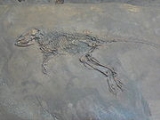
Miacoidea

Encyclopedia
Miacoidea is paraphyletic superfamily
that had been traditionally divided into two families
of carnivores: Miacidae (the miacids) and Viverravidae. Miacoids were primitive carnivore
s which lived during the Paleocene
and Eocene
Epoch about 33-65 million years ago. Today, Miacidae is recognized as a paraphyletic array of stem taxa that probably resulted in some "miacid" genera ending up just outside the order Carnivora
, the crown-group within the Carnivoramorpha
. Carnivoramorpha
consists of both Miacoidea and Carnivora, but excludes the order Creodonta
that existed alongside Carnivoramorpha. Miacoids are regarded as basal carnivoramorphs. The miacids are a paraphyletic group containing all miacoids that are not viverravids.
The transition from miacids to Carnivora
was a gradual trend during the Paleocene to late Eocene, with taxa from both North America and Eurasia involved. The miacids did not appear until the very end of the Paleocene and are characterized by their shorter skull, and loss of contact between the calcaneum and fibula in the ankle.
Viverravidae are an earlier, Paleocene
, group. In the Viverravidae the number of molars is reduced to two and the skull is elongated. The Viverravidae are a monophyletic family, a plesion-group
. Viverravidae are not considered related to any extant carnivores.
Miacoids were mostly small carnivores superficially reminiscent of marten
s or civet
s. They probably fed on invertebrates, lizard
s, bird
s and smaller mammal
s like shrew
s and opossums, while others may have been insectivores. Some species were arboreal, others lived on the ground
. Their teeth and skull
show that the miacoids were less developed than modern carnivores.
Family (biology)
In biological classification, family is* a taxonomic rank. Other well-known ranks are life, domain, kingdom, phylum, class, order, genus, and species, with family fitting between order and genus. As for the other well-known ranks, there is the option of an immediately lower rank, indicated by the...
that had been traditionally divided into two families
Family (biology)
In biological classification, family is* a taxonomic rank. Other well-known ranks are life, domain, kingdom, phylum, class, order, genus, and species, with family fitting between order and genus. As for the other well-known ranks, there is the option of an immediately lower rank, indicated by the...
of carnivores: Miacidae (the miacids) and Viverravidae. Miacoids were primitive carnivore
Carnivore
A carnivore meaning 'meat eater' is an organism that derives its energy and nutrient requirements from a diet consisting mainly or exclusively of animal tissue, whether through predation or scavenging...
s which lived during the Paleocene
Paleocene
The Paleocene or Palaeocene, the "early recent", is a geologic epoch that lasted from about . It is the first epoch of the Palaeogene Period in the modern Cenozoic Era...
and Eocene
Eocene
The Eocene Epoch, lasting from about 56 to 34 million years ago , is a major division of the geologic timescale and the second epoch of the Paleogene Period in the Cenozoic Era. The Eocene spans the time from the end of the Palaeocene Epoch to the beginning of the Oligocene Epoch. The start of the...
Epoch about 33-65 million years ago. Today, Miacidae is recognized as a paraphyletic array of stem taxa that probably resulted in some "miacid" genera ending up just outside the order Carnivora
Carnivora
The diverse order Carnivora |Latin]] carō "flesh", + vorāre "to devour") includes over 260 species of placental mammals. Its members are formally referred to as carnivorans, while the word "carnivore" can refer to any meat-eating animal...
, the crown-group within the Carnivoramorpha
Carnivoramorpha
Carnivoramorpha are a clade of mammals that includes the modern order Carnivora and its closest extinct relatives in the Miacoidea , but excludes the creodonts. The order Creodonta are a sister taxon to the Carnivoramorpha dating back 58.7 million years ago...
. Carnivoramorpha
Carnivoramorpha
Carnivoramorpha are a clade of mammals that includes the modern order Carnivora and its closest extinct relatives in the Miacoidea , but excludes the creodonts. The order Creodonta are a sister taxon to the Carnivoramorpha dating back 58.7 million years ago...
consists of both Miacoidea and Carnivora, but excludes the order Creodonta
Creodonta
The creodonts are an extinct order of mammals that lived from the Paleocene to the Miocene epochs. They shared a common ancestor with the Carnivora....
that existed alongside Carnivoramorpha. Miacoids are regarded as basal carnivoramorphs. The miacids are a paraphyletic group containing all miacoids that are not viverravids.
The transition from miacids to Carnivora
Carnivora
The diverse order Carnivora |Latin]] carō "flesh", + vorāre "to devour") includes over 260 species of placental mammals. Its members are formally referred to as carnivorans, while the word "carnivore" can refer to any meat-eating animal...
was a gradual trend during the Paleocene to late Eocene, with taxa from both North America and Eurasia involved. The miacids did not appear until the very end of the Paleocene and are characterized by their shorter skull, and loss of contact between the calcaneum and fibula in the ankle.
Viverravidae are an earlier, Paleocene
Paleocene
The Paleocene or Palaeocene, the "early recent", is a geologic epoch that lasted from about . It is the first epoch of the Palaeogene Period in the modern Cenozoic Era...
, group. In the Viverravidae the number of molars is reduced to two and the skull is elongated. The Viverravidae are a monophyletic family, a plesion-group
Crown group
A crown group is a group consisting of living representatives, their ancestors back to the most recent common ancestor of that group, and all of that ancestor's descendants. The name was given by Willi Hennig, the formulator of phylogenetic systematics, as a way of classifying living organisms...
. Viverravidae are not considered related to any extant carnivores.
Miacoids were mostly small carnivores superficially reminiscent of marten
Marten
The martens constitute the genus Martes within the subfamily Mustelinae, in family Mustelidae.-Description:Martens are slender, agile animals, adapted to living in taigas, and are found in coniferous and northern deciduous forests across the northern hemisphere. They have bushy tails, and large...
s or civet
Civet
The family Viverridae is made up of around 30 species of medium-sized mammal, including all of the genets, the binturong, most of the civets, and the two African linsangs....
s. They probably fed on invertebrates, lizard
Lizard
Lizards are a widespread group of squamate reptiles, with nearly 3800 species, ranging across all continents except Antarctica as well as most oceanic island chains...
s, bird
Bird
Birds are feathered, winged, bipedal, endothermic , egg-laying, vertebrate animals. Around 10,000 living species and 188 families makes them the most speciose class of tetrapod vertebrates. They inhabit ecosystems across the globe, from the Arctic to the Antarctic. Extant birds range in size from...
s and smaller mammal
Mammal
Mammals are members of a class of air-breathing vertebrate animals characterised by the possession of endothermy, hair, three middle ear bones, and mammary glands functional in mothers with young...
s like shrew
Shrew
A shrew or shrew mouse is a small molelike mammal classified in the order Soricomorpha. True shrews are also not to be confused with West Indies shrews, treeshrews, otter shrews, or elephant shrews, which belong to different families or orders.Although its external appearance is generally that of...
s and opossums, while others may have been insectivores. Some species were arboreal, others lived on the ground
Soil
Soil is a natural body consisting of layers of mineral constituents of variable thicknesses, which differ from the parent materials in their morphological, physical, chemical, and mineralogical characteristics...
. Their teeth and skull
Skull
The skull is a bony structure in the head of many animals that supports the structures of the face and forms a cavity for the brain.The skull is composed of two parts: the cranium and the mandible. A skull without a mandible is only a cranium. Animals that have skulls are called craniates...
show that the miacoids were less developed than modern carnivores.
Classification
- CladeCladeA clade is a group consisting of a species and all its descendants. In the terms of biological systematics, a clade is a single "branch" on the "tree of life". The idea that such a "natural group" of organisms should be grouped together and given a taxonomic name is central to biological...
CarnivoramorphaCarnivoramorphaCarnivoramorpha are a clade of mammals that includes the modern order Carnivora and its closest extinct relatives in the Miacoidea , but excludes the creodonts. The order Creodonta are a sister taxon to the Carnivoramorpha dating back 58.7 million years ago...
- Superfamily †Miacoidea
- Family †Miacidae
- genera: EosictisEosictisEosictis is an extinct genus of Miacidae. It was first named by Scott in 1945, and contains one species, Eosictis avinoffi.-Sources:**...
, IctognathusIctognathusIctognathus is an extinct genus of Miacidae....
, MiacisMiacisThe 'genus' Miacis contains extinct species of carnivorous mammals that appeared in the late Paleocene and continued through the Eocene. The genus Miacis is not monophyletic but a diverse collection of species that belong to the stemgroup within the Carnivoramorpha...
, MiocyonMiocyonMiocyon is an extinct genus of Miacidae, primitive carnivores which lived during the Paleocene and Eocene Epoch.-References:* Flynn, J.J., 1998. Early Cenozoic Carnivora . pp.110-123 in C.M. Janis, K.M. Scott, and L.L. Jacobs Evolution of Tertiary Mammals of North America...
, OodectesOödectesOodectes is an extinct genus of Miacidae.-Sources:**Fossil Mammalia of the Huerfano Formation, Eocene, of Colorado by Peter Robinson**...
, PalaearctonyxPalaearctonyxPalaearctonyx is an extinct genus of omnivorous Miacidae which inhabited North America during the Eocene living from 50.3—46.2 Ma and existed for approximately .-Taxonomy:Palaearctonyx was named by Matthew . Its type is Palaearctonyx meadi...
, ParamiacisParamiacisParamiacis is an extinct genus of Miacidae. Christian Mathis has defined to make a difference between the miacidae from Europe and the American genus Miacis. There are two species of it, P. exilis and P...
, ParoodectesParoodectesParoodectes was a miacid animal that lived during the early Eocene in the rain forests and swamps of the present-day Germany. It was a prehistoric predator that had the size and the appearance of a cat and was well adapted to climbing, as is apparent from its limbs, joints and shoulder bones...
, ProdaphaenusProdaphaenusProdaphaenus is an extinct genus of Miacidae. The genus has at least one known species: Prodaphaenus scotti.-References:***...
, QuercygaleQuercygaleQuercygale is an extinct genus of Miacidae, primitive carnivores that lived during the Paleocene and Eocene epochs. The genus contains three species: Q. angustidens , from Quercy , Q. hastingsae , from Headon Bedes, England and Q. helvetica, from Switzerland...
, TapocyonTapocyonTapocyon is an extinct genus of Miacidae, a family of primitive carnivores. Tapocyon was first discovered in Ventura County, when part of a jaw was found in the 1930's. A representative fossil of Tapocyon robustus was found in Oceanside, California...
, UintacyonUintacyonUintacyon is an extinct genus of Miacidae. There are at least two species in the genus; Uintacyon rudis and Uintacyon gingerichi, the latter being recently discovered.-Sources:...
, VassacyonVassacyonVassacyon is an extinct genus of Miacidae. It contains two species; Vassacyon promicrodon and Vassacyon bowni. It is considered the largest of the early Eocene mammals.-References:...
, VulpavusVulpavusVulpavus is an extinct genus of Miacidae.-References:* Alexander, J. 1992. Alas poor Notharctus. Natural History 9:54-59.* Flynn, J.J., 1998. Early Cenozoic Carnivora . pp.110-123 in C.M. Janis, K.M. Scott, and L.L. Jacobs Evolution of Tertiary Mammals of North America...
, XinyuictisXinyuictisXinyuictis is an extinct genus of Miacidae. It contains a species, Xinyuictis tenuis. It was once suggested that the species was the same as Miacis, but it was eventually decided that they were different.-Sources:...
, ZiphacodonZiphacodonZiphacodon is an extinct genus of Miacidae. The species Ziphacodon rugatus was described as a new species by M. R. Thorpe in 1923. The genus itself was first described by Marsh in 1872.-Sources:...
- genera: Eosictis
- Family †Viverravidae
- genera: BryanictisBryanictisBryanictis is an extinct genus of Viverravidae. It was named by MacIntyre in 1966. Species of Bryanictis include Bryanictis microlestes and Bryanictis paulus.-Sources:...
, DidymictisDidymictisDidymictis is an extinct genus of Viverravidae. It contains six species; Didymictis altidens, Didymictis leptomylus, Didymictis lysitensis, Didymictis protenus, Didymictis proteus, and Didymictis vancleveae.-Sources:...
, IctidopappusIctidopappusIctidopappus is an extinct genus of Viverravidae. The genus contains at least one species; Ictidopappus mustelinus. It was first described by Simpson in 1935.-Sources:**...
, MustelodonMustelodonMustelodon is an extinct carnivore, which belongs to the family Viverravidae. This genus contains only one species, Mustelodon primerus...
, PristinictisPristinictisPristinictis is an extinct genus of Viverravidae, and is considered a primitive member of the group. It was first named by Fox and Youzwyshyn in 1994. It contains at least one species, Pristinictis connata.-Sources:***...
, Protictis, RaphictisRaphictisRaphictis is an extinct genus of Didymictidae. It was first named by P. D. Gingerich and D. A. Winkler in 1985, and contains one species: R. gausion.-References:...
, Simpsonictis, Viverravus
- genera: Bryanictis
- Family †Miacidae
- Superfamily †Miacoidea