

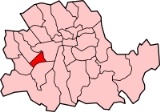
Metropolitan Borough of Chelsea

Encyclopedia
The Metropolitan Borough of Chelsea was a Metropolitan borough
of the County of London
between 1900 and 1965. It was created by the London Government Act 1899
from most of the ancient parish of Chelsea
. It was amalgamated in 1965 under the London Government Act 1963
, with the Metropolitan Borough of Kensington
to form the Royal Borough of Kensington and Chelsea
.
Civil Parishes 1801–1899
Metropolitan Borough 1900–1961
by the College of Arms
on 28 February 1903. The blazon
was:
The winged bull is the symbol of St Luke, patron saint of Chelsea
(St Luke's parish church is just off the King's Road). The other emblems referred to various holders of the manor over the centuries: the crozier for Westminster Abbey
, the lion for Earl Cadogan (first mayor of the borough), the boars' heads and sword for the Sloane family and the stag's head for the Stanley family.
The motto was Nisi dominus frustra or "It is vain without the Lord".
The fourfold division of the shield was a design favoured by Albert Woods
, Garter King of Arms
for municipal grants: other examples in London being the metropolitan boroughs of Bermondsey
, Camberwell
, Islington
, Kensington
, Southwark
, which was allied to the Conservative Party
, from its creation until 1949. In that year, the "Municipal Reform" label was discarded, and the Conservative party governed the borough until the borough's abolition in 1965. The Chelsea Town Hall, a neo-classical building containing fresco
s, remains in use. It is situated on King's Road, at the corner of Chelsea Manor Street.
For elections to parliament
, the borough formed a single constituency. By 1950, the decline in population meant that the Chelsea constituency also included the Brompton
area of the Metropolitan Borough of Kensington
.
Metropolitan boroughs of the County of London
The term metropolitan borough was used from 1900 to 1965, for the subdivisions of the County of London created by the London Government Act 1899....
of the County of London
County of London
The County of London was a county of England from 1889 to 1965, corresponding to the area known today as Inner London. It was created as part of the general introduction of elected county government in England, by way of the Local Government Act 1888. The Act created an administrative County of...
between 1900 and 1965. It was created by the London Government Act 1899
London Government Act 1899
The London Government Act 1899 was an Act of the Parliament of the United Kingdom that reformed the administration of the capital. The Act divided the County of London into 28 metropolitan boroughs, replacing the 41 parish vestries and District Boards of Works administering the area...
from most of the ancient parish of Chelsea
Chelsea, London
Chelsea is an area of West London, England, bounded to the south by the River Thames, where its frontage runs from Chelsea Bridge along the Chelsea Embankment, Cheyne Walk, Lots Road and Chelsea Harbour. Its eastern boundary was once defined by the River Westbourne, which is now in a pipe above...
. It was amalgamated in 1965 under the London Government Act 1963
London Government Act 1963
The London Government Act 1963 is an Act of the Parliament of the United Kingdom, which recognised officially the conurbation known as Greater London and created a new local government structure for the capital. The Act significantly reduced the number of local government districts in the area,...
, with the Metropolitan Borough of Kensington
Metropolitan Borough of Kensington
The Metropolitan Borough of Kensington was a Metropolitan borough in the County of London from 1900 to 1965.It bordered Chelsea, Fulham, Hammersmith, Paddington, and Westminster...
to form the Royal Borough of Kensington and Chelsea
Royal Borough of Kensington and Chelsea
The Royal Borough of Kensington and Chelsea is a central London borough of Royal borough status. After the City of Westminster, it is the wealthiest borough in England....
.
Area and population
The area of the borough was 660 acres (2.7 km²), once Kensal Town was transferred to Kensington and Paddington. The population recorded in the Census was:Civil Parishes 1801–1899
| Year | 1801 | 1811 | 1821 | 1831 | 1841 | 1851 | 1861 | 1871 | 1881 | 1891 |
|---|---|---|---|---|---|---|---|---|---|---|
| Population | 11,604 | 18,262 | 26,860 | 32,371 | 39,796 | 56,185 | 59,881 | 67,717 | 73,079 | 74,466 |
Metropolitan Borough 1900–1961
| Year | 1901 | 1911 | 1921 | 1931 | 1941 | 1951 | 1961 |
|---|---|---|---|---|---|---|---|
| Population | 73,842 | 66,385 | 63,697 | 59,031 | 50,957 | 47,256 |
Coat of arms
The borough was granted a coat of armsCoat of arms
A coat of arms is a unique heraldic design on a shield or escutcheon or on a surcoat or tabard used to cover and protect armour and to identify the wearer. Thus the term is often stated as "coat-armour", because it was anciently displayed on the front of a coat of cloth...
by the College of Arms
College of Arms
The College of Arms, or Heralds’ College, is an office regulating heraldry and granting new armorial bearings for England, Wales and Northern Ireland...
on 28 February 1903. The blazon
Blazon
In heraldry and heraldic vexillology, a blazon is a formal description of a coat of arms, flag or similar emblem, from which the reader can reconstruct the appropriate image...
was:
- Gules within a cross voided or a crozier in pale of the last in the first quarter a winged bull statant in the second a lion rampant reguardant both argent in the third a sword point downwards proper pomel and hilt gold between two boars' heads couped at the neck of the third and in the fourth a stag's head caboshed of the second.
The winged bull is the symbol of St Luke, patron saint of Chelsea
Chelsea, London
Chelsea is an area of West London, England, bounded to the south by the River Thames, where its frontage runs from Chelsea Bridge along the Chelsea Embankment, Cheyne Walk, Lots Road and Chelsea Harbour. Its eastern boundary was once defined by the River Westbourne, which is now in a pipe above...
(St Luke's parish church is just off the King's Road). The other emblems referred to various holders of the manor over the centuries: the crozier for Westminster Abbey
Westminster Abbey
The Collegiate Church of St Peter at Westminster, popularly known as Westminster Abbey, is a large, mainly Gothic church, in the City of Westminster, London, United Kingdom, located just to the west of the Palace of Westminster. It is the traditional place of coronation and burial site for English,...
, the lion for Earl Cadogan (first mayor of the borough), the boars' heads and sword for the Sloane family and the stag's head for the Stanley family.
The motto was Nisi dominus frustra or "It is vain without the Lord".
The fourfold division of the shield was a design favoured by Albert Woods
Albert Woods
Sir Albert William Woods, GCVO, KCB, KCMG, KGStJ, FSA was an English officer of arms. The Woods family has a firm tradition at the College of Arms. Albert Woods was the son of Sir William Woods, Garter Principal King of Arms from 1838 until his death in 1842...
, Garter King of Arms
Garter Principal King of Arms
The Garter Principal King of Arms is the senior King of Arms, and the senior Officer of Arms of the College of Arms. He is therefore the most powerful herald within the jurisdiction of the College – primarily England, Wales and Northern Ireland – and so arguably the most powerful in the world...
for municipal grants: other examples in London being the metropolitan boroughs of Bermondsey
Metropolitan Borough of Bermondsey
The Metropolitan Borough of Bermondsey was a Metropolitan borough in the County of London, created in 1900 by the London Government Act 1899. It was abolished and its area became part of the London Borough of Southwark in 1965.-History:...
, Camberwell
Metropolitan Borough of Camberwell
Camberwell was a civil parish and metropolitan borough in the County of London. The borough was created in 1900 by the London Government Act 1899, covering the area of the ancient parish of Camberwell...
, Islington
Metropolitan Borough of Islington
The Metropolitan Borough of Islington was a Metropolitan borough within the County of London from 1900 to 1965, when it was amalgamated with the Metropolitan Borough of Finsbury to form the London Borough of Islington.-Boundaries:...
, Kensington
Metropolitan Borough of Kensington
The Metropolitan Borough of Kensington was a Metropolitan borough in the County of London from 1900 to 1965.It bordered Chelsea, Fulham, Hammersmith, Paddington, and Westminster...
, Southwark
Metropolitan Borough of Southwark
The Metropolitan Borough of Southwark was a metropolitan borough in the County of London from 1900 to 1965. It was created to cover the western section of the ancient borough of Southwark and formed the northwestern part of the current London Borough of Southwark. In common with the rest of inner...
Politics
The borough council was controlled by the Municipal Reform PartyMunicipal Reform Party
The Municipal Reform Party was a local party allied to the parliamentary Conservative Party in the County of London. The party contested elections to both the London County Council and metropolitan borough councils of the county from 1906 to 1945.-Formation:...
, which was allied to the Conservative Party
Conservative Party (UK)
The Conservative Party, formally the Conservative and Unionist Party, is a centre-right political party in the United Kingdom that adheres to the philosophies of conservatism and British unionism. It is the largest political party in the UK, and is currently the largest single party in the House...
, from its creation until 1949. In that year, the "Municipal Reform" label was discarded, and the Conservative party governed the borough until the borough's abolition in 1965. The Chelsea Town Hall, a neo-classical building containing fresco
Fresco
Fresco is any of several related mural painting types, executed on plaster on walls or ceilings. The word fresco comes from the Greek word affresca which derives from the Latin word for "fresh". Frescoes first developed in the ancient world and continued to be popular through the Renaissance...
s, remains in use. It is situated on King's Road, at the corner of Chelsea Manor Street.
For elections to parliament
Parliament of the United Kingdom
The Parliament of the United Kingdom of Great Britain and Northern Ireland is the supreme legislative body in the United Kingdom, British Crown dependencies and British overseas territories, located in London...
, the borough formed a single constituency. By 1950, the decline in population meant that the Chelsea constituency also included the Brompton
Brompton, Kensington
Brompton is a district in the Royal Borough of Kensington and Chelsea. It is roughly defined by a triangle formed by the Brompton Cemetery, Old Brompton Road/Brompton Road and Walton Street/Fulham Road.-Development:...
area of the Metropolitan Borough of Kensington
Metropolitan Borough of Kensington
The Metropolitan Borough of Kensington was a Metropolitan borough in the County of London from 1900 to 1965.It bordered Chelsea, Fulham, Hammersmith, Paddington, and Westminster...
.