
The
method of image charges (also known as the
method of images and
method of mirror charges) is a basic problem-solving tool in
electrostaticsElectrostatics is the branch of physics that deals with the phenomena and properties of stationary or slow-moving electric charges....
. The name originates from the replacement of certain elements in the original layout with imaginary charges, which replicates the boundary conditions of the problem (see Dirichlet boundary conditions or Neumann boundary conditions).
Uniqueness theorem
Any uniqueness theorem says that an object satisfying some set of given conditions or properties is the only such object that exists; it is uniquely determined by the specified conditions.
To illustrate, draw a closed loop to define a region inside and a surface on the line. If:

within the region and
V = g on the surface
then

is
unique (given constant
f and
g).
In this case of image charges we can use the uniqueness theorem to say that provided the boundary conditions laid out by the problem are satisfied, any element can be replaced and then that this is the only alternative arrangement.
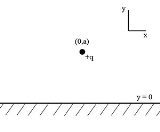
The simplest example of a use of this method is that in 2-dimensional space of a point charge, with charge +
q, located at (0,
a) above an 'infinite'
groundedIn electrical engineering, ground or earth may be the reference point in an electrical circuit from which other voltages are measured, or a common return path for electric current, or a direct physical connection to the Earth....
(ie:
V = 0) conducting plate, lying along the
x-axis. Deriving any results from this setup, such as the charge distribution on the plate, or the force felt by the point charge, is not trivial.
In order to simplify this problem, we may replace the plate of equipotential with a charge, located at (0, −
a) and with charge −
q. This arrangement will produce the same electric field at any point for which
y > 0 (ie: above the conducting plate), and satisfies the boundary condition, that the potential along the plate must be zero. This new setup is depicted below.
This situation
is equivalent to the original setup, and so calculating the force on the real charge is now trivial, by use of
Coulomb's lawCoulomb's law or Coulomb's inverse-square law, is a law of physics describing the electrostatic interaction between electrically charged particles. It was first published in 1785 by French physicist Charles Augustin de Coulomb and was essential to the development of the theory of electromagnetism...
. Finding the charge density on the plate is less obvious, but still easily attainable by using Gauss' law. In order to use Gauss' law, we now extend this case to three dimensions, so that we may construct 2-dimensional
Gaussian surfaceA Gaussian surface is a closed surface in three dimensional space through which the flux of an electromagnetic field is calculated. It is an arbitrary closed surface S=\partial V used in conjunction with Gauss's law in order to calculate the total enclosed electric charge by performing a surface...
s (ie: the plate now lies on the
xz-plane).
The potential, in cylindrical coordinates, at any point in space due to two point charges of charge +
q at +
a and -
q at -
a on the z-axis is simply:
And because of the uniqueness theorem, this turns out to be the
only solution to this problem.
The
surface chargeSurface charge is the electric charge present at an interface. There are many different processes which can lead to a surface being charged, including adsorption of ions, protonation/deprotonation, and the application of an external electric field...
on the grounded plane is given by
-

Which, after simplifying, ends up being:
-

In addition, the
total charge induced on the conducting plane will be the integral of the charge density over the entire plane, so:
-

So the total charge induced on the plane turns out to be simply -q.
Extension
This method can be extended to two or more charges, replacing the plate with the 'image charge' of each real charge. As the total electrostatic potential is equal to the scalarIn linear algebra, real numbers are called scalars and relate to vectors in a vector space through the operation of scalar multiplication, in which a vector can be multiplied by a number to produce another vector....
sum of the potentials, at any point on the xz plane the potential of any real charge will cancel with that of its image. Hence the potential anywhere on the plane will be zero, and the boundary condition satisfied.
The diagram to the right depicts a specific case of this extension, in which there are two (real) charges present, each a distance a above the plate.
If there is an electric dipole at a distance h from a grounded surface, inclined by an angle θ, you may substitute the surface by an inverse symmetric dipole.
Method of images for spheres
The method of images may be applied to a sphere as well . In fact, the case of image charges in a plane is a special case of the case of images for a sphere. Referring to the figure, we wish to find the potential inside a grounded sphere of radius R, centered at the origin, due to a point charge inside the sphere at position
. In the figure, this is represented by the green point. Let q be the charge of this point. The image of this charge with respect to the grounded sphere is shown in red. It has a charge of q'=-qR/p and lies on a line connecting the center of the sphere and the inner charge at vector position
. It can be seen that the potential at a point specified by radius vector
due to both charges alone is given by the sum of the potentials:

Multiplying through on the rightmost expression yields:

and it can be seen that on the surface of the sphere (i.e. when r=R), the potential vanishes. The potential inside the sphere is thus given by the above expression for the potential of the two charges. This potential will NOT be valid outside the sphere, since the image charge does not actually exist, but is rather "standing in" for the surface charge densities induced on the sphere by the inner charge at
. The potential outside the grounded sphere will be determined only by the distribution of charge outside the sphere and will be independent of the charge distribution inside the sphere. If we assume for simplicity (without loss of generality) that the inner charge lies on the z-axis, then the induced charge density will be simply a function of the polar angle θ and is given by:

The total charge on the sphere may be found by integrating over all angles:

Note that the reciprocal problem is also solved by this method. If we have a charge q at vector position
outside of a grounded sphere of radius R, the potential outside of the sphere is given by the sum of the potentials of the charge and its image charge inside the sphere. Just as in the first case, the image charge will have charge -qR/p and will be located at vector position
. The potential inside the sphere will be dependent only upon the true charge distribution inside the sphere.
The image of an electric point dipoleIn physics, there are several kinds of dipoles:*An electric dipole is a separation of positive and negative charges. The simplest example of this is a pair of electric charges of equal magnitude but opposite sign, separated by some distance. A permanent electric dipole is called an electret.*A...
is a bit more complicated. If the dipole is pictured as two large charges separated by a small distance, then the image of the dipole will not only have the charges modified by the above procedure, but the distance between them will be modified as well. Following the above procedure, it is found that a dipole with dipole moment
at vector position
lying inside the sphere of radius R will have an image located at vector position
(i.e. the same as for the simple charge) and will have a simple charge of:

and a dipole moment of:

Method of Inversion
The method of images for a sphere leads directly to the method of inversion (Jackson 1962 p35). If we have a harmonic functionIn mathematics, mathematical physics and the theory of stochastic processes, a harmonic function is a twice continuously differentiable function f : U → R which satisfies Laplace's equation, i.e....
of position
where
are the spherical coordinates of the position, then the image of this harmonic function in a sphere of radius R about the origin will be

If the potential Φ arises from a set of charges of magnitude
at positions
, then the image potential will be the result of a series of charges of magnitude
at positions
. It follows that if the potential Φ arises from a charge density
, then the image potential will be the result of a charge density
.
See also
- Kelvin transform
The Kelvin transform is a device used in classical potential theory to extend the concept of a harmonic function, by allowing the definition of a function which is 'harmonic at infinity'...
- Coulomb's law
Coulomb's law or Coulomb's inverse-square law, is a law of physics describing the electrostatic interaction between electrically charged particles. It was first published in 1785 by French physicist Charles Augustin de Coulomb and was essential to the development of the theory of electromagnetism...
- Divergence theorem
In vector calculus, the divergence theorem, also known as Gauss' theorem , Ostrogradsky's theorem , or Gauss–Ostrogradsky theorem is a result that relates the flow of a vector field through a surface to the behavior of the vector field inside the surface.More precisely, the divergence theorem...
- Flux
In the various subfields of physics, there exist two common usages of the term flux, both with rigorous mathematical frameworks.* In the study of transport phenomena , flux is defined as flow per unit area, where flow is the movement of some quantity per time...
- Gaussian surface
A Gaussian surface is a closed surface in three dimensional space through which the flux of an electromagnetic field is calculated. It is an arbitrary closed surface S=\partial V used in conjunction with Gauss's law in order to calculate the total enclosed electric charge by performing a surface...
- Schwarz reflection principle
This article is about the reflection principle in complex analysis. For the reflection principles of set theory, see Reflection principleIn mathematics, the Schwarz reflection principle is a way to extend the domain of definition of an analytic function of a complex variable F, which is defined on...
- Uniqueness theorem for Poisson's equation
Further reading
- James Jeans (1908) The Mathematical Theory of Electricity and Magnetism, Chapter 8, Cambridge University Press
Cambridge University Press is the publishing business of the University of Cambridge. Granted letters patent by Henry VIII in 1534, it is the world's oldest publishing house, and the second largest university press in the world...
.