

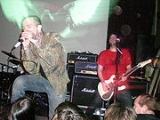
Metalcore

Encyclopedia
Metalcore is a subgenre of heavy metal
combining various elements of extreme metal
and hardcore punk
. The name is a portmanteau of the names of the two genres. The term took on its current meaning in the mid-1990s, describing bands such as Earth Crisis
, Deadguy
and Integrity
. The earliest of these groups, Integrity, began performing in 1988; some modern practitioners of the genre include Killswitch Engage
, Underoath
, All That Remains
, Trivium
, As I Lay Dying
, Bullet for My Valentine
, and The Devil Wears Prada
.
Metalcore is distinguished from other punk metal fusions by its emphasis on general heavy metal characteristics as well as breakdowns: slower, intense passages conducive to moshing
. The genre has had a saturation of bands in the last five years. Sepultura
has been credited to "lay the foundation" for the genre.
and Bad Brains
, among the originators of hardcore, admired and emulated Black Sabbath. British street punk
groups such as Discharge
and The Exploited
also took inspiration from heavy metal. The Misfits put out the Earth A.D. album, becoming a crucial influence on thrash
. Nonetheless, punk and metal cultures and music remained separate through the first half of the 1980s.
scene, which gestated at a Berkeley
club called Ruthie's, in 1984. The term "metalcore" was originally used to refer to these crossover groups. Hardcore punk groups Corrosion of Conformity
, Dirty Rotten Imbeciles
and Suicidal Tendencies
played alongside thrash metal
groups like Metallica
and Slayer
. This scene influenced the skinhead
wing of New York hardcore
, which also began in 1984, and included groups such as Cro-Mags
, Murphy's Law
, Agnostic Front
and Warzone
. The Cro-Mags were among the most influential of these bands, drawing equally from Bad Brains, Motörhead, and Black Sabbath. Cro-Mags also embraced straight edge
and, surprisingly enough, Krishna consciousness
. Other New York straight edge
groups included Gorilla Biscuits
, Crumbsuckers
, and Youth of Today
, who inaugurated the youth crew
style. 1985 saw the development of the hardcore breakdown, an amalgamation of Bad Brains' reggae
and metal backgrounds, which encouraged moshing
. Agnostic Front's 1986 album Cause for Alarm
, a collaboration with Peter Steele
, was a watershed in the intertwining of hardcore and metal.

, Biohazard
, Earth Crisis
, Converge
, Shai Hulud
, Starkweather
, Judge
, Strife
, Rorschach
, Vision of Disorder
, and Hatebreed
. Integrity drew influence primarily from the Japanese hardcore terrorism of GISM
and the metal of Slayer
, with more subtle elements of Septic Death
, Samhain
, Motörhead, and Joy Division
, while Earth Crisis, Converge, and Hatebreed borrowed from death metal
. Shai Hulud's Hearts Once Nourished with Hope and Compassion
and Earth Crisis's 1995 album Destroy the Machines
were particularly influential. In guitarist Scott Crouse's words,
Biohazard, Coalesce, and Overcast
were also important early metalcore groups. These groups are sometimes referred to as "metallic hardcore". As journalist Lars Gotrich writes, "Along with key records by Dillinger Escape Plan and Botch
, Give Them Rope
is an underground milestone that helped pioneer what was soon called 'metalcore.' At the risk of sounding too reductive — too late! — metalcore was the natural progression where extreme metal
and hardcore met, but with spiraling time signatures that somehow felt more aggressive."
. These bands tend to fuse melodic death metal
, hardcore punk
and emo
. Melodic metalcore bands include Atreyu
, Avenged Sevenfold
, Bullet for My Valentine
, Darkest Hour, Eighteen Visions
, Killswitch Engage
and Poison the Well
. These groups took major influence, cues, and writing styles from Swedish melodic death metal bands, particularly At the Gates
, Arch Enemy, In Flames
and Soilwork
. Melodic metalcore frequently makes use of clean vocals. Some of these groups, such as Shadows Fall
, have voiced an affection for '80s glam metal
. Melodic metalcore groups have been described as "embrac[ing] '80s metal clichés", such as "inordinate amounts of smoke machines, rippin' solos, [and] three bass drums".
and Metal Blade
, signing metalcore bands. By 2004, metalcore had become popular enough that Killswitch Engage's The End of Heartache
, and Shadows Fall's The War Within
debuted at numbers 21 and 20, respectively, on the Billboard album chart. All That Remains
' single "Two Weeks" peaked at number nine at the Mainstream Rock Tracks chart in the U.S. The song peaked on the Modern Rock Tracks chart at number 38. In 2007, the song "Nothing Left
" by As I Lay Dying
was nominated for a Grammy award in the "Best Metal Performance" category. An Ocean Between Us
(the album that included "Nothing Left") itself was a commercial success, debuting at #8 on the "Billboard 200
". Welsh metalcore band Bullet for My Valentine
's second album, Scream Aim Fire
, went straight to #4 on the Billboard 200, later surpassing this in 2010 with their third album Fever
, which debuted at #3 selling more than 71,000 copies in its first week in the U.S.A. and more than 21,000 in the UK. Underoath
's fifth album Define the Great Line
, released in 2006, peaked at #2 on the Billboard 200 charts, selling 98,000 copies in its first week. The Devil Wears Prada
has achieved much commercial success with their album, With Roots Above and Branches Below
, peaking at #11 on the Billboard 200
upon its release. Trivium
has met with very strong success, making top 25 positions on the charts in several countries, including the USA, and top 10 positions in both Australia and the UK, even making Gold status in the UK. Hatebreed, God Forbid
, and As I Lay Dying have also charted. Underoath's album Lost in the Sound of Separation
reached #8 on the Billboard 200 and sold 56,000 copies in its first week of sales in the U.S. alone, with Killswitch Engage's self-titled fifth album
reaching #7 on the Billboard 200 and selling 58,000 copies. Another recent success is the album "Reckless & Relentless
" by British band Asking Alexandria
, reaching up to now #9 on the Billboard 200, selling 31,000 in its first week. The most recent success is the album "Dead Throne
" by Christian band The Devil Wears Prada, debuting at #9 on the Billboard 200, selling 32,400 in its first week.
, particularly common among many 1990s metalcore groups. Today many metalcore bands combine screamed vocals throughout with the use of clean vocals
usually during the bridge
or chorus
of a song.
hardcore punk
subculture
, with many of the groups adhering to straight edge
beliefs (abstention from drugs and alcohol), although Integrity
was a notable exception. Converge was notable for their focus on personal anguish
and experiences of failed romantic love
. Dwid Hellion, frontman of Integrity, advocated the "Holy Terror Church of Final Judgment", an apocalyptic belief system related to Gnosticism
and Catharism. Several members of contemporary metalcore bands are practicing Christians
, including members of Zao, The Devil Wears Prada
, As I Lay Dying
, August Burns Red
, Texas in July
, Demon Hunter
, Oh, Sleeper
and Underoath
.
, Botch
and The Dillinger Escape Plan
. The term mathcore is suggested by analogy with math rock
. Mathcore is characterized by speed, technical riffing, and unusual time signatures. Bands such as Fear Before
are bands that incorporate metalcore standards along with odd time signatures and progressive
elements.
and death metal
. Deathcore is defined by breakdowns, blast beat
s and death metal riffs. Bands also incorporate guitar solos and melodic riffs similar to those in metalcore.
Heavy metal music
Heavy metal is a genre of rock music that developed in the late 1960s and early 1970s, largely in the Midlands of the United Kingdom and the United States...
combining various elements of extreme metal
Extreme metal
Extreme metal is a loosely defined umbrella term for a number of related heavy metal music subgenres that have developed since the early 1980s. The term usually refers to a more abrasive, harsher, underground, non-commercialized style or sound nearly always associated with genres like black metal,...
and hardcore punk
Hardcore punk
Hardcore punk is an underground music genre that originated in the late 1970s, following the mainstream success of punk rock. Hardcore is generally faster, thicker, and heavier than earlier punk rock. The origin of the term "hardcore punk" is uncertain. The Vancouver-based band D.O.A...
. The name is a portmanteau of the names of the two genres. The term took on its current meaning in the mid-1990s, describing bands such as Earth Crisis
Earth Crisis
Earth Crisis is an American metalcore band from Syracuse, New York, active from 1989 until 2001, reuniting in 2007. Their most recent record, To the Death, was released in May 2009 through Century Media....
, Deadguy
Deadguy
Deadguy was a metalcore band from New Brunswick, New Jersey, USA.-History:Formed in 1994, Deadguy took inspiration from bands like Unsane and Today is the Day. The band took their name from a line in the John Candy movie, Only the Lonely,...
and Integrity
Integrity (band)
Integrity is a metallic hardcore band formed in 1988. Their lyrical themes include religion, the supernatural, mental illness, individualism, and the occult.- Discography :*Harder They Fall - Demo cassette - 1989...
. The earliest of these groups, Integrity, began performing in 1988; some modern practitioners of the genre include Killswitch Engage
Killswitch Engage
Killswitch Engage is an American metalcore band from Westfield, Massachusetts, formed in 1999 after the disbandment of Overcast and Aftershock. Killswitch Engage's current lineup consists of vocalist Howard Jones, bassist Mike D'Antonio, guitarists Joel Stroetzel and Adam Dutkiewicz, and drummer...
, Underoath
Underoath
Underoath is an American Christian metalcore band from Tampa, Florida. Founded by Dallas Taylor and Luke Morton on November 30, 1997 in Ocala, Florida, subsequently its additional members were from Tampa, Florida...
, All That Remains
All That Remains (band)
All That Remains is an American heavy metal band from Springfield, Massachusetts, which formed in 1998. They have released five studio albums, a live CD/DVD, and have sold nearly 800,000 records...
, Trivium
Trivium (band)
Trivium is an American heavy metal band from Orlando, Florida, formed in 1999. Signed to Roadrunner Records, the band has released five studio albums, eleven singles, and twelve music videos...
, As I Lay Dying
As I Lay Dying (band)
As I Lay Dying is an American metalcore band from San Diego, California. Founded in 2000 by Tim Lambesis and having completed their first Line-up in 2001, the band consists of vocalist Tim Lambesis, drummer Jordan Mancino, lead guitarist Nick Hipa, rhythm guitarist Phil Sgrosso, and bassist Josh...
, Bullet for My Valentine
Bullet for My Valentine
Bullet for My Valentine are a Welsh heavy metal band from Bridgend, formed in 1998. The band is composed of Matt Tuck , Michael Paget , Jason James , and Michael Thomas . They were formed under the name Jeff Killed John and started their music career by covering songs by Metallica and Nirvana...
, and The Devil Wears Prada
The Devil Wears Prada (band)
The Devil Wears Prada is an American metalcore band from Dayton, Ohio. Formed in 2005, they are currently signed to Warner Music Group...
.
Metalcore is distinguished from other punk metal fusions by its emphasis on general heavy metal characteristics as well as breakdowns: slower, intense passages conducive to moshing
Moshing
Moshing is a dance in which participants push or slam into each other. They also flail their limbs to breakdowns of hardcore punk and its sub-genres. It is most associated with aggressive music genres, such as hardcore punk and heavy metal...
. The genre has had a saturation of bands in the last five years. Sepultura
Sepultura
Sepultura is a Brazilian heavy metal band from Belo Horizonte, formed in 1984. The band was a major force in the death metal, thrash metal and ultimately groove metal realms during the late 1980s and early 1990s, with their later experiments melding nu metal, hardcore punk and industrial.Sepultura...
has been credited to "lay the foundation" for the genre.
Precursors (1977–1984)
Black FlagBlack Flag (band)
Black Flag was an American punk rock band formed in 1976 in Hermosa Beach, California. The band was established by Greg Ginn, the guitarist, primary songwriter and sole continuous member through multiple personnel changes in the band...
and Bad Brains
Bad Brains
Bad Brains is an American hardcore punk band formed in Washington, D.C., in 1977. They are widely regarded as among the pioneers of hardcore punk, though the band's members objected to this term to describe their music. They are also an adept reggae band, while later recordings featured elements of...
, among the originators of hardcore, admired and emulated Black Sabbath. British street punk
Street punk
Street punk is a working class-based genre of punk rock which took shape in the early 1980s, partly as a rebellion against the perceived artistic pretensions of the first wave of British punk. Street punk emerged from the Oi! style, performed by bands such as Sham 69, Angelic Upstarts, Cockney...
groups such as Discharge
Discharge (band)
Discharge is a British hardcore punk band formed in 1977 by Terry "Tezz" Roberts and Roy "Rainy" Wainwright. They are often considered among one of the very first bands to play hardcore punk, and to mix punk with metal...
and The Exploited
The Exploited
The Exploited are a Scottish punk band from the second wave of UK punk, formed in 1979. Originally a street punk band, they transformed into a faster hardcore punk band with a heavy political influence. From about 1987 on they changed into a crossover thrash band...
also took inspiration from heavy metal. The Misfits put out the Earth A.D. album, becoming a crucial influence on thrash
Thrash metal
Thrash metal is a subgenre of heavy metal that is characterized usually by its fast tempo and aggression. Songs of the genre typically use fast percussive and low-register guitar riffs, overlaid with shredding-style lead work...
. Nonetheless, punk and metal cultures and music remained separate through the first half of the 1980s.
Crossover thrash (1984–1988)
Cross-pollination between metal and hardcore eventually birthed the crossover thrashCrossover thrash
__FORCETOC__Crossover thrash, often abbreviated to crossover, is a form of thrash metal that contains more hardcore punk elements than standard thrash. The genre lies on a continuum between heavy metal and punk rock...
scene, which gestated at a Berkeley
Berkeley, California
Berkeley is a city on the east shore of the San Francisco Bay in Northern California, United States. Its neighbors to the south are the cities of Oakland and Emeryville. To the north is the city of Albany and the unincorporated community of Kensington...
club called Ruthie's, in 1984. The term "metalcore" was originally used to refer to these crossover groups. Hardcore punk groups Corrosion of Conformity
Corrosion of Conformity
Corrosion of Conformity is an American heavy metal band from Raleigh, North Carolina formed in 1982. For almost the majority of its existence, the band has consisted of guitarist Woody Weatherman, bassist Mike Dean , drummer Reed Mullin and vocalist and rhythm...
, Dirty Rotten Imbeciles
Dirty Rotten Imbeciles
Dirty Rotten Imbeciles is a thrash metal/crossover thrash band from the United States that formed in Houston, in 1982. The band currently comprises founding members, vocalist Kurt Brecht and guitarist Spike Cassidy, as well as drummer Rob Rampy and bassist Harald Oimoen.D.R.I...
and Suicidal Tendencies
Suicidal Tendencies
Suicidal Tendencies is a U.S. crossover thrash band founded in 1981 in Venice, Los Angeles, California by Mike Muir, its leader and only permanent member. The band is sometimes credited as one of "the fathers of crossover thrash"...
played alongside thrash metal
Thrash metal
Thrash metal is a subgenre of heavy metal that is characterized usually by its fast tempo and aggression. Songs of the genre typically use fast percussive and low-register guitar riffs, overlaid with shredding-style lead work...
groups like Metallica
Metallica
Metallica is an American heavy metal band from Los Angeles, California. Formed in 1981 when James Hetfield responded to an advertisement that drummer Lars Ulrich had posted in a local newspaper. The current line-up features long-time lead guitarist Kirk Hammett and bassist Robert Trujillo ...
and Slayer
Slayer
Slayer is an American thrash metal band formed in Huntington Park, California, in 1981 by guitarists Jeff Hanneman and Kerry King. Slayer rose to fame with their 1986 release, Reign in Blood, and is credited as one of the "Big Four" thrash metal acts, along with Metallica, Megadeth and...
. This scene influenced the skinhead
Skinhead
A skinhead is a member of a subculture that originated among working class youths in the United Kingdom in the 1960s, and then spread to other parts of the world. Named for their close-cropped or shaven heads, the first skinheads were greatly influenced by West Indian rude boys and British mods,...
wing of New York hardcore
New York hardcore
New York hardcore refers to hardcore punk and metalcore music created in New York City and to the subculture associated with that music. New York hardcore grew out of the hardcore scene established in Washington, D.C., by bands such as Bad Brains and Minor Threat. Hardcore '81 is an album by the...
, which also began in 1984, and included groups such as Cro-Mags
Cro-Mags
Cro-Mags are a hardcore punk turned crossover thrash band from New York City. The band, which had a strong cult following, released many records, their first two considered the most influential...
, Murphy's Law
Murphy's Law (band)
Murphy's Law is an American hardcore band from New York City, New York, formed in 1982. While vocalist Jimmy Gestapo remains the only founding member of the band, the line-up has consisted of former members of bands such as Skinnerbox, Danzig, The Bouncing Souls, Mucky Pup, Dog Eat Dog, Hanoi...
, Agnostic Front
Agnostic Front
Agnostic Front is an American hardcore band. The band began playing hardcore similar to their contemporaries, and were thrust to the forefront of the burgeoning New York hardcore scene in the mid-1980s with their widely regarded 1984 classic Victim in Pain before evolving to incorporate thrash...
and Warzone
Warzone (band)
Warzone was an American hardcore punk band formed on the Lower East Side of Manhattan in 1982. The band helped develop the New York hardcore sound, the hardcore skinhead style and the youth crew subgenre...
. The Cro-Mags were among the most influential of these bands, drawing equally from Bad Brains, Motörhead, and Black Sabbath. Cro-Mags also embraced straight edge
Straight edge
Straight edge is a subculture of hardcore punk whose adherents refrain from using alcohol, tobacco, and other recreational drugs. It was a direct reaction to the sexual revolution, hedonism, and excess associated with punk rock. For some, this extends to not engaging in promiscuous sex, following a...
and, surprisingly enough, Krishna consciousness
International Society for Krishna Consciousness
The International Society for Krishna Consciousness , known colloquially as the Hare Krishna movement, is a Gaudiya Vaishnava religious organization. It was founded in 1966 in New York City by A.C. Bhaktivedanta Swami Prabhupada...
. Other New York straight edge
Straight edge
Straight edge is a subculture of hardcore punk whose adherents refrain from using alcohol, tobacco, and other recreational drugs. It was a direct reaction to the sexual revolution, hedonism, and excess associated with punk rock. For some, this extends to not engaging in promiscuous sex, following a...
groups included Gorilla Biscuits
Gorilla Biscuits
Gorilla Biscuits are a New York City-based vegan straight edge hardcore band consisting of Anthony "Civ" Civarelli, Walter Schreifels, Arthur Smilios, Alex Brown and Luke Abbey. The band is currently signed to Revelation Records.-Early career:...
, Crumbsuckers
Crumbsuckers
Crumbsuckers was a 1980s crossover/thrash band that formed in 1982 on Long Island by bass player Gary Meskil in their home town of Baldwin.-History:...
, and Youth of Today
Youth of Today
Youth of Today is an American hardcore punk straight edge band, formed in 1985 and still in activity. The band played a major role in establishing the Youth Crew subculture of hardcore, both espousing and evolving the philosophies of the straight edge and vegetarian lifestyles.-History:Youth Of...
, who inaugurated the youth crew
Youth crew
Youth crew is a music subgenre of hardcore punk attributed to the band Youth of Today who were primarily active during the early to mid-1980s particularly during the New York hardcore scene of 1988...
style. 1985 saw the development of the hardcore breakdown, an amalgamation of Bad Brains' reggae
Reggae
Reggae is a music genre first developed in Jamaica in the late 1960s. While sometimes used in a broader sense to refer to most types of Jamaican music, the term reggae more properly denotes a particular music style that originated following on the development of ska and rocksteady.Reggae is based...
and metal backgrounds, which encouraged moshing
Moshing
Moshing is a dance in which participants push or slam into each other. They also flail their limbs to breakdowns of hardcore punk and its sub-genres. It is most associated with aggressive music genres, such as hardcore punk and heavy metal...
. Agnostic Front's 1986 album Cause for Alarm
Cause for Alarm (album)
Your Mistake was Covered by Fear Factory with Freddy Cricien of Madball on the Demanufacture Digipak as a bonus track & Hatebreed on their Album For the Lions.-Personnel:Agnostic Front* Roger Miret – vocals* Vinnie Stigma – guitar* Alex Kinon – guitar...
, a collaboration with Peter Steele
Peter Steele
Peter Thomas Ratajczyk , better known by his stage name Peter Steele, was the lead singer, bassist, and composer for the gothic metal band Type O Negative...
, was a watershed in the intertwining of hardcore and metal.
Metallic hardcore (1989–1995)
Between 1989 and 1995, a new wave of hardcore bands emerged. These included Merauder, All Out War, IntegrityIntegrity (band)
Integrity is a metallic hardcore band formed in 1988. Their lyrical themes include religion, the supernatural, mental illness, individualism, and the occult.- Discography :*Harder They Fall - Demo cassette - 1989...
, Biohazard
Biohazard (band)
Biohazard is a band originally based in Brooklyn, New York. They are acknowledged as one of the earliest bands to fuse hardcore punk and heavy metal with elements of hip hop. The original lineup consisted of Vocalist/Guitarist Billy Graziadei, bassist/vocalist Evan Seinfeld, guitarist Bobby Hambel,...
, Earth Crisis
Earth Crisis
Earth Crisis is an American metalcore band from Syracuse, New York, active from 1989 until 2001, reuniting in 2007. Their most recent record, To the Death, was released in May 2009 through Century Media....
, Converge
Converge (band)
Converge is an American band from Salem, Massachusetts. Playing a blend of hardcore punk and metal since 1990, Converge has helped to define many of the elements of the metalcore genre.-Description:...
, Shai Hulud
Shai Hulud (band)
Shai Hulud is an American hardcore punk band with progressive metal influences, originally formed in Pompano Beach, Florida, the band later moved up to Poughkeepsie, New York....
, Starkweather
Starkweather (band)
Starkweather is a metal band from Philadelphia, United States that formed in 1989. Starkweather helped pioneer the hardcore/heavy metal crossover sound that would later be known as "metalcore"...
, Judge
Judge (band)
Judge was a New York-based straight edge band; formed in 1987 by Youth of Today guitarist, John "Porcell" Porcelly, and former Youth of Today drummer, Mike "Judge" Ferraro.-History:...
, Strife
Strife (band)
Strife is an American hardcore punk band from Thousand Oaks, California. But is now primarily based out of Los Angeles, California. They formed in 1991...
, Rorschach
Rorschach (band)
Rorschach is a New Jersey-based band that existed from 1989 to 1993 and reformed in 2009. The group often blended hardcore punk and dissonant elements of metal providing the inspiration to a number of hardcore and post hardcore bands thereafter....
, Vision of Disorder
Vision of Disorder
Vision of Disorder is a hardcore punk band from Long Island, New York, US. Vision of Disorder disbanded in 2002, but reunited from time to time over the next six years. In October 2008, they announced that they would record a new studio album...
, and Hatebreed
Hatebreed
- History :Hatebreed was formed in 1994 in Bridgeport, Waterbury and New Haven. They began by recording a three song demo and selling it to locals. Those three songs would eventually be released on a split seven inch with New York's Neglect in 1995...
. Integrity drew influence primarily from the Japanese hardcore terrorism of GISM
GISM
was a Japanese hardcore punk band formed in Tokyo, Japan in 1980. Even though the guitar style resembled heavy metal style riffs and solos, GISM were one of the first Japanese hardcore bands, while at the same time drawing influence from the early industrial/avant-garde music scene; something...
and the metal of Slayer
Slayer
Slayer is an American thrash metal band formed in Huntington Park, California, in 1981 by guitarists Jeff Hanneman and Kerry King. Slayer rose to fame with their 1986 release, Reign in Blood, and is credited as one of the "Big Four" thrash metal acts, along with Metallica, Megadeth and...
, with more subtle elements of Septic Death
Septic Death
Septic Death was a hardcore punk band fronted by artist Brian "Pushead" Schroeder on vocals. Septic Death's music became a major influence on bands like Integrity, Citizens Arrest, Infest, and many other bands tied to the hardcore punk, thrashcore, crust punk etc. scenes...
, Samhain
Samhain (band)
Samhain was an American rock band formed by singer Glenn Danzig in 1983, immediately following his departure from the Misfits. Samhain played in more of a deathrock and heavy metal-infused style of horror punk than Danzig's previous band. By 1987 Samhain's membership evolved into a new band,...
, Motörhead, and Joy Division
Joy Division
Joy Division were an English rock band formed in 1976 in Salford, Greater Manchester. Originally named Warsaw, the band primarily consisted of Ian Curtis , Bernard Sumner , Peter Hook and Stephen Morris .Joy Division rapidly evolved from their initial punk rock influences...
, while Earth Crisis, Converge, and Hatebreed borrowed from death metal
Death metal
Death metal is an extreme subgenre of heavy metal. It typically employs heavily distorted guitars, tremolo picking, deep growling vocals, blast beat drumming, minor keys or atonality, and complex song structures with multiple tempo changes....
. Shai Hulud's Hearts Once Nourished with Hope and Compassion
Hearts Once Nourished with Hope and Compassion
Hearts Once Nourished with Hope and Compassion is the first full length album by hardcore punk band Shai Hulud, released on November 4, 1997, on the Revelation Records' subsidiary, Crisis Records, in CD/LP and 12" clear brown . It is now sold through Revelation Records. It was reissued in a...
and Earth Crisis's 1995 album Destroy the Machines
Destroy the Machines
-Credits:*Karl Buechner - vocals*Scott Crouse - lead guitar*Ian Edwards - bass*Dennis Merrick - drums*Kris Wiechmann - rhythm guitar-Trivia:*The song Forced March was covered by the band Between The Buried And Me in their album The Anatomy Of....
were particularly influential. In guitarist Scott Crouse's words,
It was a very mixed reaction. I'm often quoted as saying that Earth Crisis was the first hardcore band with a metal sound. Of course we weren't the first, but I think we definitely took it to another level. We heard a lot of, 'These guys are trying to be PanteraPanteraPantera was an American heavy metal band from Arlington, Texas. Formed by the Abbott brothers, Vinnie Paul and Dimebag Darrell in 1981, bassist Rex Brown would join in late 1981 with vocalist Terry Glaze. Looking for a new and heavier sound, Pantera had Terry replaced in 1987 with Phil Anselmo as...
,' which we all took as a great compliment!
Biohazard, Coalesce, and Overcast
Overcast (band)
Overcast was an American metalcore band that started in the early 1990s, but broke up in 1998 after an unsuccessful tour; in 2008 they reunited to play a show and announced they would release a new album entitled Reborn to Kill Again with 11 re-recorded classic tracks and two unreleased...
were also important early metalcore groups. These groups are sometimes referred to as "metallic hardcore". As journalist Lars Gotrich writes, "Along with key records by Dillinger Escape Plan and Botch
Botch (band)
Botch was a four-piece mathcore band from Tacoma, Washington, United States, that formed in 1993 and disbanded in 2002.-History:The band released two full-length albums and a handful of smaller releases including several singles and an EP. Its members went on an indefinite hiatus to form Roy,...
, Give Them Rope
Give Them Rope
Give Them Rope is Missouri band Coalesce's debut full length album. It was re-released in 2004 in a remastered and remixed format. This album has never charted.-Track listing:# "Have Patience" - 3:11# "One on the Ground" - 3:42...
is an underground milestone that helped pioneer what was soon called 'metalcore.' At the risk of sounding too reductive — too late! — metalcore was the natural progression where extreme metal
Extreme metal
Extreme metal is a loosely defined umbrella term for a number of related heavy metal music subgenres that have developed since the early 1980s. The term usually refers to a more abrasive, harsher, underground, non-commercialized style or sound nearly always associated with genres like black metal,...
and hardcore met, but with spiraling time signatures that somehow felt more aggressive."
Melodic metalcore (1995–present)
In the early 1990s, a third wave of metalcore groups appeared, who placed significantly greater emphasis on melodyMelody
A melody , also tune, voice, or line, is a linear succession of musical tones which is perceived as a single entity...
. These bands tend to fuse melodic death metal
Melodic death metal
Melodic death metal is a heavy metal music style that combines elements from the New Wave of British Heavy Metal with elements of death metal. The style was developed during the early and mid-1990s, primarily in England and Scandinavia...
, hardcore punk
Hardcore punk
Hardcore punk is an underground music genre that originated in the late 1970s, following the mainstream success of punk rock. Hardcore is generally faster, thicker, and heavier than earlier punk rock. The origin of the term "hardcore punk" is uncertain. The Vancouver-based band D.O.A...
and emo
Emo
Emo is a style of rock music and its associated subcultureEmo may also refer to:- Businesses :* Emo , an Irish oil company and filling station chain* Emo Speedway, a racetrack in Emo, Ontario...
. Melodic metalcore bands include Atreyu
Atreyu (band)
Atreyu is an American rock band from Orange County, California, formed in 1998. The band consists of vocalist/lyricist Alex Varkatzas, guitarists Dan Jacobs and Travis Miguel, bassist Marc McKnight and drummer/vocalist Brandon Saller...
, Avenged Sevenfold
Avenged Sevenfold
Avenged Sevenfold is an American heavy metal band from Huntington Beach, California. Formed in 1999, the group consists of vocalist M. Shadows, lead guitarist Synyster Gates, rhythm guitarist Zacky Vengeance, bassist Johnny Christ....
, Bullet for My Valentine
Bullet for My Valentine
Bullet for My Valentine are a Welsh heavy metal band from Bridgend, formed in 1998. The band is composed of Matt Tuck , Michael Paget , Jason James , and Michael Thomas . They were formed under the name Jeff Killed John and started their music career by covering songs by Metallica and Nirvana...
, Darkest Hour, Eighteen Visions
Eighteen Visions
Eighteen Visions was an American metalcore band from Orange County, California, United States. Formed in October of 1995, the group was one of the first practitioners involved in the metalcore genre...
, Killswitch Engage
Killswitch Engage
Killswitch Engage is an American metalcore band from Westfield, Massachusetts, formed in 1999 after the disbandment of Overcast and Aftershock. Killswitch Engage's current lineup consists of vocalist Howard Jones, bassist Mike D'Antonio, guitarists Joel Stroetzel and Adam Dutkiewicz, and drummer...
and Poison the Well
Poison the Well (band)
Poison the Well was an experimental hardcore band from Miami/Ft. Lauderdale, Florida who were last signed to Ferret Music. Guitarist Ryan Primack and drummer Chris Hornbrook were the only remaining members of the band who were involved since their inception, although vocalist Jeffrey Moreira was...
. These groups took major influence, cues, and writing styles from Swedish melodic death metal bands, particularly At the Gates
At the Gates
At the Gates is an extreme metal band from Gothenburg, Sweden, and a major progenitor of the Gothenburg death-metal sound. Their early albums lean towards a death metal sound, but later albums sound more like melodic death metal.Initially active from 1990 to 1996, the band reformed in 2007 for a...
, Arch Enemy, In Flames
In Flames
In Flames is a Swedish heavy metal band from Gothenburg, formed in 1990. Since the band's inception in 1993, they have released ten studio albums and one live DVD...
and Soilwork
Soilwork
Soilwork is a Swedish melodic death metal band from Helsingborg. They are currently signed to Nuclear Blast. Formed in late 1995 by Björn Strid and Peter Wichers, originally under the name Inferior Breed, the band changed their name in late 1996 to Soilwork .Their sound is a fusion of the classic...
. Melodic metalcore frequently makes use of clean vocals. Some of these groups, such as Shadows Fall
Shadows Fall
Shadows Fall is an American heavy metal band from Springfield, Massachusetts, formed in 1995. They are one of the few contemporary metal bands who take their lyrical influence from Eastern philosophy and some references to the Rastafari culture...
, have voiced an affection for '80s glam metal
Glam metal
Glam metal is a subgenre of hard rock and heavy metal that arose in the late 1970s and early 1980s in the United States, particularly on the Los Angeles Sunset Strip music scene...
. Melodic metalcore groups have been described as "embrac[ing] '80s metal clichés", such as "inordinate amounts of smoke machines, rippin' solos, [and] three bass drums".
Commercial success (mid 2000s-present)
In the mid-2000s, metalcore emerged as a commercial force, with several independent metal labels, including Century MediaCentury Media Records
Century Media Records is an Independent record label with offices in the United States, Germany, Australia, France, Italy, Sweden, Finland, and the United Kingdom.- Background :...
and Metal Blade
Metal Blade Records
Metal Blade Records is a record label which was founded by Brian Slagel in 1982. The U.S. corporate office for Metal Blade is located in Agoura Hills, California. It also has offices in Arizona, Germany, Japan, Canada, and the UK. The label is distributed in the U.S. by Sony BMG Music...
, signing metalcore bands. By 2004, metalcore had become popular enough that Killswitch Engage's The End of Heartache
The End of Heartache
The End of Heartache is the third studio album by American metalcore band Killswitch Engage. It was released on May 11, 2004 through Roadrunner Records. It is the first album to feature lead vocalist Howard Jones from the mathcore band Blood Has Been Shed after Jesse Leach's departure from the band...
, and Shadows Fall's The War Within
The War Within (album)
This article is about the album. For other uses, see 'The War Within .-Limited edition bonus DVD:#"Stepping Outside the Circle" #"Of One Blood"...
debuted at numbers 21 and 20, respectively, on the Billboard album chart. All That Remains
All That Remains (band)
All That Remains is an American heavy metal band from Springfield, Massachusetts, which formed in 1998. They have released five studio albums, a live CD/DVD, and have sold nearly 800,000 records...
' single "Two Weeks" peaked at number nine at the Mainstream Rock Tracks chart in the U.S. The song peaked on the Modern Rock Tracks chart at number 38. In 2007, the song "Nothing Left
Nothing Left
"Nothing Left" is a song by American metal band As I Lay Dying, the song is from their fourth studio album An Ocean Between Us. The song received a Grammy Award nomination in "Best Metal Performance" category in 2008. It is featured in the video games Midnight Club: Los Angeles and Saints Row 2 by...
" by As I Lay Dying
As I Lay Dying (band)
As I Lay Dying is an American metalcore band from San Diego, California. Founded in 2000 by Tim Lambesis and having completed their first Line-up in 2001, the band consists of vocalist Tim Lambesis, drummer Jordan Mancino, lead guitarist Nick Hipa, rhythm guitarist Phil Sgrosso, and bassist Josh...
was nominated for a Grammy award in the "Best Metal Performance" category. An Ocean Between Us
An Ocean Between Us
-Reception:The record was released on August 21, 2007 to generally positive acclaim.-Personnel:As I Lay Dying* Tim Lambesis – lead vocals* Nick Hipa – lead guitar* Phil Sgrosso – rhythm guitar, piano* Josh Gilbert – bass guitar, clean vocals...
(the album that included "Nothing Left") itself was a commercial success, debuting at #8 on the "Billboard 200
Billboard 200
The Billboard 200 is a ranking of the 200 highest-selling music albums and EPs in the United States, published weekly by Billboard magazine. It is frequently used to convey the popularity of an artist or groups of artists...
". Welsh metalcore band Bullet for My Valentine
Bullet for My Valentine
Bullet for My Valentine are a Welsh heavy metal band from Bridgend, formed in 1998. The band is composed of Matt Tuck , Michael Paget , Jason James , and Michael Thomas . They were formed under the name Jeff Killed John and started their music career by covering songs by Metallica and Nirvana...
's second album, Scream Aim Fire
Scream Aim Fire
Scream Aim Fire is the second studio album by Welsh heavy metal band Bullet for My Valentine, released on 28 January 2008 in the UK and the preceding day in the US...
, went straight to #4 on the Billboard 200, later surpassing this in 2010 with their third album Fever
Fever (Bullet for My Valentine album)
Fever is the third studio album by Welsh heavy metal band, Bullet for My Valentine. Containing eleven tracks, the album was released on 26 and 27 April 2010 in the UK and in the US, respectively. The album sold 71,000 copies in the US and 21,965 in the UK in its first week of release to debut at...
, which debuted at #3 selling more than 71,000 copies in its first week in the U.S.A. and more than 21,000 in the UK. Underoath
Underoath
Underoath is an American Christian metalcore band from Tampa, Florida. Founded by Dallas Taylor and Luke Morton on November 30, 1997 in Ocala, Florida, subsequently its additional members were from Tampa, Florida...
's fifth album Define the Great Line
Define the Great Line
Define the Great Line is the fifth album by American metalcore band Underoath. The album was released in the United States on June 20, 2006 along with a limited edition version containing exclusive artwork and DVD. For the recording of this album Underoath's usual producer, James Paul Wisner, was...
, released in 2006, peaked at #2 on the Billboard 200 charts, selling 98,000 copies in its first week. The Devil Wears Prada
The Devil Wears Prada (band)
The Devil Wears Prada is an American metalcore band from Dayton, Ohio. Formed in 2005, they are currently signed to Warner Music Group...
has achieved much commercial success with their album, With Roots Above and Branches Below
With Roots Above and Branches Below
With Roots Above and Branches Below is the third studio album by American metalcore band The Devil Wears Prada, released on May 5, 2009, through Ferret Music. Upon its release it charted the Billboard 200 at number 11, selling 31,000 in its first week...
, peaking at #11 on the Billboard 200
Billboard 200
The Billboard 200 is a ranking of the 200 highest-selling music albums and EPs in the United States, published weekly by Billboard magazine. It is frequently used to convey the popularity of an artist or groups of artists...
upon its release. Trivium
Trivium (band)
Trivium is an American heavy metal band from Orlando, Florida, formed in 1999. Signed to Roadrunner Records, the band has released five studio albums, eleven singles, and twelve music videos...
has met with very strong success, making top 25 positions on the charts in several countries, including the USA, and top 10 positions in both Australia and the UK, even making Gold status in the UK. Hatebreed, God Forbid
God Forbid
God Forbid is an American heavy metal band formed in 1996 in East Brunswick, New Jersey.-Biography:Building up a following in the late 1990s by touring with bands such as GWAR, Nile, Cradle of Filth and Candiria, God Forbid's first full album Reject the Sickness was released by 9 Volt Records in 1999...
, and As I Lay Dying have also charted. Underoath's album Lost in the Sound of Separation
Lost in the Sound of Separation
Lost in the Sound of Separation is the sixth album by American metalcore band Underoath. The album was released on September 2, 2008. The album title is taken from a line of the lyrics of "We Are the Involuntary". In an interview with MTV News about the effort, the band stated it featured 11 songs...
reached #8 on the Billboard 200 and sold 56,000 copies in its first week of sales in the U.S. alone, with Killswitch Engage's self-titled fifth album
Killswitch Engage (2009 album)
Killswitch Engage is the fifth studio album by American metalcore band Killswitch Engage. It was released on June 30, 2009 through Roadrunner Records. It is the band's second album to be self-titled, the first being their debut album of the same name. It was produced by Adam Dutkiewicz and Brendan...
reaching #7 on the Billboard 200 and selling 58,000 copies. Another recent success is the album "Reckless & Relentless
Reckless & Relentless
Reckless & Relentless is the second studio album by English metalcore band Asking Alexandria. It was released on April 5, 2011 through Sumerian Records. Announced on December 22, 2009, recording for the album began in June 2010 at the Foundation Recording Studios in Connersville, Indiana and ended...
" by British band Asking Alexandria
Asking Alexandria
Asking Alexandria are a British metalcore band from York, North Yorkshire. Founded in 2008 when Ben Bruce contacted his old companions upon returning to the UK after residing in Dubai...
, reaching up to now #9 on the Billboard 200, selling 31,000 in its first week. The most recent success is the album "Dead Throne
Dead Throne
-Track listing:-Personnel:The Devil Wears Prada* Mike Hranica - lead vocals* Jeremy DePoyster - rythm guitar, clean vocals* Chris Rubey - lead guitar* Andy Trick - bass guitar* James Baney - keyboards, synthesizer, piano...
" by Christian band The Devil Wears Prada, debuting at #9 on the Billboard 200, selling 32,400 in its first week.
Vocals
The vocalizing technique in metalcore is generally screamed vocalsScreaming (music)
Screaming is a vocal technique that is most popular in subgenres of heavy metal, punk and hard rock, including metalcore, deathcore, post-hardcore, groove metal, black metal, and grindcore...
, particularly common among many 1990s metalcore groups. Today many metalcore bands combine screamed vocals throughout with the use of clean vocals
Singing
Singing is the act of producing musical sounds with the voice, and augments regular speech by the use of both tonality and rhythm. One who sings is called a singer or vocalist. Singers perform music known as songs that can be sung either with or without accompaniment by musical instruments...
usually during the bridge
Bridge (music)
In music, especially western popular music, a bridge is a contrasting section which also prepares for the return of the original material section...
or chorus
Refrain
A refrain is the line or lines that are repeated in music or in verse; the "chorus" of a song...
of a song.
Instrumentation
Harmonized guitar riffs, double bass drumming, and breakdowns are common in metalcore. Drop guitar tunings are used almost universally, earlier bands usually used either Drop D or C tunings. More recently certain bands have been known to tune as low as Drop A. Drummers typically use a lot of double bass technique and general drumming styles across the board. Blast beats are also seen at times.Ideologies
Metalcore emerged from the milieu surrounding youth crewYouth crew
Youth crew is a music subgenre of hardcore punk attributed to the band Youth of Today who were primarily active during the early to mid-1980s particularly during the New York hardcore scene of 1988...
hardcore punk
Hardcore punk
Hardcore punk is an underground music genre that originated in the late 1970s, following the mainstream success of punk rock. Hardcore is generally faster, thicker, and heavier than earlier punk rock. The origin of the term "hardcore punk" is uncertain. The Vancouver-based band D.O.A...
subculture
Subculture
In sociology, anthropology and cultural studies, a subculture is a group of people with a culture which differentiates them from the larger culture to which they belong.- Definition :...
, with many of the groups adhering to straight edge
Straight edge
Straight edge is a subculture of hardcore punk whose adherents refrain from using alcohol, tobacco, and other recreational drugs. It was a direct reaction to the sexual revolution, hedonism, and excess associated with punk rock. For some, this extends to not engaging in promiscuous sex, following a...
beliefs (abstention from drugs and alcohol), although Integrity
Integrity (band)
Integrity is a metallic hardcore band formed in 1988. Their lyrical themes include religion, the supernatural, mental illness, individualism, and the occult.- Discography :*Harder They Fall - Demo cassette - 1989...
was a notable exception. Converge was notable for their focus on personal anguish
Anguish
Anguish is a term used in philosophy, often as a translation from the German Angst. It is a paramount feature of existentialist philosophy, in which anguish is often understood as the experience of an utterly free being in a world with zero absolutes...
and experiences of failed romantic love
Broken heart
A broken heart is a common metaphor used to describe the intense emotional pain or suffering one feels after losing a loved one, whether through death, divorce, breakup, physical separation or romantic rejection....
. Dwid Hellion, frontman of Integrity, advocated the "Holy Terror Church of Final Judgment", an apocalyptic belief system related to Gnosticism
Gnosticism
Gnosticism is a scholarly term for a set of religious beliefs and spiritual practices common to early Christianity, Hellenistic Judaism, Greco-Roman mystery religions, Zoroastrianism , and Neoplatonism.A common characteristic of some of these groups was the teaching that the realisation of Gnosis...
and Catharism. Several members of contemporary metalcore bands are practicing Christians
Christianity
Christianity is a monotheistic religion based on the life and teachings of Jesus as presented in canonical gospels and other New Testament writings...
, including members of Zao, The Devil Wears Prada
The Devil Wears Prada (band)
The Devil Wears Prada is an American metalcore band from Dayton, Ohio. Formed in 2005, they are currently signed to Warner Music Group...
, As I Lay Dying
As I Lay Dying (band)
As I Lay Dying is an American metalcore band from San Diego, California. Founded in 2000 by Tim Lambesis and having completed their first Line-up in 2001, the band consists of vocalist Tim Lambesis, drummer Jordan Mancino, lead guitarist Nick Hipa, rhythm guitarist Phil Sgrosso, and bassist Josh...
, August Burns Red
August Burns Red
August Burns Red is an American metal band, from Manheim, Pennsylvania. Formed in 2003, the group began their first performances while a majority of the members were attending their senior year of high school, and soon began playing shows around Lancaster, before being signed to CI Records, and...
, Texas in July
Texas In July
Texas in July is an American metalcore band from Ephrata, Pennsylvania. Formed in 2007, the group currently consists of members ranging in ages from 18 to 21. Being previously signed to CI Records, Texas in July released one EP, Salt of the Earth and their debut full-length album, I Am both through...
, Demon Hunter
Demon Hunter
Demon Hunter is an American heavy metal band from Seattle, Washington, started in 2000 by brothers Don Clark and Ryan Clark. All of Demon Hunter's members are Christians and express their love for Jesus in many of their songs. Although the brothers created the band, only one remains, Don Clark...
, Oh, Sleeper
Oh, Sleeper
Oh, Sleeper is an American metalcore band from Fort Worth, Texas and is signed to Solid State Records. They have recorded three full-length albums to date, the most recent being their third album Children of Fire, released on September 6, 2011....
and Underoath
Underoath
Underoath is an American Christian metalcore band from Tampa, Florida. Founded by Dallas Taylor and Luke Morton on November 30, 1997 in Ocala, Florida, subsequently its additional members were from Tampa, Florida...
.
Mathcore
Mathcore began with the mid-'90s work of ConvergeConverge (band)
Converge is an American band from Salem, Massachusetts. Playing a blend of hardcore punk and metal since 1990, Converge has helped to define many of the elements of the metalcore genre.-Description:...
, Botch
Botch (band)
Botch was a four-piece mathcore band from Tacoma, Washington, United States, that formed in 1993 and disbanded in 2002.-History:The band released two full-length albums and a handful of smaller releases including several singles and an EP. Its members went on an indefinite hiatus to form Roy,...
and The Dillinger Escape Plan
The Dillinger Escape Plan
The Dillinger Escape Plan is an American mathcore band from Morris Plains, New Jersey. The group originated in 1997 after the disbanding of Arcane, a hardcore punk trio consisting of Ben Weinman, Dimitri Minakakis, and Chris Pennie. The band's current line-up consists of guitarist Ben Weinman,...
. The term mathcore is suggested by analogy with math rock
Math rock
Math rock is a rhythmically complex guitar-based style of experimental rock that emerged in the 1980s and that was very influenced by progressive rock like King Crimson, Frank Zappa, Henry Cow - and 20th century composers such as Steve Reich and John Cage...
. Mathcore is characterized by speed, technical riffing, and unusual time signatures. Bands such as Fear Before
Fear Before
Fear Before is an experimental rock band that resides in Aurora, Colorado. As stated on their Alternative Press podcast, their name originates from a Denver Post newspaper headline of local forest fires titled "The Fear Before The March of Flames." They released their debut album Odd How People...
are bands that incorporate metalcore standards along with odd time signatures and progressive
Progressive metal
Progressive metal is a subgenre of heavy metal originating in the United Kingdom and North America in the late 1980s...
elements.
Deathcore
Deathcore is an amalgamation of metalcore, hardcore punkHardcore punk
Hardcore punk is an underground music genre that originated in the late 1970s, following the mainstream success of punk rock. Hardcore is generally faster, thicker, and heavier than earlier punk rock. The origin of the term "hardcore punk" is uncertain. The Vancouver-based band D.O.A...
and death metal
Death metal
Death metal is an extreme subgenre of heavy metal. It typically employs heavily distorted guitars, tremolo picking, deep growling vocals, blast beat drumming, minor keys or atonality, and complex song structures with multiple tempo changes....
. Deathcore is defined by breakdowns, blast beat
Blast beat
A blast beat is a drum beat often associated with extreme metal and grindcore, although its usage predates the genres, and is utilised by many different styles of metal...
s and death metal riffs. Bands also incorporate guitar solos and melodic riffs similar to those in metalcore.