

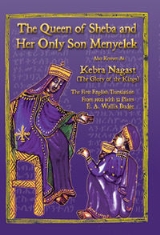
Menelik I

Encyclopedia
Menelik I first Jewish Emperor of Ethiopia
, is traditionally believed to be the son of King Solomon
of ancient Israel
and Makeda, ancient Ethiopia Queen of Sheba. He ruled around 950 BC, according to traditional sources. Tradition credits him with bringing the Ark of the Covenant
to Ethiopia, following a visit to Jerusalem to meet his father upon reaching adulthood.
According to the Kebra Nagast
, King Solomon had intended on sending one son of each of his nobles and one son each of each temple priest with Menelik upon his return to his mother's kingdom. He is supposed to have had a replica made of the Ark for them to take with them. Upon the death of Queen Makeda, Menelik assumed the throne with the new title of Emperor and King of Kings of Ethiopia
.
According to legend, he founded the Solomonic dynasty
of Ethiopia that ruled Ethiopia with few interruptions for close to three thousand years (and 225 generations later ended with the fall of Emperor Haile Selassie in 1974). However, the medieval incarnation of the Solomonic dynasty didn't come into power until 1270, claiming descent from the Kings of Aksûm, while their predecessors, the Zagwe dynasty
, were said to not be of "the house of Israel" (i.e. of Solomon and Menelik). The claims of descent of the Aksûmite Kings
preceding the Zagwe dynasty are uncertain, though early pagan inscription denote the King as "son of the unconquerable [god] Mahrem" (translated in Greek
as Ares
), while medieval Ethiopian sources ascribe them a similar claim of descent. This is consistent with the earliest records that testify that one half of Ethiopians followed the laws of Moses, while the other half worshipped pagan gods.
Emperor of Ethiopia
The Emperor of Ethiopia was the hereditary ruler of Ethiopia until the abolition of the monarchy in 1974. The Emperor was the head of state and head of government, with ultimate executive, judicial and legislative power in that country...
, is traditionally believed to be the son of King Solomon
Solomon
Solomon , according to the Book of Kings and the Book of Chronicles, a King of Israel and according to the Talmud one of the 48 prophets, is identified as the son of David, also called Jedidiah in 2 Samuel 12:25, and is described as the third king of the United Monarchy, and the final king before...
of ancient Israel
Israel
The State of Israel is a parliamentary republic located in the Middle East, along the eastern shore of the Mediterranean Sea...
and Makeda, ancient Ethiopia Queen of Sheba. He ruled around 950 BC, according to traditional sources. Tradition credits him with bringing the Ark of the Covenant
Ark of the Covenant
The Ark of the Covenant , also known as the Ark of the Testimony, is a chest described in Book of Exodus as solely containing the Tablets of Stone on which the Ten Commandments were inscribed...
to Ethiopia, following a visit to Jerusalem to meet his father upon reaching adulthood.
According to the Kebra Nagast
Kebra Nagast
The Kebra Nagast , or the Book of the Glory of Kings, is an account written in Ge'ez of the origins of the Solomonic line of the Emperors of Ethiopia. The text, in its existing form, is at least seven hundred years old, and is considered by many Ethiopian Christians and Rastafarians to be an...
, King Solomon had intended on sending one son of each of his nobles and one son each of each temple priest with Menelik upon his return to his mother's kingdom. He is supposed to have had a replica made of the Ark for them to take with them. Upon the death of Queen Makeda, Menelik assumed the throne with the new title of Emperor and King of Kings of Ethiopia
Ethiopia
Ethiopia , officially known as the Federal Democratic Republic of Ethiopia, is a country located in the Horn of Africa. It is the second-most populous nation in Africa, with over 82 million inhabitants, and the tenth-largest by area, occupying 1,100,000 km2...
.
According to legend, he founded the Solomonic dynasty
Solomonic dynasty
The Solomonic dynasty is the Imperial House of Abyssinia. Its members claim lineal descent from King Solomon and the Queen of Sheba, the latter of whom tradition asserts gave birth to the first King Menelik I after her Biblically described visit to Solomon in Jerusalem .-Overview:The dynasty, a...
of Ethiopia that ruled Ethiopia with few interruptions for close to three thousand years (and 225 generations later ended with the fall of Emperor Haile Selassie in 1974). However, the medieval incarnation of the Solomonic dynasty didn't come into power until 1270, claiming descent from the Kings of Aksûm, while their predecessors, the Zagwe dynasty
Zagwe dynasty
The Zagwe dynasty was an historical kingdom in present-day Ethiopia. It ruled large parts of the territory from approximately 1137 to 1270, when the last Zagwe King Za-Ilmaknun was killed in battle by the forces of Yekuno Amlak...
, were said to not be of "the house of Israel" (i.e. of Solomon and Menelik). The claims of descent of the Aksûmite Kings
Kings of Axum
-Kings during the zenith of the Kingdom of Axum:The following based on S.C. Munro-Hay, Aksum , pp. 67f-Later kings:The following list of rulers between 600-900 is based on E. A...
preceding the Zagwe dynasty are uncertain, though early pagan inscription denote the King as "son of the unconquerable [god] Mahrem" (translated in Greek
Greek language
Greek is an independent branch of the Indo-European family of languages. Native to the southern Balkans, it has the longest documented history of any Indo-European language, spanning 34 centuries of written records. Its writing system has been the Greek alphabet for the majority of its history;...
as Ares
Ares
Ares is the Greek god of war. He is one of the Twelve Olympians, and the son of Zeus and Hera. In Greek literature, he often represents the physical or violent aspect of war, in contrast to the armored Athena, whose functions as a goddess of intelligence include military strategy and...
), while medieval Ethiopian sources ascribe them a similar claim of descent. This is consistent with the earliest records that testify that one half of Ethiopians followed the laws of Moses, while the other half worshipped pagan gods.