

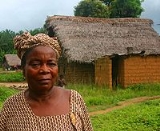
Mende people

Encyclopedia
The Mende people are one of the two largest and most dominant ethnic group
in Sierra Leone
, along with the Temne. The Mende make up 30% of Sierra Leone's total population http://www.nationsencyclopedia.com/Africa/Sierra-Leone-ETHNIC-GROUPS.html or 1,932,015 members. The Southern
and Eastern Provinces
of Sierra Leone, (collectively known as the South-East or South-Eastern Sierra Leone) is largely populated by the Mende people, with the exception of Kono District
(a cosmopolitan settlement, but primarily inhabited by the Kono people
).
The Mende belong to a larger group of Mande peoples who live throughout West Africa. The Mende are mostly farmers and hunters. The Mende are divided into two groups: The halemo are members of the hale or secret societies and kpowa are people who have never been initiated into the hale. The Mende believe that all humanistic and scientific power is passed down through the secret societies.
The Mende speak the Mende language
among each other, and is spoken both the Mende people and by other Sierra Leonean ethnic groups as a regional lingua franca
in southern Sierra Leone and in neighboring Liberia
. Their language is spoken by around 46% of Sierra Leone's population.
From the 16th through the 18th century, hundreds of thousands of Mende were captured and transported to the Americas
as slaves.
Sierra Leone's politics have been dominated by the Mende, along with the Limba
. The Mende overwhelmingly support the Sierra Leone People's Party
(SLPP), which ruled the country as recently as 2007. This has led to ethnic tensions in the country, particularly with the other major ethnic group, the Temne, who traditionally support the current ruling party, the All People's Congress
(APC).
in several waves between the 2nd and 16th centuries, and are part of greater Mande
society and linguistic group. Ethnologists identify three different sub-groups. The Kpa-Mende live to the west in the coastal bush, while the Sewa Mende are in the central forests. The Ko-Mende (or Kolo Mende) also live in the forests but generally to the north of the Sewa. (Olson, 1996).
Regional warfare throughout the 19th century led to the capture and sale of many Mende-speakers into slavery
. Most notable were those found aboard the Amistad
in 1839. They eventually won their freedom and were repatriated. This event involved fifty-two Mende tribesmen, purchased by Portuguese
slavers in 1839, who were shipped via the Middle Passage
to Havana, Cuba where they were sold to Cuban sugar plantation owners, José Ruiz and Pedro Montez. After working the plantation, they were placed on the schooner Amistad
and shipped to another Cuban plantation. On the way, they escaped their bondage and were led in a rebellion by Sengbe Pieh. They told the crew to return them to Africa
. Their efforts to return home were frustrated by the ship's remaining crew, who navigated up to the United States. The ship was intercepted off Long Island
, New York
, by a U.S. Coastal brig. The Spanish merchants Ruiz and Montez denounced the Mende and asserted that they were their property. The ensuing case, heard in Hartford
and New Haven, Connecticut
, affirmed that the men were free, and resulted in the return of the thirty-six surviving Mende to their homes.
In the Americas, especially the United States
, researchers have discovered that elements of African culture had long persistence. In some areas where there were large groups of enslaved Africans, they kept much of their heritage . In the 1930s African-American linguist Lorenzo Dow Turner
found a Gullah
family in coastal Georgia
who had preserved an ancient song in the Mende language ("A waka"), passing it down for 200 years. In the 1990s three modern researchers -- Joseph Opala
, Cynthia Schmidt, and Tazieff Koroma—located a Mende village in Sierra Leone where the same song is still sung today. The story of this ancient Mende song, and its survival in both Africa and the US, is chronicled in the documentary film The Language You Cry In.
Today in Sierra Leone, the Mende people are found mostly in the southern and eastern part of the country. Some of the major cities with significant Mende population include Bo
, Kenema, Kailahun
and Moyamba
.
and several other crops, practicing crop rotation
to protect soil productivity. Coffee, cocoa, and ginger are grown as cash crops, whereas rice, pepper, groundnuts, beniseed, and palm oil are grown for local consumption. Rice cooperatives have been formed in some rural areas.
Traditionally, Mende farming has been carried out by labour groups organised on a local basis and moving from farm to farm.(NIIP, 1973) Work is divided by gender: men attend to the heavy work of clearing the land for planting rice while women clean and pound rice, fish, and weed the planted crops. This routine is followed during ten months of every year, with a couple of months left around the New Year
, when they can spend more time in the village engaging in domestic pursuits like house building.
The Mende are patrilineal, patrilocal, and polygamous. The household unit is represented by at least one man and perhaps several of his brothers, with all of their wives and children . One or more brothers and married sisters usually leave sooner or later and are incorporated into other residential units. The senior male has moral authority—the right to respect and obedience—over the family as a whole, especially with regard to the negotiation of debts, damages, and bride-wealth.
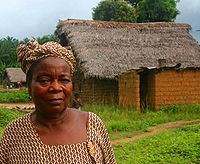 One of the greatest sins a Mende man can commit is to give away the secrets of their tribe. The Poro society
is the male equivalent to the Sande society. When inducted into this society, Mende boys are initiated into manhood. Many of their rituals parallel those of the Sande society.
The Poro prepares men for leadership in the community, so they might attain wisdom, accept responsibility, and gain power. It begins with the child's grade of discovery, followed by extensive training and service. During the seven-year initiation period, the young men converse with each other using a secret language and passwords, known only to other Poro members. The member always knows and understands what is being said. This is part of the mystery of this secret society.
At the beginning, young men aged 20 are called into the society and are trained by the group above them, along with a few elders. There is much work to be done during the initiation process. Dancing the masks is part of this work, but not the most important part. Only through work does the dance of the mask become meaningful.
begin the initiation process into the Sande society. The goals of this secret society are to teach young Mende women the responsibilities of adulthood. The girls are taught to be hard working and modest in their behavior, especially towards their elders. Sande influences every aspect of a Mende woman's life; it is present before birth and still present after.
Sande is the guardian of women; their protector and guide through life. It is Sande that grants a woman with an identity and a personality. The Sande society is concerned with defining what it is to be human and of discovering the ways of promoting love, justice, and harmony. It is a moral philosophy that focuses on the perpetual refinement of the individual. Sande leaders serve as models to women in the community. They exemplify the highest of Mende ideals, and they have the duty of enforcing positive social relationships and of removing any harm that might come to women in their community. "This is Sande; women together in their womanhood, in a free exchange of words and actions among sisters. Where ever two or three women are gathered together, there is the spirit of Sande."
Sande groups conduct masked performances that embody the Sande guardian spirit, who is associated with water and rivers. Descriptions of the society and its masquerade events have been made by visitors since the seventeenth century.
a number of positions all around. The sowie are the highest-ranking leaders of the group. It is their job to model to the Mende women the most important of Mende social values. It is also their duty to enforce proper social relationships and to remove anything that might be harmful to the women in their community. The sowie have control over certain sacred knowledge that is essential to the development of success and happiness in an individual, and also to the well-being of the community. They are the experts of the Sande women and have access to spirit ancestors and forces of nature.
The rank below sowie is ligba. There are two grades within ligba; Ligba Wa (senior) and Ligba Wulo (junior). In any group there is only one Ligba Wa, she is an executive officer in Sande. Before a woman can take a leadership role in artistic activities she must be eligible at least as a Ligba Wulo. An ordinary member is referred to as nyaha. The word indicates that the Sande initiation makes a woman of a child, and every woman into a wife. An initiate in training is called mbogdoni. A non-member is kpowa. As a noun kpowa means "an ignoramus, stupid, retarded, a fool" as a verb it means "to become insane or deranged.
and the Mendé are probably the best-known, and finely crafted in the region. The Mandé also produce beautifully woven fabrics which are popular throughout western Africa, and gold and silver necklaces, bracelets, armlets, and earrings. The bells on the necklaces are of the type believed capable of being heard by spirits, ringing in both worlds, that of the ancestors and the living. Mandé hunters often wear a single bell that can be easily silenced when stealth is necessary. Women, on the other hand, often wear multiple bells, referring to concepts of community, since the bells ring harmoniously together.
The features of a Mende mask convey Mende ideals of female morality
and physical beauty. They are unusual because the masks are worn by women. The bird on top of the head represents a woman's natural intuition that lets her see and know things that others can't. The high or broad forehead represents good luck or the sharp, contemplative mind of the ideal Mende woman. Downcast eyes symbolize a spiritual nature and it is through these small slits that a woman wearing the mask would look out of. The small mouth signifies the ideal woman's quiet and humble character. The markings on the cheeks are representative of the decorative scars girls receive as they step into womanhood. The scars are a symbol of her new, harder life. The neck rolls are an indication of the health of an ideal women. They have also been called symbols of the pattern of concentric, circular ripples the Mende spirit makes when emerging from the water. In the Mende culture full-figured women are beautiful. The intricate hairstyles reveal the close ties within a community of women. The holes at the base of the mask are where the rest of the costume is attached. A woman who wears these masks must not expose any part of her body or a vengeful spirit may take possession of her. Women often cover their bodies with masses of raffia or black cloth.
When a girl becomes initiated into the Sande society, the village's master woodcarver creates a special mask just for her. Helmet masks are made from a section of tree trunk, often of the kpole (cotton) tree, and then carved and hollowed to fit over the wearer’s head and face. The woodcarver must wait until he has a dream that guides him to make the mask a certain way for the recipient. A mask must be kept hidden in a secret place when no one is wearing it.
These masks appear not only in initiation rituals but also at important events such as funerals, arbitrations and the installation of chiefs. Examples of these masks appear in museums.
Gonde is also a Ndoli jowei, but rather than the harsh enforcer she is the comic relief. Gonde becomes a friend to the initiates, amusing them to help them forget the hard ordeals they are going through. She coaches the girls who are slow in dancing, encouraging the girls to work hard. "Gonde is a funny, lovable character who lightens the gloom and reminds everyone that Sande is not always so deadly serious."
Ndoli jowei is the principal spirit for celebration, although she also appears on other occasions besides celebrations. In Sande initiation there are three major events in which the ndoli jowei appear publicly. The first occurs 1–3 days after the initiates have been taken into the bush to be circumcised. This event is known as yaya gbegbi. At this time the ndoli jowei comes into town with a group of Sande women while the initiates stay in the bush recovering from their operations. The women come into town to tell men they have initiated people into Sande. They go through the town waving leaves and gathering food and other supplies that they need. Ndoli jowei does not dance on this occasion because it is not yet time for celebration. She is there only as a reminder of the powerful medicine which has been summoned by the Sande session. This validates the unruly behavior of the Sande women. The next time ndoli jowei appears is at a minor feast called Kpete gbula yombo le or Sowo mba yili gbi. At this occasion, an announcement is made to inform people of the date for the gani celebration; which is the last event of the Sande initiation that ndoli jowei appears at. At this time, the new initiates are brought into town for the first time since the initiation process began; accompanied by ndoli jowei. This is a happy occasion where dances are performed by both the maskers and the initiates.
White is the color of Sande. To the Mende, the pureness of white signifies the cleanliness and absence of imperfections. "It shows a 'harmlessness'; it is void of all things satanic and is thus 'a positive and helpful color. White is symbolic of the spirit world and also of the secret parts of society where people aim for the highest standards.
Objects and people who are marked with Hojo are under Sande protection and control. They are subject to authority of Sande law and punishment. Initiates are colored with this white clay to show that they are property of Sande. This signifies that they are under the protection of Sande and should not be fooled with. Sowei, the judge of women, wears white to represent clear thinking and justice.
. Both thickness and length are elements that are admired by the Mende. Thickness means the woman has more individual strands of hair and the length is proof of strength. It takes time, care and patience to grow a beautiful, full head of hair. Ideas about hair root women to nature, the way hair grows is compared to the way forests grow. The vegetation on earth is the "hair" on the head of Mother Nature in the same way the hair on the head of a woman is her "foliage." (Boone) A woman with long, thick hair illustrates a life force, she may be blessed with a green thumb giving her the ability to have a promising farm and many healthy children.
Hairstyles are very important in Mende society. A Mende woman's hair must be well groomed, clean, and oiled. Hair must be tied down under strict control and shaped into intricate, elegant styles for the sake of beauty and sex appeal. Dirty, disheveled hair is a sign of insanity. A woman who does not groom and maintain her hair has neglected the community's standards of behavior. Only a woman in mourning can let her hair loose. The Mende finds unarranged "wild" hair immoral and connects it to wild behavior.
, or female circumcision
. This surgery is supposed to foreshadow the pain a Mende woman experiences during childbirth
. The shock of this experience also tests a Mende woman's physical endurance. The shared pain of the clitoridectomy creates permanent bonds among the initiates. Vows that express a social bond are taken after the operation; these vows are a metaphor for the support the women will have during the pains of childbirth.
This procedure is considered necessary to change Mende children, who are considered to be of neutral sex before the procedure, to heterosexual, gendered adults. Circumcision is thought to remove the female's residue of maleness.
(c. 1890–1962) of Sierra Leone. Seeing how the British
managed to take over his country, Kisimi concluded that their power was partly a result of their literacy
. He decided to give his own people that ability. Kisimi claimed he was inspired in a dream to create the Mende syllabary, which he called Ki-ka-ku. During the 1920s and 1930s, he ran a school in southern Sierra Leone to teach Ki-ka-ku. The syllabary became a popular method of keeping records and writing letters.
During the 1940s, the British set up the Protectorate Literacy Bureau in Sierra Leone's second largest city of Bo
. Its goal was to teach the Mende people to read and write with a version of the Latin alphabet
. As a result, usage of Kisimi's syllabary gradually diminished and it was eventually forgotten.
The politics
of Sierra Leone have traditionally been dominated by the Mende. The Sierra Leone People's Party
(SLPP), which is one of the two major political party
in the country, is predominantly based among the Mende people. The SLPP gets most of its support in Mende- predominate south-east region of Sierra Leone. Most of the country's top government positions have been held by the Mende. Sierra Leone's first Prime minister
Sir
Milton Margai
, who led the country to independence from the United Kingdom
on April 27, 1961 was a prominent member of the Mende ethnic group. Other prominent Sierra Leonean politicians from the Mende ethnic group include the country's second prime minister Sir
Albert Margai
, who was also the younger brother of Milton Margai; former commander of the Republic of Sierra Leone Armed Forces and former Sierra Leone's head of state
Brigadier
David Lansana
; former Head of State of Sierra Leone Brigadier General
Julius Maada Bio
; former Sierra Leone's vice president Albert Joe Demby
; former Sierra Leone's vice president and attorney general
Solomon Berewa
; former Sierra Leone's vice president minister of Justice and Attorney General Francis Minah
; former Sierra Leone's attorney general and one of the founding members of the Sierra Leone People's Party (SLPP) Banja Tejan-Sie
. Samuel Hinga Norman
, who was Sierra Leone's minister of Defense and former leader of the militant
group the Civil Defense Forces (commonly known as the Kamajors
). Sierra Leonean politician Charles Margai
, who is the leader of one of the country's main opposition party the People's Movement for Democratic Change
(PMDC). He is also the son of former prime minister Albert Margai and the nephew of Milton Margai; and former Sierra Leone's minister of finance John Oponjo Benjamin
, who is currently the National Leader of the Sierra Leone People's Party (SLPP).
Ethnic group
An ethnic group is a group of people whose members identify with each other, through a common heritage, often consisting of a common language, a common culture and/or an ideology that stresses common ancestry or endogamy...
in Sierra Leone
Sierra Leone
Sierra Leone , officially the Republic of Sierra Leone, is a country in West Africa. It is bordered by Guinea to the north and east, Liberia to the southeast, and the Atlantic Ocean to the west and southwest. Sierra Leone covers a total area of and has an estimated population between 5.4 and 6.4...
, along with the Temne. The Mende make up 30% of Sierra Leone's total population http://www.nationsencyclopedia.com/Africa/Sierra-Leone-ETHNIC-GROUPS.html or 1,932,015 members. The Southern
Southern Province, Sierra Leone
The Southern Province is one of three provinces of Sierra Leone. It covers an area of 19,694 km² and has a population of 1,377,067 . It consists of four districts . Its capital and administrative center is Bo, which is also the second largest and second most populated city in Sierra Leone...
and Eastern Provinces
Eastern Province, Sierra Leone
Eastern Province is one of the four provinces of Sierra Leone. It covers an area of 15,553 km² and has a population of 1,187,532...
of Sierra Leone, (collectively known as the South-East or South-Eastern Sierra Leone) is largely populated by the Mende people, with the exception of Kono District
Kono District
Kono District is a district in the Eastern Province of Sierra Leone. Its capital and largest city is Koidu Town. The other major towns in the district include Yengema, Tombodu, Motema, Jaiama-Nimokoro and Sewafe. Kono District is the largest diamond producer in Sierra Leone.The population of Kono...
(a cosmopolitan settlement, but primarily inhabited by the Kono people
Kono people
The Kono people is a major ethnic group in Sierra Leone at about 7.6% of the country's total population. Their homeland is the diamond-rich Kono District in south-eastern Sierra Leone. They form by far the single largest ethnic group in the district at about 52% of the population...
).
The Mende belong to a larger group of Mande peoples who live throughout West Africa. The Mende are mostly farmers and hunters. The Mende are divided into two groups: The halemo are members of the hale or secret societies and kpowa are people who have never been initiated into the hale. The Mende believe that all humanistic and scientific power is passed down through the secret societies.
The Mende speak the Mende language
Mende language
Mende is a major language of Sierra Leone, with some speakers in neighboring Liberia. It is spoken by the Mende people and by other ethnic groups as a regional lingua franca in southern Sierra Leone....
among each other, and is spoken both the Mende people and by other Sierra Leonean ethnic groups as a regional lingua franca
Lingua franca
A lingua franca is a language systematically used to make communication possible between people not sharing a mother tongue, in particular when it is a third language, distinct from both mother tongues.-Characteristics:"Lingua franca" is a functionally defined term, independent of the linguistic...
in southern Sierra Leone and in neighboring Liberia
Liberia
Liberia , officially the Republic of Liberia, is a country in West Africa. It is bordered by Sierra Leone on the west, Guinea on the north and Côte d'Ivoire on the east. Liberia's coastline is composed of mostly mangrove forests while the more sparsely populated inland consists of forests that open...
. Their language is spoken by around 46% of Sierra Leone's population.
From the 16th through the 18th century, hundreds of thousands of Mende were captured and transported to the Americas
Americas
The Americas, or America , are lands in the Western hemisphere, also known as the New World. In English, the plural form the Americas is often used to refer to the landmasses of North America and South America with their associated islands and regions, while the singular form America is primarily...
as slaves.
Sierra Leone's politics have been dominated by the Mende, along with the Limba
Limba people (Sierra Leone)
The Limba people is a major ethnic group in the Republic of Sierra Leone. They form the third largest ethnic group in the country, about 8.5% of Sierra Leone's total population ....
. The Mende overwhelmingly support the Sierra Leone People's Party
Sierra Leone People's Party
Sierra Leone People's Party is one of the two major political parties in Sierra Leone, along with the All People's Congress .-Formation:...
(SLPP), which ruled the country as recently as 2007. This has led to ethnic tensions in the country, particularly with the other major ethnic group, the Temne, who traditionally support the current ruling party, the All People's Congress
All People's Congress
The All People's Congress is one of the two major political parties in Sierra Leone, the other is the Sierra Leone People's Party . The party was founded in 1960 by Pa Mucktarru Kallay, Allieu Badarr Koroma,Alhaji Sheik Gibril Sesay C A Kamara-Taylor, S A T Koroma and Abu Bakarr S Bangura...
(APC).
History
Cultural and oral traditions indicate that the Mende migrated to the area from the western SudanSudan
Sudan , officially the Republic of the Sudan , is a country in North Africa, sometimes considered part of the Middle East politically. It is bordered by Egypt to the north, the Red Sea to the northeast, Eritrea and Ethiopia to the east, South Sudan to the south, the Central African Republic to the...
in several waves between the 2nd and 16th centuries, and are part of greater Mande
Mande
Mande may refer to:* Mandé peoples of western Africa* Mande languages* Manding, a term covering a subgroup of Mande peoples, and sometimes used for one of them, Mandinka* Garo people of northeastern India and northern Bangladesh...
society and linguistic group. Ethnologists identify three different sub-groups. The Kpa-Mende live to the west in the coastal bush, while the Sewa Mende are in the central forests. The Ko-Mende (or Kolo Mende) also live in the forests but generally to the north of the Sewa. (Olson, 1996).
Regional warfare throughout the 19th century led to the capture and sale of many Mende-speakers into slavery
Slavery
Slavery is a system under which people are treated as property to be bought and sold, and are forced to work. Slaves can be held against their will from the time of their capture, purchase or birth, and deprived of the right to leave, to refuse to work, or to demand compensation...
. Most notable were those found aboard the Amistad
La Amistad
La Amistad was a ship notable as the scene of a revolt by African captives being transported from Havana to Puerto Principe, Cuba. It was a 19th-century two-masted schooner built in Spain and owned by a Spaniard living in Cuba...
in 1839. They eventually won their freedom and were repatriated. This event involved fifty-two Mende tribesmen, purchased by Portuguese
Portugal
Portugal , officially the Portuguese Republic is a country situated in southwestern Europe on the Iberian Peninsula. Portugal is the westernmost country of Europe, and is bordered by the Atlantic Ocean to the West and South and by Spain to the North and East. The Atlantic archipelagos of the...
slavers in 1839, who were shipped via the Middle Passage
Middle Passage
The Middle Passage was the stage of the triangular trade in which millions of people from Africa were shipped to the New World, as part of the Atlantic slave trade...
to Havana, Cuba where they were sold to Cuban sugar plantation owners, José Ruiz and Pedro Montez. After working the plantation, they were placed on the schooner Amistad
La Amistad
La Amistad was a ship notable as the scene of a revolt by African captives being transported from Havana to Puerto Principe, Cuba. It was a 19th-century two-masted schooner built in Spain and owned by a Spaniard living in Cuba...
and shipped to another Cuban plantation. On the way, they escaped their bondage and were led in a rebellion by Sengbe Pieh. They told the crew to return them to Africa
Africa
Africa is the world's second largest and second most populous continent, after Asia. At about 30.2 million km² including adjacent islands, it covers 6% of the Earth's total surface area and 20.4% of the total land area...
. Their efforts to return home were frustrated by the ship's remaining crew, who navigated up to the United States. The ship was intercepted off Long Island
Long Island
Long Island is an island located in the southeast part of the U.S. state of New York, just east of Manhattan. Stretching northeast into the Atlantic Ocean, Long Island contains four counties, two of which are boroughs of New York City , and two of which are mainly suburban...
, New York
New York
New York is a state in the Northeastern region of the United States. It is the nation's third most populous state. New York is bordered by New Jersey and Pennsylvania to the south, and by Connecticut, Massachusetts and Vermont to the east...
, by a U.S. Coastal brig. The Spanish merchants Ruiz and Montez denounced the Mende and asserted that they were their property. The ensuing case, heard in Hartford
Hartford, Connecticut
Hartford is the capital of the U.S. state of Connecticut. The seat of Hartford County until Connecticut disbanded county government in 1960, it is the second most populous city on New England's largest river, the Connecticut River. As of the 2010 Census, Hartford's population was 124,775, making...
and New Haven, Connecticut
New Haven, Connecticut
New Haven is the second-largest city in Connecticut and the sixth-largest in New England. According to the 2010 Census, New Haven's population increased by 5.0% between 2000 and 2010, a rate higher than that of the State of Connecticut, and higher than that of the state's five largest cities, and...
, affirmed that the men were free, and resulted in the return of the thirty-six surviving Mende to their homes.
In the Americas, especially the United States
United States
The United States of America is a federal constitutional republic comprising fifty states and a federal district...
, researchers have discovered that elements of African culture had long persistence. In some areas where there were large groups of enslaved Africans, they kept much of their heritage . In the 1930s African-American linguist Lorenzo Dow Turner
Lorenzo Dow Turner
Lorenzo Dow Turner was an African-American academic and linguist who did seminal research on the Gullah language of the Low Country of coastal South Carolina and Georgia. His studies included recordings of Gullah speakers in the 1930s...
found a Gullah
Gullah
The Gullah are African Americans who live in the Lowcountry region of South Carolina and Georgia, which includes both the coastal plain and the Sea Islands....
family in coastal Georgia
Georgia (U.S. state)
Georgia is a state located in the southeastern United States. It was established in 1732, the last of the original Thirteen Colonies. The state is named after King George II of Great Britain. Georgia was the fourth state to ratify the United States Constitution, on January 2, 1788...
who had preserved an ancient song in the Mende language ("A waka"), passing it down for 200 years. In the 1990s three modern researchers -- Joseph Opala
Joseph Opala
Joseph A. Opala is an American historian who documented the "Gullah Connection," the historical link between the Gullah people in South Carolina and Georgia, and the West African nation of Sierra Leone...
, Cynthia Schmidt, and Tazieff Koroma—located a Mende village in Sierra Leone where the same song is still sung today. The story of this ancient Mende song, and its survival in both Africa and the US, is chronicled in the documentary film The Language You Cry In.
Today in Sierra Leone, the Mende people are found mostly in the southern and eastern part of the country. Some of the major cities with significant Mende population include Bo
Bo, Sierra Leone
Bo is the second largest city in Sierra Leone and the largest city in the Southern Province. It lies about 164 miles south-east of Freetown and had a population 149,957 in the 2004 census, with a current estimate is 231,494 . The city serve as the capital and administrative center of Bo District...
, Kenema, Kailahun
Kailahun
Kailahun is the capital of Kailahun District in the Eastern Province of Sierra Leone. The town lies 300 miles east of Freetown and with a population of 25,210. The population of Kailahun is largely from the Mende ethnic group and the Mende language along with the Krio language are widely spoken...
and Moyamba
Moyamba
Moyamba is the capital and largest city of Moyamba District, in the Southern Province of Sierra Leone, with a population of 11,485 in the 2004 census. The city is about 48 miles southeast of the capital, Freetown. The population of the city is ethnically diverse although the Mende people make up...
.
Tradition and culture
The Mende traditionally live in villages of 70 to 250 residents, which are situated from 1.5 to 5 kilometers apart. There is little or no mechanization over the greater part of rural Mende country. Mende farmers use hoes and machetes, but few other tools. The Mende are generally known as growers of riceRice
Rice is the seed of the monocot plants Oryza sativa or Oryza glaberrima . As a cereal grain, it is the most important staple food for a large part of the world's human population, especially in East Asia, Southeast Asia, South Asia, the Middle East, and the West Indies...
and several other crops, practicing crop rotation
Crop rotation
Crop rotation is the practice of growing a series of dissimilar types of crops in the same area in sequential seasons.Crop rotation confers various benefits to the soil. A traditional element of crop rotation is the replenishment of nitrogen through the use of green manure in sequence with cereals...
to protect soil productivity. Coffee, cocoa, and ginger are grown as cash crops, whereas rice, pepper, groundnuts, beniseed, and palm oil are grown for local consumption. Rice cooperatives have been formed in some rural areas.
Traditionally, Mende farming has been carried out by labour groups organised on a local basis and moving from farm to farm.(NIIP, 1973) Work is divided by gender: men attend to the heavy work of clearing the land for planting rice while women clean and pound rice, fish, and weed the planted crops. This routine is followed during ten months of every year, with a couple of months left around the New Year
New Year
The New Year is the day that marks the time of the beginning of a new calendar year, and is the day on which the year count of the specific calendar used is incremented. For many cultures, the event is celebrated in some manner....
, when they can spend more time in the village engaging in domestic pursuits like house building.
The Mende are patrilineal, patrilocal, and polygamous. The household unit is represented by at least one man and perhaps several of his brothers, with all of their wives and children . One or more brothers and married sisters usually leave sooner or later and are incorporated into other residential units. The senior male has moral authority—the right to respect and obedience—over the family as a whole, especially with regard to the negotiation of debts, damages, and bride-wealth.
Poro society
Society
A society, or a human society, is a group of people related to each other through persistent relations, or a large social grouping sharing the same geographical or virtual territory, subject to the same political authority and dominant cultural expectations...
is the male equivalent to the Sande society. When inducted into this society, Mende boys are initiated into manhood. Many of their rituals parallel those of the Sande society.
The Poro prepares men for leadership in the community, so they might attain wisdom, accept responsibility, and gain power. It begins with the child's grade of discovery, followed by extensive training and service. During the seven-year initiation period, the young men converse with each other using a secret language and passwords, known only to other Poro members. The member always knows and understands what is being said. This is part of the mystery of this secret society.
At the beginning, young men aged 20 are called into the society and are trained by the group above them, along with a few elders. There is much work to be done during the initiation process. Dancing the masks is part of this work, but not the most important part. Only through work does the dance of the mask become meaningful.
Sande society
All Mende women when they reach pubertyPuberty
Puberty is the process of physical changes by which a child's body matures into an adult body capable of reproduction, as initiated by hormonal signals from the brain to the gonads; the ovaries in a girl, the testes in a boy...
begin the initiation process into the Sande society. The goals of this secret society are to teach young Mende women the responsibilities of adulthood. The girls are taught to be hard working and modest in their behavior, especially towards their elders. Sande influences every aspect of a Mende woman's life; it is present before birth and still present after.
Sande is the guardian of women; their protector and guide through life. It is Sande that grants a woman with an identity and a personality. The Sande society is concerned with defining what it is to be human and of discovering the ways of promoting love, justice, and harmony. It is a moral philosophy that focuses on the perpetual refinement of the individual. Sande leaders serve as models to women in the community. They exemplify the highest of Mende ideals, and they have the duty of enforcing positive social relationships and of removing any harm that might come to women in their community. "This is Sande; women together in their womanhood, in a free exchange of words and actions among sisters. Where ever two or three women are gathered together, there is the spirit of Sande."
Sande groups conduct masked performances that embody the Sande guardian spirit, who is associated with water and rivers. Descriptions of the society and its masquerade events have been made by visitors since the seventeenth century.
Sande hierarchy
The Sande society is organized by a hierarchyHierarchy
A hierarchy is an arrangement of items in which the items are represented as being "above," "below," or "at the same level as" one another...
a number of positions all around. The sowie are the highest-ranking leaders of the group. It is their job to model to the Mende women the most important of Mende social values. It is also their duty to enforce proper social relationships and to remove anything that might be harmful to the women in their community. The sowie have control over certain sacred knowledge that is essential to the development of success and happiness in an individual, and also to the well-being of the community. They are the experts of the Sande women and have access to spirit ancestors and forces of nature.
The rank below sowie is ligba. There are two grades within ligba; Ligba Wa (senior) and Ligba Wulo (junior). In any group there is only one Ligba Wa, she is an executive officer in Sande. Before a woman can take a leadership role in artistic activities she must be eligible at least as a Ligba Wulo. An ordinary member is referred to as nyaha. The word indicates that the Sande initiation makes a woman of a child, and every woman into a wife. An initiate in training is called mbogdoni. A non-member is kpowa. As a noun kpowa means "an ignoramus, stupid, retarded, a fool" as a verb it means "to become insane or deranged.
Arts
Much Mandé art is in the form of jewelry and carvings. The masks associated with the fraternal and sorority associations of the MarkaMarka
Marka may refer to:* Marka people, a people of Mali in Western Africa** Marka language, the language of the Marka people* Bosnia and Herzegovina convertible mark , the currency of Bosnia and Herzegovina...
and the Mendé are probably the best-known, and finely crafted in the region. The Mandé also produce beautifully woven fabrics which are popular throughout western Africa, and gold and silver necklaces, bracelets, armlets, and earrings. The bells on the necklaces are of the type believed capable of being heard by spirits, ringing in both worlds, that of the ancestors and the living. Mandé hunters often wear a single bell that can be easily silenced when stealth is necessary. Women, on the other hand, often wear multiple bells, referring to concepts of community, since the bells ring harmoniously together.
Mende masks
Masks are the collective Mind of Mende community; viewed as one body, they are the Spirit of the Mende people. The Mende masked figures are a reminder that human beings have a dual existence; they live in the concrete world of flesh and material things and the spirit world of dreams, faith, aspirations and imagination.The features of a Mende mask convey Mende ideals of female morality
Morality
Morality is the differentiation among intentions, decisions, and actions between those that are good and bad . A moral code is a system of morality and a moral is any one practice or teaching within a moral code...
and physical beauty. They are unusual because the masks are worn by women. The bird on top of the head represents a woman's natural intuition that lets her see and know things that others can't. The high or broad forehead represents good luck or the sharp, contemplative mind of the ideal Mende woman. Downcast eyes symbolize a spiritual nature and it is through these small slits that a woman wearing the mask would look out of. The small mouth signifies the ideal woman's quiet and humble character. The markings on the cheeks are representative of the decorative scars girls receive as they step into womanhood. The scars are a symbol of her new, harder life. The neck rolls are an indication of the health of an ideal women. They have also been called symbols of the pattern of concentric, circular ripples the Mende spirit makes when emerging from the water. In the Mende culture full-figured women are beautiful. The intricate hairstyles reveal the close ties within a community of women. The holes at the base of the mask are where the rest of the costume is attached. A woman who wears these masks must not expose any part of her body or a vengeful spirit may take possession of her. Women often cover their bodies with masses of raffia or black cloth.
When a girl becomes initiated into the Sande society, the village's master woodcarver creates a special mask just for her. Helmet masks are made from a section of tree trunk, often of the kpole (cotton) tree, and then carved and hollowed to fit over the wearer’s head and face. The woodcarver must wait until he has a dream that guides him to make the mask a certain way for the recipient. A mask must be kept hidden in a secret place when no one is wearing it.
These masks appear not only in initiation rituals but also at important events such as funerals, arbitrations and the installation of chiefs. Examples of these masks appear in museums.
Dancing
Learning dance is a harsh discipline that every Mende girl must tackle. Girls practice for hours at a time until they drop from exhaustion. Ndoli jowei, the expert in dancing, is in charge of teaching young Mende girls to dance. When girls make a mistake in the steps, they are whipped with a switch until they get it right. Often girls are awoken in the middle of the night to practice the dance; sometimes they are forced to stay awake for nearly 48 hours dancing almost the entire time. By the end of their brutal training, the girls have transformed into young woman who are tough and confident even in the harshest of conditions. They are in great physical shape and have endurance and stamina.Gonde is also a Ndoli jowei, but rather than the harsh enforcer she is the comic relief. Gonde becomes a friend to the initiates, amusing them to help them forget the hard ordeals they are going through. She coaches the girls who are slow in dancing, encouraging the girls to work hard. "Gonde is a funny, lovable character who lightens the gloom and reminds everyone that Sande is not always so deadly serious."
Ndoli jowei is the principal spirit for celebration, although she also appears on other occasions besides celebrations. In Sande initiation there are three major events in which the ndoli jowei appear publicly. The first occurs 1–3 days after the initiates have been taken into the bush to be circumcised. This event is known as yaya gbegbi. At this time the ndoli jowei comes into town with a group of Sande women while the initiates stay in the bush recovering from their operations. The women come into town to tell men they have initiated people into Sande. They go through the town waving leaves and gathering food and other supplies that they need. Ndoli jowei does not dance on this occasion because it is not yet time for celebration. She is there only as a reminder of the powerful medicine which has been summoned by the Sande session. This validates the unruly behavior of the Sande women. The next time ndoli jowei appears is at a minor feast called Kpete gbula yombo le or Sowo mba yili gbi. At this occasion, an announcement is made to inform people of the date for the gani celebration; which is the last event of the Sande initiation that ndoli jowei appears at. At this time, the new initiates are brought into town for the first time since the initiation process began; accompanied by ndoli jowei. This is a happy occasion where dances are performed by both the maskers and the initiates.
Color symbolism
Hojo is a white clay that Mende women use to mark their territory. The clay comes from the water like many other aspects of Sande. Its smooth, shiny surface reflects light, making it eye-catching. Hojo is found in a scale of colors from beige to pure white. The pure white Hojo is more rare, found only deep beneath the surface of the water. Hojo and Sande are parallel in that they are both well hidden and secretive in its purest form.White is the color of Sande. To the Mende, the pureness of white signifies the cleanliness and absence of imperfections. "It shows a 'harmlessness'; it is void of all things satanic and is thus 'a positive and helpful color. White is symbolic of the spirit world and also of the secret parts of society where people aim for the highest standards.
Objects and people who are marked with Hojo are under Sande protection and control. They are subject to authority of Sande law and punishment. Initiates are colored with this white clay to show that they are property of Sande. This signifies that they are under the protection of Sande and should not be fooled with. Sowei, the judge of women, wears white to represent clear thinking and justice.
Hair
A woman's hair is a sign of femininityFemininity
Femininity is a set of attributes, behaviors, and roles generally associated with girls and women. Though socially constructed, femininity is made up of both socially defined and biologically created factors...
. Both thickness and length are elements that are admired by the Mende. Thickness means the woman has more individual strands of hair and the length is proof of strength. It takes time, care and patience to grow a beautiful, full head of hair. Ideas about hair root women to nature, the way hair grows is compared to the way forests grow. The vegetation on earth is the "hair" on the head of Mother Nature in the same way the hair on the head of a woman is her "foliage." (Boone) A woman with long, thick hair illustrates a life force, she may be blessed with a green thumb giving her the ability to have a promising farm and many healthy children.
Hairstyles are very important in Mende society. A Mende woman's hair must be well groomed, clean, and oiled. Hair must be tied down under strict control and shaped into intricate, elegant styles for the sake of beauty and sex appeal. Dirty, disheveled hair is a sign of insanity. A woman who does not groom and maintain her hair has neglected the community's standards of behavior. Only a woman in mourning can let her hair loose. The Mende finds unarranged "wild" hair immoral and connects it to wild behavior.
Body alterations
A key element of Sande initiation is the clitoridectomyClitoridectomy
Clitoridectomy is the surgical removal of the clitoris. It is rarely needed as a therapeutic medical procedure, such as when cancer has developed in or spread to the clitoris...
, or female circumcision
Circumcision
Male circumcision is the surgical removal of some or all of the foreskin from the penis. The word "circumcision" comes from Latin and ....
. This surgery is supposed to foreshadow the pain a Mende woman experiences during childbirth
Childbirth
Childbirth is the culmination of a human pregnancy or gestation period with the birth of one or more newborn infants from a woman's uterus...
. The shock of this experience also tests a Mende woman's physical endurance. The shared pain of the clitoridectomy creates permanent bonds among the initiates. Vows that express a social bond are taken after the operation; these vows are a metaphor for the support the women will have during the pains of childbirth.
This procedure is considered necessary to change Mende children, who are considered to be of neutral sex before the procedure, to heterosexual, gendered adults. Circumcision is thought to remove the female's residue of maleness.
Neck rings
The neck rings at the base of the mask are an exaggeration of actual neck creases. Mende people consider a beautiful neck to be one with rings: they are a sign of beauty because they suggest wealth, high status, and are sexually attractive. The rings indicate prosperity and wholesome living, and are given by God to show his affection for a fortunate few. As well, the rings indicate a relationship with the divine: the Sowo itself is a deity from the waters, and the neck rings represent the concentric waves that are formed on still water by Sowo's head breaking through the surface. The spirit comes from the water, and what the human eye sees on the necks of women "is human in form, but divine in essence", as portrayed in the mask.Mende syllabary
The Mende syllabary was invented in 1921 by Kisimi KamaraKisimi Kamara
Kisimi Kamara was a simple village tailor from Sierra Leone who gave his people the gift of writing. He invented the Mende syllabary in 1921.-Early life:...
(c. 1890–1962) of Sierra Leone. Seeing how the British
United Kingdom
The United Kingdom of Great Britain and Northern IrelandIn the United Kingdom and Dependencies, other languages have been officially recognised as legitimate autochthonous languages under the European Charter for Regional or Minority Languages...
managed to take over his country, Kisimi concluded that their power was partly a result of their literacy
Literacy
Literacy has traditionally been described as the ability to read for knowledge, write coherently and think critically about printed material.Literacy represents the lifelong, intellectual process of gaining meaning from print...
. He decided to give his own people that ability. Kisimi claimed he was inspired in a dream to create the Mende syllabary, which he called Ki-ka-ku. During the 1920s and 1930s, he ran a school in southern Sierra Leone to teach Ki-ka-ku. The syllabary became a popular method of keeping records and writing letters.
During the 1940s, the British set up the Protectorate Literacy Bureau in Sierra Leone's second largest city of Bo
Bo, Sierra Leone
Bo is the second largest city in Sierra Leone and the largest city in the Southern Province. It lies about 164 miles south-east of Freetown and had a population 149,957 in the 2004 census, with a current estimate is 231,494 . The city serve as the capital and administrative center of Bo District...
. Its goal was to teach the Mende people to read and write with a version of the Latin alphabet
Latin alphabet
The Latin alphabet, also called the Roman alphabet, is the most recognized alphabet used in the world today. It evolved from a western variety of the Greek alphabet called the Cumaean alphabet, which was adopted and modified by the Etruscans who ruled early Rome...
. As a result, usage of Kisimi's syllabary gradually diminished and it was eventually forgotten.
Politics
It is well known in Sierra Leone that the Mendes, along with the Krios and Sherbros, are educationists. They are considered to favor learning than doing business. To them, education comes first. They are also known to command respect and possess leadership qualities.The politics
Politics
Politics is a process by which groups of people make collective decisions. The term is generally applied to the art or science of running governmental or state affairs, including behavior within civil governments, but also applies to institutions, fields, and special interest groups such as the...
of Sierra Leone have traditionally been dominated by the Mende. The Sierra Leone People's Party
Sierra Leone People's Party
Sierra Leone People's Party is one of the two major political parties in Sierra Leone, along with the All People's Congress .-Formation:...
(SLPP), which is one of the two major political party
Political party
A political party is a political organization that typically seeks to influence government policy, usually by nominating their own candidates and trying to seat them in political office. Parties participate in electoral campaigns, educational outreach or protest actions...
in the country, is predominantly based among the Mende people. The SLPP gets most of its support in Mende- predominate south-east region of Sierra Leone. Most of the country's top government positions have been held by the Mende. Sierra Leone's first Prime minister
Prime minister
A prime minister is the most senior minister of cabinet in the executive branch of government in a parliamentary system. In many systems, the prime minister selects and may dismiss other members of the cabinet, and allocates posts to members within the government. In most systems, the prime...
Sir
Sir
Sir is an honorific used as a title , or as a courtesy title to address a man without using his given or family name in many English speaking cultures...
Milton Margai
Milton Margai
Sir Milton Augustus Strieby Margai was a Sierra Leonean politician and the first prime minister of Sierra Leone...
, who led the country to independence from the United Kingdom
United Kingdom
The United Kingdom of Great Britain and Northern IrelandIn the United Kingdom and Dependencies, other languages have been officially recognised as legitimate autochthonous languages under the European Charter for Regional or Minority Languages...
on April 27, 1961 was a prominent member of the Mende ethnic group. Other prominent Sierra Leonean politicians from the Mende ethnic group include the country's second prime minister Sir
Sir
Sir is an honorific used as a title , or as a courtesy title to address a man without using his given or family name in many English speaking cultures...
Albert Margai
Albert Margai
Sir Albert Michael Margai was the second prime minister of Sierra Leone and the half-brother of Sir Milton Margai, the country's first Prime Minister...
, who was also the younger brother of Milton Margai; former commander of the Republic of Sierra Leone Armed Forces and former Sierra Leone's head of state
Head of State
A head of state is the individual that serves as the chief public representative of a monarchy, republic, federation, commonwealth or other kind of state. His or her role generally includes legitimizing the state and exercising the political powers, functions, and duties granted to the head of...
Brigadier
Brigadier
Brigadier is a senior military rank, the meaning of which is somewhat different in different military services. The brigadier rank is generally superior to the rank of colonel, and subordinate to major general....
David Lansana
David Lansana
Brigadier David Lansana was one of the very few Sierra Leoneans to be educated at the Royal Military Academy, Sandhurst, England during the colonial period. As Lieutenant David Lansana he was a frequent and popular visitor to the home of Sir Robert de Zouche Hall, Governor of Sierra Leone...
; former Head of State of Sierra Leone Brigadier General
Brigadier General
Brigadier general is a senior rank in the armed forces. It is the lowest ranking general officer in some countries, usually sitting between the ranks of colonel and major general. When appointed to a field command, a brigadier general is typically in command of a brigade consisting of around 4,000...
Julius Maada Bio
Julius Maada Bio
Brigadier Julius Maada Bio is a Sierra Leonean politician who was the military Head of State of Sierra Leone from January 16, 1996 to March 29, 1996 under the National Provisional Ruling Council military junta government....
; former Sierra Leone's vice president Albert Joe Demby
Albert Joe Demby
Albert Joe Demby is a Sierra Leonean politician and a member of the Sierra Leone People's Party. He served as the Vice President of Sierra Leone from 29 March, 1996 to 25 May 1997, when the administration was overhrown by a military junta...
; former Sierra Leone's vice president and attorney general
Attorney General
In most common law jurisdictions, the attorney general, or attorney-general, is the main legal advisor to the government, and in some jurisdictions he or she may also have executive responsibility for law enforcement or responsibility for public prosecutions.The term is used to refer to any person...
Solomon Berewa
Solomon Berewa
Solomon Ekuma Dominic Berewa was Vice-President of Sierra Leone from May 2002 to September 2007...
; former Sierra Leone's vice president minister of Justice and Attorney General Francis Minah
Francis Minah
Francis Misheck Minah was a Sierra Leonean politician. Minah earned his law degree from King's College London. He returned to Sierra Leone and served in many capacities as Sierra Leone's Minister of Foreign Affairs, Minister of Health, Minister of Justice and Attorney General, under former...
; former Sierra Leone's attorney general and one of the founding members of the Sierra Leone People's Party (SLPP) Banja Tejan-Sie
Banja Tejan-Sie
Sir Banja Tejan-Sie, GCMG was a politician and lawyer in Sierra Leone and one of the "founding fathers" of the Sierra Leone People's Party . Tejan-Sie was born in Moyamba District to a famous Muslim cleric and scholar from the Fulah tribe...
. Samuel Hinga Norman
Samuel Hinga Norman
Samuel Hinga Norman was a Sierra Leonean politician from the Mende tribe. He was the founder and leader of the traditional Civil Defence Forces, commonly known as the Kamajors. The Kamajors fought under the supported the government of Ahmed Tejan Kabbah against the Revolutionary United Front,...
, who was Sierra Leone's minister of Defense and former leader of the militant
Militant
The word militant, which is both an adjective and a noun, usually is used to mean vigorously active, combative and aggressive, especially in support of a cause, as in 'militant reformers'. It comes from the 15th century Latin "militare" meaning "to serve as a soldier"...
group the Civil Defense Forces (commonly known as the Kamajors
Kamajors
The Kamajors are a group of traditional hunters from the Mende ethnic group in the south and east of Sierra Leone...
). Sierra Leonean politician Charles Margai
Charles Margai
Charles Francis Kondo Margai is a Sierra Leonean lawyer and politician. He is the leader of the People's Movement for Democratic Change the third major political party in Sierra Leone, after the big two, the Sierra Leone People's Party and the All People's Congress . He was his party's candidate...
, who is the leader of one of the country's main opposition party the People's Movement for Democratic Change
People's Movement for Democratic Change
The People's Movement for Democratic Change is a liberal party in Sierra Leone. It is a breakaway faction of the Sierra Leone People's Party . It was officially registered on 19 January 2006...
(PMDC). He is also the son of former prime minister Albert Margai and the nephew of Milton Margai; and former Sierra Leone's minister of finance John Oponjo Benjamin
John Oponjo Benjamin
John Oponjo Benjamin is a Sierra Leonean economist and politician of Mende descent. He is the current leader of the main opposition Sierra Leone People's Party . He served as Sierra Leone's Minister of Finance from 2002 to 2007...
, who is currently the National Leader of the Sierra Leone People's Party (SLPP).
Politicians
- Sengbe Pieh, a West African warrior from Sierra Leone
- Martin Luther King, Jr.Martin Luther King, Jr.Martin Luther King, Jr. was an American clergyman, activist, and prominent leader in the African-American Civil Rights Movement. He is best known for being an iconic figure in the advancement of civil rights in the United States and around the world, using nonviolent methods following the...
(through DNA) - Marcus GarveyMarcus GarveyMarcus Mosiah Garvey, Jr., ONH was a Jamaican publisher, journalist, entrepreneur, and orator who was a staunch proponent of the Black Nationalism and Pan-Africanism movements, to which end he founded the Universal Negro Improvement Association and African Communities League...
(through DNA) - Sir Milton MargaiMilton MargaiSir Milton Augustus Strieby Margai was a Sierra Leonean politician and the first prime minister of Sierra Leone...
, Sierra Leone's first prime minister from 1961 to 1964. - Sir Albert MargaiAlbert MargaiSir Albert Michael Margai was the second prime minister of Sierra Leone and the half-brother of Sir Milton Margai, the country's first Prime Minister...
, second prime minister of Sierra Leone from 1964 to 1967; the brother of Sir Milton Margai and father of Charles Margai. - Julius Maada BioJulius Maada BioBrigadier Julius Maada Bio is a Sierra Leonean politician who was the military Head of State of Sierra Leone from January 16, 1996 to March 29, 1996 under the National Provisional Ruling Council military junta government....
, former Head of State of Sierra Leone - John Oponjo BenjaminJohn Oponjo BenjaminJohn Oponjo Benjamin is a Sierra Leonean economist and politician of Mende descent. He is the current leader of the main opposition Sierra Leone People's Party . He served as Sierra Leone's Minister of Finance from 2002 to 2007...
, current leader of the Sierra Leone People's Party (SLPP) and Finance minister of Sierra Leone from 2002 to 2007 - David LansanaDavid LansanaBrigadier David Lansana was one of the very few Sierra Leoneans to be educated at the Royal Military Academy, Sandhurst, England during the colonial period. As Lieutenant David Lansana he was a frequent and popular visitor to the home of Sir Robert de Zouche Hall, Governor of Sierra Leone...
, former Head of State of Sierra Leone - Solomon Ekuma BerewaSolomon BerewaSolomon Ekuma Dominic Berewa was Vice-President of Sierra Leone from May 2002 to September 2007...
,former vice-president of Sierra Leone from 2002 to 2007 and former Sierra Leone's Attorney General - Albert Joe DembyAlbert Joe DembyAlbert Joe Demby is a Sierra Leonean politician and a member of the Sierra Leone People's Party. He served as the Vice President of Sierra Leone from 29 March, 1996 to 25 May 1997, when the administration was overhrown by a military junta...
, former vice-president of Sierra Leone - Charles Francis MargaiCharles MargaiCharles Francis Kondo Margai is a Sierra Leonean lawyer and politician. He is the leader of the People's Movement for Democratic Change the third major political party in Sierra Leone, after the big two, the Sierra Leone People's Party and the All People's Congress . He was his party's candidate...
, Sierra Leonean politician and leader of the People's Movement for Democratic Change (PMDC) political party - Francis MinahFrancis MinahFrancis Misheck Minah was a Sierra Leonean politician. Minah earned his law degree from King's College London. He returned to Sierra Leone and served in many capacities as Sierra Leone's Minister of Foreign Affairs, Minister of Health, Minister of Justice and Attorney General, under former...
, Sierra Leone's minister of Justice and Attorney General from 1978 to 1985 and Sierra Leone's vice president from 1985 to 1987. - Dennis Sandy, current Sierra Leone's Minister of Lands, Country Planning & the Environment
- John KarimuJohn KarimuJohn Arouna Karimu is a Mende hailed from Daru Village, Kailahun District, in the Eastern Region of Sierra Leone.He was a Lecturer at the Fourah Bay College University of Sierra Leone, where he met his wife Gertrude Gbessay Karimu née Sellu who was a student there as well. He later worked for the...
, former Sierra Leone minister of Finance and former Commissioner of the Sierra Leone National Revenue Authority (NRA) - Vandi Chidi Minah, current Sierra Leone deputy minister of Foreign Affairs and International Relations
- Bernadette LahaiBernadette LahaiBernadette Lahai is a Sierra Leonean politician and educationist from the opposition Sierra Leone People's Party and currently a member of Sierra Leone's parliament representing Kenema District...
, Sierra Leonean politician and currently a member of Parliament representing Kenema District - Joe Robert PemagbiJoe Robert PemagbiJoe Robert Pemagbi is a Sierra Leonean diplomat. He has been the Sierra Leonean Ambassador to the United Nations since March 2003. He is also a graduate of Njala University college where he also was the a long time staff member: Language department head from 1986 to 1995, Dean from 1988 to 1992,...
, current Sierra Leone ambassador to the United Nations. - Sallieu Ahmed Ndoleh, member of Sierra Leone parliament from Kailahun District (SLPP)
- SirSirSir is an honorific used as a title , or as a courtesy title to address a man without using his given or family name in many English speaking cultures...
Banja Tejan-SieBanja Tejan-SieSir Banja Tejan-Sie, GCMG was a politician and lawyer in Sierra Leone and one of the "founding fathers" of the Sierra Leone People's Party . Tejan-Sie was born in Moyamba District to a famous Muslim cleric and scholar from the Fulah tribe...
, former Sierra Leone attorney general and one of the founding members of the Sierra Leone People's Party (SLPP). - Shirley GbujamaShirley GbujamaMadam Shirley Yema Gbujama is a Sierra Leonean politician who served in a number of cabinet positions, including Minister for Foreign Affairs, Minister of Social Welfare, Minister of Tourism and Culture, and Minister of Gender and Children’s Affairs. She was one of the most respected and...
, Sierra Leone Minister of Foreign Affairs from 1996 to 1997 and Sierra Leone minister of social welfare Gender and Children Affairs from 2002 to 2007 - Septimus KaikaiSeptimus KaikaiSeptimus Kaikai is a Sierra Leonean politician and broadcaster, he served as Minister of Information and Broadcasting from 2002-2007 in former president Ahmad Tejan Kabbah's second term in office. Kaikai is a member of the Mende ethnic group and a native of Kailahun District in Eastern Sierra...
, Sierra Leone minister of Information and Communication from 2002 to 2007 - Mary MusaMary MusaMary Musa is a Sierra Leonean politician and activist from Koidu-Sefadu, Kono District. She currently serves as the mayor of Koidu, and is a member of the opposition Sierra Leone People's Party .-External links:* on USAid site....
, current mayor of Koidu Town - Joseph B. DaudaJ. B. DaudaJoseph Bandabla Dauda widely known as J.B Dauda, is a Sierra Leonean politician and current Foreign minister of Sierra Leone.-Education:...
, former Sierra Leone minister of finance, former member of parliament and former minister of trade - Chief Momo Lumeh, Burma Star, British Soldier World War Two. Town Chief, Goba Town Mattru. Bonthe District.
- Joseph GandaJoseph GandaJoseph Henry Ganda was the Archbishop of the Archdiocese of Freetown and Bo in Sierra Leone.Born in the village Serabu in the Bo district, he was the first in the area to study for the priesthood....
, Sierra Leonean Archbishop - Sam BockarieSam BockarieSamuel "Sam" "Mosquito" Bockarie was a leading member of the Revolutionary United Front in Sierra Leone. Bockarie was infamous during the Sierra Leone Civil War for his brutal tactics, which included amputation, mutilation, and rape. He earned the nickname "Mosquito" for his ability to attack...
, former Sierra Leonean rebel leader - Ella Koblo GulamaElla Koblo Gulamastyle="float:right;"|Ella Koblo Gulama was a Sierra Leonean paramount chief and politician. In 1957, she became the first elected female Member of Parliament in Sierra Leone and all of sub-Saharan Africa. She was re-elected in 1962...
, the first woman to be elected in the parliament of Sierra Leone and the first woman to be elected as cabinet minister of Sierra Leone - Samuel Hinga NormanSamuel Hinga NormanSamuel Hinga Norman was a Sierra Leonean politician from the Mende tribe. He was the founder and leader of the traditional Civil Defence Forces, commonly known as the Kamajors. The Kamajors fought under the supported the government of Ahmed Tejan Kabbah against the Revolutionary United Front,...
, Sierra Leone defense minister from 1998 to 2002 and former head of the militant group the Civil Defense Forces (commonly known as the Kamajors). - David WoobayDavid WoobayDavid Woobay is a Sierra Leonean politician from the opposition Sierra Leone People's Party , who is currently serving as mayor and Council Chairman Moymaba Town. He was re-elected as Mayor and council chaiman of Moyamba with about 84% of the vote in the 2008 Sierra Leone local elections...
, current mayor and Council Chairman of Moymaba - Solomon MusaSolomon MusaSolomon Anthony Joseph Musa, also known as SAJ Musa, was an important military and political figure in the Sierra Leone Civil War.-Overview:...
, vice chairman of the NPRC, a military government that rule Sierra Leone from 1992 to 1996. - Ansu Lansana, National Secretary General of the PMDC political party
- Augustine BockarieAugustine BockarieAugustine Bockarie is a Sierra Leonean politician from the opposition Sierra Leone People's Party , who is currently a member of parliament representing Kono District.-External links:*http://www.slpp.ws/browse.asp?page=426...
, member of parliament of Sierra Leone representing Kono District - Bindi Hindowa SambaBindi Hindowa SambaBindi Hindowa Samba is a Sierra Leonean paramount chief of Bo District, one of the four districts that make up the Southern Province.-External links:*http://www.slpp.ws/browse.asp?page=426...
, paramount chief of Bo District - Allieu KondewaAllieu KondewaAllieu Kondewa is a former traditional doctor in the Kamajors tribe and military commander of the Civil Defence Forces in Sierra Leone. He was born in the Bo District and lived served until his arrest and subsequent trial by the Special Court for Sierra Leone....
, former commander of the Civil Defence ForcesCivil Defence ForcesThe Civil Defense Forces or CDF were a paramilitary organization who fought in the Sierra Leone Civil War . They supported the elected government of Ahmed Tejan Kabbah against the rebel groups RUF and AFRC . Much of the CDF was made up of the Kamajors group, which is part of the larger Mende...
. - Maya AngelouMaya AngelouMaya Angelou is an American author and poet who has been called "America's most visible black female autobiographer" by scholar Joanne M. Braxton. She is best known for her series of six autobiographical volumes, which focus on her childhood and early adult experiences. The first and most highly...
, poetess and Civil rights campaigner - Solomon berewaSolomon BerewaSolomon Ekuma Dominic Berewa was Vice-President of Sierra Leone from May 2002 to September 2007...
, Formal vice president of Sierra LeoneSierra LeoneSierra Leone , officially the Republic of Sierra Leone, is a country in West Africa. It is bordered by Guinea to the north and east, Liberia to the southeast, and the Atlantic Ocean to the west and southwest. Sierra Leone covers a total area of and has an estimated population between 5.4 and 6.4... - Dr Sandy A Bockarie, Pro Chancellor Njala University, Principal Eastern Polytechnic
Entertainers
- Emerson Amidu BockarieEmerson (Sierra Leonean musician)Emerson Amidu Bockarie better known by his first name Emerson is an internationally recognised Sierra Leonean afropop musician and the biggest and most famous musician from Sierra Leone at present. He uses his music against political corruption in Sierra Leone, while addressing the struggle of...
, Sierra Leonean musician - Isata MahoiIsata MahoiIsata Mahoi is a Sierra Leonean radio talk show host and actress in the soap opera program Atunda Ayenda. Mahoi who is commonly known in Sierra Leone by her stage name Mammy Saio and she is one of the biggest and most famous Sierra Leonean entertainers.Atunda Ayenda is the most popular and most...
, Sierra Leonean actress - Mariama Elaiza WebbyMariama Elaiza WebbyMariama Elaiza Webby is a Sierra Leonean beauty queen who was one of the six finalists at the Miss University Sierra Leone 2006 beauty contest held at the Family Kingdom Resort in Lumley Beach, Freetown. She is currently attending the Institute of Public Administration & Management, where she...
, Sierra Leonean model - Isaiah WashingtonIsaiah WashingtonIsaiah Washington IV is an American actor. A veteran of several Spike Lee films, Washington is best known for his role as Dr. Preston Burke on the ABC medical drama Grey's Anatomy from 2005 to 2007.-Personal life:...
, Sierra Leonean actor - Saliah Koromah ( Singer Musician, Acordion 1950's)
- S.A. Rogers. Rojies. ( Singer, Entertainer. 1960-1970s)
- Andy Lumeh Singer Songwriter, Producer- Now
Football stars
- Julius Gibrilla WoobayJulius WobayJulius Gibrilla Wobay nickname Gibo, is a Sierra Leonean International footballer. He is a striker for Khazar Lankaran in the Azerbaijan Premier League and for the Leone Stars, Sierra Leone national football team. He signed with Khazar Lankaran on a two year contract...
, Sierra Leonean football star - Mohamed KallonMohamed KallonMohamed Kallon is a Sierra Leonean international footballer and considered the most famous footballer from Sierra Leone. He is currently playing for I-League club Viva Kerala FC-Personal life:...
, Sierra Leonean football star - Patrick BantamoiPatrick BantamoiPatrick Bantamoi is a Sierra Leonean footballer who plays as a goalkeeper for Telstar in the Dutch second division and the Sierra Leonean national team....
, Sierra Leonean football star - Sahr LahaiSahr LahaiSahr Lahai is a Sierra Leonean professional footballer. He is a defender and plays for Digenis Oroklinis in the Cypriot Third Division. He is also a member of the Sierra Leone national football team. He made his international for the Leone Stars in 2005...
, Sierra Leonean football star - Alpha LansanaAlpha LansanaAlpha Sumoi Lansana is a Sierra Leonean international footballer who currently plays as a defender for Ports Authority, one of the top clubs in the Sierra Leone National Premier League. Lansana is a regular member of the Sierra Leone national football team. He-External...
, Sierra Leonean football star - Aluspah BrewahAluspah BrewahAluspah Brewah is an international football player. He is a striker for Tianjin Songjiang in the China League One and also for the Sierra Leone national football team.-Early career:...
, Sierra Leonean football star - Mustapha Sama, Sierra Leonean football star
- Osman YunisOsman YunisOsman Yunis is a Sierra Leonean footballer. He plays as a left back or central defender, and is the captain of Ports Authority, one of the top clubs in the Sierra Leone National Premier League...
, Sierra Leonean football star - Lamin MassaquoiLamin MassaquoiHenry Lamin Massaquoi is a Sierra Leonean international footballer. He is a member of the Leone Stars, Sierra Leone national football team.-External links:...
, Sierra Leonean football star - Emerson SambaEmerson SambaEmerson Samba is a Sierra Leonean footballer, who currently plays for Mighty Blackpool in the Sierra Leone National Premier League.-Career:Samba is rated as one of the best footballers in Sierra Leone...
, Sierra Leonean football star - Kemokai KallonKemokai KallonKemokai Kallon nickname Panbody is a Sierra Leonean footballer playing currently for Kallon F.C. where he is the captain of the team. He is the older-brother of Sierra Leonean international footballer Mohamed Kallon and the younger brother of former Sierra Leonean international footballer Musa...
, former Sierra Leonean footballer - Musa KallonMusa KallonMusa Kallon is a retired footballer and coach in Sierra Leone. He is the older brother of Sierra Leonean international footballers Mohammed Kallon, and Kemokai Kallon...
, former Sierra Leonean footballer
External links
- Pictures and detailed description of a Ndoli Jowei Mende mask at the Neuberger Museum of Art