

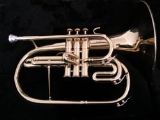
Mellophone

Encyclopedia
The mellophone is a brass instrument
that is typically used in place of the horn
(sometimes called a French horn) in marching band
s or drum and bugle corps
.
Owing to its use primarily outside of concert music, there is not much solo literature for the mellophone, other than that used within drum and bugle corps.
, operated with the right hand. Mellophone fingering is identical to that of a trumpet
. Mellophones are typically pitched in the key
of E-flat or F. The overtone series is an octave above that of the F horn, exactly like playing the lower portion of a horn in F. Many drum and bugle corps, however, use mellophones pitched in G, although the number has dwindled somewhat since the two major United States
drum and bugle corps circuits (first Drum Corps International
and then Drum Corps Associates
) passed rule changes allowing use of bell-front instruments in any key (although corps using mellophones pitched in G typically have the whole of their brass section also using G instruments, whereas those using mellophones pitched in F generally have the remainder of their brass section using B♭). G Mellophones play much more like Flugelhorns and Trumpets and share the same overtone series. The F Mellophones are much closer to an F horn in playstyle.
The direction of the bell, as well as the much-reduced amount of tubing (as compared to a concert horn) makes the mellophone look like a large trumpet. In fact, many mellophones use trumpet-style parabolic
("cup") mouthpieces
rather than the smaller, lighter, conical
("funnel") mouthpieces used on concert (French) horns. Most Drum Corps playing on G horns use V-cup Cornet style mouthpieces. When using a horn mouthpiece, an adapter is commonly used so that it fits in the lead pipe of the mellophone. However, use of a "cup" mouthpiece results in a more trumpet-like sound, when compared with the horn-like sound produced from a "funnel" mouthpiece,
but it also shares the same characteristics of a flugel horn
The "vintage" instrument was visually modeled on the (French) horn, with turned-down bell; it was used as a horn substitute both outdoors and indoors by amateurs and school ensembles. The recent instruments are visually modeled on the trumpet, and marketed strictly for outdoors use by marching bands and drum corps.
Mellophones manufactured exclusively for American drum corps use (1950s-60s-70s) had one horizontal piston valve (1 step) and one (half-step) rotary valve operated by the thumbs. When the prohibitions against vertical pistons were lifted, corps mellophones received two vertical piston valves. In 1989 rules passed to include a third vertical piston, permitting a complete chromatic scale. Mellophone Bugles keyed in G were primarily used until 2000 when rules passed allowing any-key instrument.
Mellophones are more directly related to bugle-horns such as the flugelhorn
, euphonium
, and tuba
. Their design is more radically conical than horns, producing a sound generally considered more suitable for martial music; a mellophone tends to be easier to articulate sharply as is required by martial music. In rare instances mellophones (usually old ones) have been made shaped like horns, but newer instruments are almost always built as bugle-shaped marching horns. A mellophone shaped as a concert horn is built with piston valves and with the bell facing the left, in reverse of the traditional horn.
Another factor in the greater use of mellophones is its ease of use as compared to the considerable difficulty of playing a concert horn consistently well. In a horn, the length of tubing (and the bore size) make the partials much closer together than other brass instruments in their normal range and therefore harder to play accurately. The F mellophone has tubing half the length of a horn which gives it an overtone series more similar to a trumpet or most other brass instruments. This compromises much of the range and tone that horns are famous for, but eliminates the accuracy problems encountered while marching.
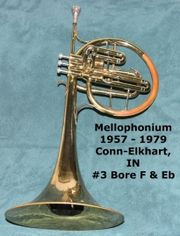 C. G. Conn
developed the 16E "Mellophonium" which was embraced by bandleader Stan Kenton
, who appeared in Conn's advertising in 1957. Contrary to popular legend, Kenton himself was not involved in the design of the Mellophonium. The new instrument was used by Kenton to "bridge the gap" in tonalities between his trumpet and trombone sections. Kenton used a four-man Mellophonium section between 1961 and 1963 on 11 albums.
also produced a mellophonium, with the coils of piping more reminiscent of the cornet.
Brass instrument
A brass instrument is a musical instrument whose sound is produced by sympathetic vibration of air in a tubular resonator in sympathy with the vibration of the player's lips...
that is typically used in place of the horn
Horn (instrument)
The horn is a brass instrument consisting of about of tubing wrapped into a coil with a flared bell. A musician who plays the horn is called a horn player ....
(sometimes called a French horn) in marching band
Marching band
Marching band is a physical activity in which a group of instrumental musicians generally perform outdoors and incorporate some type of marching with their musical performance. Instrumentation typically includes brass, woodwinds, and percussion instruments...
s or drum and bugle corps
Drum and bugle corps (modern)
A drum and bugle corps, also known as a drum corps, is a musical marching unit consisting of brass instruments, percussion instruments, and color guard. Typically operating as independent non-profit organizations, drum corps perform in competitions, parades, festivals, and other civic functions...
.
Owing to its use primarily outside of concert music, there is not much solo literature for the mellophone, other than that used within drum and bugle corps.
Characteristics
The present-day mellophone has three valvesPiston valve
A piston valve is a device used to control the motion of a fluid along a tube or pipe by means of the linear motion of a piston within a chamber or cylinder.Examples of piston valves are:...
, operated with the right hand. Mellophone fingering is identical to that of a trumpet
Trumpet
The trumpet is the musical instrument with the highest register in the brass family. Trumpets are among the oldest musical instruments, dating back to at least 1500 BCE. They are played by blowing air through closed lips, producing a "buzzing" sound which starts a standing wave vibration in the air...
. Mellophones are typically pitched in the key
Key (music)
In music theory, the term key is used in many different and sometimes contradictory ways. A common use is to speak of music as being "in" a specific key, such as in the key of C major or in the key of F-sharp. Sometimes the terms "major" or "minor" are appended, as in the key of A minor or in the...
of E-flat or F. The overtone series is an octave above that of the F horn, exactly like playing the lower portion of a horn in F. Many drum and bugle corps, however, use mellophones pitched in G, although the number has dwindled somewhat since the two major United States
United States
The United States of America is a federal constitutional republic comprising fifty states and a federal district...
drum and bugle corps circuits (first Drum Corps International
Drum Corps International
Drum Corps International , formed in 1972, is the non-profit governing body operating the North American drum and bugle corps circuit for junior corps, whose members are between the ages of 14 and 21. It is the counterpart of Drum Corps Associates which governs senior or all-age drum corps...
and then Drum Corps Associates
Drum Corps Associates
Drum Corps Associates is the governing body for modern senior or all-age drum and bugle corps in North America. It is the counterpart of Drum Corps International which governs junior drum corps...
) passed rule changes allowing use of bell-front instruments in any key (although corps using mellophones pitched in G typically have the whole of their brass section also using G instruments, whereas those using mellophones pitched in F generally have the remainder of their brass section using B♭). G Mellophones play much more like Flugelhorns and Trumpets and share the same overtone series. The F Mellophones are much closer to an F horn in playstyle.
The direction of the bell, as well as the much-reduced amount of tubing (as compared to a concert horn) makes the mellophone look like a large trumpet. In fact, many mellophones use trumpet-style parabolic
Parabola
In mathematics, the parabola is a conic section, the intersection of a right circular conical surface and a plane parallel to a generating straight line of that surface...
("cup") mouthpieces
Mouthpiece (brass)
On brass instruments the mouthpiece is the part of the instrument which is placed upon the player's lips. The purpose of the mouthpiece is a resonator, which passes vibration from the lips to the column of air contained within the instrument, giving rise to the standing wave pattern of vibration in...
rather than the smaller, lighter, conical
Cone (geometry)
A cone is an n-dimensional geometric shape that tapers smoothly from a base to a point called the apex or vertex. Formally, it is the solid figure formed by the locus of all straight line segments that join the apex to the base...
("funnel") mouthpieces used on concert (French) horns. Most Drum Corps playing on G horns use V-cup Cornet style mouthpieces. When using a horn mouthpiece, an adapter is commonly used so that it fits in the lead pipe of the mellophone. However, use of a "cup" mouthpiece results in a more trumpet-like sound, when compared with the horn-like sound produced from a "funnel" mouthpiece,
but it also shares the same characteristics of a flugel horn
History
A distinction must be made between:- the mellophone manufactured and used from the late 19th century through the early 1950s
- the mellophone in recent decades.
The "vintage" instrument was visually modeled on the (French) horn, with turned-down bell; it was used as a horn substitute both outdoors and indoors by amateurs and school ensembles. The recent instruments are visually modeled on the trumpet, and marketed strictly for outdoors use by marching bands and drum corps.
Mellophones manufactured exclusively for American drum corps use (1950s-60s-70s) had one horizontal piston valve (1 step) and one (half-step) rotary valve operated by the thumbs. When the prohibitions against vertical pistons were lifted, corps mellophones received two vertical piston valves. In 1989 rules passed to include a third vertical piston, permitting a complete chromatic scale. Mellophone Bugles keyed in G were primarily used until 2000 when rules passed allowing any-key instrument.
Mellophones are more directly related to bugle-horns such as the flugelhorn
Flugelhorn
The flugelhorn is a brass instrument resembling a trumpet but with a wider, conical bore. Some consider it to be a member of the saxhorn family developed by Adolphe Sax ; however, other historians assert that it derives from the valve bugle designed by Michael Saurle , Munich 1832 , thus...
, euphonium
Euphonium
The euphonium is a conical-bore, tenor-voiced brass instrument. It derives its name from the Greek word euphonos, meaning "well-sounding" or "sweet-voiced"...
, and tuba
Tuba
The tuba is the largest and lowest-pitched brass instrument. Sound is produced by vibrating or "buzzing" the lips into a large cupped mouthpiece. It is one of the most recent additions to the modern symphony orchestra, first appearing in the mid-19th century, when it largely replaced the...
. Their design is more radically conical than horns, producing a sound generally considered more suitable for martial music; a mellophone tends to be easier to articulate sharply as is required by martial music. In rare instances mellophones (usually old ones) have been made shaped like horns, but newer instruments are almost always built as bugle-shaped marching horns. A mellophone shaped as a concert horn is built with piston valves and with the bell facing the left, in reverse of the traditional horn.
Difference from the horn
The marching mellophone is used in place of the horn for marching because it is a bell-front instrument allowing projection of the sound in the direction that the player is facing. This is especially important in drum corps and marching bands because the audience is typically standing or sitting on only one side of the band. There are also marching B♭ horns with a bell-front configuration; mellophones also are usually constructed with a smaller bore for louder volume than marching horns. Marching B♭ horns do use a horn mouthpiece and have a much more horn-like sound, but are much more difficult to play on the field.Another factor in the greater use of mellophones is its ease of use as compared to the considerable difficulty of playing a concert horn consistently well. In a horn, the length of tubing (and the bore size) make the partials much closer together than other brass instruments in their normal range and therefore harder to play accurately. The F mellophone has tubing half the length of a horn which gives it an overtone series more similar to a trumpet or most other brass instruments. This compromises much of the range and tone that horns are famous for, but eliminates the accuracy problems encountered while marching.
Stan Kenton's instrument
C. G. Conn
C.G. Conn Ltd., sometimes called Conn Instruments or commonly just Conn, was a United States manufacturer of musical instruments, especially brass instruments. In 1985 their Strobotuner division was bought by Peterson Electro-Musical Products, who continue to service their line of products.Assets...
developed the 16E "Mellophonium" which was embraced by bandleader Stan Kenton
Stan Kenton
Stanley Newcomb "Stan" Kenton was a pianist, composer, and arranger who led a highly innovative, influential, and often controversial American jazz orchestra. In later years he was widely active as an educator....
, who appeared in Conn's advertising in 1957. Contrary to popular legend, Kenton himself was not involved in the design of the Mellophonium. The new instrument was used by Kenton to "bridge the gap" in tonalities between his trumpet and trombone sections. Kenton used a four-man Mellophonium section between 1961 and 1963 on 11 albums.
Bach instrument
The Vincent Bach CorporationVincent Bach Corporation
The Vincent Bach Corporation was an American manufacturer of brass musical instruments that began early in the twentieth century and still exists as a subsidiary of Conn-Selmer. The company was founded in 1918 by Austrian-born trumpeter Vincent Schrotenbach .-Vincent Bach:Vincent Schrotenbach was...
also produced a mellophonium, with the coils of piping more reminiscent of the cornet.
External links
- Archived discussion about mellophones from hornplayer.net
- Mellophone fingering chart
- The Middle Horn Leader
- Al's Mellophone Page
- MelloCast, a Podcast dedicated to the Mellophone
- Reviews of modern marching mellophones and related equipment
- A Review of the Conn 16E Mellophonium
- Photographs of pre-1960 instruments manufactured by Conn, shown at the Conn Loyalist website