

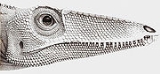
Megapnosaurus

Encyclopedia
Megapnosaurus was a dinosaur
of the theropod family Coelophysidae
, formerly called Syntarsus (named by Raath, 1969), living during the Early Jurassic
. It was renamed by American entomologist Dr. Michael Ivie (Montana State University
of Bozeman), Polish Australian
Dr. Adam Ślipiński, and Polish
Dr. Piotr Węgrzynowicz (Muzeum Ewolucji Instytutu Zoologii PAN of Warsaw
), the scientists who discovered that the genus
name Syntarsus was already taken by a colydiine
beetle
described in 1869. It was one of the first dinosaurs to be portrayed with feathers, although it and other coelophysoids probably lacked them.
It is almost identical to Coelophysis
, and Yates (2005) suggested that Megapnosaurus was possibly synonymous with Coelophysis. In 2004, Raath co-authored two papers in which he argued that Syntarsus was a junior synonym of Coelophysis.
s (70 lb
). The bones of 30 Megapnosaurus individuals were found together in a fossil bed in Zimbabwe
, so paleontologists think it may have hunted in packs. The various fossils attributed to Megapnosaurus have been dated over a relatively large time span - the Hettangian
, Sinemurian
, and Pliensbachian
stages of the Early Jurassic
- meaning the fossils represent either a highly successful genus or a few closely related animals all currently assigned to Megapnosaurus.
Megapnosaurus is a good example of how dinosaurs spread across the globe from their ancestral habitats (which was possibly South America). This small predator had the same basic features found in early dinosaurs, and its appearance in both Africa and the southwestern U.S. indicates that it migrated through the continents, which at the time were joined together as Pangaea
. There is species-level differentiation between the African and U.S. specimens, again supporting the migration and adaptation theories.
 The African species (M. rhodesiensis) is known from almost 30 specimens. The North American species (M. kayentakatae) had small crests and may show an evolutionary step toward later and larger coelophysoids, such as the more derived Dilophosaurus
. Both possess a weak joint between the premaxillary and the maxillary
bones, creating a hooked premaxillary jaw. This led to the early hypothesis that dinosaurs such as these were scavengers, as the front teeth and bone structure were thought to be too weak to take down and hold struggling prey.
Age determination
studies using growth ring counts suggest that the longevity of Megapnosaurus was approximately seven years.
Comparisons between the scleral ring
s of Megapnosaurus and modern birds and reptiles indicate that it may have been nocturnal.
In Syntarsus rhodesiensis healed fractures of the tibia
and metatarsus
have been observed, but are very rare. "[T]he supporting butresses of the second sacral rib" in one specimen of Syntarsus rhodesiensis showed signs of fluctuating asymmetry. Fluctuating asymmetry
results from developmental disturbances and is more common in populations under stress and can therefore be informative about the quality of conditions a dinosaur lived under.
, a pack of Megapnosaurus (referred to as Syntarsus) attack an Anchisaurus
, only to be scared off by a Dilophosaurus
.
Dinosaur
Dinosaurs are a diverse group of animals of the clade and superorder Dinosauria. They were the dominant terrestrial vertebrates for over 160 million years, from the late Triassic period until the end of the Cretaceous , when the Cretaceous–Paleogene extinction event led to the extinction of...
of the theropod family Coelophysidae
Coelophysidae
The Coelophysidae are a family of primitive carnivorous theropod dinosaurs. Most species were relatively small in size. The family flourished in the Late Triassic and Early Jurassic periods....
, formerly called Syntarsus (named by Raath, 1969), living during the Early Jurassic
Early Jurassic
The Early Jurassic epoch is the earliest of three epochs of the Jurassic period...
. It was renamed by American entomologist Dr. Michael Ivie (Montana State University
Montana State University - Bozeman
Montana State University – Bozeman is a public university located in Bozeman, Montana. It is the state's land-grant university and primary campus in the Montana State University System, which is part of the Montana University System...
of Bozeman), Polish Australian
Poland
Poland , officially the Republic of Poland , is a country in Central Europe bordered by Germany to the west; the Czech Republic and Slovakia to the south; Ukraine, Belarus and Lithuania to the east; and the Baltic Sea and Kaliningrad Oblast, a Russian exclave, to the north...
Dr. Adam Ślipiński, and Polish
Poland
Poland , officially the Republic of Poland , is a country in Central Europe bordered by Germany to the west; the Czech Republic and Slovakia to the south; Ukraine, Belarus and Lithuania to the east; and the Baltic Sea and Kaliningrad Oblast, a Russian exclave, to the north...
Dr. Piotr Węgrzynowicz (Muzeum Ewolucji Instytutu Zoologii PAN of Warsaw
Warsaw
Warsaw is the capital and largest city of Poland. It is located on the Vistula River, roughly from the Baltic Sea and from the Carpathian Mountains. Its population in 2010 was estimated at 1,716,855 residents with a greater metropolitan area of 2,631,902 residents, making Warsaw the 10th most...
), the scientists who discovered that the genus
Genus
In biology, a genus is a low-level taxonomic rank used in the biological classification of living and fossil organisms, which is an example of definition by genus and differentia...
name Syntarsus was already taken by a colydiine
Colydiinae
Colydiinae is a subfamily of beetles, commonly known as cylindrical bark beetles. They have been treated historically as a family, but have recently been moved into the Zopheridae , where they constitute the bulk of the diversity of the new composite family, with about 140 genera worldwide. There...
beetle
Beetle
Coleoptera is an order of insects commonly called beetles. The word "coleoptera" is from the Greek , koleos, "sheath"; and , pteron, "wing", thus "sheathed wing". Coleoptera contains more species than any other order, constituting almost 25% of all known life-forms...
described in 1869. It was one of the first dinosaurs to be portrayed with feathers, although it and other coelophysoids probably lacked them.
History
Some paleontologists did not like the naming of Megapnosaurus, partially because taxonomists are generally expected to allow original authors of a name to correct any mistakes in their work. Raath was aware of the homonymy between the dinosaur Syntarsus and beetle Syntarsus, but the group who published Megapnosaurus had been led to believe Raath was deceased and proceeded accordingly. Megapnosaurus remains the valid name for the fossil material.It is almost identical to Coelophysis
Coelophysis
Coelophysis , meaning "hollow form" in reference to its hollow bones , is one of the earliest known genera of dinosaur...
, and Yates (2005) suggested that Megapnosaurus was possibly synonymous with Coelophysis. In 2004, Raath co-authored two papers in which he argued that Syntarsus was a junior synonym of Coelophysis.
Description
Megapnosaurus measured up to 3 meters (10 ft) long from nose to tail and weighed about 32 kilogramKilogram
The kilogram or kilogramme , also known as the kilo, is the base unit of mass in the International System of Units and is defined as being equal to the mass of the International Prototype Kilogram , which is almost exactly equal to the mass of one liter of water...
s (70 lb
Pound (mass)
The pound or pound-mass is a unit of mass used in the Imperial, United States customary and other systems of measurement...
). The bones of 30 Megapnosaurus individuals were found together in a fossil bed in Zimbabwe
Zimbabwe
Zimbabwe is a landlocked country located in the southern part of the African continent, between the Zambezi and Limpopo rivers. It is bordered by South Africa to the south, Botswana to the southwest, Zambia and a tip of Namibia to the northwest and Mozambique to the east. Zimbabwe has three...
, so paleontologists think it may have hunted in packs. The various fossils attributed to Megapnosaurus have been dated over a relatively large time span - the Hettangian
Hettangian
The Hettangian is the earliest age or lowest stage of the Jurassic period of the geologic timescale. It spans the time between 199.6 ± 0.6 Ma and 196.5 ± 1 Ma . The Hettangian follows the Rhaetian and is followed by the Sinemurian.In Europe stratigraphy the Hettangian is a part of the time span in...
, Sinemurian
Sinemurian
In the geologic timescale, the Sinemurian is an age or stage in the Early or Lower Jurassic epoch or series. It spans the time between 196.5 ± 2 Ma and 189.6 ± 1.5 Ma...
, and Pliensbachian
Pliensbachian
The Pliensbachian is an age of the geologic timescale or stage in the stratigraphic column. It is part of the Early or Lower Jurassic epoch or series and spans the time between 189.6 ± 1.5 Ma and 183 ± 1.5 Ma . The Pliensbachian is preceded by the Sinemurian and followed by the Toarcian.The...
stages of the Early Jurassic
Early Jurassic
The Early Jurassic epoch is the earliest of three epochs of the Jurassic period...
- meaning the fossils represent either a highly successful genus or a few closely related animals all currently assigned to Megapnosaurus.
Megapnosaurus is a good example of how dinosaurs spread across the globe from their ancestral habitats (which was possibly South America). This small predator had the same basic features found in early dinosaurs, and its appearance in both Africa and the southwestern U.S. indicates that it migrated through the continents, which at the time were joined together as Pangaea
Pangaea
Pangaea, Pangæa, or Pangea is hypothesized as a supercontinent that existed during the Paleozoic and Mesozoic eras about 250 million years ago, before the component continents were separated into their current configuration....
. There is species-level differentiation between the African and U.S. specimens, again supporting the migration and adaptation theories.
Dilophosaurus
Dilophosaurus was a theropod dinosaur from the Sinemurian stage of the Early Jurassic Period, about 193 million years ago. The first specimens were described in 1954, but it was not until over a decade later that the genus received its current name...
. Both possess a weak joint between the premaxillary and the maxillary
Maxilla
The maxilla is a fusion of two bones along the palatal fissure that form the upper jaw. This is similar to the mandible , which is also a fusion of two halves at the mental symphysis. Sometimes The maxilla (plural: maxillae) is a fusion of two bones along the palatal fissure that form the upper...
bones, creating a hooked premaxillary jaw. This led to the early hypothesis that dinosaurs such as these were scavengers, as the front teeth and bone structure were thought to be too weak to take down and hold struggling prey.
Age determination
Age determination of dinosaurs
Age determination in dinosaurs is mainly used to determine the approximate age of a dinosaur when the animal died.-History:Early attempts to estimate the longevity of dinosaurs used allometric scaling principles. Ages were determined by dividing individual mass estimates by rates of growth for...
studies using growth ring counts suggest that the longevity of Megapnosaurus was approximately seven years.
Comparisons between the scleral ring
Sclerotic ring
Sclerotic rings are rings of bone found in the eyes of several groups of vertebrate animals, except for mammals and crocodilians. They can be made up of single bones or small bones together. They are believed to have a role in supporting the eye, especially in animals whose eyes are not spherical,...
s of Megapnosaurus and modern birds and reptiles indicate that it may have been nocturnal.
In Syntarsus rhodesiensis healed fractures of the tibia
Tibia
The tibia , shinbone, or shankbone is the larger and stronger of the two bones in the leg below the knee in vertebrates , and connects the knee with the ankle bones....
and metatarsus
Metatarsus
The metatarsus or metatarsal bones are a group of five long bones in the foot located between the tarsal bones of the hind- and mid-foot and the phalanges of the toes. Lacking individual names, the metatarsal bones are numbered from the medial side : the first, second, third, fourth, and fifth...
have been observed, but are very rare. "[T]he supporting butresses of the second sacral rib" in one specimen of Syntarsus rhodesiensis showed signs of fluctuating asymmetry. Fluctuating asymmetry
Asymmetry
Asymmetry is the absence of, or a violation of, symmetry.-In organisms:Due to how cells divide in organisms, asymmetry in organisms is fairly usual in at least one dimension, with biological symmetry also being common in at least one dimension....
results from developmental disturbances and is more common in populations under stress and can therefore be informative about the quality of conditions a dinosaur lived under.
In popular culture
In When Dinosaurs Roamed AmericaWhen Dinosaurs Roamed America
When Dinosaurs Roamed America is a two-hour American television program that first aired on Discovery Channel in 2001. It was directed by Pierre de Lespinois and narrated by actor John Goodman...
, a pack of Megapnosaurus (referred to as Syntarsus) attack an Anchisaurus
Anchisaurus
Anchisaurus is a genus of basal sauropodomorph, and was an early herbivorous dinosaur. Until recently it was classed as a member of Prosauropoda. The name comes from the Greek αγχι/agkhi...
, only to be scared off by a Dilophosaurus
Dilophosaurus
Dilophosaurus was a theropod dinosaur from the Sinemurian stage of the Early Jurassic Period, about 193 million years ago. The first specimens were described in 1954, but it was not until over a decade later that the genus received its current name...
.