
All Topics  
Meerkat

 
Meerkat

   Email Print
   Bookmark   Link


Meerkat


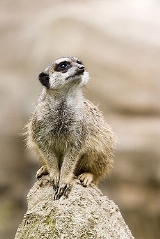
The meerkat or suricate Suricata suricatta is a small mammal
Mammal

Mammals are a class of vertebrate animals whose name is derived from their distinctive feature, mammary glands, with which they feed their young....
 and a member of the mongoose
Mongoose

A mongoose is a member of the family Herpestidae , a family of small, cat-like Carnivoras.The word mongoose is derived from the Marathi language name mangus "mongoose", perhaps ultimately from Dravidian languages ....
 family. It inhabits all parts of the Kalahari Desert
Kalahari Desert

The Kalahari Desert is a large, arid desert area in southwestern Sub-Saharan Africa extending 900,000 km? , covering much of Botswana and parts of Namibia and South Africa....
 in Botswana
Botswana

The Republic of Botswana , is a landlocked country in Southern Africa. Citizens of Botswana are called "Batswana" , regardless of ethnicity. Formerly a British protectorate of Bechuanaland Protectorate, Botswana adopted its new name after becoming independent within the Commonwealth of Nations on 30 September 1966....
 and South Africa
South Africa

The Republic of South Africa, also known by Official names of South Africa, is a country located at the southern tip of the continent of Africa....
. A group of meerkats is called a "mob", "gang" or "clan". A meerkat clan often contains about 20 meerkats at a time, but some superfamilies have had 50 or more. Meerkats have an average life span of 12-14 years.

rkat" is a loanword
Loanword

A loanword is a word directly taken into one language from another with little or no translation. By contrast, a calque or loan translation is a related concept whereby it is the Meaning or idiom that is borrowed rather than the lexical item itself....
 from Afrikaans
Afrikaans

Afrikaans is an Indo-European language, derived from Dutch language and thus classified as Low Franconian languages West Germanic languages. It is mainly spoken in South Africa and Namibia, with smaller numbers of speakers living in Botswana, Angola, Swaziland, Zimbabwe, Lesotho, Zambia, Australia, New Zealand, United States of America, Taiwa...
.


Discussion
Ask a question about 'Meerkat'
Start a new discussion about 'Meerkat'
Answer questions from other users
Full Discussion Forum


Recent Posts


Encyclopedia


The meerkat or suricate Suricata suricatta is a small mammal
Mammal

Mammals are a class of vertebrate animals whose name is derived from their distinctive feature, mammary glands, with which they feed their young....
 and a member of the mongoose
Mongoose

A mongoose is a member of the family Herpestidae , a family of small, cat-like Carnivoras.The word mongoose is derived from the Marathi language name mangus "mongoose", perhaps ultimately from Dravidian languages ....
 family. It inhabits all parts of the Kalahari Desert
Kalahari Desert

The Kalahari Desert is a large, arid desert area in southwestern Sub-Saharan Africa extending 900,000 km? , covering much of Botswana and parts of Namibia and South Africa....
 in Botswana
Botswana

The Republic of Botswana , is a landlocked country in Southern Africa. Citizens of Botswana are called "Batswana" , regardless of ethnicity. Formerly a British protectorate of Bechuanaland Protectorate, Botswana adopted its new name after becoming independent within the Commonwealth of Nations on 30 September 1966....
 and South Africa
South Africa

The Republic of South Africa, also known by Official names of South Africa, is a country located at the southern tip of the continent of Africa....
. A group of meerkats is called a "mob", "gang" or "clan". A meerkat clan often contains about 20 meerkats at a time, but some superfamilies have had 50 or more. Meerkats have an average life span of 12-14 years.

Name

"Meerkat" is a loanword
Loanword

A loanword is a word directly taken into one language from another with little or no translation. By contrast, a calque or loan translation is a related concept whereby it is the Meaning or idiom that is borrowed rather than the lexical item itself....
 from Afrikaans
Afrikaans

Afrikaans is an Indo-European language, derived from Dutch language and thus classified as Low Franconian languages West Germanic languages. It is mainly spoken in South Africa and Namibia, with smaller numbers of speakers living in Botswana, Angola, Swaziland, Zimbabwe, Lesotho, Zambia, Australia, New Zealand, United States of America, Taiwa...
. The name has a Dutch
Dutch language

Dutch is a West Germanic languages spoken by over 22 million people as a first language, and about 5 million people as a second language."1% of the EU population claims to speak Dutch well enough in order to have a conversation." Outside the European Union the number of second language speakers of Dutch is very small. Most native...
 origin but by misidentification. Dutch meerkat refers to the "guenon
Guenon

The guenons are the genus Cercopithecus of Old World monkeys. Not all the members of this genus have the word "guenon" in their common names, and because of changes in scientific classification, some monkeys in other genera may have common names that do include the word "guenon"....
", a monkey of the Cercopithecus genus. The word "meerkat" is Dutch for "lake cat", but the suricata is not in the cat family
Felidae

Felidae is the family of the cats; a member of this family is called a felid. Felids are the most strictly Carnivore of the sixteen mammal families in the order Carnivora....
, and neither suricatas nor guenons are attracted to lakes; the word possibly started as a Dutch adaptation of a derivative of Sanskrit
Sanskrit

Sanskrit is a historical Indo-Aryan language, one of the liturgical languages of Hinduism and Buddhism, and one of the 22 official languages of India....
 markata ????? = "monkey
Monkey

A monkey is a nonhuman primate mammal with the exception usually of the lemurs and tarsiers. More specifically, the term monkey refers to a subset of monkeys: any of the smaller longer-tailed catarrhine or platyrrhine primates as contrasted with the apes....
", perhaps in Africa via an Indian sailor onboard a Dutch East India Company
Dutch East India Company

The Dutch East India Company was a trading company, which was established in 1602, when the States-General of the Netherlands granted it a 21-year monopoly to carry out colonial activities in Asia....
 ship. The traders of the Dutch East India Company were likely familiar with monkeys, but the Dutch settlers attached the name to the wrong animal at the Cape. The suricata is called stokstaartje = "little stick-tail" in Dutch.

According to African popular belief (mainly in the Zambia
Zambia

The Republic of Zambia is a landlocked country in Southern Africa. The neighbouring countries are the Democratic Republic of the Congo to the north, Tanzania to the north-east, Malawi to the east, Mozambique, Zimbabwe, Botswana, and Namibia to the south, and Angola to the west....
n/Zimbabwe
Zimbabwe

Zimbabwe , is a landlocked country located in the southern part of the continent of Africa, between the Zambezi and Limpopo River rivers. It is bordered by South Africa to the south, Botswana to the southwest, Zambia to the northwest and Mozambique to the east....
an region), the meerkat is also known as the sun angel, as it protects villages from the moon devil or the werewolf
Werewolf

Werewolves, also known as lycanthropes from the Greek ????????p??, ????? and ?????p?? , are Mythology or folklore humans with the ability to shape shifting into Gray Wolf or anthropomorphism wolf-like creatures, either purposely, by being bitten by another werewolf, or after being placed under a curse....
 which is believed to attack stray cattle or lone tribesmen.

Anatomy

The meerkat is a small diurnal herpestid (mongoose
Mongoose

A mongoose is a member of the family Herpestidae , a family of small, cat-like Carnivoras.The word mongoose is derived from the Marathi language name mangus "mongoose", perhaps ultimately from Dravidian languages ....
) weighing on average about 731 gram
Gram

The gram , ; symbol g, is a Physical unit of mass.Originally defined as "the absolute weight of a volume of pure water equal to the cube of the hundredth part of a metre, and at the temperature of melting ice" , a gram is now defined as one one-thousandth of the SI base unit, the kilogram, or Scientific notation kg, which itself is...
s (1.61 pounds) for males and 720 grams (1.58 pounds) for females. Its long slender body and limbs give it a body length of 25 to 35 cm (10 to 14 inches) and an added tail length of 17 to 25 cm (7 to 10 inches). Its tail is not bushy like all other mongoose species, but is rather long and thin and tapers to a black or reddish colored pointed tip. The meerkat uses its tail to balance when standing upright. Its face tapers, coming to a point at the nose, which is brown. The eyes always have black patches around them, which help deflect the sun's glare. The meerkat has small black crescent-shaped ears that can close when digging to keep sand out. Like cats, meerkats have binocular vision
Binocular vision

Binocular vision is Visual perception in which both eyes are used together. The word binocular comes from two Latin roots, bini for double, and oculus for eye....
, a large peripheral range, depth perception, and eyes on the front of their faces.

At the end of each of a meerkat's "fingers" is a non-retractable, strong, 2 cm (0.8 inches) long, curved claw
Claw

A claw is a curved, pointed appendage, found at the end of a toe or finger in most mammals, birds, and some reptiles. Somewhat similar fine hooked structures are found in arthropods such as beetles and spiders, at the end of the leg or Arthropod leg for gripping a surface as the creature walks....
 used for digging underground burrow
Burrow

A burrow is a hole or tunnel dug into the ground by an animal to create a space suitable for habitation, temporary refuge, or as a byproduct of locomotion....
s and digging for prey
Predation

In ecology, predation describes a biological interaction where a predator feeds on its prey, the organism that is attacked. Predators may or may not kill their prey prior to feeding on them, but the act of predation always results in the death of the prey....
. Claws are also used with muscular hindlegs to help climb the occasional tree. They have four toes on each foot and long slender limbs. The coat is usually fawn-colored peppered with gray, tan, or brown with a silver tint. They have short parallel stripes across their backs, extending from the base of the tail to the shoulders. The patterns of stripes are unique to each meerkat. The underside of the meerkat has no markings but the belly has a patch which is only sparsely covered with hair and shows the black skin underneath. The meerkat uses this area to absorb heat while standing on its rear legs, usually early in the morning after cold desert nights.

Diet and foraging behaviour

Meerkats are primarily insectivore
Insectivore

An insectivore is a type of carnivore with a diet that consists chiefly of insects and similar small creatures.Although individually small, insects exist in enormous numbers and make up a very large part of the animal biomass in almost all non-marine environments....
s, but also eat lizard
Lizard

Lizards are a large and widespread group of squamate reptiles, with nearly 5,000 species, ranging across all continents except Antarctica as well as most oceanic island chains....
s, snake
Snake

Snakes are elongate legless carnivore reptiles of the suborder Serpentes that can be distinguished from legless lizards by their lack of eyelids and external ears....
s, scorpion
Scorpion

Scorpions are any arachnid of the order Scorpionida. They are members of the order Scorpiones within the class Arachnida. There are about 2,000 species of scorpions, found widely distributed south of about Latitude, except New Zealand and Antarctica....
s, spider
Spider

Spiders are air-breathing chelicerate arthropods that have eight legs, and chelicerae modified into fangs that inject venom. In their bodies the usual arthropod segments are fused into two Tagma , the cephalothorax and abdomen, joined by a small, cylindrical pedicel....
s, plant
Plant

Plants are Life organisms belonging to the Kingdom Plantae. They include familiar organisms such as trees, herbs, bushes, grasses, vines, ferns, mosses, and green algae....
s, eggs
Egg (biology)

In most birds and reptiles, an egg is the zygote, resulting from fertilization of the ovum. To enable incubation the egg is usually kept within a favourable temperature range as it nourishes and protects the growing embryo....
, small mammal
Mammal

Mammals are a class of vertebrate animals whose name is derived from their distinctive feature, mammary glands, with which they feed their young....
s, millipede
Millipede

Millipedes are arthropods that have two pairs of arthropod leg per segment . Each segment that has two pairs of legs is a result of two single segments fused together as one....
s, centipede
Centipede

For information about the old arcade game, see Centipede .Centipedes are arthropods belonging to the class Chilopoda and the Subphylum Myriapoda....
s and, more rarely, small birds. They are partially immune
Immunity (medical)

Immunity is a medical term that describes a state of having sufficient biological defenses to avoid infection, disease, or other unwanted biological invasion....
 to certain venoms; they are immune to the very strong venom of the scorpions of the Kalahari Desert
Kalahari Desert

The Kalahari Desert is a large, arid desert area in southwestern Sub-Saharan Africa extending 900,000 km? , covering much of Botswana and parts of Namibia and South Africa....
, unlike humans. They have no excess body fat
Adipose tissue

In histology, adipose tissue or fat is loose connective tissue composed of adipocytes. Adipose tissue is derived from lipoblasts. Its main role is to store energy in the form of fat, although it also cushions and Thermal insulation the body....
 stores, so foraging for food is a daily need.

Meerkats forage in a group with one "sentry" on guard watching for predators while the others search for food. Sentry duty is usually approximately an hour long. Baby meerkats do not start foraging for food until they are about 1 month old, and do so by following an older member of the group who acts as the pup's tutor. The meerkat standing guard makes peeping sounds when all is well. If the meerkat spots danger, it barks loudly or whistles.

Reproduction

Suricata
Meerkats become sexually mature at about one year of age and can have 1 to 5 pups in a litter, with 3 pups being the most common litter size. Wild meerkats may have up to four litters per year. Meerkats are iteroparous and can reproduce any time of the year but most births occur in the warmer seasons. The female meerkat can have more than one litter
Litter (animal)

A litter is the offspring at one birth of animals from the same mother and usually from one set of parents. The word is most often used for the offspring of mammals, but can be used for any animal that gives birth to multiple young....
 a year. The pups are allowed to leave the burrow
Burrow

A burrow is a hole or tunnel dug into the ground by an animal to create a space suitable for habitation, temporary refuge, or as a byproduct of locomotion....
 at three weeks old. When the pups are ready to emerge from the burrow, the whole clan of meerkats will stand around the burrow to watch. Some of the adolescents might try to show off so they can have more attention than the pups.

Reports show that there is no precopulatory display; the male ritually grooms the female until she submits to him and copulation
Sexual intercourse

Sexual intercourse, also known as copulation or coitus, commonly refers to the act in which the Penis enters the Vagina. The two entities may be of opposite sexes or not, or they may be hermaphrodite, as is the case with snails....
 begins, the male generally adopting a seated position during the act. Gestation
Gestation

Gestation is the carrying of an embryo or fetus inside a female viviparous animal. Mammals during mammalian pregnancy can have one or more gestations at the same time ....
 lasts approximately 11 weeks and the young are born within the underground burrow and are altricial
Altricial

Altricial, meaning "requiring nourishment", refers to a pattern of growth and development in organisms which are incapable of moving around on their own soon after hatching or being born....
. The young's ears open at about 15 days of age, and their eyes at 10-14 days. They are wean
Weaning

Weaning is the process of gradually introducing a mammal infant, either human or animal, to what will be its adult diet and withdrawing the supply of its mother's milk....
ed around 49 to 63 days. They do not come above ground until at least 21 days of age and stay with babysitters near the burrow. After another week or so, they join the adults on a foraging party.

Usually, the alpha pair
Alpha (biology)

In social animals, the alpha is the individual in the community to whom the others follow and defer. Where one male and one female fulfill this role, they are referred to as the alpha pair....
 reserves the right to mate and normally kills any young not its own, to ensure that its offspring has the best chance of survival. The dominant couple may also evict, or kick out the mothers of the offending offspring.

New meerkat groups are often formed by evicted females pairing with roving males.

If the members of the alpha group are relatives (this tends to happen when the alpha female dies and is succeeded by a daughter), they do not mate with each other and reproduction is by group females stray-mating with roving males from other groups; in this situation, pregnant females tend to kill and eat any pups born to other females.

Behavior

Meerkats are small burrowing animals, living in large underground networks with multiple entrances which they leave only during the day. They are very social, living in colonies averaging 20-30 members. Animals in the same group regularly groom each other to strengthen social bonds. The alpha pair often scent-mark subordinates of the group to express their authority, and this is usually followed by the subordinates grooming the alphas and licking their faces. This behavior is also usually practiced when group members are reunited after a short period apart. Most meerkats in a group are all siblings or offspring of the alpha pair.

Meerkats demonstrate altruistic
Altruism

Altruism is the deliberate pursuit of the interests or welfare of others or the public interest....
 behavior within their colonies; one or more meerkats stand sentry (lookout) while others are foraging or playing, to warn them of approaching dangers. When a predator is spotted, the meerkat performing as sentry gives a warning bark, and other members of the gang will run and hide in one of the many bolt holes they have spread across their territory. The sentry meerkat is the first to reappear from the burrow and search for predators, constantly barking to keep the others underground. If there is no threat, the sentry meerkat stops signaling and the others feel safe to emerge.

Meerkats also babysit the young in the group. Females that have never produced offspring of their own often lactate
Lactation

Lactation describes the secretion of milk from the mammary glands, the process of providing that milk to the young, and the period of time that a mother lactates to feed her young....
 to feed the alpha pair's young, while the alpha female is away with the rest of the group. They also protect the young from threats, often endangering their own lives. On warning of danger, the babysitter takes the young underground to safety and is prepared to defend them if the danger follows. If retreating underground is not possible, she collects all young together and lies on top of them.

Meerkats are also known to share their burrow with the Yellow Mongoose
Yellow Mongoose

The Yellow Mongoose, sometimes referred to as the Red Meerkat, is a small mammal averaging about 1 lb in weight and about 20 in in length. A member of the mongoose family, it lives in open country, from semi-desert scrubland to grasslands in Angola, Botswana, South Africa, Namibia, and Zimbabwe....
 and ground squirrel
Ground squirrel

The ground squirrels are the members of the Sciuridae most closely related to the genus Marmota. They make up the Tribe Marmotini in the large and mainly Terrestrial animal squirrel subfamily Xerinae, and containing six living genera....
, species with which they do not compete for resources. If they are unlucky, sometimes they share their burrow with snake
Snake

Snakes are elongate legless carnivore reptiles of the suborder Serpentes that can be distinguished from legless lizards by their lack of eyelids and external ears....
s.

Like most species, meerkat young learn by observing and mimicking adult behaviour though adults also engage in active instruction. For example, meerkat adults teach their pups how to eat a venomous scorpion: they will remove the stinger and help the pup learn how to handle the creature.

Despite this altruistic behaviour, meerkats sometimes kill young members of their group. Subordinate meerkats have been seen killing the offspring of more senior members in order to improve their own offspring's position.

Meerkats have been known to engage in social activities, including what appear to be wrestling matches and foot races.

Vocalization

It has recently been noted that meerkat calls may carry specific meanings, with specific calls indicating the approach of snakes, birds of prey, or other predators. How these calls work is not yet clear.

Meerkat groups

A meerkat group may die out because of predator attack, its alpha pair being unable to breed, starvation in a year when the rains fail, or epidemic disease.

A new meerkat group often arises from evicted females meeting and staying with roving males, looking for chances to mate. The litter size is usually 2-5 pups.

The size of the groups
Group size measures

Many animals, including humans, tend to live in groups, herds, flock , bands, Pack , parties, or Bird colony of conspecific individuals. The size of these groups, as expressed by the number of participant individuals, is an important aspect of their social environment....
 is variable. A group which becomes over-large may routinely have to disperse widely to find enough food when foraging. As a result, when suddenly needing to run for shelter, members of the group may choose different holes, resulting in the group fissioning.

See also

  • Kalahari Meerkat Project
    Kalahari Meerkat Project

    The Kalahari Meerkat Project, or KMP, is a long term research project focused on studying the evolutionary causes and ecological consequences of cooperative behaviors in meerkats....
    , a long-term research project
  • Meerkat Manor
    Meerkat Manor

    Meerkat Manor is a British television programme produced by Oxford Scientific Films for Animal Planet. Blending more traditional animal documentary film style footage with Dramatic programming narration, the series tells the story of the Whiskers, one of over a dozen families of meerkats in the Kalahari Desert being studied as part of the...
    , a very popular television show
  • The Meerkats
    James Honeyborne

    James Honeyborne is the director of The Meerkats feature film and the producer and director of many award-winning BBC wildlife documentaries....
     - 2008 documentary feature film


External links