


Mechanical energy

Encyclopedia
In physics
, mechanical energy is the sum of potential energy
and kinetic energy
present in the components of a mechanical system
. It is the energy associated with the motion and position of an object. The law of conservation of energy states that in an isolated system that is only subject to conservative force
s, like the gravitational force, the mechanical energy is constant. If an object is moved in the opposite direction of a conservative net force, the potential energy will increase and if the speed
(not the velocity
) of the object is changed, the kinetic energy of the object is changed as well. In all real systems, however, non-conservative forces, like frictional forces, will be present, but often they are of negligible values and the mechanical energy's being constant can therefore be a useful approximation. In elastic collision
s, the mechanical energy is conserved but in inelastic collision
s, some mechanical energy is converted into heat. The equivalence between lost mechanical energy and an increase in temperature was discovered by James Prescott Joule
.
Many modern devices, such as the electric motor
or the steam engine
, are used today to convert mechanical energy into other forms of energy, e.g. electrical energy, or to convert other forms of energy, like heat
, into mechanical energy.
quantity and the mechanical energy of a system is the sum of the potential energy which is measured by the position of the parts of the system, and the kinetic energy which is also called the energy of motion:

The law of conservation of mechanical energy states that if a body or system is subjected only to conservative force
s, the total mechanical energy of that body or system remains constant. The difference between a conservative and a non-conservative force is that when a conservative force moves an object from one point to another, the work done by the conservative force is independent of the path. On the contrary, when a non-conservative force acts upon an object, the work done by the non-conservative force is dependent of the path.
The potential energy, U, depends on the position of an object subjected to a conservative force
. It is defined as the object's ability to do work and is increased as the object is moved in the opposite direction of the direction of the force. If F represents the conservative force and x the position, the potential energy of the force between the two positions x1 and x2 is defined as the negative integral of F from x1 to x2:
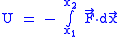
The kinetic energy, K, depends on the speed of an object and is the ability of a moving object to do work on other objects when it collides with them. It is defined as one half the product of the object's mass with the square of its speed, and the total kinetic energy of a system of objects is the sum of the kinetic energies of the respective objects:

is regarded as the most important. According to this law, the mechanical energy of an isolated system
remains constant in time, as long as the system is free of all frictional forces, including eventual internal friction from collision
s of the objects of the system. In any real situation, frictional forces and other non-conservative forces are always present, but in many cases their effects on the system are so small that the principle of conservation of mechanical energy can be used as a fair approximation
. Though energy cannot be created nor destroyed in an isolated system, it can be internally converted
to any other form of energy.
Thus, in a mechanical system like a swinging pendulum subjected to the conservative gravitational force where frictional forces like air drag and friction at the pivot are negligible, energy passes back and forth between kinetic and potential energy but never leaves the system. The pendulum reaches greatest kinetic energy and least potential energy when in the vertical position, because it will have the greatest speed and be nearest the Earth at this point. On the other hand, it will have its least kinetic energy and greatest potential energy at the extreme positions of its swing, because it has zero speed and is farthest from Earth at these points. However, when taking the frictional forces into account, the system loses mechanical energy with each swing because of the work done by the pendulum to oppose these non-conservative forces.
That the loss of mechanical energy in a system always resulted in an increase of the system's temperature has been known for a long time, but it was the amateur physicist James Prescott Joule
who first experimentally demonstrated how a certain amount of work done against friction resulted in a definite quantity of heat
which should be conceived as the random motions of the particles that matter is composed of. This equivalence between mechanical energy and heat is especially important when considering colliding objects. In an elastic collision
, mechanical energy is conserved; i.e. the sum of the kinetic energies of the colliding objects is the same before and after the collision. After an inelastic collision
, however, the total mechanical energy of the system will have changed. Usually, the total mechanical energy after the collision is smaller than the initial total mechanical energy and the lost mechanical energy is converted into heat. However, the total mechanical energy can be greater after an inelastic collision if for example the collision causes an explosion which converts chemical energy
into mechanical energy. In inelastic collisions, the smaller particles of which the colliding objects consist are shaken up and rattle around. These small-scale motions are perceived as an increase in heat and need kinetic energy which must be taken from the large-scale motion of the objects that are observed directly. Thus, the total energy of the system remains unchanged though the mechanical energy has been changed.
Physics
Physics is a natural science that involves the study of matter and its motion through spacetime, along with related concepts such as energy and force. More broadly, it is the general analysis of nature, conducted in order to understand how the universe behaves.Physics is one of the oldest academic...
, mechanical energy is the sum of potential energy
Potential energy
In physics, potential energy is the energy stored in a body or in a system due to its position in a force field or due to its configuration. The SI unit of measure for energy and work is the Joule...
and kinetic energy
Kinetic energy
The kinetic energy of an object is the energy which it possesses due to its motion.It is defined as the work needed to accelerate a body of a given mass from rest to its stated velocity. Having gained this energy during its acceleration, the body maintains this kinetic energy unless its speed changes...
present in the components of a mechanical system
Mechanical system
A mechanical system manages power to accomplish a task that involves forces and movement. Mechanical is derived from the Latin word machina, which in turn derives from the Doric Greek μαχανά , Ionic Greek μηχανή "contrivance, machine, engine" and that from μῆχος , "means, expedient, remedy".The...
. It is the energy associated with the motion and position of an object. The law of conservation of energy states that in an isolated system that is only subject to conservative force
Conservative force
A conservative force is a force with the property that the work done in moving a particle between two points is independent of the path taken. Equivalently, if a particle travels in a closed loop, the net work done by a conservative force is zero.It is possible to define a numerical value of...
s, like the gravitational force, the mechanical energy is constant. If an object is moved in the opposite direction of a conservative net force, the potential energy will increase and if the speed
Speed
In kinematics, the speed of an object is the magnitude of its velocity ; it is thus a scalar quantity. The average speed of an object in an interval of time is the distance traveled by the object divided by the duration of the interval; the instantaneous speed is the limit of the average speed as...
(not the velocity
Velocity
In physics, velocity is speed in a given direction. Speed describes only how fast an object is moving, whereas velocity gives both the speed and direction of the object's motion. To have a constant velocity, an object must have a constant speed and motion in a constant direction. Constant ...
) of the object is changed, the kinetic energy of the object is changed as well. In all real systems, however, non-conservative forces, like frictional forces, will be present, but often they are of negligible values and the mechanical energy's being constant can therefore be a useful approximation. In elastic collision
Elastic collision
An elastic collision is an encounter between two bodies in which the total kinetic energy of the two bodies after the encounter is equal to their total kinetic energy before the encounter...
s, the mechanical energy is conserved but in inelastic collision
Inelastic collision
An inelastic collision, in contrast to an elastic collision, is a collision in which kinetic energy is not conserved.In collisions of macroscopic bodies, some kinetic energy is turned into vibrational energy of the atoms, causing a heating effect, and the bodies are deformed.The molecules of a gas...
s, some mechanical energy is converted into heat. The equivalence between lost mechanical energy and an increase in temperature was discovered by James Prescott Joule
James Prescott Joule
James Prescott Joule FRS was an English physicist and brewer, born in Salford, Lancashire. Joule studied the nature of heat, and discovered its relationship to mechanical work . This led to the theory of conservation of energy, which led to the development of the first law of thermodynamics. The...
.
Many modern devices, such as the electric motor
Electric motor
An electric motor converts electrical energy into mechanical energy.Most electric motors operate through the interaction of magnetic fields and current-carrying conductors to generate force...
or the steam engine
Steam engine
A steam engine is a heat engine that performs mechanical work using steam as its working fluid.Steam engines are external combustion engines, where the working fluid is separate from the combustion products. Non-combustion heat sources such as solar power, nuclear power or geothermal energy may be...
, are used today to convert mechanical energy into other forms of energy, e.g. electrical energy, or to convert other forms of energy, like heat
Heat
In physics and thermodynamics, heat is energy transferred from one body, region, or thermodynamic system to another due to thermal contact or thermal radiation when the systems are at different temperatures. It is often described as one of the fundamental processes of energy transfer between...
, into mechanical energy.
General
Energy is a scalarScalar (physics)
In physics, a scalar is a simple physical quantity that is not changed by coordinate system rotations or translations , or by Lorentz transformations or space-time translations . This is in contrast to a vector...
quantity and the mechanical energy of a system is the sum of the potential energy which is measured by the position of the parts of the system, and the kinetic energy which is also called the energy of motion:
The law of conservation of mechanical energy states that if a body or system is subjected only to conservative force
Conservative force
A conservative force is a force with the property that the work done in moving a particle between two points is independent of the path taken. Equivalently, if a particle travels in a closed loop, the net work done by a conservative force is zero.It is possible to define a numerical value of...
s, the total mechanical energy of that body or system remains constant. The difference between a conservative and a non-conservative force is that when a conservative force moves an object from one point to another, the work done by the conservative force is independent of the path. On the contrary, when a non-conservative force acts upon an object, the work done by the non-conservative force is dependent of the path.
The potential energy, U, depends on the position of an object subjected to a conservative force
Conservative force
A conservative force is a force with the property that the work done in moving a particle between two points is independent of the path taken. Equivalently, if a particle travels in a closed loop, the net work done by a conservative force is zero.It is possible to define a numerical value of...
. It is defined as the object's ability to do work and is increased as the object is moved in the opposite direction of the direction of the force. If F represents the conservative force and x the position, the potential energy of the force between the two positions x1 and x2 is defined as the negative integral of F from x1 to x2:
The kinetic energy, K, depends on the speed of an object and is the ability of a moving object to do work on other objects when it collides with them. It is defined as one half the product of the object's mass with the square of its speed, and the total kinetic energy of a system of objects is the sum of the kinetic energies of the respective objects:
Conservation and interconversion of energy
Of the three great conservation laws of classical mechanics, the conservation of energyConservation of energy
The nineteenth century law of conservation of energy is a law of physics. It states that the total amount of energy in an isolated system remains constant over time. The total energy is said to be conserved over time...
is regarded as the most important. According to this law, the mechanical energy of an isolated system
Isolated system
In the natural sciences an isolated system, as contrasted with an open system, is a physical system without any external exchange. If it has any surroundings, it does not interact with them. It obeys in particular the first of the conservation laws: its total energy - mass stays constant...
remains constant in time, as long as the system is free of all frictional forces, including eventual internal friction from collision
Collision
A collision is an isolated event which two or more moving bodies exert forces on each other for a relatively short time.Although the most common colloquial use of the word "collision" refers to accidents in which two or more objects collide, the scientific use of the word "collision" implies...
s of the objects of the system. In any real situation, frictional forces and other non-conservative forces are always present, but in many cases their effects on the system are so small that the principle of conservation of mechanical energy can be used as a fair approximation
Approximation
An approximation is a representation of something that is not exact, but still close enough to be useful. Although approximation is most often applied to numbers, it is also frequently applied to such things as mathematical functions, shapes, and physical laws.Approximations may be used because...
. Though energy cannot be created nor destroyed in an isolated system, it can be internally converted
Energy conversion
Transforming energy is when the energy changes into another form.In physics, the term energy describes the capacity to produce changes within a system, without regard to limitations in transformation imposed by entropy...
to any other form of energy.
Thus, in a mechanical system like a swinging pendulum subjected to the conservative gravitational force where frictional forces like air drag and friction at the pivot are negligible, energy passes back and forth between kinetic and potential energy but never leaves the system. The pendulum reaches greatest kinetic energy and least potential energy when in the vertical position, because it will have the greatest speed and be nearest the Earth at this point. On the other hand, it will have its least kinetic energy and greatest potential energy at the extreme positions of its swing, because it has zero speed and is farthest from Earth at these points. However, when taking the frictional forces into account, the system loses mechanical energy with each swing because of the work done by the pendulum to oppose these non-conservative forces.
That the loss of mechanical energy in a system always resulted in an increase of the system's temperature has been known for a long time, but it was the amateur physicist James Prescott Joule
James Prescott Joule
James Prescott Joule FRS was an English physicist and brewer, born in Salford, Lancashire. Joule studied the nature of heat, and discovered its relationship to mechanical work . This led to the theory of conservation of energy, which led to the development of the first law of thermodynamics. The...
who first experimentally demonstrated how a certain amount of work done against friction resulted in a definite quantity of heat
Heat
In physics and thermodynamics, heat is energy transferred from one body, region, or thermodynamic system to another due to thermal contact or thermal radiation when the systems are at different temperatures. It is often described as one of the fundamental processes of energy transfer between...
which should be conceived as the random motions of the particles that matter is composed of. This equivalence between mechanical energy and heat is especially important when considering colliding objects. In an elastic collision
Elastic collision
An elastic collision is an encounter between two bodies in which the total kinetic energy of the two bodies after the encounter is equal to their total kinetic energy before the encounter...
, mechanical energy is conserved; i.e. the sum of the kinetic energies of the colliding objects is the same before and after the collision. After an inelastic collision
Inelastic collision
An inelastic collision, in contrast to an elastic collision, is a collision in which kinetic energy is not conserved.In collisions of macroscopic bodies, some kinetic energy is turned into vibrational energy of the atoms, causing a heating effect, and the bodies are deformed.The molecules of a gas...
, however, the total mechanical energy of the system will have changed. Usually, the total mechanical energy after the collision is smaller than the initial total mechanical energy and the lost mechanical energy is converted into heat. However, the total mechanical energy can be greater after an inelastic collision if for example the collision causes an explosion which converts chemical energy
Chemical energy
Chemical energy is the potential of a chemical substance to undergo a transformation through a chemical reaction or, to transform other chemical substances...
into mechanical energy. In inelastic collisions, the smaller particles of which the colliding objects consist are shaken up and rattle around. These small-scale motions are perceived as an increase in heat and need kinetic energy which must be taken from the large-scale motion of the objects that are observed directly. Thus, the total energy of the system remains unchanged though the mechanical energy has been changed.
Conversion
Today, many technological devices converts mechanical energy into other forms of energy or vice versa. These devices can be placed in these categories:- An electric motorElectric motorAn electric motor converts electrical energy into mechanical energy.Most electric motors operate through the interaction of magnetic fields and current-carrying conductors to generate force...
converts electrical energy into mechanical energy. - A generatorGeneratorGenerator may refer to:* Electrical generator* Engine-generator, an electrical generator, but with its own engine.* Generator , any of several closely related usages in mathematics.Computing:...
converts mechanical energy into electrical energy. - An internal combustion engineInternal combustion engineThe internal combustion engine is an engine in which the combustion of a fuel occurs with an oxidizer in a combustion chamber. In an internal combustion engine, the expansion of the high-temperature and high -pressure gases produced by combustion apply direct force to some component of the engine...
is a heat engineHeat engineIn thermodynamics, a heat engine is a system that performs the conversion of heat or thermal energy to mechanical work. It does this by bringing a working substance from a high temperature state to a lower temperature state. A heat "source" generates thermal energy that brings the working substance...
that obtains mechanical energy from chemical energyChemical energyChemical energy is the potential of a chemical substance to undergo a transformation through a chemical reaction or, to transform other chemical substances...
by burning fuelFuelFuel is any material that stores energy that can later be extracted to perform mechanical work in a controlled manner. Most fuels used by humans undergo combustion, a redox reaction in which a combustible substance releases energy after it ignites and reacts with the oxygen in the air...
. From this mechanical energy, the internal combustion engine often generates electricity. - A steam engineSteam engineA steam engine is a heat engine that performs mechanical work using steam as its working fluid.Steam engines are external combustion engines, where the working fluid is separate from the combustion products. Non-combustion heat sources such as solar power, nuclear power or geothermal energy may be...
converts the heat energyHeatIn physics and thermodynamics, heat is energy transferred from one body, region, or thermodynamic system to another due to thermal contact or thermal radiation when the systems are at different temperatures. It is often described as one of the fundamental processes of energy transfer between...
of steam into mechanical energy. - A turbineTurbineA turbine is a rotary engine that extracts energy from a fluid flow and converts it into useful work.The simplest turbines have one moving part, a rotor assembly, which is a shaft or drum with blades attached. Moving fluid acts on the blades, or the blades react to the flow, so that they move and...
converts the kinetic energy of a stream of gas or liquid into mechanical energy.
Distinguished from other types
The classification of energy into different types often follows the boundaries of the fields of study in the natural sciences.- Chemical energyChemical energyChemical energy is the potential of a chemical substance to undergo a transformation through a chemical reaction or, to transform other chemical substances...
is the kind of potential energyPotential energyIn physics, potential energy is the energy stored in a body or in a system due to its position in a force field or due to its configuration. The SI unit of measure for energy and work is the Joule...
stored in chemical bonds and is studied in chemistryChemistryChemistry is the science of matter, especially its chemical reactions, but also its composition, structure and properties. Chemistry is concerned with atoms and their interactions with other atoms, and particularly with the properties of chemical bonds....
. - Nuclear energy is energy stored in interactions between the particles in the atomic nucleusAtomic nucleusThe nucleus is the very dense region consisting of protons and neutrons at the center of an atom. It was discovered in 1911, as a result of Ernest Rutherford's interpretation of the famous 1909 Rutherford experiment performed by Hans Geiger and Ernest Marsden, under the direction of Rutherford. The...
and is studied in nuclear physicsNuclear physicsNuclear physics is the field of physics that studies the building blocks and interactions of atomic nuclei. The most commonly known applications of nuclear physics are nuclear power generation and nuclear weapons technology, but the research has provided application in many fields, including those...
. - Electromagnetic energy is in the form of electric charges, magnetic fields, and photons. It is studied in electromagnetismElectromagnetismElectromagnetism is one of the four fundamental interactions in nature. The other three are the strong interaction, the weak interaction and gravitation...
. - Various forms of energy in quantum mechanicsQuantum mechanicsQuantum mechanics, also known as quantum physics or quantum theory, is a branch of physics providing a mathematical description of much of the dual particle-like and wave-like behavior and interactions of energy and matter. It departs from classical mechanics primarily at the atomic and subatomic...
; e.g., the energy levelEnergy levelA quantum mechanical system or particle that is bound -- that is, confined spatially—can only take on certain discrete values of energy. This contrasts with classical particles, which can have any energy. These discrete values are called energy levels...
s of electronElectronThe electron is a subatomic particle with a negative elementary electric charge. It has no known components or substructure; in other words, it is generally thought to be an elementary particle. An electron has a mass that is approximately 1/1836 that of the proton...
s in an atom.