
Home      Discussion      Topics      Dictionary      Almanac
Signup       Login
Mazda MX-3

Mazda MX-3

Overview
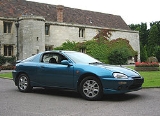
The Mazda MX-3 is a four-seat hatchback
Hatchback
A Hatchback is a car body style incorporating a shared passenger and cargo volume, with rearmost accessibility via a rear third or fifth door, typically a top-hinged liftgate—and features such as fold-down rear seats to enable flexibility within the shared passenger/cargo volume. As a two-box...

 coupé first introduced at the Geneva Motor Show in March 1991. The MX-3 was marketed as the Mazda MX-3 Precidia in Canada
Canada
Canada is a North American country consisting of ten provinces and three territories. Located in the northern part of the continent, it extends from the Atlantic Ocean in the east to the Pacific Ocean in the west, and northward into the Arctic Ocean...

, the Eunos 30X in Australia
Australia
Australia , officially the Commonwealth of Australia, is a country in the Southern Hemisphere comprising the mainland of the Australian continent, the island of Tasmania, and numerous smaller islands in the Indian and Pacific Oceans. It is the world's sixth-largest country by total area...

, and as the Eunos Presso, Autozam
Autozam
In the late 1980s, Mazda diversified in the Japan market with the launch of three new marques. The company created Autozam, Eunos, and Efini, in addition to the Mazda and Ford brands already marketed there. This experiment was ended in the mid-1990s....

 AZ-3
and Mazda AZ-3 in Japan
Japan
Japan is an island nation in East Asia. Located in the Pacific Ocean, it lies to the east of the Sea of Japan, China, North Korea, South Korea and Russia, stretching from the Sea of Okhotsk in the north to the East China Sea and Taiwan in the south...

.The MX-3 is quite popular for modification because of the range of performance engines which can be transplanted, such as the KL-ZE.
Discussion
Ask a question about 'Mazda MX-3'
Start a new discussion about 'Mazda MX-3'
Answer questions from other users
Full Discussion Forum
 
Recent Discussions
Encyclopedia
The Mazda MX-3 is a four-seat hatchback
Hatchback
A Hatchback is a car body style incorporating a shared passenger and cargo volume, with rearmost accessibility via a rear third or fifth door, typically a top-hinged liftgate—and features such as fold-down rear seats to enable flexibility within the shared passenger/cargo volume. As a two-box...

 coupé first introduced at the Geneva Motor Show in March 1991. The MX-3 was marketed as the Mazda MX-3 Precidia in Canada
Canada
Canada is a North American country consisting of ten provinces and three territories. Located in the northern part of the continent, it extends from the Atlantic Ocean in the east to the Pacific Ocean in the west, and northward into the Arctic Ocean...

, the Eunos 30X in Australia
Australia
Australia , officially the Commonwealth of Australia, is a country in the Southern Hemisphere comprising the mainland of the Australian continent, the island of Tasmania, and numerous smaller islands in the Indian and Pacific Oceans. It is the world's sixth-largest country by total area...

, and as the Eunos Presso, Autozam
Autozam
In the late 1980s, Mazda diversified in the Japan market with the launch of three new marques. The company created Autozam, Eunos, and Efini, in addition to the Mazda and Ford brands already marketed there. This experiment was ended in the mid-1990s....

 AZ-3
and Mazda AZ-3 in Japan
Japan
Japan is an island nation in East Asia. Located in the Pacific Ocean, it lies to the east of the Sea of Japan, China, North Korea, South Korea and Russia, stretching from the Sea of Okhotsk in the north to the East China Sea and Taiwan in the south...

.The MX-3 is quite popular for modification because of the range of performance engines which can be transplanted, such as the KL-ZE.

The MX-3 was notable for having one of the lowest displacement V6 engines ever fitted to a production vehicle with its 1.8 L V6.

History


First introduced at Geneva in March 1991, production continued to 1998. The MX-3's platform is called the EC platform, and shares much with the BG platform of the contemporary Familia/323/Protegé
Mazda Familia
Mazda's automotive plans for the early sixties consisted of growing alongside the Japanese economy. To achieve this goal, they began by building an extremely cheap Kei car, the R360 in 1960, planning on introducing gradually larger and pricier cars as the Japanese customers became able to afford them...

. The first model year available for most markets, including North America where it went on sale in September 1991, was 1992. Originally available with a single-cam 1.6-liter inline-four or the twin-cam V6, a few more engines were available as development continued. In the summer of 1991 the Autozam AZ-3 was added to the Japanese market lineup. "Autozam" was meant to be Mazda's more youthful brand, so it combined a somewhat lower price with a sportier (but smaller) twin-cam four of 1.5 liters.

In January 1994 a DOHC version of the familiar B6 engine, the B6D, replaced the previous version. This provided a useful power increase but conversely also made the considerably more expensive V6 version less desirable. Sales of the V6 in the North American market came to an end after the 1994 model year, although they continued in Japan and many other export markets. While called K8-DE in North American specs, Japanese and other markets received an engine called the K8-ZE. Aside from emissions equipment and varying power claims due to myriad ratings methods, the differences are negligible.

Performance


The V6 MX-3 had a factory claimed top speed of 202 km/h (125.5 mph) (in European trim). The US-spec MX-3 GS could accelerate from 0 to 60 mph (96.6 km/h) in 8.4 seconds, and could travel a quarter mile in 16.4 seconds. With a turning rate of 0.89 g (8.7 m/s²), its handling capabilities were among the best in its class.

The V6 engine was impressive for the time, belonging to the Mazda K-series
Mazda K engine
The Mazda K-series automobile engine is a short stroke, 60° V6 24-valve with belt-driven DOHC and aluminum-alloy cylinder heads and block. Their displacements range from a tiny 1.8 L to 2.5 L. They all use a 27-degree DOHC valvetrain with directly actuated hydraulic bucket lifters...

, which were used in a range of Mazda vehicles. These engines were designed to be smooth and hold a high torque
Torque
Torque, moment or moment of force , is the tendency of a force to rotate an object about an axis, fulcrum, or pivot. Just as a force is a push or a pull, a torque can be thought of as a twist....

 across the RPM range. These engines used a variable length intake manifold
Variable Length Intake Manifold
In internal combustion engines, a variable length intake manifold , or variable intake manifold is an automobile internal combustion engine manifold technology...

 (VLIM), in order to provide optimal torque using intake resonance. Mazda called their system on the MX-3 the "Variable Resonance Induction System" (VRIS). This engine had a 7,000 rpm redline, and a 7,800 rpm fuel cutoff. It has been rumored that Porsche designers assisted in the creation of the K series engine.

For the rear suspension of the MX-3, Mazda used its proprietary Twin-Trapezoidal Link (TTL) technology. TTL is designed to provide a smooth ride while delivering responsive handling and minimizing body lean. It achieves this by passively allowing the rear wheels to turn slightly to more closely approach their optimal angle during steering maneuvers. In this way, TTL delivers some of the benefits associated with active four-wheel steering systems while being lighter and mechanically less complicated than such systems. TTL has been used on a range of other Mazda vehicles before and since the MX-3.

Models and specifications (North America)

  • RS • 1992-1998
  • GS • 1992-1994


1.6L B6-ME SOHC 16 Valve
Type Inline 4
Power 88 hp at 5,000 rpm
Torque 98 ft.lbf at 4,000 rpm
Model years 1992-1993

1.6L B6-D DOHC 16 Valve
Type Inline 4
Power 106 hp
Model years 1994-1998

1.8L K8-DE DOHC 24 Valve
Type 60° V6
Power 130 hp at 6,500 rpm
Torque 115 ft.lbf at 4,500 rpm
0-60mph 9.2 s
1/4 mile 16.8 s @ 82.5 mph (133 km/h)
Top speed estimated 120 mph
Model years 1992-1994

Special Editions


In 1993, Mazda Canada offered a limited Special Edition model of its Mazda MX-3 GS to celebrate the company's 25th year in Canada. At the same time, Mazda USA
United States
The United States of America is a federal constitutional republic comprising fifty states and a federal district...

 offered a similar model as a Special Edition as well. Only a total of 2,000 Special Edition models were supposedly made. The special edition MX-3 featured the V6 engine, leather interior (including seats, steering wheel and shift knob), heated seats (Canada only), and custom Enkei manufactured 15 inch alloy wheels. Most special edition models came in the color Raspberry Metallic; however, there were also Blaze Red, Brilliant Black, and Laguna Blue colors available for the Special Edition.

In 1996, Mazda Europe produced 100 Mazda MX-3 V6 SEs. These had a leather and suede interior, and all had the clear White body colour. There were also a limited number of Mazda MX-3 V6 Equipes, with Sparkle Green Metallic or Noble Green exteriors.

Modifications


The MX-3 is becoming a rare car, so modifications for it can be difficult to find unless one knows where to look since it has not been sold in North America since 1997. Since the MX-3 has two engine classes, I4
Straight-4
The inline-four engine or straight-four engine is an internal combustion engine with all four cylinders mounted in a straight line, or plane along the crankcase. The single bank of cylinders may be oriented in either a vertical or an inclined plane with all the pistons driving a common crankshaft....

 and V6, many of the engine performance modifications are dependent upon what platform is installed.

There is now a decent range of body modifications for the MX-3 along with performance brakes and suspension.http://mx-3.com/ Most extensive modification must be entirely custom fabricated due to limited availability.

RS


The MX-3 RS with the 4-cylinder engine can upgrade to the BP 132 hp, B6-T 147 hp, BP-T 179 hp and BPD-T 206 hp engines.

Swapping of the 4-cylinder RS engines can be slightly more complicated than the V6 GS mainly due to ECU
Engine control unit
An engine control unit is a type of electronic control unit that determines the amount of fuel, ignition timing and other parameters an internal combustion engine needs to keep running...

, wiring harness, and MAF
Mass flow sensor
A mass air flow sensor is used to find out the mass flowrate of air entering a fuel-injected internal combustion engine. The air mass information is necessary for the engine control unit to balance and deliver the correct fuel mass to the engine. Air changes its density as it expands and contracts...

 combinations as well as motor mounts. V6 swaps require specific ECU, intake manifold, and VAF sensor combinations, but there are far fewer variables to deal with. Many improvements can be made after the engine swap and during the engine tuning
Engine tuning
Engine tuning is the adjustment, modification or design of internal combustion engines to yield optimal performance, to increase an engine's power output, economy, or durability....

 process to find the best combination of engine peripherals.

GS


The most common engine swap
Engine swap
An engine swap is the process of removing a car's engine and replacing it with another. This is done either because of failure, or to install a different engine, usually one that is more powerful or more modern and maintainable....

 for MX-3 GS owners with the V6 engine
Engine
An engine or motor is a machine designed to convert energy into useful mechanical motion. Heat engines, including internal combustion engines and external combustion engines burn a fuel to create heat which is then used to create motion...

 is a 2.5 L V6, either a North American-spec KL-DE 168 hp, found most commonly in the 1993-1997 Ford Probe
Ford Probe
The Ford Probe was a coupé based on the Mazda GD platform, and powered by a 2.2 L SOHC 4 cylinder Mazda F2 engine.The first generation Probe appeared in 1988 and lasted until 1992 in the United States. In some markets the model years were from 1987 to 1991...

 GT, the 1993-1997 Mazda MX-6
Mazda MX-6
The first generation MX-6 appeared in 1988 and lasted until 1992 in the United States. In some markets the model years were from 1987 to 1991. It was based on a series of futuristic sports compact concept cars of the early 1980s...

 LS, or the 1993-2002 Mazda 626
Mazda 626
The Mazda 626 is an automobile that was produced by Mazda for the export market. It was based on the Japan-market Mazda Capella. The 626 replaced the 616/618 and RX-2 in 1979 and was sold through 2002, when the new Mazda6 took over as Mazda's large family car...

 LX or ES, or the Japan
Japan
Japan is an island nation in East Asia. Located in the Pacific Ocean, it lies to the east of the Sea of Japan, China, North Korea, South Korea and Russia, stretching from the Sea of Okhotsk in the north to the East China Sea and Taiwan in the south...

ese-spec KL-ZE 200 hp, found in such vehicles as the Efini MS-8
Efini MS-8
The Efini MS-8 was a luxury car produced by Mazda and sold through the Efini marque from March 1992 through 1995. The car is a replacement to the Mazda Persona and Eunos 300....

, Xedos 9, & Eunos 800. A 2.0 L V6 KF-ZE is also available, but this swap can prove to be quite difficult due to the unavailability of required components. For this reason, this particular engine swap is not often attempted.
The GS apart from the engine had dual tip exhaust, tighter steering ratio, 4 disc brakes and front and rear spoiler.

Future model


Since the final discontinuation of the MX-3, many enthusiasts continuously hope for a return of the MX-3 model. The upcoming Mazda Kabura
Mazda Kabura
The Mazda Kabura is a concept car shown by the Japanese manufacturer Mazda in 2006.-Concept overview:The Kabura, introduced at the 2006 North American International Auto Show, is a sport compact which shows styling themes and technologies which could appear in future production models...

 concept
Concept car
A concept vehicle or show vehicle is a car made to showcase new styling and or new technology. They are often shown at motor shows to gauge customer reaction to new and radical designs which may or may not have a chance of being produced....

, initially shown in 2006, is similar in concept to the MX-3. The Kabura is said to borrow significant mechanical components from the Mazda MX-5
Mazda MX-5
The MX-5, also known as Miata in North America and Eunos Roadster in Japan, is a lightweight two-seater roadster, of front-engine, rear-wheel drive layout, built by Mazda in Hiroshima, Japan. The model was introduced in 1989 at the Chicago Auto Show...

 while the styling appears as a blend between the MX-3 and RX8. This was rumored to have a 2009 release date however this did not happen. The planned 2011 RX-7 is inspired by the Kabura concept.

External links


  • MX-3.com - Specifications and other details