
All Topics  
Maurice de Vlaminck

 
Maurice De Vlaminck

   Email Print
   Bookmark   Link


Maurice de Vlaminck


Maurice de Vlaminck (4 April 1876 – 11 October 1958) was a French
France

France , officially the French Republic , is a country whose Metropolitan France is located in Western Europe and that also comprises various Overseas departments and territories of France....
 painter
Painting

Painting is the practice of applying paint, pigment, color or other medium to a surface . In art, the term describes both the act and the result, which is called a painting....
. Along with André Derain
André Derain

Andr? Derain was a French painter and co-founder of Fauvism with Henri Matisse....
 and Henri Matisse
Henri Matisse

Henri Matisse was a France artist, known for his use of colour and his fluid, brilliant and original draftsmanship. As a drawing, printmaking, and Sculpture, but principally as a Painting, Matisse is one of the best-known artists of the 20th century....
 he is considered one of the principal figures in the Fauve
Fauvism

Les Fauves were a short-lived and loose grouping of early 20th century Modern artists whose works emphasized painterly qualities and strong colour over the Realism or Representation values retained by Impressionism....
 movement, a group of modern art
Modern art

Modern art is a term that refers to artistic works produced during the period extending roughly from the 1860s through the 1970s, and denotes the style and philosophy of the art produced during that era....
ists who from 1904 to 1908 were united in their use of intense color.

Life
Maurice de Vlaminck was born in Paris
Paris

Paris is the Capital of France and the country's largest city. It is situated on the river Seine, in northern France, at the heart of the ?le-de-France Regions of France ....
 to a family of musicians.


Discussion
Ask a question about 'Maurice de Vlaminck'
Start a new discussion about 'Maurice de Vlaminck'
Answer questions from other users
Full Discussion Forum


Encyclopedia


Seinechatou
Maurice de Vlaminck (4 April 1876 – 11 October 1958) was a French
France

France , officially the French Republic , is a country whose Metropolitan France is located in Western Europe and that also comprises various Overseas departments and territories of France....
 painter
Painting

Painting is the practice of applying paint, pigment, color or other medium to a surface . In art, the term describes both the act and the result, which is called a painting....
. Along with André Derain
André Derain

Andr? Derain was a French painter and co-founder of Fauvism with Henri Matisse....
 and Henri Matisse
Henri Matisse

Henri Matisse was a France artist, known for his use of colour and his fluid, brilliant and original draftsmanship. As a drawing, printmaking, and Sculpture, but principally as a Painting, Matisse is one of the best-known artists of the 20th century....
 he is considered one of the principal figures in the Fauve
Fauvism

Les Fauves were a short-lived and loose grouping of early 20th century Modern artists whose works emphasized painterly qualities and strong colour over the Realism or Representation values retained by Impressionism....
 movement, a group of modern art
Modern art

Modern art is a term that refers to artistic works produced during the period extending roughly from the 1860s through the 1970s, and denotes the style and philosophy of the art produced during that era....
ists who from 1904 to 1908 were united in their use of intense color.

Life


Maurice de Vlaminck was born in Paris
Paris

Paris is the Capital of France and the country's largest city. It is situated on the river Seine, in northern France, at the heart of the ?le-de-France Regions of France ....
 to a family of musicians. His father taught him to play the violin. He began painting in his late teens. In 1893, he studied with a painter named Henri Rigalon on the Ile de Chatou
Chatou

Chatou is a commune in France in the western suburbs of Paris, France. It is located . from the Kilometre Zero....
. In 1894 he married Suzanne Berly. The turning point in his life was a chance meeting on the train to Paris towards the end of his stint in the army. Vlaminck, then 23, met an aspiring artist, André Derain, with whom he struck up a life-long friendship. When Vlaminck completed his army service in 1900, the two rented a studio together for a year before Derain left to do his own military service. In 1902 and 1903 he wrote several mildly pornographic novels illustrated by Derain. He painted during the day and earned his livelihood by giving violin lessons and performing with musical bands at night.

In 1911, Vlaminck traveled to London
London

London is the capital of both England and the United Kingdom, and the most populous municipality in the European Union. An important settlement for two millennia, History of London goes back to its founding by the Roman Empire....
 and painted by the Thames. In 1913, he painted again with Derain in Marseille
Marseille

"Marseille" is the second-largest city of France and forms the third-largest aire urbaine, after those of Paris and Lyon, with a population recorded to be 1,516,340 at the 1999 census and estimated to be 1,605,000 in 2007....
 and Martigues
Martigues

Martigues is a Communes of France in the southeastern part of France, to the northwest of Marseille. It is part of the Bouches-du-Rh?ne Departments of France and lies in the Provence-Alpes-C?te d'Azur Regions of France on the eastern end of the Canal de Caronte....
. In World War I
World War I

World War I, or the First World War , was a global military conflict which involved the Great powers, organized into two opposing military alliances: the Allies of World War I and the Central Powers....
 he was stationed in Paris, and began writing poetry. Eventually he settled in the northwestern suburbs of Paris. He married his second wife, Berthe Combes, with whom he had two daughters. From 1925 he traveled throughout France, but continued to paint primarily along the Seine
Seine

The Seine is a slow flowing major river and commercial waterway within Regions of France of ?le-de-France and Haute-Normandie in France and famous as a romantic backdrop in photographs of Paris, France....
, near Paris.

Vlaminck died in Rueil-la-Gadelière on 11 October 1958.

Artistic career

Two of Vlaminck's groundbreaking paintings, Sur le zinc (At the Bar) and L'homme a la pipe (Man Smoking a Pipe) were painted in 1900.

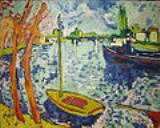
For the next few years Vlaminck lived in or near Chatou (the inspiration for his painting houses at Chatou), painting and exhibiting alongside Derain, Matisse, and other Fauvist painters. At this time his exuberant paint application and vibrant use of color displayed the influence of Vincent van Gogh
Vincent van Gogh

Vincent Willem van Gogh was a Dutch people Post-Impressionism artist. Some of his paintings are now among the world's best known, most popular and expensive works of art....
. Sur le zinc called to mind the work of Toulouse-Lautrec and his portrayals of prostitutes and solitary drinkers, but does not attempt to probe the sitter's psychology—a break with the century-old European tradition of individualized portraiture. According to art critic Souren Melikian, it is "the impersonal cartoon of a type." In his landscape paintings, his approach was similar. He ignored the details, with the landscape becoming a mere excuse to express mood through violent color and brushwork. An example is Sous bois, painted in 1904. The following year, he began to experiment with "deconstruction," turning the physical world into dabs and streaks of color that convey a sense of motion. His paintings Le Pont de Chatou (The Chatou Bridge), Les Ramasseurs de pommes de terre (The Potato Pickers), La Seine a Chatou (The River Seine at Chatou) and Le Verger (The Orchard) exemplify this trend.

Artistic influences

Vlaminck's compositions show familiarity with the Impressionists, several of whom had painted in the same area in the 1870s and 1880s. After visiting a van Gogh exhibit, he declared that he "loved van Gogh that day more than my own father". From 1908 his palette grew more monochromatic, and the predominant influence was that of Cézanne. His later work displayed a dark palette, punctuated by heavy strokes of contrasting white paint.

External links