
| |
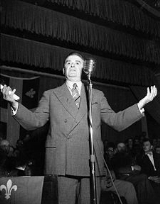
Maurice Le Noblet Duplessis (20 April 1890–7 September 1959) served as the premier of the Canadian province of Quebec from 1936 to 1939 and 1944 to 1959. A founder and leader of the highly conservative Union Nationale party, he rose to power after exposing the misconduct and patronage of Liberal Premier Louis-Alexandre Taschereau.
His reign is often referred to in Quebec as La Grande Noirceur ("The Great Darkness"), especially due to to the prevalent corruption and for the scandal surrounding the Duplessis Orphans.

Discussion
Ask a question about 'Maurice Duplessis'
Start a new discussion about 'Maurice Duplessis'
Answer questions from other users
|
Quotations
Less than fifteen cents to the province and more than twenty-five cents to Ottawa, this is far from being excessive!
Bill 43, Québec Legislative Assembly, January 14, 1954

Encyclopedia
Maurice Le Noblet Duplessis (20 April 1890–7 September 1959) served as the premier of the Canadian province of Quebec from 1936 to 1939 and 1944 to 1959. A founder and leader of the highly conservative Union Nationale party, he rose to power after exposing the misconduct and patronage of Liberal Premier Louis-Alexandre Taschereau.
His reign is often referred to in Quebec as La Grande Noirceur ("The Great Darkness"), especially due to to the prevalent corruption and for the scandal surrounding the Duplessis Orphans. During the time, the Liberal opposition was unsuccessful in challenging Duplessis' power. Duplessis championed rural areas, provincial rights, anti-Communism and opposed the trade unions.
Early life
Born in Trois-Rivières and son of local politician Nérée Le Noblet Duplessis, Duplessis studied at the Séminaire Saint-Joseph de Trois-Rivières, obtained a law degree from Université Laval's Montréal branch (later renamed Université de Montréal) and was admitted to the Barreau du Quebec in 1913. He returned to his home town to practice law until running for public office. He was a life-long bachelor.
Political career He first won a seat as a Conservative Party of Quebec candidate in the 1927 Quebec election. In the 1931 election, Duplessis was reelected in his seat, but Conservative leader Camillien Houde lost both the election and his own seat. The Conservative caucus chose C.E. Gault to be interim leader of the Opposition but, after Houde resigned as party leader in 1932, Duplessis won the leadership of the party during the 1933 convention over the only other candidate, Onésime Gagnon.
Two weeks before the 1935 provincial election, he engineered a coalition with Paul Gouin's Action libérale nationale (ALN), a party of dissident reform Liberals and nationalists who had quit the governing Parti libéral du Québec. While he lost that election, Duplessis was soon able to exploit a patronage scandal involving the family of Premier Louis-Alexandre Taschereau to force Taschereau's resignation.
Gouin withdrew his support from Duplessis on June 18, 1936, but most members of the ALN caucus sided with Duplessis and joined with his Conservative caucus to formally merge into the Union Nationale party. Duplessis and the UN won the August 1936 election in a landslide, putting an end to thirty-nine consecutive years of Liberal rule. Duplessis's first government was defeated in the 1939 election, a snap election called by the premier in hopes of exploiting the issue of Canadian participation in World War II.
Duplessis returned as premier in the 1944 election, and held power without serious opposition for the next fifteen years, until his death, winning elections in 1948, 1952 and 1956. He became known simply as le Chef ("the boss").
He was elected to five terms of office in all, the last four of them consecutive. Duplessis remains the only Quebec premier to have won three or more consecutive majority governments. After him, no political party in Quebec elections at the provincial level had managed to win more than two terms of office in a row until the December 2008 victory of Jean Charest's Liberal party, its third consecutive win.
Policies Duplessis favoured rural areas over city development and introduced various agricultural credits during his first term. He also was noted for meagre investment in social services. Duplessis also opposed military conscription and Canadian involvement in World War II.
Duplessis championed anti-Communism and also opposed trade unions such as the Trades and Labour Congress of Canada (TLC). He introduced several laws that were criticised by the unions, most notably the Padlock Law, which initially was a law that would eliminate Communist propaganda. In 1949, Duplessis also tried to introduce a copycat law of the U.S Taft-Hartley Act, created in 1947, which would have eliminated certain rights for union groups that were acquired by the Labour Relations Law of 1944, the equivalent of the American Wagner Act of 1935. It was withdrawn due to the fierce opposition by union groups. Duplessis later reintroduced a nearly similar law in 1954, known as Bill 19, that would force union groups to ban any members that supported Communism; any group would lose its trade-union accreditation if any there is a single member that had ties with Communist groups or supported the ideology. The party lost even the support of the Catholic union group and forced it to review its structure which would lead to the creation of the Confédération des syndicats nationaux (CSN).
During Duplessis' mandates, several significant labour strikes occurred such as the Dominion Textile in Valleyfield in 1946, the asbestos in the Beauce region in 1949 and the Murdochville copper mine strike in 1957. In those conflicts, Duplessis responded rapidly with force, using the provincial police to disperse picket lines and restore order. Several arrests were made in these conflicts. However, the latter led to a major victory to union groups which acquired several rights.
The Union Nationale often had the active support of the Roman Catholic Church in its political campaigns and employed the slogan Le ciel est bleu; l'enfer est rouge: The sky/heaven is blue (UN); Hell is red (Liberal). Only during the labour strikes in the 1950s did the Church break with the Union Nationale by supporting the unions. Duplessis also actively opposed Jehovah's Witnesses and once used his influence to revoke a liquor license from one of their organizer's businesses. This decision was overturned by the Supreme Court of Canada shortly after his death.
Duplessis' government was characterized by patronage and corruption, used to keep the Liberal opposition weak. He once proclaimed that a much-needed bridge at Trois-Rivières would not be built should a Liberal MNA be elected and kept his word while the opposition held the seat. In a rural district which had always elected a Liberal, the roads were kept unpaved, making it difficult for commerce and medicine to be transported, so the residents decided in 1956 to vote for the Union Nationale as that was the only way to get new roads constructed. He was also accused of vote-fixing. Legend has it that Union Nationale groups would arrive in rural towns armed with whiskey, food and appliances in exchange for votes.
On January 21, 1948, Duplessis made one of his most enduring contributions to Quebec with the adoption of an official Flag of Quebec, the fleurdelysé, which replaced the Union Flag at the top of the Quebec Parliament Building.
Death and legacy Duplessis died in office in Schefferville, Quebec, on September 7, 1959. After his death, Quebec society was caught in the Quiet Revolution (Révolution tranquille), a swift socio-cultural change away from his conservative policies toward a highly secular, socially liberal welfare state. Many of these major changes occurred when the Liberals regained power in 1960 under Jean Lesage.
Most of his surviving relatives have not handed down the "Duplessis" name to their children, although one of his nieces, Berthe Brunet-Dufresne, has taken it upon herself to rehabilitate her uncle.
See also
External links
Reference works
- Conrad Black, Duplessis, ISBN 0-7710-1530-5, McClelland & Stewart, Toronto, 1977.
- Jacques Rouillard, Le syndicalisme Québécois, Boreal, Montreal, 2004
- CSN-CSQ, Histoire du mouvement ouvrier au Quebec, 2001
*The Union Nationale was founded as an alliance in 1935 with Duplessis as leader. In 1936 the UN formally became a unitary political party with the Quebec Conservative Party dissolving into it.
|