


Maunder Minimum

Encyclopedia
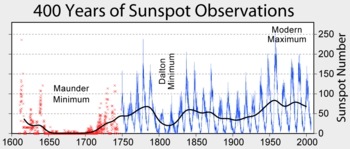
Sunspot
Sunspots are temporary phenomena on the photosphere of the Sun that appear visibly as dark spots compared to surrounding regions. They are caused by intense magnetic activity, which inhibits convection by an effect comparable to the eddy current brake, forming areas of reduced surface temperature....
s became exceedingly rare, as noted by solar observers of the time.
The concept became notable after John A. Eddy published a landmark 1976 paper in Science
Science (journal)
Science is the academic journal of the American Association for the Advancement of Science and is one of the world's top scientific journals....
titled "The Maunder Minimum". Astronomers before Eddy had also named the period after the solar astronomer Edward W. Maunder (1851–1928) who studied how sunspot latitudes changed with time. The periods he examined included the second half of the 17th century. Edward Maunder published two papers in 1890 and 1894, and he cited earlier papers written by Gustav Spörer
Gustav Spörer
Friederich Wilhelm Gustav Spörer was a German astronomer.He is noted for his studies of sunspots and sunspot cycles. In this regard he is often mentioned together with Edward Maunder. Spörer was the first to note a prolonged period of low sunspot activity from 1645 to 1715...
.
Like the Dalton Minimum
Dalton Minimum
The Dalton Minimum was a period of low solar activity, named after the English meteorologist John Dalton, lasting from about 1790 to 1830. Like the Maunder Minimum and Spörer Minimum, the Dalton Minimum coincided with a period of lower-than-average global temperatures...
and Spörer Minimum
Spörer Minimum
The Spörer Minimum was a 90-year span of low solar activity, from about 1460 until 1550, which was identified and named by John A. Eddy in a landmark 1976 paper published in Science titled "The Maunder Minimum"...
, the Maunder Minimum coincided with a period of lower-than-average global temperatures.
During one 30-year period within the Maunder Minimum, astronomers observed only about 50 sunspots, as opposed to a more typical 40,000-50,000 spots in modern times.
Sunspot observations
The Maunder Minimum occurred between 1645 and 1715 when very few sunspots were observed. This was not due to a lack of observations; during the 17th century, Giovanni Domenico CassiniGiovanni Domenico Cassini
This article is about the Italian-born astronomer. For his French-born great-grandson, see Jean-Dominique Cassini.Giovanni Domenico Cassini was an Italian/French mathematician, astronomer, engineer, and astrologer...
carried out a systematic program of solar observations at the Observatoire de Paris, thanks to the astronomers Jean Picard
Jean Picard
Jean-Felix Picard was a French astronomer and priest born in La Flèche, where he studied at the Jesuit Collège Royal Henry-Le-Grand. He was the first person to measure the size of the Earth to a reasonable degree of accuracy in a survey conducted in 1669–70, for which he is honored with a...
and Philippe de La Hire
Philippe de La Hire
Philippe de La Hire was a French mathematician and astronomer. According to Bernard le Bovier de Fontenelle he was an "academy unto himself"....
. Johannes Hevelius
Johannes Hevelius
Johannes Hevelius Some sources refer to Hevelius as Polish:Some sources refer to Hevelius as German:*Encyplopedia Britannica * of the Royal Society was a councilor and mayor of Danzig , Pomeranian Voivodeship, in the Polish-Lithuanian Commonwealth...
also performed observations on his own. The total numbers of sunspots (but not Wolf number
Wolf number
The Wolf number is a quantity that measures the number of sunspots and groups of sunspots present on the surface of the sun....
s) in different years were as follows:
| Year | Sunspots |
|---|---|
| 1610 | 9 |
| 1620 | 6 |
| 1630 | 9 |
| 1640 | 0 |
| 1650 | 3 |
| 1660 | Some sunspots reported by Jan Heweliusz in "Machina Coelestis" |
| 1670 | 0 |
| 1680 | 1 huge sunspot observed by Giovanni Domenico Cassini Giovanni Domenico Cassini This article is about the Italian-born astronomer. For his French-born great-grandson, see Jean-Dominique Cassini.Giovanni Domenico Cassini was an Italian/French mathematician, astronomer, engineer, and astrologer... |
During the Maunder Minimum enough sunspots were sighted so that 11-year cycles could be extrapolated from the count. The maxima occurred in 1676, 1684, 1695, 1705 and 1716.
The sunspot activity was then concentrated in the southern hemisphere of the Sun, except for the last cycle when the sunspots appeared in the northern hemisphere, too.
According to Spörer's law
Spörer's law
Spörer's law predicts the variation of sunspot latitudes during a solar cycle. It was discovered by the English astronomer Richard Christopher Carrington around 1861. Carrington's work was refined by the German astronomer Gustav Spörer....
, at the start of a cycle, spots appear at ever lower latitudes until they average at about lat. 15° at solar maximum. The average then continues to drift lower to about 7° and after that, while spots of the old cycle fade, new cycle spots start appearing again at high latitudes.
The visibility of these spots is also affected by the velocity of the sun's rotation at various latitudes:
| Solar latitude Latitude In geography, the latitude of a location on the Earth is the angular distance of that location south or north of the Equator. The latitude is an angle, and is usually measured in degrees . The equator has a latitude of 0°, the North pole has a latitude of 90° north , and the South pole has a... | Rotation period (days) |
|---|---|
| 0° | 24.7 |
| 35° | 26.7 |
| 40° | 28.0 |
| 75° | 33.0 |
Visibility is somewhat affected by observations being done from the ecliptic
Ecliptic
The ecliptic is the plane of the earth's orbit around the sun. In more accurate terms, it is the intersection of the celestial sphere with the ecliptic plane, which is the geometric plane containing the mean orbit of the Earth around the Sun...
. The ecliptic is inclined 7° from the plane of the Sun's equator (latitude 0°).
Little Ice Age
The Maunder Minimum coincided with the middle — and coldest part — of the Little Ice AgeLittle Ice Age
The Little Ice Age was a period of cooling that occurred after the Medieval Warm Period . While not a true ice age, the term was introduced into the scientific literature by François E. Matthes in 1939...
, during which Europe and North America were subjected to bitterly cold winters. A causal connection between low sunspot activity and cold winters has recently been made using data from the from NASA's Solar Radiation and Climate Experiment which shows that solar UV output is more variable over the course of the solar cycle than scientists had previously thought, and a UK scientific team published in the Nature Geoscience
Nature Geoscience
Nature Geoscience is a monthly, peer reviewed, scientific journal published by Nature Publishing Group. The Chief Editor is Heike Langenberg. The first issue was published in January 2008.-Scope:...
journal a link that ties this variability to terrestrial climate impacts in the form of warmer winters in some places and colder winters in others. The winter of 1708–9
Great Frost of 1709
The Great Frost or was an extraordinarily cold winter in Europe in late 1708 and early 1709, and was found to be the coldest European winter during the past 500 years...
was extremely cold.
Other observations
Stradivarius
The name Stradivarius is associated with violins built by members of the Stradivari family, particularly Antonio Stradivari. According to their reputation, the quality of their sound has defied attempts to explain or reproduce, though this belief is controversial...
instruments was caused by slow tree growth during the cooler period. Instrument maker Antonio Stradivari
Antonio Stradivari
Antonio Stradivari was an Italian luthier and a crafter of string instruments such as violins, cellos, guitars, violas, and harps. Stradivari is generally considered the most significant artisan in this field. The Latinized form of his surname, Stradivarius, as well as the colloquial, "Strad", is...
was born a year before the start of the Maunder Minimum.
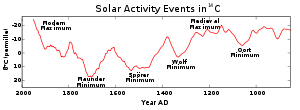
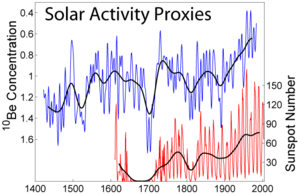
Past solar activity may be recorded by various proxies
Proxy (climate)
In the study of past climates is known as paleoclimatology, climate proxies are preserved physical characteristics of the past that stand in for direct measurements , to enable scientists to reconstruct the climatic conditions that prevailed during much of the Earth's history...
including carbon-14
Carbon-14
Carbon-14, 14C, or radiocarbon, is a radioactive isotope of carbon with a nucleus containing 6 protons and 8 neutrons. Its presence in organic materials is the basis of the radiocarbon dating method pioneered by Willard Libby and colleagues , to date archaeological, geological, and hydrogeological...
and beryllium-10
Beryllium-10
Beryllium-10 is a radioactive isotope of beryllium. It is formed mainly by cosmic ray spallation. Be-10 has a half-life of 1.36 × 10⁶ years, and decays by beta decay to stable Boron-10 with a maximum energy of 556.2 keV....
. These indicate lower solar activity during the Maunder Minimum. The scale of changes resulting in the production of carbon-14
Carbon-14
Carbon-14, 14C, or radiocarbon, is a radioactive isotope of carbon with a nucleus containing 6 protons and 8 neutrons. Its presence in organic materials is the basis of the radiocarbon dating method pioneered by Willard Libby and colleagues , to date archaeological, geological, and hydrogeological...
in one cycle is small (about 1 percent of medium abundance) and can be taken into account when radiocarbon dating
Radiocarbon dating
Radiocarbon dating is a radiometric dating method that uses the naturally occurring radioisotope carbon-14 to estimate the age of carbon-bearing materials up to about 58,000 to 62,000 years. Raw, i.e. uncalibrated, radiocarbon ages are usually reported in radiocarbon years "Before Present" ,...
is used to determine the age of archaeological artifacts
Archaeology
Archaeology, or archeology , is the study of human society, primarily through the recovery and analysis of the material culture and environmental data that they have left behind, which includes artifacts, architecture, biofacts and cultural landscapes...
.
Other historical sunspot minima have been detected either directly or by the analysis of carbon-14 in tree rings; these include the Spörer Minimum
Spörer Minimum
The Spörer Minimum was a 90-year span of low solar activity, from about 1460 until 1550, which was identified and named by John A. Eddy in a landmark 1976 paper published in Science titled "The Maunder Minimum"...
(1450–1540), and less markedly the Dalton Minimum
Dalton Minimum
The Dalton Minimum was a period of low solar activity, named after the English meteorologist John Dalton, lasting from about 1790 to 1830. Like the Maunder Minimum and Spörer Minimum, the Dalton Minimum coincided with a period of lower-than-average global temperatures...
(1790–1820). In total there seem to have been 18 periods of sunspot minima in the last 8,000 years, and studies indicate that the sun currently spends up to a quarter of its time in these minima.
One recently published paper, based on an analysis of a Flamsteed
John Flamsteed
Sir John Flamsteed FRS was an English astronomer and the first Astronomer Royal. He catalogued over 3000 stars.- Life :Flamsteed was born in Denby, Derbyshire, England, the only son of Stephen Flamsteed...
drawing, suggests that the Sun's rotation slowed in the deep Maunder minimum (1684).
During the Maunder Minimum auroras had been observed normally. Detailed analysis has been published by Wilfried Schröder and J. P. Legrand et al.
The fundamental papers on the Maunder minimum (Eddy, Legrand, Gleissberg, Schröder, Landsberg et al.) have been published in Case studies on the Spörer, Maunder and Dalton Minima.
Trivia
- Curiously, the duration of the Maunder Minimum (1645–1715) coincides very closely with the reign of King Louis XIV of FranceLouis XIV of FranceLouis XIV , known as Louis the Great or the Sun King , was a Bourbon monarch who ruled as King of France and Navarre. His reign, from 1643 to his death in 1715, began at the age of four and lasted seventy-two years, three months, and eighteen days...
(1643–1715), known as the Sun King.
See also
- Global WarmingGlobal warmingGlobal warming refers to the rising average temperature of Earth's atmosphere and oceans and its projected continuation. In the last 100 years, Earth's average surface temperature increased by about with about two thirds of the increase occurring over just the last three decades...
- Spörer MinimumSpörer MinimumThe Spörer Minimum was a 90-year span of low solar activity, from about 1460 until 1550, which was identified and named by John A. Eddy in a landmark 1976 paper published in Science titled "The Maunder Minimum"...
- Solar minimumSolar minimumSolar minimum is the period of least solar activity in the solar cycle of the sun. During this time, sunspot and solar flare activity diminishes, and often does not occur for days at a time...
- John A. Eddy, the astronomer who popularised the Maunder Minimum